

Wholesale Shirt Transfers Guide for Small Print Shops
A rush order lands in your inbox on Tuesday afternoon. A local team needs a stack of shirts by the weekend, the artwork has several colors, and your shop's printer is already booked with existing work. You can print everything in-house, outsource the decoration, or buy ready-to-press wholesale shirt transfers and finish the order at your heat press.
For many small print shops, the third option offers the cleanest balance of speed, labor, equipment, and control. You're buying the decoration in a finished format, then applying it to the blank garment when the order is ready. That keeps production moving without requiring every shop to own and maintain a full DTF printing setup.
The smart question isn't just, “What's the lowest price per transfer?” It's which workflow gives you the most reliable landed cost and the fewest production problems. That means considering fabric compatibility, transfer quality, minimum quantities, shipping time, customs exposure, pressing labor, reorders, and customer expectations together.
Introduction to Wholesale Shirt Transfers for Growing Shops
A small shop often feels the pressure of a large order before it feels the profit. You might have the customer, the artwork, and the blank shirts, but not enough printer capacity to produce everything without disrupting other jobs. Buying transfers in bulk can turn that bottleneck into a straightforward finishing job: verify the design, position the transfer, press it, peel the carrier, and inspect the shirt.
That workflow is especially useful for custom apparel sellers, school and team orders, e-commerce brands, event merchandise, and print shops handling designs that change frequently. Instead of printing a large inventory of finished shirts, you can keep blank garments on hand and decorate them as orders arrive. You're also less likely to tie up cash in shirts that may never sell.
What you're really buying
A wholesale transfer is more than printed artwork on a sheet. It's a prepared decoration built from the image layer, adhesive, and carrier film. The supplier has already handled the specialized printing and transfer preparation, so your shop's main production responsibility becomes accurate heat application.
That division of labor matters. In-house printing gives you maximum control, but it also brings equipment maintenance, consumable management, color calibration, powder handling for DTF, and operator time. Wholesale purchasing shifts those tasks to the transfer supplier while leaving you with the flexible part of production, pressing the right design onto the right garment.
The market context supports that shift. The global DTF transfer film market was valued at USD 760.0 million in 2025 and is projected to reach USD 1.64 billion by 2032, with a projected compound annual growth rate of 11.58%, according to market data on DTF transfer film demand. Apparel and fashion accounted for about 71.87% of that market in 2025, which points to strong alignment between transfer production and custom shirt buying.
This guide focuses on practical decisions. You'll learn how the main transfer types differ, how fabric affects results, how to judge a supplier beyond the unit price, and how to protect your margin when shipping delays or import costs change the economics.
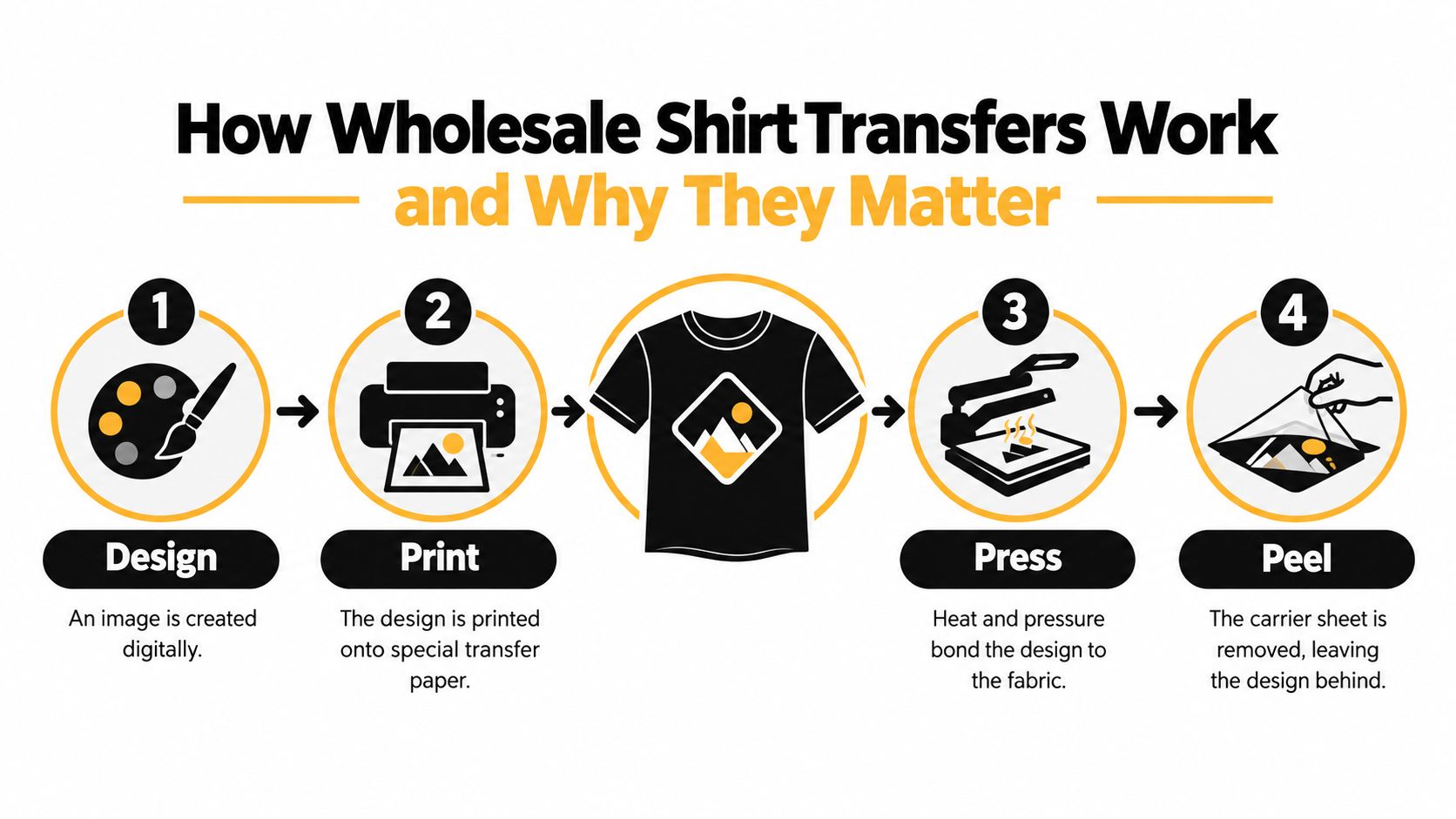
How Wholesale Shirt Transfers Work and Why They Matter
Think of a shirt transfer as a temporary tattoo for fabric, except the adhesive is activated by heat and pressure rather than water. The carrier film holds the design in the correct position while the press bonds the printed image to the garment. Once the film is removed, the design remains attached to the shirt.
The process usually follows four basic stages:
- Design: A digital image is prepared for the intended print size and garment location.
- Print: The image is produced onto a specialized transfer film or paper with the required color and adhesive layers.
- Press: Heat and pressure activate the adhesive and bond the design to the fabric.
- Peel: The carrier sheet is removed according to the supplier's hot-peel or cold-peel instructions.
Why the workflow is useful
Transfer printing on garments emerged as a distinct industrial process during the 1980s, and the field has traditionally included thermal transfer and sublimation transfer methods. One academic source cited in an overview of T-shirt transfer trends reports that worldwide printed textile production exceeds 27 billion square meters per year, while digital printer output is about 500 million square meters, or roughly 1.8% of total textile printing volume.
That contrast helps explain why transfer-based production still has room to expand. Conventional textile decoration remains enormous, while digital and transfer-enabled workflows give smaller operators a way to produce detailed graphics without building the same infrastructure used by large textile facilities.
Wholesale purchasing makes the most sense when your order volume is varied. A customer may want a small run of full-color artwork today, a simple sleeve logo tomorrow, and a different garment color next week. Ready-to-press transfers let you respond to those changes without preparing screens or running a full print cycle for every design.
Quality still matters at the shirt level. The film must carry the image cleanly, the adhesive must bond evenly, and the press operator must follow the correct settings. A cheap transfer that lifts at the edges creates rework, replacement costs, and an unhappy customer.
Practical rule: Treat the transfer, blank garment, and press settings as one production system. A strong transfer can still fail on an unsuitable fabric or with incorrect heat and pressure.
Comparing the Main Types of Shirt Transfers
Choosing a transfer starts with the garment, not the artwork. A full-color design on a cotton hoodie has different requirements from a one-color logo on a stable polyester uniform. The most common options are DTF, sublimation, heat-transfer vinyl, and screen-printed plastisol transfers.
DTF is often the flexible choice for cotton, polyester, and many blends because it can reproduce detailed, multicolor artwork without requiring a separate screen for each color. It leaves a printed layer on top of the fabric, so the final feel depends on the film, ink coverage, adhesive, and design size.
Sublimation behaves differently. The dye becomes part of the polyester fibers rather than sitting as a separate film on the surface. That can create a very soft result, but sublimation generally requires light-colored polyester or polyester-rich garments. It isn't the universal answer for dark cotton shirts.
Vinyl is a practical fit for simple lettering, numbers, and logos. It works well when the design has limited colors and clean shapes, but detailed artwork can require more cutting and weeding. Screen-printed plastisol transfers can provide a familiar screen-print feel and strong opacity, particularly for larger repeat orders, but they may be less convenient when every design is different.
For readers comparing transfer options across garments and accessories, this headwear decoration method guide offers useful context on how DTF can be adapted beyond standard shirt applications.
Wholesale Shirt Transfer Types Compared
| Transfer Type | Best Fabrics | Color and Feel | Durability and Limitations |
|---|---|---|---|
| DTF | Cotton, polyester, and compatible blends | Detailed full color, with a film-based hand feel that varies by coverage | Flexible for short runs, but results depend on curing, fabric chemistry, and pressing |
| Sublimation | Light-colored polyester | Very soft because the dye integrates into the fabric | Poor fit for dark garments and most cotton products |
| Heat-transfer vinyl | Stable cotton, polyester, and suitable blends | Smooth, distinct surface, especially effective for simple graphics | Strong for basic designs, but intricate artwork can require extra preparation |
| Screen-printed plastisol transfer | Cotton and compatible apparel fabrics | Opaque color and a traditional screen-print character | Useful for repeat graphics, though large or highly varied catalogs can be less efficient |
Match the transfer to the job
Use DTF when you need detailed color on mixed garment types. Choose sublimation for light polyester performance apparel or all-over decoration. Select vinyl for names, numbers, and uncomplicated logos. Consider screen-printed transfers when you want a screen-print-style result across a repeat design.
The most common buying mistake is treating “works on shirts” as “works on every shirt.” Always test the transfer on the actual blank, especially when the garment contains polyester, stretch fibers, specialty dyes, or a textured surface.
Understanding Pricing Minimums Lead Times and Profit Margins
A transfer's listed price is only one line in the production budget. Size, quantity, color coverage, film and ink quality, packaging, shipping, and turnaround can all change the final cost. A small chest logo may use less material than a full-front graphic, while a gang sheet may reduce handling costs when you're producing several designs together.
Suppliers also structure orders differently. One may sell individual transfers, another may encourage gang sheets, and another may offer price tiers at larger quantities. Before comparing quotes, make the products equivalent. Check the finished dimensions, transfer type, carrier format, shipping charge, production time, and whether the price includes trimming or sorting.
Use landed cost, not sticker price
A low overseas unit price can lose its advantage once you add freight, customs processing, tariffs, damaged pieces, and the cost of waiting for a delayed shipment. Independent reporting has described DTF consumables in Southeast Asia falling by 50% over 12 months, while broader estimates place the DTF printing market at about $2.85 billion in 2025, growing to about $3.03 billion in 2026 and toward $4.46 billion by 2032, as summarized in industry market coverage. Those figures show a volatile supply environment, not a reason to chase the lowest quote blindly.
Calculate your landed cost as:
Transfer price + shipping + duties or tariffs + receiving labor + expected waste + rush or reorder cost
A domestic supplier may charge more per transfer but give you predictable delivery, simpler reordering, and less exposure to customs delays. For a small shop, dependable stock can protect a customer deadline more effectively than a nominally cheaper transfer that arrives after the event.
For buyers comparing quantity tiers, this guide to bulk order discounts can help you think through volume pricing without confusing a lower unit price with a lower total production cost.
A simple margin example
Suppose a transfer costs $2.50 and the blank shirt costs $4. If you sell the finished shirt for $25, the initial product cost is $6.50, leaving $18.50 before labor, packaging, payment fees, shipping to the customer, overhead, and tax.
That example is useful because it reveals what the transfer price doesn't include. If pressing takes significant labor, if several garments are misaligned, or if a replacement shipment is needed, the actual margin will be lower. Build your pricing around successful finished shirts, not just the number of transfers purchased.
Artwork Setup and Heat Press Application Made Simple
Most transfer failures begin before the press closes. A low-resolution file, an unwanted background, incorrect sizing, or poor garment alignment can ruin an otherwise well-made transfer. Ask for the supplier's file requirements before you prepare a large batch.
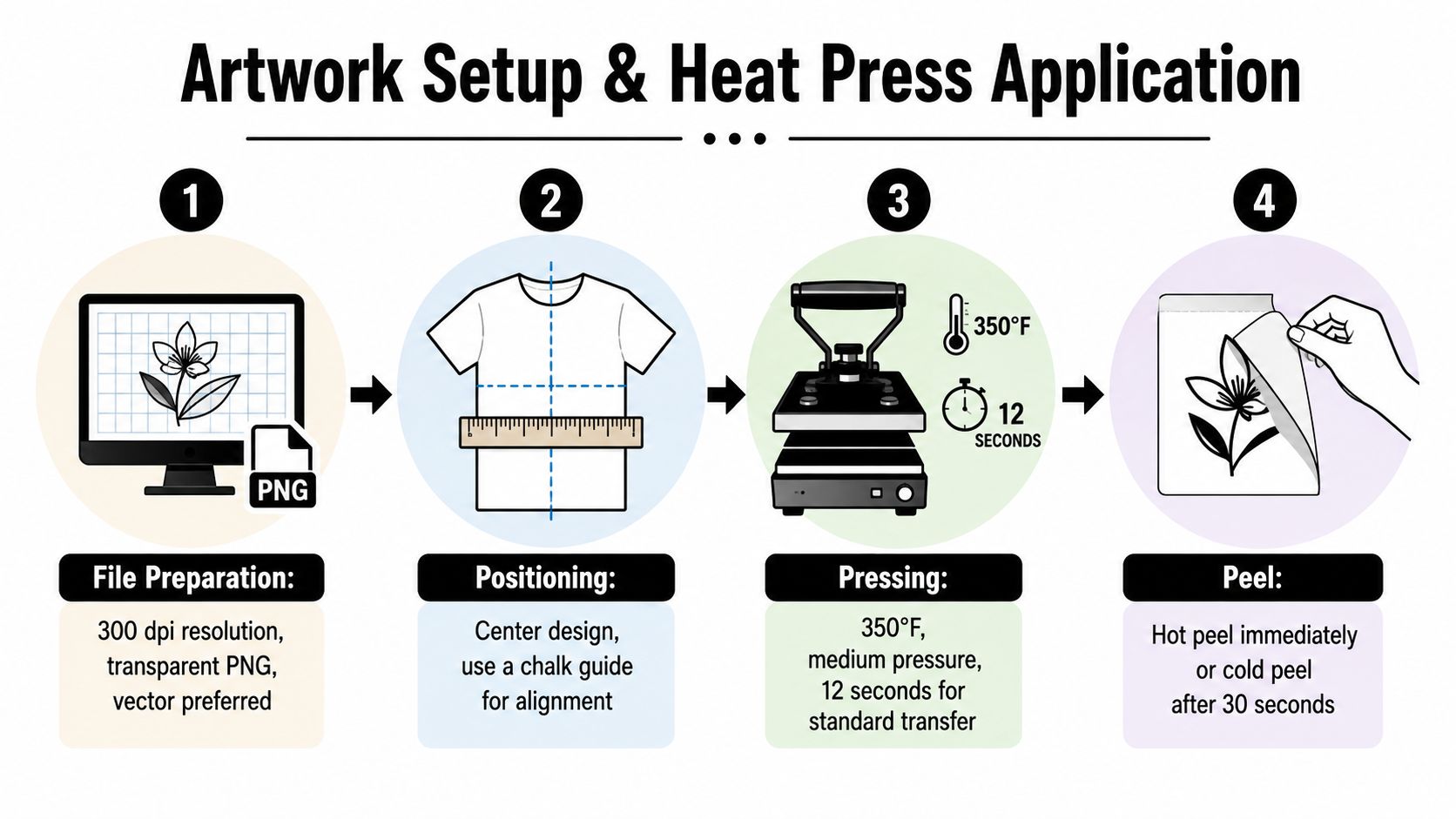
For artwork, use a transparent background when the design calls for it, keep edges clean, and provide vector artwork when available. Raster artwork should be supplied at the resolution needed for the final size. The infographic below includes a common preparation workflow, including 300 dpi, transparent PNG files, and vector preferences.
If you're still building an artwork library, a practical resource on how to find T-shirt design images can help you source and organize visual ideas while keeping licensing and file quality in mind.
A repeatable pressing sequence
- Prepare the garment. Remove lint, place the shirt flat, and pre-press briefly if the fabric holds moisture or wrinkles.
- Mark the position. Use a center guide or chalk mark. Measure from the collar rather than relying on eyesight.
- Set the press. Follow the transfer supplier's temperature, dwell time, pressure, and peel instructions. Don't substitute a generic setting when the transfer has its own specification.
- Press evenly. Make sure the entire design sits under firm, consistent pressure. Seams, zippers, and thick collars can create uneven contact.
- Peel correctly. Some films peel immediately while hot. Others need to cool before removal. Test the peel type on a sample first.
- Finish the bond. If the supplier recommends a second press with protective paper, complete it before folding or packaging.
The golden rule: Heat activates the adhesive, but pressure creates the contact. You need both, applied evenly, for a dependable bond.
For more detailed pressing guidance, use this practical heat press design application guide. Keep a written press recipe beside the machine so every operator follows the same process.
Troubleshoot by looking at the failure
- Lifting edges: Check pressure, garment seams, and whether the fabric was compatible.
- Dull color: Inspect the artwork, film coverage, and temperature before blaming the press.
- Cracking: Review stretch, curing, and wash care. A design forced across a highly elastic area may need a different transfer.
- Uneven adhesion: Look for wrinkles, thick seams, or inconsistent platen pressure.
Durability Care Instructions and Sustainable Choices
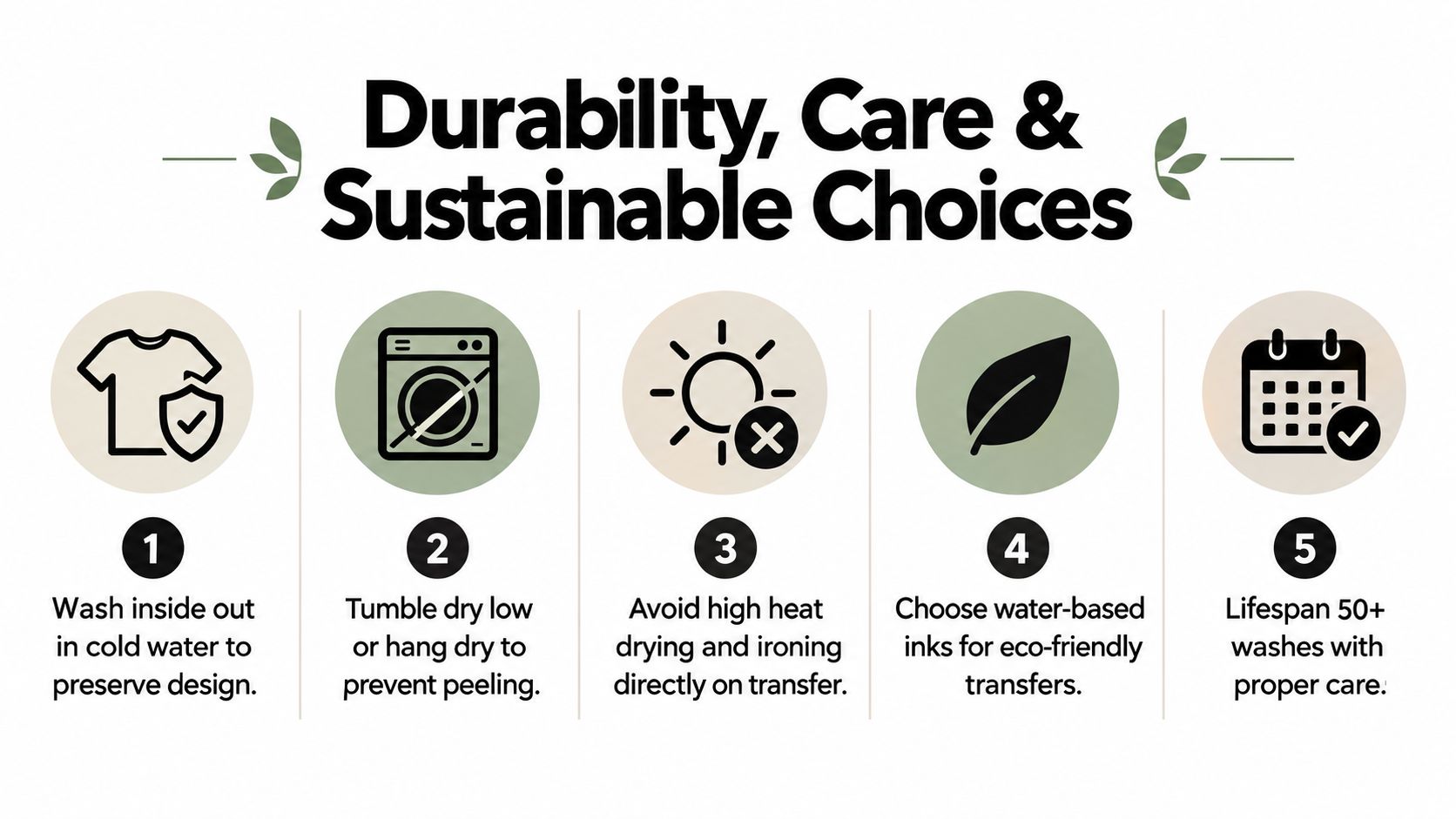
Customers usually judge a transfer after wearing and washing the shirt, not when they first see it on your production table. A well-applied DTF shirt transfer typically lasts about 50 to 80 or more wash cycles with proper care, while poor curing or budget-grade transfers may fall to roughly 20 to 40 washes, according to this DTF transfer durability wash test.
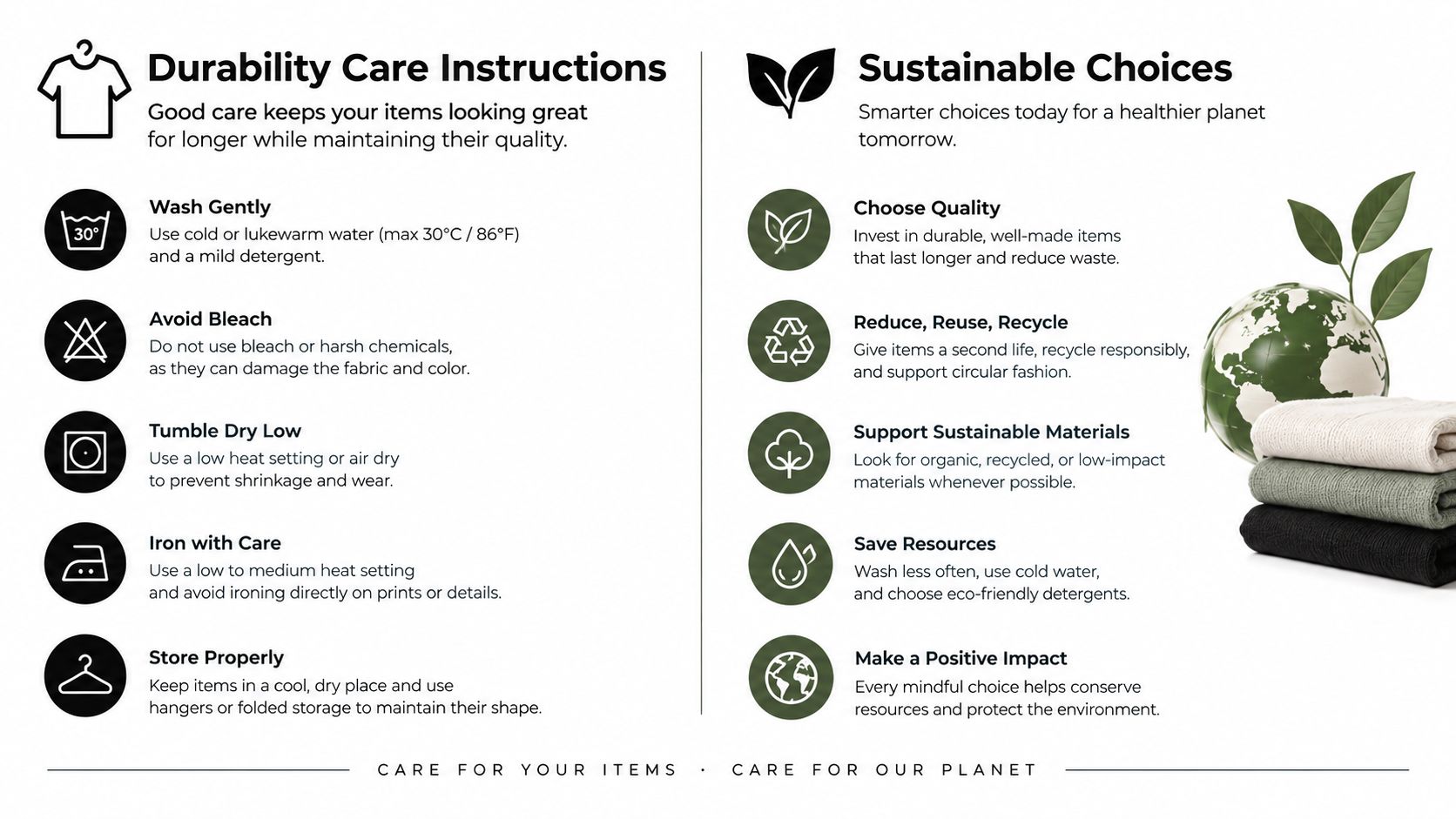
Care instructions protect that result. Recommend cold-water washing, turning the garment inside out, using gentle agitation, and drying on low heat or by air. Hot water, aggressive tumble drying, and direct ironing can weaken the adhesive bond or stress the printed layer.
What fabric chemistry changes
Transfer performance depends on more than the image. Quality polyurethane transfers are commonly applied around 150 to 165°C for 15 to 20 seconds with medium pressure and can reach about 40 to 50 wash cycles on compatible garments, while poorer vinyl products may fail after 5 to 15 washes, according to heat-transfer vinyl troubleshooting guidance.
Polyester blends can reduce durability compared with 100% cotton because heat and dye migration may weaken edge adhesion or affect visual sharpness. That doesn't make polyester unusable. It means you should select a transfer designed for the fabric and confirm the press recipe before committing to a wholesale run.
Give customers a short care card with every order:
- Wash inside out: This reduces friction against the printed surface.
- Choose cold water: Lower temperatures are gentler on the adhesive and color layer.
- Dry gently: Use low heat or hang the shirt to dry.
- Avoid direct ironing: Never place a hot iron directly over the transfer.
- Test special fabrics: Performance materials and blends need verified settings.
Sustainability also belongs in the buying conversation. Efficient gang-sheet layouts can reduce unused film, accurate pressing can reduce rejected garments, and domestic sourcing can shorten the distance between production and your shop. If your brand makes environmental claims, document the actual materials and processes rather than using broad labels without evidence. This guide to sustainable printing practices can help you evaluate waste and material choices more carefully.
Choosing Your Wholesale Supplier and Next Steps
A supplier should fit your production calendar, not just your purchasing spreadsheet. Start with a sample order and press each transfer onto the blanks you sell most often. Test dark cotton, light cotton, polyester, and blends if those fabrics appear regularly in your catalog.
Supplier checklist
- Print consistency: Check sharp edges, complete coverage, clean trimming, and repeatable color.
- Fabric guidance: Confirm which materials the transfer supports and whether dye migration is a concern.
- Press documentation: Look for clear temperature, time, pressure, and peel instructions.
- Turnaround: Ask when production begins, when the order ships, and how delays are handled.
- Landed cost: Include shipping, customs exposure, rush fees, receiving time, and likely reorders.
- Quality resolution: Confirm the process for replacing damaged or misprinted transfers.
- Environmental information: Request specific details about films, inks, packaging, and waste practices.
The right choice depends on your order pattern. If your shop produces highly repetitive artwork at substantial volume, in-house printing or screen printing may eventually make sense. If your work consists mainly of varied designs, short runs, seasonal launches, and deadline-sensitive orders, wholesale transfers can keep your equipment and labor focused on pressing and fulfillment.
Market reporting cited earlier says DTF is a primary short-run method for more than 52% of mid-sized apparel brands, and that more than 38,000 U.S. commercial print service providers operate DTF systems, according to industry coverage of DTF workflow adoption. Those figures point to a broad production ecosystem, but your own sample tests should make the final decision.
Order samples, press them on your best-selling blanks, wash-test the finished shirts, and calculate the cost of a successful completed garment. Then compare domestic and overseas options using landed cost and deadline reliability. That process will tell you whether wholesale shirt transfers are the right production layer for your shop.
Cobra DTF offers USA-made DTF transfers for garments, including ready-to-press designs for chest logos, sleeve graphics, and full-front artwork, with same-day shipping available for qualifying orders placed by 1 PM CST and delivery within 1 to 3 days. Visit Cobra DTF to review transfer options, order samples, and test a domestic workflow against your current production costs.