

How to Get Bulk Order Discounts on DTF Transfers
You've just opened a reorder invoice and realized the “small” price increase has eaten the margin on an entire batch of shirts. The supplier's bulk table promises savings, but the larger tier also means more film sitting on a shelf, a heavier shipment, and cash tied up in designs that may not sell quickly.
That's why bulk order discounts on DTF transfers should be judged by total landed cost and turnover speed, not the percentage printed beside a quantity tier. The useful question isn't, “How much is the unit price reduced?” It's, “What will each usable transfer cost after freight, storage, defects, and the next reorder?”
Why Bulk Order Discounts on DTF Transfers Work Differently Than You Think
DTF transfers don't behave like screen-printed blanks. A supplier's material consumption is driven heavily by the artwork's square-inch footprint, including film, ink, and powder, rather than by the garment count alone. A large gang sheet can contain many designs, while a small number of oversized graphics can consume more printable area than a much larger count of compact logos.
That changes the supplier's economics. A 1,000-piece run may not require proportionally more setup work than a 250-piece run if the artwork is already approved and the production layout is established. The supplier may therefore have room to reduce the unit price, but that reduction doesn't automatically mean your business should buy the largest available tier.
Buyer's rule: A discount only counts after you add every cost required to receive, store, use, and replace the order.
Quantity discounts are a long-standing form of nonlinear pricing, where the per-unit price falls as purchase volume rises. Economics literature has treated quantity discounts as an established pricing mechanism for decades, and inventory models commonly compare item cost, ordering cost, and holding cost across price breaks in this CARESS working paper on nonlinear pricing. That framework fits DTF purchasing well because the lowest quote can still produce the highest total cost if inventory moves slowly.
The four numbers that matter
Start with the supplier's quoted transfer price, then add:
- Freight: Include the actual shipping charge, not an assumed free-shipping benefit.
- Production and art fees: Confirm whether gang-sheet setup, color adjustments, or file preparation costs sit outside the tier.
- Storage carry cost: Account for the money and space tied up while transfers wait for orders.
- Turnover speed: Estimate how soon you'll use the stock and how the purchase changes your next reorder.
Website tables often show only the first number. A tier can look excellent at checkout and perform poorly once you add a split shipment, a rush replacement, or several months of unused inventory.
Use the rest of your buying process to test four things: whether the tier math is transparent, where your break-even volume sits, how shipping changes the result, and which supplier terms protect you when demand shifts. That approach turns bulk pricing from a sales table into a purchasing decision.
How Tiered and All-Units Pricing Structures Compare
A 500-piece DTF order can produce two very different invoices, even with the same quoted tiers. Suppliers generally use either an all-units discount or an incremental discount. With all-units pricing, reaching a threshold reprices every qualifying transfer at the lowest tier reached. With incremental pricing, each quantity band keeps its own rate, so only the units inside a higher band receive the deeper reduction.
The question shifts from unit-price reduction to total usable cost after freight, storage, defects, and reorder frequency. A low headline price saves money only when the stock turns quickly enough to justify the larger cash outlay and shipping commitment.
Consider these quoted rates:
- Single transfers: $2.80 each
- Orders of 250 or more: $2.20 each
- Orders of 500 or more: $1.80 each
Under all-units pricing, the full 500-piece order is billed at $1.80. The product total is $900, compared with $1,400 at the single-transfer rate, creating a $500 saving before freight and other costs.
Under incremental pricing, the first 250 units remain at $2.80, while the next 250 receive the $2.20 rate. None receive the 500-unit rate because the top band applies only after the threshold is crossed according to the supplier's stated method. The product total becomes $1,050, for a $350 saving against the single-transfer baseline.
Why the higher tier can reverse the result
A 1,200-piece order raises a separate pricing question. If the supplier applies the 500-unit price only to units above that threshold, incremental pricing leaves earlier bands at higher rates while all-units pricing reprices the entire order. If the incremental schedule gives a strong rate to the added units, however, crossing one break may cost less than repricing every transfer under a different rule.
Never infer the method from “volume discount” or “bulk savings.” Oracle's pricing documentation distinguishes simple discounts, which apply one rate to all units after a threshold, from tiered discounts, where each quantity band has its own rate. It also warns that pricing may be calculated by quote or order line, so splitting the same SKU across lines can prevent quantities from being aggregated, as explained in Oracle's volume-discount documentation.
| Order Volume | Tier Thresholds | All-Units Total | Incremental Total | Winner |
|---|---|---|---|---|
| 500 transfers | $2.80, $2.20 at 250+, $1.80 at 500+ | $900 | $1,050 | All-units |
| 1,200 transfers | Same thresholds, supplier calculation required | Reprice-all model | Band-by-band model | Depends on written rules |
For Shopify stores, recurring-order tools can apply another pricing layer. Review Shopify volume pricing for subscriptions to check whether storefront discounts match the supplier's quote logic.
Before accepting the quote, ask: “Is the discount all-units or incremental, and are quantities across separate lines and mixed designs aggregated?” Get the answer in writing.
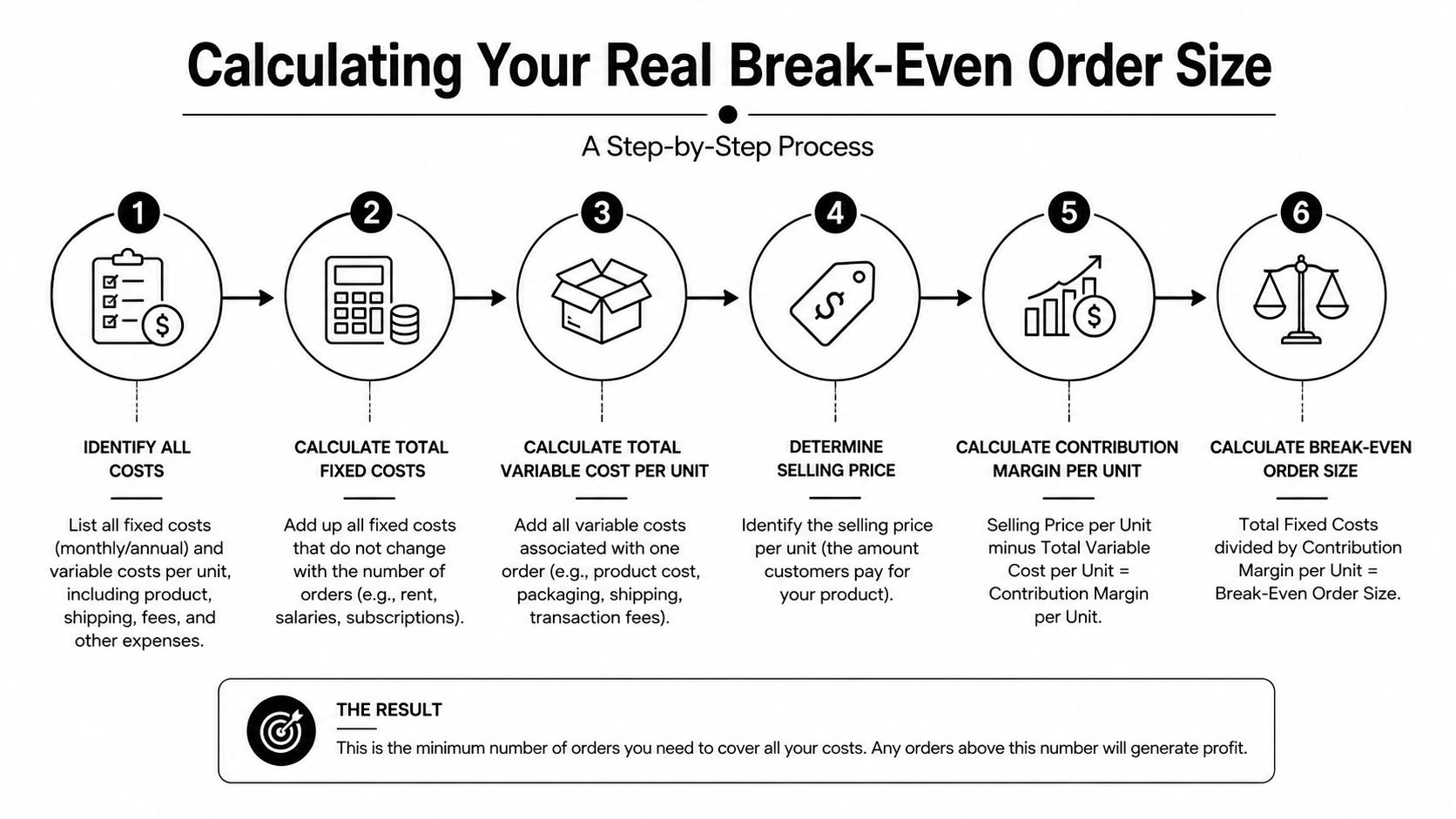
Calculating Your Real Break-Even Order Size
A 500-piece tier can look profitable on the quote and still weaken your margin if those transfers sit in storage while demand shifts. Calculate break-even using total landed cost and turnover speed before committing to a larger run.
Build the worksheet
Record these inputs for each proposed tier:
- Product cost: Multiply the quantity by the quoted transfer price.
- Freight and fees: Add shipping, handling, setup, artwork, applicable tax, and any surcharge.
- Holding cost: Estimate what unused inventory costs while it remains in storage.
- Turnover adjustment: Include a rush reorder, expedited freight, or lost sale if the larger order leads you to misread demand.
Use this formula:
Landed cost = product cost + freight and fees + holding cost + turnover adjustment
Divide that total by the number of usable transfers. Exclude units that are defective, outdated, or unlikely to sell. A low quoted unit price has little value when the denominator includes inventory your shop cannot use.
For climate-sensitive film, a practical planning assumption is roughly 1% to 2% of unit value per month for carrying cost. Apply your own storage and financing costs rather than treating that range as guaranteed. For a fuller review of material usage across artwork sizes, see this guide to DTF cost per print.
A worked example
Suppose a small shop buys 11x14 gang sheets at $2.00 each and qualifies for a 500-piece tier at $1.60 each. The quoted saving is $0.40 per transfer, or $200 across 500 pieces, before other costs.
The shop then incurs $120 in storage cost because demand is too slow. By month five, sales have shifted toward different designs, forcing a rush reorder. If the rush order and related disruption consume 60% of the original discount, the tier delivers only $80 of effective savings before the owner's time or obsolete artwork is counted.
Practical cutoff: If carrying cost exceeds 40% of the per-unit saving, treat the higher tier as suspect and test the previous tier first.
That cutoff is strict by design. With a $0.40 per-unit saving, carrying cost above $0.16 per unit consumes too much of the discount before freight and demand risk are included. Reconsider the larger order when turnover is unpredictable, designs are seasonal, or the supplier charges fees for split delivery.
Choose the tier that lowers your usable landed cost after freight, storage, and demand risk are included. A headline discount matters only when your shop can convert the inventory into sales quickly.
Matching Discount Tiers to Your Shop's Volume Profile
A discount tier earns its place only when your shop can sell the stock quickly enough to offset freight, storage, and the next reorder. Industry pricing guidance places volume discounts across a broad 5% to 25% range, while some practitioners recommend a 20% to 30% maximum cap to protect margin in this volume-discounting overview. Use those figures as screening points. Confirm the actual rate, included SKUs, shipping terms, and release schedule with each DTF vendor.
| Shop Profile | Monthly Volume | Best-Fit Tier | Typical Discount | Reorder Window |
|---|---|---|---|---|
| Solo Etsy seller | 80 transfers | 50 to 199 | 8% to 12% | Reorder near monthly demand |
| Mid-size print shop | 600 transfers | 500+ | 22% to 28% | Replenish on a stable cycle |
| Contract decorator | 2,500+ transfers | Negotiated high-volume tier | Custom | Planned recurring releases |
The solo seller
An Etsy seller averaging 80 transfers a month should begin with the 50-to-199 band unless the deeper tier turns faster inventory into a lower landed cost. Evergreen designs and reasonable freight support the larger order. One-off graphics, seasonal artwork, and slow-moving sizes favor smaller releases, even when the unit quote looks less attractive. Protect cash for the next reorder instead of filling storage with designs that may never sell.
The growing print shop
A shop moving 600 transfers a month has a credible case for the 500-plus tier. Review sales by specification before committing. The tier works when that volume repeats across core sizes and designs, with shipping spread over enough sellable units to improve margin. A single promotional rush can make the threshold look achievable while leaving excess stock afterward, so base the order on ordinary turnover rather than the best month.
The contract decorator
A decorator ordering 2,500 or more transfers should take the website table as a starting quote. Request scheduled releases, locked pricing, mixed-SKU aggregation, defect credits, and a forecast-based commitment. Releasing inventory in planned batches can preserve turnover speed and reduce storage pressure while retaining the negotiated rate. The supplier's willingness to structure those terms often matters more than another small reduction in the headline unit price.
Apply one rule before moving up: the higher tier should beat your current landed cost by more than 7%, or the shop should use the stock within 90 days. These thresholds come from the supplied buying framework, not a universal guarantee. If neither condition holds, keep the smaller tier and preserve reorder flexibility.
Negotiating Terms, Email Scripts, and Contract Clauses
Don't begin by asking, “What's your best price?” That invites a generic answer. Give the supplier a defined SKU, artwork size, expected order pattern, delivery location, and target reorder behavior.
Use this negotiation sequence
- Request the price sheet. Ask for every quantity break and whether the schedule is all-units or incremental.
- Order a sample run. Check color, adhesion, edge quality, peel behavior, and packaging before committing to volume.
- Challenge the threshold. Ask whether the vendor can extend the next tier at a lower quantity or aggregate approved designs.
- Negotiate freight. Request a delivered quote, shipping cap, or scheduled partial releases.
- Set payment terms. A smaller deposit or net terms may protect cash flow more than a marginal unit-price reduction.
- Put the quote in writing. Request a validity period and a clear expiration date.
You can adapt this message:
Subject: Volume pricing request for DTF transfer SKU
Hi [Supplier],
I'm requesting volume pricing for [transfer specification and size] at an estimated order volume of [quantity] per reorder. Please send your all-units or incremental tier schedule, shipping cost to [location], production lead time, and any artwork or setup fees.
Please provide a written quote valid for 30 days and confirm whether mixed designs, repeat orders, and separate order lines count toward the same threshold. I'd also like to understand whether I can reduce or increase the next reorder without losing the quoted price.
Thanks, [Name]
For supplier screening, this guide to choosing a DTF printing supplier gives you a useful checklist of operational questions to ask before negotiating price.
Clauses worth protecting
- Minimum order quantity: State the exact SKU and whether mixed artwork qualifies.
- Price lock: Define how long the quote remains valid and what triggers a revision.
- Artwork storage: Clarify whether the supplier may retain files and whether you can request deletion.
- Defect allowance: Set a written cap, such as the supplied 2% to 3% planning range, and define replacement or credit procedures.
- Remake guarantee: Specify whether the remedy is a free remake, credit, or refund.
- Missed lead time: Require notice, a revised date, and a remedy if the delay disrupts your customer order.
Avoid blanket non-refundable deposits above 50%, uncapped price increases tied to resin costs, and exclusivity clauses that prevent you from sourcing blanks or related materials elsewhere. A low unit price isn't protection if the contract removes your ability to react.
Shipping, Lead Times, and the Hidden Cost of a Cheap Tier
Shipping can erase a discount before the transfers reach your production table. A supplier may quote a lower price for a larger order, but the heavier package can raise freight, require split delivery, or force you to store inventory that you won't use soon.
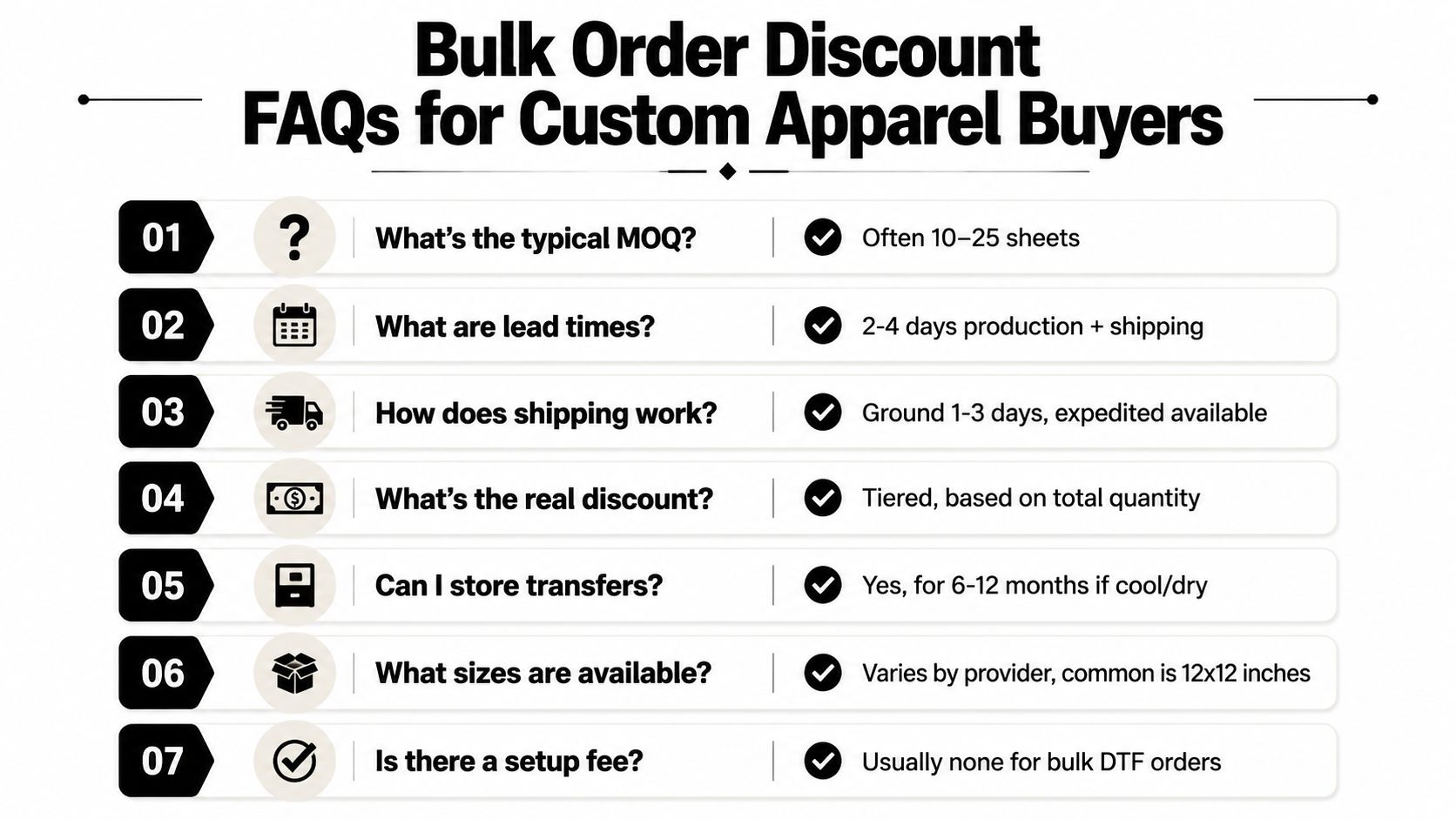
For planning, some DTF suppliers advertise standard production in 2 to 4 business days, same-day cutoffs around 10 AM Central Time, and domestic ground delivery in 1 to 3 days. Treat those figures as supplier-specific promises to verify, not industry guarantees. A tier that saves $0.12 per transfer can become expensive if it creates a five-day production queue and forces a paid rush reorder.
Check these items before ordering
- Production clock: Does it start after payment, artwork approval, or proof approval?
- Cutoff time: Is the same-day cutoff based on the supplier's time zone?
- Ship method: Is ground service included, or does the quote assume expedited delivery?
- Split shipments: Can the supplier release part of the order without adding handling fees?
- Delay remedy: Will the vendor remake, credit, or refund an order that misses the promised window?
Shipping rule: If a tier pushes your effective reorder cycle beyond 10 business days, assume the saving disappears the first time you need an air-freighted top-up.
For larger international purchasing programs, it helps to understand the broader mechanics of container shipping for importers, even if your DTF transfers usually arrive by parcel. Freight mode, consolidation, handoffs, and delivery timing all affect the cost that lands at your door.
Use the same discipline for domestic orders. A small per-unit reduction isn't valuable if it causes a customer cancellation, a missed production slot, or a second shipment. Your supplier agreement should state the production cutoff, shipping method, delivery estimate, and escalation process. A practical supply chain optimization guide can help you organize those inputs into a repeatable purchasing routine.
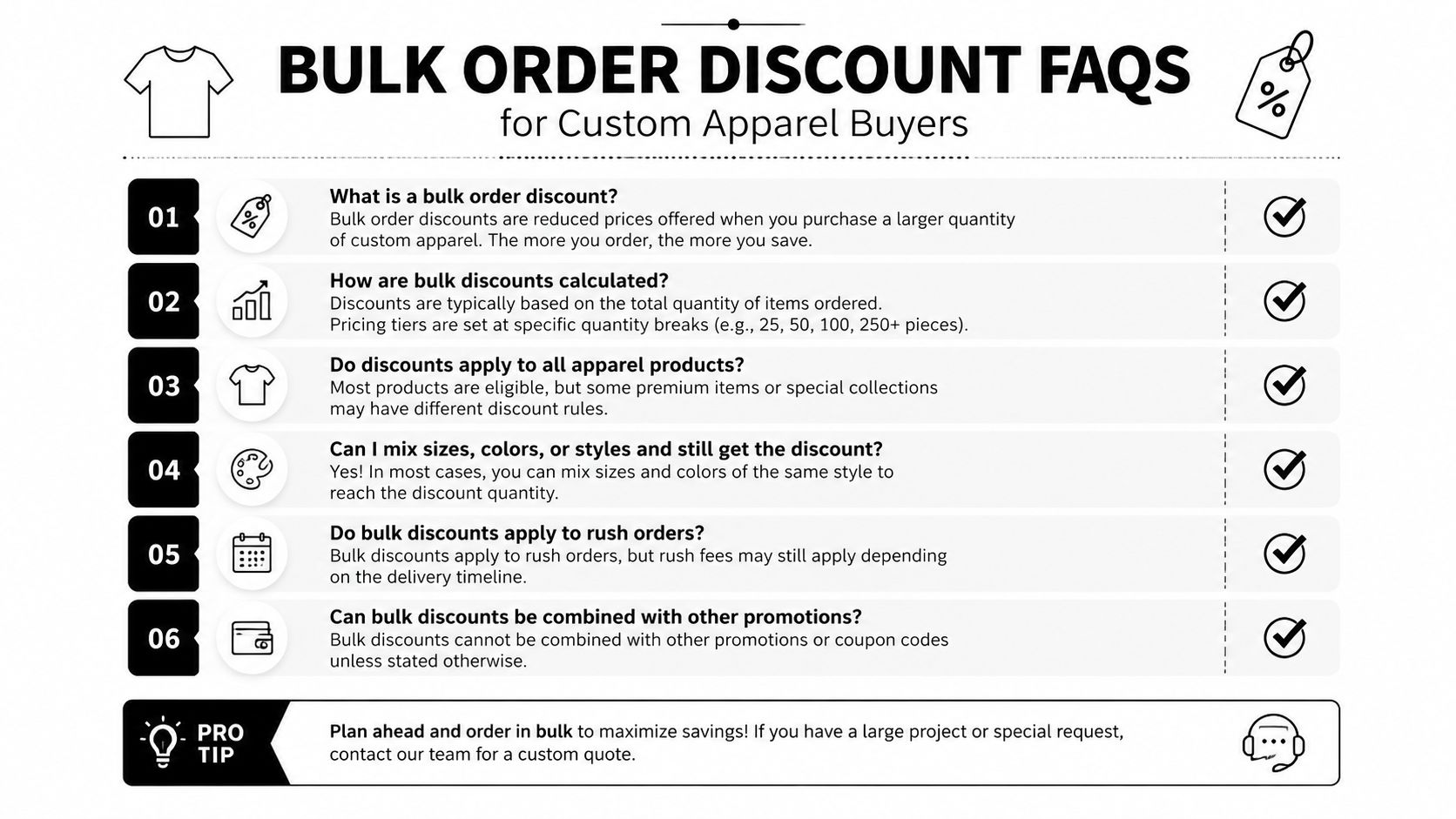
Bulk Order Discount FAQs for Custom Apparel Buyers
What's a sensible minimum order quantity?
Entry tiers often start around 10 to 25 sheets, while deeper discounts may require 50 or more. Ask the supplier to state the MOQ for each transfer size, artwork type, and finish in writing. A low MOQ is more useful than a large discount when your designs change frequently.
Do different custom designs count together?
Sometimes, but never assume it. Ask whether mixed SKUs, sizes, colors, or artwork files aggregate toward one threshold, and confirm whether the system treats each design as a separate order line.
Will reorders keep the first-order price?
Not automatically. Request a written reorder price, its validity period, and the volume needed to retain it. Also ask whether the supplier will preserve your artwork setup without charging a new preparation fee.
Can the supplier guarantee color matching?
Get the standard in writing. Ask how the supplier handles approved color references, reprints, and differences caused by the garment fabric. A color guarantee should explain the remedy, not just promise consistency.
What happens when transfers are defective?
Request a defect-rate cap and a replacement or credit process. Send photos, batch details, and the affected quantity promptly, then confirm whether the supplier replaces the full defective set or only verified pieces.
Which payment terms should I request?
Ask for the deposit, balance timing, accepted payment methods, and any credit terms before approving production. A lower deposit can preserve working capital, but don't trade away a clear defect remedy or delivery commitment for it.
What if demand drops?
Ask for smaller releases, a tier reset, or the ability to reduce the next order without a penalty. Bulk discounts should support your turnover, not force you to keep buying inventory that no longer matches customer demand.
Cobra DTF offers USA-made DTF transfers, competitive volume pricing, fast production, and delivery designed for apparel businesses that can't afford avoidable delays. Review your expected volume against landed cost, then visit Cobra DTF to request transfers that fit your reorder cycle instead of chasing a headline discount.