

DTF Cost Per Print: Your 2026 Calculation Guide
A realistic DTF cost per print usually lands between $1.10 and $4.45 per print in standard operations. Your exact number depends on more than ink, film, and powder. It also depends on labor, maintenance, electricity, waste, and the hidden overhead most quick calculators leave out.
That's the part that trips people up. Orders are coming in, prints are moving, cash is leaving the account, and you still can't say with confidence what each transfer costs you. On paper, a job looks profitable because the material cost feels low. In practice, the margin disappears once you count reprints, cleanup time, and the fixed costs of keeping the shop open.
I've seen this pattern in small shops over and over. A left chest run looks easy, a gang sheet feels efficient, and a custom order gets priced fast just to win the sale. Then the month ends and the owner realizes they were busy, not necessarily profitable.
The shops that stay healthy track all-in cost, not just transfer cost. That means knowing what one successful print really costs after direct materials, production time, maintenance, and the “oops” factor are all included. If you want a usable DTF cost per print, that's the only number that matters.
Why Your DTF Cost Per Print Is More Than You Think
A shop owner prices a 12-inch transfer off film, ink, and powder, wins the order, runs the job, and sees money come in. At the end of the week, the printer needs attention, two sheets were wasted on setup, someone spent extra time trimming and pressing, and the margin is thinner than expected. That happens every day in DTF shops because material cost gets mistaken for print cost.
DTF looks cheap if you only count what gets consumed on the sheet. Profit gets decided by everything wrapped around that sheet.
Production volume can hide weak margins
A full schedule creates confidence. Orders are printing, boxes are shipping, and the press stays hot. That feels healthy, but volume can cover up underpricing for a long time, especially if nobody is assigning a cost to machine wear, cleanup time, reprints, and the empty space left on poorly nested gang sheets.
The number that matters is simple: what did one usable transfer cost by the time it shipped without needing to be remade? That includes the transfer you sold and the mistakes, downtime, and support work required to deliver it.
I tell new operators to treat DTF the same way they would treat any other production business. If a cost repeats, it belongs in the job math. If it does not happen on every order but shows up every month, it still belongs in the job math.
The hidden costs are usually the ones that hurt
Online calculators usually stop at consumables. Real shops carry more than consumables.
Printer and shaker payments have to be spread across the prints they produce. Maintenance parts do too. Rent, utilities, RIP software, insurance, bookkeeping, admin time, heat press wear, packaging, and shop labor all pull from the same margin. A basic primer from Bookkeeping and Accounting of Florida Inc. is useful here because it reinforces a point many print shops learn late: if a cost supports production, it has to show up somewhere in your cost of goods sold.
Then there is the "oops" margin. Every shop has one. Misprints, clogged white ink channels, bad cures, customer file issues, rushed reorder jobs, and test presses are part of DTF production. Owners who ignore that buffer usually end up paying for it out of net profit.
Ink deserves special attention because white coverage, artwork density, and printer settings can swing cost harder than many beginners expect. A closer look at how DTF ink pricing affects real print cost makes that point clear.
Shops that know their numbers do one thing differently. They build cost per print from the ground up, then add a margin on top. Shops that guess from consumables first usually discover the actual number after the money is already gone.
Deconstructing the Total Cost of a DTF Print
A real cost model has three buckets. Direct costs, operational costs, and indirect costs. If one bucket is missing, your DTF cost per print is incomplete.
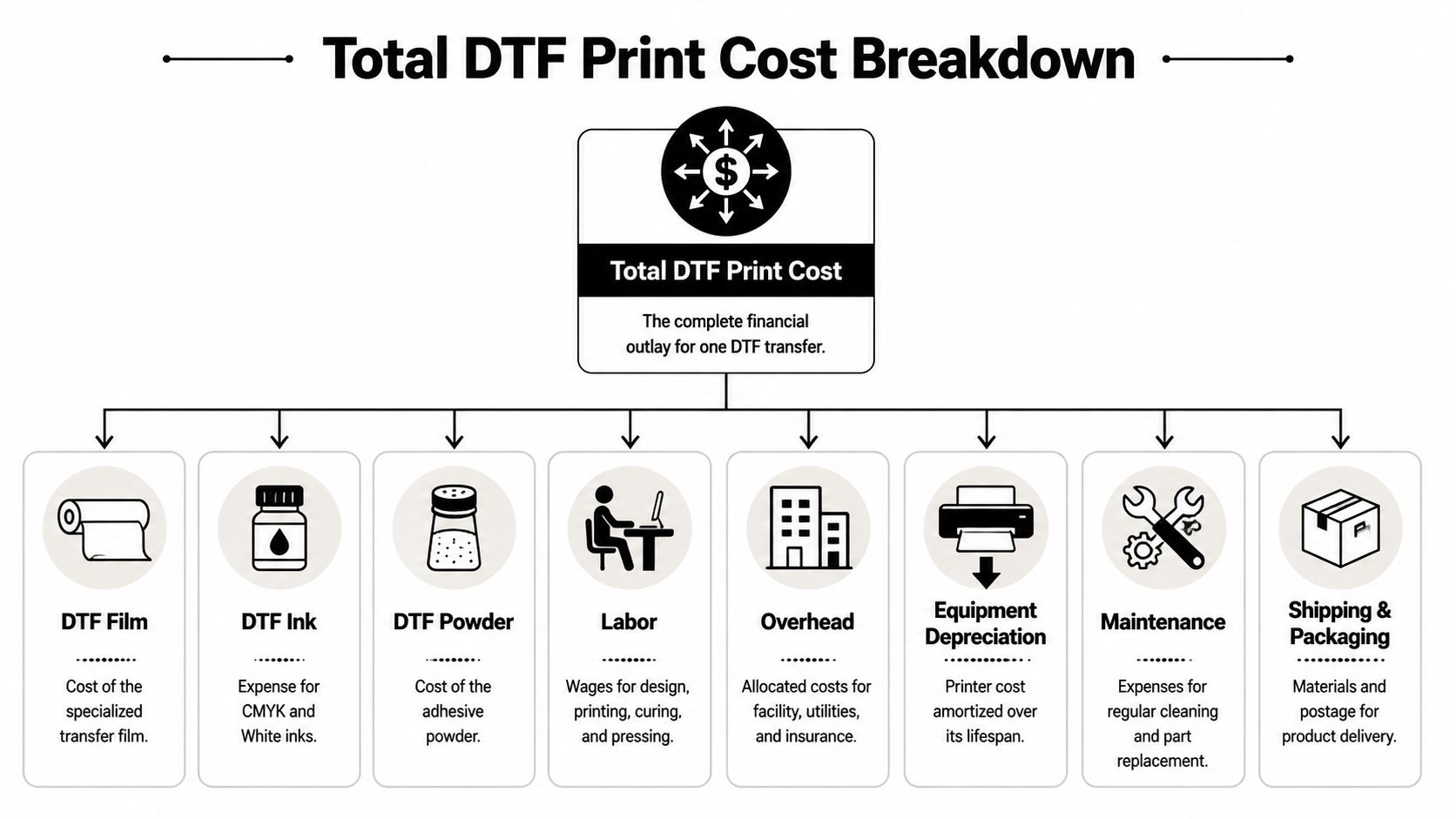
Direct costs
These are the costs commonly tracked first, and they should be. They're the clearest part of the formula.
- Ink: White ink changes the math fast, especially on dense graphics. If you want a deeper look at how shops think about DTF ink pricing, it helps to break ink cost out separately instead of burying it inside a flat estimate.
- Film: Sheet cost is easy to see, but layout efficiency determines what you really pay per usable print.
- Adhesive powder: Cheap on paper, but expensive when curing inconsistency creates reprints.
A strong direct-cost estimate starts with actual usage, not supplier list prices. If you buy film at one price but waste part of each run through poor nesting, your real film cost is higher than the invoice suggests.
Operational costs
Many “simple calculators” fall apart at this point.
- Labor: Someone has to prep files, print, powder, cure, press, trim, inspect, and pack. Even if you're doing it yourself, that labor still belongs in your cost.
- Electricity: Printers, shakers, ovens, and heat presses all draw power.
- Maintenance consumables: Cleaning solution, wipes, replacement parts, and routine servicing belong in the job cost, not in a mental junk drawer.
If you want your books to reflect reality, you need a clean method for assigning those costs. A practical primer on calculating cost of goods sold from Bookkeeping and Accounting of Florida Inc. is useful here because it forces you to separate what belongs inside product cost from what belongs elsewhere.
Shops don't usually lose money because film was expensive. They lose money because nobody counted the time and waste around the film.
Indirect costs
Indirect costs are the quiet killers. They don't show up on a single print, but every print should carry part of them.
Equipment amortization
Your printer, shaker, oven, and heat press wear out. If you don't spread that cost across production, you're treating expensive equipment like it's free.
Overhead
Rent, insurance, software, internet, climate control, bookkeeping, and admin work are real business costs. They may not touch the print physically, but the print couldn't exist without them.
Packaging and fulfillment
If you sell transfers or finished shirts, shipping materials matter. Sleeves, mailers, labels, and handling time need to be included somewhere in your pricing model.
A lot of shops keep chasing cheaper consumables when the better fix is reducing waste and stabilizing process quality. Consistent film, ink, and curing behavior lower the true cost per successful print because they reduce remakes and labor drag.
Sample Calculations for Real-World Print Jobs
A 25-piece left-chest order and a 200-piece gang sheet run can use the same printer, the same ink set, and the same press. They do not produce the same margin. The difference usually comes from the costs that never show up in a quick online calculator.
Small run of 25 chest logos
Short runs are where underpricing shows up fast. The print area is small, but the job still needs art setup, RIP time, printer checks, powdering, curing, sorting, and pressing. If one transfer fails, that remake can move the average cost more than people expect.
On a 25-piece chest logo order, direct materials usually look manageable. The hidden drag is everything wrapped around the print:
- File prep and setup time get spread across only 25 units
- Film use is less efficient if the layout leaves dead space
- Pressing labor stays high because the order is too small to smooth out handling time
- One or two remakes can erase the margin on the whole job
- Your overhead allocation per piece stays heavy because the run is short
I price these jobs with an oops margin built in from the start. Not because every order goes wrong, but because enough of them do. A mislabeled file, a powder issue, a rushed repress, or one shirt loaded crooked is part of normal shop life.
Large run using gang sheets
A larger run gives you room to recover your fixed effort. Better nesting improves film yield. Setup time gets spread across more prints. Labor per piece drops because the workflow has fewer interruptions relative to volume.
That said, volume does not guarantee profit. Big jobs can hide expensive mistakes. If a color issue, curing problem, or registration error shows up late, the remake cost lands on a much larger quantity. Good process control matters more on a 200-piece run than on a 25-piece order because the downside is bigger in total dollars.
The shops that make money on gang sheets usually do three things well. They nest tightly, keep the printer running without stoppages, and catch quality problems early.
Cost per print comparison
| Cost Component | Small Run (25 Prints) | Large Run (200 Prints) |
|---|---|---|
| Direct materials | Higher per print because film usage is less efficient | Lower per print because nesting is tighter |
| Labor allocation | Higher per print because setup and handling are spread across fewer units | Lower per print because more units absorb the same setup work |
| Equipment amortization | More noticeable on each print | Easier to spread across the run |
| Electricity and maintenance | More visible on a short job | Less visible per piece, but still present |
| Oops margin impact | One remake can shift job profitability fast | Misprints hurt less per piece, but total remake dollars can still be painful |
| Overhead allocation | Heavier burden per piece | Lower burden per piece when production stays steady |
| Likely all-in result | Usually lands near the top of your internal cost range | Usually lands near the bottom, if waste stays controlled |
The practical lesson is simple. A print that fits on film is not automatically a good job. A good job gives you enough units, enough layout efficiency, and enough room for normal production mistakes to leave profit behind.
Pricing Your DTF Prints for Profitability
Once you know your true DTF cost per print, pricing gets simpler. Not easy, but simpler. You stop guessing and start deciding.
Cost-plus is the floor
The first job of pricing is covering your all-in cost. That includes every category you assigned in your internal model. If your price doesn't absorb materials, labor, maintenance, waste, and overhead, you're subsidizing your customers.
Cost-plus pricing works well as a minimum guardrail. It keeps you from taking work that looks good at the sales stage but drains cash later.
Competitive pricing only works if your math is strong
A lot of shops glance at local market prices and match them. That can work if your shop is lean and disciplined. It fails if your internal costs are sloppier than the competitor's.
Competitive pricing is useful as a reality check, not as your whole strategy. If the market price is lower than your profitable price, you don't have a pricing problem first. You have a cost structure or positioning problem.
Value-based pricing rewards reliability
Customers don't always buy the lowest transfer price. They buy dependable turn times, strong color, consistent adhesion, and fewer headaches.
That's why some shops can charge more without apologizing. They sell confidence. A transfer that presses cleanly and reduces remake risk has more value than a cheaper option that creates extra work.
A practical pricing model usually combines all three approaches:
- Use cost-plus to protect your floor.
- Check the market so you don't drift into fantasy pricing.
- Price for value when your service, consistency, or turnaround solves a real customer problem.
If you're always competing on the cheapest visible transfer cost, you'll end up cutting quality or absorbing unpaid labor. Neither lasts.
Actionable Tips to Lower Your DTF Costs
A shop can stay busy all week and still lose money on DTF. It usually happens in the gaps. Extra film between layouts, remakes from inconsistent curing, idle labor during maintenance, and the small but real pile of prints that never ship.
Tighten the workflow before chasing cheaper supplies
Lowering DTF cost starts with controlling the hidden loss points that calculators skip. Film waste, setup time, press errors, routine cleaning, and the prints you rerun after a color or adhesion issue all belong in the job cost, whether you itemize them or not.
Film is the easiest place to see this. Shops that print mixed logos, left-chest designs, and neck labels on separate sheets usually overpay for usable print area. Shops that batch work and build tighter DTF transfer gang sheets stretch each foot of film further and lower effective cost without cutting price.
The same logic applies to your oops margin. Every shop has one. I would rather budget for misprints up front than pretend every run goes perfectly and watch margin disappear at the end of the month.
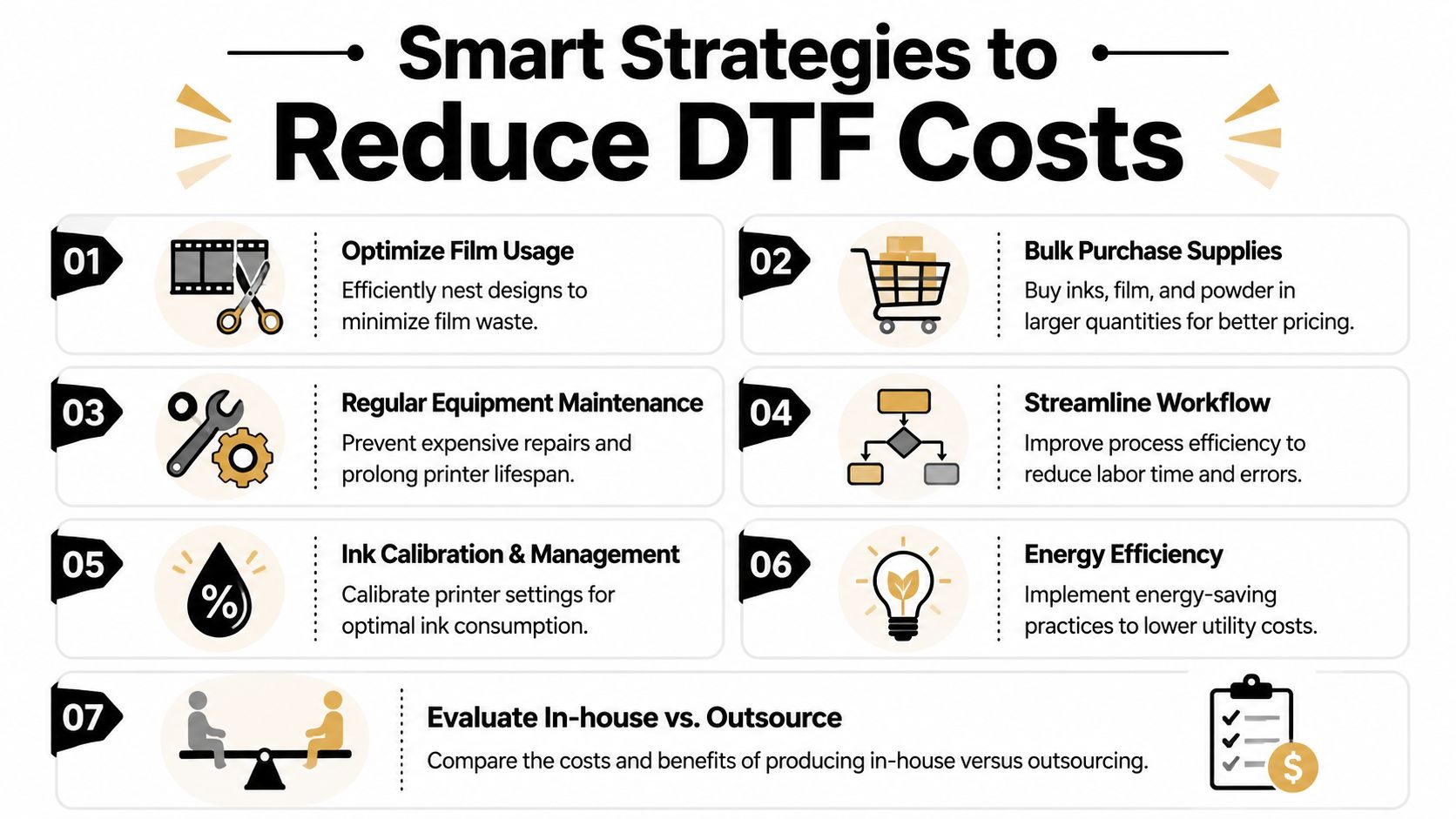
Seven practical ways to protect margin
- Fill dead space on every layout: Empty film is a direct cost. Nesting artwork tighter lowers film cost per delivered print.
- Switch formats only when the volume supports it: Roll film can reduce unit cost, but only if your output is steady enough to justify the handling, storage, and workflow change.
- Carry an oops allowance in every estimate: Misprints, clogged heads, powder contamination, and rushed reloads are part of production. Price for them before they happen.
- Lock down curing settings: A bad cure costs more than powder. It creates remakes, customer complaints, and wasted press time.
- Measure labor by step: File cleanup, RIP setup, printing, powdering, curing, trimming, pressing, and packing all add cost. If you do not track them, you will underprice.
- Treat maintenance as a production cost: Head cleanings, nozzle checks, replacement parts, and downtime belong in your print math. They are not random surprises.
- Compare in-house output against outsourced transfers objectively: Some shops make better money selling finished garments and letting a transfer supplier absorb the printer maintenance, spoilage, and equipment depreciation.
One more point gets missed all the time. Cheap consumables are expensive if they create rework.
Shop advice: The lowest invoice price rarely gives the lowest true print cost. Consistent film, adhesive powder, and transfer quality usually save more money than bargain supplies that increase remakes.
Cobra DTF is one supplier shops may consider in that equation. The practical value is not hype. Reliable turnaround and consistent transfers can reduce how much film, ink, and blank inventory a shop has to carry while keeping production schedules tighter.
DTF Costs Compared to Screen Printing and DTG
A 12-piece order with full-color left chest prints and two hoodie sizes can make money fast with DTF. The same job can turn into a pricing mistake if you compare methods using only ink and transfer cost.
Where DTF fits
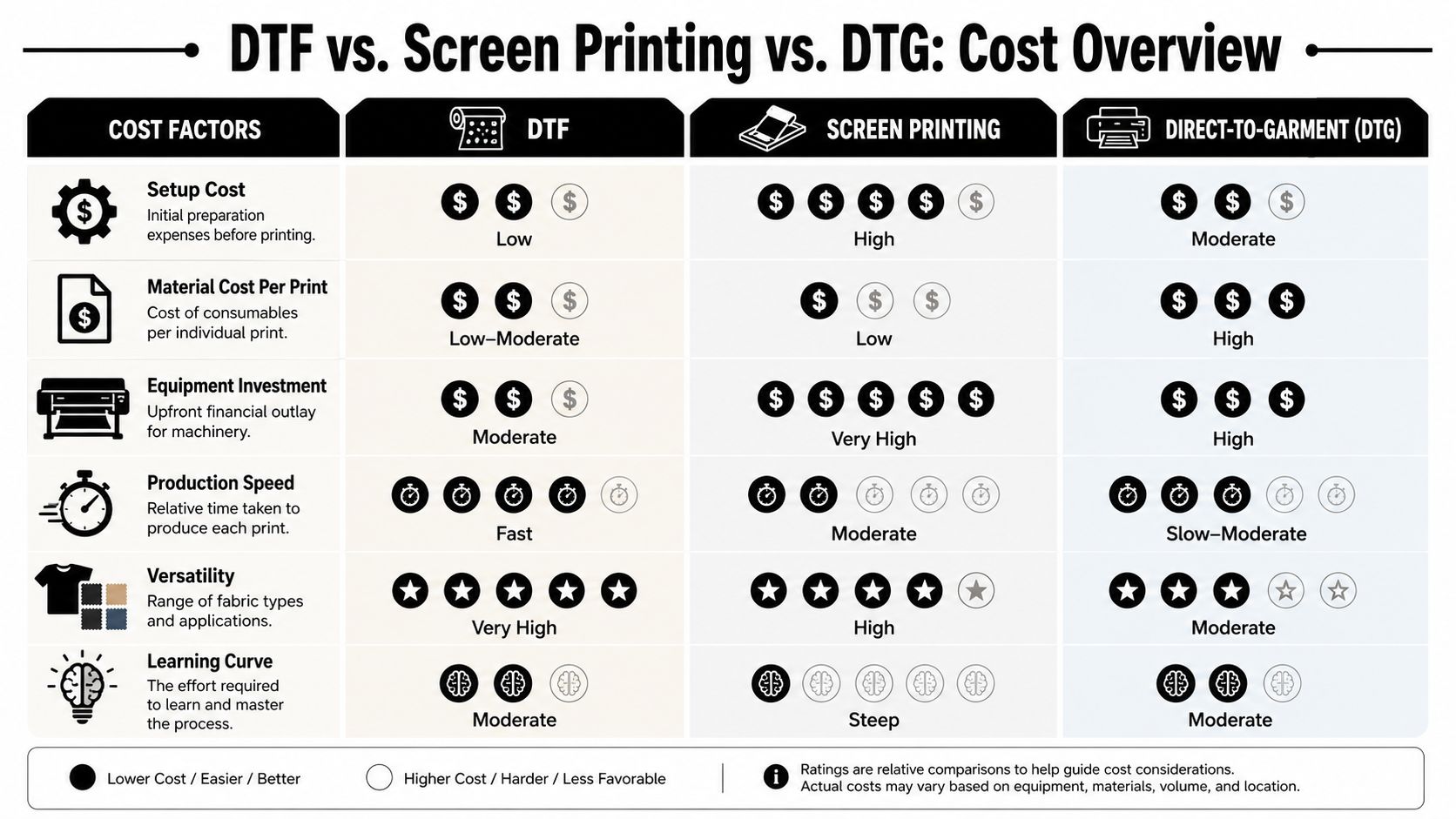
DTF usually lands in the strongest spot for short and mid-size runs, mixed garment types, and artwork with lots of color. It handles the kind of order mix many custom shops see. Ten shirts here, twenty hoodies there, three different designs, rush turnaround, and no appetite for a long setup.
That is why simple cost-per-print comparisons often miss the full picture. DTF may look more expensive than screen printing on consumables alone, but screen printing carries setup labor, screen prep, reclaiming, and the risk of tying up production time on small runs. DTF may look cheaper than DTG on some jobs, but that only holds if you count pretreatment differences, fabric limitations, and remake rates accurately.
Earlier cost references in this article showed that DTF can produce low direct print costs on common sheet sizes and leave solid gross profit on standard shirt orders. In a working shop, those numbers only matter after you add the hidden costs that calculators skip. Equipment depreciation, head maintenance, shop overhead, and an oops margin change the comparison.
How it compares in the shop
- Screen printing: Best fit for longer runs where setup gets spread over dozens or hundreds of pieces. Once the screens are built and the press is running, unit cost drops hard. On short runs, the setup time can wipe out margin quickly.
- DTG: Good fit for one-offs and soft hand prints on cotton garments. The trade-off is slower production on some jobs, pretreatment workflow, and tighter garment compatibility.
- DTF: Strong fit for shops selling variety. It works across more fabric types, handles multicolor art without extra setup, and stays competitive on the order sizes where customization matters more than pure volume efficiency.
The decision is not which method has the cheapest print in theory. It is which process leaves the most profit after labor, setup time, remake risk, and machine cost are included.
For many shops, screen printing wins on large repeat orders. DTG wins on certain single-piece cotton jobs. DTF wins in the middle, where flexibility pays the bills and the hidden costs are still controllable.
If you want a broader workflow breakdown, this guide on DTF vs. DTG printing for different shop workflows is a useful reference.
Partnering for Predictable Costs and Quality
Healthy margins come from control. You control what you can count, and you count what you're willing to manage. That's the whole game with DTF cost per print.

The shops that stay profitable don't rely on optimistic estimates. They build pricing from real job costs, include waste on purpose, and keep their production variables as stable as possible. That means fewer surprises from inconsistent materials, fewer margin leaks from remakes, and fewer late adjustments when a quote turns out to be too cheap.
A dependable supplier helps with that because predictable inputs make your cost model more accurate. Consistent transfer quality, reliable shipping, and fewer production interruptions matter just as much as a low sticker price.
If your numbers are fuzzy today, fix that first. Once your cost model is honest, pricing decisions get easier and scaling gets safer.
If you want a more predictable way to source transfers without guessing at quality or delivery timing, take a look at Cobra DTF. They provide U.S.-made DTF transfers with fast turnaround, which can help shops simplify production, reduce variability, and price work with more confidence.