

Sustainable Printing Practices for Apparel Shops
You've got a customer asking for “eco-friendly” shirts, a supplier offering three different green labels, and a production schedule that leaves no room for experiments. Meanwhile, your DTF printer is warming up, the dryer is running between orders, and test prints are eating film. That's the shop-floor reality behind sustainable printing practices. Good intentions don't reduce waste by themselves. A repeatable operating system does.
The practical path is to measure the largest loads first, then change the inputs and habits that affect energy, consumables, reprints, and disposal. The sustainable printing market was valued at USD 2.07 billion in 2023 and is projected to reach USD 3.35 billion by 2030, with a 7.5% CAGR from 2024 to 2030, according to this industry estimate of sustainable printing growth. That trajectory tells you sustainability has moved into procurement and compliance conversations, but it doesn't tell you how to stop wasting film on Monday morning. This guide does.
Why Most Apparel Shops Stall at the Starting Line
The contradiction is easy to see. Forty percent of print service providers say sustainability is a core priority, yet only 4% report that at least 90% of their output uses sustainable materials or inks, while average adoption sits at 35%, according to the FESPA 2026 Print Census. The problem isn't that shop owners don't care. The problem is that “sustainable” often arrives as a pile of labels, higher quotes, and no agreed measurement method.
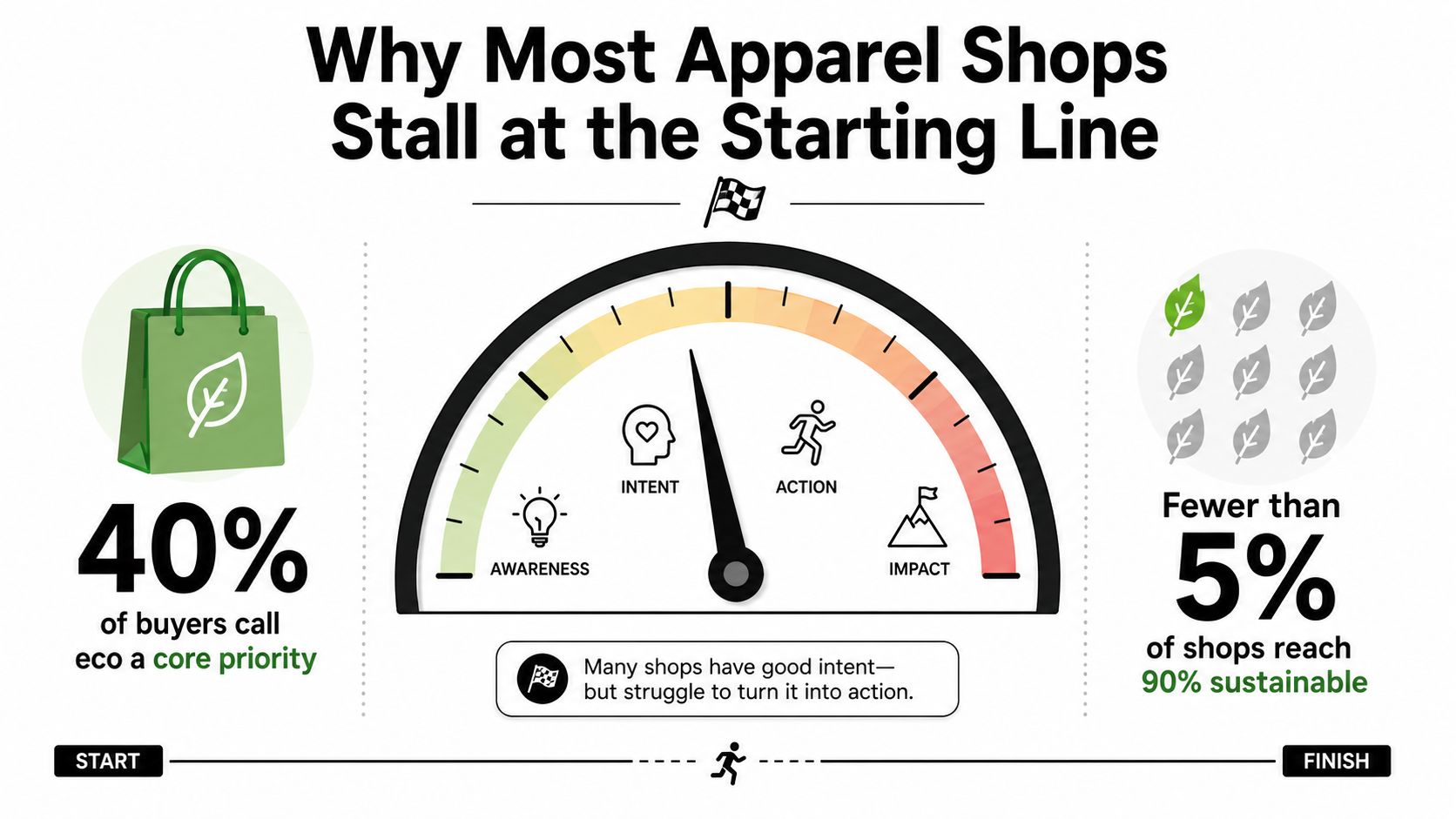
A small apparel shop has an advantage that a large factory often lacks. The owner can change film, test a different powder, retune a curing profile, and update the test-print rule without waiting for several departments to approve the change. That flexibility matters because the gap between intent and action is usually operational, not philosophical.
The three stalls that keep appearing
Certification overload comes first. Owners see OEKO-TEX, GOTS, recycled-content claims, chain-of-custody language, and supplier-specific “eco” labels. They freeze, or they pick the label with the strongest marketing instead of asking what the certificate covers and whether it applies to the finished garment, the fiber, the ink, or the manufacturing site.
Upfront cost anxiety is next. A certified blank, a lower-impact ink, or a more efficient dryer can cost more at purchase. That doesn't automatically make it a bad decision, but it does mean you need to separate fast payback from brand-building expenditure.
Finally, there's unclear measurable progress. Only 54% of surveyed respondents had sustainability metrics in place or under development, according to research on environmental impacts in commercial printing. If you don't record energy, waste, ink usage, and reprints, you can't tell whether a greener input improved the shop.
Start with a short supplier and workflow review. Practical references such as supply point product guides can help you organize material questions, but your own production records must decide what stays.
Practical rule: Don't promise a greener workflow until you can name the input, the process change, and the measurement that supports the claim.
Choosing Eco-Friendly Inks, Films, and Substrates
Start with the garment, because the printed decoration is only one part of the product's footprint. Paper and substrate choices are repeatedly identified as major impact drivers, and the water footprint associated with printing and writing paper has been estimated at 300 to 2600 cubic meters per ton, or roughly 2 to 13 liters for an A4 sheet, in the technical review of paper and printing water impacts/p.565-577.pdf). Apparel shops should apply the same discipline to blanks and transfer materials. Ask where the fiber comes from, what certification covers it, and whether the supplier can provide documentation rather than a badge alone.
Put blanks and films under scrutiny
For cotton apparel, look first at recycled or responsibly certified fiber that still meets your customer's hand-feel, shrinkage, and color requirements. OEKO-TEX can address harmful-substance testing, while GOTS applies broader organic textile processing requirements. Neither label is a universal environmental score, so request the certificate scope and current supplier documentation.
For DTF film, compare standard PET transfer film with alternatives such as PLA-based films where the application and supplier instructions support them. Don't assume a biodegradable film solves the whole disposal problem. Adhesive powder, cured ink, garment fiber, and local waste infrastructure still determine what happens at end of life.
Money-saving switch: right-size gang sheets and stop printing unused space around designs. This cuts film and powder consumption without changing the finished garment.
Brand-building switch: offer certified blanks for customers who value documented sourcing, then price the option clearly instead of absorbing the premium invisibly.
Pretreatment chemistry deserves the same caution in DTG work. Use only the amount needed for the fabric and image, verify nozzle and cure performance, and track reprints caused by poor adhesion or uneven coverage. A cheaper chemical that creates failed garments isn't cheaper once labor and disposal enter the calculation.
Choose inks by use case, not label
Water-based pigment systems can offer a softer feel and lower solvent burden, but they may require different curing and maintenance routines. DTF systems also depend on film, powder, humidity control, and heat settings, so changing ink without validating the complete stack is careless. Before ordering, review the technical discussion in this guide to heat transfer inks, then ask the supplier for compatibility instructions and test samples.
Your supplier conversation should cover certification scope, printable area, cure requirements, film compatibility, cleaning chemistry, packaging, and end-of-life guidance. Current 2026 merch sourcing strategies can help frame sourcing decisions, but your production test remains the final filter.
A sustainable input that causes more misprints, more cleaning, or more rejected garments may increase the total footprint.
Comparing Ink Options for Small Apparel Printers
Ink choice changes the job in three places: the garment's hand feel, the equipment's cure profile, and the number of failed prints. Use the table as a starting screen, not a substitute for a supplier test. Exact pricing varies by formulation and supplier, so compare the actual printable area and waste rate before approving a switch.
Ink Options Compared for Small Apparel Printers
| Ink Type | Avg Cost Per Print | Hand Feel | Cure Temp | Best On |
|---|---|---|---|---|
| Water-based | Often higher consumable cost | Soft on light garments | Requires a validated, often longer cure window | Light cotton and soft-hand applications |
| Pigment | Often higher cost per milliliter | Soft to moderate, depending on deposit | Simple, supplier-defined cure window | Cotton and selected blends |
| Eco DTF | Compare by printable area, not cartridge price | Film-dependent, generally flexible | Tight control around 150 to 160°C | DTF work where lower VOC and wastewater are priorities |
Water-based ink is the clear choice when a light cotton shirt needs a soft print and the shop can manage the cure profile. It's a weaker default for dark polyester blends, where coverage and adhesion can become more demanding. Pigment ink gives a broader cotton and blend workflow, but the higher price per milliliter needs to be offset by consistent output and fewer failures.
Eco DTF ink can make sense when you want to reduce solvent and wastewater concerns, but it isn't a “load it and forget it” product. Keep the dryer temperature stable, validate white-layer coverage, and record wash-test results for each garment category. A small change in heat or dwell can affect powder bonding and durability.
Ask every supplier two trap questions:
- What is the cost per printable area? Cartridge price hides ink density, white ink usage, purge waste, and rejected transfers.
- Does it require proprietary film? Standard PET compatibility gives you more sourcing flexibility and makes comparison easier.
The best option is the one that performs reliably across your actual order mix. A theoretically lower-impact ink that drives reprints is a poor sustainability decision.
Cutting Energy Use and Waste at the Press
Energy and consumables deserve attention before cosmetic upgrades. Life-cycle assessments of commercial analog and digital printing identify press energy and consumables as major impact drivers after the printed substrate, as summarized in the commercial printing life-cycle research. On a DTF line, that means the idle printer, curing oven, dryer, pretreatment equipment, cleaning cycle, and rejected transfer all belong in the same operating review.
Changes you can make without buying equipment
Set the press and dryer to sleep after 10 idle minutes. Put the rule on a visible card beside the control panel, and make the lead operator responsible for checking the shutdown log. The setting costs nothing, and it prevents a machine from heating an empty workspace.
Use a 4 × 4 cm swatch for routine color, adhesion, and garment tests instead of an A4 test print. Reserve a full-size test for a job where scale, placement, or edge behavior needs validation. Save clean PET offcuts as transfer carriers for compatible small jobs, but label them and reject pieces with dust, creases, or damaged coating.
For cotton jobs, don't blindly run the oven hotter or longer than the ink, powder, and film require. A profile such as 160°C for 35 seconds may be a useful trial point, but confirm it against the supplier's specification and your wash testing. Never trade a few seconds of energy for a batch of failed shirts.
A week-one operating table
| Tactic | Setup Cost | Est. Monthly Savings | Payback |
|---|---|---|---|
| Idle-down timer and sleep setting | None to low | Measure from your meter | Immediate |
| 4 × 4 cm test swatches | None | Measure film and powder avoided | Immediate |
| PET offcut sorting and reuse | None | Measure recovered material | Immediate |
| LED curing where the duty cycle fits | Small capital outlay | Measure electricity reduction | Depends on usage |
| External dryer exhaust in warm weather | Low to moderate | Measure HVAC load change | Depends on installation |
A DTF press idling for 4 hours per day can waste roughly $18 per week in power, based on the operational estimate provided in the brief. Trimming cure time by 5 seconds across 200 shirts can save about 11 kWh daily, also based on the supplied estimate. Treat those figures as planning examples, then replace them with readings from your own meter and utility rate.
Use a weekly waste review alongside the energy log. The sustainable manufacturing practices guide is a useful reference for building that review around process control rather than slogans.
Calculating the Cost and ROI of Going Greener
Approve a green upgrade only after you can show its cost, operational effect, and payback period. On Monday morning, open one worksheet with the current input, replacement input, energy effect, waste effect, and reprint effect. Keep the premium visible instead of hiding it inside general supply expenses.
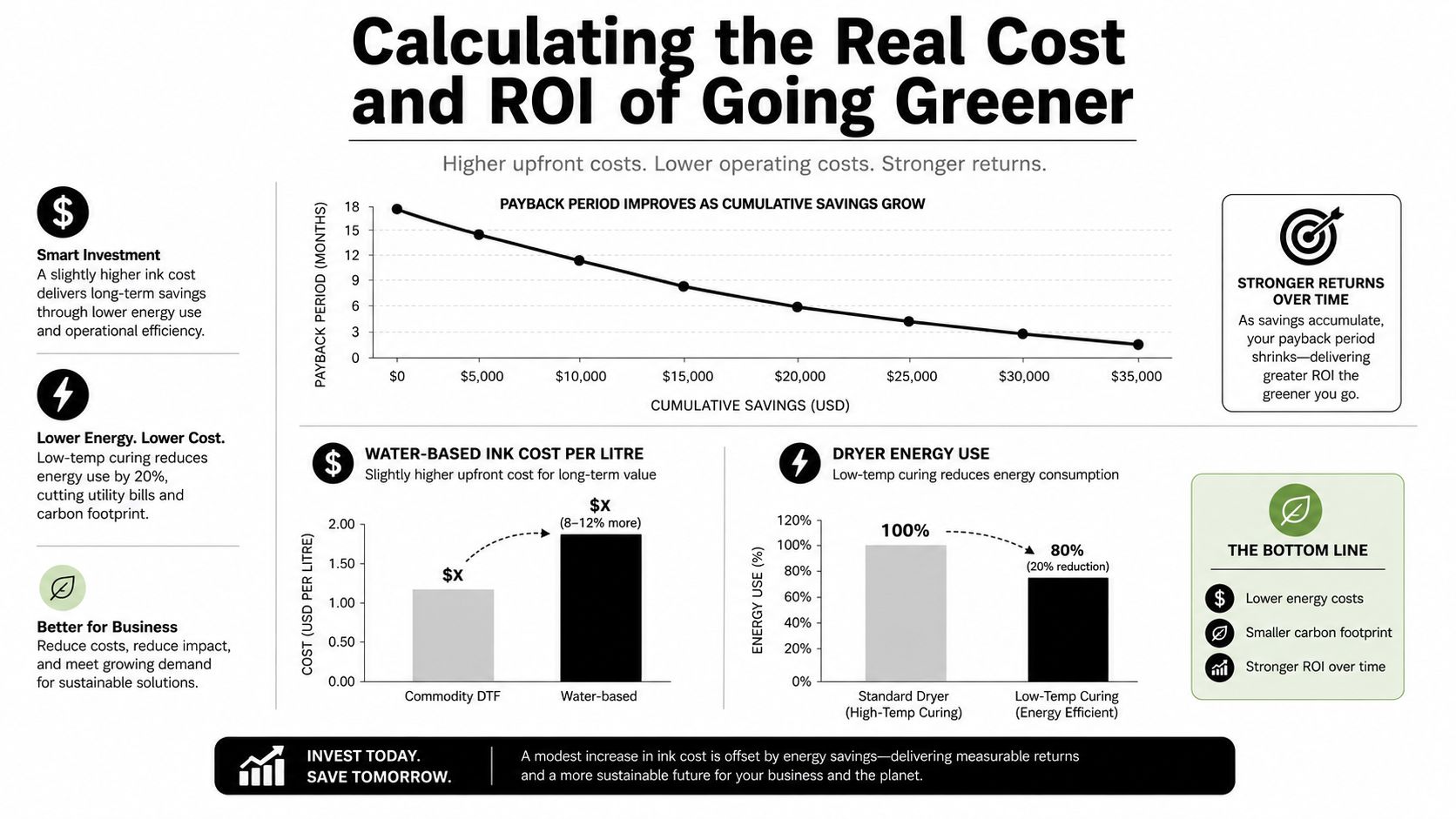
Water-based ink may cost about 8% to 12% more per liter than commodity DTF ink, while lower-temperature curing may reduce dryer energy by roughly 20%, according to the supplied operating scenario. Use these figures for planning only. Your formulation, machine, coverage, and cure settings determine the actual result.
Separate fast payback from strategic spend
The supplied example switches 60% of cotton jobs to water-based ink at 200 prints per week and recovers the ink premium in roughly 4 to 5 months after accounting for energy, waste disposal, and fewer reprints. Do not copy that outcome into your budget. Record your energy rate, ink coverage, cure profile, garment mix, and failure rate, then calculate the result for your shop.
Projects with a direct operating effect usually pay back faster:
- Idle management cuts electricity without changing product quality.
- LED curing can lower energy use when the equipment matches the duty cycle and curing requirement.
- Film reclamation reduces consumable purchases when recovered material remains usable.
- Right-sized testing prevents full-sheet waste during routine checks.
Certified blanks and third-party audits serve a different purpose. They can strengthen customer trust and document procurement, yet the financial return may take years. Classify them as brand-building or compliance investments unless a customer contract pays for the distinction.
Owner's calculation: monthly green savings divided by upgrade cost equals months to breakeven.
Track reprints on their own line. A change that lowers energy use but creates more failed garments is losing money across the job, even if the utility bill improves. Review the worksheet by job type each month, and keep any upgrade that reduces total cost without weakening print quality.
A 90-Day Rollout Plan for a Small Custom Shop
Consider a four-person custom shop in Austin. The owner handles purchasing and reporting, the lead operator controls production settings, the sales coordinator updates customer messaging, and the fulfillment employee sorts scraps and records rejected pieces. That division keeps sustainability from becoming everyone's vague responsibility and nobody's daily task.
Days 1 through 30
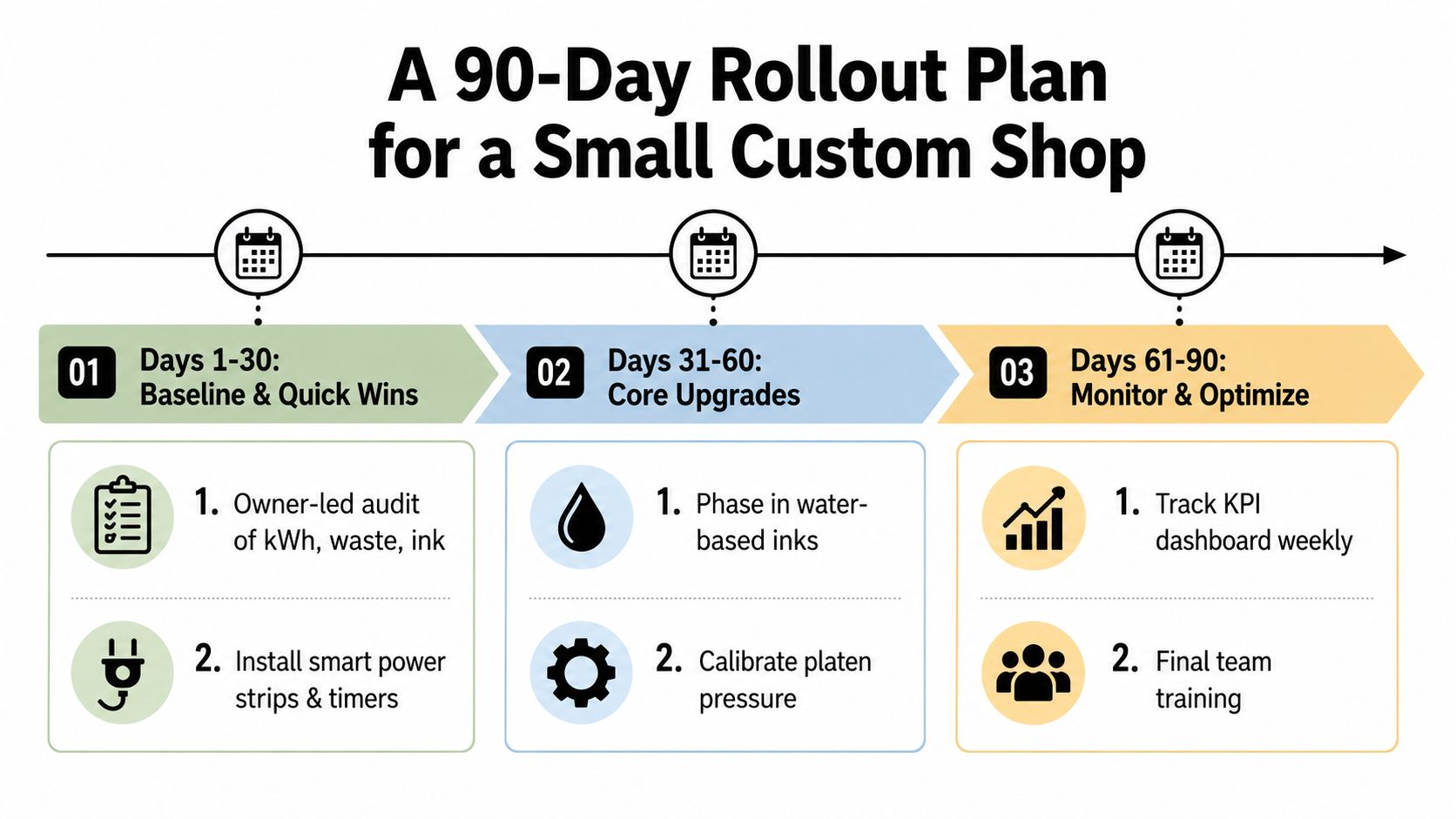
The owner creates a baseline for kWh, waste weight, ink usage, and reprints. The lead operator records machine idle periods and cure settings by garment category. The fulfillment employee separates PET, fabric, packaging, and contaminated waste, while the sales coordinator notes which customers request certified or recycled materials.
Install smart power strips and timer switches where safe and appropriate. Change every routine test print to a 4 × 4 cm swatch. At the day-30 checkpoint, confirm that the baseline exists and that staff can find the logs without asking the owner.
Days 31 through 60
The lead operator trials two water-based inks on the shop's best-selling cotton garment. Keep the garment, artwork, film, powder, cure profile, and wash-test method consistent enough to compare results. Record ink usage, cure settings, handling time, defects, and customer-facing hand feel.
Retrain the team on idle-down behavior, platen pressure checks, and PET offcut sorting. The owner should review the numbers weekly rather than waiting for the end of the trial. At day 60, approve the change only if quality and workflow remain acceptable.
Days 61 through 90
The owner schedules a supplier call to negotiate certified film and substrate pricing. Ask for documentation, minimum order requirements, compatibility information, and disposal guidance. The sales coordinator updates the website with claims supported by actual shop records, while the fulfillment employee maintains the waste log.
Use reduce costs with sustainable practices as a broader prompt for reviewing disposal and material handling, but keep the plan tied to your own measurements. At day 90, confirm whether the upgrade reached breakeven. If it didn't, identify whether the cause was price, waste, energy, or reprints, then adjust one variable instead of abandoning the program.
KPIs, Monitoring, and Your Final Checklist
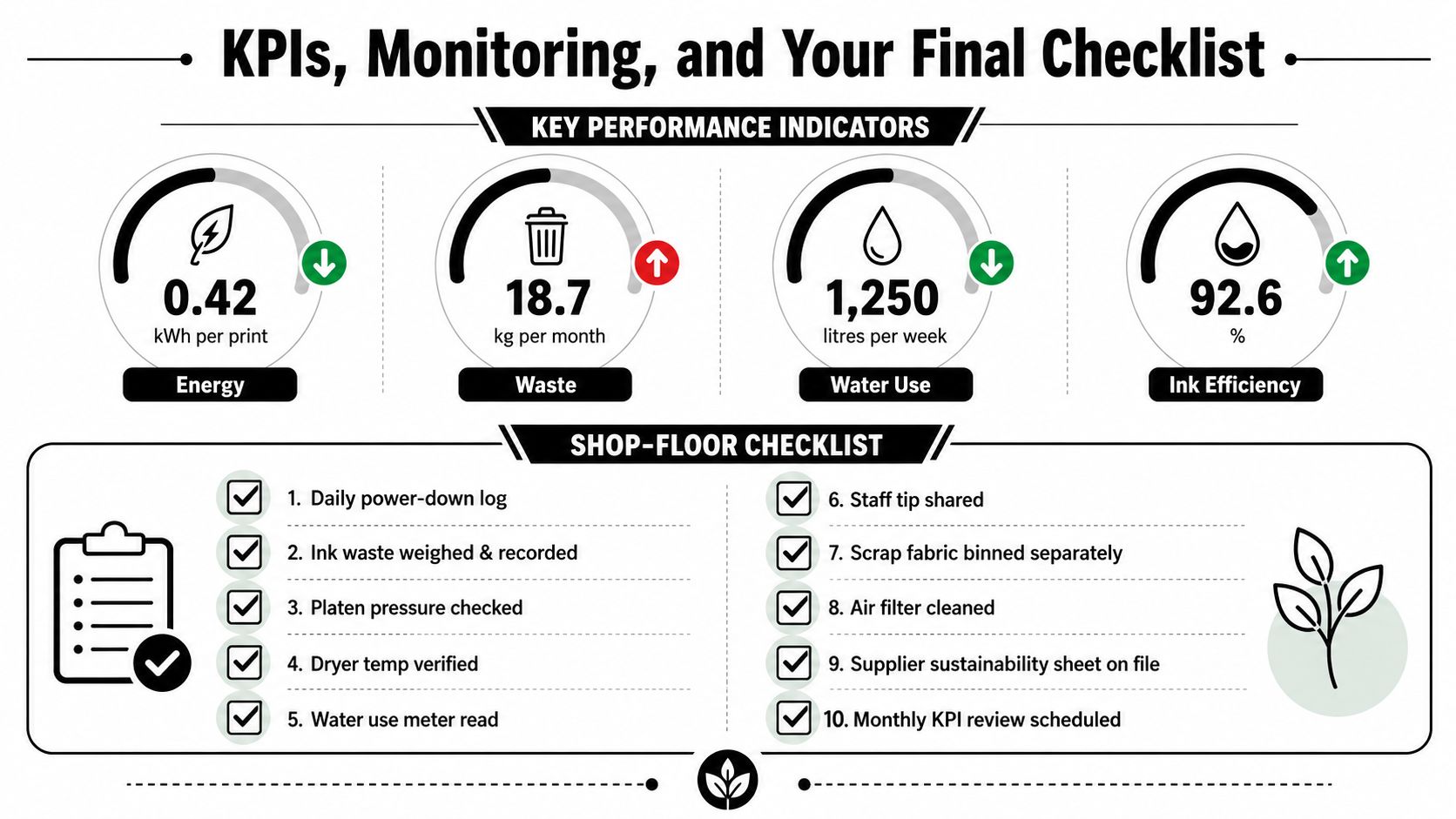
A sustainable shop doesn't need a complicated dashboard. It needs a few measures recorded consistently enough to expose waste. Track energy per print, waste per month, water use per week, ink efficiency, reprint count, and the share of output using the approved material and ink set.
The broader industry still has a measurement problem. One survey found 27% of printing companies had no sustainability policy, while 46% were not developing sustainability metrics, according to the FESPA-cited background in the supplied data. Your advantage is operational simplicity. A small shop can weigh its waste, read a meter, and review production records without building a corporate reporting department.
The shop-floor checklist
- Log power-downs daily.
- Weigh and record ink waste.
- Check platen pressure before production.
- Verify dryer temperature and dwell.
- Read the water meter weekly.
- Share one staff improvement tip each week.
- Bin scrap fabric separately.
- Clean the air filter on schedule.
- Keep supplier sustainability sheets on file.
- Schedule a monthly KPI review.
Use the waste reduction guide to support the process, then adapt the checklist to your equipment and local disposal options. Don't publish a sustainability claim until the supporting record exists.
The right sequence is simple: measure the shop, cut idle energy, reduce test waste, validate the full ink and film system, then pay for certifications where customers or contracts value them. Sustainable printing practices become credible when the operator can explain exactly what changed and show the record.
Cobra DTF offers USA-made DTF transfers using USA-sourced inks and films, giving apparel shops another supplier option when they're reviewing material sourcing and workflow consistency. Visit Cobra DTF to compare transfer options and build your next quarter's sustainability trial around documented production results.