

Waste Reduction: DTF & Apparel Playbook 2026
Most shops start waste reduction in the wrong place. They buy recycling bins, put up a few signs, and feel responsible, but the biggest scrap and cost leaks in a DTF operation usually happen long before anything reaches a bin, in ordering, nesting, queue logic, inventory, and how the floor is set up.
That matters because waste is already a systems problem at global scale. The world generates about 2.1 to 2.3 billion tonnes of municipal solid waste each year, and projections point to 3.8 to 3.9 billion tonnes by 2050 if current trends continue, with waste generation rising by more than 77% by the end of 2050 and the fastest growth expected in Sub-Saharan Africa (+124%) and South Asia (+99%) UN DESA publication. In other words, this isn't a side issue. It's a design and operations problem.
Why Recycling Bins Are Not Your Biggest Win
Recycling bins are visible, which is why they get attention first. But in a DTF shop, the expensive waste is usually hidden in the boring places, like overbuying film, running oversized gang sheets, printing rushed jobs out of sequence, or keeping inventory that ages into dead stock. Those are upstream decisions, and they decide how much material ever becomes scrap.
Waste starts before the first print
The global data makes the same point at industrial scale. Only 62% of municipal solid waste is managed in controlled facilities globally, while 16% remains uncollected and 39% is handled in uncontrolled facilities. In low-income countries, about 90% of waste is discarded in unregulated dumps or burned openly UN DESA publication. That's why source reduction, reuse, and better materials management matter more than cleanup theater.
In a print shop, the translation is simple. If you buy the wrong film width, order too much ink, or schedule jobs in a way that forces repeat cleanouts, you create waste upstream and pay for disposal downstream. Recycling only deals with the leftover material.
The real levers live in ordering and layout
The biggest gains usually come from controlling three things, demand, layout, and inventory. Demand alignment keeps you from speculating on jobs you don't have. Layout discipline cuts offcuts and reruns. Inventory discipline keeps you from tying cash to aging film, powder, inks, and packaging that may never move.
Practical rule: If a piece of material can be prevented from becoming scrap, that's better than sorting it later.
That's also why waste reduction shows up as an economic issue, not just an environmental one. Waste management costs are projected to rise from US$252 billion in 2020 to US$640.3 billion by 2050 if waste growth isn't addressed Eurostat waste statistics. The lesson for a shop owner is direct, every extra bin trip, reprint, and over-order has a cost attached to it.
Running a Real Waste Audit on Your DTF Floor
A DTF shop can't cut waste it has not measured. Most operators can name their biggest complaints from memory, but they have never weighed scrap by stream, which means they are guessing when they decide what to fix first. A real waste audit gives you a baseline, and that baseline turns “we think we improved” into a decision you can defend.
Define the boundary before you count anything
Start with the physical boundary of the audit. Include printers, curing ovens, finishing tables, trimming areas, packaging stations, and the scrap bins nearby. Leave out unrelated office waste, or the numbers blur together and you lose sight of whether the problem sits in production or admin.
Good waste programs start the same way every time, define the boundary, collect baseline data, sort and weigh waste by category, identify root causes, then monitor and retarget continuously. A simple tracking system works if it stays current and gets used every day. The part that fails most often is the one nobody wants to do, keeping the baseline honest when the floor gets busy.
Build the baseline from actual material streams
For DTF, separate the waste streams that matter operationally. That usually means film offcuts, misprinted transfers, ink waste, powder waste, packaging waste, and damaged or rejected completed jobs. If you only record “trash,” you miss the difference between a design problem, a machine problem, and a handling problem.
Use one sheet, one log, or one digital tracker, but keep it consistent. Record the job name, the type of waste, the reason it happened, and the correction needed. For a practical operating rhythm, the waste minimization cycle laid out in the EPA WasteWise guidance, commitment, quantification, process mapping, root-cause analysis, monitoring and targeting, action planning, review, communication, and continual improvement, is a strong fit for a small shop.
Don't measure during an oddball rush week and call it normal. Baseline data only helps if it reflects regular production.
After the first audit, the goal is not perfection. The goal is to pick one or two high-visibility fixes and measure them against the same baseline every month. If you want a practical way to improve throughput while controlling waste, the workflow ideas in this production efficiency guide fit well with a small shop environment.
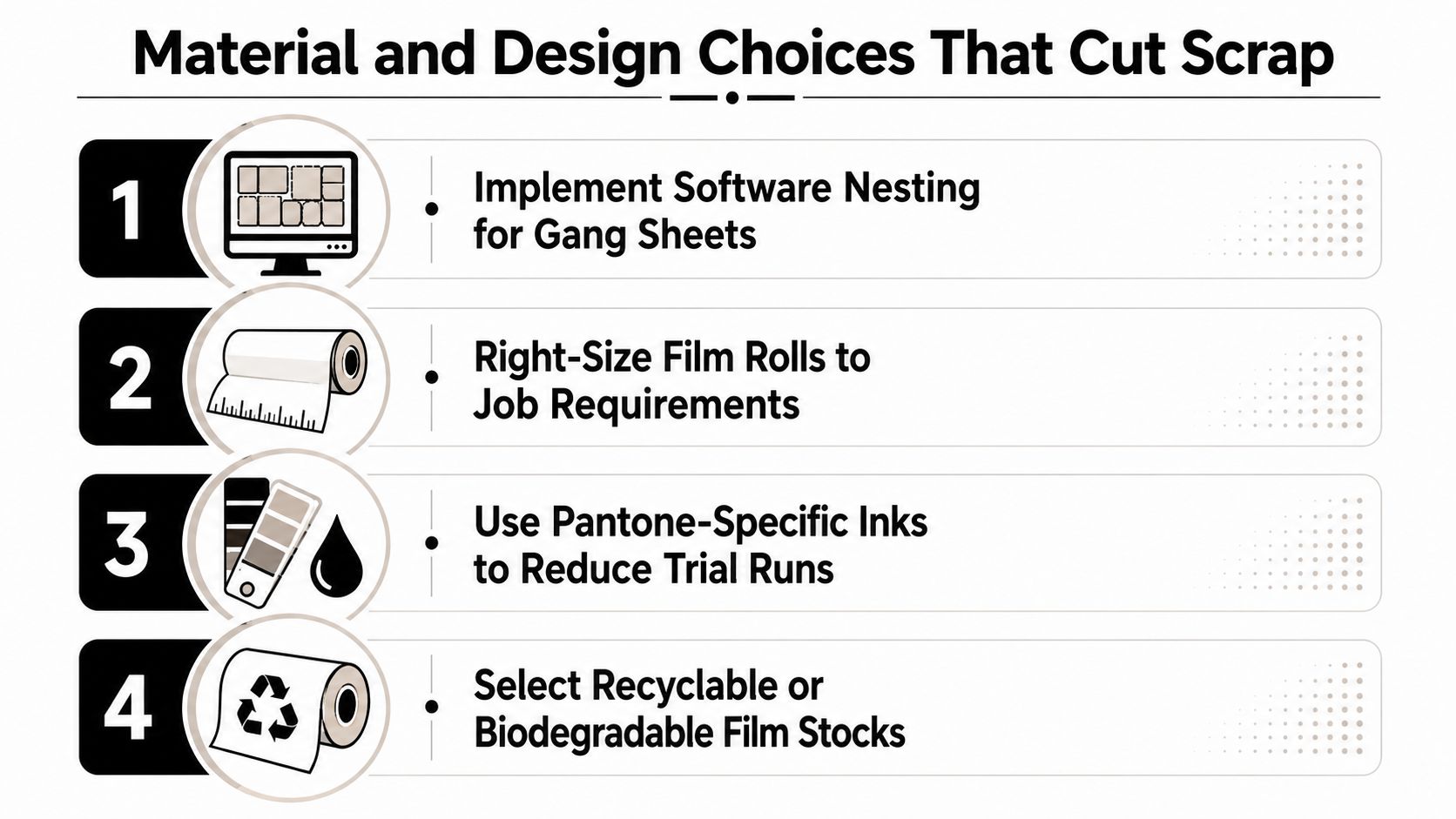
Material and Design Choices That Cut Scrap
Once the audit shows where scrap is coming from, the next move is usually at the design desk, not the dumpster. In DTF work, a lot of waste is baked in before the film ever touches the printer, through poor nesting, oversized margins, repeated proof cycles, or transfer sizes that don't match what the shop sells most often.
Tighten the artwork and film logic
Gang sheet nesting is the obvious win. If artwork is laid out loosely, you're paying for blank film, extra trimming, and more handling on the back end. If your common shirt sizes and chest logos are standardized, set your RIP and artwork templates to those dimensions instead of rebuilding the wheel for every order.
Film width matters too. Buying stock that doesn't align with common job dimensions leaves you with repetitive offcuts. That's not just material loss, it's time lost in trimming and more chances for handling damage. When the same widths keep appearing in your order mix, standardizing around them makes more sense than trying to force every job onto a “universal” setup.
Reduce trial runs and variable quality
Ink coverage is another quiet source of waste. Heavy coverage on low-visibility areas, repeated color correction, and back-and-forth proofing all chew through supplies and time. If the artwork process is sloppy, the printer spends its day correcting upstream mistakes instead of producing finished transfers.
Quality consistency matters here. Shops that work with predictable inks and films spend less time chasing rework from inconsistent output, while shops that swap cheap inputs constantly often pay for that savings in failures. The best rule I've seen on a real floor is simple, standardize the few setups you repeat most, then leave custom work for the edge cases.
Practical rule: Don't optimize every job differently. Optimize the jobs you repeat every week.
The waste conversation gets more useful than generic recycling advice. Savings come from fewer offcuts, fewer misprints, and fewer do-overs. If your shop also wants a broader view of sustainability in production, the sustainable manufacturing practices guide is a useful companion to those operational choices.
Production and Inventory Workflows That Prevent Waste
The floor habits matter as much as the file setup. A clean design can still become scrap if the queue is chaotic, the stock is old, or the press operator is forced to switch materials too often. Waste prevention is mostly about reducing those interruptions before they turn into reprints or rejected transfers.
Queue jobs so the machine spends more time producing
Batch jobs by substrate type when you can. That cuts unnecessary setup changes, reduces purge cycles, and keeps the printer in a more stable rhythm. In DTF, stability is money, because every restart invites calibration drift, dry time inconsistencies, or operator mistakes.
Inventory discipline needs the same treatment. Use FIFO, first in, first out, so the oldest film and consumables get used before newer stock. That sounds basic, but it prevents the common shop problem of buying around the current panic and discovering old inventory later when it's already degraded or obsolete.
Separate prevention from diversion
Internal reporting should distinguish waste prevented from waste diverted. Those are not the same thing. If you re-use a cardboard sleeve, that's helpful. If you redesign packaging so the sleeve never existed, that's a stronger win.
Training matters at the point of use, not in a quarterly meeting. Put scrap bins where the work happens, not across the room, so staff sort material correctly instead of tossing everything into the nearest bin. Same with misprints, catch them before the curing oven when possible, because a transfer that never reaches final cure costs less to fix than one that's already been baked.
A practical way to stay on track is to set short-term targets and review them monthly. That helps keep the first burst of enthusiasm from fading into old habits. If you want another operational reference point for reducing waste without slowing production, the circular packaging workflow notes are worth a look alongside your own SOPs.
Recycling, Reuse, and Supplier Take-Back Options
Even a disciplined shop still ends up with leftovers. Film offcuts, empty ink cartridges, powder containers, and packaging materials all have to go somewhere, and the best answer depends on local infrastructure, supplier programs, and how much handling the team can realistically support.
Use end-of-life options without overrating them
Recycling is useful, but it's still second-best to source reduction. The environmental hierarchy is clear about that, prevention first, then rescue, then recycling. The Environmental Law Institute's roadmap puts waste reduction in that sequence and highlights upstream actions like better distribution, handling, and product management before materials ever become waste ELI food waste roadmap.
That hierarchy matters in DTF too. PET film offcuts may be recyclable in some places, but printed film isn't universally accepted. Ink containers and packaging are easier wins when suppliers offer take-back or reuse pathways. The right question is not “Can I recycle it?” The better question is “What handling effort produces the highest net benefit for this stream?”
Watch for waste shifting
Some substitutions just move the problem. A “green” material that creates more wastewater, more energy use, or more reject rates can be worse overall. The Nature Conservancy's guidance explicitly includes reducing wastewater, going digital, and making green purchases, while also pointing to water-saving habits like fixing leaks and using low-flow fixtures Nature Conservancy waste reduction guide.
That broader view helps with supplier conversations too. If a vendor can take back containers or packaging, ask what happens after pickup. A useful mindset comes from circular-economy work in other industries, where the goal is to transform IT assets into value rather than move them out of sight. The same logic applies here, value recovery beats symbolic disposal.
Tracking Metrics and Selling Your Sustainability Story
Waste reduction only matters commercially if you can prove it and communicate it without sounding like you're making it up. DTF buyers, especially B2B buyers, notice when a shop can explain its process, its material choices, and its consistency without overclaiming. The story has to be backed by metrics, or it turns into greenwash fast.
Build a monthly dashboard that shows both loss and improvement
Track the metrics that connect directly to shop behavior. That usually means scrap rate per roll of film, misprint percentage, ink waste per square foot, prevented waste, diverted waste, and dead stock on hand. Those are the numbers that tell you whether ordering, nesting, calibration, and queue logic are working.
| Core Waste Reduction Metrics for DTF Shops | Definition | Typical Target |
|---|---|---|
| Scrap rate per roll of film | Portion of film lost to offcuts, setup waste, and unusable remnants | Trending downward month to month |
| Misprint percentage | Share of jobs that need reprint or are rejected before completion | Trending downward month to month |
| Ink waste per square foot | Ink lost to purge, correction, and failed output relative to production area | Trending downward month to month |
| Prevented waste | Material not ordered, not printed, or not overproduced because of process changes | Trending upward month to month |
| Diverted waste | Material routed to reuse, recycling, or take-back programs instead of disposal | Trending upward month to month |
A circular mindset helps here. For teams that want a practical framework for recovering value from materials instead of throwing it away, DPP Grid's practical circular guide is a solid reference point for thinking beyond the bin.
Turn the numbers into a customer message
The best sustainability story is grounded in operations. If your shop uses fewer reprints, tighter purchasing, and cleaner workflow controls, say that plainly. If you use USA-sourced inks and films, talk about consistency, reduced rework, and local production, not vague eco language.
You can also connect waste reduction to buyer trust. A brand that sees proof of tighter material control tends to trust your quoting, your turnaround, and your repeatability more. That's especially true when your product pages or proposals explain what was prevented, what was recovered, and what still goes to disposal.
Practical rule: Show cost savings and environmental benefits side by side. Buyers understand both when they're presented in plain language.
Your 90-Day Waste Reduction Rollout
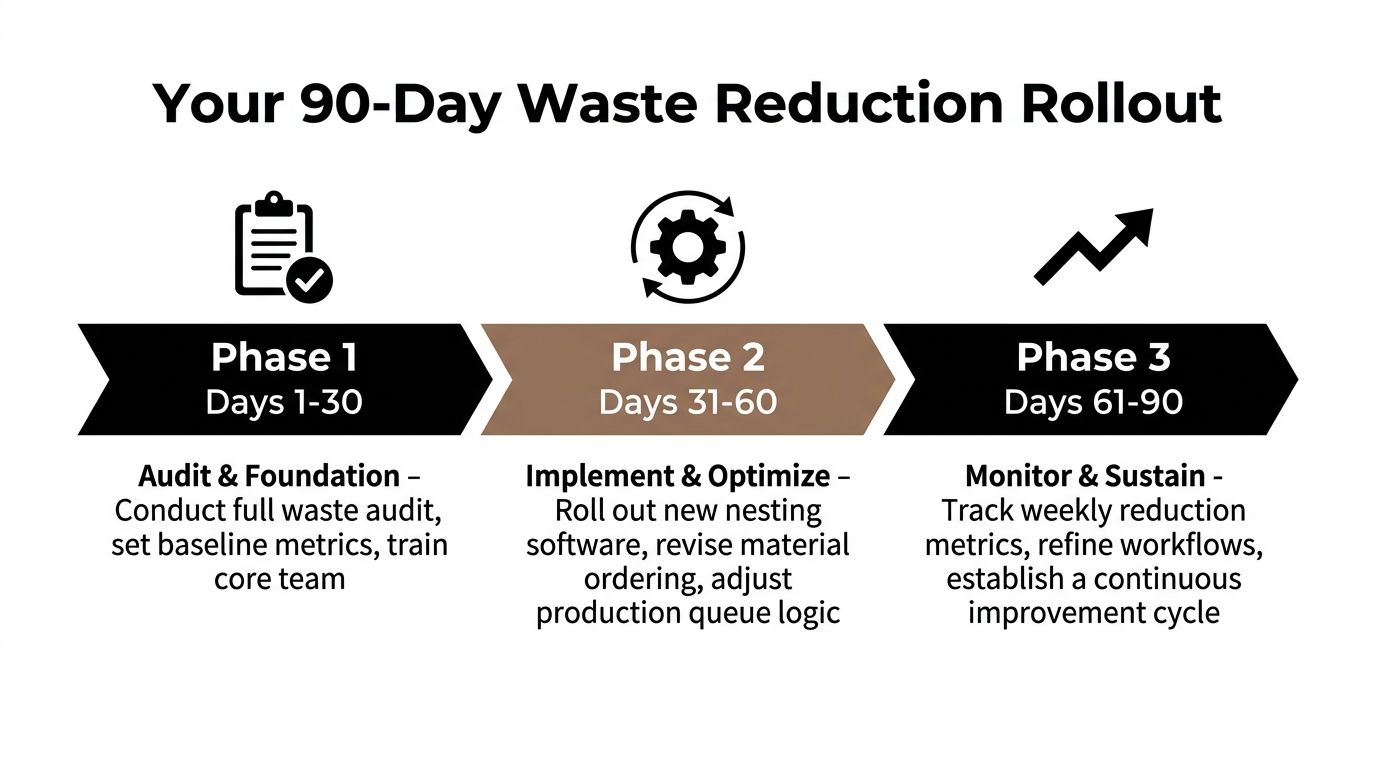
The shops that get traction don't try to fix everything in one week. They start with a baseline, make one or two changes that touch the biggest waste streams, then keep score long enough to know whether the changes held. In practice, the first month is about measurement, the second is about process changes, and the third is about locking them in.
A simple shop-floor arc
In the first 30 days, one operator or manager owns the audit and baseline. They define the waste streams, weigh the scrap, train the core team, and write down the biggest causes. In the next 30 days, the shop changes the obvious upstream issues, nesting, ordering, FIFO, queue sequencing, and proofing discipline.
The final 30 days are for review and correction. That means weekly tracking, supplier conversations, and setting up the recycling or take-back paths that fit the shop's material mix. If you want software support for that kind of operational discipline, optimise waste management processes with tools that help keep the metrics visible and the follow-through consistent.
The fastest way to lose momentum is to celebrate the first clean week and stop measuring.
Common failure modes are predictable. Shops skip the baseline, overfocus on recycling bins, or let staff engagement fade after the first burst of attention. The fix is the same every time, make the work visible, review it monthly, and treat waste reduction like a production habit, not a marketing project.
Cobra DTF helps shops tighten the part of the workflow that matters most, the transfer itself, with USA-made DTF products, quick turnaround, and materials built for consistent output. If you want to cut scrap, reduce rework, and keep your shop moving with less waste, visit Cobra DTF and see how their transfers fit into a cleaner production routine.