

How to Source a USA Made T Shirt for DTF Transfers
The rush order is packed, but the blank shirt invoice is still open on your screen. The imported tee looked cheaper when you bought it. Then the shipment arrived late, replacement blanks needed expensive expedited freight, and a rerun consumed the margin you thought you had protected.
That experience is pushing more print shops to reconsider the USA-made T-shirt. The right question isn't just what the blank costs. It's what you'll pay after freight, duties, delays, rework, inventory exposure, and the value of giving a customer a sourcing story you can defend.
Why USA-Made Blanks Are Suddenly Worth a Second Look
A domestic blank can look expensive beside an imported case. That comparison changes once transit delays, short shipments, emergency replacements, and missed event deadlines enter the job. A three-day domestic shipment may protect more margin than a lower unit price that arrives too late to press.
The 2026 tariff changes have also rewritten the cost calculation. Apparel imports faced a 10% Section 122 surcharge effective February 24, 2026. Effective duties for some imported T-shirts reached roughly 34% for cotton knit and 49.8% for synthetic knit, according to this 2026 tariff overview for the fashion industry. Those rates do not apply identically to every shirt, classification, or country, so confirm the applicable HTS treatment with a customs professional. Older sourcing articles that treat import costs as stable can now produce bad quotes.
Shop-floor rule: Compare the delivered shirt you can test and press on schedule, not the blank price printed on a distributor page.
The category still has broad demand. One 2026 market summary estimates that Americans move about 2.1 billion T-shirts annually, representing just under one-fifth of global sales, with annual growth of roughly 3.8%. The same T-shirt industry summary reports that more than 61% of U.S. T-shirt purchases happen digitally and that social media influences nearly 46% of buying decisions. That buying path raises customer expectations for garment quality, delivery, and origin.
Domestic production remains unusual. Fewer than 4% of garments bought in the U.S. were produced domestically in 2023, as reported in the same market reference. For a printer, limited domestic supply can support branded merchandise, premium collections, rush work, and customers who ask for traceable sourcing.
The T-shirt also carries durable cultural recognition. The U.S. Navy issued it as a standard undershirt in 1913. By the 1950s, it had become visible outerwear and part of pop culture, as documented in this history of the T-shirt. That history supports its practical range. A well-chosen blank can serve uniforms, events, retail runs, and everyday branding, provided its fabric and finish pass the same DTF testing used for any other source.
Reading the Specs That Actually Matter for DTF
A supplier quote should tell you more than color, size, and unit price. DTF transfers bond to the garment surface, so the blank's knit, fiber mix, finish, and dimensional stability all affect the result.
Start with fabric weight. For an everyday tee receiving a transfer, a working range of 5.3 to 6.0 oz per square yard is useful because it gives the shirt enough body to handle pressing without feeling like a heavyweight fashion blank. Ask for both ounces and GSM, then confirm whether the figure describes the finished fabric or an unfinished mill specification.
Fiber content comes next. 100% ringspun cotton is a dependable starting point because it generally presents a receptive print surface and a familiar hand. Cotton-rich blends can work, but ask for the exact polyester content and test the actual colorway. High-polyester surfaces can resist DTF adhesive, especially when the fabric has a slick finish or heat-sensitive dye behavior.
Yarn size, single-jersey construction, and stitch density affect how flat the print area sits. A loosely knit surface can allow transfer edges to bridge over texture. Excessive surface sizing or finishing can also interfere with adhesive contact. Don't approve a blank based on a showroom sample if the production fabric will come from a different lot.
Request shrinkage tolerance and colorfastness information before you quote the customer. A shirt that changes shape after laundering can make a centered graphic look off, while unstable dye can alter the appearance of a bright transfer.
For a practical DTF checklist, compare the fabric and construction questions with this guide to the best shirts for DTF.
DTF-critical blank specs to request
| Spec | Target Range | DTF Failure If Missed |
|---|---|---|
| Fabric weight | 5.3 to 6.0 oz per square yard | Thin body can show transfer stiffness or distort under pressure |
| Fiber content | 100% ringspun cotton or a controlled cotton-rich blend | Excess polyester can reduce adhesive grip or affect color |
| Construction | Single jersey with a stable, even surface | Uneven knit can create incomplete contact and rough edges |
| Finish | Minimal surface sizing and a print-ready face | Over-finishing can block adhesive wet-out |
| Shrinkage | Supplier's documented finished-garment tolerance | Graphic placement can shift after laundering |
| Colorfastness | Documented testing for the production color | Dye migration or fading can change the transfer's appearance |
Send the same artwork, press settings, dwell time, and peel method across every sample. Otherwise, you're testing your process and the blank at the same time.
Domestic vs Imported Blanks Compared
Domestic and imported blanks solve different production problems. An imported shirt may win a commodity bid when the buyer cares almost entirely about unit price and can tolerate a long planning window. A USA-made blank earns its premium when delivery, small-batch flexibility, origin language, or tariff exposure carries more weight.
Domestic suppliers commonly offer shorter trucking lead times, smaller starting orders, and more direct communication. They may also support custom dye work, relabeling, or construction changes that aren't practical with a large overseas production run. Those benefits aren't automatic, so confirm them in writing rather than treating “made here” as a complete service description.
Imported blanks can still fit a planned program. If you have stable demand, enough storage, and a replenishment schedule that absorbs ocean transit, the lower factory price may remain useful. The risk appears when a shop uses that model for unpredictable orders and then carries emergency freight, excess sizes, or discontinued colors.
| Factor | USA-Made Blank | Imported Blank |
|---|---|---|
| Unit price | Often higher at the quote stage | Often lower before freight and duties |
| Lead time | Typically suited to short domestic replenishment | Requires a longer ocean and customs planning window |
| Minimum order quantity | More workable for small and medium runs | Often tied to case packs or larger production commitments |
| Customization | May allow closer access to dye, labeling, and cut-and-sew decisions | Usually requires earlier commitments and larger runs |
| Tariff exposure | Avoids import duties on the domestic blank | Can absorb surcharges and country-specific duties |
| Risk profile | Lower transit exposure, but supplier capacity still matters | Greater exposure to port, customs, freight, and inventory changes |
| Best fit | Rush work, premium merchandise, branded programs | Planned commodity orders with flexible delivery dates |
A customer asking for an usa made t shirt may not accept a domestic print shop finishing an imported blank as an equivalent answer. Be precise about whether the shirt, fabric, transfer, or only the finishing work is domestic.
Vetting a USA-Made Supplier
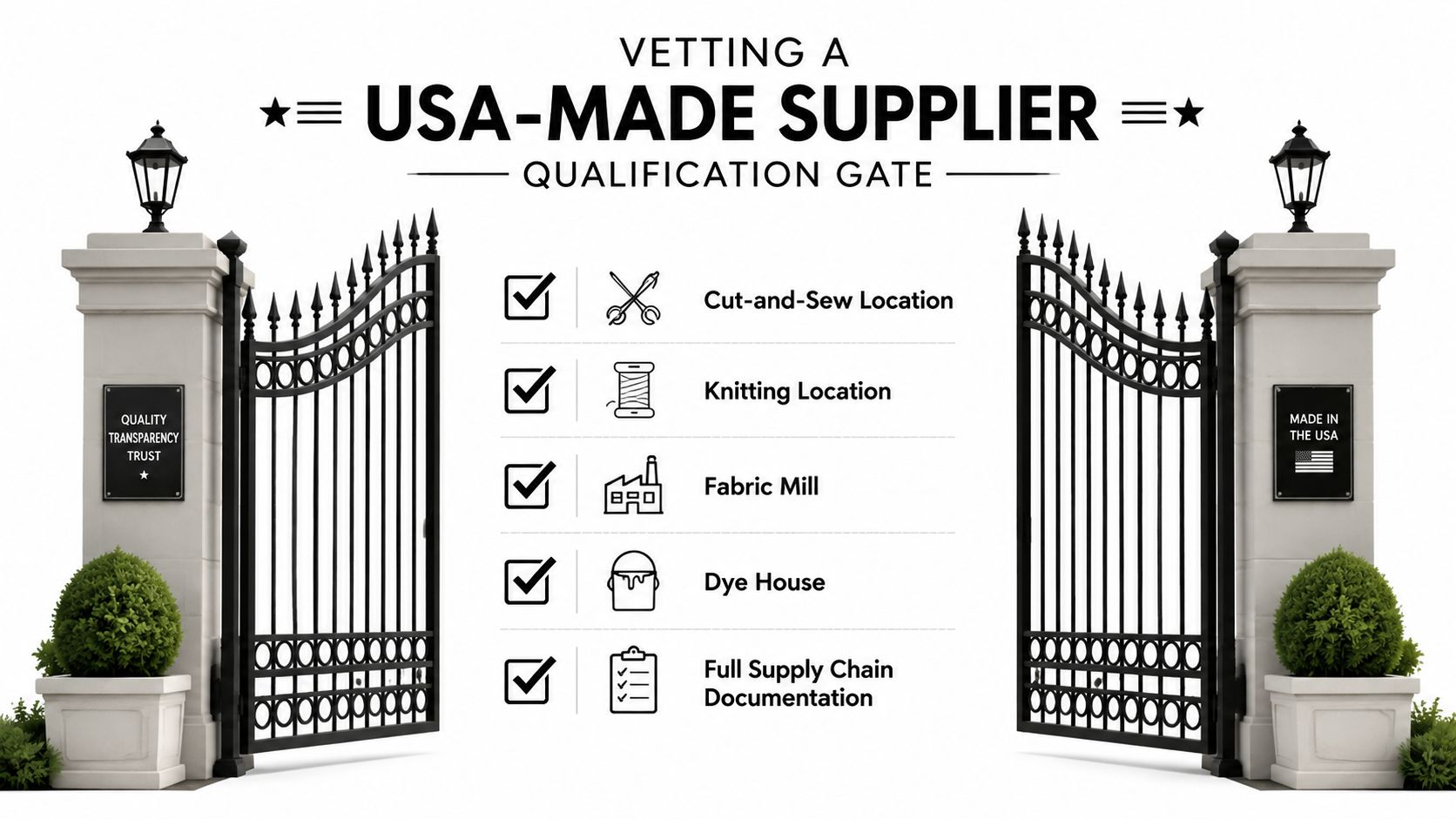
Treat supplier qualification as a gate, not a shopping comparison. Before requesting a quote, write down every origin statement you may use: where the garment is cut and sewn, where the fabric is knitted, which mill made it, where dyeing occurs, and where final assembly takes place.
Ask the supplier to provide documentation for each stage. Useful records can include a cut-and-sew affidavit, an FTC origin affidavit, a bill of materials, and relevant certifications such as Cotton USA or Berry Amendment documentation when applicable. A certification can support a sourcing decision, but it doesn't replace checking the actual product and claim language.
Use a qualification gate
Request a live video tour if an in-person visit isn't practical. Ask the supplier to show the sewing floor, fabric storage, finishing area, and shipping operation. A real manufacturer should be able to explain its production path without routing every technical answer through an unrelated salesperson.
Call references that operate at your order volume. Ask about consistency between lots, late shipments, communication when fabric changes, and how the supplier handles defects. A reference from a major apparel brand may tell you little about how a small print shop gets treated.
You can also check business registrations and public company records. Search Secretary of State filings and business directories, and investigate unresolved disputes before sending a deposit. The supplier doesn't need a spotless history, but it should answer reasonable questions directly.
Red flags include refusal to provide origin records, vague claims that only mention “American finishing,” lead times that resemble overseas fulfillment, and samples that don't match production blanks. For DTF, request a test print on the actual production-floor garment, using your transfer specification rather than a showroom piece.
This guide to Made-in-USA suppliers can help organize the supplier questions before you start collecting quotes.
Placing Your First Order
Treat the first order as a controlled pilot, not a commitment based on one attractive swatch. The objective is to verify the blank, paperwork, DTF press behavior, packing, and delivery plan as one working system. That combined test matters more than a supplier's catalog description.
Build a repeatable pilot
- Request three to five blanks. Order the sizes and colors you expect to sell. Light and dark garments can respond differently to heat, pressure, and transfer coverage. Keep one shirt unpressed as a control.
- Press one standard DTF transfer on every sample. Hold the artwork, powder system, press temperature, pressure, dwell time, peel method, and post-press routine constant. Write the settings beside each sample so a failed result can be traced to the garment or the process.
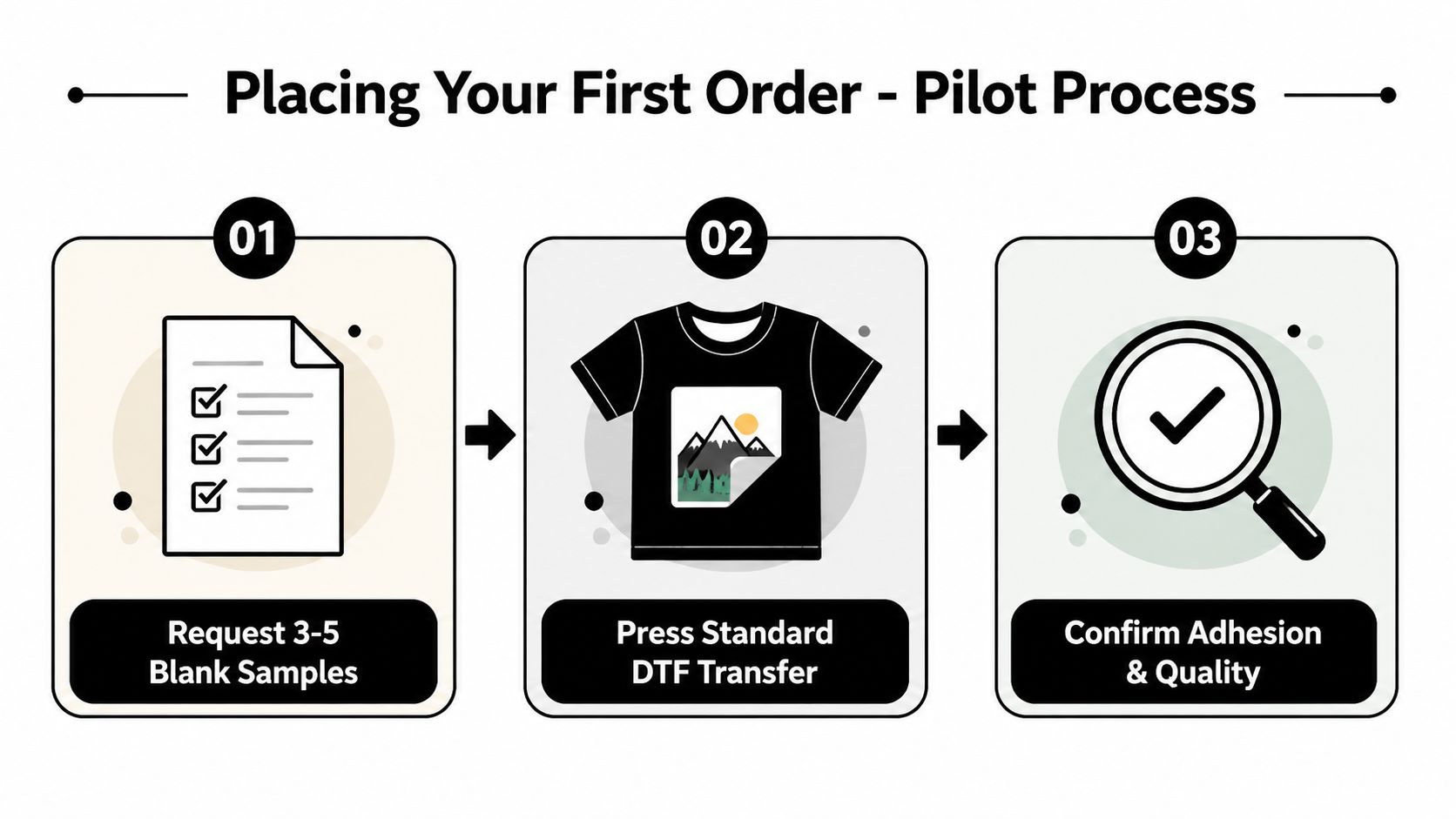
- Inspect adhesion and appearance. Check for edge lift, incomplete bonding, color change, shine, scorching, and an unusually heavy film feel. Stretch the print area gently, then photograph it before washing. Record whether the fabric texture shows through the transfer as expected.
- Confirm the commercial terms. Request one written quote covering minimum order, price breaks, setup charges, relabeling fees, packing charges, and freight method. A phone promise has no place in a margin model unless the supplier puts it in writing.
- Lock the delivery plan. Put the required arrival date on the purchase order. Ask for written milestones covering cutting, sewing, finishing, and shipping. Add enough buffer to protect the customer commitment instead of assuming every production day will run perfectly.
- Specify packing. State the poly-bag quantity, size ratio, carton labels, SKU format, and whether mixed sizes may share a carton. Clear packing instructions reduce counting and fulfillment work after the shirts reach your shop.
- Clarify payment terms. A domestic cut-and-sew supplier may require a deposit, while a distributor may offer account terms. Confirm the deposit amount, balance trigger, cancellation rules, and treatment of defective goods before approval.
- Save one sourcing file. Keep the quote, approved sample photos, transfer settings, origin records, packing instructions, and final purchase order together. The file makes reordering a controlled process rather than a memory test.
The 2026 tariff environment changes the cost comparison used in older sourcing articles. Recalculate imported blanks using the duties and surcharges that apply to the specific garment classification, shipment, and origin. Do not treat a headline rate as universal. A domestic quote can look higher while producing a lower job cost if it arrives in time for the scheduled press run.
Build the landed-cost worksheet around the blank, freight, duty, brokerage, warehousing, inspection, rework, and inventory carrying cost. Assign a practical cost to delay as well. For a shop with a fixed production slot, a late low-cost blank can cost more than a higher-priced domestic blank that arrives when promised.
The U.S. market supports several sourcing models, but domestic production remains a smaller part of overall apparel purchasing. That leaves room for decorators to sell domestic origin as a deliberate product feature rather than treating it as the default choice. The claim only works commercially when the garment quality and delivery performance support the price.
A domestic blank generally fits a short lead time, uncertain demand, or an order that requires a documented origin story. An imported blank can still suit a stable, price-led program with enough planning time and inventory discipline. Test the choice against the full order economics, DTF results, and reorder risk, not the first number in the spreadsheet.
For further research, use this wholesale blank apparel supplier guide to organize supplier questions and compare quotes. Verify every price, production detail, and origin statement directly with the supplier before sending a deposit.
Staying Compliant With Made-in-USA Labeling
“Made in USA” isn't a general feeling about a shirt. The FTC standard is “all or virtually all” domestic content, and an unqualified claim requires the product to meet that standard. The FTC enforcement policy for U.S. origin claims explains the standard and why a business needs to review the whole origin story rather than focusing only on final sewing.
Textile labeling adds another layer. For textile and wool products, a Made in USA label can be used when the final product is manufactured in the United States from fabric manufactured in the United States, even if earlier inputs such as fiber or yarn were imported. A shirt made in the U.S. from imported fabric may need qualified wording instead.
That distinction matters for DTF shops because pressing a transfer onto a blank doesn't automatically change the blank's origin. The transfer, shirt, label, packaging, and marketing copy should each be described accurately.
Separate claim types before printing labels
| Claim Type | FTC Standard | When to Use | Required Documentation |
|---|---|---|---|
| Made in USA | All or virtually all domestic content, with the applicable textile and apparel requirements satisfied | The documented garment path supports an unqualified claim | Fabric origin records, supplier affidavits, cut-and-sew records, and component documentation |
| Made in USA of U.S. and imported parts | Domestic production with clearly identified imported components | The product has meaningful domestic production but doesn't support an unqualified claim | A bill of materials and records identifying each imported component |
| Assembled in USA | Final assembly occurs in the United States, without implying all components are domestic | Assembly is the accurate description of the production path | Assembly location records and component origin documentation |
| Printed in USA on imported blank | Domestic decoration only | The shirt itself is imported and the domestic activity is printing | Blank invoice, country-of-origin label, and accurate decoration records |
The FTC also requires most textile products to disclose fiber content, country of origin, and the identity of the responsible company, as described in the FTC clothing and textile guidance. That means a compliant tee label has three core data fields, not just an origin phrase.
Keep the following in the job file:
- Fabric evidence: Mill information, fabric invoices, and origin affidavits.
- Production evidence: Cut-and-sew records and final assembly details.
- Component evidence: Thread, labels, trims, and other inputs that may affect the claim.
- Marketing evidence: The exact website, invoice, hangtag, and social language used for the product.
Don't let a supplier use “American-made” as a substitute for a documented claim. Legal labeling and a fully domestic supply chain aren't identical. A shirt may qualify for a legal Made in USA claim while still containing foreign dye, thread, or neck labels, which is why this apparel origin explanation distinguishes the FTC standard from stronger procurement rules such as the Berry Amendment.
Run a five-sample durability gate
Before approving a blank, use five samples from the intended production lot. You'll need a household washer, tumble dryer, heat press, ruler, and stretch gauge.
Press identical transfers, photograph each shirt, and record the blank lot, color, size, and press settings. Wash the samples with the same water temperature, detergent type, and cycle selection your customer is likely to use. Run a minimum of five cycles, with 10 cycles recommended, then inspect after each cycle for cracking, peeling, edge lifting, color change, and visible distortion.
Test stretch recovery at 25% elongation. Grade each shirt as pass, marginal, or fail, and note the exact failure mode rather than writing “bad adhesion.” A blank that only passes when you press unusually slowly or apply excessive pressure may not be suitable for repeat production.
Approval rule: If two of the five samples fail, remove that blank from the approved list regardless of its price.
That rule protects you from accepting a low-cost shirt that creates customer service work later. Send the photos and notes to the supplier, ask for a written response, and retest any revised fabric or finish as a new material.
Your Sourcing Playbook Summary
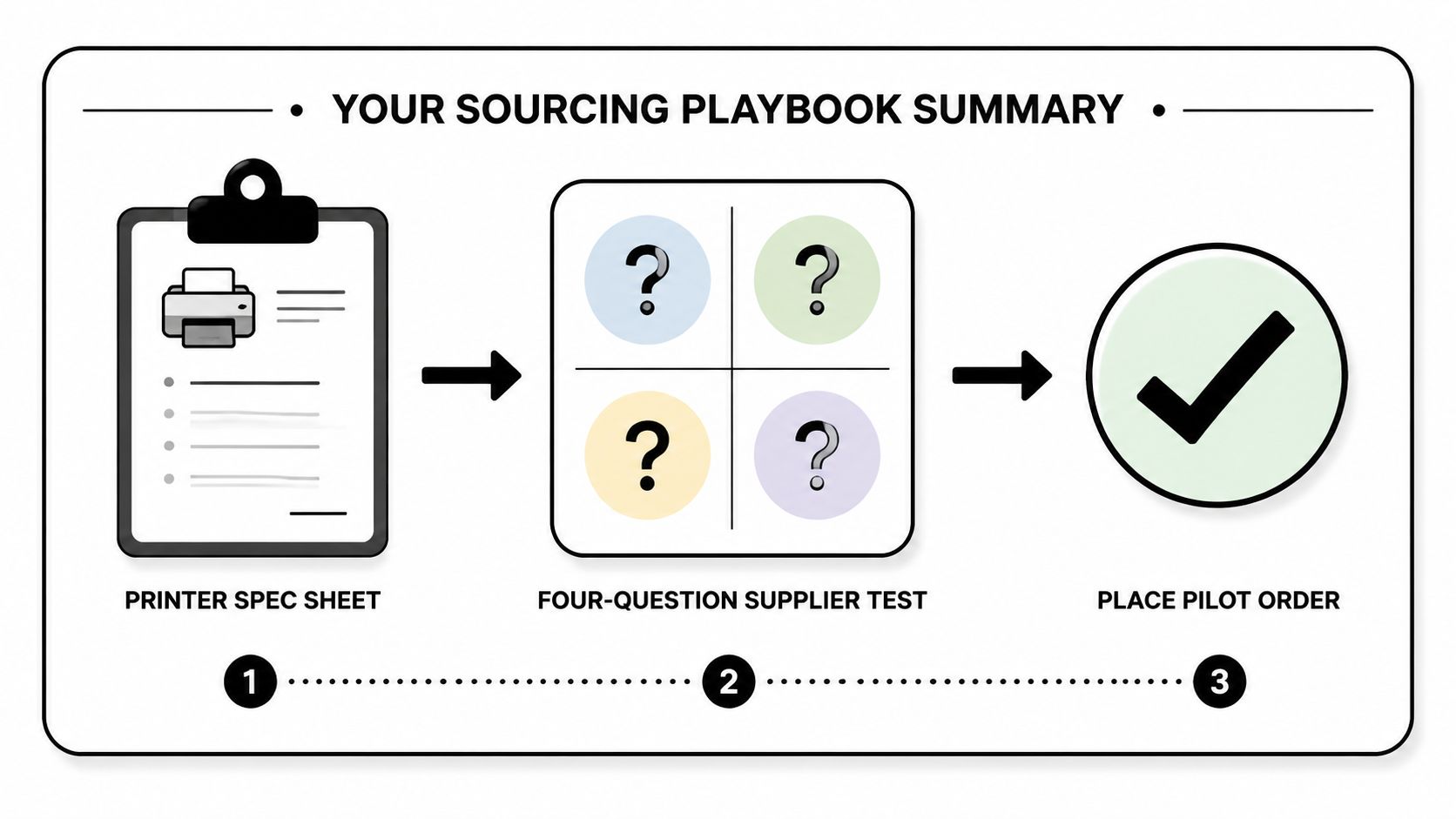
A profitable sourcing routine fits on one page and lives near the cutting table. Start with a printer spec sheet that records weight, GSM, fiber content, construction, finish, shrinkage information, colorfastness, available sizes, and the supplier's origin documentation.
Then ask four qualification questions:
- Can the supplier document the fabric and final assembly locations?
- Can the blank pass your standard DTF press and wash test?
- Can the supplier meet the required delivery window in writing?
- Can the landed cost support the customer's price after freight, duty, rework, and delay risk?
Order samples before approving the vendor. Press the same transfer on each sample, run the wash and stretch gate, photograph failures, and keep the approved sample with the sourcing file. Place the first production order only after the supplier confirms the specification, quantity, packing, payment terms, and delivery milestones.
Choose domestic when a lead time under two weeks matters, when the garment will carry an origin claim, when the order is difficult to forecast, or when import duties make the landed-cost difference narrow. Choose imported when price is the deciding factor, demand is predictable, storage is available, and the delivery window can absorb international transit.
Score each supplier on quality, on-time delivery, communication, and price stability. Re-test approved blanks quarterly and whenever the mill changes fabric, dye, finish, label, or production location. A supplier that performs well once can still change a component later.
The shop that stays profitable usually isn't the one that finds a single perfect blank. It's the one that reviews the blank, supplier, tariff exposure, transfer behavior, and customer requirements as a recurring sourcing process.
Cobra DTF supplies USA-made DTF transfers that can be used with cotton, polyester, and blends, giving your shop a domestic transfer option to test alongside an American-made blank. Review the available transfer options and production details at Cobra DTF, then run your own press, wash, and origin-documentation checks before approving a full shirt program.