

Personalized Father's Day Shirts: Design and Fit Guide
U.S. consumers were projected to spend $24 billion on Father's Day in 2025, according to the National Retail Federation and Prosper Insights & Analytics, as reported by the Footwear Distributors and Retailers of America. That's a major gifting occasion, but a big budget doesn't make a shirt a good gift. The recipient still has to like the message, feel comfortable in the garment, and want to wear it outside the family photo.
The best personalized Father's Day shirts start with the person, not the artwork. Choose a style he'd normally wear, make the personal detail easy to read, and check the finished shirt before committing to a family batch.
Personalization Styles Compared at a Glance
Choose the style by his public personality, not by which design gets the biggest laugh on your phone. Father's Day falls on the third Sunday in June, as the U.S. House of Representatives' historical account explains, so you can plan the gift around a predictable annual occasion.
Personalization styles and when each one works
| Style | Best for | Sample line | Text length |
|---|---|---|---|
| Name and role | Dads who wear shirts every day | Dave, the Grill Boss | Short name and role |
| Inside joke | Dads with a known family story | Ask Me About the Boat | A short sentence |
| Photo-based design | Dads who love a shared memory | Kids' faces on a vintage trip map | An image plus a short caption |
| Date and place | Milestone or trip gifts | Lake Tahoe, Summer Together | Place plus a brief date or caption |
| Group or family set | Multigeneration photo days | Same graphic, role on the back | A role per shirt |
Treat these text lengths as layout targets, not guaranteed readability. Letter size, contrast, and the available chest area matter more than word count alone.
A dad who lives in plain work shirts may prefer a discreet name and role. A regular barbecue host might enjoy a larger picture or family joke. If you're still deciding between a shirt and another personal keepsake, Get Spliced lets you browse dad gift ideas for 2026 for comparison.
If the joke needs an explanation, choose a name, role, or meaningful date instead.
Pick a main style before adding extra details. A shirt doesn't need to carry the whole family story.
Wording and Design Ideas That Get Worn
Start with something recognizably his: his name, the children's names, a hobby, a hometown, or the role he enjoys playing. Grill Boss, Fishing Captain, and a family nickname give you a clear message without requiring a crowded illustration. A milestone year can work too, provided the buyer confirms what it represents.
Specificity matters more than novelty for its own sake. A 2025 analysis from Northwestern University's Spiegel Research Center reported that 46.2% of Father's Day shoppers prioritized gifts that were unique or different. A familiar phrase from a camping trip can feel more personal than an elaborate generic dad slogan.
Make the wording readable
Give the main message the strongest visual position. Put supporting names or a date beneath it, rather than making every line equally large. Use a plain lettering style for small details, even if the headline uses decorative type.
For humor inspiration, ROCKS Whiskey Chilling Stones' collection of hilarious dad quotes to engrave can help you find a direction. Treat engraving wording as a starting point, not a ready-made chest layout. Something that works on a small object may need shortening for a shirt.
Keep font choices restrained and leave clear space around the artwork. Don't let decorative flourishes run into the collar, sleeve seam, or pocket. Print the proof at its intended size and stand back from it; a screen preview hides lettering that's too small.
Prepare photos and production files
For photos, choose a tight crop with clear faces and a simple background. A busy holiday snapshot often works better after removing background clutter. On a dark garment, consider a simplified line-art treatment if the original image relies on subtle shadows.
A physical test print tells you more than a mockup about facial detail and contrast. Don't approve a tiny screenshot as the production file.
For a shop combining approved family designs, DTF Transfers Upload Your Gang Sheet accepts prearranged, print-ready gang sheets. Finish the individual proofs before arranging them together.
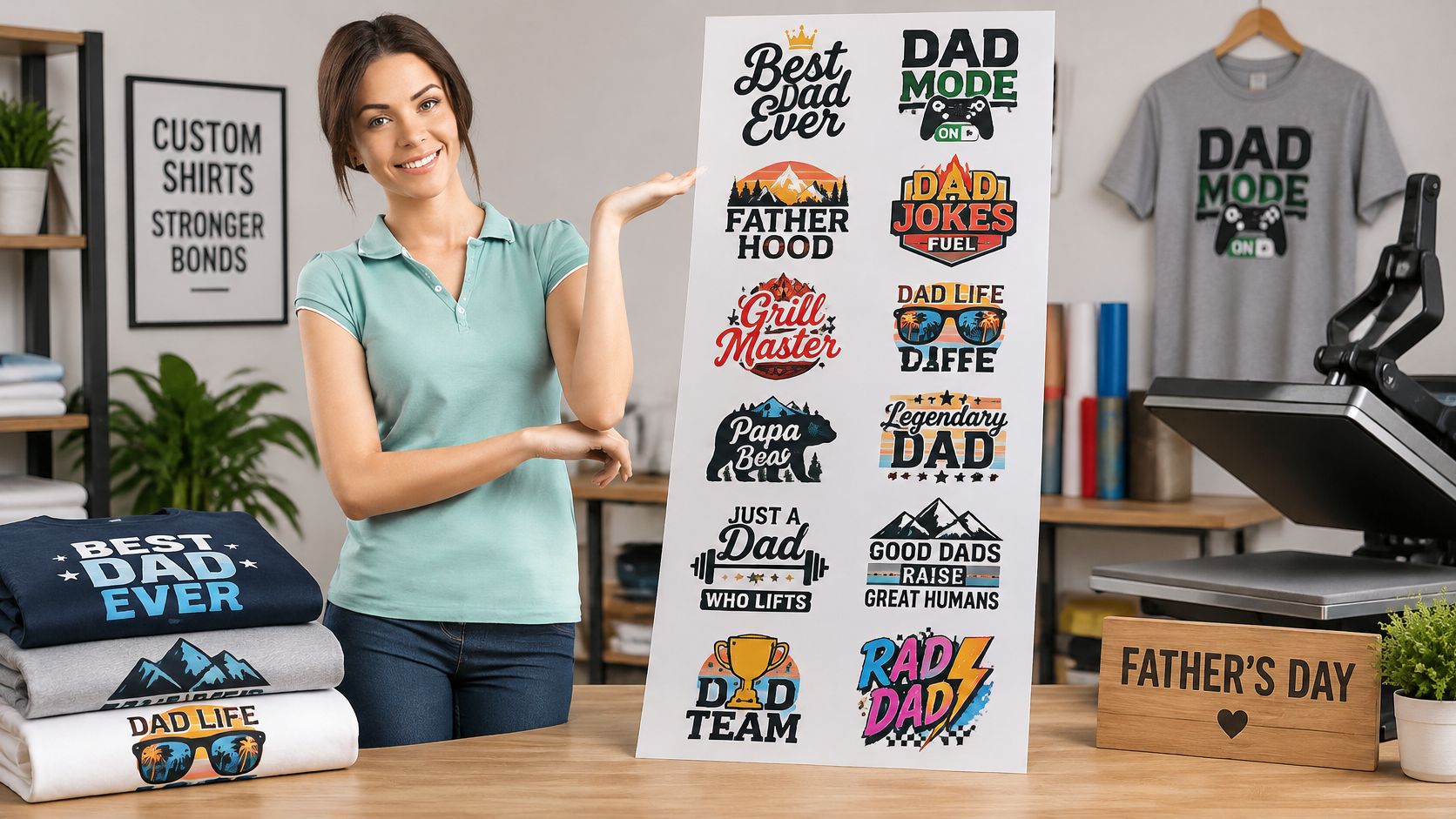
Before approving the artwork:
- Check every character: Compare names and dates against the buyer's written instructions, not memory.
- Confirm relationship wording: Dad, Stepdad, Papa, and Grandpa aren't interchangeable.
- Get a cold read: Ask someone outside the family to read the message without an explanation.
Coordinated Shirts for Shared Days Out
A Father's Day fishing trip with Dad, Grandpa, and the adult children needs shirts that read as one group in the photo and still sit well on each body. A shared fish graphic on the front gives the crew a common look. Individual names on the back keep each shirt personal, and the front stays free of a full roster.
Chain Store Age reports that 70% of shoppers believe fathers prefer experiences and quality time over traditional gifts. Plan the shirt design after you pick the fishing spot, so the back print can name the lake or dock.

Shared marks and personal marks
Pick names or roles. Names suit a fishing crew. Dad, Son, Uncle, and Grandpa may suit a reunion. If you use both, give each line a job: a role above a first name, with clear space between them.
Keep one color family and allow different cuts. Navy tees and navy polos can look coordinated across different builds. If polos suit the outing better, 2ndShotMVP's guide to caring for matching family polos is a useful companion when planning garment care.
Put a shared location or trip detail on the back. A QR code to a private photo album is another option. I would print a sample, wear the shirt, and scan it before approving the file.
Lay the shirts side by side on a table. If the group reads as one team, the design works.
Golf, a backyard barbecue, or a sporting event can use the same split. Ask whether he would wear the shirt on an ordinary Saturday, and whether the wording still looks right when everyone stands together.
Matching Size and Fit to the Recipient
Measure a favorite shirt laid flat before choosing a size. Smooth it without stretching, measure across the chest beneath the armholes, then measure from the shoulder near the collar to the hem. Compare those measurements with the exact blank's garment chart.
Don't compare flat chest width directly with a body circumference. A body chart describes the person; a garment chart describes the finished shirt, including its intended room. Check which chart the seller provides before selecting a label.
Sizing deserves this attention. The custom-apparel industry summary from Rawshot reports that 83% of shoppers identify sizing as the biggest reason they avoid buying clothing online. For a personalized gift, guessing also risks wasting the decoration work.
Fit types and how to choose the size
| Fit | How it sits | Best for | How to choose size |
|---|---|---|---|
| Standard | Closer to chest and shoulders | Recipients who prefer a conventional fit | Compare a favorite shirt laid flat |
| Relaxed | Roomier chest and sleeves | Dads who like loose casual wear | Allow extra room only if the reference shirt feels snug |
| Heavyweight | Thicker fabric, often a structured drape | Workwear and substantial-shirt buyers | Check fabric weight and garment dimensions |
| Oversized | Deliberately generous silhouette | Recipients who already wear oversized clothing | Check shoulder position, chest, and body length |
Heavyweight describes fabric, not a guaranteed fit. A heavyweight shirt can have a standard or oversized cut. Likewise, a tall recipient doesn't automatically need an oversized shirt; he may need extra length without extra width.
Handle awkward sizing cases
If he falls between sizes, favor extra chest room when he layers. Choose the smaller option only when its actual dimensions still match a close-fitting shirt he likes. Cotton can shrink after washing, so check the blank's shrinkage guidance rather than adding an arbitrary size.
For broad shoulders, compare shoulder width and sleeve openings as well as chest width. Women choosing unisex shirts should check body length and hip clearance rather than assuming their usual label will translate.
Families mixing brands should collect measurements for each garment. Our T-shirt fit guide can help distinguish fit choices before ordering. Send the favorite-shirt measurements with the order, or explicitly approve the garment-specific chart before production.
Transfer Methods Compared for Shirts
Choose the decoration method using fabric, batch size, and detail, in that order. Read the blank's composition label first. Then decide whether you're making a personal gift or a repeatable group order, and whether the artwork uses solid lettering, fine detail, or a photograph.
Fabric isn't a minor purchasing detail. Textile research published in the Journal of Engineered Fibers and Fabrics has evaluated transfer printing on cotton/polyester blends under laundering conditions. The practical lesson is to assess the decorated fabric as a system, not judge durability from an attractive fresh print.
Transfer methods by fabric, batch size, and detail
| Method | Best fabric | Small-batch fit | Detail and color |
|---|---|---|---|
| DTF, direct-to-film | Cotton, polyester, and compatible blends | Good for individual gifts and small batches | Full color and fine detail |
| Heat transfer vinyl | Cotton and compatible blends with flat print areas | Good for names and single words | Solid colors with cut edges |
| Screen printing | Cotton, including light and dark shirts | Setup is harder to justify for individual gifts | Sharp, repeatable prints at volume |
| Sublimation | Light-colored polyester | Good for individual polyester shirts | Full color without an opaque white base |
Match the process to the artwork
DTF suits photo-based designs and multicolor wording without requiring separate cut pieces. Large solid areas can feel more noticeable on the garment, so don't fill the entire chest merely because the file allows it.
Heat transfer vinyl works well for a bold name or role. Intricate lettering adds cutting and weeding work, and layered colors need careful alignment. Screen printing makes more sense when the same design repeats across a larger run; changing every name complicates that advantage.
Sublimation suits light polyester because it doesn't provide the opaque backing needed to reproduce the same image on dark fabric. Our T-shirt printing techniques guide offers more detail on these process differences.
Buying rule: For an individual gift, minimize setup. For a group, prioritize repeatable color and placement across the chosen blanks.
Request a sample on the exact garment before committing the order. Check the surface feel, color, and adhesion together, not as separate promises.
How to Press and Test a Personalized Shirt
A transfer that looks good when peeled hasn't yet proved it will survive laundering. Heat, pressure, and time must work together on the actual garment. We recommend testing settings on a piece first to find the right temperature and pressure for that fabric.
The process overview below is useful, but the transfer's specified peel condition takes precedence. Don't automatically cool a transfer that requires a hot peel.
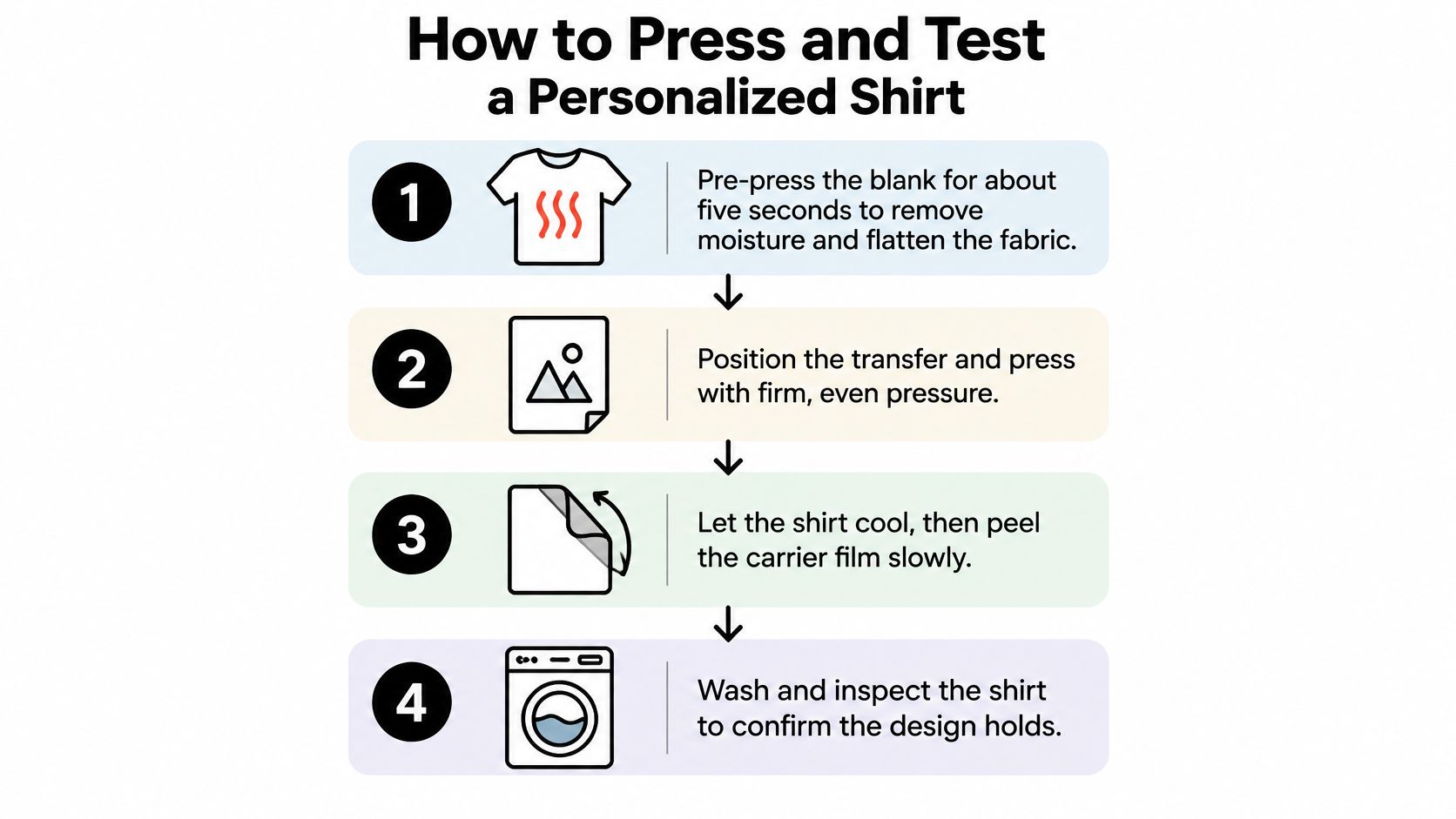
Prepare and press consistently
- Pre-press the blank. Use a brief pre-press appropriate to the fabric to remove moisture and flatten the print area. Check for scorching, shine, or other heat sensitivity before placing the transfer.
- Position the artwork. Lay the garment square on the platen and center the design against the shirt body, not a twisted collar. Keep seams, pockets, and bulky hems from interfering with even contact.
- Set the press for the combination. Use the transfer supplier's temperature, pressure, and dwell instructions within the blank's heat tolerance. If you suspect uneven heating, use our heat press test strips guide to check the press before troubleshooting the artwork.
- Complete the full dwell. Don't lift early because the surface appears bonded. Keep the garment still and the pressure consistent throughout the application.
- Peel as specified. Follow the required hot, warm, or cold peel procedure. Apply a finishing press with the specified protective sheet only when the transfer instructions call for it.
- Record the settings. Log the blank, composition, transfer, temperature, dwell, pressure, and peel procedure. Keep the successful test garment with the job details so the operator has a physical reference.
- Wash and inspect the sample. Run a test of at least five to six wash cycles before approving a batch; the Printing Industries Association's textile washfastness guidance identifies failure within that interval as a common sign of insufficient heat during curing or pressing. Inspect edges, fine lettering, and saturated areas after laundering.
Judge the result, not just the settings
A successful sample should have no lifting edges or cracked characters, with color that remains consistent with the approved test print. Look closely at children's names and small icons. A large central graphic can appear sound while individual letters begin to detach.
If the sample fails, stop production and isolate the cause before changing several settings together. Check the press, garment compatibility, and application instructions, then test again. Don't treat repeated pressing of a damaged sample as proof that the original process works.
Confirm Your Plan Before You Order
A shirt bought as a family gift needs a different quantity than a batch you produce for sale. Before you pay, lock three things: who owns the file, how many garments, and which proof stays with the order. Count every person who will wear a shirt in the group photo, at the size already chosen for that body.
Purchase use. Purchases are intended for personal use or for application onto apparel, garments, or other merchandise the buyer produces for sale. One decorated shirt kept in the family is personal use. A run you apply and sell is merchandise you produce for sale, so the quantity should match that plan.
Order checklist
- File ownership: Name who owns the artwork file and keep that file with the order.
- Quantity: Write the count for the family gift or the resale batch before print dimensions are final.
- Proof saved with the order: Save the accepted proof with the order so names and placement are not left open.
Print-ready, approved orders placed before 1 PM CT ship the same day. That clock starts only once Cobra DTF holds the approved file. An unresolved proof is not ready for dispatch.
Cobra DTF sells DTF transfers for fabric shirts. Visit Cobra DTF when the file, quantity, and proof are ready to send.