

Your Ultimate Guide to Choosing an Industrial Heat Press
If you're in the custom apparel game, you know that a heat press is the heart of your operation. But there's a world of difference between a starter machine and a true industrial heat press. Think of it as the heavy-duty workhorse built for the grind of high-volume, commercial-grade heat transfer jobs. It’s what separates a hobby from a serious, growing business.
Unlike consumer-grade models that can waver in performance, these machines are engineered to deliver relentlessly consistent temperature and pressure over thousands upon thousands of cycles. This is how you get professional, durable results that keep customers coming back.
Why Your Business Needs an Industrial Heat Press
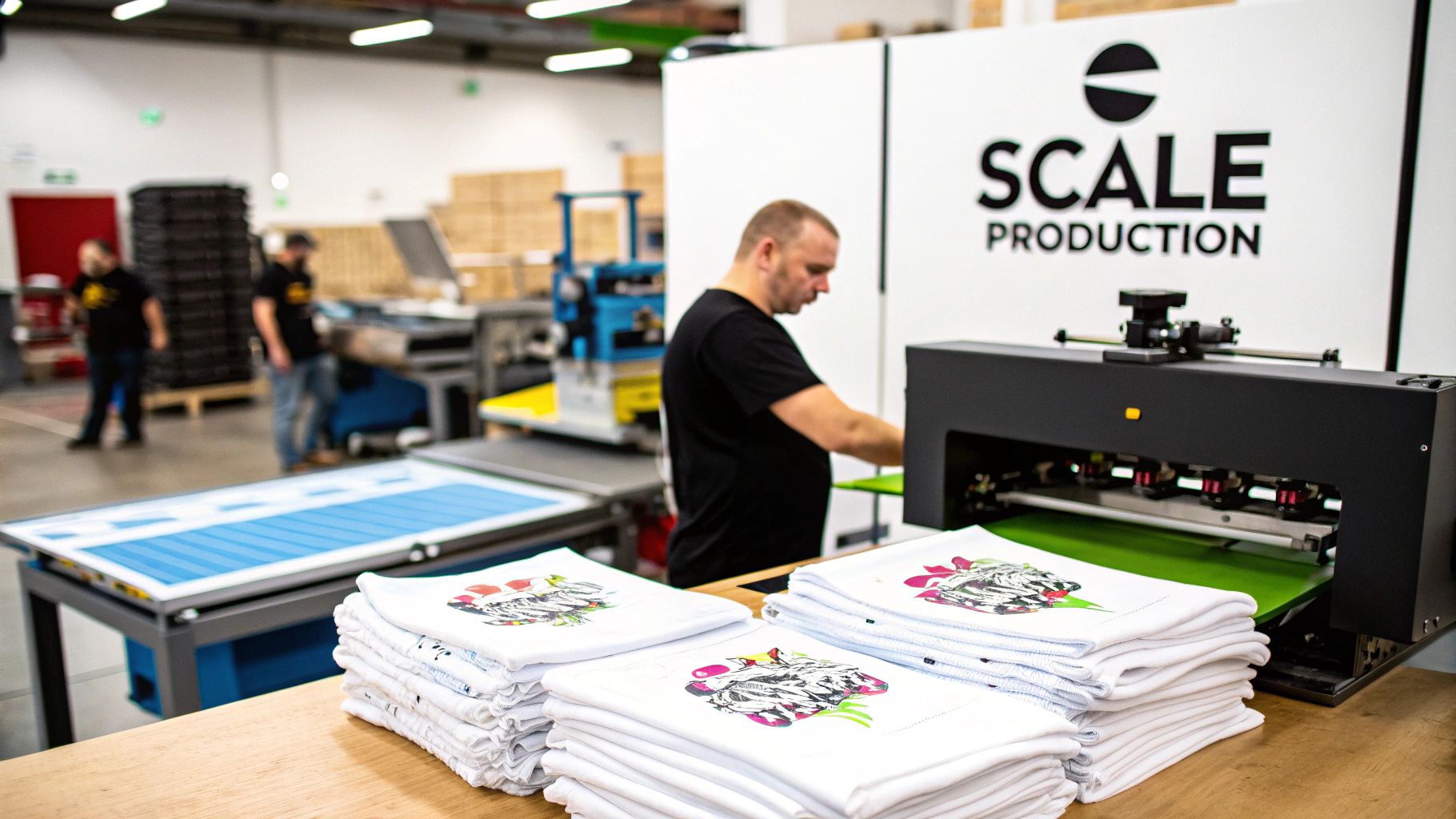
Let’s paint a picture. Your custom apparel shop is finally taking off, and the orders are pouring in. The problem? Your trusty little heat press just can't keep up. You're hitting a production wall. This is a classic growing pain, and it’s a clear sign that you’ve outgrown your initial setup. The answer isn't working longer hours; it's about getting smarter with more powerful equipment.
An industrial heat press is the engine that will drive your production forward. It’s like upgrading from your standard kitchen oven to a commercial convection model. Both can bake, sure, but only one can handle the non-stop demands of a busy restaurant while churning out perfectly consistent results every single time.
This guide will walk you through how investing in the right machine can unlock serious efficiency, top-tier quality, and the capacity to handle that booming demand. When you pair an industrial press with premium DTF transfers, like those from Cobra DTF, you're creating a powerhouse combination for success.
Key Advantages of Upgrading
- Boosted Efficiency: A serious machine dramatically cuts down your pressing time per item. That means you can knock out more orders in a day, plain and simple.
- Superior Quality: Consistent heat and pressure are everything. They get rid of common headaches like peeling or faded transfers, which means less waste and fewer costly reprints.
- Increased Profitability: When you can produce more, faster, and with fewer mistakes, your bottom line will thank you. It’s a direct path to healthier profit margins.
- Business Scalability: This is the kind of equipment that lets you confidently say "yes" to bigger clients and more complex jobs. It’s the foundation you need for real, long-term growth.
A professional-grade heat press isn't just another piece of hardware; it’s a strategic investment in your brand's reputation. It's your promise that every single product leaving your shop meets the high-quality standards customers expect. This move is less about buying a new machine and more about building a solid foundation for lasting success.
Choosing Your Industrial Heat Press Model
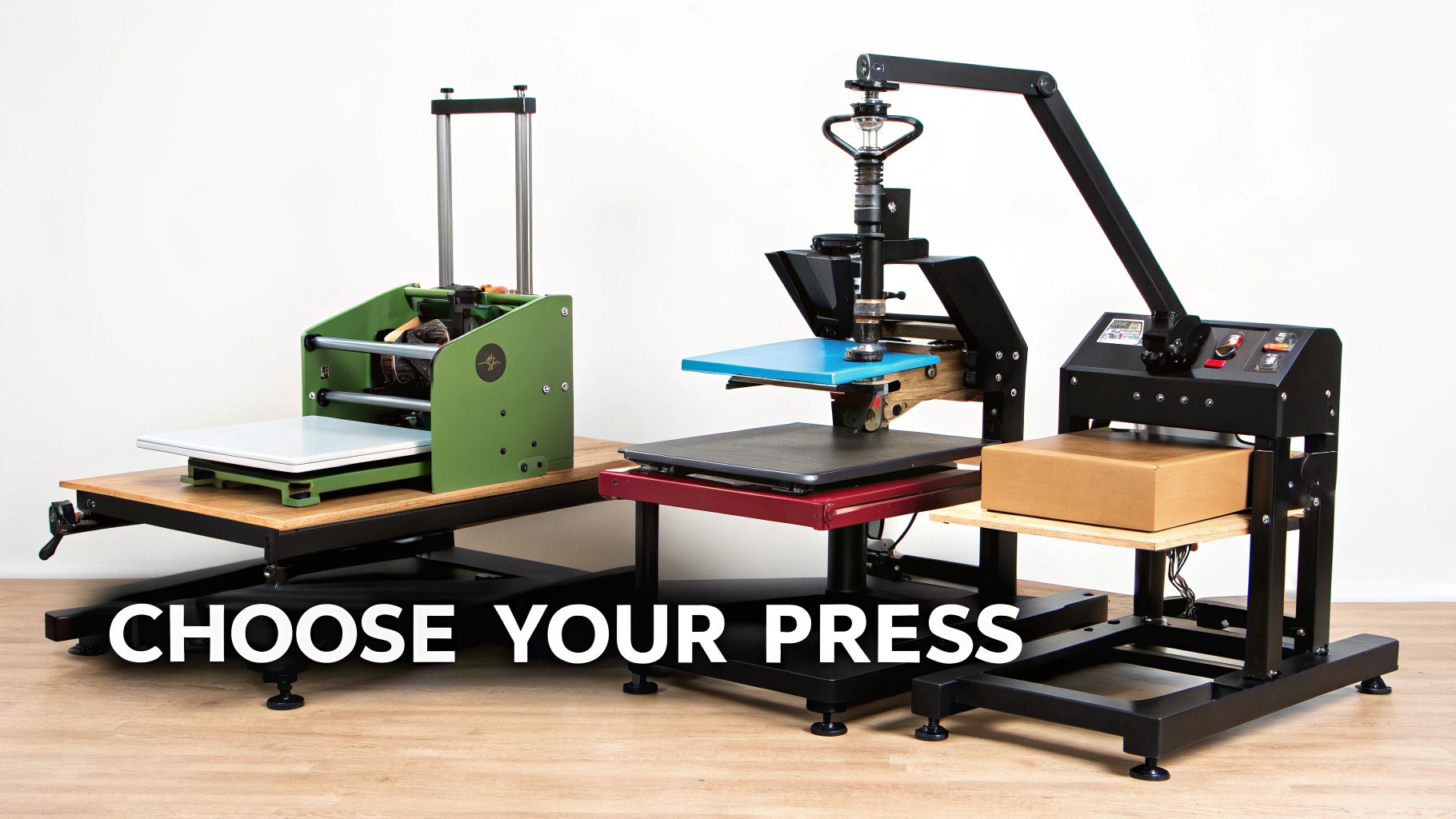
Picking the right industrial heat press is like choosing the right tool for a construction job. You wouldn't frame a house with a tack hammer, and you wouldn't do fine detail work with a sledgehammer. Each press is built for a purpose, and matching the machine to your daily production needs is the first real step toward a smooth, profitable workflow.
Let's dive into the main types you'll find out there. Getting a feel for how they work, where they shine, and what their limitations are will help you zero in on the perfect fit for your shop—whether you're just starting out or running a full-blown production floor.
Clamshell Heat Press: The Compact Powerhouse
Picture a high-tech waffle iron, and you've got the basic idea of a clamshell press. The top platen is hinged at the back, opening and closing in a simple up-and-down motion. This design is incredibly efficient and has a small footprint, making it a go-to for shops where every square foot counts.
The direct open-and-close action is built for speed. An operator can load a t-shirt, press it, and have the next one ready to go with almost no wasted motion. It's the undisputed champ for cranking out high volumes of standard flat garments.
But there's a trade-off. The heated platen is always hovering right over your workspace. This can make it tricky to perfectly align transfers on thicker items like hoodies or awkward pieces like hats without feeling the heat.
Swing-Away Heat Press: Precision And Versatility
A swing-away heat press works more like a lazy Susan. The top platen lifts vertically and then swings completely to the side, leaving the lower platen totally exposed and accessible. This gives you a wide-open, unobstructed view to work with.
This clear workspace is a game-changer for detailed jobs or pressing on bulky items. You can easily place complex DTF transfers on jackets, hoodies with zippers, or polos with buttons without worrying about burning your knuckles. The straight-down pressure it applies is also fantastic for getting crisp, even results across all sorts of materials.
This blend of precision and power has made it a top seller. The swing-away segment now holds a commanding 31.09% market share of the global heat press market in 2024. Its ability to handle just about any job you throw at it makes it a favorite for custom apparel businesses that can't compromise on quality.
Key Takeaway: The swing-away's open design dramatically cuts down on placement errors. Having total access to the lower platen means you can nail the alignment on intricate designs or expensive garments where there's no room for mistakes.
Automatic And Pneumatic Presses: The Throughput Maximizers
Automatic presses are the workhorses of the industry, built for serious volume. Instead of you muscling the press shut, these machines use air pressure (pneumatic) or an electric motor to open and close. They deliver the exact same pressure every single time, all at the push of a button.
This automation brings two huge advantages. First, it virtually eliminates operator fatigue, which is a major bottleneck in any high-volume shop. Second, it guarantees consistency. Every press is identical, wiping out the frustrating inconsistencies that can ruin a batch of prints.
If your business is all about maximizing daily output without sacrificing quality, an automatic press is an investment that pays for itself. They do require a bigger upfront cost (and an air compressor for pneumatic models), but the jump in productivity and reliability often leads to a quick ROI. For anyone just starting out, we've put together a helpful resource on the best heat press machines for a small business.
Conveyor And Roller Presses: The Non-Stop Production Lines
Finally, we have the heavyweights: conveyor or roller presses. These machines are the assembly lines of the heat transfer world, designed for massive, continuous runs where stopping is not an option. Garments are fed onto a moving belt that carries them through a large heating element, applying transfers seamlessly as they pass through.
These aren't for your average print shop. You'll find this type of industrial heat press in huge manufacturing plants that churn out thousands of identical items a day. They are the pinnacle of automated pressing, built for one thing: industrial-scale throughput.
To help you visualize which machine might be right for you, here’s a quick breakdown of their core strengths and weaknesses.
Industrial Heat Press Types At a Glance
| Machine Type | Best For | Key Advantage | Potential Drawback |
|---|---|---|---|
| Clamshell | High-volume, standard garments (e.g., t-shirts) | Fast cycle times and a small footprint | Limited access for placing transfers on bulky items |
| Swing-Away | Detailed work, thick or irregularly shaped items | Unobstructed workspace for precise alignment | Requires more physical space to operate |
| Automatic | High-throughput production, maximizing consistency | Reduces operator fatigue and ensures even pressure | Higher initial investment and may need an air compressor |
| Conveyor/Roller | Massive, continuous industrial-scale runs | Unmatched speed and automation for huge volumes | Very high cost; not practical for small-batch work |
Ultimately, the best press is the one that removes friction from your specific workflow. Think about your current orders, your future goals, and the space you have to work with before making a final decision.
Digging into the Technical Specs That Really Matter
Once you’ve settled on the type of industrial heat press that fits your shop's layout and workflow, it’s time to get into the nitty-gritty: the technical specifications. This is where the real differences lie, separating a high-performance machine from one that will cause you endless headaches. Think of it like buying a pro camera; a bunch of models might look the same, but it's the quality of the lens and sensor that truly determines if you get a stunning shot or a blurry mess.
In the DTF world, these specs are your guarantee of flawless, long-lasting prints. Knowing what to look for means you can read any product sheet like a seasoned pro and spot a machine genuinely built for performance and profit.
Heat Uniformity: The Bedrock of Quality
Let's be blunt: heat uniformity is probably the single most important factor for getting DTF applications right. It’s all about the heat press’s ability to maintain the exact same temperature across every square inch of its heating platen. A press with poor uniformity is like an oven that burns one side of a pizza while leaving the other doughy and raw.
Imagine you're pressing a big design on the front of a shirt. If your platen has "cold spots," parts of that DTF transfer simply won't get hot enough to cure properly. That’s a direct ticket to peeling, cracking, and prints that fall apart in the wash—which means wasted materials and, even worse, unhappy customers.
Here's the inside scoop: High-quality industrial presses have superior heating elements that are meticulously wound throughout the entire platen. Cheaper models often skimp, leaving gaps between the elements. This creates huge temperature swings that can ruin an entire run of garments. Always look for machines that guarantee temperature accuracy within just a few degrees across the whole surface.
Platen Size: Your Key to Versatility and Efficiency
The platen size of your industrial heat press directly defines what you can and can't produce. A larger platen isn’t just for oversized designs on the back of hoodies or on blankets; it’s also a massive efficiency booster for your everyday jobs.
For instance, with a bigger platen (say, 16" x 20" or larger), you can press multiple smaller items at once—a few baby onesies or a full set of sleeve designs in one go. "Ganging" your jobs like this dramatically cuts your cost-per-press and lets you crank out more orders in less time.
- Standard T-Shirts: A 15" x 15" platen is a decent starting point, but a 16" x 20" gives you much more breathing room.
- Oversized Apparel: For hoodies, jackets, and all-over prints, you'll need larger formats like 20" x 25".
- Specialty Items: Look for machines with interchangeable smaller platens. Being able to swap in platens for sleeves, pant legs, and hats is invaluable for expanding what you can offer.
Investing in a machine with a versatile platen size means you can say "yes" to a much wider range of customer requests, from simple tees to more complex (and profitable) custom projects.
Pressure Control: The Secret to a Permanent Bond
Consistent, accurate pressure is what physically fuses the DTF adhesive into the fabric's fibers. Without the right amount of force, the transfer just sits on top of the garment instead of becoming a part of it. The result? A print that fails way too soon.
You’ll find different systems out there, each with its own level of control. The market definitely shows a preference for simple, effective solutions. For example, manual controls hold a whopping 75.45% market share because they're affordable and dependable for small to mid-sized shops. At the same time, electric heating dominates with a 71.30% share thanks to its precise temperature control—a must-have for quality transfers. You can see more details in this recent heat press technology market analysis.
Here’s a quick rundown of the common pressure systems:
- Manual Systems: This is the most straightforward—the operator physically closes and locks the press. They're cost-effective, but the pressure can vary from person to person, and even with the same person as they get tired throughout the day.
- Magnetic Auto-Open: These presses use a powerful electromagnet to hold the machine shut, then automatically pop it open when the timer hits zero. It’s a fantastic feature for preventing over-pressing and giving the operator's arms a break.
- Pneumatic Systems: Hooked up to an air compressor, these automatic presses deliver perfectly even and repeatable pressure with every single cycle. This is the gold standard for high-volume production where absolute consistency is non-negotiable.
For a deeper dive into how these features impact different business sizes, check out our guide on choosing the right DTF heat press.
Cycle Speed: How You Maximize Your Throughput
Finally, let's talk about cycle speed—the total time it takes to complete one full press. This number translates directly to your daily output and revenue. While the actual pressing time is set by the DTF transfer's instructions, the machine’s design has a huge impact on how quickly you can move from one garment to the next.
Features like an auto-open function or a smooth swing-away design can shave precious seconds off each cycle. It might not sound like much, but saving just five seconds per press can add up to dozens of extra finished garments by the end of an eight-hour shift. This is how an industrial heat press pays for itself over time—by increasing your throughput.
Your Step-By-Step Workflow for a Perfect Press
Having a beast of an industrial heat press in your shop is a great start, but knowing how to use it with skill and precision is what really prints money. The secret to those consistently vibrant, tough-as-nails custom prints? It all comes down to a rock-solid, repeatable workflow.
This guide will walk you through the essential steps for pressing DTF transfers, helping you nail it every single time. Mastering this process takes the guesswork out of the equation, slashes your rate of costly mistakes, and ensures every single garment that goes out the door is a testament to your quality.
Setting Up Your Press for Success
Before you even think about laying down a transfer, your machine needs to be dialed in. Think of it like a musician tuning their instrument before a big show—if it's not perfectly calibrated, the final product just won't be right. The holy trinity of heat pressing is time, temperature, and pressure.
For most DTF transfers, a good starting point is somewhere in the ballpark of 280-320°F for about 10-15 seconds. But here's the golden rule: always, always check the specific instructions that came with your transfers. Different films and inks can have their own sweet spots.
Pro-Tip: Don't just blindly trust the digital display on your press. Grab an infrared temperature gun every now and then and scan your platen for cold spots. This quick check confirms that the heat is actually uniform across the entire surface, which can save you a world of headaches from failed presses.
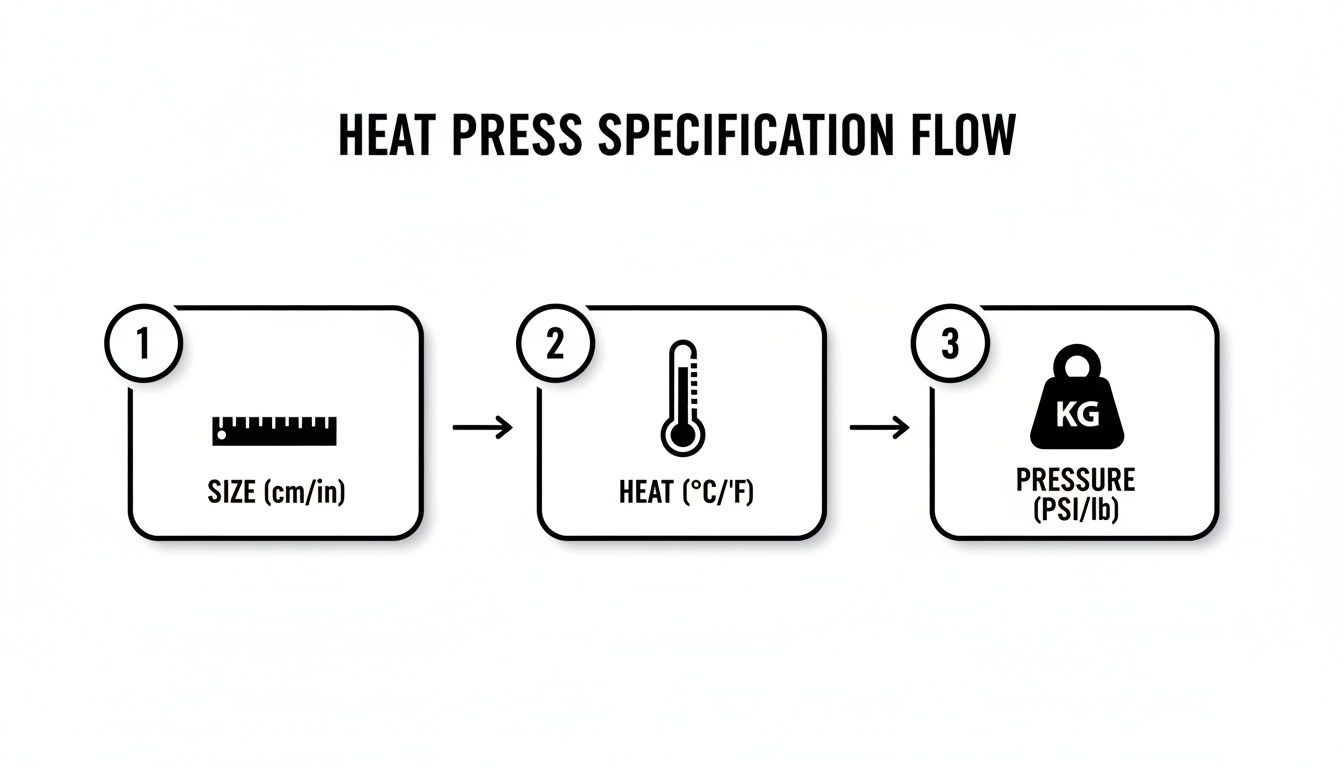
As you can see, getting a handle on these three interconnected variables is the foundation of any great heat press operation.
The Pressing Process Step-by-Step
Alright, your machine is warmed up and ready to go. Now it’s time to focus on the garment. Follow these steps methodically, and you’ll get flawless results.
-
The Pre-Press Is Non-Negotiable: Lay your garment flat on the lower platen and give it a quick press for 5-7 seconds. This is a mission-critical step. It zaps any hidden moisture out of the fabric and smooths out wrinkles, giving you a perfect canvas. Skipping it is asking for trouble—trapped steam can completely ruin the transfer's adhesion.
-
Precise Transfer Placement: Now, carefully position your DTF transfer on the pre-pressed area. This is where you separate the pros from the amateurs. Use an alignment tool or even a simple T-square ruler to make sure the design is dead center and perfectly straight. Your customers will notice and appreciate this consistency.
-
Protect Your Investment: Always, always place a Teflon sheet or a sheet of parchment paper over the transfer before closing the press. This simple barrier does two things: it prevents any ink from getting on your upper platen and it protects the garment from scorching. It’s cheap insurance for your equipment and your product.
-
Execute the Press: Clamp it down and let the timer do its thing. If you're running a manual press, make sure you're applying firm and even pressure. For you folks with automatic or pneumatic presses, the machine takes care of this for you, delivering that perfect, consistent pressure every time.
-
The Critical Cold Peel: When the timer buzzes, open the press and move the garment to a cool, flat surface. Now, patience is key. You must wait until the transfer is completely cool to the touch. Seriously, don't rush this. Trying to peel the film while it's still warm is the number one cause of failed DTF prints. Once it's cool, peel the film back slowly and at a low angle to reveal your crisp, finished design.
Calculating Your ROI and Boosting Profitability
An industrial heat press isn't just another piece of equipment; it's the engine that can drive your shop's growth. The smartest operators I know don't see it as an expense—they see it as a strategic investment. This mindset shift starts when you connect the machine's real-world performance directly to your bottom line, and that begins with understanding its Return on Investment (ROI).
Calculating your ROI doesn't need to be a complex accounting exercise. At its heart, you're just weighing what you paid for the press against the extra profit it helps you generate over time. Look past the initial sticker price and think about the concrete gains. An industrial machine's raw speed and rock-solid reliability mean you save on labor and crank out more products every single day. Those are real, measurable wins.
Breaking Down Your Cost Per Press
To get a true handle on the financial picture, you have to figure out your cost-per-press. This one simple number tells you exactly what it costs to make a single item, and it's absolutely vital for setting prices that actually make you money.
Here’s what you need to include in your calculation:
- Machine Amortization: Take the initial cost of your press and spread it out over its expected lifespan.
- Labor Costs: How much do you pay an operator per hour? Divide that by how many items they can press in that hour.
- Material Costs: This is the cost of the blank garment, the DTF transfer itself, and any consumables you use, like finishing sheets.
- Overhead: Assign a tiny slice of your shop's rent and utilities to each press.
Once you have that final number, you can see with crystal clarity how an efficient industrial press pushes your costs down and widens your profit margin on every sale. When you're running these numbers, don't forget to look into smart procurement cost reduction strategies to lower your material costs even further.
Maximizing Throughput and Efficiency
Throughput—the raw number of finished products you can get out the door in a day—is where a true industrial heat press earns its keep. A high-quality machine's speed and sheer dependability slash the number of misprints and wasted materials, which is a direct boost to your profits. Your job is to organize your workflow to take full advantage of this power.
Even small tweaks can have a massive impact. For instance, batching similar jobs together means you aren't constantly stopping to adjust temperature and pressure settings. A smart shop layout that minimizes how much your operator has to walk between stations can shave precious seconds off every cycle. That might not sound like much, but it adds up to hundreds of extra garments a week.
An industrial machine’s real value is its ability to scale your production without sacrificing quality. It raises your operational ceiling, giving you the confidence to take on those big, lucrative orders that fuel serious business growth.
The global market for heat presses is huge, with some estimates putting it at over 10 million units sold each year across all types. Industrial models account for a smaller but significant slice, around 2 million units, and their higher price tags reflect just how crucial they are for commercial-scale work.
By keeping a close eye on these financial metrics, you'll stop seeing your industrial press as a cost and start seeing it for what it is: a profit multiplier. To dig deeper into optimizing your shop’s finances, be sure to check out our guide on how to reduce production costs.
An Essential Buyer's Checklist Before You Purchase
Alright, you're close to pulling the trigger on a new heat press. Before you do, let's run through one final pre-flight check. Think of this as the last sanity check to make sure you're getting a machine that will be a workhorse, not a headache.
This isn’t just about buying a piece of equipment; it’s about investing in the core of your production line. Getting it right now saves a world of frustration later.
Machine Specs and Features
First, let's get into the nuts and bolts of the machine itself. These are the non-negotiables.
- Platen Size and Versatility: Does the platen actually fit the work you do most often? For most shops, a 16" x 20" platen is the sweet spot, handling everything from standard tees to larger hoodies. Also, ask about interchangeable platens—you'll want options for sleeves, hats, and other tricky items down the road.
- Time and Temperature Controls: Look for precise, digital controls. Consistency is everything with DTF, and old-school analog dials just don't offer the accuracy you need. A bright, easy-to-read digital screen is a must-have.
- Pressure System: How do you want to work all day? A manual press is straightforward but tiring. A magnetic auto-open is a fantastic upgrade that prevents scorching. A fully pneumatic system is the top tier for high-volume shops that need perfect, repeatable pressure every single time.
Logistics and Support
The machine is only half the battle. Now, let's think about the reality of getting it into your shop and keeping it running.
An industrial heat press is a long-term investment in your production capability. The quality of the manufacturer's warranty and the responsiveness of their customer support team are just as important as the machine's technical specifications.
- Workspace Footprint: Seriously, have you measured your space? People always forget this. Swing-away presses need a ton of clearance to operate, while a clamshell is much more compact. Map out the exact dimensions before you click "buy."
- Warranty and Customer Support: What’s the warranty look like? What does it actually cover, and for how long? Dig around for reviews on their customer support. When a machine goes down on a big order day, you need a support team that actually picks up the phone.
- Safety and Compliance: Don't overlook the safety side of things. Make sure the press you’re eyeing meets all the required safety standards for your region. For a detailed breakdown, a resource like this UK workplace safety compliance guide can be invaluable for ensuring your setup is completely by the book.
Got Questions? We've Got Answers.
Stepping up to an industrial heat press is a big move, and it's smart to have a few questions. To help you feel confident in your decision, I’ve put together answers to some of the most common things people ask when they're getting ready to invest.
For DTF, What's the One Thing I Absolutely Can't Skimp On?
When you’re working with Direct-to-Film (DTF), it all boils down to two things: precise temperature control and even pressure distribution. You can’t have one without the other. These two are the secret sauce for making sure your DTF adhesive cures perfectly and locks into the fabric for good.
I always tell people to think of it like baking a cake. If your oven has hot spots or the temperature keeps fluctuating, you're going to get a half-raw, half-burnt mess. An industrial press with a well-made heating element and a solid pressure system is non-negotiable if you want pro-level results that won’t crack or peel after a few washes.
The name of the game in DTF is consistency. Uneven heat or pressure is the #1 reason transfers fail, leading to wasted shirts and unhappy customers. A great press takes that guesswork completely out of the equation.
How Much Upkeep Does an Industrial Press Really Need?
This is one of the best parts. These machines are built to be workhorses, so they don’t ask for much in return. Industrial heat presses are incredibly low-maintenance and will run reliably for years with just a little attention.
Here's a quick look at your typical routine:
- Keep it clean: A quick wipe-down of the platen with a soft cloth is usually all you need to keep residue from building up.
- Check the cords: Give the power cables a quick look-over every so often to check for any wear and tear.
- Glance at air lines: If you’re running a pneumatic press, just make sure the compressor and lines look good.
- Spot-check the temp: Once a month or so, grab an infrared thermometer and check a few spots on the platen. This simple step ensures your machine stays calibrated and your prints stay perfect.
Can I Press More Than Just T-Shirts?
Oh, absolutely. That’s where the real fun begins. A good industrial press is a gateway to so much more than just tees. With the right settings and maybe a few interchangeable platens, you can open up a whole new world of products.
Your press can handle a huge variety of items. People use them every day for:
- Bulky hoodies and sweatshirts
- Tote bags and other canvas items
- Hats and caps (using a special hat platen)
- Ceramic tiles and other hard goods
- Polo shirts (working around the buttons and collar)
Just remember to look up the recommended time, temperature, and pressure for whatever you’re pressing. This flexibility is what lets you take on those more interesting—and often more profitable—jobs.
Ready to pair your top-tier press with transfers that can keep up? Cobra DTF crafts 100% USA-made DTF transfers that pop with color and last wash after wash, all with a guaranteed 1-3 day delivery. Check out our transfers and start pressing with total confidence.