

Top Picks: best heat press machine for small business
When you're just starting out, picking the right heat press can feel like a huge decision. If I had to give one piece of advice, it would be this: invest in quality and consistency from day one. For most small businesses, a 15"x15" swing-away press with digital controls is the sweet spot. It's versatile enough for t-shirts and most common items, and it delivers the kind of even pressure you need for professional results.
Why Your Heat Press Is a Business Cornerstone
Choosing the best heat press machine for a small business is about so much more than just sticking a design on a shirt. It’s about building a reputation with every single item that leaves your shop. Think of your press not as just another tool, but as the heart of your production line.
A cheap, unreliable press will frustrate you to no end. It leads to inconsistent prints, wasted materials, unhappy customers, and ultimately, lost money. On the flip side, a quality machine is the foundation for creating vibrant, durable products that people are happy to pay good money for. It builds loyalty.
The right press ensures all your creative effort pays off with professional-grade results, every single time. This is especially critical for newer methods like Direct-to-Film (DTF), which demand precise temperature and perfectly even pressure to get that soft, long-lasting finish everyone wants. A smart investment upfront saves you from the headache of costly reprints and protects your most valuable asset: your brand's reputation.
A Market Built for Small Business Growth
The good news? You’re jumping in at the perfect time. The demand for customized apparel and personalized products has lit a fire under the heat press industry. The global market is booming, currently valued at around USD 1.1 billion and on track to nearly double to USD 2.0 billion by 2033. That’s a steady growth rate of 6.8% a year, driven almost entirely by the energy of small businesses and creative entrepreneurs like you. You can read more about these market trends at DataHorizzon Research.
This growth means manufacturers are paying attention. They're designing more machines specifically for the needs of small-scale operators, which means you have more accessible, high-quality options than ever before.
The real job of a great heat press isn't just applying heat. It's about flawlessly transferring your creative vision onto a physical product, time after time. Consistency is what turns a hobby into a profitable business.
In this guide, we're going to cut through the confusing tech specs and talk about what really matters for your small business. We’ll explore how different types of presses affect your day-to-day workflow and which features actually make you money. We'll cover everything you need to know, including:
- Different Machine Styles: The real-world pros and cons of clamshell, swing-away, and draw-style presses.
- Key Specifications: What platen size, pressure systems, and digital controls actually mean for your products.
- Workflow and Profitability: How to plan your investment for a solid return and smooth production.
- Transfer Compatibility: Making sure you get perfect results with DTF, sublimation, vinyl, and more.
Clamshell vs. Swing-Away vs. Draw Machines
Picking the right style of heat press is your first big decision. Think of it like a professional chef choosing an oven—each type has a completely different workflow and is built for different kinds of jobs. The three main players are the clamshell, the swing-away, and the draw press. Your choice here will shape your daily production speed, how safe your setup is, and even what kinds of products you can make.
Clamshell: The Compact Workhorse
The clamshell heat press is the go-to for many beginners and shops tight on space. It works exactly like it sounds, opening and closing like a clam or a waffle iron. The top platen is hinged at the back and lifts straight up.
Its biggest pro is speed. The simple up-and-down motion is quick and efficient, letting you fly through a stack of t-shirts or tote bags in no time. But there's a trade-off. Because the top platen is always looming over your workspace, you have a pretty narrow area to lay out your garment and transfer. It's easy to accidentally burn your knuckles if you're not careful.
Swing-Away: Precision and a Clear View
A swing-away heat press is like an artist's easel. Instead of lifting up, the top platen swings completely out of the way, usually off to the side. This gives you a wide-open, totally unobstructed view of the lower platen.
That clear workspace is a game-changer. It makes it so much easier and safer to place detailed DTF transfers or line up designs perfectly, without feeling rushed by a hot surface overhead. The pressure is also more even, coming straight down instead of at an angle like a clamshell. This is crucial when you're working with thicker items like hoodies, ceramic tiles, or wooden plaques.
It’s no surprise that swing-away presses are a market leader, holding a 31.09% market share worth a cool USD 244.5 million. They’re known to cut setup time by 20-30% and drastically reduce the risk of burns or bad presses. For more on the market breakdown, you can check out the research from Verified Market Research.
Draw: The Best of Both Worlds
Finally, we have the draw heat press. This style cleverly combines the benefits of the other two. Think of it like a baker’s oven with a sliding rack. The bottom platen pulls out toward you like a drawer.
This gives you that same safe, open workspace you get with a swing-away but often in a more compact, space-saving design. You can lay out your shirt and transfer comfortably, with no hot metal anywhere near you. Once everything is perfect, you just slide the drawer in, and you're ready to press. It’s an incredibly ergonomic design that prioritizes safety and a mistake-proof workflow.
In the end, it’s a classic trade-off: speed vs. space vs. precision. A clamshell is your speed demon for simple, high-volume jobs. A swing-away or draw press gives you the control and safety needed to produce a wider, more professional range of products.
If you’re just starting out and want a little more guidance, our guide on the best heat press for beginners can help you narrow down the options even further.
This flowchart can help you visualize which path makes the most sense based on where your business is today and where you want it to go.
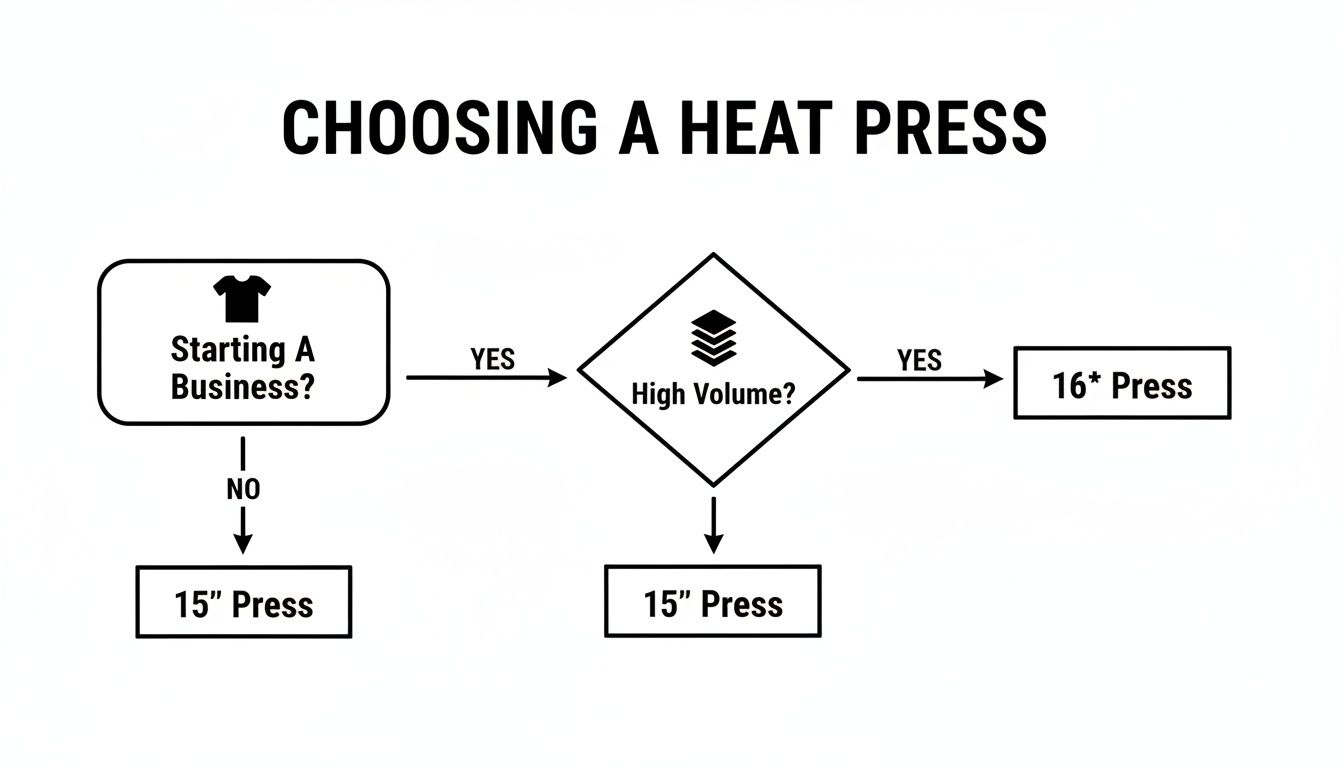
The takeaway here is pretty clear. While a standard 15"x15" press is a fantastic starting point for most new shops, businesses with their sights set on serious volume should really be looking at a 16"x20" model to get the most out of every press.
Decoding the Specs That Actually Matter
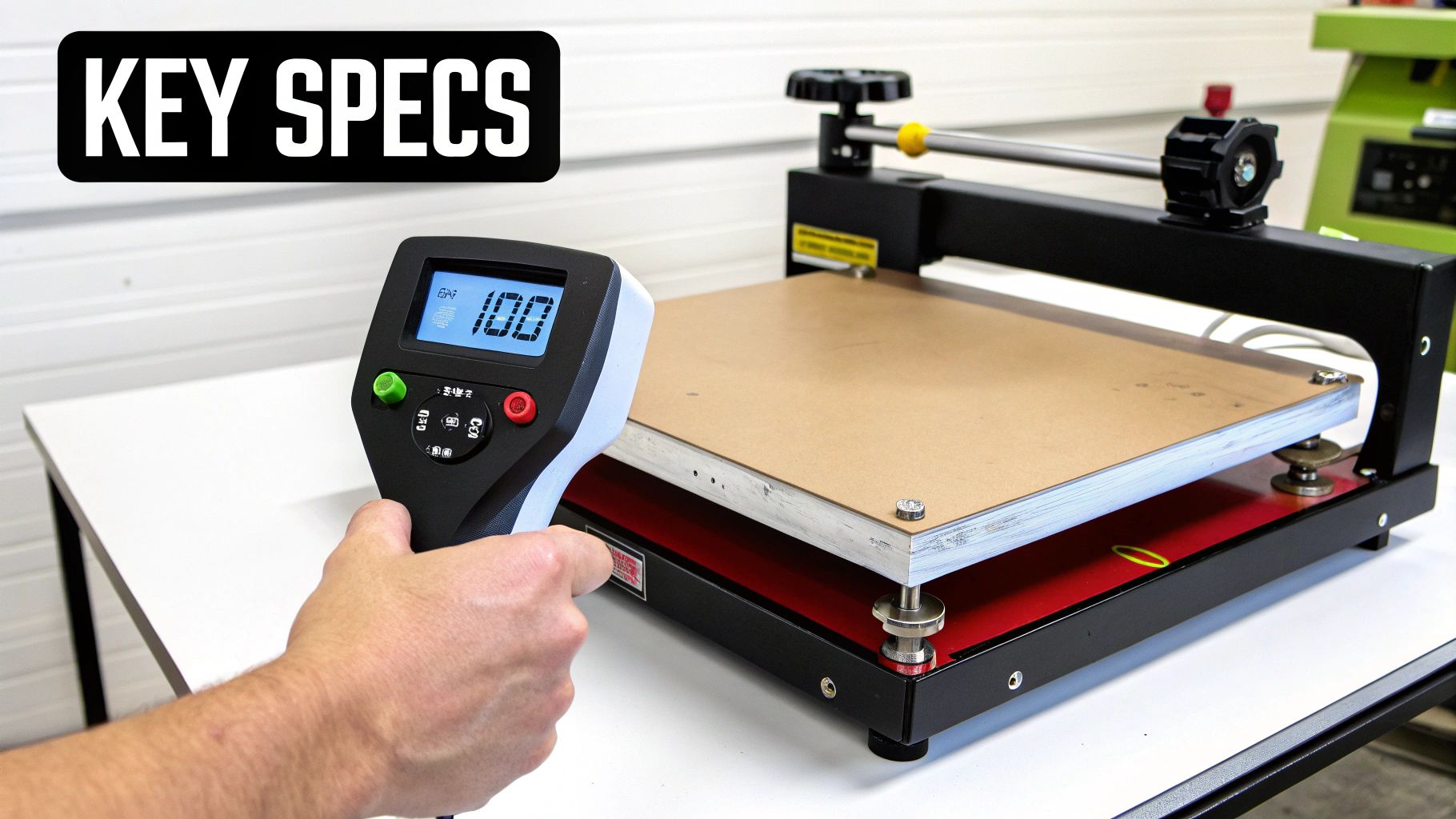
When you first start shopping for a heat press, the spec sheet can feel a bit like reading a foreign language. It's easy to get bogged down in technical jargon, but let's cut through the noise. To get professional-grade results, you really only need to master three core things: platen size, temperature accuracy, and pressure consistency. Get these right, and you're on your way to making products that people love and buy.
Platen Size Is Your Canvas
Think of the platen—that big, heated metal plate—as your canvas. Its size dictates the biggest designs you can create and, just as importantly, how efficiently you can work. For most small businesses, it really comes down to two choices.
- 15" x 15" Platen: This is the industry standard for a good reason. It’s the perfect size for the vast majority of adult t-shirt designs, tote bags, and other popular flat items. You get a ton of versatility without taking up a huge amount of space in your workshop.
- 16" x 20" Platen: If you've got plans to grow, stepping up to a larger platen is a smart investment. This size opens the door to creating those trendy, oversized designs that cover a larger portion of the garment. Even better, it can literally double your productivity on smaller jobs—think pressing two youth shirts or a dozen patches at the same time.
While a 15"x15" is a fantastic workhorse to get you started, the 16"x20" is where you'll find real efficiency and future-proof your business.
Temperature Accuracy: The Key to Durability
For a print that lasts, consistent temperature is absolutely non-negotiable. This is where cheap presses really fall short; they’re notorious for having "cold spots" where parts of the platen just don't get as hot as the display says. This uneven heating is the main reason why transfers peel, crack, or fade after just a couple of washes.
It’s like baking a cake in an oven that's 50 degrees cooler on one side. You'll end up with a mess that's half-burnt and half-raw. A heat press works the exact same way. Good machines have high-quality heating elements woven tightly throughout the entire platen, ensuring true edge-to-edge heat. This guarantees every single part of your transfer gets the heat it needs to bond permanently with the fabric.
A reliable heat press doesn't just get hot; it stays consistently hot across every square inch. This consistency is what separates amateur hobby gear from professional business equipment.
While manual temperature controls still dominate the market with a 75.45% share, digital automatic controls are quickly becoming the standard for serious shops. Their precision can slash material waste by up to 15% by stamping out temperature-related mistakes. You can dig deeper into these heat press market insights at Verified Market Research.
Pressure Consistency: The #1 Factor for Flawless Prints
If wonky temperatures are a problem, then uneven pressure is the absolute enemy of a good print, especially with modern methods like Direct-to-Film (DTF). Without firm, even pressure across the whole design, the transfer's adhesive simply won't bond correctly with the garment fibers. The print might look fine coming off the press, but it will fail spectacularly after the first wash.
Think about applying a screen protector to your phone. If you only push down in the center, you know the edges are going to bubble and lift. A quality heat press works the same way, applying uniform pressure from corner to corner and forcing that ink and adhesive deep into the fabric. The result is a soft, durable finish that actually lasts.
Let's look at a real-world example. An Etsy seller, "Jenna's Custom Tees," was pulling her hair out over a 20% failure rate on her DTF shirts. She was using a budget press, and the corners of her prints kept peeling. She was literally throwing away one out of every five shirts she made.
She finally upgraded to a mid-range press with a digital pressure readout. This single feature allowed her to dial in the exact pressure her DTF supplier recommended and repeat it perfectly every time. Within a month, her failure rate plummeted to less than 1%. She wasn't just saving money on wasted materials; she was now able to sell nearly 100% of her inventory. That one upgrade paid for itself in a matter of weeks.
Calculating Your Throughput and Return on Investment
It's easy to look at a heat press as just another line item on your expense sheet. That's a mistake. A much better way to think about it is as a dedicated employee that's there to generate revenue, day in and day out. To really see its value, you need to get a handle on two simple but crucial ideas: throughput and Return on Investment (ROI). Getting these right will completely change how you shop for a new press.
Let's start with ROI. Don't let the acronym intimidate you; it's just a straightforward way to figure out how quickly your new machine will pay for itself.
Imagine you find a solid, reliable swing-away press for $600. You've figured out your costs for blank shirts and transfers, and you know you can make a clean $15 profit on every shirt you sell. The math to figure out your break-even point is simple:
$600 (Press Cost) ÷ $15 (Profit Per Shirt) = 40 Shirts
That’s it. You only need to sell 40 shirts to completely recoup your investment. Every single shirt after that—the 41st, the 100th, the 1,000th—is pure profit going straight into your pocket.
Understanding Your Production Capacity
While ROI tells you when you'll get your money back, throughput tells you how fast you can do it. Throughput is simply the number of finished items you can realistically pump out in a given time, whether it's an hour or a full workday. This number is tied directly to your press's features.
For example, a manual clamshell press might feel quick for a one-off job. But an auto-open swing-away press can seriously boost your daily output. Why? Because while one shirt is curing under the heat, the press pops open on its own, freeing you up to prep the next garment. You're not stuck babysitting the machine. That small bit of efficiency adds up big time over a long production day.
The whole reason we can even have this conversation is the massive growth in demand for custom products, driven by small e-commerce shops and side hustles. This boom means you can get your shop set up with a quality press, often for under $500, and potentially see a 200-300% ROI in your first year on high-volume products.
How Heat Press Features Impact Business Throughput
The features on a press aren't just for convenience—they directly impact how much money you can make. A small upgrade in machine capability can lead to a huge jump in your production capacity and, ultimately, your daily profit.
Let's break down how different press types affect your workflow and output.
| Feature | Estimated Shirts Per Hour | Impact on Workflow | Ideal Business Size |
|---|---|---|---|
| Manual Clamshell | 25-30 | Requires constant operator attention to open the press. Best for simple, one-off jobs. | Hobbyist or very low-volume startup. |
| Auto-Open Clamshell | 35-45 | Frees the operator to prep the next shirt while the current one is pressing. Great for multitasking. | Growing small business, frequent small-to-medium batches. |
| Manual Swing-Away | 30-40 | Safer layout and better for thicker items, but requires manual opening and swinging. | Businesses needing versatility for different products. |
| Auto-Open Swing-Away | 40-50+ | The best of both worlds: automatic opening for efficiency and a clear workspace for safe, precise placement. | High-volume small businesses, serious production shops. |
As you can see, investing in a machine with features like auto-open isn't a luxury; it's a strategic business decision. It streamlines your entire process, letting you take on more orders and grow faster. For a more detailed guide on business planning, you can learn how to measure ROI with more advanced methods.
Just remember, your heat press doesn't work in a vacuum. If you're pairing it with a blazing-fast printer, you need a press that can keep pace. Make sure your entire setup is balanced by checking out our guide on the best DTF printer for a small business.
Getting Flawless Results with DTF and Other Transfers
A great heat press is so much more than a one-trick pony; it's the versatile heart of any print shop. Its real value is in turning out perfect applications every single time, whether you're working with classic vinyl or jumping into modern methods like Direct-to-Film (DTF). This adaptability is what makes your investment a smart one for the long haul.
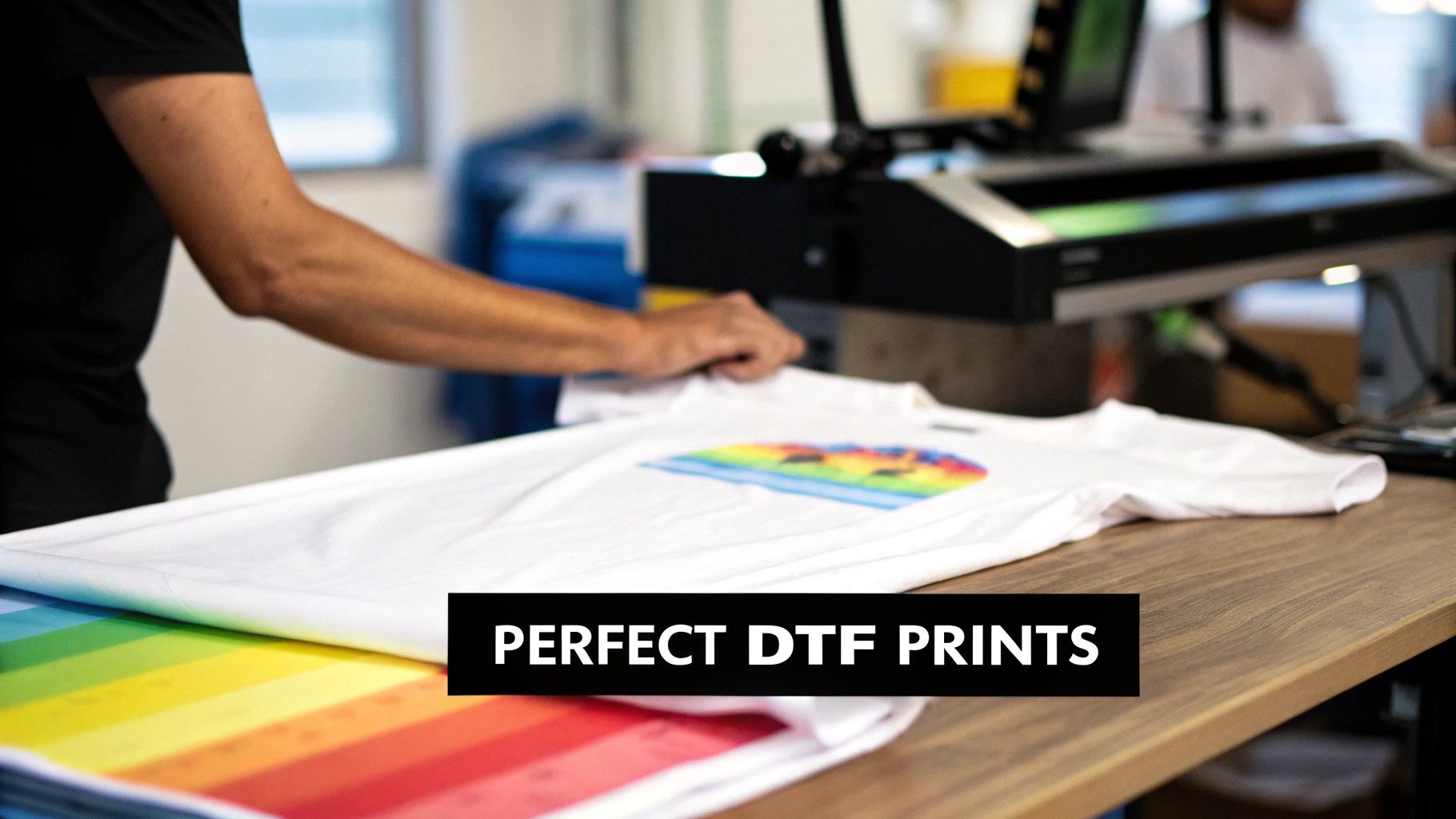
DTF, in particular, is a game of precision. Think of it like baking a delicate cake—if the oven has hot spots or the temperature is off by just a few degrees, you end up with a disaster. For a DTF transfer to come out perfectly, three things must be spot-on, and only the best heat press machine for a small business can deliver that consistency:
- Precise Temperature: DTF films have a specific temperature window where the magic happens.
- Consistent Pressure: You need even, firm pressure across the entire design to lock it into the fabric fibers. No weak spots allowed.
- Accurate Timing: Too short, and the transfer won't stick. Too long, and you risk scorching the garment or the design itself.
The Must-Have Features for Nailing DTF Prints
If you want that signature soft feel and vibrant color that DTF is famous for, some features are simply non-negotiable. Digital controls for time and temperature are a must for repeatability, making sure the tenth shirt looks just as good as the first. Even more critical is a platen with excellent edge-to-edge heat distribution, which is the secret to avoiding those peeling corners that plague prints made on cheaper presses.
A great heat press removes the guesswork from your workflow. It lets you trust the process and focus on creativity, knowing that the machine will deliver a perfect, sellable product every time.
These exact same features are what make other transfer methods successful, too. For the best results, you'll always need to dial in the right temperature and pressure for your material, so having some background knowledge from resources on understanding different fabric types is a huge help.
One Press to Rule Them All
Here's the good news: a machine that excels at DTF is naturally going to give you better results with everything else. It’s just a smarter investment.
- Sublimation: This process turns ink into a gas that needs seriously consistent heat—often up to 400°F—to properly dye polyester fibers. Any cold spots on the platen will leave you with blotchy, faded results.
- Heat Transfer Vinyl (HTV): While a bit more forgiving than sublimation, HTV still needs that even pressure to create a strong bond that won’t crack or peel after a few trips through the laundry.
- Screen-Printed Transfers: Much like DTF, these transfers rely on that perfect combination of time, temperature, and pressure to cure the ink and fuse it to the garment.
When you invest in a press with professional-grade controls and solid construction, you're not just buying a tool for a single job. You're setting your business up with a reliable workhorse ready to handle whatever printing trends come your way.
To hit the ground running, check out our detailed guide on the ideal heat press settings for DTF to ensure you get it right from the very first press.
Keeping Your Heat Press Happy (And Your Workspace Safe)
Think of your heat press as the workhorse of your business. It's not just a tool; it's a long-term partner in everything you create. And just like any valuable partner, it needs a little TLC to perform at its best and keep you safe. Consistent maintenance is how you protect that investment and guarantee every single item you ship is perfect.
A few simple habits can be the difference between a machine that lasts for years and one that causes constant headaches. It’s like a quick pre-flight check before a pilot takes off—these small steps ensure your press runs smoothly and delivers the pro-level results your customers are paying for.
Your Quick-and-Easy Maintenance Checklist
Keeping your press in prime condition doesn't mean spending hours on upkeep. Honestly, a few minutes a week is all it takes to make a massive difference in its performance and lifespan.
- Wipe Down the Platen: Once the press is completely cool, give the platen a good wipe with a soft, clean cloth. This simple step gets rid of any stray fibers, dust, or bits of adhesive that could otherwise ruin your next garment.
- Always Use a Protective Sheet: A Teflon sheet or cover is your press's best friend. Seriously. It creates a barrier that stops ink and glue from ever touching the platen surface, which is the #1 cause of gunk buildup and uneven presses down the line.
- Check Your Temperature: Don't just blindly trust the digital readout. About once a month, grab an infrared temperature gun and check for cold spots. Test the center and all four corners to make sure the heat is as even as the display claims it is.
These little rituals prevent that slow, sneaky decline in quality that can creep into a busy shop when you're not looking.
Setting Up a Safe Workspace
Let's be real: a heat press gets incredibly hot. Safety can't be an afterthought. Creating a secure environment protects you from accidents and also helps the machine do its job without interference.
First thing's first, your press needs a solid foundation. Make sure it's on a sturdy, level work surface that can handle its weight without any wobbling. Clear the surrounding area of anything flammable—piles of paper, chemicals, or stray fabric scraps are a big no-no.
A Note on Fumes: Proper ventilation isn't just a suggestion; it's a must. When you're pressing, fumes are released from the inks and adhesives. Working in a well-ventilated room, or at least near an open window, is essential for keeping your workspace healthy.
Beyond the basics, a few smart workflow decisions can make you safer and more efficient. For businesses in the US, choosing a quality press and pairing it with domestic material suppliers can mean getting your transfers in just 1-3 days. That's a huge leg up on competitors stuck waiting weeks for overseas shipments.
We're also seeing small business owners report an average 35% productivity gain when they upgrade to presses with features like auto-open platens. These not only reduce the risk of accidental burns but also prevent over-pressing. You can dig into more of this data on heat press market efficiencies over at Verified Market Reports.
By focusing on both machine care and a smart, safe setup, you're building a professional environment primed for consistent quality and real growth.
Heat Press FAQs: Your Questions Answered
Stepping into the world of heat pressing is exciting, but it naturally comes with a lot of questions. It's a big investment for your business, and you need straight answers to feel good about your choice. Let's tackle some of the most common questions we hear from business owners who are just starting out.
What Platen Size Is Best for a New Small Business?
For most startups, a 15" x 15" heat press is the sweet spot. Think of it as the all-around workhorse of your shop. It’s plenty big for standard adult t-shirts, tote bags, and most of the popular items you'll be making.
This size gives you the best balance of versatility, cost, and space-saving for a new setup. While a larger 16" x 20" press is tempting for oversized designs or ganging up multiple smaller items, the 15" x 15" gets you launched and making money without the bigger upfront cost.
Is a Swing-Away Press Really Necessary for DTF?
Honestly, yes. While you can technically use other presses, a swing-away model is what we strongly recommend for DTF transfers. The biggest reason is simple: you get a completely clear, unobstructed view of your garment. This makes lining up your DTF transfers perfectly so much easier, and you aren't fighting a hot platen hovering over your hands.
Even more critical is the pressure. Swing-away presses are built to deliver perfectly even, straight-down pressure. That consistent pressure is the secret sauce for getting the DTF adhesive to bond flawlessly with the fabric, giving you that durable, soft-hand feel that customers love.
What Should I Budget for a Quality Heat Press?
Plan on spending between $300 and $800 for a reliable, professional-grade machine that you can build a business on. It's tempting to grab one of those sub-$200 presses, but those are hobby-grade machines. They're notorious for inconsistent heat and uneven pressure—the two things that will absolutely ruin your prints and waste your inventory.
In that $300-$800 range, you'll find quality machines from brands with a solid reputation. They’ll have the sturdy build and digital controls you need to produce consistent, sellable products day in and day out. It's a smart investment that pays for itself.
Can I Just Use a Home Iron Instead of a Heat Press?
For a business, that's a hard no. A home iron simply can't provide the three critical ingredients for a professional, long-lasting transfer:
- Consistent High Heat: Irons have hot and cold spots that fluctuate wildly.
- Even and Firm Pressure: You can't physically apply the kind of uniform, heavy pressure needed for the adhesive to set properly.
- Precise Timing: It's pure guesswork with an iron.
Using an iron is a recipe for prints that crack, peel, and fade right after the first wash. That leads to unhappy customers and can sink your brand's reputation before you even get going. A quality heat press isn’t just a tool; it's your foundation for quality.
At Cobra DTF, we're all about creating top-tier, USA-made DTF transfers that produce stunning results. When you combine our transfers with the right equipment, you're set up to build a business that people trust for quality. See what makes our transfers different at https://cobradtf.com.