

Top Picks for best dtf printer for small business and ROI
If you're a small business trying to break into the custom apparel game, finding the best DTF printer for small business is about hitting that sweet spot between cost, capability, and quality. Direct-to-Film (DTF) technology has really changed things, letting entrepreneurs create bright, long-lasting designs on virtually any fabric—from basic cotton to tricky polyester blends—without needing a huge upfront investment.
Why DTF Printing Is a Superpower for Small Business Growth
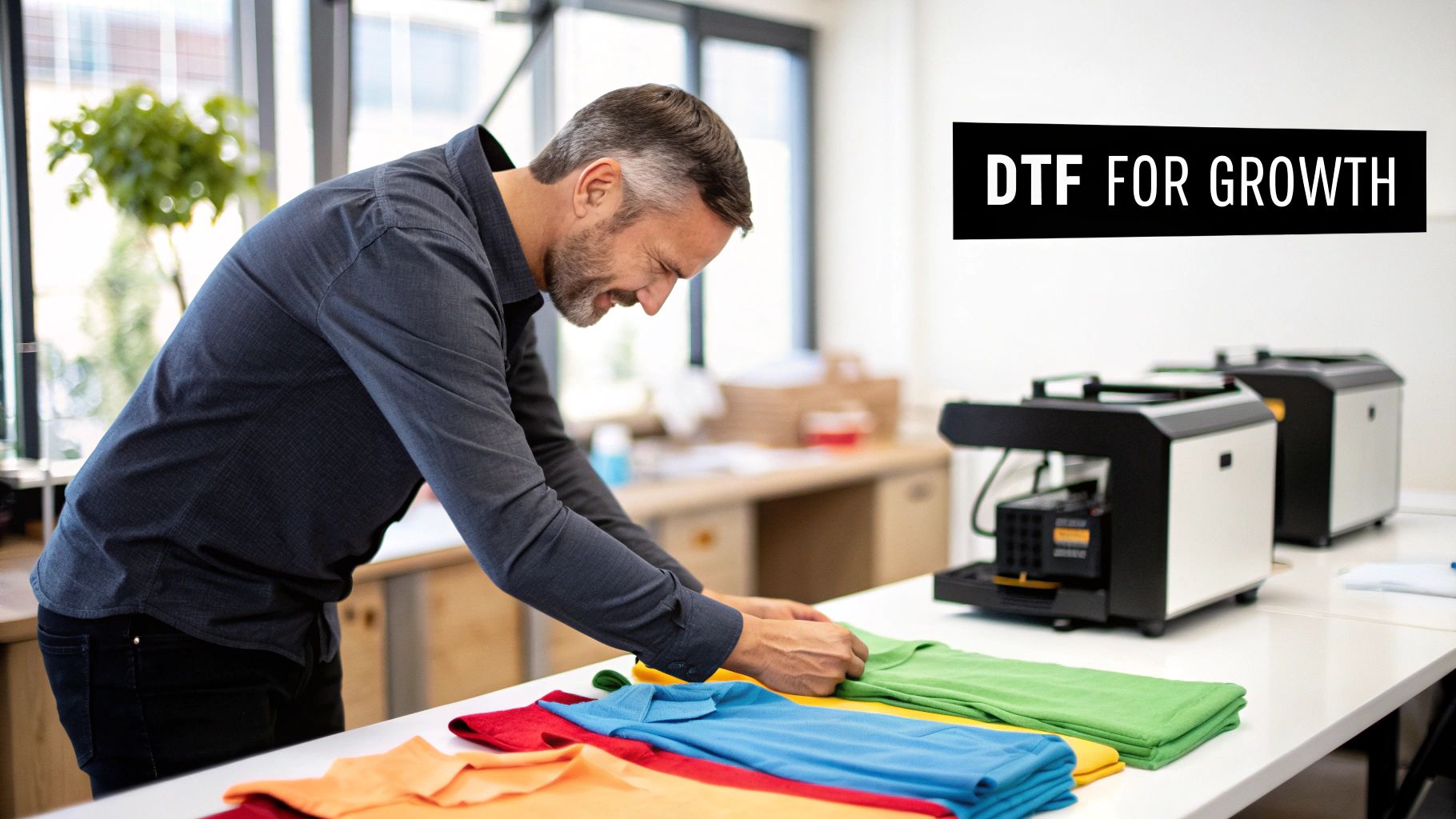
For a long time, small shops were stuck in a dilemma. Screen printing had massive setup costs, while Direct-to-Garment (DTG) was picky about fabrics. DTF printing came along and bridged that gap perfectly, offering a killer solution that takes the best from both worlds. You get the freedom to print on all sorts of materials without the hassle of pre-treatment, which is a major bottleneck in most DTG workflows.
This flexibility is a huge deal. A small business can go from printing custom cotton tees one day to performance polyester hoodies or even canvas bags the next, all using the same machine. That kind of agility means you can expand your product line on the fly and say yes to just about any customer request.
The Strategic Edge for Entrepreneurs
Another reason DTF has caught on is its low barrier to entry. Screen printing demands separate screens for every single color and takes up a ton of space. A compact DTF setup, on the other hand, can easily fit into a small studio, a back room, or even a home office. This makes it the perfect launchpad for startups and side hustles.
Imagine you're launching a custom merch line. Instead of outsourcing the printing and watching your profits shrink, you can bring it all in-house with a DTF printer. This doesn't just save money; it gives you total control over the final quality and how fast you can get orders out the door. Adopting DTF is one of the most practical business process improvement techniques you can implement, fundamentally changing how you produce and grow.
A DTF printer isn't just another piece of equipment—it's an engine for growth. It gives you the power to take on complex, multi-color jobs and work with all kinds of fabrics, opening up revenue streams you couldn't touch before.
A Market That's Taking Off
The numbers back this up. The global DTF printer market is booming, largely because it’s so attractive to entrepreneurs. The market was valued at around USD 667 million in 2025 and is expected to grow at a Compound Annual Growth Rate (CAGR) of 5.2% through 2033. This surge is fueled by DTF's unique blend of versatility and lower equipment costs compared to other digital printing methods. You can find more details about this growing market on marketreportanalytics.com.
At the end of the day, putting your money into the right DTF printer isn't just about printing shirts. It's about building a business that can scale, turn a healthy profit, and let your creativity run wild.
How to Choose the Right DTF Printer for Your Business
Picking your first DTF printer is a huge decision, and frankly, it should be. This machine is going to be the heart of your operation, so you have to look past the price tag and really dig into what makes a printer a reliable workhorse versus a constant headache. Finding the best DTF printer for a small business is all about matching its capabilities to your real-world needs and future goals.
Think of it this way: you're not just buying a piece of equipment; you're hiring a production partner. The right one will make your workflow smooth and profitable. The wrong one? It'll cost you time, money, and sanity. Let's walk through the critical factors you need to weigh before pulling the trigger.
Print Quality and Resolution
Your customers will judge your business on one thing first: the quality of the print. If you want a reputation for top-tier products, you need to deliver vibrant colors and razor-sharp details, and that all comes down to the printer's resolution.
We measure resolution in dots per inch (DPI). A higher DPI means the printer can lay down more ink in a small area, which translates to finer details and smoother color transitions. For professional-grade results, don't even consider a printer with less than 1440 DPI. Anything lower risks turning detailed artwork into a pixelated mess, especially when you have small text or intricate lines.
A printer's knack for consistently kicking out high-resolution transfers is what separates the hobbyist from the professional. It directly shapes how customers see your brand and whether they'll come back for more.
Production Speed and Realistic Daily Output
Don't get fooled by the speeds you see on a spec sheet. Manufacturers love to advertise eye-popping numbers in square feet per hour, but those figures are almost always based on "draft" mode—a low-quality setting you'd never actually use for a customer's order.
A much better question to ask is, "How many shirt-sized transfers can this thing actually produce in an 8-hour shift?" You have to factor in the time it takes for the RIP software to process the file, the printing itself, and the daily maintenance routine. A shop aiming for 50-100 prints a day has totally different needs than one scaling to 300+. Get real about your current volume and where you want to be in a year so you don't buy a machine that immediately becomes a bottleneck.
For many small businesses, weighing speed against versatility is a key part of the decision. If you're curious how DTF stacks up against other methods, our guide on the differences between DTF and DTG printing breaks it down in more detail.
Ink System and White Ink Management
The ink system is the lifeblood of any DTF printer, and its design can make or break your entire workflow. Pay close attention to the white ink circulation system. White ink is notoriously tricky because its main pigment, titanium dioxide, is heavy and settles quickly. When it settles, it creates clogs in the printhead, which happens to be the most expensive component to replace.
A good printer solves this problem with an automated system that constantly circulates or agitates the white ink, keeping the pigment suspended. This single feature saves you countless hours of maintenance and protects you from catastrophic printhead failures. Printers without it force you to manually shake cartridges and perform endless cleanings, which is a recipe for downtime and frustration. Trust me, prioritizing a machine with a solid white ink management system is one of the smartest moves you can make.
Footprint and Operational Space
Last but not least, where are you going to put this thing? DTF printers range from compact desktop units to much larger industrial machines. Before you buy, get out a tape measure and map out your workspace. You don't just need room for the printer; you also need space for your powdering and curing station, a heat press, and some elbow room to work.
Remember to plan for good ventilation, easy access for maintenance, and storage for your consumables like film, ink, and powder. A lot of successful shops are run out of a garage or a spare room, but they all have one thing in common: a well-planned layout. Make sure you have the right electrical setup to handle the load and enough airflow to keep the space safe and comfortable. An organized workspace is the foundation of an efficient business.
Comparing Top DTF Printers for Small Businesses
Picking the right DTF printer is easily one of the most important decisions you'll make for your custom apparel business. It's so much more than just the price tag; you're locking into a specific workflow, maintenance schedule, and production ceiling. A close look at the top contenders reveals the small but critical differences that decide whether a machine becomes your business's workhorse or its biggest headache.
Forget a generic pro/con list. Let's dig into the real-world, day-to-day impact of choosing between the top models. We'll evaluate them based on what actually affects your operations and, ultimately, your bottom line.
This chart gives you a quick visual on the balancing act every small business owner faces: finding the sweet spot between print quality, production speed, and the machine's physical footprint.
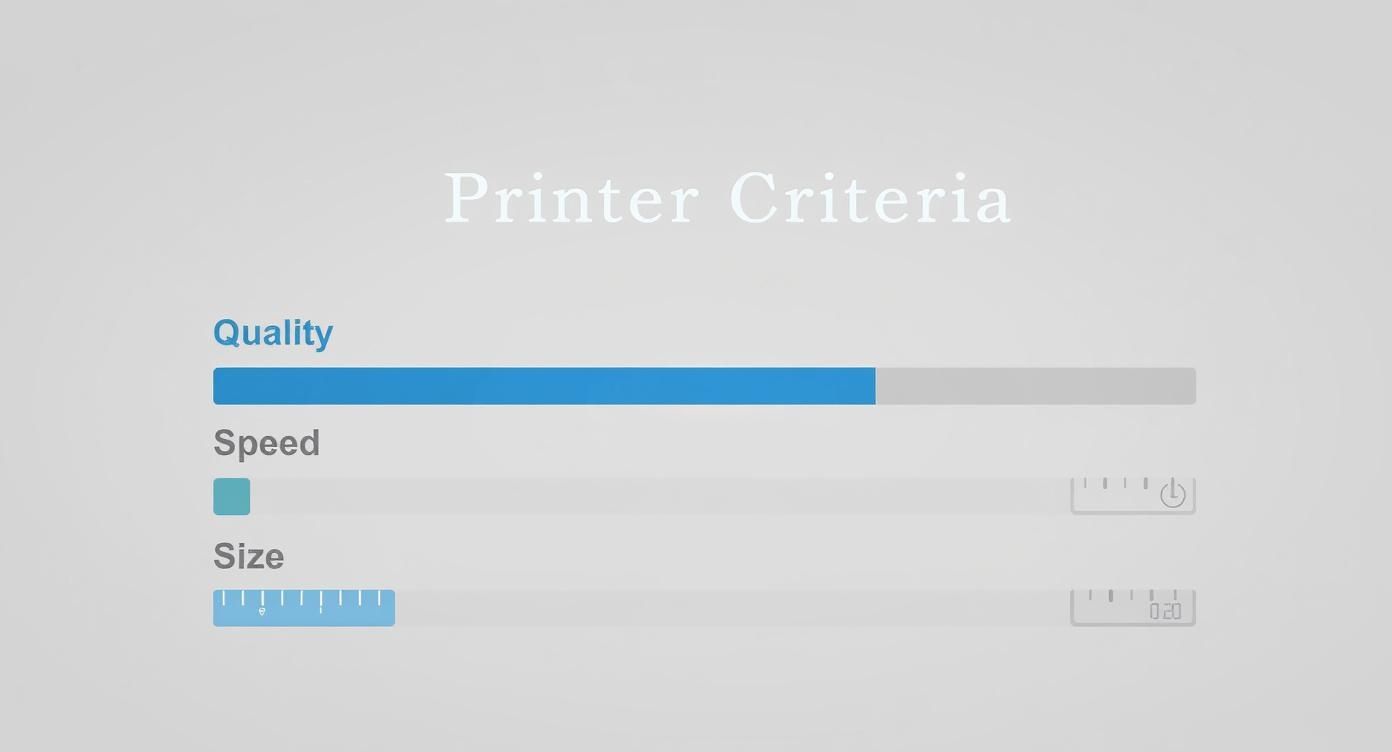
As you can see, there are always trade-offs. Printers that deliver jaw-dropping quality might move at a crawl, while a smaller, space-saving unit might not keep up with a surprise rush of orders.
The Entry-Level Workhorses
For startups and garage-based shops, budget-friendly models like a converted Epson L1800 or the Prestige A3+ are usually the first stop. These printers give you a way into the DTF game without needing to take out a massive loan, letting you start producing fantastic transfers from day one.
The Prestige A3+ is a popular choice, known for its solid print quality and compact, desktop-friendly size. It's a great option if you're just testing the waters or handling smaller, one-off custom orders. Its main advantage is delivering professional-looking prints for a pretty low initial investment.
The catch? Maintenance and speed. These entry-level machines demand more hands-on attention, especially when it comes to managing the white ink. You'll spend a good chunk of your morning on cleanings and system checks to keep clogs at bay. Speed is also modest, which can become a real bottleneck if your orders start climbing past 50-75 prints per day.
When does this make sense? The Prestige A3+ is a perfect fit for a new Etsy seller or a small boutique that specializes in unique, low-volume orders. If your business thrives on creative freedom and top-tier quality rather than mass production, this category gives you a phenomenal return on your investment.
The Scalable All-Rounders
When you're ready to step up, you'll find printers like the Cobra DTF Model X. This category is a major leap forward in automation, reliability, and production power, built for small businesses that have their sights set on growth.
The big difference here is the focus on an efficient workflow. The Cobra DTF, for example, has an automated white ink circulation and filtration system. This isn't just a nice-to-have feature; it’s a game-changer that slashes your daily maintenance time and dramatically lowers the risk of a catastrophic printhead failure. While an entry-level machine might need 20 minutes of your attention every morning, a system like this can cut that time in half.
That saved time means more prints. A business running a Cobra DTF can confidently handle 100-200+ prints a day without the constant worry of downtime. These machines are also built tougher, engineered to withstand the grind of a full-time production schedule.
Here’s a snapshot of the key features and costs for these popular models.
Feature and Cost Comparison of Leading Small Business DTF Printers
This table provides a side-by-side comparison of the top DTF printers, focusing on the key metrics that matter most to small business owners, from initial setup costs to long-term operational expenses and performance capabilities.
| Feature | Cobra DTF Model X | Prestige A3+ | Competitor Model Z |
|---|---|---|---|
| Initial Cost | $4,500 | $2,800 | $3,500 |
| Print Speed | Up to 25 sq ft/hr | Up to 12 sq ft/hr | Up to 18 sq ft/hr |
| Max Print Width | 13 inches | 13 inches | 12 inches |
| Ink System | Automated Circulation | Manual Agitation | Semi-Automated |
| Daily Maintenance | ~10 mins (automated) | ~20 mins (manual) | ~15 mins (manual) |
| Best For | Growing Shops | Startups / Hobbyists | Mid-Volume Shops |
| Ideal Daily Volume | 100-200+ prints | Up to 75 prints | Up to 125 prints |
As this breakdown shows, the all-rounder models like the Cobra DTF Model X justify their higher price through features that directly impact your daily output and long-term reliability.
Commercial-Grade Powerhouses
For established shops poised for serious growth, commercial-grade printers like the Brother GTX Pro or Mimaki TxF150-75 start to make sense. These are beasts built for high-volume, non-stop production, and they come with a price tag to match.
A printer like the Brother GTX Pro offers lightning-fast print speeds and sophisticated features like cloud-based maintenance alerts. It's designed to be the core of a busy print shop, cranking out hundreds of transfers with very little hands-on help. The print quality is top-of-the-line, and the whole system is engineered for maximum uptime.
The main thing to consider is the investment. These printers are a huge financial commitment, often costing $15,000 or more. For a small business, you have to ask: does my order volume justify the cost? A machine this powerful is a money pit if it's just sitting idle.
The market backs this up. The DTF printer industry is booming, especially for small and medium-sized businesses. In 2024, DTF printers brought in around USD 1.31 billion in revenue, with Roll-to-Roll printers being the fastest-growing type. This tells us there's a huge demand from small businesses needing to scale up. You can learn more about the growth of the direct-to-film market.
Making the Right Choice for Your Business
At the end of the day, the best DTF printer for you comes down to your unique situation. Don't get distracted by the fastest speeds or the lowest price. Be honest about where your business is now and where you want it to be in a year.
- For the Creative Starter: If you're building a brand from the ground up, focusing on killer designs with a tight budget, an entry-level model like the Prestige A3+ gives you the quality you need without breaking the bank.
- For the Growth-Focused Shop: If you've already got steady demand and your main goal is to pump out more orders reliably, an all-rounder like the Cobra DTF Model X is the smart move. It hits the sweet spot of cost, performance, and automation to build a scalable operation.
- For the Volume Producer: If you're already juggling hundreds of orders a day and need to maximize every minute, a commercial-grade machine is the logical next step—as long as you have the capital and the order flow to feed it.
Calculating the Real ROI of a DTF Printer Investment
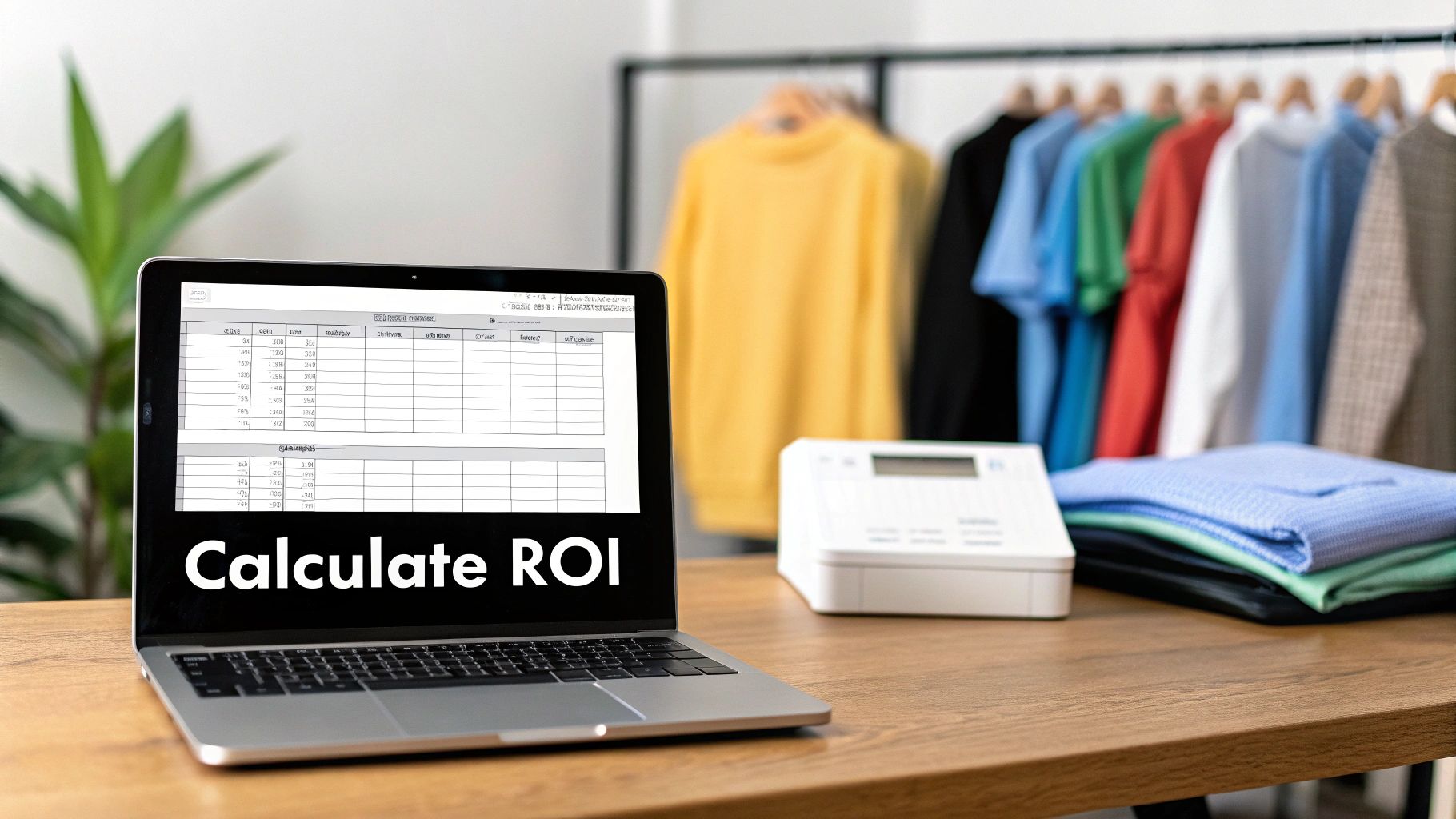
Buying a DTF printer is a huge step for any small business, but you can't just run on gut feelings. To make a smart call, you need to build a real financial case by figuring out its true Return on Investment (ROI). This means looking way beyond the sticker price and getting a grip on every single cost that goes into making your final product.
The main goal here is to nail down your cost-per-print. This number is the bedrock of your pricing strategy and tells you exactly how profitable you can be. By breaking down the hard costs and the softer, long-term benefits, you can see precisely when your new machine will start making you money.
Tallying Up the Tangible Costs
First things first, let's get a complete picture of your expenses. A lot of people just fixate on the initial cost of the printer, but that’s a rookie mistake. The real costs are spread out, and you need a full list to be accurate.
Here’s what you absolutely must account for:
- Initial Equipment Investment: The total bill for the printer, heat press, and anything else you need to get started, like a fume extractor.
- DTF Ink: Figure out the cost per milliliter and get a feel for how much you'll use per print. Don't forget, white ink is usually the thirstiest, so factor that in.
- DTF Film: Film comes in rolls or sheets. You’ll need to calculate the cost per square inch to price out different-sized transfers accurately.
- Adhesive Powder: It’s a smaller but constant expense. Track how much you use per print or over a full day of production.
- Maintenance Supplies: Think cleaning swabs, solution, and the eventual replacement parts like dampers or wiper blades.
- Utilities: It’s easy to forget the electricity needed to power the printer, curing oven, and heat press, especially when you’re running them all day.
Understanding your cost-per-print isn't just an accounting exercise; it’s a strategic tool. It empowers you to price your products competitively while ensuring healthy profit margins on every single order you fulfill.
Calculating Your Break-Even Point
Once your costs are clear, you can find your break-even point. This is the magic number—the exact amount of product you need to sell to cover your entire initial investment. It turns a hopeful purchase into a measurable business goal.
Let's walk through a real-world example:
- Calculate Your Total Startup Cost: Imagine your complete setup (printer, press, starter supplies) runs you $6,000.
- Determine Your Cost-Per-Print: After tallying up ink, film, and powder, you find an average 10x12 inch chest logo transfer costs you $1.50 to make.
- Set Your Selling Price: You decide to sell a t-shirt with this custom print for $25. The blank shirt itself costs you $3.50.
-
Find Your Profit Per Shirt:
- Selling Price: $25.00
- Subtract Blank Shirt Cost: -$3.50
- Subtract DTF Transfer Cost: -$1.50
- Net Profit Per Shirt: $20.00
-
Calculate Break-Even Point:
- Total Investment / Net Profit Per Shirt = Number of Shirts to Break Even
- $6,000 / $20.00 = 300 shirts
This simple math shows you need to sell 300 shirts to make back your entire initial investment. When you see it laid out like that, the goal becomes tangible and much more achievable.
The Intangible ROI That Fuels Growth
The financial breakdown is crucial, but it's only half the story. The best DTF printer for a small business also delivers powerful returns that don’t show up on a spreadsheet but are absolutely vital for long-term success.
These benefits are game-changers:
- Full Quality Control: You’re no longer at the mercy of third-party printers. You control the final look and feel, making sure every item meets your brand’s standards.
- Faster Turnaround Times: Being able to offer same-day or next-day service is a huge competitive edge. It lets you take on rush jobs and charge a premium for them.
- Expanded Creative Freedom: You can finally say "yes" to those complex, multi-color, and high-margin jobs that were once too difficult or expensive to outsource.
- Increased Production Efficiency: Bringing printing in-house just makes your whole workflow smoother. We actually dive deeper into this in our guide on improving your production efficiency.
When you combine a clear financial analysis with an appreciation for these strategic perks, you can make a data-backed decision that truly sets your business up for profit and growth.
Future-Proofing Your Business with DTF Technology
Choosing the right DTF printer for your small business is more than just a purchase for today—it’s an investment in your company’s future. The world of digital printing moves fast, and DTF is leading the charge. If you stay on top of the trends, your equipment will remain a powerful asset, not a piece of outdated tech.
The next generation of DTF technology is all about making the process smarter, more efficient, and even more sustainable. These aren't just minor tweaks; they're advancements designed to solve the real-world headaches small business owners deal with, from frustrating color matching to costly maintenance downtime. Knowing what’s coming down the pike helps you make a buy that sets you up for long-term success.
Smarter and More Sustainable Printing
One of the biggest shifts on the horizon is the integration of AI-powered software. Picture a system that takes the guesswork out of color management. New AI tools are being developed that can analyze your designs and automatically dial in the perfect ink levels, nailing the color on the very first print. That means less wasted material and far less time spent on trial and error.
At the same time, the push for eco-friendly production is getting stronger. Manufacturers are responding with biodegradable inks and adhesive powders, which is a huge selling point for environmentally conscious customers. Offering sustainable printing isn't just a good deed—it's a smart marketing move that can make your business stand out.
The technological evolution includes AI-driven color correction tools that reduce calibration errors, cloud-based print management systems that enable remote monitoring and predictive maintenance, and hybrid printing models. These innovations reduce operating complexity and minimize downtime, making DTF printers increasingly attractive. To see the full scope of these advancements, you can discover more insights about DTF printer innovations on 360iresearch.com.
The Rise of Hybrid and Specialized Systems
The incredible versatility of DTF is also branching out into new areas. We’re starting to see hybrid printers hit the market, combining DTF with other methods like Direct-to-Garment (DTG) or even UV printing. Imagine one machine that could flawlessly decorate a t-shirt and then pivot to printing on a hard-surface promotional item. This opens up entirely new product lines for your shop.
This expansion into new materials is a massive area of growth. For instance, specialized transfers are making it easier than ever to decorate items that go way beyond standard fabrics. If that piques your interest, you should check out our guide on UV DTF printing to see how this tech is being used on hard surfaces.
Ultimately, buying a DTF printer today means you're getting in on a platform with a very bright future. When you choose a quality machine from a trusted brand like Cobra DTF, you’re not just buying a printer; you're building a foundation that can grow and adapt as these exciting new technologies become the new standard.
Your Top DTF Printer Questions, Answered
Jumping into DTF printing is a big move, and it's totally normal to have a ton of questions. After all, you're making a serious investment in your business, and you need to feel confident about it. I've put together this section to give you straight-up answers to the most common questions I hear from small business owners, so you can make your decision with your eyes wide open.
We'll get into the real-world stuff—from what it really costs to get started to what running one of these machines day-to-day actually looks like. The goal here is to cut through the noise and help you move forward.
What’s the True Startup Cost for a DTF Printing Business?
The printer is just the start. To figure out your real startup cost, you have to think about the entire setup you’ll need to actually produce anything. A quality best DTF printer for small business will set you back anywhere from $3,000 to $8,000, but that's just piece number one.
You’ll also need to budget for a few other non-negotiable items to get your operation running professionally.
Here’s a realistic look at what you should plan for:
- Heat Press: Absolutely essential. A good one costs between $300 and $1,000.
- DTF Ink Sets: A starter set of inks will usually run from $200 to $400.
- Transfer Film and Powder: Your first batch of film and adhesive powder will add another $90 to $230.
- RIP Software: This often comes bundled with the printer. If not, expect to spend $300 to $600.
When you add it all up, a safe and realistic startup budget lands somewhere between $4,500 and $10,000. This range ensures you have everything you need for high-quality work without running out of supplies a week after you start.
How Much Maintenance Does a DTF Printer Really Need?
Here’s the honest truth: consistent maintenance is the key to keeping your DTF printer alive and well. It's not optional, especially because the white ink system can be finicky. Taking care of your machine proactively is what keeps you from dealing with expensive, business-stopping repairs later.
Daily tasks are simple but critical. You'll want to run a quick nozzle check, do a basic head cleaning, and make sure the white ink is agitated. This little routine is what stops the pigments from settling and clogging up the works.
Weekly, things get a bit more involved. Plan on giving the capping station, wiper blade, and the area around the printhead a more thorough cleaning. While some of the more advanced printers have automated white ink circulation systems that help, you should still expect to spend about 15-20 minutes on maintenance every day you print. Trust me, that small time investment pays for itself over and over again in performance and longevity.
Can I Run a DTF Printer From Home?
Yes, you absolutely can. One of the best things about the DTF printers built for small businesses is their compact size. They can easily fit into a home office, a corner of the garage, or a spare bedroom. Plenty of successful apparel brands got their start in a home-based workshop.
There is one critical thing you can't ignore, though: ventilation. The process of curing the adhesive powder on the film releases fumes, and for your own health and safety, you have to operate in a well-ventilated space.
I strongly recommend getting a dedicated air filtration unit, sometimes called a fume extractor. It makes for a much safer and more comfortable work environment. Also, always double-check the printer's power requirements to make sure your home's circuits can handle both the printer and the heat press running at the same time.
Is DTF or DTG Better for a Small T-Shirt Business?
This is the classic fork in the road for new apparel businesses. For the vast majority of small businesses just getting their feet wet, DTF printing is the smarter, more flexible choice. The main reason boils down to one thing: what you can print on.
DTF is a game-changer because it works on an incredible range of fabrics. You can print on cotton, polyester, tricky blends, and even some hard surfaces without having to pre-treat every single item. This opens up a massive catalog of products you can offer your customers right out of the gate.
Direct-to-Garment (DTG), on the other hand, gives you a slightly softer feel on 100% cotton, but it’s extremely limited beyond that. Plus, DTG demands a messy and time-consuming pre-treatment step for every single garment. When you look at the lower startup costs and broader material options, DTF is simply a more scalable and secure investment for a new business trying to grow.
Ready to find the perfect DTF printer that combines reliability, quality, and exceptional support? Explore the solutions offered by Cobra DTF and see how American-made quality can elevate your small business.