
Discover t shirt materials: Fabrics for DTF Printing & Comfort
When you're running a custom apparel business, picking the right t shirt materials is one of the most critical decisions you'll make. It’s the very foundation of your product, and it has a ripple effect on everything from print quality and durability to customer comfort and, ultimately, your bottom line.
Think of it this way: a blank t-shirt is your canvas. The better the canvas, the more your artwork will pop and the longer it will last.
Why Your Choice of T Shirt Material Matters
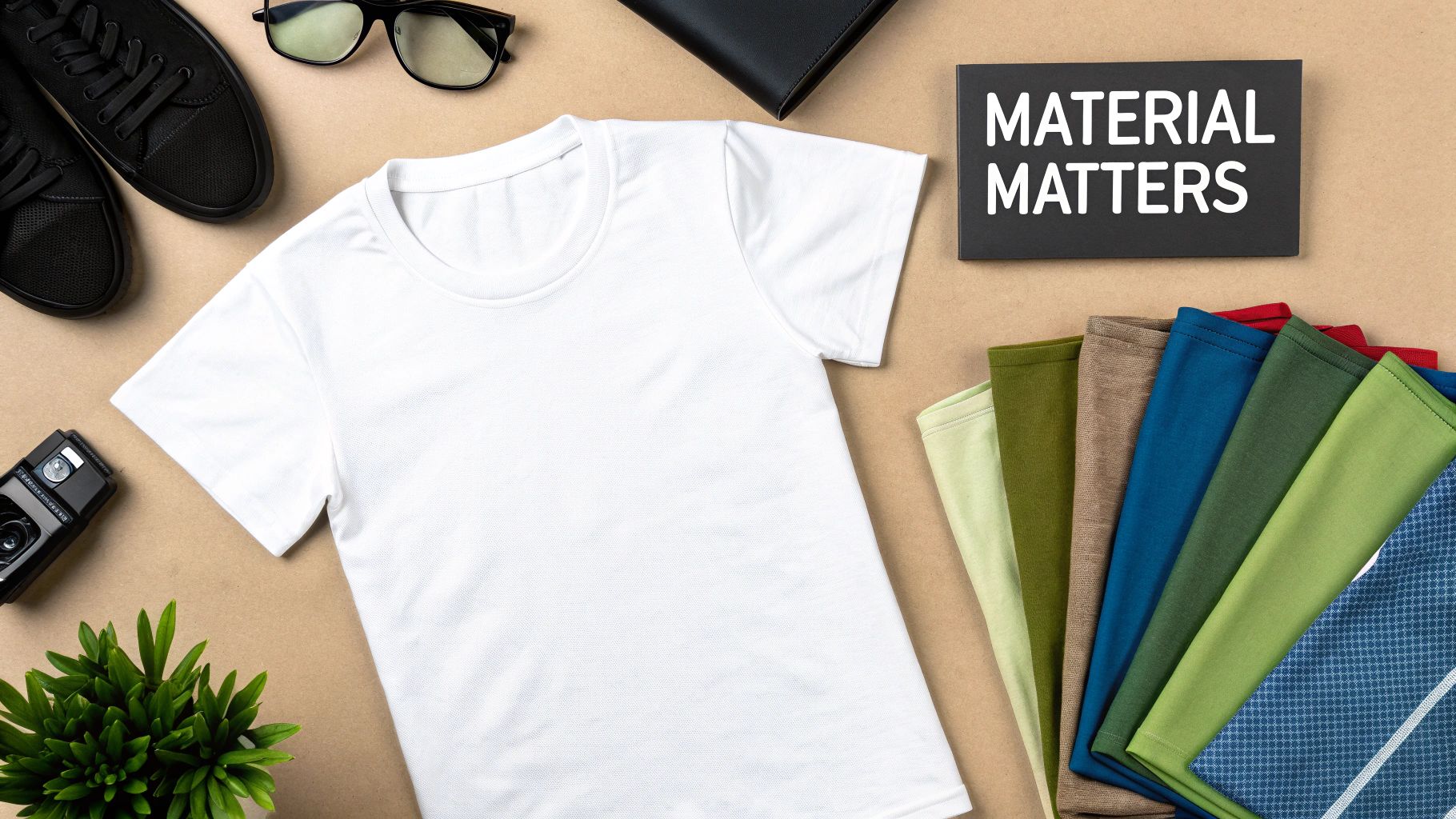
The material you choose is so much more than just a backdrop for your design—it’s a core part of your brand identity. It literally shapes how a customer feels about your product from the first touch. A super-soft, breathable shirt can turn a first-time buyer into a lifelong fan. On the flip side, a scratchy, poorly-fitting tee is a fast track to a bad review.
Your fabric choice also telegraphs your brand's values loud and clear. Are you a premium, high-end label or an approachable, budget-friendly option? The material tells that story before a customer even looks at the price tag. For any serious apparel business, getting a handle on the different t shirt materials isn't just a technical detail; it’s a massive strategic advantage.
The Foundation of Print Quality
The magic really happens where ink meets fabric. Every material takes ink differently, and this is a huge deal for modern printing methods. For instance, a smooth, tightly-woven cotton provides a perfect, flat surface that lets detailed graphics shine with sharp lines and vibrant colors.
The texture and makeup of a fabric will completely change how a print looks and feels. A smooth surface, like ringspun cotton, results in crisp, high-definition designs. A rougher, open-weave fabric, however, will soak up more ink and give you more of a muted, vintage vibe.
Understanding this relationship is non-negotiable, especially when you're working with a versatile method like Direct-to-Film (DTF). To get a better grasp of the technology, you can dive into our complete guide on what DTF printing is.
In this guide, we'll break down the industry's go-to options:
- Cotton: The undisputed classic, loved for its softness and breathability.
- Polyester: The performance powerhouse, known for durability and moisture-wicking.
- Blends: The best-of-both-worlds fabrics that combine the strengths of different fibers.
By the time you're done reading, you'll be able to confidently pick fabrics that not only feel amazing but also make your designs look their absolute best.
Cotton: The Timeless Standard for T-Shirts
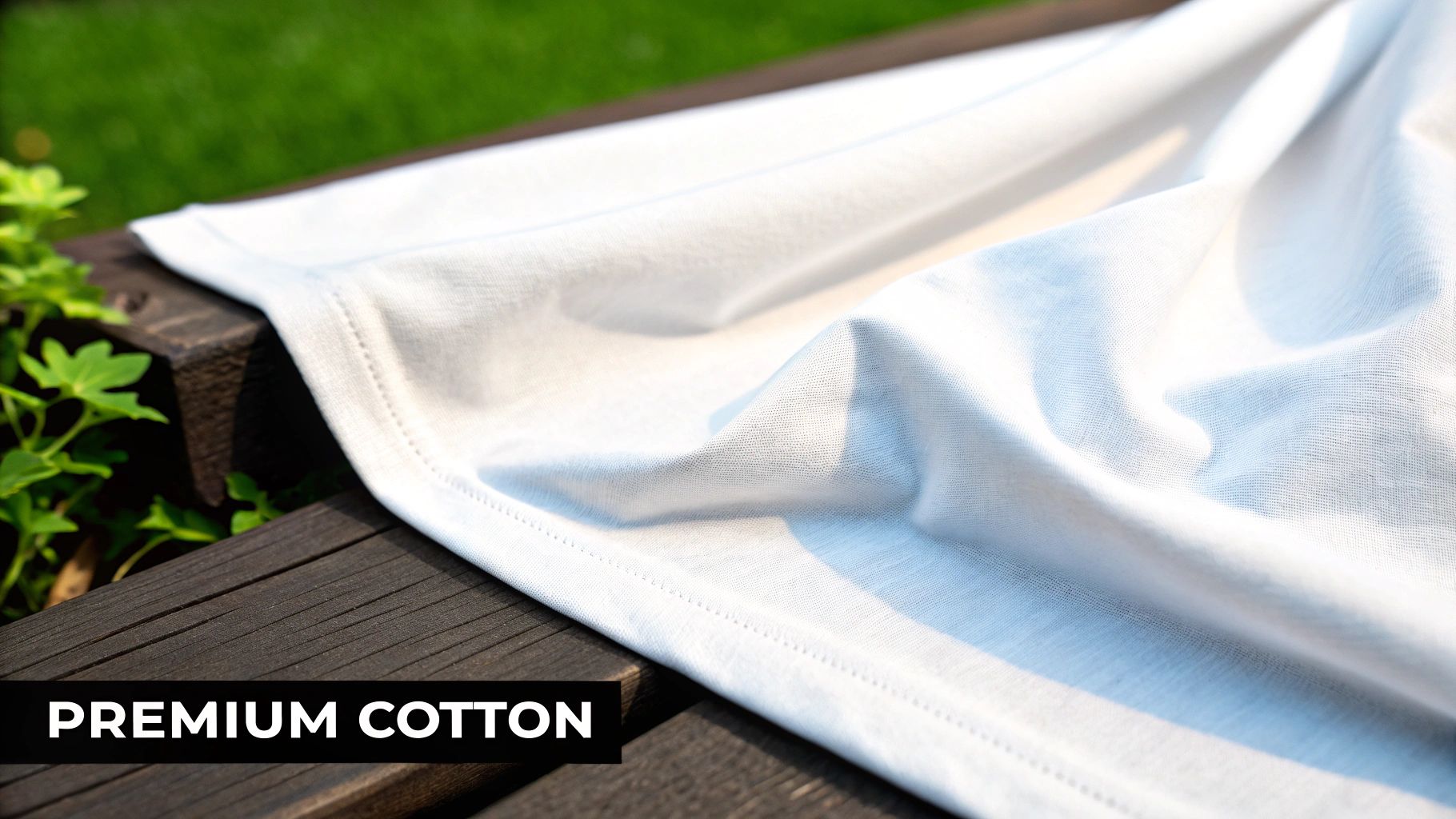
When people think of a classic t-shirt, they’re almost always picturing cotton. This natural fiber is the undisputed champion of the apparel world, loved for its softness, breathability, and that familiar comfort everyone knows. It’s the safe bet, the reliable foundation for any custom t-shirt business.
Cotton’s popularity is staggering. It commands over 50% of the market share for t-shirt materials worldwide. With a global appetite for around 22 billion t-shirts annually, cotton is the engine of the industry. Manufacturing powerhouses like China produce about 6.38 billion of those shirts, accounting for roughly 29% of the world's supply. The global t-shirt market data really puts its dominance into perspective.
But here’s the thing: just saying you use "cotton" is like a chef saying they cook with "vegetables." It’s a start, but it doesn’t tell you anything about the quality. The feel, durability, and especially the printability of a cotton tee all come down to how the raw fibers are processed.
Carded Open-End Cotton: The Workhorse
Think of Carded Open-End (COE) cotton as your standard, no-frills option. It's the most budget-friendly of the bunch, making it the go-to for promotional giveaways, one-off event shirts, or any time you need a large volume of tees without breaking the bank.
The fibers are "carded," which is a bit like brushing tangled hair—it gets them mostly aligned but leaves some short fibers and impurities behind. This results in a slightly rougher texture. While it’s a dependable and affordable choice, COE cotton isn’t the best surface for high-detail printing. Its looser weave can make prints look a little less vibrant and even a bit fuzzy up close.
The Painter's Canvas Analogy
Imagine your DTF transfer is a crisp, high-resolution photograph. Printing on Carded Open-End cotton is like using a rough, budget-friendly canvas. The paint will stick, sure, but the underlying texture will soften the sharp lines and mute some of the finer details.
This is your pick when the bottom line and sheer quantity are the most important factors.
Ringspun Cotton: A Softer Upgrade
Take a step up the quality ladder, and you'll find ringspun cotton. The process here is more refined—the cotton strands are continuously twisted and thinned, creating a yarn that is much finer, stronger, and noticeably softer. You can feel the difference immediately. Ringspun tees are smoother to the touch and just feel more premium.
That extra smoothness is a huge plus for printing. The tighter, more uniform surface is an excellent base for DTF transfers. They adhere beautifully, giving you sharper lines and more vibrant colors. It’s that perfect sweet spot between cost and quality, making it a fantastic, versatile choice for retail-focused brands.
- Softer Hand-Feel: The spinning process results in a garment that's way more comfortable.
- Improved Durability: Those tightly twisted fibers make the fabric more resilient and less prone to tearing.
- Better Print Surface: The even texture acts as a superior canvas for all your detailed designs.
Combed and Ringspun: The Premium Choice
At the very top of the cotton pyramid sits combed and ringspun cotton. This fabric gets an extra step of pampering. Before the fibers are spun, they're meticulously combed with fine brushes to pull out any remaining impurities and short, stubby fibers. All that’s left are the longest, straightest, and strongest fibers.
The result is an exceptionally smooth, soft, and durable fabric that creates the ultimate canvas for printing.
For any business aiming for a truly premium apparel line, this is the gold standard. DTF prints on combed and ringspun cotton come out incredibly sharp, with brilliant color fidelity and a clean, professional finish that easily justifies a higher price tag. This is the material you choose when every detail matters and you want to deliver an absolutely uncompromising experience.
Polyester: The Champion of Performance and Durability
If cotton is the comfortable, everyday classic, then polyester is the engineered workhorse of the apparel world. This synthetic fabric is the undisputed star of athletic and performance gear, built from the ground up for one mission: to perform. Where a cotton shirt soaks up sweat and gets heavy, polyester actively pulls it away from your skin to keep you dry.
Think of it this way: a cotton tee is like a sponge, but a polyester tee is more like a high-tech gutter system, channeling moisture away. This moisture-wicking superpower is exactly why polyester is the go-to for gym clothes, team jerseys, and any activity where staying comfortable is non-negotiable.
But its strengths don't stop there. Polyester fibers are incredibly tough. They resist shrinking, stretching, and wrinkling, making it the perfect material for garments that have to survive rough-and-tumble use and frequent washes while still looking sharp.
Why Polyester Dominates Performance Wear
The secret to polyester's success is that its fibers are hydrophobic—they literally repel water. Instead of soaking moisture in, the fabric allows sweat to travel to the surface where it can evaporate in a flash. It's a simple bit of science that has completely secured its place in the market.
Polyester's role is only getting bigger, thanks to its durability and cost-effectiveness. It currently holds about 12% of the market share for t-shirts, with production steadily rising. As you can see in Textile Exchange's comprehensive 2025 report, polyester blends are now essential, especially in performance apparel where they can make up 65% of an athletic tee's composition.
For a custom apparel shop, the benefits are huge:
- Vibrant, Fade-Resistant Color: Polyester grabs onto dye and doesn't let go. That means bold team colors and bright graphics stay that way, wash after wash.
- Wrinkle Resistance: You can pull a polyester shirt out of a gym bag and it’s ready to wear. No fuss.
- Exceptional Durability: It stands up to scuffs, scrapes, and general abuse, making it ideal for sports uniforms or demanding workwear.
Printing on Polyester T-Shirt Materials
Now for the tricky part. As great as polyester is, it brings a unique challenge to the print shop: dye migration. This is what happens when the fabric's own dye gets heated up during the pressing process and "bleeds" into your transfer, ruining the colors. That crisp white logo on a red jersey? It could easily turn out pink.
The good news is, this is a totally preventable problem, especially if you're working with DTF transfers.
The key to preventing dye migration is all about controlling your heat and using the right transfer. It's like cooking a delicate sauce—too much heat and it curdles. With polyester, you need just enough heat to cure the ink without waking up the fabric's dye.
To get your DTF transfers on polyester looking sharp and true-to-color, you need to follow a few critical steps:
- Use Sublimation Blocker Transfers: This is your best defense. These DTF transfers are made with a special black or charcoal-colored layer on the back that acts as a solid barrier, stopping the fabric's dye in its tracks.
- Lower Your Heat Press Temperature: Polyester doesn't need as much heat as cotton. Dropping your press to around 275-300°F (135-150°C) is usually all it takes to cure the transfer without causing a dye bleed.
- Reduce Your Pressing Time: A shorter press time of about 10-15 seconds works hand-in-hand with lower temperatures to minimize the risk. As always, do a quick test on a scrap piece of fabric to dial in your settings.
Once you get these techniques down, you can confidently offer high-performance polyester garments to a whole new set of customers. You'll be ready to outfit local sports teams, gyms, and corporate events, serving clients who need their apparel to be as tough and vibrant as they are.
Blends: Combining the Best of Both Worlds
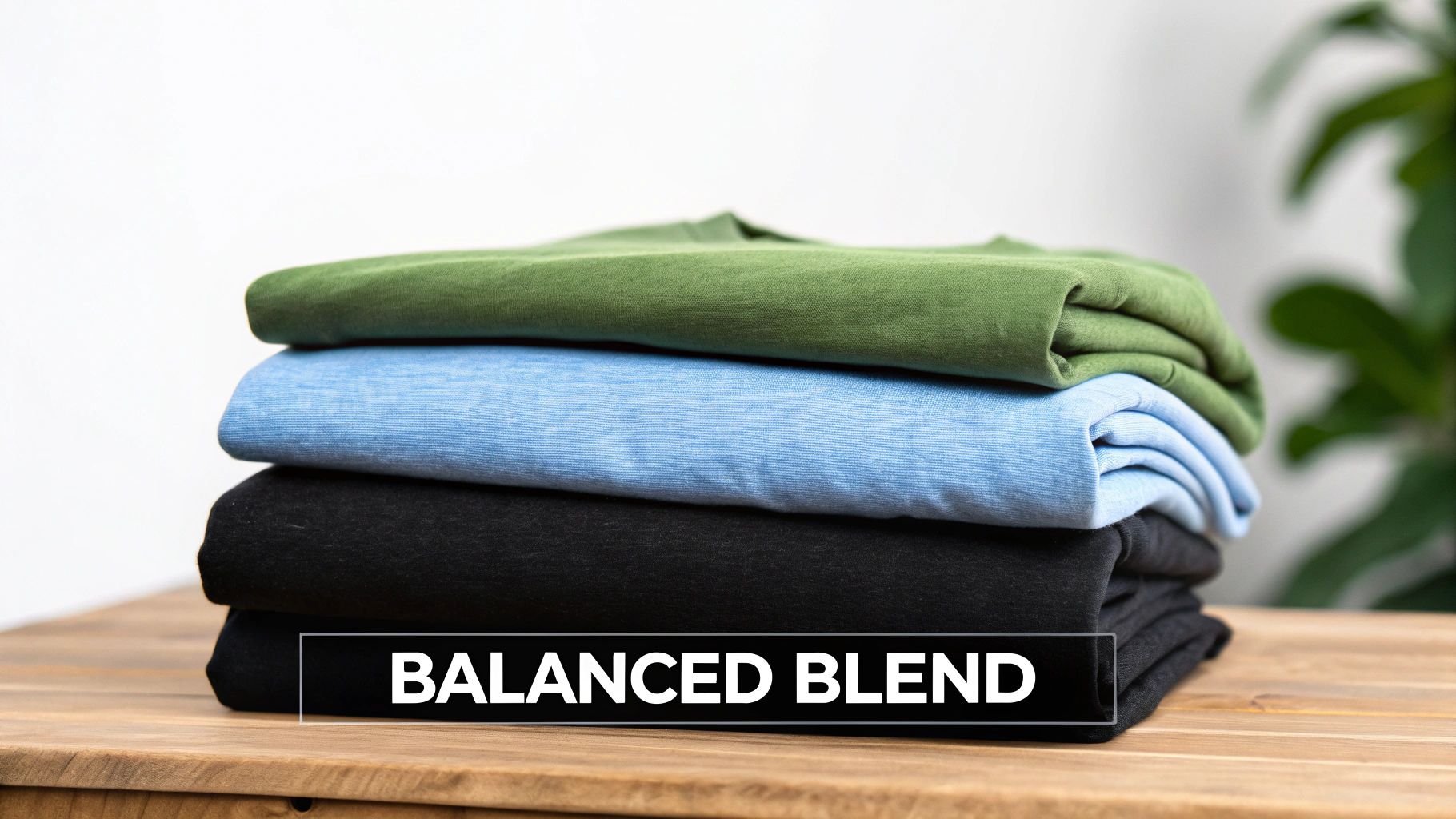
While pure cotton and pure polyester each have their place, the real magic for many apparel businesses happens in the middle ground: fabric blends. Think of blends as a team of specialists. Each fiber brings its A-game, and together, they create a garment that’s often far more versatile than any single material could be on its own.
By strategically mixing different t shirt materials, you can hit that sweet spot of comfort, durability, and printability. For a custom apparel shop, understanding blends isn't just helpful—it's how you offer a solution for nearly every customer request.
The Classic 50/50 Cotton and Polyester Blend
The 50/50 blend is the original workhorse of the industry, and for good reason. It’s a perfectly balanced partnership between cotton and polyester that delivers on both comfort and performance. You'll find it everywhere, from staff uniforms to band merch.
Here's the breakdown: cotton brings its natural softness and breathability, making the shirt feel great. At the same time, polyester steps in to provide toughness, wrinkle resistance, and shape retention, wash after wash. The result is a tee that feels comfortable, holds up over time, and is far less likely to shrink than its 100% cotton counterpart.
This combination is a cornerstone of the t-shirt market, which was valued at $169.143 billion back in 2021 and is expected to climb to $195.6 billion by 2025. Blends are a huge driver of that growth, partly because they can cut shrinkage by up to 50% compared to pure cotton. You can dive deeper into the growth of the t-shirt market to see just how big of an impact these fabrics have.
A 50/50 blend is like the perfect duo in a movie—one brings the heart, the other brings the muscle. Together, they create something that’s both relatable and incredibly resilient, appealing to a much wider audience.
When it comes to printing, the 50/50 blend's surface is generally smoother than basic cotton, which helps DTF transfers come out looking sharp. Just remember that the polyester content can lead to dye migration on darker shirts, so using a slightly lower temperature on your heat press is a smart precaution.
CVC Blends For a Softer Feel
What if you want the durability of a blend but crave a softer, more cotton-like feel? That's where Chief Value Cotton (CVC) blends come in. These fabrics flip the ratio, typically using more cotton than polyester—think 60% cotton and 40% polyester.
The whole point of a CVC blend is to lean into the softness and premium feel of cotton while keeping the performance perks of polyester. This makes CVC tees feel noticeably softer and more breathable than a 50/50, bringing them much closer to the feel of 100% ringspun cotton without sacrificing durability.
- Enhanced Softness: The higher cotton content gives it a much better feel against the skin.
- Good Durability: You still get the shrink and wrinkle resistance from the polyester component.
- Great Printability: Its cotton-dominant surface is a fantastic canvas for vibrant DTF prints.
Tri-Blends: The Ultimate in Softness and Drape
For those projects where softness and style are everything, the tri-blend is the undisputed champion. This premium fabric combines three materials—cotton, polyester, and rayon—to create a t-shirt that's exceptionally soft, lightweight, and has that perfect, stylish drape.
Rayon is the secret weapon here. It’s a fiber made from wood pulp that’s famous for its silky-smooth texture and fluid feel. When you mix it into a cotton/poly blend, you get a fabric that’s unbelievably soft, has a bit of natural stretch, and hangs just right, giving it that retail-ready, vintage vibe.
A common tri-blend recipe is 50% polyester, 25% cotton, and 25% rayon. This unique mix often results in a subtle, heathered look that's incredibly popular in fashion. While you have to be a little more careful with heat when printing on tri-blends, the end result is a high-end garment that offers unmatched comfort and can command a premium price.
T Shirt Material Comparison for Custom Printing
Choosing the right blank is half the battle in the custom apparel world. This table breaks down the most common materials to help you match the right fabric to the right job, ensuring your prints look great and your customers are happy.
| Material Type | Feel & Comfort | Durability | Shrinkage Rate | DTF Printability | Best For |
|---|---|---|---|---|---|
| 100% Cotton | Soft, breathable, classic feel. Ringspun is softer. | Good, but can wear out faster than blends. | High (up to 5-7%) | Excellent, especially on ringspun. | Everyday wear, brand merch, events where comfort is key. |
| 100% Polyester | Smooth, silky, lightweight. Less breathable. | Excellent. Resists wrinkles, shrinking, and fading. | Very Low (<1%) | Excellent, but requires lower heat to avoid dye migration. | Athletic wear, performance gear, team jerseys. |
| 50/50 Blend | Softer than pure poly, more durable than pure cotton. | Very Good. Balances comfort with resilience. | Low (1-3%) | Very Good. Smooth surface, but watch heat on darks. | All-purpose tees, staff uniforms, large-volume orders. |
| CVC Blend | Very soft, feels more like premium cotton. | Good. Retains some polyester strength. | Low (2-4%) | Excellent. The cotton-rich face is ideal for DTF. | Customers who want a softer-than-average blend. |
| Tri-Blend | The softest option. Lightweight with a stylish drape. | Good, but can be prone to pilling over time. | Low (2-4%) | Good, but requires low heat and careful application. | Fashion apparel, retail brands, premium merchandise. |
Ultimately, the best material depends entirely on the project's goal. Whether it's a budget-friendly event tee or a high-end fashion piece, having these options in your arsenal lets you deliver exactly what your customer needs.
How Fabric Weight and Weave Define Quality
It's easy to get hung up on the type of fiber, but the real personality of a t-shirt—what makes it feel just right—comes down to two things people often miss: its weight and its weave. These construction details are the difference between a flimsy, one-wash-wonder and a high-quality shirt that becomes a go-to favorite for years. If you want to pick the best t shirt materials for your project, you've got to understand this stuff.
Think of fabric weight as the density of the material, usually measured in ounces per square yard (oz/yd²) or grams per square meter (g/m²). It's a lot like paper. You know the difference between a thin sheet of copy paper and a heavy piece of cardstock, right? One feels light and flexible, the other feels substantial and rigid.
T-shirts work the same way. A lighter fabric feels airy and drapes nicely, while a heavier one feels tough and durable.
Decoding Fabric Weights
T-shirt fabrics generally fall into three weight classes. There’s no single "best" weight—it’s all about matching the shirt to its purpose and the vibe you're going for.
Here’s a simple way to think about what those numbers mean:
-
Lightweight (Under 5 oz/yd² or ~170 g/m²): These are your breezy, super-soft shirts. They're perfect for summer clothing, athletic lines, or that fashionable, slightly sheer look. They feel great but might not be the most durable option.
-
Midweight (5-6 oz/yd² or ~170-200 g/m²): This is the sweet spot and the industry standard for a reason. It’s the perfect compromise between being tough enough for everyday wear and comfortable enough that people actually want to wear it. Most band merch and general-purpose tees live here.
-
Heavyweight (Over 6 oz/yd² or ~200+ g/m²): These are the tanks of the t-shirt world. They feel thick, structured, and scream "premium." If you're creating for a streetwear brand, durable workwear, or just want a high-end feel that holds its shape, this is your category.
For an even deeper look at how to pick the right blank, our guide on choosing the best quality tee shirts for printing has you covered.
Understanding Fabric Weave and Knit
While weight tells you how dense a fabric is, the weave—or for t-shirts, more accurately, the knit—tells you how the threads are actually put together. The knit is like the architectural plan for the fabric; it determines the texture, how much it stretches, and how it feels on your skin.
By far the most common knit you'll encounter is the Jersey Knit. This is a single-knit fabric that’s smooth and flat on the outside, with a slightly more textured inside. It’s what gives a classic tee its signature softness and comfortable stretch. That perfectly smooth face also makes it an ideal canvas for DTF transfers, letting all the fine details in your design pop.
Think of a Jersey Knit as a freshly paved road—it's smooth, even, and gives your DTF transfer a perfect surface to bond to. Other knits can be more like a cobblestone street, where the texture can interfere with the final look of the print.
You'll also run into Piqué Knit, especially with polo shirts. It has a very distinct, textured waffle or honeycomb pattern. It's breathable and tough, but that uneven surface can be a real headache for printing intricate designs. Small text or fine lines can get lost in the texture.
Getting a handle on both weight and knit lets you make truly intentional choices. You can confidently pick a lightweight jersey for a breezy summer promo shirt or a heavyweight jersey for a premium streetwear drop, knowing exactly how that choice will shape the look, feel, and quality of the final product.
Choosing the Right T-Shirt Material for Your Business
Picking the right fabric for your apparel line is so much more than a technical detail. It's one of the most critical business decisions you'll make, shaping everything from your brand identity to your profit margins. Every choice, whether it's a basic lightweight cotton or a high-end tri-blend, tells your customers a story about who you are.
This is where your product meets your promise. Are you the go-to brand for affordable, great-looking tees for big events? Or are you building a premium streetwear label where the feel and drape are just as important as the design? The right t-shirt materials are the foundation of that entire strategy.
Aligning Fabric with Business Goals
Before you even look at a fabric swatch, you need to answer a few key questions about your business. Thinking this through creates a clear roadmap, helping you cut through the noise of a massive supplier catalog and zero in on the perfect options for your brand.
- Who are you selling to? A high school basketball team needs something durable that wicks sweat, like a good polyester. But a customer at a chic boutique? They're probably looking for the super-soft, luxe feel of a tri-blend or ringspun cotton.
- How do you want your brand to feel? If you're building a premium brand, you need to invest in premium materials like heavyweight combed cotton or specialty blends. If you're focused on value, a trusty 50/50 blend often hits that sweet spot between quality and cost.
- What’s your price point? Your material costs directly dictate your retail price. Make sure the fabric you choose leaves you enough room for a healthy profit margin while still giving your customer a great deal.
- What’s the shirt for? A tee for a one-off music festival doesn't need the same resilience as a company uniform that gets washed every other day. Match the fabric's performance to its real-world purpose.
This decision tree gives you a simple framework for matching different t-shirt materials to what you're trying to achieve.
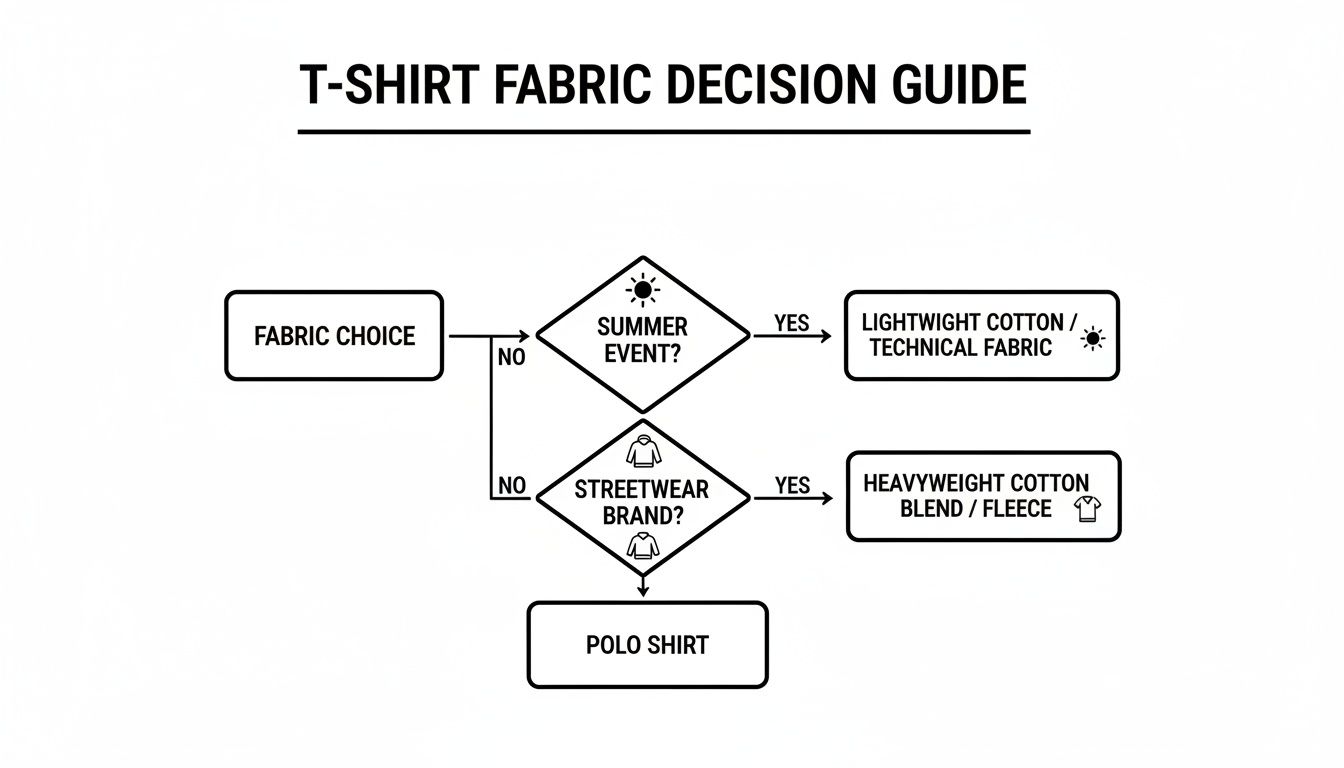
As you can see, the end use—whether it’s for a casual giveaway, a high-end fashion line, or a professional work uniform—should always be the starting point for your fabric choice.
Making the Final Decision
At the end of the day, the fabric you choose is a direct reflection of your commitment to quality. It shows your customers you care about their comfort, how the shirt fits, and how long it will last. For those of us in the DTF printing world, knowing how different fabrics react to heat and ink is absolutely crucial. To dive deeper, check out our curated guide on the https://cobradtf.com/blogs/guides/best-shirts-for-dtf.
Your blank t-shirt isn't just another piece of inventory. It’s the canvas for your art and the physical product your customer connects with. Get the material right, and you build a positive connection that creates loyal fans and repeat business.
Of course, a fantastic product is only the first step. You also need solid strategies to increase online sales to get your apparel into your customers' hands. But it all starts here, with the fabric. Get this choice right, and you're well on your way.
Got Questions About T-Shirt Materials? We've Got Answers.
When you're building an apparel business, picking the right t-shirt material can feel like a huge puzzle. You're trying to juggle quality, cost, and how well your designs will actually print. Let's clear up some of the most common questions we hear from creators just like you.
What's the Absolute Softest T-Shirt Material?
If you're looking for that "I never want to take this off" feel, tri-blends are king. They're a mix of cotton, polyester, and rayon, and it's the rayon that gives them that incredibly silky, lightweight drape. For a premium, retail-ready shirt where comfort is everything, a tri-blend is the way to go.
Looking for a pure fiber that’s just as luxurious? Your next best bet is 100% combed and ringspun cotton. The combing process yanks out all the short, scratchy fibers, leaving behind only the long, smooth ones. The result is a ridiculously soft and smooth fabric that feels amazing against the skin.
How Can I Stop My Shirts From Shrinking?
Ah, the dreaded shrinkage. We've all been there. Luckily, choosing the right material from the start is your best defense. Here's what you need to know:
- 100% Polyester: This one's easy. Polyester is a synthetic fiber, so it's naturally shrink-resistant. It’s a super safe choice if fit consistency is a top priority.
- Cotton/Polyester Blends: A 50/50 blend or a CVC (Chief Value Cotton) blend will slash shrinkage by as much as 50% compared to a 100% cotton tee. You get the best of both worlds—the feel of cotton with the stability of polyester.
- Pre-Shrunk Cotton: If you're set on using 100% cotton, always look for the "pre-shrunk" label. This means the factory has already put the fabric through a wash-and-dry cycle, so most of the shrinking happens before the shirt ever gets to you or your customer.
Quick tip: Heat is the #1 enemy of a t-shirt's fit. Always tell your customers to wash their shirts in cold water and tumble dry on low. This will protect not just the size of the shirt, but the life of your print, too.
What's the Best Fabric for DTF Printing?
For DTF transfers, a smooth, tightly woven surface is your best friend. This is why 100% ringspun cotton is such a popular choice. Its ultra-smooth face allows the transfer's adhesive to get a perfect grip, leading to prints that are razor-sharp and bursting with color. CVC blends are another fantastic option, offering a similarly smooth surface thanks to their high cotton content.
The beauty of DTF is that you can print on almost anything, from 100% polyester to tri-blends. Just remember that the smoother the fabric, the crisper the final detail will be. And a pro-tip for polyester and dark blends: use lower heat settings during pressing to keep that pesky dye migration at bay.
Will You Be Able to Feel the DTF Print?
Yes, but that's actually one of its best features. A well-pressed DTF transfer feels incredibly soft and flexible. It’s a world away from the thick, stiff feel of old-school vinyl and is often much softer to the touch than a heavy layer of screen printing ink.
The print actually stretches and moves with the fabric, so you don't have to worry about it cracking or peeling. It’s a perfect blend of durability and comfort that your customers will definitely notice.
Ready to print designs that look and feel amazing on any fabric? Cobra DTF provides premium, USA-made DTF transfers that make your artwork pop. Check out our high-quality transfers and see the difference for yourself.