
Sweat Wicking Fabric: What It Is and How It Works
The most common advice about sweat wicking fabric is also the least useful: choose any shirt labeled “moisture-wicking” and expect it to keep the wearer cool and dry. That label can describe a real performance feature, but it doesn't tell you how quickly sweat moves, how far it spreads, how fast it evaporates, or what happens after a transfer covers part of the garment.
For a printer or custom-shirt maker, the distinction matters. Two shirts can carry the same artwork and look identical on the press, yet behave differently in wear because their fiber blend, knit density, air permeability, surface finish, seams, and print coverage aren't the same. A reliable buying decision starts with measurable moisture management, then connects those measurements to the finished decorated garment.
Why Sweat Wicking Is More Than a Label
Sweat wicking isn't a magic property contained in one special thread. It's a moisture-management system. The fabric has to pick up liquid at the skin-facing surface, move it through capillary pathways, spread it across the outer face, and give the surrounding air enough access for evaporation. A weakness at any point can leave the wearer feeling damp, even when the product description sounds impressive.
A useful analogy comes from the print shop. A transfer doesn't perform because the artwork file has a good name. It performs because the film, adhesive, powder, press temperature, pressure, and garment surface work together. Wicking works in much the same way. Fiber chemistry creates one part of the behavior, while yarn geometry and knit construction create the channels that carry liquid.
Practical rule: Treat “moisture-wicking” as a starting question, not a finished answer.
The 2024 study of multilayer knitted sportswear fabrics found that fiber type, yarn structure, and fabric density affected moisture transport. It also identified a significant relationship between stitch density and transport efficiency at p < 0.05, while higher outer-layer porosity generally improved moisture movement. That finding has a direct shop-floor consequence. A polyester label doesn't tell you whether the garment has open pathways, dense loops, layered channels, or a surface that slows evaporation.
Four questions that clarify performance
A buyer, decorator, and end customer may ask different questions:
- The buyer wants consistent garments from one order to the next.
- The printer needs a surface that accepts adhesive and survives curing.
- The wearer wants less wet cling and a reasonable drying experience.
- The brand owner needs claims that match the finished product.
Those needs meet in the test data. A fabric can transport liquid efficiently without producing a noticeable cooling effect if the environment is humid or airflow is poor. A controlled exercise study found no significant differences in several temperature, cardiovascular, oxygen-consumption, or comfort measures between a purportedly evaporative polyester garment and traditional cotton under moderate heat, showing why wicking alone can't guarantee better thermoregulation (controlled exercise findings).
The rest of the buying decision should follow that logic. First define the physical process, then compare fibers and structures, then inspect what a DTF print changes, and finally ask suppliers for test conditions and results instead of accepting a broad label.
What Sweat Wicking Fabric Actually Means
Wicking is the movement of liquid through or along a textile, usually through capillary pathways formed by fibers, yarns, and loops. Absorption is different. An absorbent material takes liquid into its structure and may hold it there. Drying is different again. It describes the evaporation of that liquid into the surrounding air.
Those three actions often get bundled together in product copy, but they don't always arrive together. A fabric may absorb a lot while releasing moisture slowly. Another may move a small amount of liquid rapidly across its surface but offer limited storage. A third may transport moisture well in a dry, breezy room and perform less impressively in a humid microclimate.
The measurements behind the label
Researchers can separate these behaviors with several kinds of tests:
| Measurement | What it helps reveal |
|---|---|
| Wetting time | How quickly liquid begins interacting with the fabric |
| Absorption rate | How quickly the material takes up liquid |
| Wetted radius | How widely the liquid spreads |
| Spreading speed | How rapidly the wet area expands |
| One-way transport | Whether moisture moves preferentially from one face to the other |
| Overall moisture-management capacity | How several transport behaviors work together |
| Vertical wicking height | How far liquid climbs through a suspended fabric strip |
| Air permeability | How readily air passes through the construction |
| Drying behavior | How quickly moisture leaves the fabric under stated conditions |
A vertical-wicking test uses a defined fabric strip, a liquid reservoir, and a set observation period. In one recent study, strips measuring 3 × 25 cm were suspended with their lower ends immersed, and liquid movement was recorded for 30 minutes. The strongest profiled polyester sample reached 18 cm during that test (vertical-wicking test description).
That result isn't a universal pass mark. Laboratories may change the strip dimensions, liquid supply, duration, temperature, fabric direction, or other conditions. Results from different methods aren't automatically comparable. A moisture-management tester, for example, evaluates movement from a limited droplet between sensors, while vertical wicking uses an effectively unlimited liquid supply.
For a plain-language overview before you review supplier specifications, this explanation of the basic concept is explained by 2ndShotMVP. Use it as background, then return to the actual method and result on the fabric specification sheet.
Why evaporation changes the answer
Moving sweat away from the skin isn't the same as removing heat. The liquid has to reach a surface where it can evaporate, and evaporation depends on relative humidity, airflow, exposed area, and fabric saturation. Lower humidity and stronger airflow generally support evaporation, while humid conditions and saturated fabric restrict it (moisture-management and air-permeability research).
That is why a supplier's statement should include the test method and conditions. “Moisture-wicking” tells you very little without knowing whether the claim refers to vertical movement, spreading, one-way transport, drying, or a finished-garment test.
Fibers and Blends That Move Moisture
Fiber names matter, but they don't tell the whole story. Polyester can transfer liquid effectively, while cotton or wool layers may add absorption and comfort. The 2024 multilayer study cited earlier shows why fiber blend and fabric architecture deserve equal attention. The same fiber can act differently when yarn structure, stitch density, layer position, and porosity change.
Polyester is common in performance apparel because it can support rapid liquid transfer when its filaments and knit structure create useful capillary pathways. It doesn't automatically win every application. A 2024 double-layer study found that polyester on the inner side with cotton on the outer side delivered very good moisture management and dried faster than the tested 100% polyester double-layer samples. The study also reported that increasing polyester filament number reduced moisture management and drying rate (double-layer fiber comparison).
Compare the behavior, not just the fiber name
Cellulosic fibers such as cotton and other regenerated materials can absorb moisture into the fiber interior. That can create a familiar, comfortable hand, but absorption may leave more liquid held in the fabric rather than rapidly spread across an evaporative outer surface. Wool can contribute moisture handling and comfort in a blend or layered construction. The right choice depends on the activity, climate, garment design, and decoration.
Recent activewear research also found that synthetic fabrics generally dried faster than natural fabrics, while airflow and sweat volume changed drying performance. Another study found that knit construction was decisive, with a plaited polyester and polyester-cotton construction achieving strong air permeability and wickability, while a two-layer design that moved moisture from the inner face to an outer evaporative layer outperformed simpler constructions (activewear moisture-management research).
| Fiber or construction family | Water affinity | Wicking behavior | Drying tendency | Typical use |
|---|---|---|---|---|
| Polyester | Often selected for liquid transfer | Can move moisture through engineered channels | Can dry quickly when construction and airflow support evaporation | Teamwear, activewear, decorated performance shirts |
| Cotton-containing blend | Adds absorbency and familiar comfort | Depends heavily on layer position and knit structure | May dry more slowly in some constructions | Casual performance blends and comfort-focused garments |
| Wool-containing blend | Can contribute moisture handling and comfort | Depends on yarn, layer, and fabric architecture | Application-specific | Premium or temperature-variable apparel |
| Multilayer fabric | Different faces can perform different jobs | Can direct liquid from skin side toward outer face | Strongly dependent on outer-layer porosity and airflow | Technical sportswear and specialized garments |
For a practical garment-level comparison before choosing a blank, review this cotton versus polyester guide. For customers preparing for long-distance events, a marathon race day gear guide can also help frame the choice around activity and conditions rather than fiber marketing alone.
Knit Structure, Weight, and Finishing
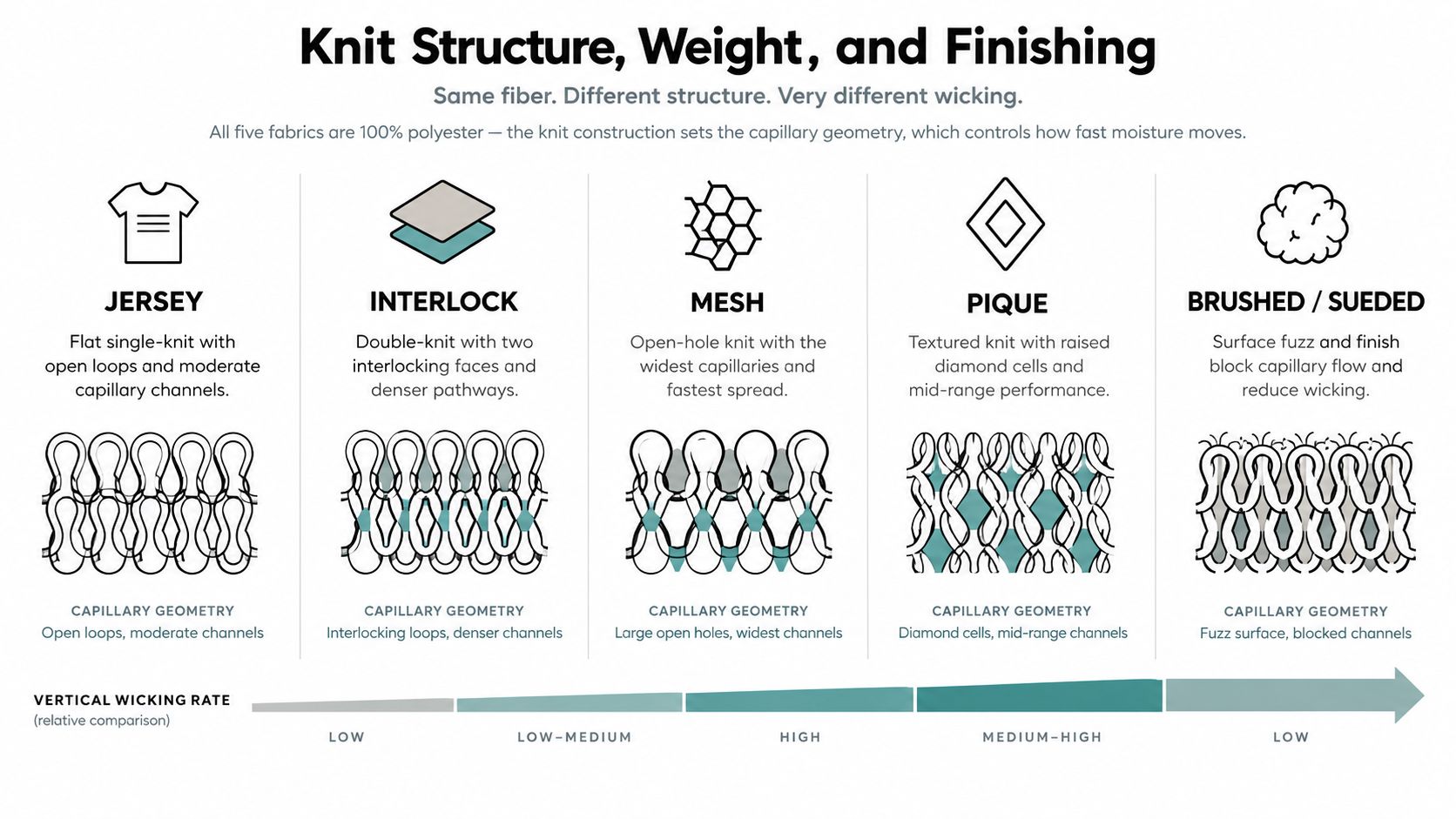
Two shirts can both say 100% polyester and still manage moisture differently. The loops determine the size and continuity of the capillary pathways, the yarn changes the available surface area, and the fabric density affects how readily liquid and air move through the body of the garment.
A jersey knit usually presents a relatively straightforward single-face construction. Interlock creates a denser double-knit structure. Mesh opens larger pathways for air and liquid movement. Pique adds texture and raised cells. Brushed or sueded surfaces change the contact area and can interrupt the direct path that liquid would otherwise follow.
Weight is a trade-off
Fabric weight affects coverage, hand, air movement, and the amount of material available to hold moisture. A light open knit may ventilate well but provide less opacity. A denser fabric may offer a smoother print surface but restrict air exchange. Don't judge weight in isolation. Ask how the garment combines mass, loop geometry, porosity, and surface finish.
A useful supplier conversation includes terms such as moisture-management treated, eyelet mesh, birdseye, and a specific performance-polyester grade where the supplier can provide test evidence. These terms describe construction or treatment, but they still aren't substitutes for a measured result.
Finishes can change with care
Heat-setting can improve dimensional stability. Chemical treatments can temporarily increase the fabric's attraction to liquid, while mechanical processes such as sanding or singeing change the hand and surface. A finish may perform well when new and lose effectiveness as laundering changes the surface chemistry. The Outrig Supply Co t-shirt guide is useful background when comparing weight and fit, but your own sample should still be tested after laundering.
For decoration, size also matters. A small chest mark leaves more of the garment's original surface available for air and vapor movement than a dense full-front graphic. When artwork needs different placements, DTF Transfers By Size provides size-specific options for chest logos, sleeve hits, and full-front graphics, with 18 variants across option 1, option 2, and option 3 listed in the catalog snapshot.
How Wicking Performance Is Measured
A supplier's claim becomes useful when you know what was measured, how it was measured, and under what conditions. One number can't describe every part of moisture management. Vertical wicking tells you about capillary movement in a direction. A spreading test shows how broadly liquid moves. Air permeability describes airflow, not liquid transport. Drying tests describe moisture loss under stated environmental conditions.
Match each test to a wear experience
| Test | Standard or method reference | What it measures | Typical good range | What it tells you |
|---|---|---|---|---|
| Vertical wicking | A defined vertical-strip procedure | Distance liquid travels over time | No universal range without matching specimen and conditions | Whether liquid can climb through the fabric |
| Moisture spreading | A moisture-management procedure such as AATCC TM217 | Liquid spreading through and across fabric | Compare like-for-like results | Whether moisture distributes across the surface |
| One-way transport | Related moisture-management testing | Movement from one fabric face to the other | Compare the reported index and conditions | Whether sweat is directed away from the skin side |
| Drying test | Gravimetric or timed moisture-loss method | Moisture lost during drying | Request the stated endpoint and environment | How quickly the garment becomes less wet |
| Air permeability | An air-flow test | Air movement through the textile | Compare the same method and pressure conditions | How much ventilation the fabric may permit |
| Vapor transmission | Water-vapor transport testing | Passage of vapor through the material | Compare the same test setup | Whether vapor can leave the garment system |
A vertical-wicking study used 3 × 25 cm strips and observed movement for 30 minutes, with one profiled polyester sample reaching 18 cm. Other procedures use 20 × 2 cm specimens and record movement at regular intervals for periods of up to 20 or 30 minutes (published test-method comparison). The different setups are precisely why a result needs its method beside it.
A useful spec sheet might show vertical movement, spreading, one-way transport, drying behavior, and air permeability for the same fabric. A label-only claim gives you no way to compare suppliers or investigate why a printed panel feels clammy.
A strong fabric result is only half the story. Test the finished garment, because seams, compression, laundering, and print coverage can alter the pathways.
When possible, request samples after laundering and inspect both the unprinted and decorated areas. A transfer may not change the base fabric's fiber chemistry, but it can change the local balance of open surface, air exchange, and vapor movement.
What Wicking Means for DTF Printing
DTF printing adds a new surface to a moisture-management system. The transfer film and adhesive layer sit over the textile, so a dense graphic can reduce local air and vapor movement even when the underlying fabric performs well. The effect is most noticeable on large, solid designs placed over an open knit.
Polyester also requires care during decoration. Sublimated polyester can present dye-migration risk, which may affect bright white areas and alter the appearance of the finished graphic. Hydrophilic surface finishes can change how the garment accepts adhesive before curing. Always test the actual blank, especially when the supplier has treated the fabric for moisture management.
Pair the garment with the decoration
Use a sample workflow rather than relying on the blank's label:
- Inspect the construction. Note whether the fabric is jersey, interlock, mesh, pique, or a layered design.
- Compare print coverage. A small logo and a dense full-front image create different breathable areas.
- Follow the transfer supplier's process. Powder amount, curing conditions, pressure, and dwell time affect adhesion.
- Check the finished panel. Look for dye migration, edge lift, excessive stiffness, and a noticeable change in air movement.
- Launder the sample. A finish or adhesive interaction can change after care.
For a garment-specific discussion of polyester decoration, see whether DTF works on polyester. A shop that needs varied artwork sizes can arrange files with the DTF Transfers Gangsheet Builder, which supports uploads, scaling, duplication, drag-and-drop placement, live preview, auto-build, and sheet lengths from 1 foot to 30 feet, with 14 variants across option 1, option 2, and option 3 listed in the catalog snapshot.
Keep this pairing guide near the press
- Open mesh plus small or medium graphic: Preserves more of the garment's ventilation potential.
- Dense jersey plus large solid graphic: Test for local heat and wet cling before selling it as a cooling garment.
- Sublimated polyester plus light transfer areas: Check dye migration and white opacity on the actual colorway.
- Treated performance fabric plus any transfer: Test adhesion before production and after laundering.
- Layered construction plus full coverage: Evaluate the entire garment system, not only the outer face.
Common Myths About Wicking Fabrics
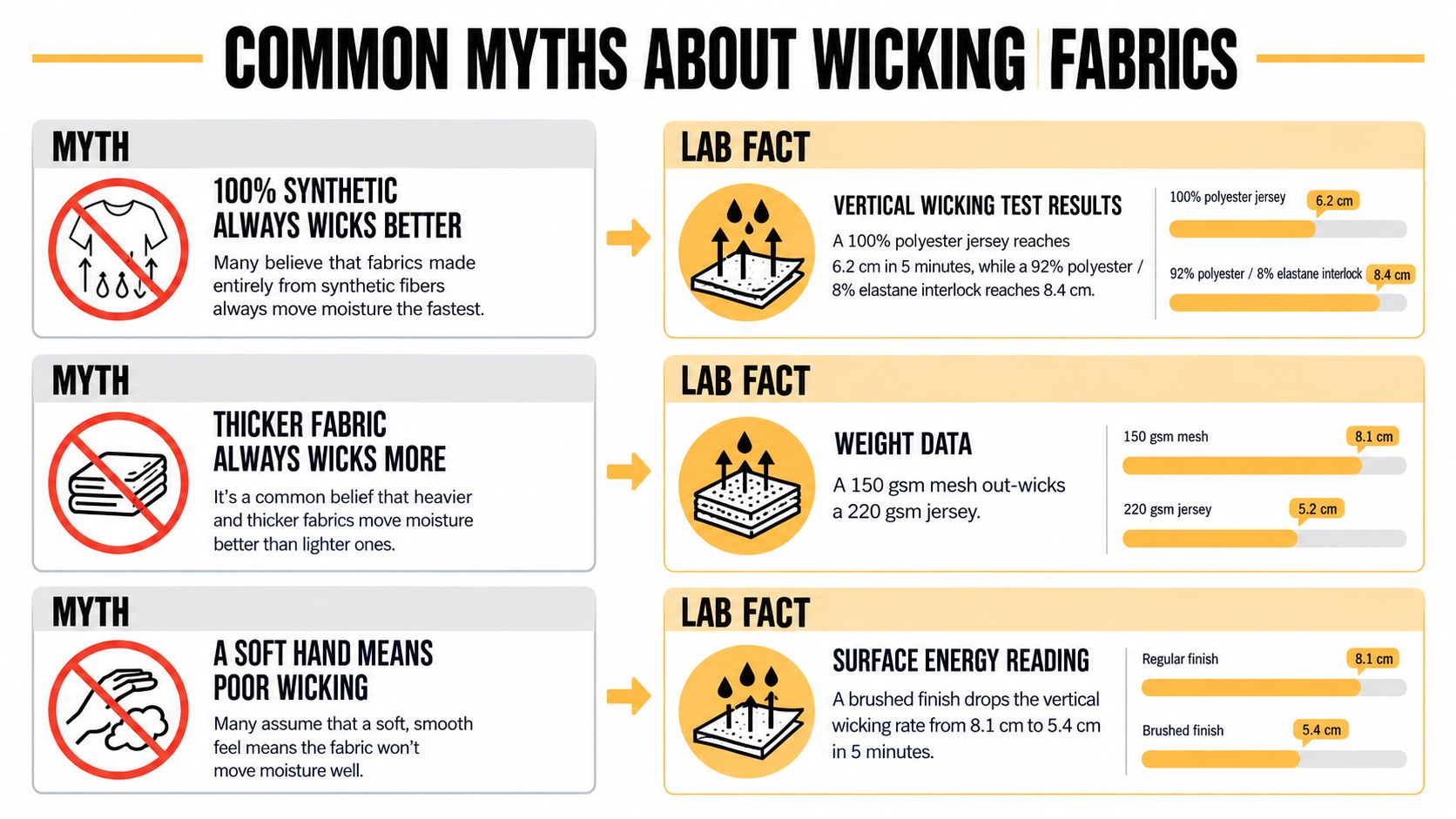
The first myth is that 100% synthetic always wicks better. Fiber content doesn't reveal stitch density, yarn structure, layer arrangement, or porosity. Verified textile research has found that polyester can transfer liquid effectively, while cotton or wool layers can improve absorption and comfort. Another comparison found a polyester-inner and cotton-outer double layer performed very well and dried faster than the tested 100% polyester double-layer samples (fiber and construction comparison).
The second myth is that wicking equals cooling. Wicking moves liquid. Cooling requires evaporation, and evaporation depends on humidity, airflow, exposed surface, and the condition of the fabric. A controlled exercise study found no significant differences across several body-temperature, cardiovascular, oxygen-consumption, and comfort measures between a purportedly evaporative polyester garment and cotton under moderate heat (exercise comparison).
The third myth is that a label guarantees performance. It doesn't tell you the test method, the result, the condition of the garment, or whether the result applies after printing and laundering. A supplier should be able to explain the fabric's liquid transport, drying behavior, and air movement with comparable test information.
The safest customer language is specific and modest. Say that a garment uses a construction designed for moisture management when you have supporting data. Don't promise that it will always feel cooler, dry instantly, or outperform every natural-fiber alternative.
Choosing the Right Wicking Fabric for Your Shop
Make fabric selection a short operating procedure instead of a guess.
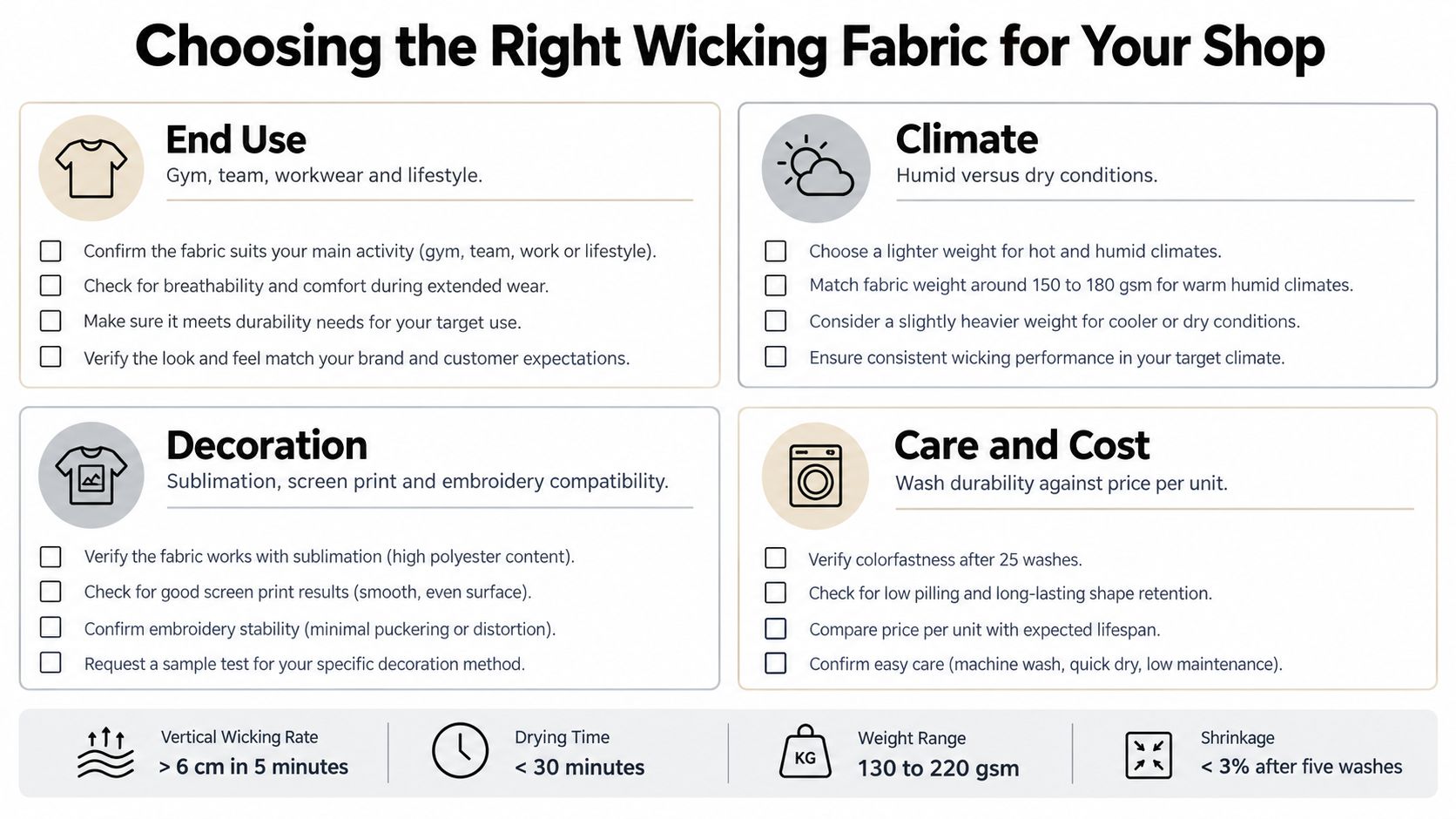
- End use: Gym shirts may prioritize spread and drying. Teamwear may need ventilation and a stable print surface. Workwear may need comfort across changing conditions. Lifestyle garments may value hand feel and appearance as much as transport.
- Climate: Humid environments demand careful attention to airflow and exposed evaporative area. Drier conditions may let the same construction evaporate more readily.
- Decoration: Match print size and density to the fabric's open area. Test sublimated polyester, treated surfaces, layered garments, and large graphics before production.
- Care and cost: Ask whether the performance depends on a topical finish, and check the decorated garment after laundering rather than relying on the untreated blank.
A supplier should answer these questions in writing:
- What vertical wicking distance did the fabric achieve, and over what test period?
- How was drying measured, and what environmental conditions were used?
- What air-permeability or vapor-transport result applies to the finished fabric?
A fabric guide such as this t-shirt material resource can support blank selection, but your production sample remains the final reference. Record the fabric construction, weight, finish, color, transfer coverage, press settings, and wash outcome in one shop worksheet.
Cobra DTF provides DTF transfers for decorated garments, including size-specific transfer options and a customizable gangsheet builder for arranging artwork before ordering. Visit Cobra DTF with your tested blank specifications, print dimensions, and application requirements so you can match the transfer workflow to the fabric's moisture-management performance.