
A Complete Guide to Modern Shirt Printing Methods
So you want to print custom shirts, but where do you even start? Picking the right shirt printing methods is about more than just getting ink on fabric; it’s about matching your vision, your budget, and your customers' expectations with the right technology. The big five techniques you'll hear about are Screen Printing, Direct-to-Garment (DTG), Direct-to-Film (DTF), Heat Transfer Vinyl (HTV), and Dye Sublimation. Each one is a tool, and the trick is knowing which one to pull out of the toolbox for the job at hand.
Unlocking Your Brand Potential With The Right Printing Method
If you're a small business owner or a creator trying to launch an apparel line, the number of printing options can feel overwhelming. The real challenge isn't just learning what DTG or sublimation means—it's figuring out which one will give you the quality, cost, and look that brings your brand to life. This guide is designed to cut through the noise and show you exactly how each method works, so you can make a smart choice for your business.
Remember, the quality of your print is a direct reflection of your brand. A shirt with a vibrant, durable design that feels great to wear is one of the most powerful tools for improving ecommerce customer experience and earning repeat customers. Our goal here isn't to just throw technical terms at you, but to give you a practical roadmap to creating products you can be proud of.
Key Factors in Your Decision
Before we dive into the nitty-gritty of each technique, let's zoom out. Choosing a printing method always comes down to a few key questions. Answering these for your specific project will immediately help you narrow down the options and point you in the right direction.
Think through these essential factors:
- Order Size: Are you making a one-off custom tee for a birthday gift, or are you running 500 shirts for a company event? Methods like screen printing are built for bulk, while others are perfect for single-item orders.
- Fabric Compatibility: What is your shirt made of? A 100% cotton tee and a moisture-wicking polyester athletic shirt are completely different beasts. The fabric's composition is a huge factor in what methods will even work. You can learn more about how fabrics behave by reading up on different types of T-shirt fabric material.
- Design Complexity: Is your design a simple, one-color logo, or is it a full-color photograph with subtle shading and gradients? The intricacy of your artwork will make certain methods shine and others fall flat.
- Durability and Feel: How do you want the final print to feel on the shirt? Some methods dye the fabric itself, leaving a super-soft, breathable finish. Others lay a thin layer on top, which can have a different texture. And, of course, how long does it need to last through wash and wear?
1. Screen Printing: The Time-Tested Workhorse
When you think of a classic printed t-shirt, chances are you're picturing screen printing. This technique is the OG of the apparel world, the powerhouse behind decades of band tees, event merch, and company uniforms. It’s a craft that has been fine-tuned over years and still holds its ground for some very good reasons.
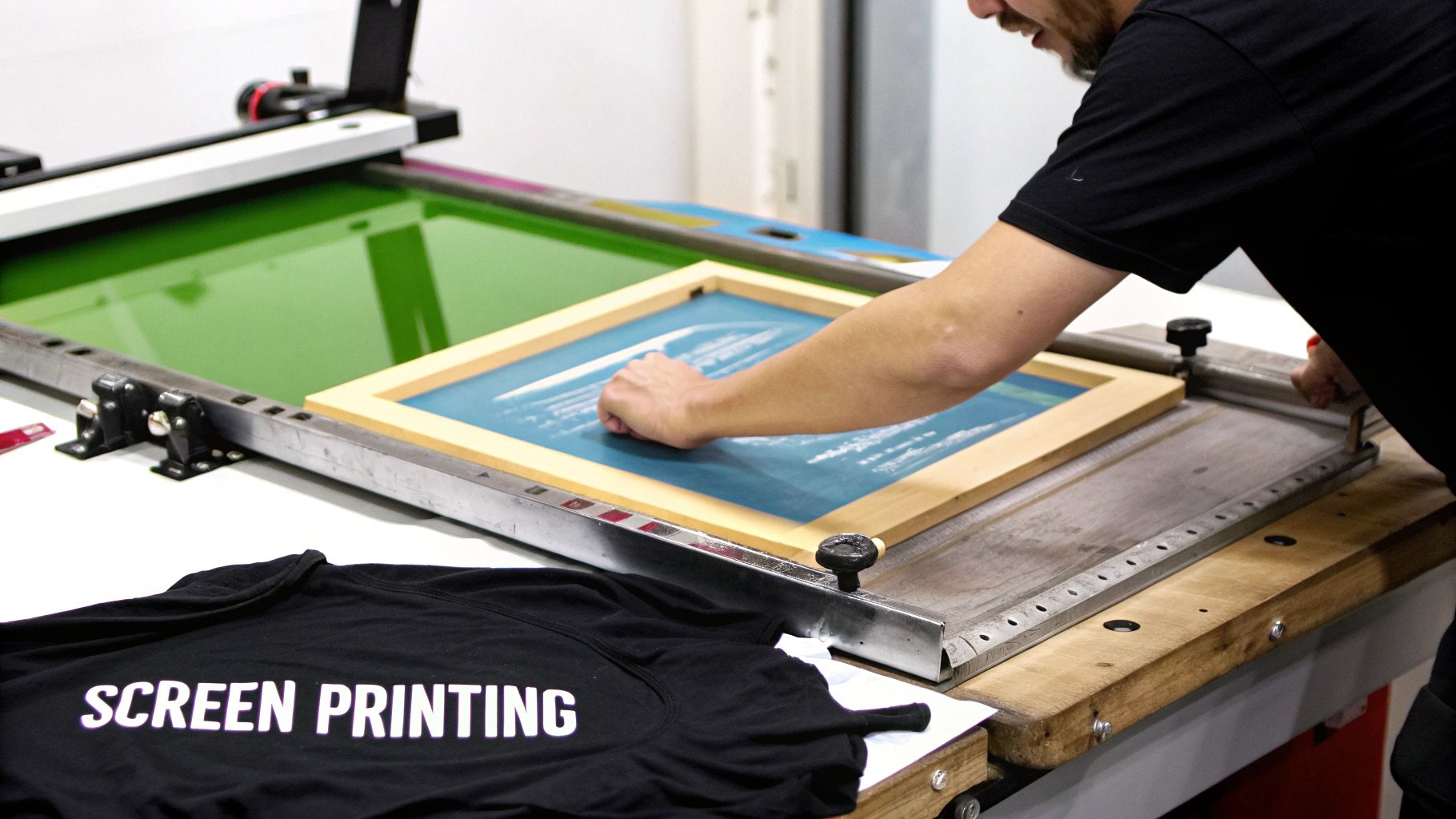
The concept is beautifully simple. Think of it like a highly sophisticated stencil. A fine mesh screen is stretched over a frame, and your design is burned into it as a stencil, creating areas where ink can pass through and areas where it's blocked.
The shirt is laid flat, the screen is placed over it, and a squeegee pushes a thick, vibrant layer of ink through the mesh and onto the fabric. For every single color in your design, you need a separate screen. A three-color logo? That's three different screens, three pulls of the squeegee, all lined up perfectly to create the final image.
Why It Still Dominates for Bulk Orders
The real magic of screen printing kicks in when you need to print a lot of something. Yes, the initial setup can be labor-intensive—creating those screens takes time and money. But once you're up and running, you can crank out shirts with incredible speed.
This economy of scale is why screen printing is the undisputed king of large-volume jobs. In fact, it still accounts for an estimated 55–65% of all printed apparel globally, especially for orders north of 100 pieces. A decent automatic press can churn out 500–700 shirts an hour. That’s how you print thousands in a single day.
For any order of 50 or more identical shirts, the cost per piece plummets, making it way more affordable than printing them one by one.
Key Takeaway: Screen printing’s superpower is its cost-effectiveness at scale. All that initial setup cost gets spread so thin across a large run that it becomes the only logical choice for big jobs like concert merchandise, staff uniforms, or promotional giveaways.
The inks used, typically a plastisol ink, create a thick, opaque layer that sits right on top of the fabric. This is why screen-printed designs on dark shirts look so punchy and bold. The ink is solid, vibrant, and incredibly durable, often lasting for years without fading.
But It's Not Perfect for Everything
No method is a one-size-fits-all solution, and screen printing has its limits. The very thing that makes it great for bulk orders—the screen setup—is also its biggest drawback.
Because every color needs its own screen, designs with complex color palettes or photographic-style gradients get complicated and expensive fast. Forget about printing a single, one-off shirt with a multi-color design; the setup cost alone would be astronomical. It's just not built for that.
If you're just starting out, getting a handle on the whole workflow is crucial. Our guide on how to start screen printing breaks down the equipment and steps involved.
Here's a quick look at where screen printing shines and where it falls short:
- Vibrancy and Durability: The colors are incredibly bright, especially on dark fabrics. The print itself is tough as nails and often outlives the shirt.
- Cost at Scale: It’s unbeatable for big runs (think 50+ items). The more you print, the cheaper each shirt gets.
- Color Limitations: It's not the right tool for photorealistic images or designs with dozens of colors and gradients.
- High Setup Costs: The time and money needed to create the screens make it a poor fit for single prints or very small batches.
At the end of the day, screen printing is still a vital part of the custom apparel world. When volume, durability, and bold, vibrant color are what matter most, it remains the champion.
The Digital Revolution: DTG and Sublimation
While screen printing is still the undisputed king of bulk orders, the digital age brought a couple of game-changers to the t-shirt world: Direct-to-Garment (DTG) and Dye Sublimation. These methods picked up right where screen printing left off, making it possible to print incredibly detailed, complex designs, even for a single shirt. They shine when it comes to small orders and photorealistic images.
Think of Direct-to-Garment (DTG) printing like a high-end inkjet printer, but instead of paper, it prints directly onto a t-shirt. A specialized print head sprays water-based inks right into the fabric, soaking into the fibers. This is how you get those stunning, full-color prints of photographs or intricate illustrations with all the subtle shading intact.
The result is a print that feels incredibly soft to the touch. Because the ink becomes part of the cotton itself rather than sitting on top like a plastic layer, you get a premium, breathable finish. That soft-hand feel is a huge deal for brands that want to be known for comfort and quality.
The Engine of On-Demand Printing
What really made DTG a big deal was its ability to make one-off prints affordable. The first commercial DTG printer actually showed up way back in 1996, but the tech didn't truly hit its stride until after 2013, when big improvements in speed and reliability came along. This was the breakthrough that fueled the entire print-on-demand (POD) industry, letting anyone with a great idea sell custom t-shirts without ever touching inventory. Today, POD giants ship millions of DTG-printed items every year. You can dive deeper into the evolution of printing trends from TFE Times.
The one catch with DTG? It’s a bit of a fabric snob. It works its magic best on 100% cotton or blends with a high cotton content, because those natural fibers do a fantastic job of absorbing the water-based inks.
Dye Sublimation: Fusing Ink with Fabric
Now for a completely different beast. Dye Sublimation is a pretty fascinating process that uses special heat-sensitive inks. The real magic happens when you apply heat and pressure: the solid ink turns directly into a gas and permanently bonds with the fibers of the fabric.
Analogy: Imagine the ink isn't just sitting on the shirt; it's becoming a permanent part of the fabric's DNA. The design is literally infused into the material, which means the print has zero feel and will never crack, peel, or fade.
This unique process is why sublimation is the undisputed champ for those vibrant, all-over designs you see on sportswear and athletic apparel. Since the ink becomes part of the fabric, it doesn't block the pores, maintaining the material's moisture-wicking and performance properties.
Sublimation has its own non-negotiable rule, though. It only works on 100% polyester or high-polyester blends. And because the dyes are transparent, you have to print on white or very light-colored garments for the design to show up properly.
Comparing DTG and Sublimation
So, both are digital methods perfect for full-color designs, but they play in completely different arenas. The choice between them really boils down to what you’re making and what fabric you’re using.
Here’s a quick way to think about it:
- Go with DTG if: You're printing a detailed photo or complex artwork onto 100% cotton shirts and want a super-soft, breathable feel. This is the sweet spot for fashion brands, artists, and most print-on-demand stores.
- Go with Sublimation if: You need a vibrant, edge-to-edge pattern on 100% polyester performance wear, and you need it to last forever. It’s the go-to for custom jerseys, leggings, and those eye-popping, full-coverage graphic tees.
At the end of the day, these two digital pioneers solved a massive problem in the apparel industry. They blew the doors open for cost-effective, high-detail printing on small runs, giving a whole new generation of creators the power to bring their ideas to life without the old-school limitations.
The Modern Contender: A Deep Dive into Direct-to-Film
If screen printing is the old-school veteran and DTG is the high-tech specialist, then Direct-to-Film (DTF) is the incredibly versatile newcomer that’s changing the game. Think of it as a hybrid approach that cherry-picks the best features of other printing methods. It gives you the stunning, full-color detail of DTG but with the freedom to print on almost any fabric, much like screen printing. For a lot of small shops, this has been a total problem-solver.
Imagine being able to print a vibrant, full-color photograph and press it onto cotton, polyester, nylon, leather, or even a tricky blend. That's the magic of DTF. It completely removes the walls that used to force you to choose between a complex design and the right fabric. It’s a powerful "have your cake and eat it too" solution.
Instead of laying ink directly onto a shirt, DTF takes a smarter, indirect route. The design is first printed onto a special, clear film. This simple change in the process is the key to its amazing flexibility, opening up a whole new world for apparel decorators.
How Does DTF Printing Actually Work?
The beauty of DTF is that its workflow is surprisingly straightforward. It might sound a bit technical at first, but it really boils down to three main stages. Best of all, it gets rid of a lot of the fussy prep work, like the pre-treatment that DTG printing demands for dark garments.
The process is consistent from shirt to shirt, which is exactly what you need when you're trying to deliver repeatable quality across a bunch of different products. Let’s walk through the steps, from a digital file on your computer to a finished, ready-to-wear shirt.
- Print on Film: First things first, your design is printed onto a special PET transfer film using a dedicated DTF printer. The printer lays down water-based inks to create your image, then automatically adds a layer of white ink on top. This white layer acts as the foundation that makes your colors pop.
- Apply Adhesive Powder: While the ink is still wet, a fine, hot-melt adhesive powder is sprinkled over the entire print. After a quick shake to remove the excess, the powder sticks only to the inked areas. The film then goes through a small heater that melts the powder, creating a smooth, even adhesive layer.
- Heat Press to Fabric: Finally, you place the prepared film onto your garment exactly where you want the design. Using a heat press, you apply a specific amount of heat and pressure for a few seconds. This activates the adhesive, permanently bonding the ink to the fabric's fibers. Once it cools, you peel the film away, and you're left with a crisp, vibrant, and surprisingly durable print.
The DTF Advantage for Small Businesses
For anyone running a small business or an e-commerce store, DTF solves a ton of common headaches. Its biggest superpower is versatility. You're no longer stuck with 100% cotton for your detailed prints or 100% polyester for your performance wear. A single DTF setup can decorate your entire product line—from cotton tees and poly-blend hoodies to nylon windbreakers and canvas tote bags.
This kind of flexibility is a massive advantage. It means you can test out new products and materials without having to buy a whole new set of expensive equipment. And because it's a digital process, there are no screens to burn, which means no setup fees for designs with lots of colors. This makes DTF incredibly cost-effective for small runs or even one-off custom orders. You can offer a huge catalog of designs without the risk of being stuck with piles of unsold inventory.
The Bottom Line: DTF empowers small businesses by combining no-minimum-order flexibility with the ability to print full-color designs on nearly any fabric. It delivers premium, durable results that rival older, more restrictive methods.
The final print feels great, too—it's soft to the touch, stretchable, and built to last. A high-quality DTF transfer can easily withstand dozens and dozens of washes without cracking, peeling, or fading. In many cases, it will outlast the garment itself. The colors are incredibly bright and solid, standing out beautifully even on the darkest fabrics.
If you really want to get into the nuts and bolts, our complete guide on what is Direct-to-Film printing covers every detail.
When to Choose DTF
So, when is DTF the right call for your project? It truly shines in a few key situations where other methods just can't keep up.
Choose DTF when you need to:
- Print on a Wide Variety of Fabrics: This is DTF’s signature move. If your products include cotton, polyester, blends, spandex, or other synthetics, DTF is your all-in-one solution.
- Produce Full-Color, Complex Designs: Got photorealistic images, intricate logos, or artwork with gradients? DTF handles them flawlessly without adding extra costs for each color.
- Fulfill Small to Medium-Sized Orders: The on-demand world is where DTF thrives. You can profitably print a single custom shirt just as easily as you can a run of 50 for a local event.
- Ensure Vibrant Colors on Dark Garments: That white ink underbase is a game-changer. It makes your colors incredibly opaque and bright, no matter how dark the shirt is.
In the end, DTF has firmly established itself as a powerful, modern option in the world of custom apparel. It hits that sweet spot of quality, versatility, and cost-effectiveness that makes it a perfect choice for ambitious brands ready to create amazing products without limits.
Making the Right Choice: A Practical Guide for Your Business
Figuring out which printing method to use can feel like a huge hurdle, but it really just comes down to answering a few key questions. Once you get clear on your order size, design complexity, and fabric type, you'll know exactly which technique makes sense for your project and your budget.
Think of it as a simple checklist. Forget the technical jargon for a second—these questions will guide you to the perfect method, whether you're making a couple of custom tees for a friend or a massive batch for a corporate event. It's about taking the guesswork out of the equation so you can make a smart, cost-effective decision every single time.
This simple guide is a great starting point. The first—and most important—question is always about quantity.
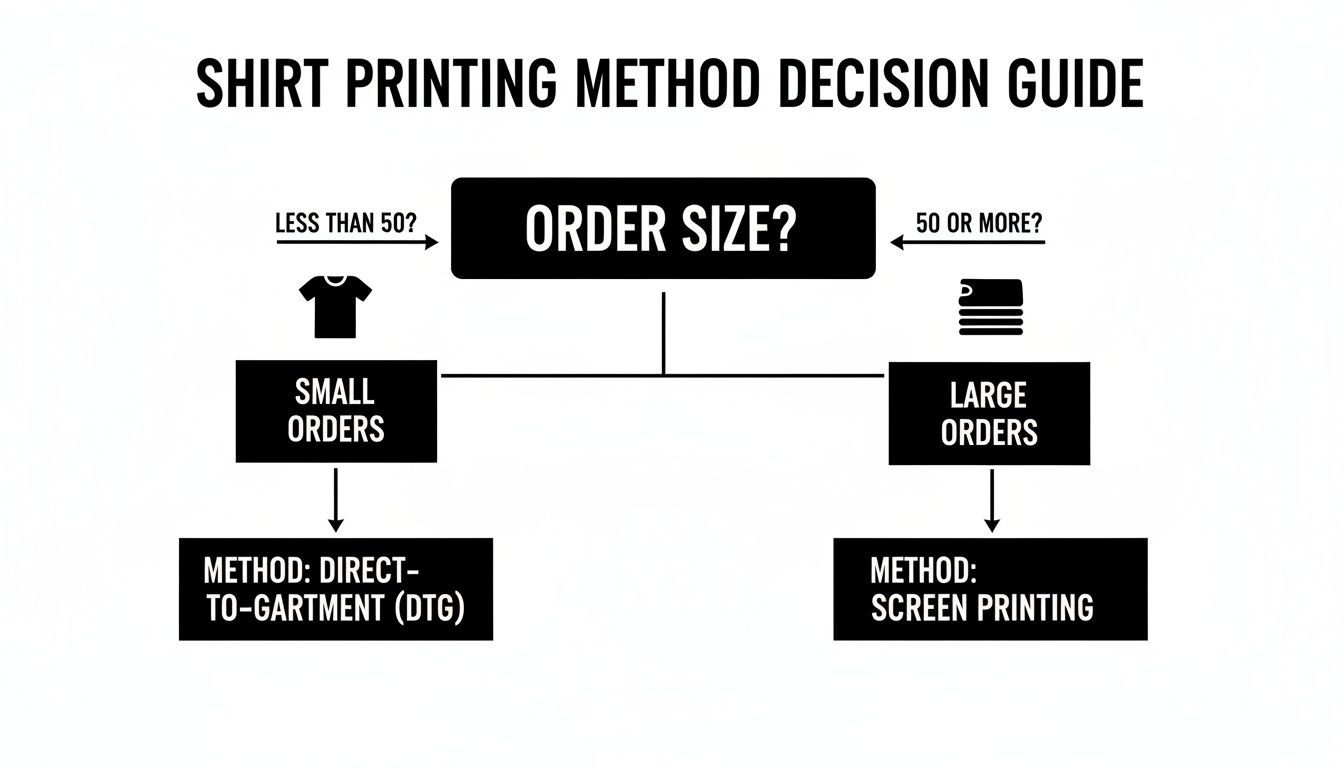
As you can see, the size of your order immediately splits the path. Small jobs are perfect for digital methods, while bulk production is where traditional techniques really pay off.
How Many Shirts Are You Making?
This is your first filter. The number of items you need is the single biggest factor when it comes to cost.
If you’re doing a large run—think 50 shirts or more—screen printing is almost always your best bet. Yes, there's a higher cost upfront to create the screens, but that cost gets spread so thin across a big order that the price per shirt drops dramatically. This is why it’s the go-to for events, band merch, and company swag.
On the flip side, for small orders, one-offs, or a print-on-demand shop, digital methods are your hero. DTG and DTF have zero setup costs per design. Printing one shirt costs the same on a per-item basis as printing ten, giving you incredible flexibility to offer tons of designs without stocking a single blank tee.
How Complex Is Your Design?
Next up, take a good look at your artwork. Are you printing a simple logo with just a few colors, or is it a full-color photograph packed with gradients and tiny details?
- Simple Designs (1-4 Colors): This is screen printing's sweet spot. It lays down thick, vibrant layers of ink that create bold, super-durable graphics that really pop off the shirt.
- Complex, Full-Color Designs: Here’s where digital methods take the lead. Both DTG and DTF can reproduce millions of colors, capturing photorealistic details and smooth gradients with stunning accuracy.
If your brand is built on detailed illustrations, photography, or colorful art, a digital method like DTF is the only way to go. You get unlimited colors without the per-color fees that would make a screen print impossibly expensive.
What Fabric Are You Printing On?
Finally, what’s the shirt made of? The fabric composition can immediately rule out some printing methods.
DTF printing is the most flexible of the bunch. It works beautifully on just about anything you can throw at it—cotton, polyester, blends, nylon, even treated leather. Its universal appeal makes it a safe and reliable choice for brands with a diverse product catalog.
Other methods are much more picky:
- DTG Printing: Needs 100% cotton (or at least a very high-cotton blend). Its water-based inks are designed to soak into natural fibers.
- Dye Sublimation: This one is only for 100% polyester garments. The ink turns into a gas and bonds directly with the synthetic fibers, which is perfect for athletic apparel.
- Screen Printing: While pretty versatile, it really performs best on cotton and poly-cotton blends where the ink can cure properly and last a long time.
Shirt Printing Methods Compared
To make things even clearer, here’s a side-by-side comparison that breaks down the key factors for each method. Think of this table as your ultimate cheat sheet for weighing the pros and cons.
| Method | Best For Quantity | Design Complexity | Fabric Versatility | Durability | Cost Profile |
|---|---|---|---|---|---|
| Screen Printing | Large (50+) | Simple (1-4 colors) | Good (Cotton/Blends) | Excellent | High setup, low per item |
| DTG | Small (1-25) | Photorealistic | Limited (Cotton) | Good | No setup, moderate per item |
| DTF | Small to Medium | Photorealistic | Excellent (Any Fabric) | Excellent | No setup, moderate per item |
| Sublimation | Small (1-25) | Full-Color Patterns | Limited (Polyester) | Permanent | No setup, higher per item |
| Heat Transfer Vinyl | Small (1-10) | Simple Shapes/Text | Good (Most Fabrics) | Good | No setup, varies by material |
By walking through these three questions—quantity, design, and fabric—you can confidently find the right path for your project. This simple process ensures you not only get a fantastic-looking print but also choose the smartest, most efficient method for your business.
Got Questions About Shirt Printing? We've Got Answers.
Jumping into the world of custom apparel can feel like a lot at first. As you weigh your options, you're bound to have questions. This is where we clear things up, tackling the most common concerns we hear from small businesses and creators every day.
Our goal here is simple: give you practical, straightforward answers so you can choose the right printing method with confidence.
Which Shirt Printing Method Is the Most Durable?
When you’re talking about prints that last, screen printing and dye sublimation are the heavyweights. A well-made screen print can handle years of washing and wearing, often outlasting the t-shirt itself. It's the go-to for a reason, especially for things like band merch and work uniforms.
That said, sublimation is probably the most permanent method out there. The ink literally becomes part of the polyester fabric by turning into a gas and bonding with the fibers. This means zero cracking, peeling, or fading, ever.
This is also where Direct-to-Film (DTF) really makes its mark. Modern, high-quality DTF transfers are built for the long haul, offering fantastic wash resistance that goes toe-to-toe with the classics. For anyone needing that blend of durability and the freedom to print on any fabric, DTF is an incredibly reliable choice.
What's Best for Small Orders With Lots of Colors?
If you have a small batch—say, anywhere from 1 to 50 items—with a complex, colorful design, you’ll want to look at Direct-to-Film (DTF) or Direct-to-Garment (DTG). Both are digital, so they work a lot like your office printer, laying down all the colors in a single pass.
This completely sidesteps the setup fees you'd face with screen printing, where every color needs its own screen. It makes printing a one-off shirt with a full-color photo just as affordable as printing a dozen.
Between the two, DTF usually comes out ahead because it works on so many different materials. While DTG is best for 100% cotton, DTF prints beautifully on cotton, polyester, blends, and even nylon, opening up a ton of creative doors.
Key Insight: Digital printing like DTF and DTG has been a game-changer, letting small businesses sell vibrant, detailed designs without needing to invest in huge inventory runs.
How Does DTF Compare to Screen Printed Transfers?
While they both involve a transfer, DTF printing and screen printed transfers are worlds apart, especially for modern apparel brands. The biggest difference comes down to design complexity and setup.
A screen printed transfer needs a separate screen for every single color in your design. That makes the setup process slow and costly for anything more than a simple, few-color logo. DTF, on the other hand, prints unlimited colors, gradients, and even photorealistic images in one go, with zero extra setup.
Here's a quick side-by-side of these shirt printing methods:
- Color Capability: DTF handles infinite colors with ease. Screen printed transfers are best for simple logos with just a few colors.
- Feel and Stretch: A good DTF transfer feels soft and flexible, moving right along with the fabric. Screen printed transfers can feel a bit thicker and more rigid.
- Minimum Orders: Since DTF is digital, it’s perfect for any quantity, whether you need a single custom piece or a medium-sized batch.
At the end of the day, DTF is simply a more advanced and flexible way to create high-quality, full-color graphics on demand.
Can I Use a Home Iron for DTF Transfers?
You might see people trying this online, but let me be clear: using a home iron for professional DTF transfers is a terrible idea. A successful DTF application hinges on three things working together perfectly: consistent temperature, even pressure, and precise timing. A home iron fails on all three counts.
A professional heat press is engineered to distribute heat evenly across its entire plate and apply a specific, consistent amount of pressure. This is the only way to properly cure the adhesive and permanently bond the ink to the fabric.
Using an iron will almost guarantee a failed print. You’ll get patchy adhesion, peeling corners, and a design that won’t survive the wash. To get reliable, professional results that last, a heat press isn't just a recommendation—it's essential.
Ready to create vibrant, durable custom apparel with one of the best shirt printing methods on the market? At Cobra DTF, we provide premium, American-made DTF transfers that empower your business to produce stunning results on any fabric. Skip the international shipping delays and high costs—get your high-quality transfers fast.
Explore our custom DTF transfers and see the difference today!