
Puff DTF Transfers A Complete Guide to 3D Textured Apparel
If you're looking to add some serious "wow" factor to your custom apparel, Puff DTF transfers are one of the coolest tools in the modern decorator's toolbox. They create a 3D, textured effect that literally pops off the fabric, giving your designs a premium, tactile feel that you just have to touch.
Think of it like this: a special ink is printed onto a film, and when you heat-press it onto a garment, the ink gently rises. This transforms a flat design into a soft, puffy graphic that you can both see and feel. It's an awesome way to get a high-end look without the complexity of traditional embroidery.
What Are Puff DTF Transfers and Why Do They Matter?
In the world of custom apparel, texture is everything right now. Flat, two-dimensional graphics are fine, but customers are increasingly drawn to unique, sensory details that make their clothing feel special. This is exactly where puff DTF transfers shine, bridging the gap between that high-end, custom feel and a simple, accessible production process.
Unlike older methods that required messy screens or expensive machinery, puff DTF gives you a straightforward path to achieving a sophisticated, dimensional look. This technique is becoming a huge deal in the industry for a few key reasons:
- Elevated Perceived Value: The moment someone touches that raised texture, the garment feels more premium and custom-made. This lets you command higher prices for your work.
- Tactile Engagement: A design you can physically feel creates a much stronger connection. It turns a simple t-shirt or hoodie into a piece people remember and talk about.
- Creative Versatility: From big, bold logos on streetwear to subtle, elegant accents on corporate gear, the puff effect adds a dynamic element to just about any design.
And this isn't just a niche trend. The entire Direct-to-Film (DTF) printing market has been growing like crazy, and innovations like puff transfers are a game-changer for everyone from home-based sellers to large-scale print shops. The global market is on track to hit USD 3.92 billion by 2030, fueled by the massive demand for custom apparel in fashion and sportswear—two areas where these transfers are a perfect fit. You can learn more about the growth of the DTF printing market and see just how much it's shaping the industry.
This explosive growth points to a clear shift in what people want: personalized, high-quality products. For creators and businesses, getting the hang of puff DTF transfers isn't just a cool new trick—it’s a real competitive edge. And with suppliers like Cobra DTF making it easier than ever to get reliable, USA-made transfers, anyone can start producing professional-grade textured apparel right away.
The Science Behind the 3D Puff Effect
Ever wonder how a perfectly flat transfer can suddenly puff up into a soft, three-dimensional design right before your eyes? It’s not magic—it's some clever chemistry at work, engineered specifically for the custom apparel world. The whole trick lies in a special puff ink that’s completely different from the standard stuff.
At the heart of this ink is a foaming agent, sometimes called a blowing agent. Think of it as countless microscopic chemical bubbles mixed right into the ink. At room temperature, they’re just sitting there, completely dormant and stable. They’re like tiny, uninflated balloons, waiting for the signal to expand.
Activating the Puff with Heat and Pressure
The real transformation from flat to puffy happens in a flash under the heat press. When you apply heat and pressure to the puff DTF transfers, two critical things happen at once. First, the adhesive powder on the back of the transfer melts, creating a strong bond that fuses the design to the fabric.
At that exact moment, the heat activates the foaming agent within the ink. As the temperature hits the sweet spot, usually around 320-340°F, those tiny spheres in the agent break down and release a harmless gas. This gas gets trapped inside the ink, which is now soft and pliable from the heat, forcing it to swell up and expand.
Key Takeaway: The 3D puff effect is really just a controlled chemical reaction. The heat press provides the energy to release gas inside the ink, inflating it from within to create that awesome raised texture.
This is a huge step up from older methods. Take puff screen printing, for example. That process involved messy screens, multiple layers of chemicals, and a much more involved setup. You needed a separate screen for every single color, making it a real headache for detailed, multi-color designs.
Puff DTF, on the other hand, packs that entire chemical reaction into one simple, easy-to-use film. It makes creating complex, textured graphics incredibly straightforward, letting anyone from a home crafter to a large shop produce stunning results without all the old-school hassle.
If you're curious about the building blocks of this technology, learning about the different kinds of DTF printer ink gives you a great look into how these specialized formulas come together. It's this streamlined science that lets creators focus on what they do best: designing.
Puff DTF vs. Other Textured Printing Methods
When you want to add that eye-catching 3D texture to a garment, you've got a few options. But how do puff DTF transfers really stack up against the old-school heavyweights like traditional puff screen printing, embroidery, and 3D puff HTV? Picking the right one isn't just a creative choice—it's a business decision that affects your production speed, costs, and design flexibility.
Puff DTF really hits a sweet spot, offering a modern mix of efficiency and quality. It completely sidesteps the need for messy screens, complicated color separations, and long setup times that come with puff screen printing. This is a game-changer for small batches and full-color designs that would be a nightmare to produce—both in time and money—with traditional methods.
Then you have embroidery, which delivers that classic, premium stitched look. But it has its own set of challenges. Embroidery machines are slow, every design needs to be digitized just right, and the cost per piece can get pretty high, especially for larger graphics. Puff DTF gives you a similar raised feel but with the speed and unlimited color potential of a digital transfer, making it a much nimbler option for today's on-demand businesses.
The magic behind the puff effect is actually pretty straightforward: a special ink, a little heat, and a big reaction.
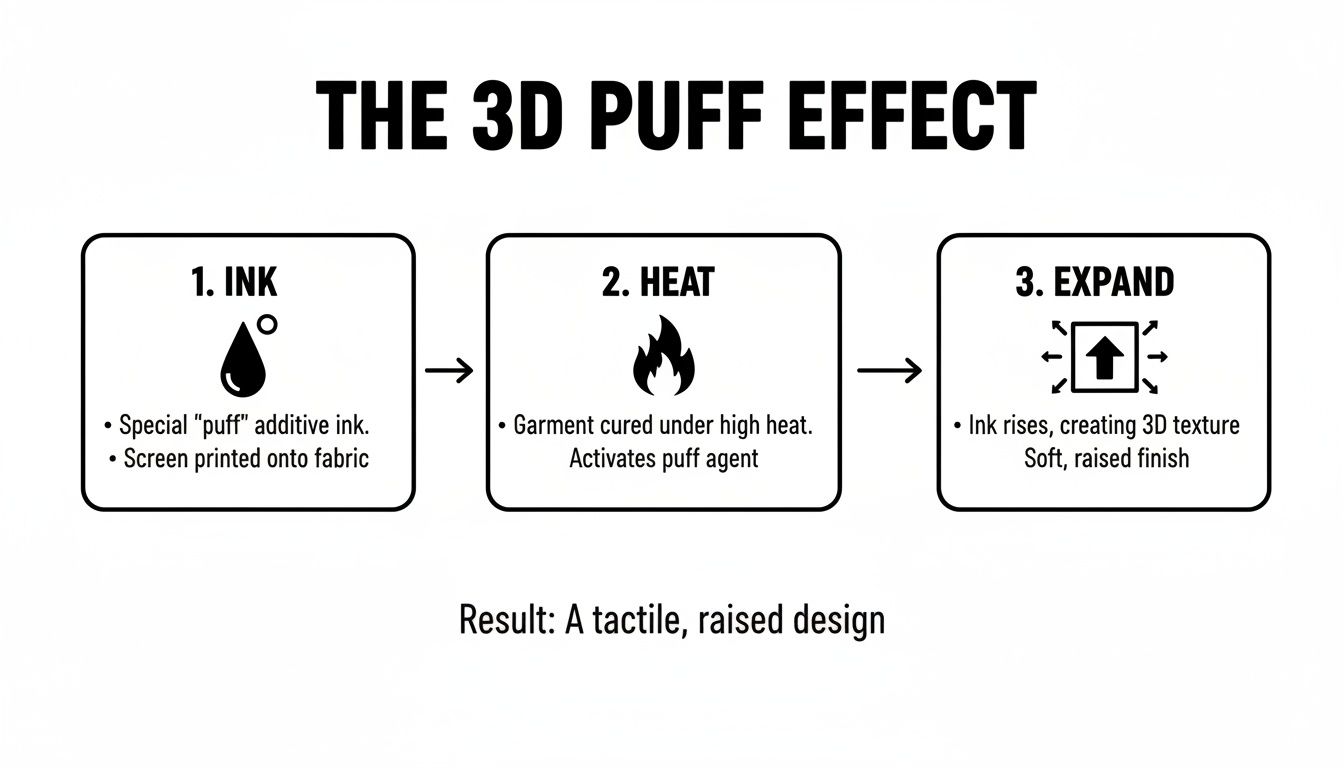
As you can see, the process is simple. When you press the transfer, the heat activates the ink, causing it to expand and create that signature 3D texture right on the fabric.
A Head-to-Head Comparison
Let's get down to the nitty-gritty and compare how these methods perform on the factors that really matter for your shop.
- Puff DTF Transfers: Fantastic for capturing detail in bold designs. There are no per-color setup fees, making them incredibly efficient for both small and large runs. The final texture is a clean, uniform puff.
- Puff Screen Printing: Gives you that classic, slightly rugged puff texture that many people love. It only starts to make financial sense at very high volumes because of the intense setup involved for every single color in the design.
- Embroidery: Delivers a distinct, high-end stitched texture that screams quality. On the flip side, it's the slowest method by a long shot, and trying to replicate fine details or gradients is basically impossible.
- 3D Puff HTV: This heat transfer vinyl provides a very sharp, foam-like lift. The catch is that it requires cutting and weeding, which gets old fast with intricate designs. Layering colors can also be a complex puzzle.
Business Insight: For small businesses and e-commerce shops, puff DTF transfers dramatically lower the barrier to entry for creating textured apparel. You can offer premium-feeling products without dropping thousands on screen printing equipment or embroidery machines.
Making The Right Call For Your Business
So, which one should you choose? To make the decision a little clearer, here’s a side-by-side look at how these popular methods compare across the board.
Textured Apparel Printing Method Comparison
| Feature | Puff DTF Transfers | Puff Screen Printing | Embroidery | 3D Puff HTV |
|---|---|---|---|---|
| Setup Time | Very Low | High | Medium | Medium |
| Best for Small Runs | Excellent | Poor | Good | Good |
| Color Capability | Full Color | Limited | Limited | Limited |
| Design Detail | Good | Fair | Fair | Good |
| Cost Per Unit | Low-Medium | Low (at high volume) | High | Medium |
| Fabric Versatility | High | Medium | High | High |
The table really highlights the standout advantages of puff DTF transfers in both versatility and efficiency. They offer a scalable solution that works just as well for a one-off custom hoodie as it does for a run of 100 branded tees. That kind of flexibility is exactly what modern apparel decorators need to thrive.
Mastering Your Heat Press for Flawless Puff Transfers
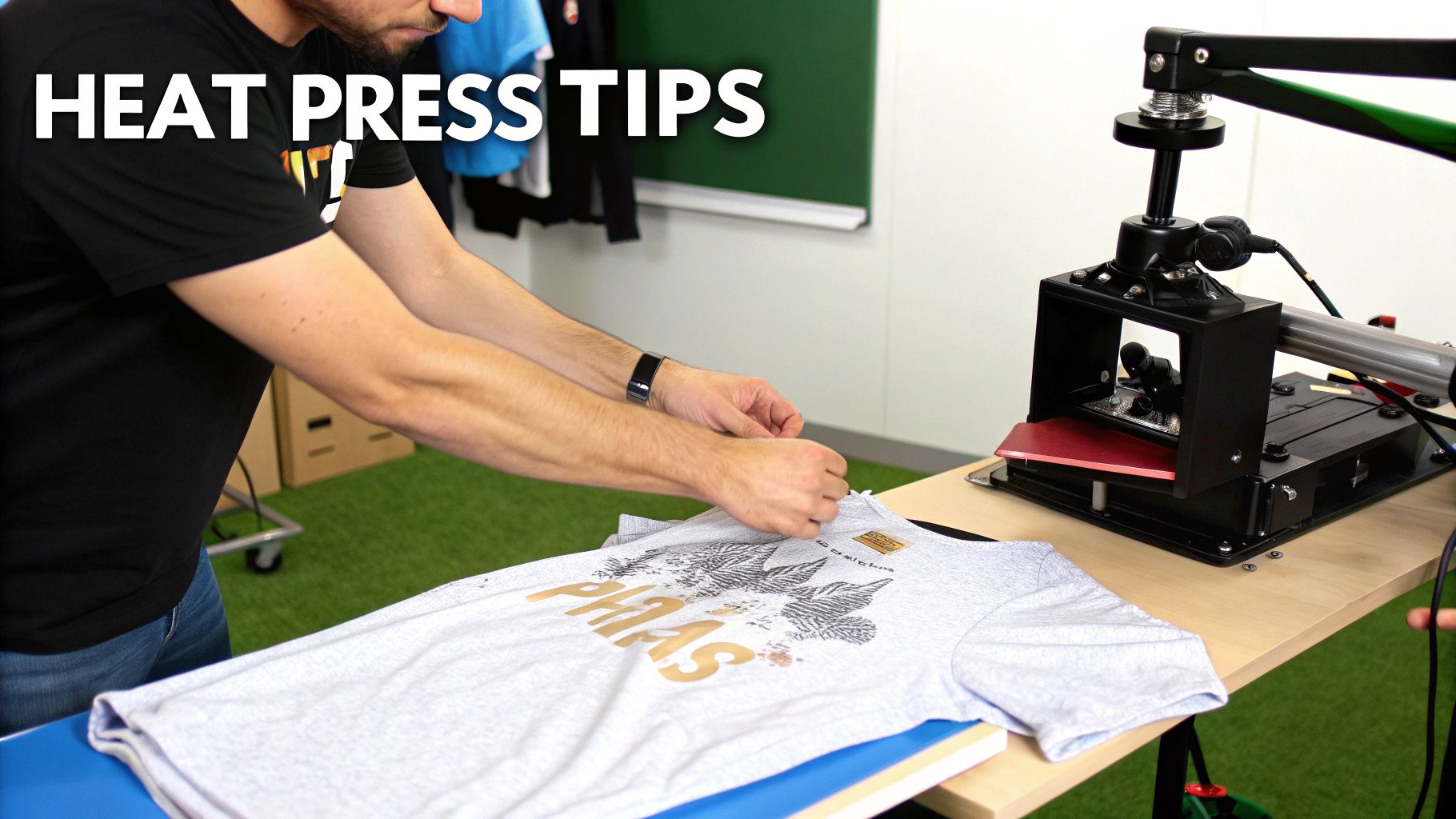
This is where the magic happens. Your heat press is the final step that brings puff DTF transfers to life, turning a flat print into a fantastic 3D design. Getting your settings dialed in isn't just a good idea—it's absolutely essential for a professional, durable finish.
The whole process boils down to three key variables: temperature, pressure, and time. Think of it like baking a cake. If the oven's too hot or you take it out too soon, you won't get the result you want. Get one of these wrong, and you could end up with a flat, smashed design, a transfer that peels off, or even a scorched shirt.
The Perfect Balance of Temperature and Time
Puff transfers need just the right amount of heat to activate the foaming agent in the ink. You're aiming for a temperature between 320-340°F (160-170°C). If you go too low, the design just won't puff up. Go too high, and you can actually deflate the effect or damage the garment itself.
Time is the other half of this equation. A press time of 10-15 seconds is typically the sweet spot. It's just enough time for the ink to expand and the adhesive to get a solid grip, but not so long that you over-bake the print.
Pro Tip: Always pre-press your garment for 5-7 seconds. This quick step is a game-changer. It gets rid of any moisture and smooths out wrinkles, giving you a perfect canvas for the transfer to adhere to.
Understanding Pressure and Peeling
Now for the final piece of the puzzle: pressure. You’ll want to set your press to medium to firm pressure. This is a bit different from standard transfers where you might clamp it down hard. With puff, too much force will just flatten the very effect you're trying to create. The goal is to apply enough pressure for a strong bond without crushing the ink as it expands.
Once the timer goes off, how you peel the film is just as important.
- Hot Peel: This means you peel the film off immediately after the press opens. It tends to create a more dramatic, textured puff.
- Cold Peel: With this method, you let the transfer cool down completely before peeling. This usually results in a smoother, more uniform finish.
Always double-check the instructions that came with your transfers, as they are often designed specifically for one method or the other. For a deeper dive, check out our complete guide on heat press settings for DTF transfers.
Getting these settings right is what makes every puff print look incredible. It's no surprise the demand for these tactile designs is booming, with the DTF printing market expected to hit USD 4.56 billion by 2032. Adding a textured feel can increase a product's perceived value by up to 30%, making it a smart investment for any custom apparel business. You can discover more insights about the DTF printing industry's expansion to see how it's changing the game.
Designing and Caring for Your Puff DTF Apparel
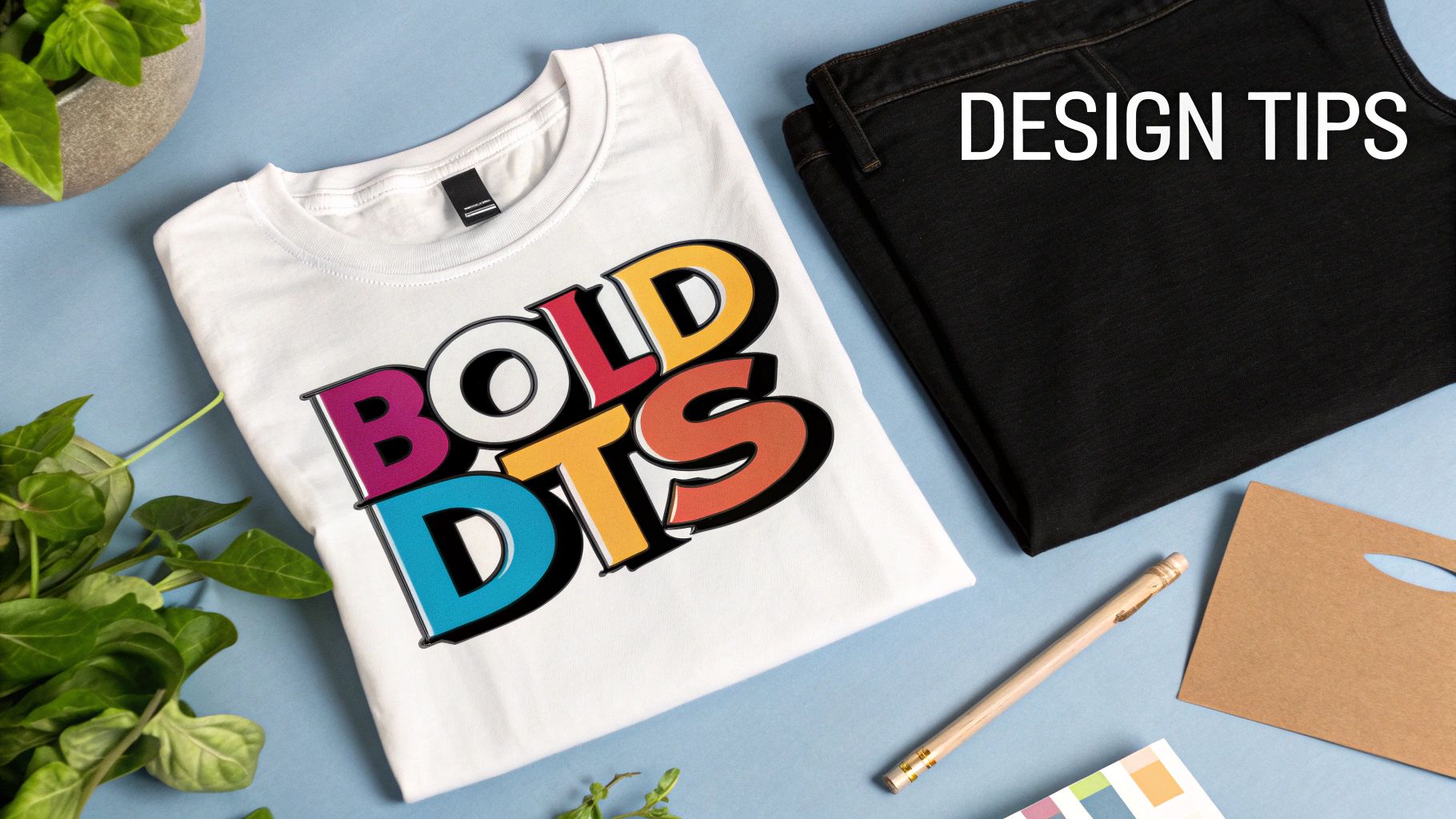
A fantastic final product comes from two things: a smart design and proper care. Once you've nailed the heat press process, the next step is making sure your art is perfect for the puff effect and your customers know how to keep their new gear looking fresh.
Creating Artwork for Puff DTF
Designing for puff DTF transfers isn't quite the same as for standard flat prints. You have to think in 3D. The ink needs enough room to expand, so bold designs are your best friend. Imagine you're trying to inflate a balloon—you need enough material for it to fill out properly.
Thin lines and super intricate details can get swallowed up or look blurry once the print puffs up. To get that crisp, professional 3D pop that makes these transfers so popular, you’ll want to focus on chunky text, solid shapes, and graphics with plenty of clear negative space. We cover this in more detail in our guide to creating amazing DTF transfer designs.
How to Care for Puff Prints So They Last
Giving your customers simple care instructions is a huge value-add and shows you stand behind your quality. These prints are tough, but a little TLC goes a long way in keeping them looking perfect.
Here are a few easy tips to pass along:
- Wash It Inside-Out: This is the golden rule. It protects the raised design from getting scraped and roughed up by other clothes in the laundry.
- Keep It Cool: Always wash on a cold cycle. Hot water can mess with the puff texture and fade the ink over time.
- Air Dry When Possible: High heat from a dryer is the number one enemy of a puff print. The absolute best way to dry is to hang it up, but if you must use a machine, make sure it’s on a tumble dry low setting.
The durability of these transfers is a big reason they're taking off. The global DTF market is exploding, with projections hitting USD 4.57 billion by 2033, all driven by the demand for custom gear. Puff transfers are incredibly resilient, holding onto 95% of their color brightness even after 50 industrial-strength washes. That’s why they’re such a dependable choice for any apparel business. You can read more about the expanding DTF market to see just how big this is getting.
When you pair great design with simple care, every piece you make will not only look incredible right off the press but also stand up to whatever life throws at it.
How to Choose a Reliable Puff DTF Supplier
Let's be real: the final quality of your apparel hinges just as much on your supplier as it does on your heat press. Picking the right partner for your puff DTF transfers is a massive business decision. It directly affects your product consistency, how fast you can get orders out the door, and ultimately, how happy your customers are. A good supplier isn't just a vendor; they're an extension of your own production line.
When you're checking out potential suppliers, consistency is everything. Always ask for samples. You need to see and feel the print quality, the color pop, and how uniform the puff effect is. A top-tier provider will send you transfers that look and feel the same every single time, which takes all the guesswork out of your process.
Look for Speed and Support
In the on-demand world of custom apparel, speed gives you a serious edge. You want a supplier who offers fast shipping, like the same-day options you see from industry leaders like Cobra DTF. That kind of speed means you can turn customer orders around in a flash without having to sit on a mountain of inventory.
Just as important is getting a real human on the line when you need help. When you hit a snag or just have a question, you need a partner who gives you clear, helpful answers—and fast. A supplier who's actually invested in your success will be there for you.
Business Tip: Partnering with a USA-based manufacturer can be a game-changer. It usually means quicker shipping, zero surprise customs fees or delays, and support staff who are actually awake when you are. That’s huge for keeping your business running without a hitch.
Material Quality and Eco-Consciousness
The quality of the raw materials—the inks, films, and adhesive powders—is what dictates the durability and feel of your final product. When you see a supplier using premium, eco-friendly materials, it's a great sign they care about quality. This doesn't just give you better-looking gear; it also connects with the growing number of customers who want to buy sustainable products.
Once you’ve narrowed down your list of potential partners, getting good at negotiating is key to landing the best deal on your puff DTF materials. Knowing how to negotiate with suppliers can seriously lower your costs and help build a stronger relationship for the long haul. If you focus on these key things—quality, speed, support, and materials—you’ll find a supplier that truly helps your business grow.
Got Questions About Puff DTF? We've Got Answers.
Jumping into a new printing method always sparks a few questions. To help you get started on the right foot, we’ve tackled some of the most common things people ask when they're new to puff DTF transfers.
What Kinds of Fabric Can I Use Puff DTF On?
One of the best things about puff DTF is its versatility. These transfers work beautifully on cotton, polyester, and cotton/poly blends, and you don't even need to pre-treat the fabric.
For the cleanest, sharpest results, stick with fabrics that have a relatively smooth surface, like your standard t-shirts, hoodies, and crewneck sweatshirts. It's always a smart move to press a small test transfer on a scrap piece of your material first—this lets you nail down your settings and make sure everything looks perfect.
Can I Just Use My Home Iron for These?
You'll definitely need a professional heat press for this job. A home iron just can't deliver the consistent, even pressure and stable temperature needed to make the puff ink activate correctly.
Attempting it with an iron will likely leave you with a flat, uneven, or peeling transfer. A heat press is the only way to get that professional, high-quality finish your customers will love.
The Bottom Line: A quality heat press isn't just recommended; it's required. It's the only tool that can deliver the precise heat and pressure needed to trigger the 3D puff effect, ensuring a durable, fantastic-looking print every single time.
How Well Do Puff DTF Prints Hold Up in the Wash?
When you follow the care instructions, puff DTF prints are surprisingly durable and can easily handle dozens of washes. That cool raised texture is tough, but like any special-effect garment, a little extra care goes a long way.
To keep the print looking great, just turn the garment inside out, wash it in cold water, and avoid the high-heat setting on your dryer. Simple steps like these will preserve the texture and color for the long haul.
Are Puff DTF Transfers More Expensive Than Regular DTF?
Puff DTF transfers do cost a little more than standard flat transfers, mainly because of the special ink that creates the 3D effect. But here's the upside: that premium, almost embroidered finish gives the final product a much higher perceived value.
This means you can charge more for the finished garment, making puff DTF an incredibly profitable option for anyone in the custom apparel game.
Ready to create apparel that not only looks great but feels amazing to the touch? Cobra DTF offers top-tier, USA-made puff DTF transfers that deliver incredible quality and pop with every single press. Explore our high-quality puff DTF transfers today!