
Choosing the Best Methods of Printing on T Shirts for Your Brand
So you're diving into the world of custom t-shirts. Awesome. But before you get lost in designs and fabrics, the single most important decision you'll make is how you're going to get your art onto the shirt. This choice is a big deal—it impacts the quality, the feel, and ultimately, your bottom line.
Getting to Grips With T-Shirt Printing Methods
Whether you're launching a fashion startup, ordering promo gear for your company, or running a print-on-demand shop, picking the right printing technique is everything. Each one has its own personality, its own strengths, and its own quirks. It's like having a toolbox; you need to know when to grab the hammer and when to reach for the precision screwdriver.
This guide will walk you through the top 5 methods out there. We'll cut through the jargon and get straight to what you need to know, helping you match the right process to your specific vision.
The Main Players in T-Shirt Printing
To get started, let's meet the heavy hitters of the custom apparel game. Each of these techniques was born to solve a different kind of problem, from massive print runs to one-of-a-kind masterpieces.
-
Screen Printing: The OG of t-shirt printing. This is your go-to for big batches, delivering bold, vibrant colors that are built to last on pretty much any fabric.
-
Direct-to-Garment (DTG): Think of this as an inkjet printer for clothes. It's perfect for printing super-detailed, full-color images directly onto cotton, especially for smaller orders.
-
Direct-to-Film (DTF): The versatile newcomer that's shaking things up. DTF gives you the rich, full-color detail of digital printing but works on almost any material you can think of—cotton, polyester, blends, you name it.
-
Heat Transfer Vinyl (HTV): Best for simple, clean graphics. If you need to put names and numbers on team jerseys or create bold logos, HTV is your friend.
-
Dye-Sublimation: This one’s a bit of a science experiment. The ink actually becomes part of the polyester fabric, creating a permanent design you can't even feel. It’s the top choice for performance and athletic wear.
To give you a quick visual, here's how they stack up against each other in the areas that matter most.
T-Shirt Printing Methods at a Glance
| Printing Method | Best For | Feel on Fabric | Durability | Color Vibrancy |
|---|---|---|---|---|
| Screen Printing | Bulk orders (50+) with simple designs (1-4 colors) | Slightly raised, thick layer of ink | Very High | Excellent |
| DTF | Small to large orders, full-color complex designs | Soft, flexible, and smooth | Very High | Excellent |
| DTG | Small batches & one-offs, photo-realistic prints | Very soft, ink soaks into the fibers | Good | Very Good |
| Heat Transfer Vinyl | Simple text & logos, personalizing individual items | Slightly raised plastic feel | Good | Excellent |
| Dye-Sublimation | All-over prints on 100% white/light polyester | Zero feel, becomes part of the fabric | Permanent | Very Good |
This table is just the starting point. The real magic happens when you understand the "why" behind each recommendation.
By getting a handle on how these printing methods actually work, you can make a smart, strategic choice that lines up perfectly with your designs, your order size, and your budget. This one decision shapes everything about your final product.
Think of this guide as your playbook. We're about to break down each process, showing you how it works, what it's good for, and where it falls short. Let's get to it.
Screen Printing: The Time-Tested Workhorse
When you think of classic t-shirt printing, you’re probably thinking of screen printing. It’s the undisputed heavyweight champ in the apparel world, a robust technique that has been the backbone of bulk t-shirt production for decades.
At its core, screen printing is a refined stenciling process. You create a separate screen—a fine mesh stretched tight over a frame—for every single color in your design. Ink is then pushed through the stencil on that screen and directly onto the fabric. This is repeated layer by layer, color by color, building up the final image.
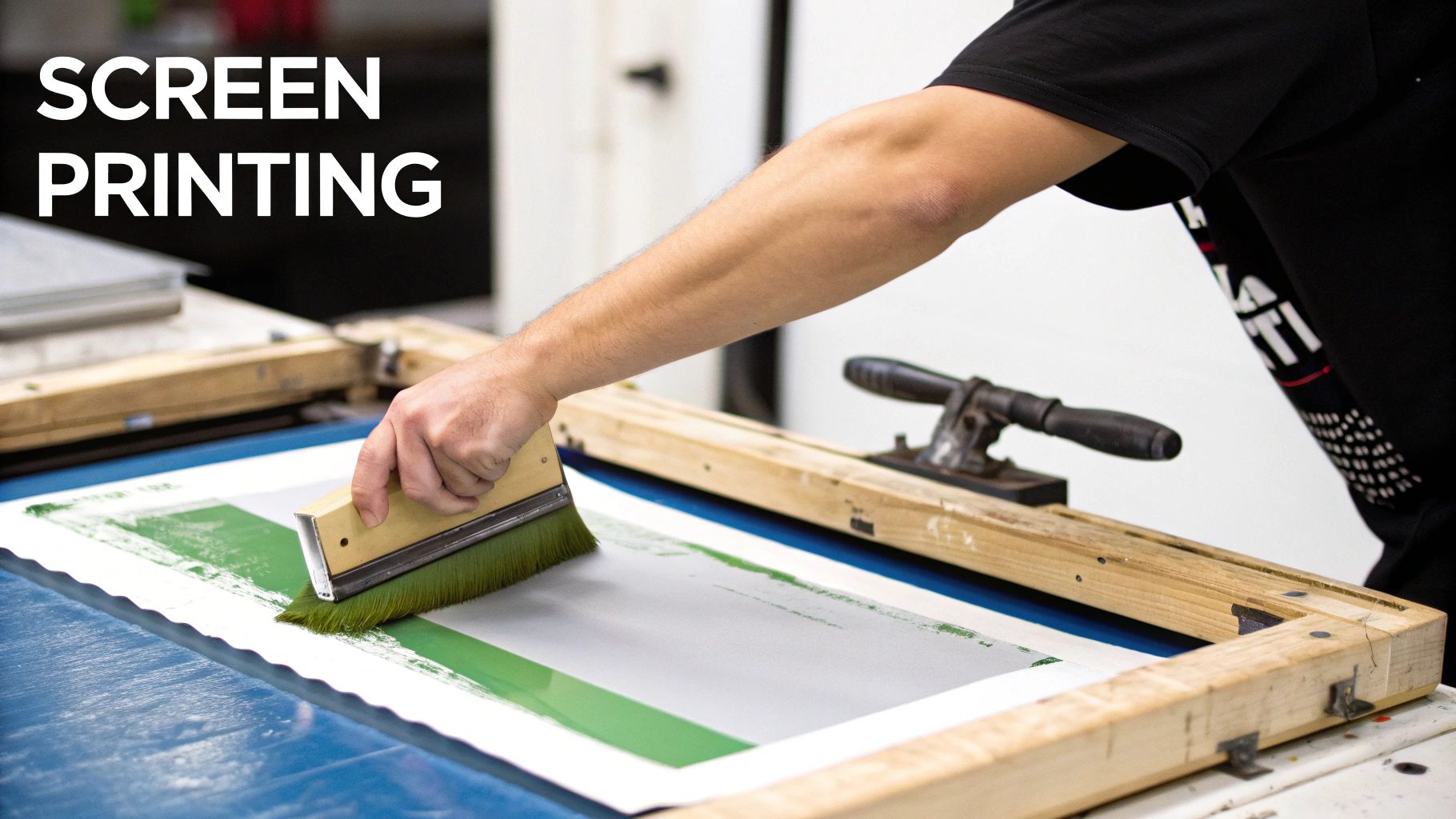
The result is a thick, incredibly durable layer of ink (often plastisol) that sits right on top of the garment. This is what gives screen-printed shirts that classic, slightly raised feel and makes the colors pop—especially on darker fabrics.
How Does Screen Printing Actually Work?
The real magic of screen printing is in its methodical, hands-on setup. While it takes more prep work than modern digital methods, that initial effort is what makes it possible to print hundreds of shirts with speed and consistency once you get going.
Here’s a look at the key steps:
- Separating the Design: First, the artwork is broken down into separate layers, one for each color.
- Making the Screens: A stencil is created for each color. A mesh screen is coated with a light-sensitive emulsion, the design is laid on top, and it's all zapped with UV light. Where the light hits, the emulsion hardens; the rest washes away, leaving a perfect stencil of your design.
- Applying the Ink: The t-shirt is laid flat on a printing board, and the screen is placed over it. A squeegee is used to pull a thick layer of ink across the screen, forcing it through the open mesh and onto the shirt.
- Curing the Print: Once all the colors are on, the shirt goes for a trip through a large dryer. The heat "cures" the ink, creating a permanent bond with the fabric so it won’t crack or wash out.
This is a quick look, but it highlights why screen printing shines for certain jobs. If you want to really get your hands dirty, check out our full guide on how to start screen printing.
Strengths and When to Use It
Screen printing’s superpower is its economy of scale. All the heavy lifting—the time, effort, and cost—is front-loaded into creating the screens. But once they're ready, you can churn out hundreds, or even thousands, of shirts with incredible speed. This makes the cost-per-shirt drop dramatically as your order size goes up.
Screen printing is foundational to the custom apparel industry, first appearing in the early 1900s. It wasn't until the 1960s, with the invention of rotary multicolor machines and tough plastisol inks, that it became the giant it is today. Even now, it commands 60-70% of the market for promotional tees, with costs per shirt as low as $2-5 on big runs and prints that can easily withstand 50+ washes.
This cost-efficiency makes screen printing the obvious choice for specific needs:
- Large Merchandise Runs: Perfect for bands, brands, or events that need 100+ identical shirts.
- Team Uniforms and Staff Apparel: The best way to get consistent, rugged logos and numbers on jerseys or workwear.
- Promotional Events: The go-to for giveaway shirts at trade shows, concerts, and festivals where you need high volume without breaking the bank.
- Simple, Bold Designs: It truly excels with graphics that have a limited color palette (think 1-4 colors) for maximum impact and cost-effectiveness.
On the flip side, the intense setup makes it completely impractical for one-off prints or designs with tons of colors and photographic detail. For those kinds of jobs, other printing methods are a much better fit.
Direct to Garment: The Digital Artist for Cotton
Imagine your office inkjet printer, but instead of sliding in a sheet of paper, you're loading a blank cotton T-shirt. That’s the simplest way to think about Direct-to-Garment (DTG) printing. This method uses specialized printers to spray water-based inks directly onto the fabric, where they soak right into the fibers instead of just sitting on top.
The result is a print that feels incredibly soft and breathable. You can barely feel it’s there because the ink literally becomes part of the shirt. This amazing "no-hand" feel has made it a favorite for fashion brands and anyone who puts comfort first.
The DTG Printing Process Explained
Unlike screen printing, with all its messy screens, stencils, and manual setup, DTG is a clean, digital workflow. It’s a precise process, perfectly suited for those complex, multi-colored designs that would be a nightmare to prep for screen printing.
Here’s a look at how a design gets from your computer screen onto a finished shirt:
- Pre-Treatment Application: First things first, the shirt gets a spritz of a special pre-treatment solution. This is especially crucial for dark-colored garments, as it helps the inks bond properly to the cotton fibers and creates a smooth canvas for the printer.
- Digital Printing: The T-shirt is then carefully smoothed out and secured onto a flat plate, called a platen, which slides into the DTG printer. From there, it works much like a standard inkjet, moving back and forth to meticulously apply the design directly onto the fabric with water-based inks.
- Curing the Ink: Once the last drop of ink is laid down, the shirt is moved to a heat press or conveyor dryer. This final step is essential—it permanently sets the ink into the fabric, locking in the vibrant colors and making sure the design is fully washable.
Because the whole process is digital, you can skip all those screen setup fees. This makes DTG incredibly cost-effective for one-off custom pieces or small orders. You can dive deeper into the specifics by exploring our comprehensive guide on what is direct to garment printing.
Key Strengths and Ideal Use Cases
DTG truly shines when it comes to detail and color. It's the undisputed champion for reproducing photorealistic images, intricate illustrations, and designs full of subtle gradients and shading. The ability to print a single shirt just as affordably as a small batch has made it the engine driving the massive print-on-demand industry.
A DTG printer can replicate over 16 million colors in a single pass. This is a game-changer, allowing for a level of detail and color fidelity that’s simply out of reach for traditional screen printing, which is always limited by the number of screens you can use.
This printing method is the perfect match for a few specific scenarios:
- Print-on-Demand (POD) Stores: It's the go-to for e-commerce shops selling unique designs without ever touching inventory.
- Photographic and Artistic Prints: If your design is a high-resolution photo or a complex piece of art, DTG will capture every nuance beautifully.
- Small Batch Orders: Perfect for startups, small brands, or events that need fewer than 25 shirts with a full-color design.
Understanding DTG Limitations
For all its strengths, DTG is a bit of a fabric snob. It performs best on 100% cotton or, at the very least, high-cotton blends. The water-based inks are formulated to bond with natural fibers, so trying to print on polyester or other synthetics usually leads to faded, dull results.
It's also not built for bulk orders. While perfect for small runs, the cost-per-shirt doesn't drop much as you increase the quantity, unlike screen printing. For larger orders of 50 or more identical shirts, screen printing quickly becomes the smarter financial choice. The slower print time for each garment also makes it less efficient for mass production, cementing its place as a specialist for high-detail, low-volume jobs on cotton apparel.
Direct to Film: The Versatile Modern Solution
In the ever-evolving world of custom apparel, Direct-to-Film (DTF) has quickly become the talk of the town. Think of it as the ultimate problem-solver, neatly bridging the gap between the rich detail of Direct-to-Garment (DTG) and the fabric-agnostic nature of screen printing. It’s a powerful hybrid that gives modern print shops incredible flexibility.
The magic behind DTF is its clever, indirect approach. Instead of printing ink straight onto a shirt, a specialized printer first lays down the design onto a sheet of transparent PET film. This printed film then gets a light dusting of a powdered adhesive, which is melted to create a smooth, ready-to-press transfer. From there, a standard heat press is all you need to permanently bond the design to almost any garment, resulting in a print that’s vibrant, stretchy, and feels great.
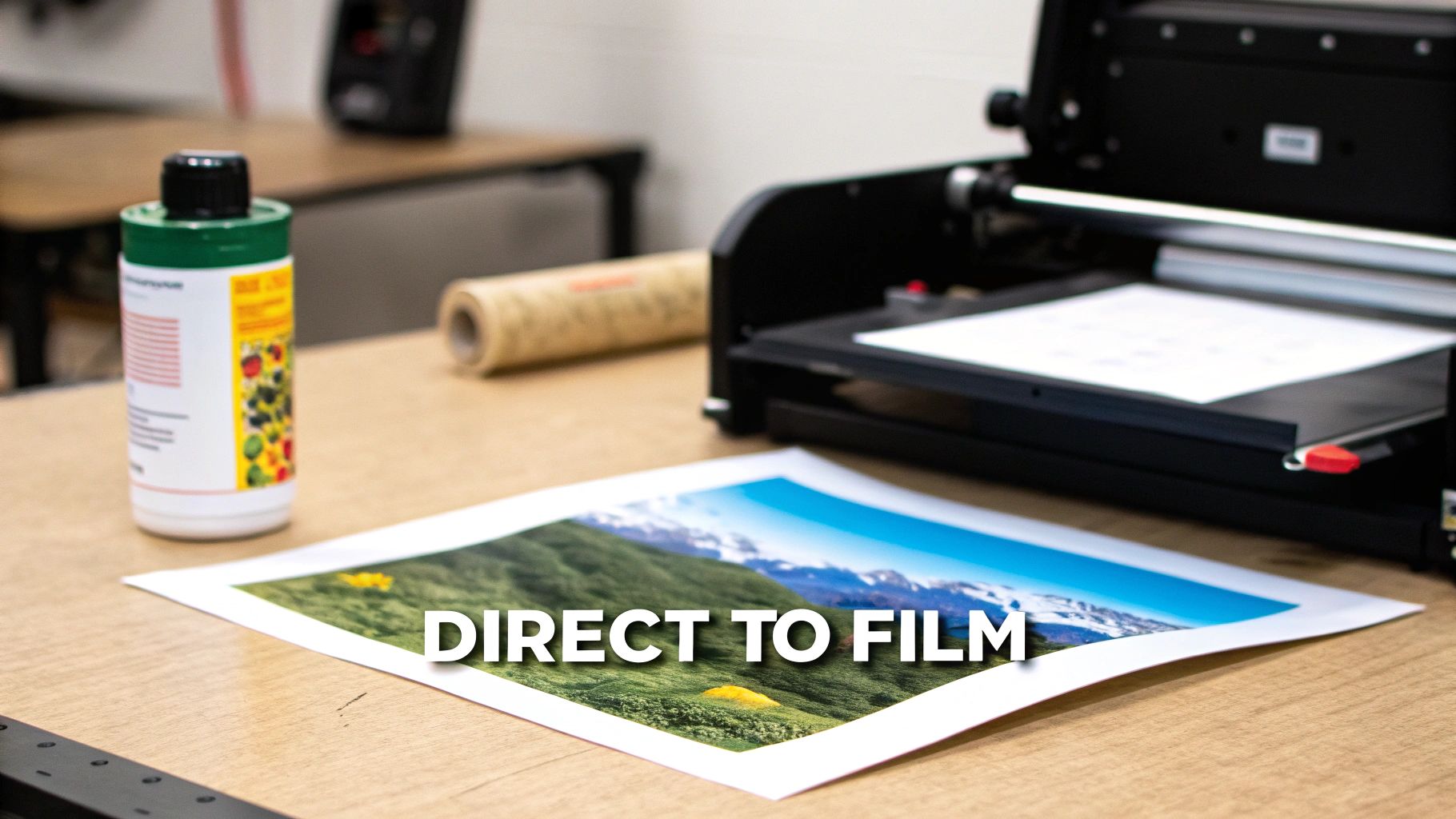
Unpacking the DTF Process Step-by-Step
The DTF workflow feels like a perfect blend of digital precision and hands-on craftsmanship. This multi-step process is the key to achieving a high-quality finish on a massive variety of materials, blowing the limitations of other methods out of the water.
Here’s a quick look at how it all comes together:
- Print on Film: First, your full-color design is printed onto a special DTF transfer film. This is where every detail, color gradient, and fine line is captured with perfect digital accuracy.
- Apply Adhesive Powder: While the ink is still wet, the film is coated with a hot-melt adhesive powder. This stuff is smart—it only sticks to the inked parts of your design.
- Cure the Transfer: The powdered film then goes through a curing oven or under a heat press, which melts the adhesive into a smooth, even layer. This is what will ultimately bond the ink to the fabric.
- Heat Pressing: Now for the main event. The cured transfer is placed onto the T-shirt and pressed. The heat and pressure activate the adhesive, permanently transferring the design from film to fabric.
- Peel the Film: After a quick cool-down, the film is peeled away. What’s left behind is a brilliant, durable, and surprisingly flexible print.
The Unmatched Versatility of DTF Printing
The single biggest selling point for DTF is its incredible material compatibility. Where DTG is picky (mostly sticking to cotton) and sublimation is exclusive (polyester only), DTF simply doesn't care. It delivers stunning results on just about any fabric you can throw at it.
This makes it a true game-changer for any business wanting to expand its product line without cluttering the shop with different machines for every job.
- Fabric Freedom: It works beautifully on cotton, polyester, nylon, rayon, leather, and tricky poly-blends.
- Color Versatility: You can apply DTF transfers to garments of any color, from crisp white to jet black, with no need for the chemical pre-treatments that DTG requires.
- Product Diversity: DTF isn't just for T-shirts. You can easily customize hats, bags, hoodies, and even hard surfaces like phone cases or mugs.
DTF cherry-picks the best features from other print methods. It gives you the full-color, no-setup-fee advantage of DTG, but with the material freedom that used to be the exclusive territory of screen printing and vinyl.
This unique adaptability makes DTF one of the most cost-effective and efficient methods of printing on t shirts for small-to-mid-sized businesses. Direct-to-Film printing has seen explosive growth, with market projections showing a 25% CAGR. It elegantly sidesteps DTG’s fabric limitations and screen printing’s costly setups, often cutting production expenses by 30-50% on mid-sized runs. Better yet, DTF prints are built to last, easily enduring over 60 washes. The rise of US-based suppliers like Cobra DTF, who offer same-day shipping and fair pricing without overseas tariffs, has made it even easier for American brands to jump in. You can explore more data on the custom t-shirt market and its growth trends.
When DTF is Your Best Choice
DTF is more than just another way to print; it’s a smart business decision. It shines brightest in situations where you need a mix of flexibility, high quality, and efficiency.
You should seriously consider DTF printing when:
- You Need to Print on Various Materials: If your catalog includes cotton tees, polyester athletic wear, and blended-fabric hoodies, DTF lets you handle it all with a single, streamlined process.
- Your Designs are Colorful and Complex: It’s perfect for photorealistic images, graphics with fine lines, and designs with a wide spectrum of colors.
- You Handle Small to Medium-Sized Orders: With no screens to burn, it’s ideal for anything from a one-off custom job to a run of several hundred. The cost-per-print stays consistent and affordable.
- Durability is a Must: DTF prints are known for their fantastic stretch and resistance to cracking, fading, and peeling. They often look great long after the shirt itself has worn out.
Heat Transfer Vinyl & Sublimation: The Niche Specialists
While the "big three" printing methods handle the bulk of T-shirt jobs, a couple of other techniques fill some very important gaps. These aren't your everyday, all-purpose solutions. Think of them as specialists you bring in when the job has unique demands.
First, let's talk about Heat Transfer Vinyl (HTV). The simplest way to picture HTV is to imagine a professional-grade, super-durable iron-on decal. The process is pretty direct: a machine cuts your design out of a sheet of colored vinyl, and you then use a heat press to bond it to the shirt. The heat activates an adhesive backing on the vinyl, locking it onto the fabric for good.
Getting a Feel for Heat Transfer Vinyl (HTV)
HTV is the hands-down winner for simple, bold graphics and personalization. Need to put names and numbers on the back of a team's jerseys? HTV is your go-to. Want a clean, single-color logo on a batch of company polos? Perfect for HTV.
Because you're cutting shapes out of solid-colored vinyl sheets, it’s not the right tool for creating photorealistic images or designs with intricate color gradients. Where it truly shines, though, is in its incredible variety of specialty finishes—effects that are a real headache, or just plain impossible, to get with other methods.
- Glitter and Metallic Finishes: Instantly add some serious sparkle or a cool chrome effect.
- Flock Vinyl: Gives your design a soft, fuzzy, slightly raised texture that people love to touch.
- Holographic and Reflective: Create an eye-catching iridescent shimmer or add a high-visibility safety element.
The final print has a distinct feel—it's a smooth, slightly raised layer that sits on top of the fabric. It's tough as nails, but that tactile quality is part of the deal. For a closer look at what this method can do, check out our guide on what is heat transfer vinyl.
The Magic of Dye Sublimation
On the complete opposite end of the spectrum, we have Dye Sublimation. This one feels less like printing and more like a science experiment. Here's how it works: your design is printed onto special transfer paper using sublimation inks. When you apply heat and pressure, the ink bypasses the liquid state and turns directly into a gas (sublimation). This gas then permanently infuses itself into the polyester fibers of the shirt.
The ink doesn't just sit on the surface; it literally becomes part of the fabric.
With dye sublimation, the final print has zero feel. You can run your hand across it, stretch the shirt, and wash it a hundred times—it will never crack, peel, or fade because the design is now one with the material.
This makes sublimation the undisputed king for all-over prints on performance wear, cycling jerseys, and any athletic gear where breathability and a lightweight feel are everything. The prints are stunningly sharp and vibrant, capturing every little detail with incredible clarity.
But this amazing process has two very firm rules that keep it in its niche.
- Fabric Restriction: Sublimation only works on 100% polyester or high-poly blends. The chemical reaction needs synthetic fibers to bond with, so it's a total non-starter for natural fabrics like 100% cotton.
- Color Limitation: Since the process is literally dyeing the fabric, it has to be done on a white or very light-colored shirt. Trying to sublimate on a black T-shirt is like using a watercolor marker on black construction paper—the colors just won't be visible.
At the end of the day, HTV and sublimation are masters of their craft. HTV gives you unmatched options for bold, simple designs and incredible special effects, while sublimation delivers permanent, vibrant prints you can't even feel, making it perfect for the world of performance apparel.
How to Choose the Right Printing Method for Your Business
Diving into the world of t-shirt printing can feel like a lot to take in, but don't worry. Picking the right technology is actually pretty straightforward once you connect it to what you’re trying to build. The "best" choice really just depends on your specific goals.
Ask yourself a few simple questions to find the clearest path forward. What’s your typical order size? How complex are your designs? What kind of fabrics do you want to print on?
For instance, if you get a massive order for 1,000 shirts with a simple two-color logo for a company event, that's a job for screen printing. Nothing beats its value on big runs, as the price per shirt plummets the more you print.
On the other hand, if you're firing up a print-on-demand shop featuring highly detailed, artistic designs on cotton tees, Direct-to-Garment (DTG) is your workhorse. It shines at reproducing photo-quality images with zero setup fees, making it perfect for one-off custom orders.
Matching the Method to Your Vision
The kind of products you dream up will point you to the right technology. A brand focused on athletic wear made from 100% polyester will lean heavily on dye-sublimation. It creates permanent, breathable prints that are a must-have for performance apparel.
What about team jerseys with bold, single-color numbers or names? That’s where Heat Transfer Vinyl (HTV) comes in, giving you that durable, slightly raised finish that really pops.
Each method is a tool designed to solve a different problem. The trick is to match the tool's strengths with your business needs. This way, you create products that not only look fantastic but are also profitable and easy to scale.
The most common mistake I see new businesses make is picking a printing method because it’s familiar, not because it’s a good fit. Aligning your choice with your order volume, design complexity, and fabric type from day one is the secret to avoiding expensive mistakes and keeping customers happy.
And then there's Direct-to-Film (DTF), which has emerged as an incredibly versatile powerhouse. It gives you the vibrant, full-color detail of DTG, but it works beautifully on almost any fabric you can think of—cotton, polyester, blends, you name it. This flexibility makes DTF a phenomenal all-around choice for brands needing consistent quality across a varied product line.
This simple flowchart can help guide your initial decision based on two of the most common factors: fabric type and design style.
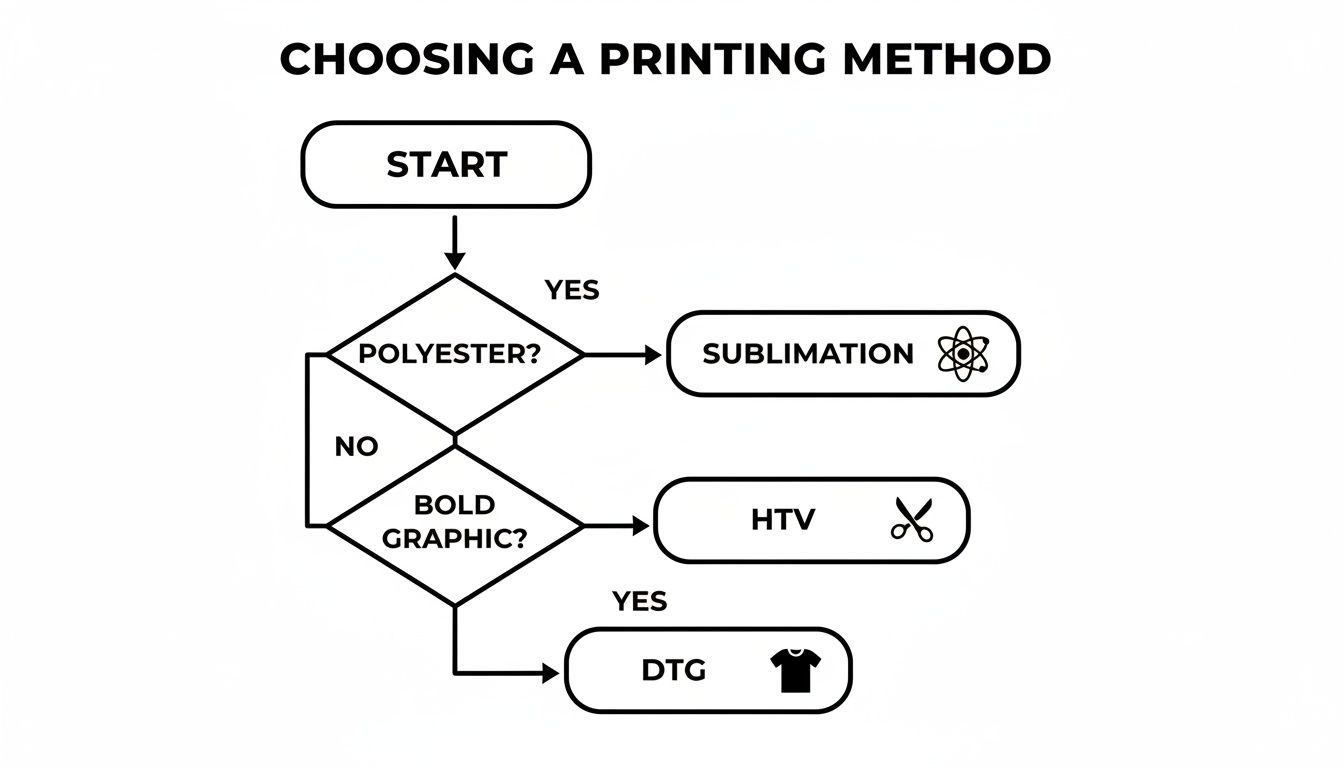
As you can see, just knowing your fabric and design simplicity can quickly narrow the field, pointing you toward specialized tools like Sublimation or HTV when they're the best fit for the job.
From Print Method to Product Launch
Once you’ve locked in the best printing method for your brand, you have to think about how you'll show off your amazing products. This is where effective T Shirt Product Photography becomes the next crucial step in turning a perfectly printed shirt into a sale. Great photos highlight the quality of your print and the appeal of your design, which directly sways how customers see your brand and whether they decide to buy.
Picking the right process and partners is the foundation of any successful apparel business. By taking the time to weigh these factors, you can invest intelligently, smooth out your production workflow, and create high-quality t-shirts that your customers will absolutely love.
Your T-Shirt Printing Questions, Answered
Alright, we've covered a lot of ground. But even after digging into all the different ways to print a t-shirt, you probably still have some practical questions swirling around. Let's tackle the big ones I hear all the time from people trying to get their projects off the ground.
Which Printing Method Is the Most Durable?
When it comes to pure, rugged longevity, you can't beat screen printing and dye-sublimation.
A screen print using quality plastisol ink is like a coat of armor for a shirt—it's incredibly tough. Meanwhile, sublimation prints literally become one with the polyester fabric, meaning they will never crack or peel, period. Right on their heels, though, is a high-quality Direct-to-Film (DTF) print. With proper care, a good DTF transfer will often outlast the t-shirt it's printed on.
What Is the Most Affordable Method for Small Orders?
If you just need a few shirts, your best friend is any method that doesn't have a big setup fee.
- DTG and DTF: Both are fantastic choices if you're ordering just one or a small batch of 1-10 shirts. There are no screens to make or complicated setups, so you're not paying extra just to get the press running.
- Heat Transfer Vinyl (HTV): This is another great, low-cost option, especially for simple, one-color designs like text or basic logos on a handful of items.
For small businesses or anyone just starting out, avoiding the hefty initial setup costs of screen printing is a game-changer. Digital methods like DTF and DTG really level the playing field, making it possible to create professional-grade custom apparel without a huge upfront investment.
Can You Print Photorealistic Images on a T-Shirt?
Absolutely, and the results can be stunning.
For printing hyper-realistic photos with millions of colors and subtle gradients directly onto a cotton shirt, Direct-to-Garment (DTG) is king. It's essentially an inkjet printer for fabric. However, Direct-to-Film (DTF) is a very close second, producing incredibly vibrant, detailed images that have the added advantage of working on a much wider range of materials, including synthetics and blends.
Which Method Works Best on Polyester or Athletic Wear?
This one's easy. For 100% light-colored polyester garments, dye-sublimation is the undisputed champion. The ink actually fuses into the fabric fibers, creating a permanent design you can't even feel. It’s completely breathable, making it perfect for athletic apparel.
That said, for all-around versatility, DTF is an amazing alternative. It works beautifully on polyester of any color, and it’s also the go-to for the popular cotton/poly blends you see in so much modern sportswear.
Ready to see what the power and flexibility of Direct-to-Film can do for your business? Cobra DTF provides premium, USA-made DTF transfers known for their brilliant colors and serious durability. You get same-day shipping and can finally say goodbye to the headaches of dealing with overseas suppliers.