
A Guide to the Best Methods of Printing on Shirts
When it comes to getting a design onto a shirt, you've got a few solid options: Screen Printing, Direct-to-Garment (DTG), Direct-to-Film (DTF), and Dye-Sublimation. Each one has its own strengths, and the best choice really depends on what you're trying to accomplish—things like your design's complexity, how many shirts you need, and the fabric you're working with.
How to Find the Right Printing Method
Choosing from all the different methods of printing on shirts can feel overwhelming, especially if you're new to the game. The truth is, the "best" method comes down to four key things: your design, order size, fabric, and budget. These pieces all fit together, and figuring out how they relate is the first step to getting a print you'll love.
Think of it like picking the right tool for a job. If you need to print a simple, one-color logo for a 500-person company event, screen printing is your workhorse. But if you want a single t-shirt with a full-color, photorealistic cat portrait on it, you’ll need a totally different approach—that’s where something like DTG or sublimation shines. This guide will give you the practical knowledge to make that call with confidence.
Key Factors to Consider
Before we get into the nitty-gritty of each technique, let's nail down the questions you need to ask yourself. Answering these will immediately help you rule out certain methods and zero in on the right one.
- Design Complexity: Is your design simple, with just a few solid colors? Or is it a complex photograph with tons of shades and gradients?
- Order Quantity: Are you making just one or two custom shirts for yourself, a small run for a team, or hundreds for a big event or merchandise launch?
- Fabric Type: Are you printing on classic 100% cotton, a poly-cotton blend, or a slick synthetic performance fabric like polyester?
- Budget and Durability: Are you after the cheapest option for a one-off event, or do you need a super durable print that will survive countless washes?
To help you see how this all connects, check out this chart. It’s a great visual for walking through the decision process.
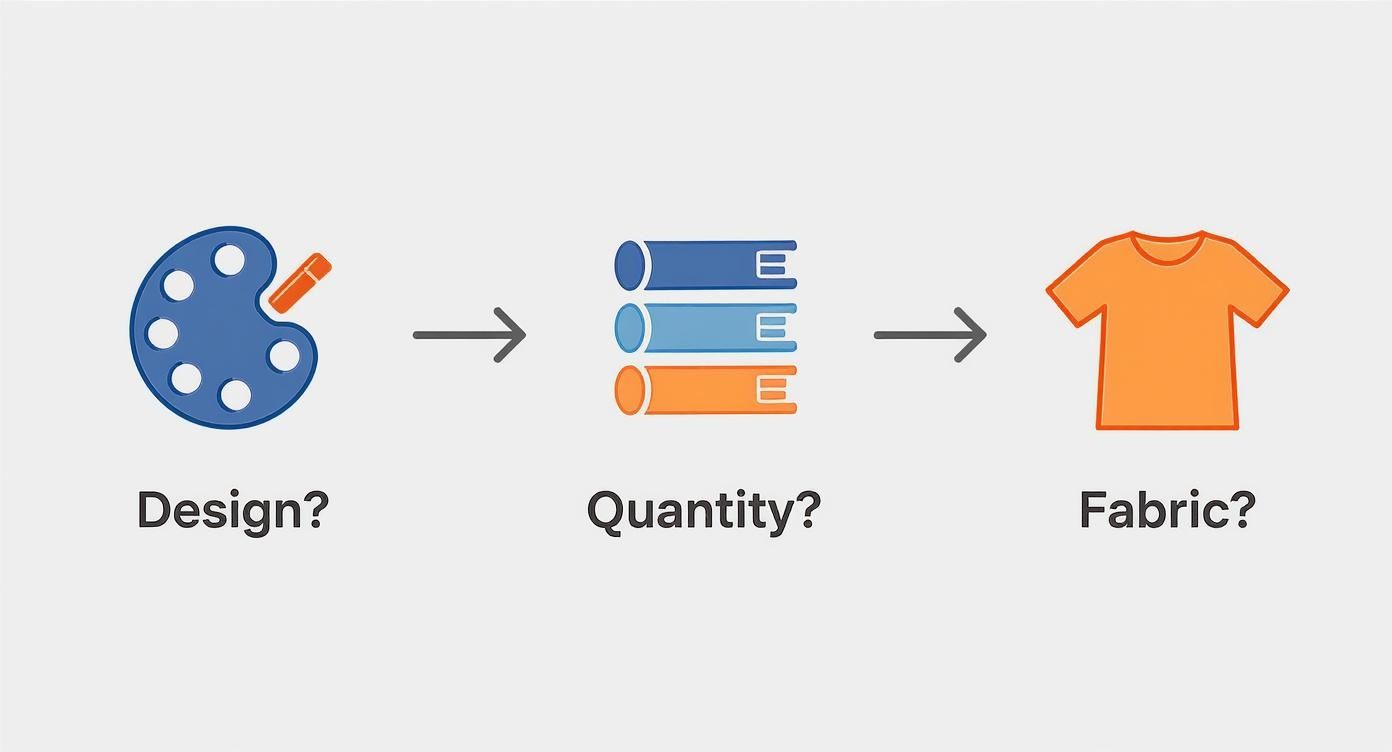
As the infographic lays out, your project’s needs point directly to the best technical solution. It’s all about matching the method to the mission.
To give you a head start, here's a quick reference table that breaks down the most common methods and what they're truly good for.
Quick Guide to Shirt Printing Methods
This table offers a snapshot of the main printing methods, helping you quickly see which one aligns with your project's goals.
| Printing Method | Best For | Color Capability | Feel on Shirt |
|---|---|---|---|
| Screen Printing | Large batches (25+), simple designs (1-4 colors) | Limited by screen count | Thicker layer of ink on top |
| DTG | Small orders, complex photorealistic designs | Unlimited colors, gradients | Soft, breathable, dyed-in feel |
| DTF | Versatile fabrics (cotton, poly, blends), all quantities | Unlimited colors, vibrant | Flexible, slightly rubbery feel |
| Sublimation | 100% polyester, all-over prints, sportswear | Unlimited colors, permanent | Zero feel, ink becomes fabric |
Hopefully, this gives you a clearer picture of your options. Each method has a time and a place where it truly excels.
An Introduction to Popular Methods
As we break down each technique, you'll see how they solve different problems. For example, screen printing has been the industry king for bulk orders with simple graphics for decades because it's incredibly cost-effective at scale. On the flip side, Direct-to-Garment (DTG) is perfect for one-off prints or small batches that need high-detail, full-color images, especially on cotton.
The best printing method isn't about which one is "highest quality" in a vacuum; it's about which one is the highest quality for your specific project. Aligning the technique with your goals for design, volume, and fabric is the secret to a perfect print.
Then there's the newer kid on the block, Direct-to-Film (DTF). It’s a game-changer because it offers the stunning color range of DTG but works on a huge variety of fabrics, from cotton to polyester and blends. Finally, dye-sublimation is the specialist for polyester, creating incredibly vibrant, permanent prints that literally become part of the fabric itself. For a more detailed breakdown of how to make the final call, our guide on the best printing method for t-shirts can help.
Once you’ve got your printing method locked in, you'll need to think about how you'll show off your finished shirts. Checking out some AI apparel photoshoot solutions can be a great way to get professional-looking product shots without a massive budget.
The Classic Choice: Screen Printing Explained
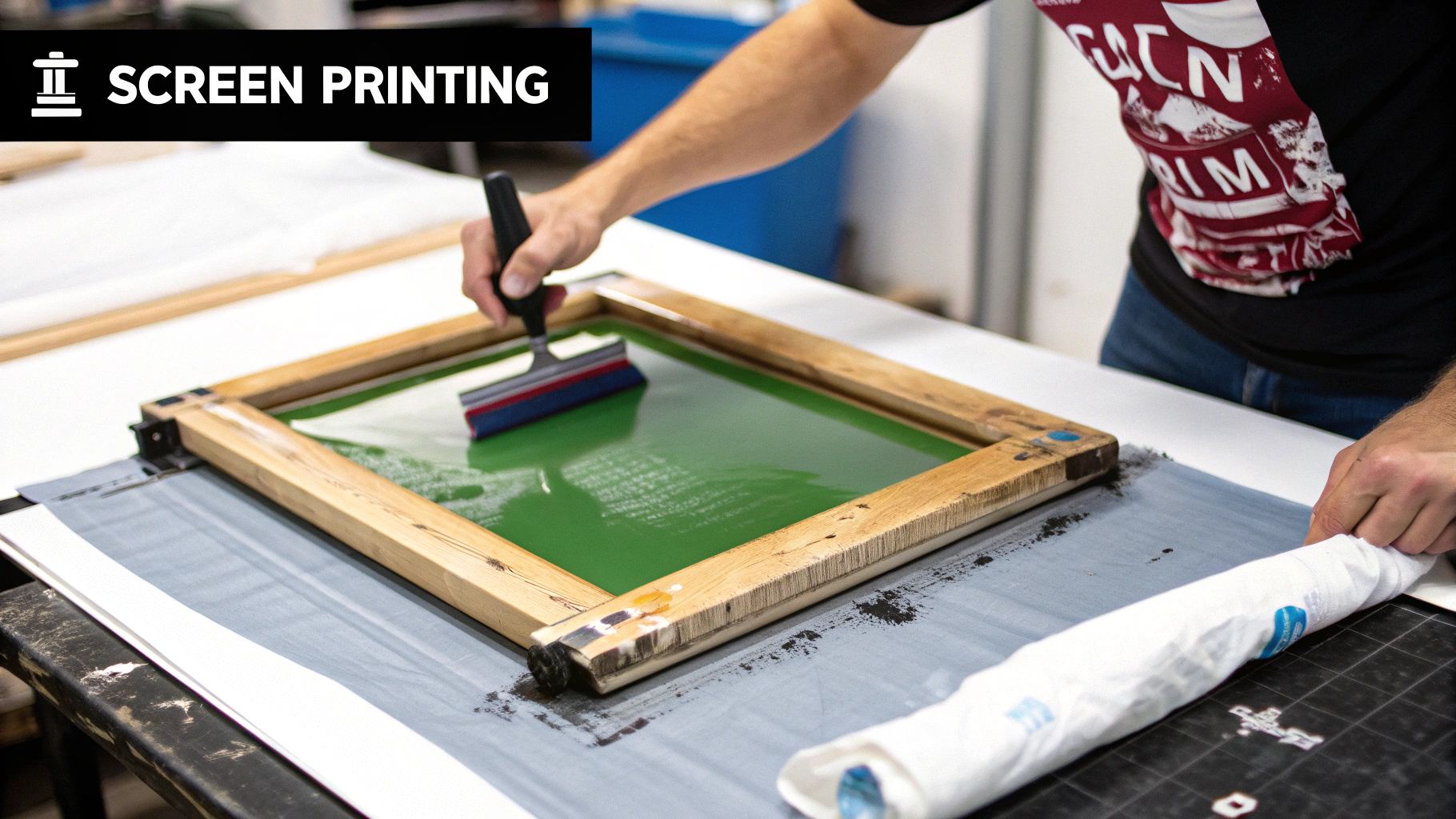
When you think of a classic printed t-shirt—the kind with bold, vibrant graphics that feel like they'll last forever—you're almost certainly picturing screen printing. For decades, this has been the go-to method for professional apparel, and for good reason. It’s the undisputed champion for bulk orders where you need durability and a low price per shirt.
So, how does it work? Think of it like a highly sophisticated stenciling process. For every single color in your design, a unique screen—a fine mesh stretched taut over a frame—is created. A light-sensitive emulsion is applied to the screen, and your design is then "burned" onto it, creating a precise stencil.
Once the screens are ready, a thick, durable ink is pushed through the stencil's open areas and directly onto the shirt using a squeegee. This process is repeated for each color, layering them to build your final design. Because the ink sits right on top of the fabric, the result is an incredibly rich and opaque print that really pops, especially on dark-colored shirts.
How Screen Printing's History Shapes Its Strengths
This technique has been around for a very long time. Its roots trace back to China’s Song Dynasty (960–1279 AD), and it has been refined over centuries. The modern version we know today was really kicked into high gear in the 1960s with the invention of the multi-color rotary press, which made printing complex, colorful designs much, much faster.
This long, proven history is why screen printing still accounts for an estimated 60-70% of all printed t-shirts worldwide. It’s a testament to its unmatched efficiency for mass production. You can dive deeper into the evolution of print-on-demand and its historical roots to see just how these methods came to be.
The Best Use Cases for Screen Printing
The real magic of screen printing kicks in with volume. The initial setup—creating a separate screen for each color—is the most labor-intensive part and has a higher upfront cost. But that cost is spread across the entire order. Once the press is up and running, shirts can be cranked out incredibly fast, which brings the cost per shirt way down as the quantity goes up.
This makes it the perfect choice for:
- Event Merchandise: Think concert tours, festivals, and 5K runs where you need hundreds (or thousands) of identical shirts.
- Company Uniforms: Perfect for businesses wanting a durable, professional logo on staff apparel that won't fade.
- Team and School Apparel: It's the standard for sports teams, clubs, and school spirit wear featuring bold, simple logos.
- Brand Merchandising: A no-brainer for clothing lines producing large batches of a single design.
The core trade-off with screen printing is simple: you invest more time and money upfront in the setup, but you reap the rewards with a lower per-item cost and superior durability on large orders. It's a classic example of economy of scale in action.
Pros and Cons of This Timeless Method
Like any technique, screen printing isn't a one-size-fits-all solution. Knowing its strengths and weaknesses is key to deciding if it's the right move for your project.
Pros of Screen Printing
- Exceptional Durability: The thick plastisol or water-based inks are cured to create a print that can handle countless washes without cracking or fading. It’s built to last.
- Vibrant Colors: The opacity of the ink makes colors pop, even on the darkest fabrics. You just can't beat the vibrancy.
- Cost-Effective for Bulk: The price per shirt drops dramatically on larger orders, making it the most affordable option for runs of 25+ units.
Cons of Screen Printing
- High Setup Costs: Creating individual screens for each color makes it too expensive for small orders or one-off prints.
- Limited Color Complexity: Designs with tons of colors, smooth gradients, or photorealistic details are tough and expensive to pull off. Every new color means another screen and another cost.
- Not Ideal for On-Demand: The lengthy setup process makes it completely impractical for print-on-demand, where single items are printed as they're ordered.
Bottom line? If your project involves a relatively simple design and a large quantity, screen printing remains one of the absolute best methods of printing on shirts out there.
The Digital Revolution: Direct-to-Garment (DTG) Printing
If screen printing is the tried-and-true workhorse of the apparel world, then Direct-to-Garment (DTG) is its high-tech, artistic counterpart.
Think of it this way: imagine taking your home office inkjet printer, scaling it up, and feeding it a t-shirt instead of a piece of paper. That's the core idea behind DTG, a method that has completely opened up the world of custom, detailed, and small-batch shirt printing.
The magic is in the specialized, water-based inks that are sprayed directly onto the fabric. The ink soaks into the fibers, becoming a part of the shirt itself. This is why a DTG print feels incredibly soft and breathable—there’s no thick, heavy layer of ink sitting on top of the garment.
Since it’s a fully digital process, DTG can handle pretty much any design you can cook up on a computer. It's the go-to for complex, full-color images, photorealistic portraits, and intricate designs with gradients that would be a nightmare (or just impossible) to pull off with screen printing.
How Does DTG Printing Actually Work?
The DTG process is surprisingly straightforward, especially for one-off prints or small orders. It all starts with prepping the shirt so the ink can do its job properly.
- Pre-Treatment: First, the shirt gets a light misting of a special pre-treatment solution before being run through a heat press. This liquid creates the perfect canvas for the ink, helping it bond to the cotton fibers so the final image is crisp and doesn't bleed.
- Digital Printing: Next, the shirt is smoothed onto a flat platform (called a platen) and slid into the DTG printer. Just like your desktop printer, print heads glide across the fabric, meticulously applying the ink to bring the design to life. If you're printing on a dark shirt, the machine first lays down a solid base of white ink to make sure the colors on top pop.
- Curing the Ink: Once the printer is finished, the shirt is carefully removed and cured, usually with another trip through a heat press or a conveyor dryer. This final step locks the ink into the fabric for good, making the design durable enough to stand up to washing.
DTG printing’s biggest superpower is its ability to handle incredible complexity with zero extra setup. Whether your design has one color or a million, the process is the same. This makes it the engine of on-demand apparel.
When to Choose DTG
DTG truly shines where other methods of printing on shirts just can't compete. The key is the lack of setup fees. There are no screens to burn or films to create, which makes it a no-brainer for small quantities.
Need just one custom shirt for a birthday gift? A dozen for your startup team? DTG is your best friend.
Here’s where this technique really makes sense:
- Photorealistic and Complex Designs: If your artwork involves photos, detailed illustrations with lots of shading, or subtle color gradients, DTG is the only way to capture that level of detail with perfect accuracy.
- Print-on-Demand Businesses: This technology is the backbone of the entire print-on-demand industry. Online sellers can offer hundreds of designs without ever touching a shirt, as each one is printed only after a customer places an order.
- Small Batch Orders: For any order under 25 pieces, DTG is almost always the more economical choice over screen printing.
To get a better feel for the nuances, you can learn more about what Direct-to-Garment printing is and see how it stacks up against the alternatives.
Limitations You Should Know
For all its strengths, DTG isn't a silver bullet. It has a few important limitations to keep in mind.
The technology is at its best on 100% cotton garments. Natural fibers do a great job of soaking up the water-based inks. While you can get decent results on some high-cotton blends, printing on polyester or other synthetics is generally a non-starter.
Also, while DTG is quick for a single shirt, it can't match the speed of screen printing for large volumes. The time it takes to print each shirt one-by-one adds up, making production for hundreds of units slow and expensive. When you need to go big, screen printing is still the champ.
A Closer Look at Heat Transfer Methods
Beyond printing ink directly onto fabric, there's a whole family of methods that work a bit differently. These are all forms of heat transfer, and they operate on a simple, core idea: applying a design to a garment using a combination of heat and pressure. Think of it as a professional, high-tech version of the iron-on patches you might remember from when you were a kid.
Instead of a standard home iron, these professional techniques rely on a specialized machine called a heat press. This piece of equipment is crucial because it delivers consistent, even temperature and pressure across the entire design. This ensures the graphic bonds permanently to the fabric for a durable, long-lasting finish that can handle the rigors of daily wear.
This category is incredibly flexible, opening up possibilities for everything from simple text on a t-shirt to vibrant, full-color photographs on all sorts of materials.
The Power of Heat Transfer Vinyl (HTV)
One of the most popular heat transfer techniques you'll come across is Heat Transfer Vinyl, or HTV. Picture a solid sheet of colored material with a heat-activated adhesive on the back. A special machine, a vinyl cutter, then precisely carves your design—like a logo, a name, or a number—out of this sheet.
After the excess vinyl is carefully peeled away (a process known in the biz as "weeding"), the design is placed on the shirt and put into the heat press. The heat activates the adhesive, fusing the vinyl directly onto the fabric. This method is the undisputed champion for customizing sports jerseys with player names and numbers. It creates crisp, sharp lines and a slightly raised, durable finish that’s perfect for bold, simple graphics.
HTV really shines when it comes to:
- Personalization: Adding names and numbers to team uniforms.
- Simple Logos: Creating bold, single-color or multi-layered logos for small businesses or clubs.
- Small Orders: It’s incredibly cost-effective for one-off items and small batches, as there are no major setup costs.
DIY-Friendly Transfer Paper Prints
Another incredibly common approach involves using heat transfer paper. This method is fantastic because it makes full-color printing accessible to just about anyone with a computer. The process kicks off by printing your design with a standard inkjet or laser printer onto a specially coated sheet of transfer paper.
Once it's printed, you place the paper face-down on the shirt and press it. The heat works its magic, lifting the ink from the paper and transferring it onto the garment, creating a complete, full-color image. It’s a go-to option for DIY projects or for making a single custom shirt with a photograph on it without needing to invest in expensive gear.
Heat transfer methods bridge the gap between hobbyist and professional. Techniques like HTV and transfer paper empower small-scale creators to produce high-quality, custom apparel that would otherwise require significant investment in industrial machinery.
While these prints are super accessible, their durability can be a mixed bag. They often have a distinct feel on the shirt and may be prone to cracking or fading a bit faster than other professional methods after many wash cycles. Still, for one-off events, gag gifts, or personal projects, their convenience is simply unbeatable.
The Best of Both Worlds: Plastisol Transfers
Finally, let's talk about plastisol transfers. This clever technique is a hybrid, combining the premium quality of screen printing with the straightforward application of a heat press. Instead of screen printing the ink directly onto the shirt, the design is first printed onto a special release paper using the same durable plastisol inks.
This pre-printed transfer can then be stored and applied to a shirt whenever you're ready using a heat press. This gives you the vibrant colors, incredible durability, and professional feel of a screen-printed shirt, but without having to manage the messy, multi-step screen printing process yourself. Brands often use plastisol transfers to stock up on their most popular designs, allowing them to press them onto different shirt sizes and styles on-demand. This makes it a wonderfully flexible and efficient solution for small to medium-sized apparel businesses.
The Modern Innovators: DTF and Sublimation Printing
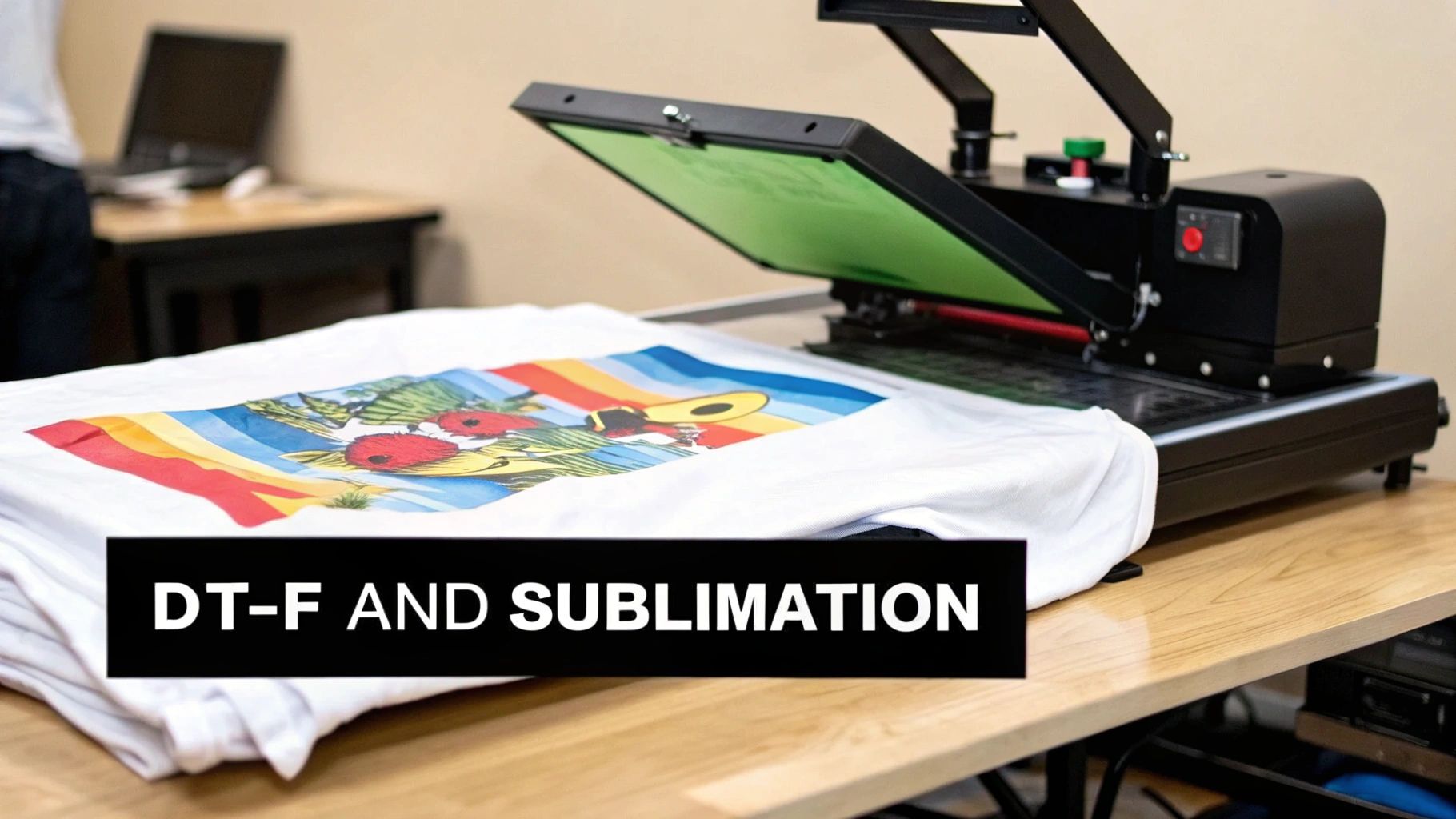
As the world of custom apparel keeps moving forward, two techniques have really started to turn heads: Direct-to-Film (DTF) and Dye-Sublimation. These aren't just minor tweaks to old methods; they're modern solutions that solve problems traditional printing can't touch. They open up new doors for versatility, color vibrancy, and long-lasting quality.
DTF printing, especially, has made a name for itself by taking the best parts of DTG and screen printing and rolling them into one powerful process. You get the stunning, full-color detail of a digital print, but without being stuck printing only on certain fabrics. The magic happens by printing the design onto a special transfer film first, not directly onto the shirt.
This film gets a dusting of adhesive powder, which is then cured. The final step is using a heat press to transfer the design from the film to the garment. It’s a clever workaround that creates a durable, flexible graphic that feels a bit like a screen print but with an infinite color palette.
DTF Printing: The Ultimate All-Rounder
The real game-changer with DTF is its incredible versatility. Since you're transferring the design onto the fabric, it doesn't care what the material is. We're talking 100% cotton, polyester, nylon, fleece, or tricky blends. This opens up a massive range of products you can print on, from basic t-shirts to technical performance gear.
This "print on anything" capability makes DTF a fantastic choice for shops that need one reliable method to handle a huge variety of jobs. The final print has a soft, pliable feel that stretches with the fabric and holds up exceptionally well in the wash, resisting the cracking and peeling that plagues lesser heat transfers. To get a deeper look at the process, our complete guide on what is DTF printing covers every technical detail.
So, when is DTF the hero?
- When you need to print on a wide range of fabrics, especially polyesters and dark garments that give DTG printers trouble.
- When you want vibrant, photorealistic designs with crisp details and brilliant whites on any color shirt.
- When you're handling both small custom jobs and larger production runs without the messy, time-consuming setup of screen printing.
DTF printing acts as a universal adapter for apparel decoration. It takes the digital freedom of modern printing and makes it compatible with nearly any fabric, effectively bridging the gap between niche specialization and mass-market appeal.
This flexibility is exactly why it has become one of the fastest-growing shirt printing methods out there.
Dye-Sublimation: The Art of Infusion
While DTF lays a design on top of the fabric, dye-sublimation does something completely different—it infuses the ink into the fabric. It's less like printing and more like a chemistry experiment. The process starts by printing a design onto special transfer paper using sublimation dyes.
When you take that paper and heat-press it onto a polyester garment, the magic happens. The solid dye instantly turns into a gas (a process called sublimation), completely skipping the liquid phase. This gas seeps into the pores of the polyester fibers, and as the fabric cools, the ink turns back into a solid, permanently trapped inside.
The result is a print you literally cannot feel. There's zero texture or hand-feel because the design isn't a layer on top; it is the fabric now. This also means the print can never crack, peel, or fade, giving it unmatched durability.
The Polyester Specialist
Sublimation’s unique process has one major rule: it only works on 100% polyester or high-polyester blend fabrics that are white or light-colored. The dye needs those synthetic fibers to bond with, and since the inks are transparent, they simply won't show up on a dark background.
This makes it a specialist's tool, but for the right job, it's unbeatable.
- Sportswear and Performance Apparel: The zero-feel print is perfect for athletic jerseys, ensuring the fabric stays lightweight and breathable.
- All-Over Prints: You can create those incredible, seam-to-seam designs by sublimating the fabric pieces before they're sewn together.
- Photographic Quality on Hard Goods: Sublimation isn't just for shirts. It works beautifully on polyester-coated items like mugs, phone cases, and mousepads.
While its material limitations mean you can't use it for everything, nothing comes close to the permanence and pure color intensity of a sublimated print when used in the right context.
A Look Back at Where It All Started
Before we had sophisticated digital printers and high-speed presses, getting a design onto a shirt was a true hands-on craft. It’s worth taking a quick look at these foundational methods, as they really set the stage for the technology we rely on today. Long before anyone dreamed of a digital file, artisans figured out clever ways to turn one-of-a-kind art into repeatable patterns for textiles.
The earliest and most important of these methods is block printing. Think of it like a very old-school, artistic version of a rubber stamp. The idea is simple, but the execution was an art form in itself.
The Art of the Carved Block
Picture an artist carving a design, in reverse, into a solid block of wood. Every single line and detail had to be chiseled out by hand. Once the block was ready, they'd apply ink to the raised surface. Then, they would carefully place the block onto the fabric and press down firmly to transfer the image.
It was a slow, meticulous process that demanded incredible skill. If you wanted a multi-color design, you had to carve a separate block for each color. And each one had to be lined up perfectly to create the final image. It was tough work, but it was an incredibly effective way to create beautiful, repeating patterns for clothing and decor.
At its core, block printing was the leap from decorating fabric by hand to creating scalable, repeatable designs. This simple concept—a carved surface transferring ink to cloth—is the ancestor of almost every printing method we have today.
This technique was one of the first ways to mass-produce decorated textiles, with roots going back thousands of years. It was a massive step forward, paving the way for the Industrial Revolution's roller printing and eventually, the screen printing industry we know. It made decorated clothing accessible to far more people. You can find more details on the history of T-shirt printing methods on shirtworks.co.uk.
While you won't find anyone block printing a modern band t-shirt, its core principles live on. Isolating a design, applying ink, and transferring it with pressure is the DNA of modern printing. Screen printing, for instance, is a direct descendant—it just uses a screen as a more advanced stencil instead of a carved block. Understanding this history gives you a new appreciation for just how far we've come with innovations like DTG and DTF.
Common Questions About Shirt Printing
Even after you've looked at all the options, you might still have a few questions buzzing around. Let's tackle some of the most common ones to help you lock in the perfect printing method for your project.
What’s the Absolute Best Printing Method for Quality?
This is the million-dollar question, but the truth is, there's no single "best" one. The highest quality print is the one that best suits your specific needs.
If you're aiming for a photorealistic design with tons of detail on a 100% cotton shirt, Direct-to-Garment (DTG) is your champion. For big batches with simpler, bold graphics, nothing beats the vibrant, durable finish of classic screen printing. And for performance sportswear made of polyester, dye-sublimation is king—the ink becomes part of the fabric itself, so you can't even feel it.
Which Print Will Last the Longest?
When it comes to durability, two methods stand out: screen printing and dye-sublimation.
A good screen print uses thick, robust inks that are cured to the fabric, meaning it can handle countless washes before it even thinks about fading. Sublimation takes it a step further by infusing the ink directly into the polyester fibers, making the design as permanent as the shirt itself. It simply can't crack or peel.
Key Takeaway: The "best" method is the one that aligns with your specific goals for design complexity, fabric type, and order quantity. Define your project's needs first to find the perfect match.
Can I Print on Polyester or Poly-Blends?
You absolutely can, but you'll need to pick your method carefully.
Direct-to-Film (DTF) is a fantastic, versatile choice that shines on polyester, cotton, and blends alike, delivering crisp, full-color designs. For a print that's completely breathable and permanent on polyester, however, dye-sublimation is the go-to, making it ideal for athletic gear.
Once you’ve nailed the printing, you'll want to show off your awesome new shirts. Getting great photos is key, so it's worth checking out some professional T-shirt product photography techniques to make your creations look as good online as they do in person.
At Cobra DTF, we specialize in high-quality, USA-made DTF transfers that bring your designs to life on any fabric. Get vibrant, durable prints with fast, reliable shipping by visiting https://cobradtf.com.