
Is DTF Printing Good Quality? the Honest Answer
A well-made DTF transfer can survive around 50 or more wash cycles, yet a poorly cured one can begin failing quickly. That's the part many buyers miss when they ask, “Is DTF printing good quality?” The answer isn't built into the printer or the transfer film. It comes from controlling the entire chain, from ink and powder through curing, pressing, cooling, and garment care.
Direct-to-film printing has moved beyond a niche workflow. One market estimate valued global DTF printing at USD 2.72 billion in 2024 and projected USD 3.92 billion by 2030, with a 6.0% CAGR (Grand View Research's DTF market analysis). Another industry forecast said more than 7.2 billion DTF prints were produced globally in 2024, almost 30% more than the previous year, a scale that reflects repeat commercial use rather than casual experimentation.
The Short Answer on DTF Print Quality
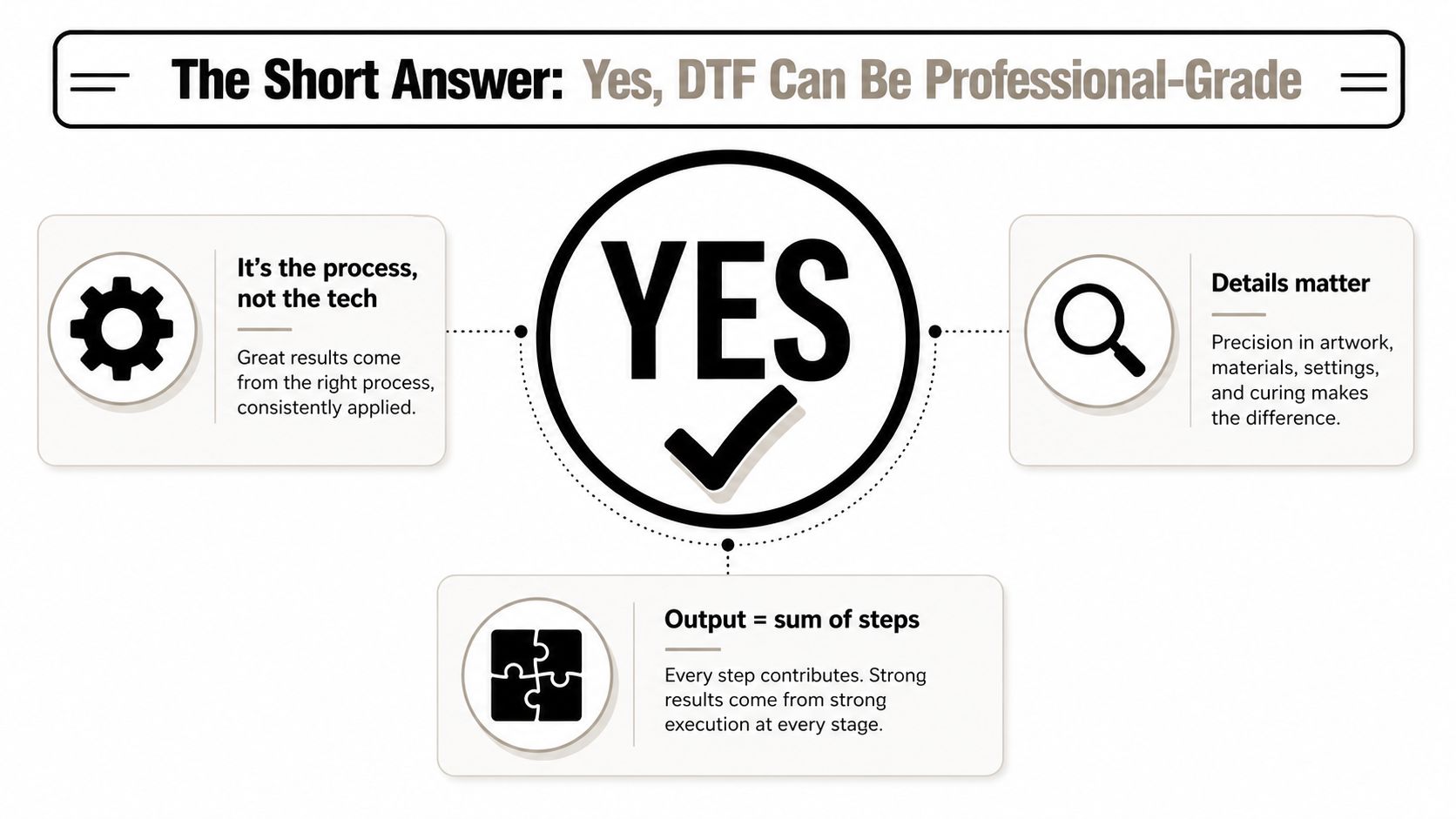
Yes, DTF printing can produce professional-grade quality. It delivers saturated color, fine artwork, opacity on dark garments, and useful fabric flexibility. The process suits custom apparel because it handles detailed graphics without the screen setup required by traditional screen printing.
The important qualification is that DTF quality is a process outcome. A reliable transfer depends on film and ink compatibility, adhesive-powder coverage, curing, press temperature, pressure, time, and substrate preparation. If one of those variables is wrong, the final shirt can crack, peel, feel stiff, or lose visual impact even when the original artwork looked perfect.
The variables that decide the result
Film and ink compatibility affect sharpness, white-layer opacity, and color density. Cheap or mismatched materials can create banding, uneven white ink, weak adhesion, or a surface that feels heavier than expected.
Powder curing determines whether the adhesive fully gels into a dependable bonding layer. Under-curing leaves weak spots. Over-curing can change the hand feel and make the transfer less flexible.
Heat-press settings matter just as much. A controlled study found that pressing DTF prints at 170°C for 10 seconds minimized color change, reduced black-density loss, and limited white-layer contamination across TPU-based materials (the heat-press optimization study).
Practical rule: Treat the transfer, garment, and heat press as one system. Changing any one of them can change the result.
A pre-pressed garment also matters because moisture, lint, seams, and surface texture affect contact. The same artwork can look smooth and integrated on one shirt, then show edge lift or inconsistent bonding on another. DTF is good quality when the operator controls those differences instead of treating every blank as identical.
How DTF Printing Actually Works
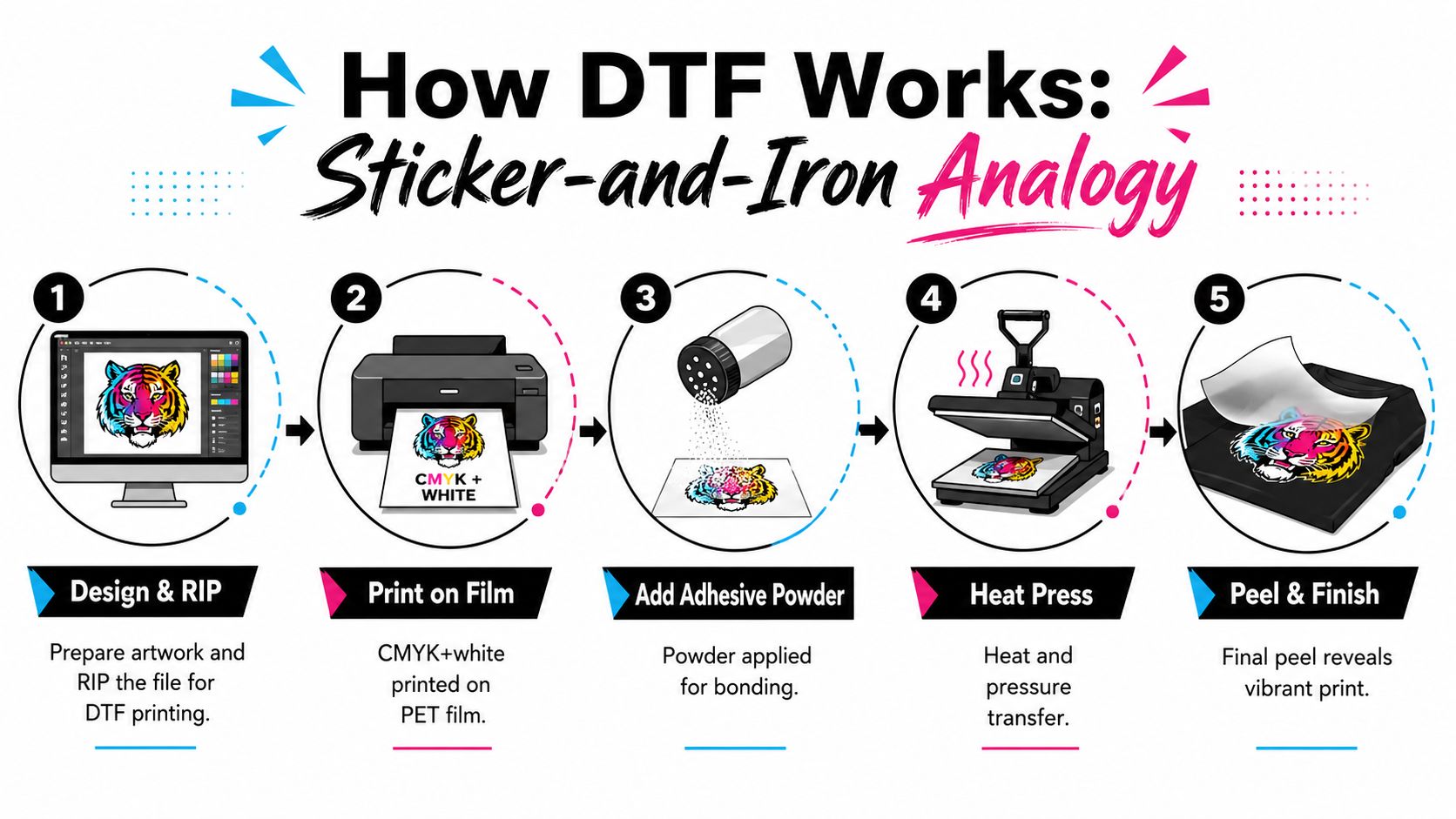
DTF is easiest to understand as a printed sticker combined with an iron-on adhesive, except the “sticker” is engineered for fabric and carries a flexible ink layer. The design starts digitally, but the visible result depends on what happens after the file leaves the computer.
From artwork to printed film
First, RIP software prepares the artwork for printing. The printer lays down CMYK color and a white ink underbase onto PET release film. The white layer gives the color layer something opaque to sit on, which is why DTF can produce bright graphics on black, navy, and other dark garments.
The printer uses DTF-specific pigment inks rather than ordinary desktop ink. The RIP controls color management, white-ink density, mirroring, and the amount of ink placed on the film. Too little ink can make the design look weak. Too much can create a thick, wet layer that is harder to powder and cure evenly.
Powder creates the bond
While the printed ink remains wet, hot-melt adhesive powder is applied across the design. The powder sticks to the wet ink and becomes the bonding layer between the transfer and garment.
The film then moves through a curing station, shaker oven, or controlled heat process. Heat melts the powder into a continuous adhesive surface. The operator must remove excess powder and avoid clumps, because loose or uneven adhesive produces weak edges and inconsistent wash performance.
Pressing finishes the transfer
The cured film is positioned on the garment and placed in a heat press. The press supplies the heat and pressure needed to activate the adhesive and push the transfer into contact with the textile. After pressing, the film is peeled according to its construction, either while hot or after cooling.
The white underbase supplies opacity, while the cured adhesive contributes to stretch and attachment. The final hand feel is usually a little more noticeable than direct-to-garment printing, but a correctly tuned transfer shouldn't feel like a rigid plastic patch. For a broader technical overview, see this guide to what DTF printing is.
What the Evidence Says About Durability and Vibrancy
DTF quality depends on process control, not the label “DTF.” A transfer may survive a controlled wash test yet fail in customer use if the garment is pressed at the wrong temperature or pressure, the powder is poorly cured, or the customer uses hot water, high-heat drying, bleach, or aggressive ironing.
Independent textile testing supports DTF's potential. One study comparing decorated textiles found DTF samples among the more abrasion- and wash-resistant options tested. Its strongest DTF samples retained color without significant loss after 15 wash cycles (the textile durability study). That result describes a tested sample and process, not a guaranteed lifespan for every printer, film, ink, garment, or press.
A separate technical summary reports black DTF prints surviving approximately 52 washes without fading, while another test reported no cracking or peeling after about 20 washes (the DTF durability summary). These figures show what a controlled workflow can achieve. They do not define one universal service life. Film and ink selection, powder coverage, curing, pressing, and wash care all change the result. For practical expectations, compare the DTF transfer wash-life guide with the care conditions your customers use.
Why good transfers fail
Four process failures account for many early complaints:
- Under-cured powder: The adhesive does not form a complete bond, allowing cracking or edge lift during laundering.
- Over-cured powder: Excess heat can reduce flexibility and leave a stiffer print.
- Incorrect pressure: Too little pressure limits contact. Too much can flatten the film and alter its surface.
- Poor garment care: Hot water, high dryer temperatures, bleach, and aggressive ironing shorten the useful life of an otherwise sound transfer.
Industry and supplier wash tests commonly cite 50 to 80 or more wash cycles for well-applied DTF. Some 2026 test writeups report 100 wash/dry cycles with little visible fading. Those reports also mention garment shrinkage and care conditions. Judge adhesion and color stability against the customer's laundering habits, not a headline number. See the wash-care guidance from Printing Planet UK for handling factors that affect results.
Quality benchmarks at a glance
| Metric | Properly Executed DTF | Poorly Executed DTF |
|---|---|---|
| Color | Strong, saturated color with a clean white underbase | Dull color, white contamination, or uneven density |
| Adhesion | Even bond across the design and edges | Edge lift, peeling, or powder gaps |
| Stretch | Flexes with the fabric when correctly cured | Cracks when the garment is stretched |
| Washing | Maintains appearance through repeated laundering under controlled care | Fades, cracks, or peels early under harsh care |
| Hand feel | Noticeable transfer surface, flexible and consistent | Stiff, brittle, glossy, or excessively thick |
DTF can be vibrant and durable, but good quality describes execution, not merely the printing method. Temperature, pressure, curing, film, ink, and care instructions determine whether that potential reaches the finished garment.
DTF Versus DTG, Screen Printing, and Heat Transfers
DTF is a practical middle option for shops that need full-color detail across different fabrics. Its quality depends on the transfer film, ink, powder, curing, and pressing, so the method itself does not guarantee the same result on every garment.
DTG prints directly onto the garment and can provide a soft, breathable feel, especially on suitable cotton apparel. It handles photographic artwork well. The trade-off is a more involved workflow when white ink and pretreatment are required. Switching among cotton, polyester, and blended fabrics also requires closer process control than DTF.
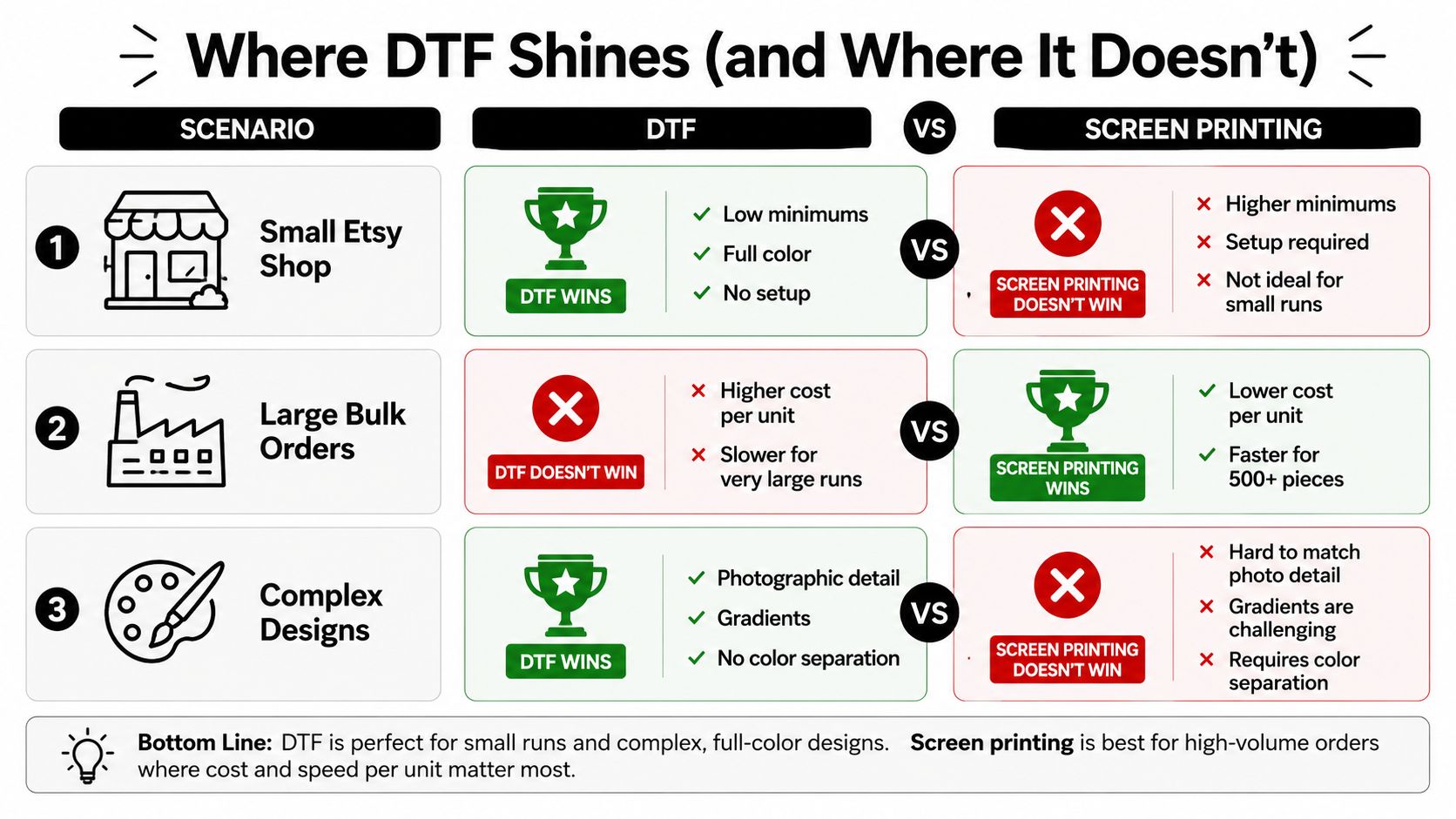
Screen printing remains difficult to beat for large repeat orders and vintage or discharge-style effects. With the right ink system, it can produce a very soft print. Screen preparation, color separation, setup, and cleanup make it less efficient for one-off jobs or frequently changing artwork. Simple designs at high volume often favor screen printing, while detailed short runs may favor DTF.
Heat-transfer vinyl has a low entry barrier for names, numbers, and uncomplicated single-color graphics. Cutting and weeding limit fine detail, and vinyl can leave a visible edge. On stretch garments, the result may feel less natural than a correctly applied DTF transfer.
Comparing the practical trade-offs
| Method | Setup Cost | Cost Per Print (avg) | Best Fabric Range | Wash Cycles to Fading | Hand Feel |
|---|---|---|---|---|---|
| DTF | Moderate equipment and transfer workflow | Varies by artwork, garment, and supplier | Cotton, polyester, blends, and many mixed textiles | Can reach around 50 or more with strong process control | Flexible transfer surface, usually slightly raised |
| DTG | Specialized printer and pretreatment workflow | Varies with ink coverage and garment | Best suited to cotton and compatible blends | Depends on pretreatment, ink, curing, and care | Soft and breathable |
| Screen printing | Higher setup for screens, separation, and cleanup | Often more favorable for high-volume repeat work | Broad garment range, depending on ink system | Depends on ink, cure, fabric, and laundering | Can be very soft with suitable inks |
| Heat-transfer vinyl | Low entry cost for cutter and vinyl | Varies by vinyl type, design size, and weeding time | Common apparel fabrics, with stretch limits by vinyl | Depends on vinyl quality, pressing, and care | Smooth or plastic-like, with visible edges possible |
DTF's strongest commercial advantage is flexibility. A shop can produce detailed, multicolor artwork without preparing separate screens for each design. That suits short runs, custom names, changing catalogs, and garments that are difficult to print directly.
Its versatility does not make it the cheapest option in every job. A large order with identical, simple artwork may have better production economics with screen printing. A soft photographic print on suitable cotton may feel better with DTG. Heat-transfer vinyl remains sensible for basic lettering when the visible edge and hand feel are acceptable.
Choose by artwork, fabric, quantity, surface feel, and expected laundering. Also compare the supplier's film, ink, curing method, and pressing instructions. Those variables determine whether a DTF transfer stays bonded and flexible, or cracks and peels long before the lab-style wash result suggests.
Best Use Cases for DTF Transfers
A one-person Etsy shop selling custom children's shirts often needs flexibility more than maximum production speed. DTF lets the seller use full-color artwork without screens or garment pretreatment, then apply the same type of transfer to cotton tees, polyester athletic shirts, and blended hoodies. That reduces the number of separate workflows a small operation has to manage.
For a mid-sized apparel brand producing repeated designs, DTF can remain effective when each design needs detailed gradients, names, or changing artwork. The brand can keep transfers ready and press garments as orders arrive. Once a design becomes a very large, predictable run with limited color complexity, screen printing deserves a cost comparison because its setup becomes easier to justify across many identical pieces.
A print-on-demand store has a different priority. It needs to fulfill individual orders without carrying finished inventory. Prepared DTF transfers can be stored flat and applied when the order comes in, which keeps the decoration stage compact and avoids the pretreatment steps associated with some direct-print workflows.
Where DTF earns its place
- Short-run custom apparel: Detailed graphics remain economical without screen creation for every variation.
- Mixed-fabric catalogs: The same production approach can serve cotton, polyester, and blends, provided the transfer and press settings suit the garment.
- On-demand fulfillment: Shops can press only what has sold instead of printing and storing finished shirts.
- Small-batch testing: A brand can test artwork and garment combinations before committing to a larger production method.
DTF is a poor match for some jobs. A distressed, discharge-style vintage print may look more authentic when produced with screen printing. An all-over design on 100% polyester performance wear generally calls for sublimation because the dye becomes part of the fabric rather than sitting as a transfer layer.
Business owners also need to consider presentation, packaging, garment selection, and customer expectations. A practical guide to brand merchandise can help connect decoration choices with the broader product experience. DTF makes the most sense when the buyer values color detail, flexible quantities, and fabric range more than the absolute softest hand or the lowest unit cost at very high volume.
How to Vet a DTF Supplier Before You Buy
Supplier quality is easier to judge with a sample than with a product description. Order a sample pack containing different colors, garment types, and artwork coverage. Press each sample using the supplier's written instructions, then inspect the transfer under normal light and while stretching the fabric.
Run your own laundering test. The supplier may provide an attractive marketing sample, but your customer's washing habits determine the outcome. Check for cracking, edge lift, color change, and a roughening of the print surface after repeated washing and drying.
A practical inspection checklist
- Check the powder layer. Under magnification, the adhesive should look evenly distributed rather than glossy, clumped, or visibly bare in places. Uneven powder coverage can create weak bonding or inconsistent texture.
- Ask about the ink system. Find out which DTF inks the supplier uses and whether those inks are matched to the film and RIP profile. Compatibility matters more than a brand name alone.
- Confirm the film construction. Ask whether the supplier uses hot-peel or cold-peel film and how the chosen film should be pressed. Film release behavior affects the finish.
- Get pressing instructions in writing. The supplier should state temperature, time, pressure, peel method, and whether a second press is recommended. If the instructions are vague, reproducing the sample result will be difficult.
- Request wash-test evidence. Ask for cycle counts, test conditions, and care instructions rather than accepting “wash durable” as a complete specification.
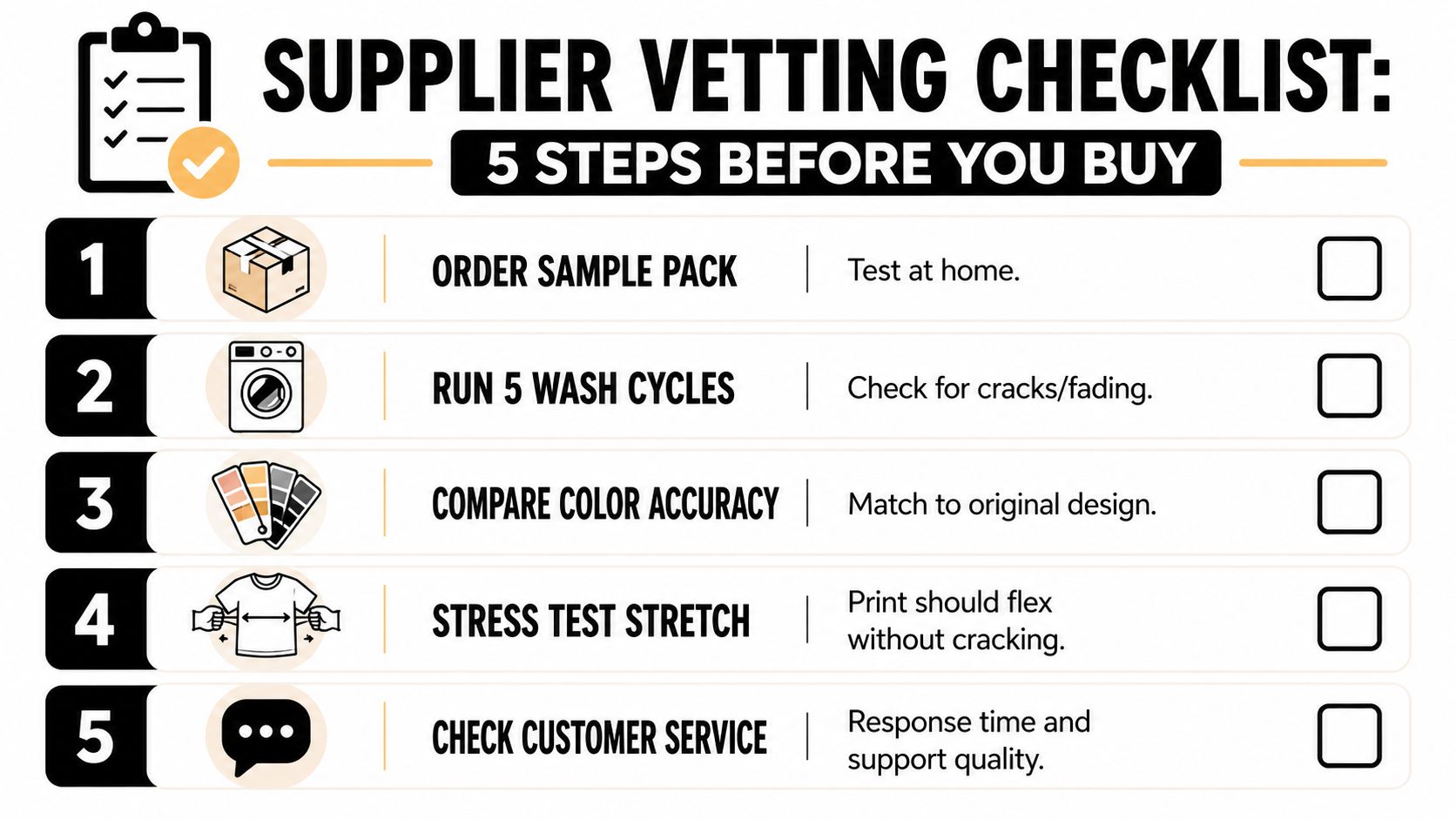
A supplier should also explain how it handles artwork files, color expectations, reprints, and damaged transfers. Consistent communication matters because quality problems often come from unclear assumptions about the garment, press, or design rather than from the printer alone. This DTF printing supplier guide is a useful reference when comparing vendors and building your own checklist.
Defining Good Quality for Your Business
“Good quality” needs a business definition. A promotional shirt, a retail hoodie, and a uniform order don't face the same wear pattern, wash routine, or customer expectation.
Start by setting the durability target. Decide how many washes the garment should reasonably withstand, how much color change is acceptable, and whether cracking at stretch points would trigger a replacement. Then match the decoration to the use case. A small one-color tote and a full-color gradient on a blended hoodie require different expectations for coverage, texture, and adhesion.
Finally, lock down the supplier and press variables. Confirm the film, ink, powder, curing approach, temperature, pressure, time, peel method, and garment preparation. Identical transfers can produce different results when pressed on different machines or applied to different blanks.
Quality benchmarks by buyer profile
| Buyer Profile | Wash Cycle Target | Color Shift Tolerance | Key Process Controls |
|---|---|---|---|
| POD reseller | Repeated household laundering with clear care instructions | Low visible shift on popular designs | Consistent transfer stock, repeatable press profile, garment testing |
| Etsy maker | Reliable performance for varied custom garments | Low to moderate shift, depending on product price | Sample testing, accurate artwork handling, fabric-specific pressing |
| Uniform supplier | Strong adhesion through frequent use and laundering | Low shift across replacement garments | Documented curing, calibrated pressure, approved blanks, batch checks |
The evidence supports a measured verdict. DTF has demonstrated strong abrasion, wash, color, and detail potential when operators control the process, and the 2025 DTF State of the Industry Survey found that 95% of respondents rated their overall DTF transfer print quality as good or excellent (the textile study and survey reference). That satisfaction doesn't remove the need for testing. It reinforces the point that a repeatable workflow is what turns the technology into a dependable product.
For buyers who want a ready-made option, Cobra DTF supplies full-color transfers with published pressing guidance and wash-durability information. Visit Cobra DTF to review transfer options, confirm the recommended application settings, and order samples before committing to a larger apparel run.