
Fabric Paper for Printing: Best Choices for Vibrant Apparel
If you've ever searched for "fabric paper for printing," you've probably noticed it can be a bit confusing. That’s because it’s not a single, specific product. Instead, it’s a catch-all term for several different materials used to get a design from your computer onto a piece of clothing.
Think of it like this: if you want to attach two pieces of wood, you could use nails, screws, or glue. Each one does the job, but the best choice depends on the project. The same goes for decorating apparel—the right "paper" depends entirely on what you're trying to achieve.
Unpacking the World of Fabric Printing
At its heart, "fabric paper for printing" is usually a special sheet or film that acts as a carrier. You print your design onto it, and then use heat to transfer that design to a garment.
This broad category covers a few very different technologies, each with its own process, strengths, and weaknesses. To get a handle on the basics, you can start by exploring what transfer paper is and how the general concept works. Getting this foundational knowledge is the first step in picking the right method for your business or hobby.
The Main Types of Fabric Paper
Let's break down the main players in this space. Each one offers a different combination of feel, durability, and visual pop, which makes them suited for different kinds of jobs.
-
Fabric Transfer Paper: This is your classic "iron-on" paper, the kind you can grab at most craft stores. It's a great starting point for beginners. It essentially works like a high-tech sticker that you fuse onto the fabric's surface with heat.
-
Heat Transfer Vinyl (HTV): With HTV, you're not printing. Instead, you're cutting your design out of a pre-colored sheet of vinyl. It's famous for its bold, solid colors and tough-as-nails durability, which is why you see it so often on sports jerseys and company logos.
-
Direct-to-Film (DTF) Transfers: This is the newest and most versatile method of the bunch. You print your design onto a special PET film, apply an adhesive powder, and then heat-press it onto the garment. DTF is a game-changer because it produces brilliant, full-color images on almost any fabric, all while feeling soft and holding up incredibly well in the wash.
The common thread here is heat. All these methods rely on heat and pressure to make a design a permanent part of the fabric. But the materials, the process, and the final look and feel are worlds apart.
You can think of these options on a spectrum. On one end, you have simple, DIY-friendly transfer papers for one-off projects. On the other end, you have professional solutions like DTF transfers, which deliver the kind of retail-quality results you need to build a serious apparel brand. Now, let’s dig into how they really stack up against each other.
Navigating the world of fabric printing can feel overwhelming, with a few key players constantly vying for the top spot. When you're looking to put designs on apparel, your main choices boil down to traditional fabric transfer paper, Heat Transfer Vinyl (HTV), and the more modern Direct-to-Film (DTF) transfers.
Figuring out which one is right for you isn't just about the final look; it's about matching the method to your business goals, your budget, and the quality your customers expect. Let's break down how these three stack up against each other in a real-world context.
The Core Differences That Matter
Think about a common job: printing a detailed, multi-color company logo on a batch of dark-colored polo shirts. This single scenario immediately highlights the strengths and weaknesses of each printing method.
To make a smart decision, you need to look at a few key factors:
- The "Hand" or Feel: How does the design actually feel on the shirt? Is it soft and part of the fabric, or does it feel like a thick, plastic sticker sitting on top?
- Durability: Will the design crack, peel, or fade after a few trips through the washer and dryer? A professional print needs to last.
- Color & Detail: Can the method handle complex, photorealistic images with brilliant colors, or is it better suited for simple, bold graphics?
- Startup Costs & Labor: What equipment do you need to buy, and how much hands-on time does each shirt take? This directly impacts your upfront investment and how many orders you can fulfill.
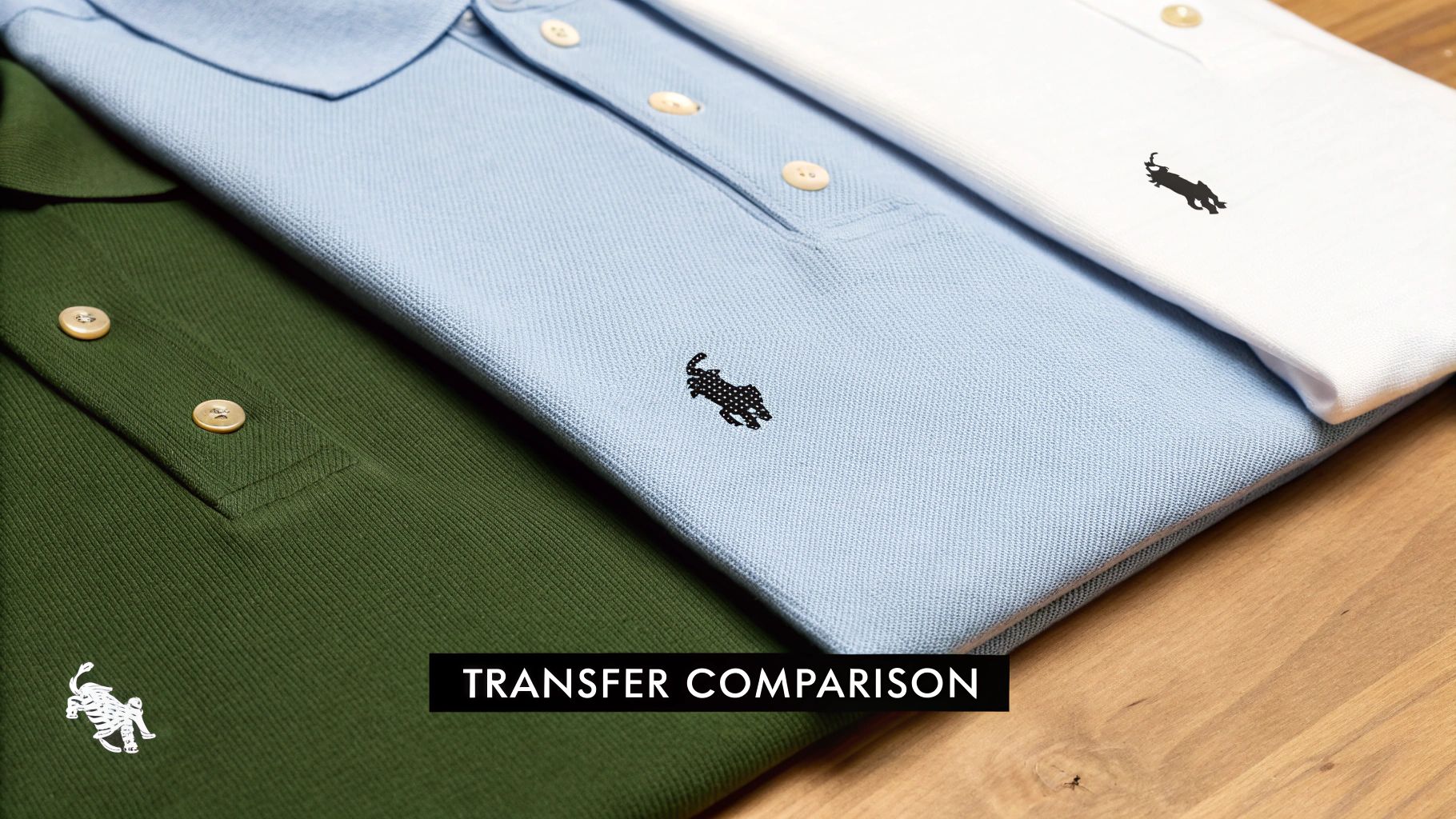
The following table gives you a quick side-by-side comparison to see how these methods perform across these critical areas.
Comparison of Fabric Printing Methods
| Feature | Fabric Transfer Paper | Heat Transfer Vinyl (HTV) | Direct-to-Film (DTF) |
|---|---|---|---|
| Feel (Hand) | Often thick and stiff, feels like a plastic patch. | Can be thick, especially with multiple layers. | Very soft, flexible, and integrated with the fabric. |
| Durability | Low. Prone to cracking and fading after a few washes. | Excellent. Very durable and long-lasting. | Excellent. Rated for 60+ washes with no cracking. |
| Color/Detail | Good for photos, but poor vibrancy on darks. | Limited to single-color layers; not for complex designs. | Unlimited colors and photorealistic detail in one pass. |
| Fabric Type | Works best on cotton/poly blends. | Works on cotton, polyester, and blends. | Works on nearly any fabric, including synthetics. |
| Startup Cost | Very low. Just a printer and a heat press. | Moderate. Requires a vinyl cutter and heat press. | Moderate to high for in-house; low with pre-made transfers. |
| Best For | Hobbyists, prototypes, and one-off personal projects. | Simple text, numbers, and single-color logos. | Professional apparel businesses needing quality and versatility. |
As you can see, each method has its place. Your choice really depends on the specific job at hand and the standards you need to meet for your customers.
One of the most important lessons in this business is that there's no single best t-shirt printing method for every single project. The smart move is to pick the tool that best fits the job you're doing today.
Fabric Transfer Paper: A Good Starting Point
Fabric transfer paper is where many people start. It's affordable and accessible, making it great for hobbyists or creating a quick one-off shirt for an event. You simply print your design on the special paper with a standard inkjet printer and press it onto the shirt.
The trade-off, however, is professional quality. The final design often has that heavy, plastic feel and sits noticeably on top of the fabric. Durability is its biggest weakness—don't be surprised if it starts cracking or fading after just a handful of washes. While you can get full-color images, they tend to look washed out on dark garments unless you use an opaque paper, which only makes the design feel thicker.
Heat Transfer Vinyl (HTV): The Standard for Bold Graphics
HTV is a completely different animal. You're not printing anything; instead, you're cutting your design out of a sheet of colored vinyl with a special cutter and then pressing it onto the garment. It's the undisputed champion for things like names and numbers on sports jerseys or clean, single-color logos.
HTV is incredibly durable and produces vibrant, solid colors that pop, even on black fabric. The downside is its clumsiness with complex designs. If your image has multiple colors, you have to cut and press each color as a separate layer, which is incredibly time-consuming and often impractical. The final result can also feel quite thick if you're stacking several layers of vinyl.
Direct-to-Film (DTF): The Professional All-Rounder
DTF is a game-changer that truly combines the best of both worlds. The process involves printing a full-color design directly onto a transparent film, coating it with an adhesive powder, and then pressing it onto almost any type of fabric.
The results are stunning. You get photorealistic detail with an unlimited color palette, all applied in a single press. The final transfer has an incredibly soft, flexible feel and can stretch with the fabric without cracking. Its durability is top-notch, easily lasting 60+ washes and rivaling what you’d get from traditional screen printing.
DTF solves the major pain points of both transfer paper and HTV, making it the ideal solution for businesses that demand high quality, detail, and efficiency. While setting up your own DTF printing station is an investment, you can get started immediately by ordering ready-to-press transfers from a supplier like Cobra DTF. This versatility is a key principle in printing, whether you're working with fabric or printing on different substrates like coroplast.
A Better Way to Print on Fabric: Why DTF is Taking Over
If you've ever wrestled with fabric paper or spent hours weeding heat-transfer vinyl (HTV), you know the limitations. Transfer paper can feel stiff and crack after a few washes, while HTV gets complicated and time-consuming with anything more than a simple, one-color design. This is where Direct-to-Film (DTF) printing comes in, and it's not just another option—it's a massive leap forward for anyone serious about custom apparel.
DTF gives you the best of all worlds: the full-color, photographic detail you can't get with vinyl, combined with the professional durability that transfer paper often lacks. Forget about weeding tiny, intricate pieces. Forget about designs that fade or peel. With DTF, you can print complex, multi-color graphics onto a special film and press them onto almost any fabric—cotton, polyester, blends, you name it. It works on any color, too, from white to black, without any extra steps.
What This Looks Like in the Real World
Imagine a small custom apparel business that started out making single-color logos with a vinyl cutter. Their process was slow, and they had to turn away customers who wanted photos on their shirts or designs with lots of colors. It was a constant bottleneck.
When they switched to DTF, everything changed.
Suddenly, those complex, multi-color jobs they used to say "no" to became their most profitable orders. They could print a vibrant, detailed graphic and have it pressed on a shirt in minutes, a fraction of the time it would have taken to layer multiple colors of vinyl. This let them expand from basic t-shirts to team jerseys, hoodies, and even custom tote bags, all with a soft, stretchy feel that customers loved.
DTF bridges that awkward gap between hobby-level methods and the massive expense of traditional screen printing. It's a professional solution that lets you take on more complex, higher-margin work without breaking the bank on setup costs.
And this isn't a niche trend. The demand for high-quality printed textiles is booming. The global market, which includes materials like fabric paper for printing and DTF films, hit a staggering 28.2 billion square meters in 2024. Projections show it climbing to 37.0 billion square meters by 2030. That growth is fueled by a demand for better, more efficient printing solutions. You can dig into the numbers yourself by checking out the complete textile printing market analysis.
One Transfer, Almost Any Fabric
One of the biggest wins with DTF is its incredible versatility. Other methods can be picky about the fabric you use, but DTF is far more forgiving.
- Cotton and Blends: Creates a soft, breathable print that feels like part of the shirt, perfect for tees and hoodies.
- Polyester and Performance Wear: It adheres beautifully to slick athletic fabrics without cracking when stretched.
- Tougher Materials: Works great on canvas, denim, and other textiles that are often a nightmare for other methods.
This means you can use the exact same transfer for a cotton t-shirt, a polyester sports jersey, and a canvas bag. For a business, this is huge. It simplifies your inventory and your entire production process, letting you offer a much wider range of products without juggling different types of paper or vinyl.
The Key Advantages Broken Down
So, what really makes DTF the go-to choice for so many professional apparel decorators? It boils down to a few key benefits.
-
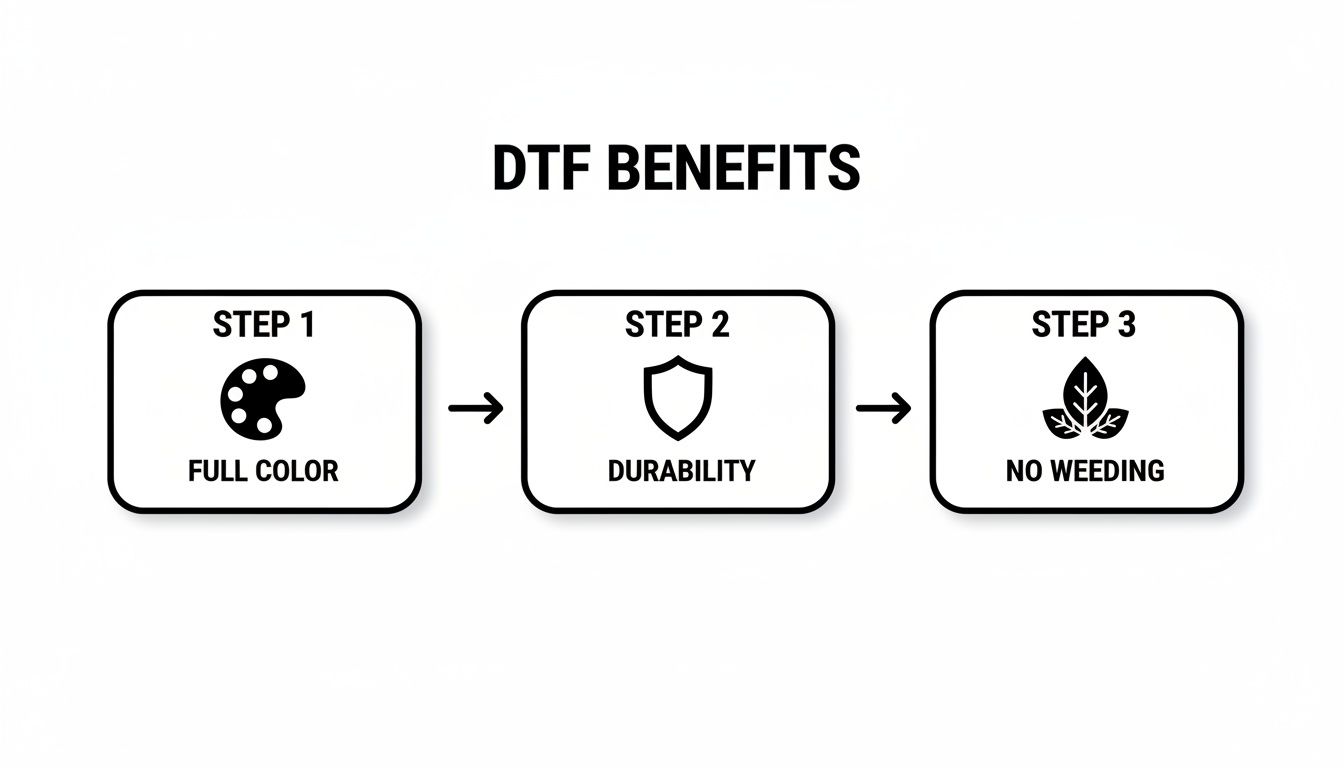
No More Weeding. Period. This is easily the biggest time-saver. You can forget about the tedious, eye-straining task of picking out tiny bits of vinyl with a hook tool. The entire DTF design, no matter how detailed, is printed and pressed as a single piece.
-
Unlimited Colors and Fine Detail. DTF prints everything in one go, from smooth gradients to high-resolution photos. There’s no need to layer colors, which keeps the print feeling soft and light on the shirt.
-
Incredible Durability and Feel. A well-applied DTF transfer can easily last for 60+ washes without cracking, peeling, or fading. Because the ink bonds so well with the fabric, the final print is soft and flexible, moving with the garment instead of feeling like a stiff plastic shield.
-
Works on Any Color Garment. DTF printers automatically lay down a base layer of white ink under the colors. This makes your design pop with bright, opaque color, whether you're pressing it onto a white shirt or a black one. No more stocking separate papers for light and dark fabrics.
When you add it all up, DTF offers a faster, more versatile, and higher-quality way to get designs onto fabric. It’s the natural evolution of fabric paper for printing, redesigned for the demands of today’s custom apparel market.
Your Step-By-Step Guide to Applying DTF Transfers
Applying a Direct-to-Film (DTF) transfer might seem simple, but getting that professional, retail-quality finish comes down to the details. Think of it less like a science and more like a craft. Every step matters, from prepping your shirt to that final press.
Let's walk through the exact process we use to get flawless results every time.
Preparing Your Garment and Heat Press
You can't build a great house on a shaky foundation, and you can't get a great print on a poorly prepped shirt. Start by making sure your garment is clean and free of any lint or wrinkles—these little things can ruin the adhesion.
Now, let's get your heat press dialed in. These settings are crucial for a print that not only looks good but lasts. For most of the DTF transfers we work with on cotton or poly-blends, we stick to a pretty tight range.
- Temperature: Aim for a sweet spot between 280–320°F (138–160°C).
- Pressure: You'll want medium-to-heavy pressure. It needs to be firm enough to properly bond the adhesive into the fabric fibers, but not so hard that it smashes the life out of the design.
- Time: The first press is quick—just 10-15 seconds.
Once your press is up to temp, lay your garment flat and give it a quick "pre-press" for about 3-5 seconds. This is a pro-tip that many people skip. It irons out any hidden wrinkles and, more importantly, removes any lingering moisture from the fabric, giving you the perfect canvas.
The Application Process Step-By-Step
Alright, your press is hot and your shirt is prepped. It's go time.
-
Position the Transfer: Lay the DTF transfer down on the garment. Because the carrier film is clear, you can see exactly where your design will land. If you're worried about it shifting, a little bit of heat-resistant tape on the corners is your best friend.
-
Protect Your Work: Always cover the transfer with a Teflon sheet or a piece of parchment paper. This simple step protects your shirt from scorch marks and keeps your heat press platen clean from any ink residue.
-
The First Press: Close the press and let it work its magic for 10-15 seconds. As soon as the timer beeps, open it up and carefully move the garment to a cool, flat surface to rest.
Following these steps is what gets you the incredible results DTF is known for: vibrant, full-color designs that are durable and require absolutely no weeding.
Each part of this process plays a role in making sure your finished product looks amazing and holds up in the wash.
Mastering the Cold Peel and Final Cure
Patience is a virtue, especially right now. This next part is arguably the most critical step for getting a smooth, matte finish and ensuring the print lasts. Don't even think about peeling that film while it's hot.
The "cold peel" is non-negotiable for professional-grade results. You have to wait until the transfer is completely cool to the touch. If you try to peel it warm, you risk pulling up the ink and ruining the whole thing.
Once it's cool, find a corner and start peeling the film back slowly and at a low angle. It should come off smoothly, leaving behind a crisp, perfect design bonded to the fabric.
But you're not done just yet. That final press, or "curing," is what truly locks the design into the fibers for maximum durability. Put the garment back on the press, cover the design with your Teflon sheet one last time, and press it for another 5-10 seconds. This melts the ink just enough to make it a permanent part of the shirt.
For a deeper dive into perfecting your method, check out our complete DTF press instructions.
How to Troubleshoot Common Application Issues
Even the most seasoned pros run into a snag every now and then when applying DTF transfers. If you hit a bump, don’t sweat it. Most of these issues are easy to fix with a few small tweaks to your process. Think of it as dialing in your technique to get that flawless, professional finish every single time.
Let's walk through the most common problems and exactly how to solve them. Getting this right will help you minimize waste and keep your production line humming.
Poor Adhesion or Peeling Edges
This is the big one. If a transfer isn't sticking right, especially around the edges, 99% of the time it comes down to one of three things: temperature, pressure, or time.
- Check Your Heat Press Temperature: Your press might read 300°F, but is it actually at 300°F? An inexpensive infrared temp gun is your best friend here. Use it to check the real surface temperature of your platen. If it’s too cool, the adhesive simply won’t melt and bond properly.
- Increase the Pressure: "Medium pressure" is a vague term that varies from press to press. If your transfers are peeling, it’s a good bet you’re not getting enough clamp-down force. Crank up the pressure a notch and make sure your platen is level so the force is applied evenly across the entire transfer.
- Garment Seams and Obstructions: Pressing over a seam, collar, or zipper is a recipe for failure. These raised areas create an uneven surface, preventing the transfer from getting the direct pressure it needs. The solution? Slip a heat press pillow under the print area to raise it up, guaranteeing firm, even contact.
By running through these three variables, you can solve just about any adhesion headache you come across.
Colors Appear Dull or Muted
Did your vibrant design come out looking lackluster and dull after pressing? The culprit is almost always too much heat. High temperatures can literally scorch the inks, zapping the vibrancy right out of them.
First, make sure you’re working within the recommended temperature range (280–320°F). If you are, try knocking the temperature down in 5-10 degree increments. Sometimes, just a slight drop is all it takes to make the colors pop without hurting the adhesion. This is particularly important for heat-sensitive fabrics like polyester.
A classic mistake is thinking hotter is better. With DTF, precision trumps raw heat every time. The real magic happens when you find that sweet spot between temperature and pressure to unlock those bright, durable colors.
The Print Feels Stiff or Plasticky
A great DTF transfer should feel soft, pliable, and part of the shirt. If yours feels stiff like a sheet of plastic, you’re likely overdoing the final curing press—either for too long or at too high a temperature. Remember, that second press is just a quick finishing move to meld the ink into the fabric fibers.
Try shortening your final press to just 3-5 seconds. That’s typically all you need to lock in the design for good without over-baking it. You'll preserve that soft-hand feel that your customers will absolutely love. A quality fabric paper for printing solution like DTF is engineered for a soft finish, so don't cook it away!
Fading or Cracking After Washing
When applied correctly, DTF transfers are built to last. For anyone making custom shirts, modern fabric paper for printing stats show DTF has 90% higher opacity than vinyl, which helps it achieve an impressive wash-fastness of 60+ cycles. The e-commerce boom, which has driven a 25% surge in demand, is expected to fuel a 226% increase in digital printing by 2035. This allows shops like Cobra DTF to deliver incredibly fade-resistant prints. You can find more insights on the growth of commercial printing on towardspackaging.com.
If you’re seeing prints fade or crack way too soon, it points directly back to an incomplete cure. The ink and adhesive never fully bonded with the garment in the first place. Go back and review your application process. Focus on ensuring you have enough pressure and—this is crucial—that you performed that final press after the cold peel. That last 5-10 second press is what guarantees a print that can stand up to wash after wash.
Choosing the Right DTF Transfer Supplier
Once you’ve settled on DTF as your printing method, you have another huge decision to make: picking a supplier. Don't gloss over this step. The company you choose to print your transfers is just as critical as the technology itself. Think of them less as a vendor and more as a partner in your business—their work directly impacts your product quality, how fast you can get orders out the door, and ultimately, your brand's reputation.
The market is flooded with options, and it’s crucial to understand that not all DTF transfers are made the same. The quality of the film, the adhesive powder, and the inks can vary wildly from one supplier to the next. While it's tempting to just go for the lowest price, a cheap transfer that peels, cracks, or has washed-out colors will end up costing you a fortune in angry customers and dead inventory.
Evaluating Print Quality and Consistency
The very first thing you need to do is get your hands on the physical transfers. The best way to judge quality is to order sample packs from a few different companies you're considering. Don't just give them a quick glance—put them through the wringer.
Press the samples onto the different types of fabrics you actually plan to use, both lights and darks. Here’s what you should be looking for:
- Color Vibrancy: Are the colors bright and punchy, or do they look dull and faded? Pay special attention to how deep the blacks are and how brilliant the whites are.
- Print Detail: Get up close and inspect the fine lines and any small text. You want to see crisp, clean edges, not a blurry or pixelated mess.
- Feel and Flexibility: A great transfer should feel soft to the touch and stretch right along with the fabric without cracking. If it feels stiff and plasticky, that’s a big red flag.
- Wash-Testing: This is the most important test of all. Wash the sample shirts over and over again. You need to see how the transfer survives the real-world abuse of a washing machine and dryer.
Remember, consistency is key. A supplier has to deliver the same fantastic results on your hundredth order as they did on your very first sample.
Turnaround Time and Reliability
In the custom apparel game, speed is everything. Your ability to turn jobs around quickly is a massive competitive advantage. Waiting weeks for a shipment to arrive from overseas can completely derail your workflow and lead to frustrated customers canceling their orders. This is a huge reason why choosing a US-based supplier like Cobra DTF can make all the difference.
Look for a supplier who guarantees not just the quality of their prints but also how fast they'll get to you. A guaranteed delivery window of 1-3 days can be a total game-changer, letting you confidently take on those last-minute rush jobs that others have to turn down.
This kind of reliability is a huge part of what’s driving the digital textile printing industry forward. The market, fueled by innovations like DTF, is expected to explode from USD 3.89 billion in 2025 to USD 14.13 billion by 2035. That growth is all about the increasing demand for fast, high-quality production. You can dive deeper into the digital textile printing market forecast on precedenceresearch.com.
Essential Questions for Potential Suppliers
Before you commit to anyone, get on the phone or send an email with a few direct questions. A transparent, customer-focused supplier will have no problem answering them.
- What’s your policy on reprints if there’s a quality issue? A true partner stands behind their work and will make it right, no questions asked.
- Can you give me a guaranteed shipping and turnaround time? Vague promises like "soon" won't cut it. You need a firm commitment you can build your schedule around.
- What specific brands of ink, film, and adhesive do you use? This isn't about you becoming a materials scientist; it's about seeing if they know their stuff and are confident enough to be transparent.
- If I run into a problem during pressing, do you offer support? Knowing you have an expert to call when something goes wrong is priceless.
Making the right call here sets your business up for long-term success, ensuring every single garment you sell is something you can be proud of.
Answering Your Top Fabric Printing Questions
As you get into custom apparel, you'll find a few questions pop up again and again. Getting these sorted out early is the key to making smart choices for your shop and sidestepping those all-too-common rookie mistakes. Let's break down some of the biggest questions people have about modern fabric printing.
Can I Just Use My Home Iron for DTF Transfers?
I get this question all the time, especially from people just starting out. While it’s tempting to grab a standard household iron for a one-off project, it’s a definite no-go for anything you plan to sell or want to last. The reason is simple: an iron fails at the two most important parts of the job—consistent temperature and even pressure.
A real heat press is built for this. It holds a specific temperature across the entire plate and clamps down with a level of force you just can't replicate by hand. That combination is what melts the DTF adhesive properly, forcing it to bond deep down into the fabric's weave.
Using a home iron is a recipe for disaster. The transfer might look okay for a moment, but it's almost guaranteed to start peeling or cracking after its first trip through the laundry. If you want professional results that make customers happy, a quality heat press isn't just a recommendation; it's essential.
What Kind of Fabrics Can I Actually Print on with DTF?
This is where Direct-to-Film really flexes its muscles and leaves other methods in the dust. The sheer versatility of DTF is probably its biggest draw, blowing the doors wide open for the kinds of products you can create. You're no longer stuck with just one or two "safe" fabric choices.
With DTF transfers, you can print on pretty much anything:
- 100% Cotton: The go-to for classic tees and casual gear.
- 100% Polyester: A must-have for jerseys, athletic wear, and performance apparel.
- Cotton/Poly Blends: Works great on 50/50s, tri-blends, and all the popular mixes.
- Specialty Materials: Think canvas tote bags, rugged denim jackets, and even certain types of leather.
What's great about this is that you can use the same exact fabric paper for printing (the DTF film) for all of it. Whether you're decorating a standard hoodie or a niche tote bag, your workflow stays simple and consistent.
How Does DTF Durability Stack Up Against Screen Printing?
This is the million-dollar question for anyone serious about quality. For years, screen printing has been the undisputed champion of durability. But the truth is, modern DTF technology has come a long, long way.
A properly applied, high-quality DTF transfer is incredibly tough. We're talking prints that are rated to handle 60+ wash cycles without any major fading, cracking, or peeling. They also have fantastic stretch and rebound, moving with the fabric instead of fighting against it, which is a huge deal for performance garments.
Sure, if you put them head-to-head in a lab, a perfectly cured screen print might technically outlast a DTF transfer in some extreme chemical wash test. But for real-world use and what customers expect from a high-end shirt, DTF’s durability is right there on par. It delivers a professional, long-lasting finish that stands tall next to traditional methods.
Ready to see the quality and versatility of professional-grade DTF transfers for yourself? At Cobra DTF, we provide 100% USA-made transfers with vibrant, fade-resistant colors and a guaranteed 1-3 day delivery. Check out our custom DTF transfers.