

DTF Transfers in Bulk a Buyer's Guide to Scale Smart
You're probably in the same spot a lot of growing shops hit. Orders are getting more consistent, you're tired of setting up tiny transfer runs, and bulk pricing looks like the obvious next move. Then a client changes a logo color, a seasonal design dies early, or a reorder comes in for the one size you didn't stock enough of.
That's where DTF transfers in bulk either help your margins or eat them.
Buying bigger can absolutely speed up production. It can also lock cash into dead inventory, multiply artwork mistakes, and turn one bad file into a stack of unusable transfers. The shops that scale well don't just chase the lowest piece price. They look at total landed cost, reprint exposure, storage discipline, and how fast they can replenish when demand shifts.
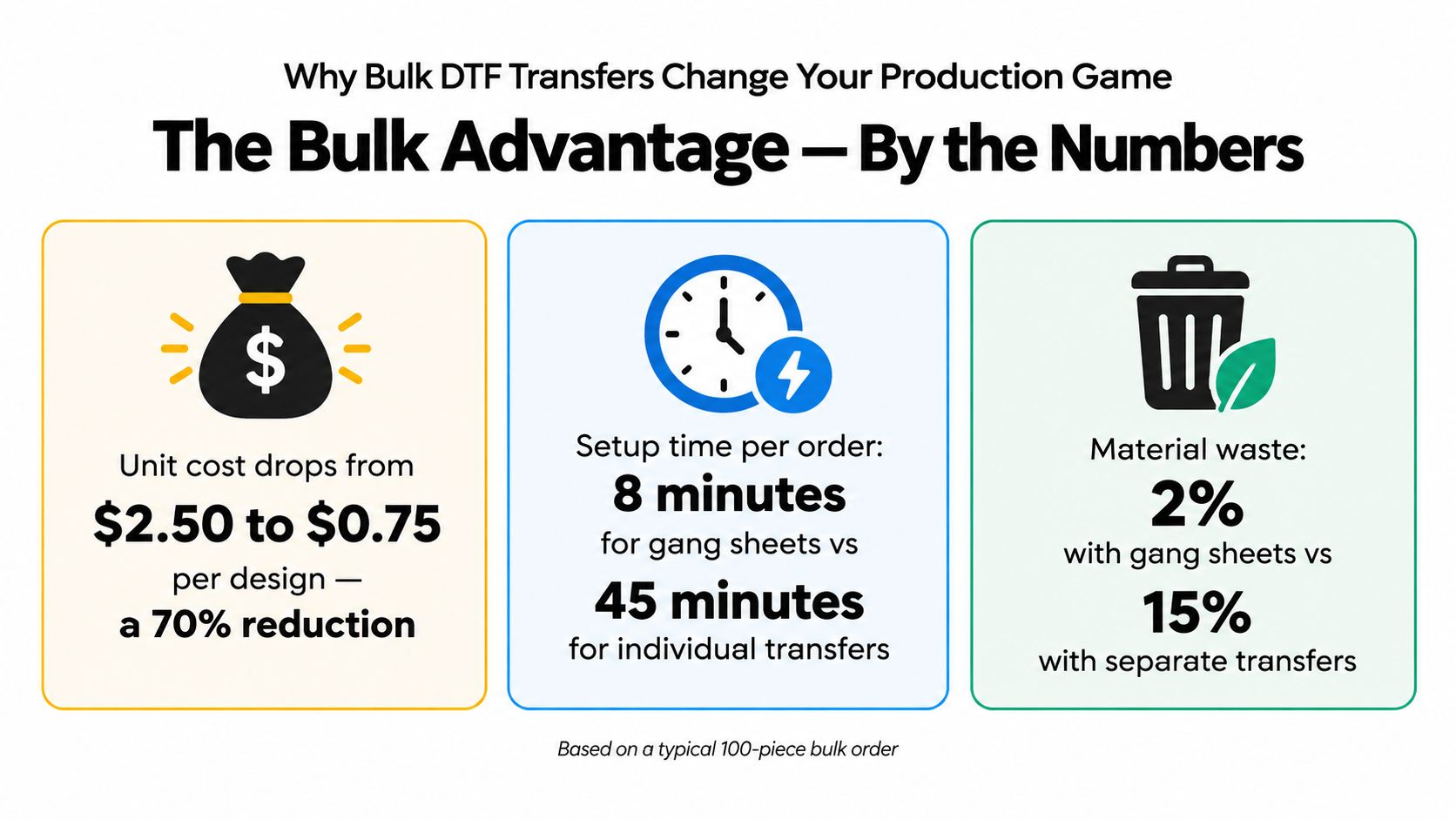
Why Bulk DTF Transfers Change Your Production Game
The first reason shops move to bulk is simple. Pressing ready-made transfers is faster than printing every small run from scratch, and having transfers on hand makes rush jobs easier to absorb. If your shop handles repeat left-chest logos, event tees, staff uniforms, or frequent online orders, bulk stock can smooth out your week.
But bulk also raises the stakes.
If one file has a bad edge, weak transparency, or the wrong sizing logic, that problem doesn't show up once. It shows up across the whole order. That's why experienced buyers stop thinking only about unit price and start thinking about error amplification.
What changes when you stop ordering one-offs
At small volume, you can get away with a loose process. Someone names files inconsistently, gang sheets are packed on the fly, and sizing decisions happen at the press. In bulk, that starts breaking down.
Three things usually change first:
- Artwork needs to be standardized. You can't batch well if every file version lives in a different folder.
- Pressing gets more repeatable. The more similar the placements and substrates, the less time operators waste adjusting.
- Reorders become operational, not creative. That's where margin improves. The design is already approved, the placement is known, and the transfer is ready.
Practical rule: Bulk saves money when your process is tighter than your order volume is large.
The broader market is moving this way too. The global direct-to-film printing market was estimated at USD 2.72 billion in 2024 and is projected to reach USD 3.92 billion by 2030 at a 6.0% CAGR, according to Images Magazine's state of the DTF market report. That matters because more shops are building around repeat-transfer workflows, not just one-off experimentation.
Why speed can beat sheer volume
A lot of buyers assume the winning move is always to order the biggest run they can afford. That works for evergreen designs. It fails fast when your catalog changes often.
If you sell trend-based graphics, run limited drops, or handle client work with frequent revisions, replenishment speed can matter more than pile-it-high volume. A fast domestic turnaround changes the math because you don't need to overprotect yourself with huge inventory buffers.
For readers still getting their bearings on the format itself, this guide to what DTF transfers are is a useful baseline before you lock in larger buying decisions.
There's also a scale reality behind this. A 2025 industry review reported that more than 7.2 billion DTF prints were produced globally in 2024, almost a 30% increase from the prior year, with output growing from nothing to more than 7 billion prints covering 184 million square meters, according to Research Intelo's market review. Bulk is no longer a niche workflow. It's normal production behavior now.
Preparing Artwork and Gang Sheets for Bulk Orders
Bulk orders don't fail at the press first. They fail in the file.
When shops complain that a bulk run came back with thin outlines filling in, tiny text closing up, or spacing that made cutting miserable, the cause is usually preflight discipline, not the transfer method. The bigger the order, the more expensive sloppy prep becomes.
Build files for repetition
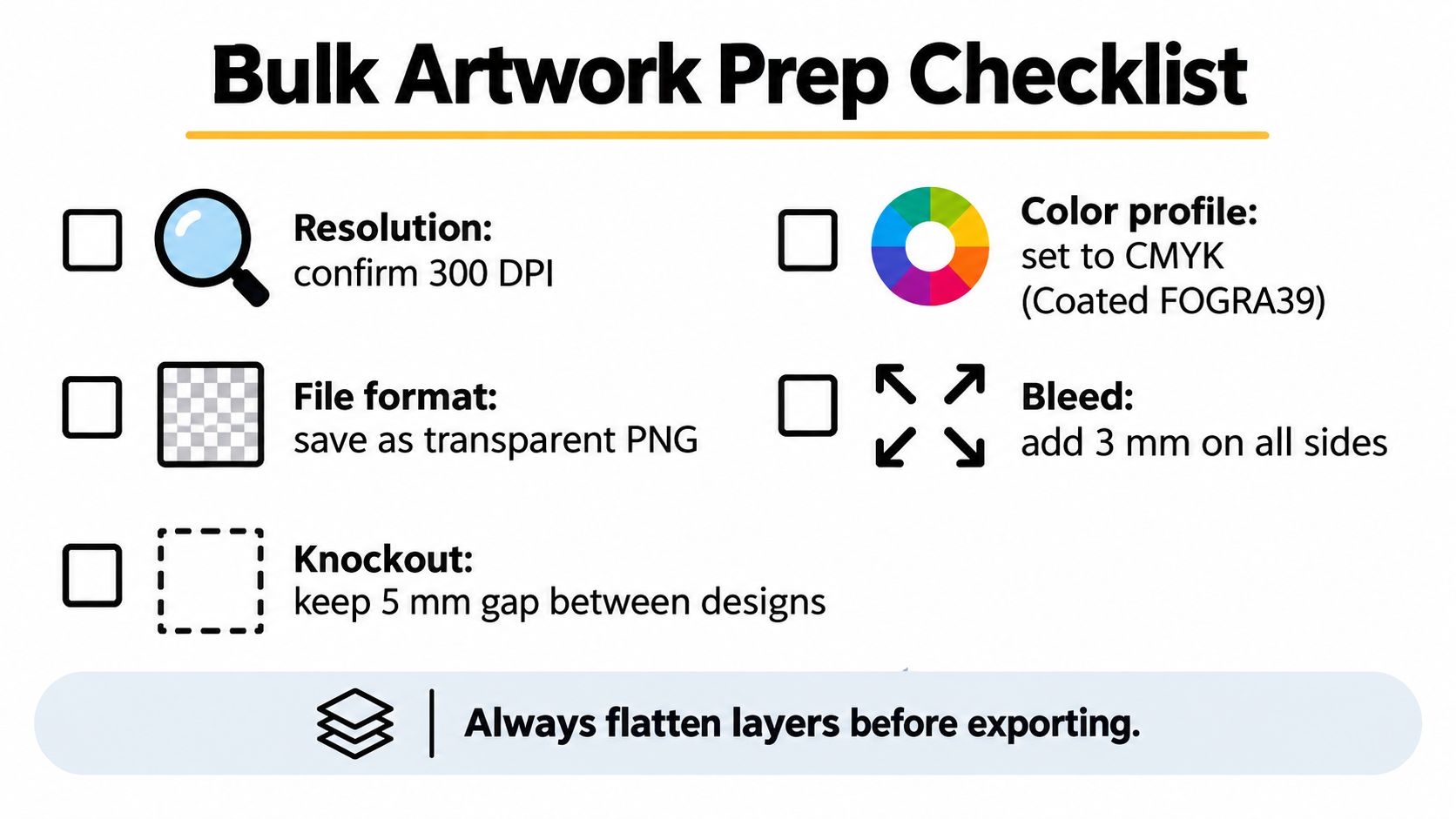
A bulk file should be boring in the best way. Clean naming. Final sizing. No hidden layers. No mystery version numbers from three rounds ago.
I treat every repeat design like a production asset, not a loose art file. That means:
- Lock the final dimensions early. Don't send “roughly front size” artwork and expect consistency.
- Flatten what needs flattening. If effects or shadows depend on software interpretation, export them cleanly.
- Keep transparent backgrounds transparent. Fake white boxes around art become expensive very quickly.
- Group by SKU logic. If youth, adult, oversized, and sleeve placements are all mixed without labels, receiving and pressing slows down.
A gang sheet should help the press team, not just the buyer. If two logos look similar but go on different garments or need different placement sizes, separate them intentionally.
Gang sheet packing that actually works
Overpacking a sheet to save space can backfire. If designs are too close, cutting gets slower and handling gets riskier. If mixed client jobs are packed with no visual logic, someone at the press table will eventually grab the wrong transfer.
This is the layout logic that tends to hold up:
- Cluster by order type. Keep one client, collection, or garment program together.
- Repeat high-volume SKUs in blocks. Don't scatter your best-seller across the whole sheet.
- Leave sane cutting lanes. A little breathing room can save more labor than it costs in film area.
- Separate odd placements. Hat tags, sleeves, neck labels, and jumbo fronts shouldn't live in a random mix.
If the gang sheet needs a meeting to explain it, it isn't ready for bulk.
For shops building volume layouts regularly, a dedicated DTF transfer gang sheet guide helps standardize the setup before you start ordering at scale.
A preflight checklist worth using
Before a bulk order goes out, run this checklist every time:
- Art approval: Final customer-approved version only
- Sizing: Every design assigned to an exact use case
- Naming: File names match PO, SKU, or reorder logic
- Background: Transparent and checked after export
- Edges: Fine details reviewed at actual print size
- Sheet logic: Similar jobs grouped together
- Reorder archive: Save the print-ready version in one permanent folder
Here's what doesn't work. Uploading mixed files from email attachments, repacking art manually each reorder, and relying on memory for which chest logo was “the slightly larger one.” That approach survives at low volume. It breaks under bulk.
Understanding Bulk Pricing Minimums and True Landed Cost
The most expensive transfer order isn't always the one with the highest invoice. It's the one that looked cheap upfront and then bled money through spoilage, dead stock, and forced reorders.
That's why smart buying starts with true landed cost, not just bulk tier pricing.
Piece price is only one line item
Most suppliers structure pricing around volume, gang sheet area, or standardized transfer sizes. On paper, that rewards bigger orders. Sometimes it should. If you run stable repeat designs, larger buys can reduce handling time and simplify your production calendar.
But some shops overbuy because they compare only the initial quote. They ignore what happens after delivery:
- Spoilage from bad prep
- Inventory that sits too long
- Cash tied up in slow movers
- Design revisions that obsolete stock
- Rush fill-in orders for the sizes you underbought
Independent market commentary has started to call out that gap directly. One 2026 estimate pegs the direct-to-film printing market at USD 3.03 billion in 2026, rising to USD 4.46 billion by 2032, while also noting that most bulk-buying coverage focuses on unit price rather than total landed cost and over-ordering risk, as outlined in this 2026 DTF transfer market discussion.
Bulk order size vs total cost trade off
| Factor | Small Replenishment Orders | Large Bulk Orders |
|---|---|---|
| Cash flow | Easier to manage | More money tied up upfront |
| Design flexibility | Better for frequent SKU changes | Better for stable repeat designs |
| Storage pressure | Lower | Higher |
| Risk of obsolete stock | Lower | Higher |
| Per-transfer price | Often higher | Often lower |
| Speed to react | Strong if supplier turnaround is fast | Weaker if you guessed demand wrong |
| Reprint exposure from bad files | Smaller batch affected | Entire order affected |
| Operational simplicity | More frequent ordering work | Fewer purchase cycles |
When smaller replenishment wins
If your business runs on trends, influencer drops, seasonal launches, or frequent client revisions, smaller replenishment often wins even when the unit price is higher. You preserve cash, reduce stale inventory, and can adapt faster.
That's the same basic logic packaging buyers use when they weigh scale discounts against carrying risk. This explainer on how Monopack ltd uses volume pricing is useful because it frames bulk pricing as a decision model, not just a discount ladder.
Shop-floor reality: A transfer you never use is overpriced at any unit cost.
For buyers comparing domestic options, Cobra DTF is one example of a U.S.-made supplier model that changes this equation by removing tariff and customs exposure while supporting fast replenishment, which is relevant when you're deciding whether to buy deep or reorder lean. If you want the pricing mechanics behind larger runs, their overview of bulk order discounts lays out the structure.
The right question isn't “What's the cheapest per transfer?” It's “What order size leaves me with the lowest real cost after use, storage, reorders, and change risk?”
How to Order and Manage Lead Times Like a Pro
Lead time problems usually start before production. They start when the shop sends files that aren't final, approves late, or places a “rush” order without matching it to the sales calendar.
Strong ordering is mostly administrative discipline.
The clean ordering workflow
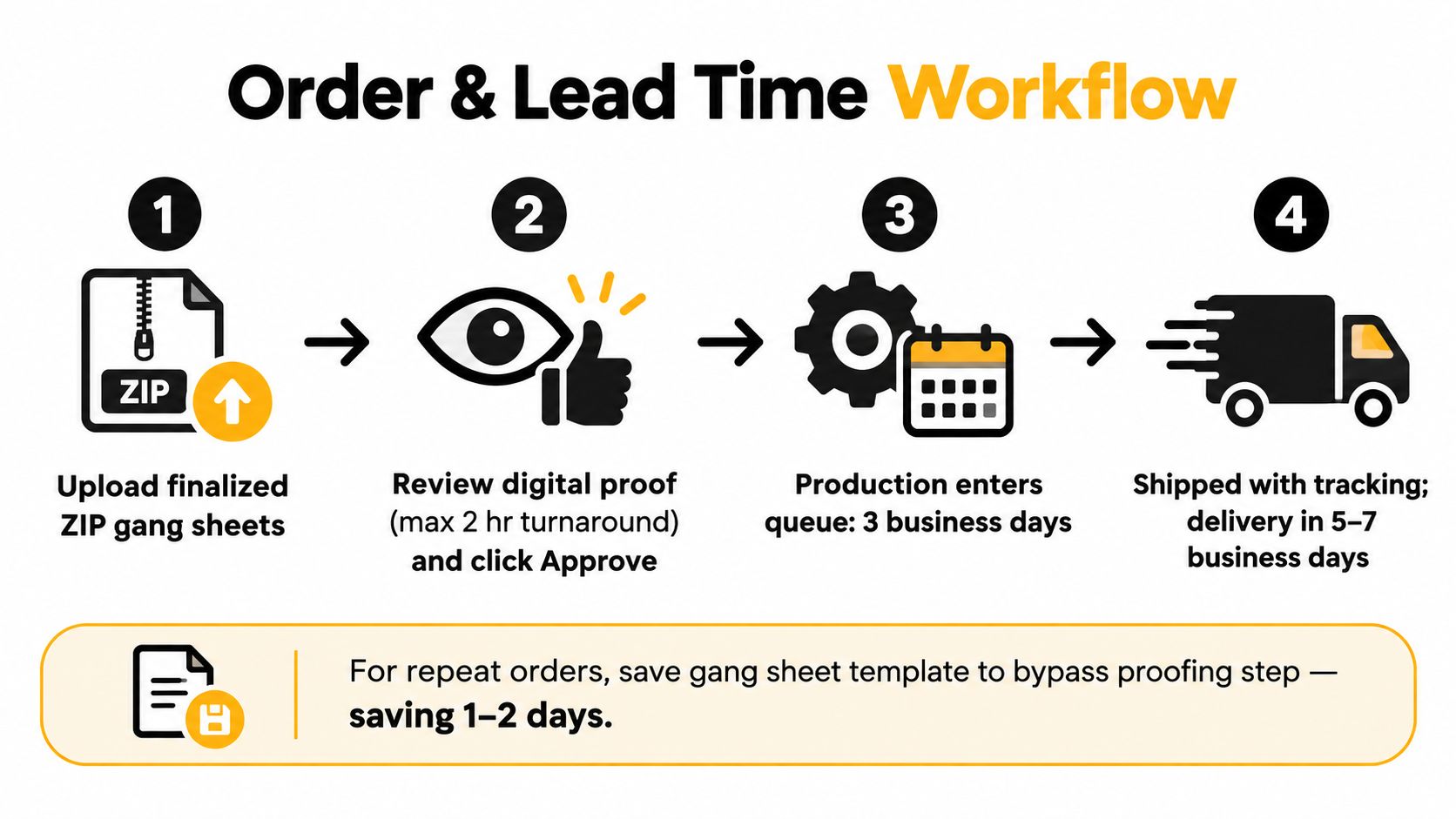
For bulk runs, I like a simple sequence that removes guesswork:
- Upload final production files only. No draft art. No “use the newer one from yesterday's email.”
- Match quantities to actual sales rhythm. Event work, evergreen uniforms, and online trend SKUs shouldn't be bought the same way.
- Approve proofs fast. Delays here are self-inflicted more often than supplier-caused.
- Log the order internally before it lands. By the time the box shows up, your team should know what's in it and where it belongs.
That sounds basic, but most fulfillment snags come from skipping one of those steps.
Plan around the calendar, not your stress level
Good buyers don't order only when shelves look empty. They order against known demand windows: school launches, tournament weekends, staff onboarding cycles, event seasons, promo drops, and holiday pushes.
If your supplier offers same-day shipping on orders placed by 1 PM CST and 1 to 3 day delivery, that shortens the amount of backup stock you need to hold. Domestic speed won't fix bad planning, but it does let you run leaner than you could with slow overseas replenishment.
A few habits help:
- Build a reorder threshold by SKU family. Not every design deserves the same buffer.
- Separate evergreen from experimental. Core logos can justify deeper stock than trend graphics.
- Keep one order owner. One person should own approvals, ETA tracking, and receiving coordination.
Fast turnaround is most valuable when your reorder system is already organized.
Receiving without creating a mess
When bulk transfers arrive, don't just stack them near the press and hope the team sorts them later. Intake is where you either preserve speed or lose it.
Use a simple receiving routine:
- Check the shipment against your PO
- Verify client grouping or SKU labels
- Pull a few representative pieces for inspection
- Store by priority and expected use
- Archive the approved art with the order reference
That last step matters more than most shops think. Repeat orders should become clerical, not investigative.
Quality Checks Storage and Press Tips for Consistent Results
Bulk quality control doesn't need to be fancy. It does need to be consistent.
The mistake I see most often is treating a delivered batch like it's automatically production-ready. It might be. It might also have a substrate mismatch, a press-setting issue, or a curing problem that only appears after washing. In bulk, you want to catch that before the main run starts.
A bulk QC workflow that's worth the time
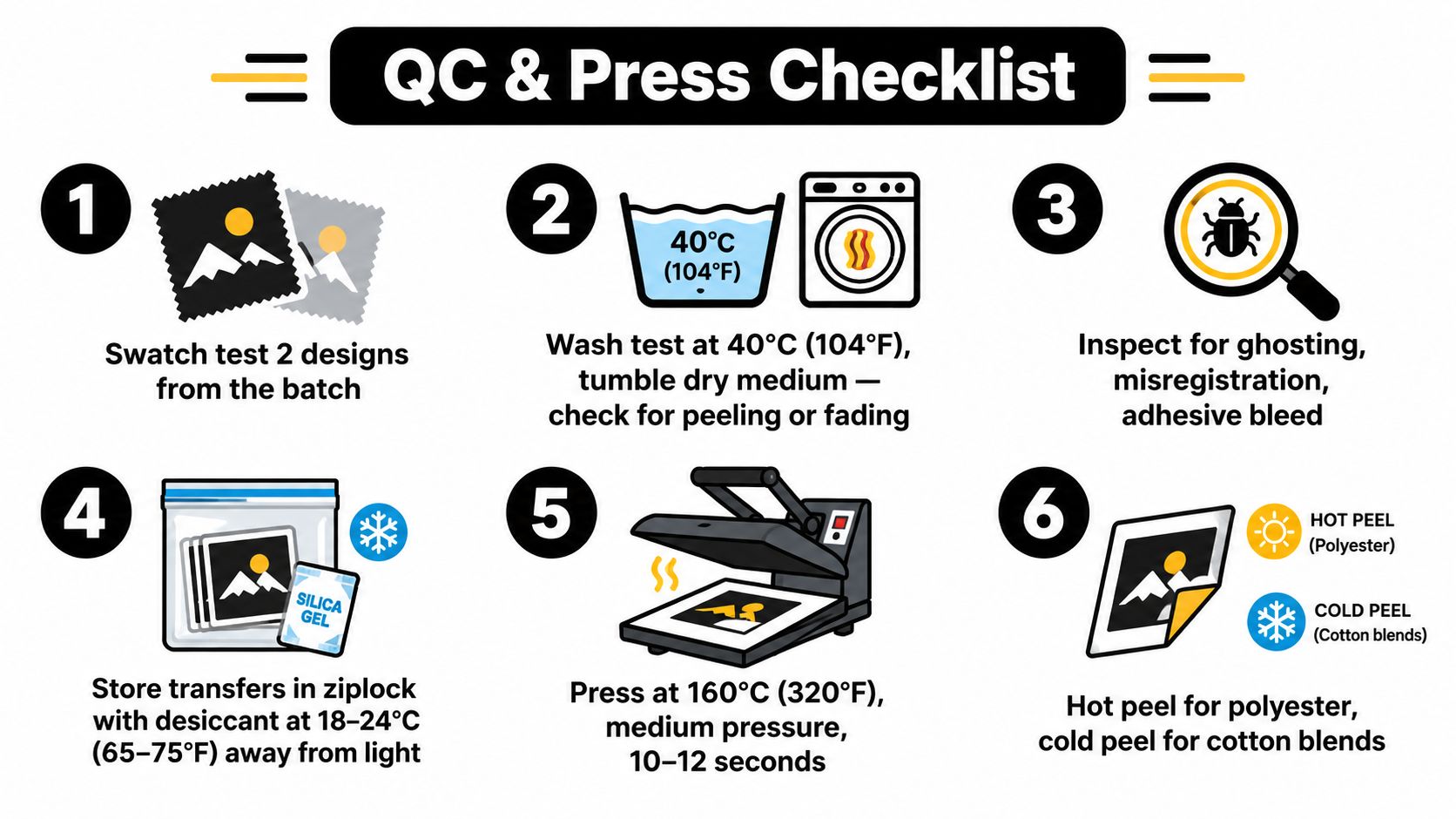
A practical check used in bulk DTF production is to print a 10 cm × 10 cm test piece, wait 24 hours for adhesive cure, then run a 60°C household wash cycle in a mesh bag, dry flat, and inspect both color shift with a spectrophotometer using ΔE and any edge lift before full production, as outlined in this DTF fabric and validation guidance.
Even if you don't use a spectrophotometer in-house, the discipline behind that workflow is what matters. Test before you commit the whole order.
My stripped-down receiving QC looks like this:
- Pull from more than one spot in the stack. Don't inspect only the top piece.
- Press a swatch on the actual garment family. Cotton, blends, and performance fabrics don't all behave the same.
- Check edge behavior after pressing. Corners tell the truth fast.
- Watch for color surprises. Deep blacks, skin tones, and saturated reds usually reveal issues first.
Press habits that improve durability
A lot of durability complaints come from rushed finishing, not the transfer itself.
Field guidance commonly recommends a post-press reheat of 5 to 10 seconds with parchment or PTFE and a minimum 24-hour cure before first wash. When those steps are followed, independent durability guides report expected lifespan around 50 to 60 washes, with many systems targeting stable results across 20 to 40 wash cycles under less controlled conditions, according to this DTF heat press and durability guide.
Press-room habit: Don't judge a transfer only by the peel. Judge it by the reheat, cure, and first wash.
What doesn't work is pressing one test shirt, liking the look, and sending the whole batch without any wash validation. Bulk failures usually look fine on day one.
Storage mistakes that create waste
Transfers don't need complicated storage, but they do need clean handling. Moisture, heat, bending, and dirty worktables all create trouble. Curling film, contaminated adhesive, and shuffled job stacks can turn usable inventory into rework.
Keep bulk transfers:
- Flat
- Dry
- Away from direct light
- Separated by order or SKU
- Handled with clean hands and surfaces
Another angle worth watching is substrate expansion. Industry coverage says DTF has moved beyond apparel-only workflows toward paper substrates, packaging, and stationery, while related reporting also points to specialty films, ready-to-press solutions, and growth in UV DTF for packaging decoration and cross-material compatibility, as summarized in this DTF transfer film market overview. If your inventory needs to serve mixed-use applications, storage discipline and batch labeling become even more important.
Scaling Your Shop With a Smarter Bulk Strategy
The shops that scale cleanly don't just buy more. They buy more selectively.
That usually means separating your catalog into three buckets. First, the repeat designs that justify deeper inventory. Second, the mixed-SKU work that belongs on efficient gang sheets. Third, the unstable designs that should stay on a short reorder cycle because they change too fast to stock aggressively.
A practical scaling model
If you want bulk to improve margins, build your workflow around these decisions:
- Go deeper on repeat demand. Uniform programs, staff logos, team stores, and proven evergreen sellers are strong bulk candidates.
- Stay lean on trend designs. If the shelf life is short, replenishment speed beats pile-up inventory.
- Standardize reorder assets. Final art, approved size, garment pairing, and press notes should live in one place.
- Use mixed gang sheets intelligently. They work well when you need variety without committing to large counts of each design.
That approach gives you room to grow without forcing every SKU into the same buying pattern.
What actually protects margin
Most small shops think scaling means moving from manual hustle to bigger purchase orders. In reality, it usually means moving from reactive ordering to controlled replenishment.
Watch the places where margin leaks:
- old designs sitting too long
- rush reorders caused by poor forecasting
- duplicate art versions
- stock that can't be matched to jobs quickly
- preventable reprints from weak preflight and QC
The strongest bulk strategy isn't the biggest order. It's the order structure your shop can actually control.
If you decorate beyond tees, that discipline matters even more. Mixed-use demand across apparel, paper goods, packaging, or specialty surfaces changes what “bulk” should look like. In that environment, flexibility and turnaround often beat raw sheet count.
Scale that way and bulk starts acting like a production advantage, not a storage problem.
Cobra DTF offers U.S.-made DTF transfers, gang sheet ordering, same-day shipping for orders placed by 1 PM CST, and delivery in 1 to 3 days, which fits the kind of lean replenishment strategy that keeps bulk useful instead of risky. If you want faster restocks without dealing with tariffs, customs delays, or overseas lead-time drag, visit Cobra DTF.