
Guide: dtf screen printing vs Screen Printing for Small Businesses
When you're trying to choose between Direct-to-Film (DTF) and traditional screen printing, it really boils down to a simple trade-off: volume versus versatility. If your business thrives on small, custom orders with intricate, full-color designs, DTF is your workhorse. But if you’re pushing out large batches of apparel with simpler graphics, nothing beats the per-item cost of screen printing.
Ultimately, your business model will point you to the right choice.
A High-Level Comparison of DTF and Screen Printing
Picking the right printing method can feel like a huge decision, but it gets a lot clearer when you understand what each technology was built for. The whole DTF vs. screen printing debate is a classic battle between digital flexibility and analog efficiency. One gives you incredible creative freedom for on-demand jobs, while the other delivers unbeatable cost-effectiveness when you're producing at scale.
This guide will walk you through the nuances, helping you make the smart choice for your shop.
Key Differentiators to Consider
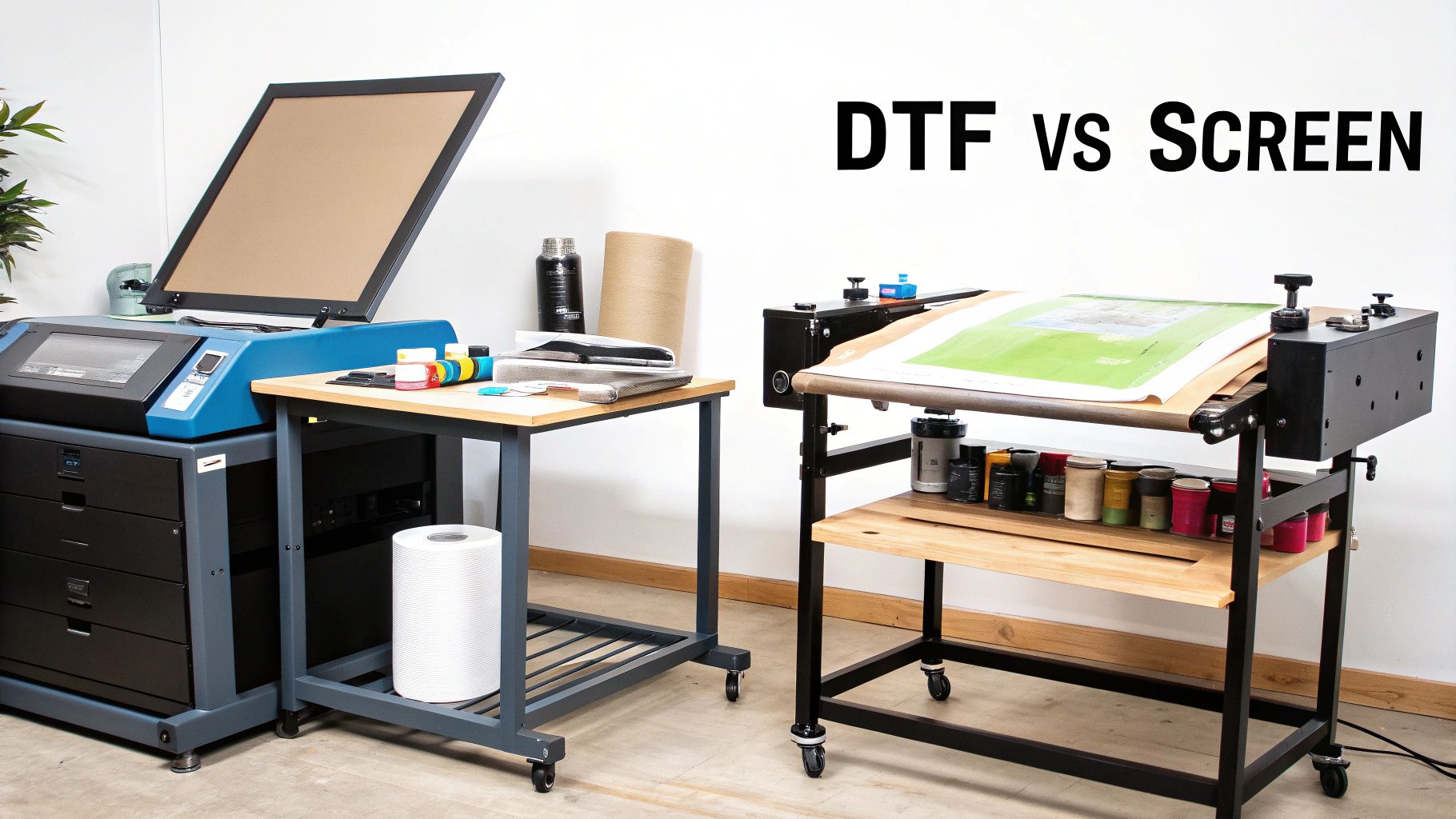
DTF has exploded in popularity, especially with e-commerce brands and small businesses that live and die by customization. It’s a direct answer to the market’s need for quick, on-demand prints across a huge range of products. In fact, the global DTF market is on track to hit USD 4.56 billion by 2032, driven by an agility that older methods just can't match. You can get more details about this impact on the apparel industry and see why so many are making the switch.
Screen printing, on the other hand, is still the undisputed king of bulk. The entire process is engineered for mass production, making it the most economical option by a long shot once you’re past the initial setup.
DTF vs Screen Printing At a Glance
To make things simple, here’s a quick summary of how these two powerhouse methods compare on the factors that matter most to any apparel business. Use this table as a starting point to see which process lines up best with your specific production needs.
| Factor | DTF Printing | Screen Printing |
|---|---|---|
| Best For | Small to medium runs, full-color designs, varied fabrics | High-volume orders, simple designs (1-4 colors) |
| Setup Time | Minimal; digital file preparation only | High; screen creation, emulsion, and registration |
| Color Complexity | Unlimited colors and gradients at no extra cost | Cost increases with each additional color screen |
| Fabric Versatility | High (Cotton, Polyester, Blends, Nylon) | Moderate (Best on cotton, requires special inks for synthetics) |
| Feel on Garment | Soft, flexible, slightly raised layer | Can be soft and integrated or thick, depending on ink |
| Cost Per Print | Consistent for small runs, less economical for bulk | Very low for bulk, prohibitively high for small runs |
As you can see, the "better" method truly depends on the job at hand. Neither is a one-size-fits-all solution, which is why understanding their core strengths is so critical for making profitable decisions.
A Head-to-Head Comparison of Printing Processes
To really get to the bottom of the DTF screen printing debate, you have to look beyond the surface. Let's dig into the nitty-gritty operational details that actually affect your workflow, your product quality, and ultimately, your bank account. Each method has its own distinct personality, and one will shine where the other stumbles. This breakdown will pit them against each other on the metrics that matter most to any apparel business.
Setup Time and Workflow Efficiency
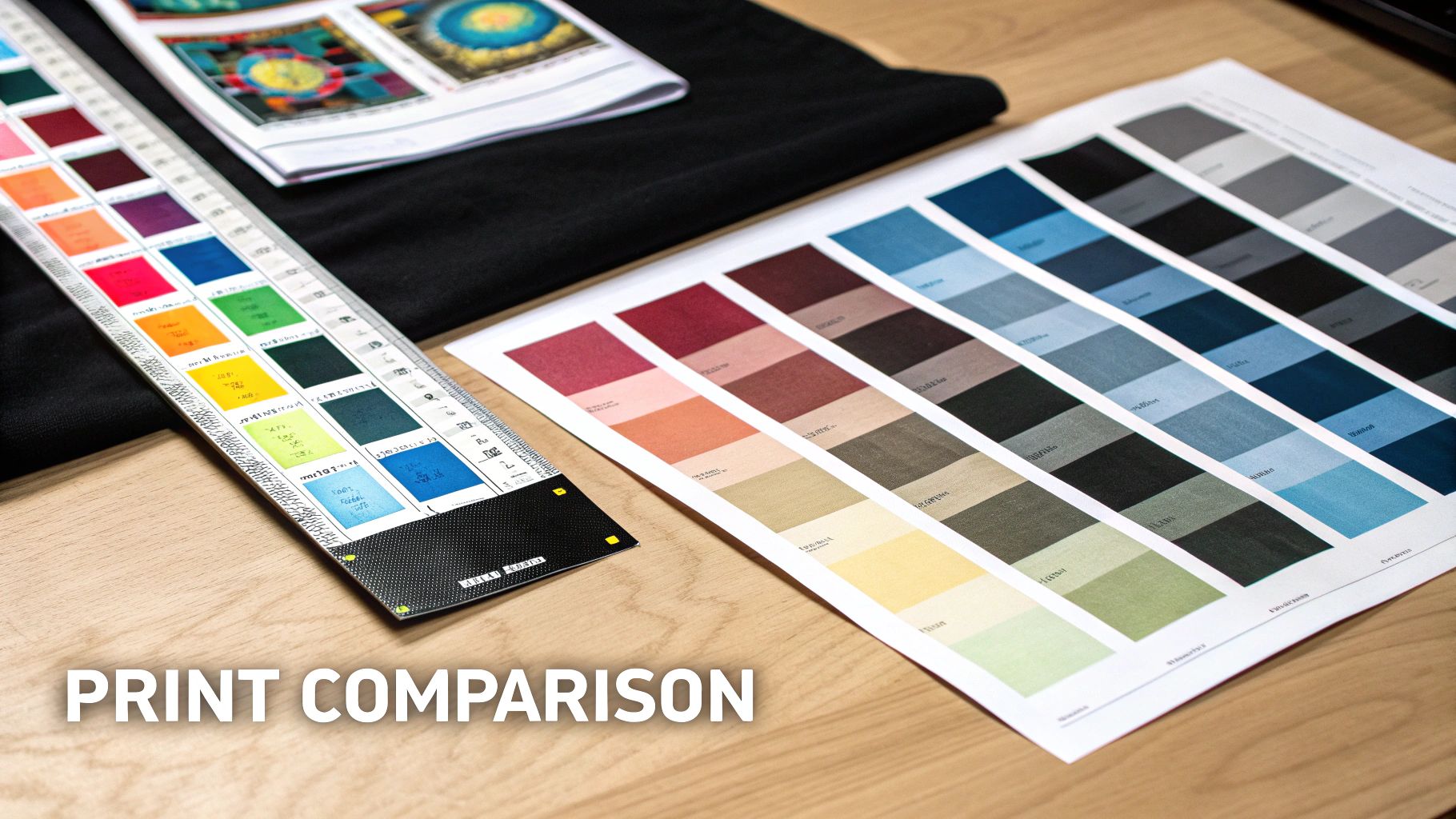
The first, most glaring difference you'll encounter is the prep work. What it takes to get ready for that very first print will define how nimble your business can be, especially when it comes to quick turns and on-demand orders.
Screen printing is a hands-on, multi-step beast. For every single color in your design, you have to coat a screen with emulsion, burn the art onto it, wash it out, and then painstakingly line it up on the press. This whole ordeal can take anywhere from 30 minutes to a few hours, all depending on how complex the art is and how many colors you're dealing with.
DTF, on the other hand, lives in the digital world. The process is dead simple: send a file to the printer, and you're off. No screens, no messy chemicals, no frustrating registration. This near-zero setup time means you can go from a customer's design file to a transfer that's ready to press in just a few minutes.
Key Takeaway: DTF completely skips the entire screen prep phase, making it leagues faster for small batches and one-off custom jobs. The heavy setup of screen printing only makes financial sense when you can spread that cost across a massive run of identical shirts.
Color Capabilities and Design Complexity
How each method handles color is a game-changer and directly impacts your creative freedom. Screen printing is what’s known as a spot-color process—every color is mixed individually and pushed through its own dedicated screen.
This creates two big hurdles:
- Cost per Color: Every color you add means more screens, more ink, and more setup time. A five-color design requires five separate setups, and that cost gets passed on.
- Gradient Limitations: Trying to print smooth gradients or photorealistic images is a nightmare. It requires advanced tricks like halftones, which often just don't capture the detail you want.
Because DTF is digital, it prints everything at once, much like your desk printer at home. This means you can throw an unlimited number of colors, tiny details, and full-blown photographs into a design without adding a penny to the setup cost. A two-color design costs the exact same to produce as a two-hundred-color one. To learn more, our guide on t-shirt printing methods covers this in greater detail.
This opens up a whole new world, allowing businesses to take on jobs with highly detailed or photographic art—a market that's incredibly expensive and difficult to serve with screen printing.
Final Print Feel and Texture
How a print feels on the shirt is a huge deal for customers. In this department, the two methods produce very different results.
Screen printing, especially with plastisol inks, often leaves a thick layer of ink sitting on top of the fabric. While there are ways to get a softer "hand," a big, bold design can sometimes feel stiff and heavy. Water-based inks are much softer because they soak into the fibers, but they tend to work best only on light-colored garments.
DTF transfers have their own unique feel. They’re soft, flexible, and have a bit of stretch to them, forming a thin, tough layer on the garment's surface. While it doesn't soak in quite like a water-based screen print, it's typically much lighter and more pliable than a thick plastisol print. You won't get that "bulletproof" feeling you sometimes get with screen-printed gear.
Substrate and Fabric Versatility
Your ability to print on different materials can make or break your product line, and this is where DTF has a massive leg up.
Screen printing really loves 100% cotton. Sure, you can print on polyester and blends, but it often means buying special inks and additives to stop the fabric's dye from bleeding into your print—a common headache called dye migration.
DTF, however, is a jack-of-all-trades. The adhesive powder it uses is engineered to stick to almost anything.
Materials DTF Excels On:
- Cotton and Cotton Blends: Handles standard apparel perfectly.
- Polyester: Awesome for athletic wear without needing special dye-blocking inks.
- Nylon and Leather: Opens the door to printing on jackets, bags, and other cool items.
- Canvas and Denim: Works great on heavy, textured fabrics.
This incredible flexibility means a single DTF setup can decorate a much wider variety of products than a typical screen printing shop. You can move from t-shirts to hats to tote bags without a second thought, simplifying your process and removing the technical hurdles of printing on tricky synthetic fabrics.
Breaking Down The True Costs for Small Businesses
For a small business, choosing a printing method isn't just about the final product—it’s about your bottom line. The financial reality of picking DTF versus screen printing will shape your profitability right from the start. You have to look past the simple price-per-shirt and dig into the total cost of ownership, from the big equipment purchase down to labor and hidden expenses.
Right away, the initial investment creates a huge gap between the two. A basic screen printing setup might seem cheap at first, but the costs pile up fast. You need screens for every single color, a washout booth, an exposure unit, and a small army of chemicals. A professional-grade setup can easily climb into thousands of dollars, which is a massive hurdle for most startups.
DTF, on the other hand, packages the initial investment into a more contained system. Yes, you still need a specialized printer, inks, and a heat press, but you get to skip the long shopping list of accessories for screen prep and reclamation. This makes the entry point much more realistic for businesses that want to focus on custom, smaller-batch orders.
Variable Costs Print by Print
Once you're up and running, the real cost story unfolds with every single print. This is where your business model will really decide which method is the right fit.
Screen printing is all about volume. The big costs are the ink and the time-consuming setup. But once those screens are aligned and the press is humming, the cost per shirt drops dramatically. The 100th shirt costs a fraction of the first, making it the undisputed champion for large runs of the same design.
DTF plays by a different set of economic rules. The cost to produce a print stays pretty much the same, whether you’re making one shirt or fifty. Your main consumables are the DTF film, ink, and adhesive powder. Since there are no screens or complex color separations, a vibrant, multi-color design costs the exact same to run as a simple one-color logo.
A key financial game-changer with DTF is the ability to run single-item jobs profitably. This capability is fueling the print-on-demand market, a space where screen printing’s setup fees make it a non-starter for one-off orders.
This trend is backed by some serious market growth. The DTF sector is on track to hit USD 3.92 billion by 2030, largely because it fits perfectly with e-commerce and the growing demand for personalized items—areas where screen printing just can't compete on small orders. For a deeper dive, check out the full market analysis from Grand View Research.
Let's look at how these costs play out in the real world. Below is a table that breaks down the estimated per-shirt cost for both DTF and a 3-color screen print job at different quantities.
Cost Comparison for Different Order Sizes
| Order Quantity | Estimated DTF Cost Per Shirt | Estimated Screen Printing Cost Per Shirt (3 Colors) | Recommendation |
|---|---|---|---|
| 10 | $3.50 - $5.00 | $15.00 - $20.00+ | DTF is the clear winner for small, custom runs. |
| 50 | $3.00 - $4.50 | $7.00 - $9.00 | DTF remains more cost-effective. |
| 250 | $2.75 - $4.00 | $4.00 - $5.50 | This is the breakeven zone. The choice depends on design complexity. |
| 1000 | $2.50 - $3.75 | $2.00 - $3.50 | Screen printing's economy of scale takes over for large volumes. |
As you can see, the math is pretty clear. For small orders, DTF is your most profitable option. Once you start hitting several hundred pieces with a limited color palette, screen printing becomes the more financially sound choice.
Uncovering the Hidden Expenses
It's easy to overlook the "hidden" operational costs that slowly eat away at your profits. Screen printing, in particular, has a few that can catch you by surprise.
- Space Requirements: A full screen printing operation is a space hog. You need room for the press itself, plus screen storage, a washout booth, and drying racks.
- Chemicals and Disposal: Emulsion, screen reclaimers, and ink thinners are recurring costs, and you might have to pay environmental compliance fees for their disposal.
- Labor Intensity: The time spent prepping screens, printing, and then cleaning everything up is a huge labor cost. All that non-printing time is a direct hit to your efficiency, especially on small jobs.
The streamlined, digital workflow of DTF slashes these overhead costs. The equipment has a much smaller footprint, and with no screen-related chemicals, cleanup is simpler and environmental concerns are minimized. This baked-in efficiency is a big reason why many shops are adding DTF printing to handle their custom work. You can explore more strategies in our guide on how to reduce production costs in your printing business.
To put it all together, think about these two common scenarios for a small apparel brand.
Scenario 1: 25 Shirts, 5-Color Design
- DTF: This is a perfect job for DTF. The cost per shirt stays low and predictable, and you don’t pay a penalty for the five colors. The labor is minimal.
- Screen Printing: This would be a financial disaster. The cost to create and set up five separate screens would likely wipe out any chance of making a profit.
Scenario 2: 500 Shirts, 1-Color Design
- DTF: It's still a decent option, but your cost per shirt will be higher than with screen printing. It will also take longer, since each transfer is printed one by one.
- Screen Printing: This is the sweet spot. That initial setup cost gets spread so thin across 500 units that your per-piece price becomes incredibly low, maximizing your margins.
Real-World Scenarios: When to Choose DTF vs. Screen Printing
Knowing the technical specs is one thing, but making the right call for your business happens when you're staring at a real job order. How do the strengths and weaknesses of DTF screen printing actually shake out in the real world? The difference between a profitable run and a costly mistake often comes down to understanding the context—the client's budget, the design's complexity, and your own business goals.
Let's move past the abstract and dive into a few concrete examples. We'll look at common business scenarios, break down the factors that matter most, and give a clear recommendation for each. This is where the theory meets the pavement.
Scenario 1: The Etsy Shop Owner
Picture an Etsy seller who built a brand around quirky, pop-culture t-shirts. Their entire business model is based on offering a huge variety of designs without holding a single piece of inventory. Orders trickle in one at a time, each for a different shirt with a complex, full-color graphic.
Critical Factors to Consider:
- Order Volume: Very low, often just 1-5 units per design.
- Design Complexity: High. We're talking unlimited colors, gradients, and photorealistic details.
- Turnaround Time: Quick shipping is key to keeping those five-star reviews coming.
- Inventory Risk: Must be zero. Printing on-demand is the only way this works.
In this case, the choice is a no-brainer. Screen printing would be a financial disaster. The setup costs for a single, multi-color shirt would be astronomical, making every sale a money-losing venture.
Recommendation: DTF Printing
Direct-to-Film was practically made for this model. The Etsy seller can print a single, vibrant, complex design with absolutely no setup fees. This print-on-demand power eliminates inventory risk and unlocks the potential for a massive virtual catalog, which is exactly what they need to grow.
Scenario 2: The Local Band Merchandise
A local band is hitting the road and needs 300 t-shirts to sell at their merch table. The design is straightforward: a bold, two-color logo on the front of standard black, 100% cotton tees. Their budget is tight, so every penny of profit from each shirt counts.
Critical Factors to Consider:
- Order Volume: A solid bulk order of 300 units.
- Design Complexity: Simple—just two spot colors.
- Fabric Type: Standard 100% cotton, the perfect canvas for screen printing.
- Primary Goal: Get the lowest possible cost-per-shirt to maximize their revenue.
For this job, it's all about the economics of scale. While DTF could get the job done, it wouldn't be the smartest financial move.
Decision Breakdown:
- Screen Printing: The initial cost to create two screens is quickly spread out over 300 shirts. After that, the per-shirt cost for ink and labor drops dramatically, leaving a healthy profit margin.
- DTF Printing: The cost for a DTF transfer stays pretty much the same whether you're printing one shirt or 300. The total cost would be much higher than screen printing, eating directly into the band's tour funds.
Recommendation: Screen Printing
When it comes to bulk orders with simple graphics, screen printing is still the undisputed king of cost-effectiveness. The band gets the lowest unit cost, which means they can price their shirts to sell and make more money at every show.
Scenario 3: The Corporate Promotional Event
A tech company needs 75 performance polo shirts for a trade show, and they need them in less than a week. The shirts are 100% polyester, and the design is their full-color company logo, complete with subtle gradients.
Critical Factors to Consider:
- Order Volume: A mid-sized run of 75 units.
- Fabric Type: Tricky synthetic fabric—100% polyester.
- Design Complexity: Full-color with gradients.
- Turnaround Time: The deadline is non-negotiable and tight.
This scenario throws a few curveballs that completely change the game. The combination of synthetic fabric, a full-color design, and a rush timeline makes screen printing a poor choice. Printing on polyester requires special low-cure inks and dye-blocking underbases to prevent the fabric dye from bleeding through, which adds cost and complexity.
Plus, setting up a full-color screen print is time-consuming. DTF, on the other hand, is built for these exact challenges. For many businesses, choosing the right production method is a key part of their Proven Ecommerce Growth Strategies because it directly impacts profitability and scalability.
Recommendation: DTF Printing
DTF is the clear winner here. The transfers stick perfectly to polyester without any special inks or concerns about dye migration. The full-color, gradient logo can be reproduced flawlessly with no setup cost per color, and the digital workflow means the company can hit its tight deadline with ease.
Why American-Made DTF Transfers Matter
When you're running a small apparel business, your supply chain can either make or break you. The choice between DTF screen printing suppliers is a huge one, and where you get your transfers from directly affects how smoothly your business runs. Going with a US-based supplier isn't just about waving a flag; it's a smart business move that protects you from the headaches that come with international supply chains.
A lot of businesses look overseas to source their materials, thinking they'll save a few bucks. But that approach often backfires, bringing a ton of unpredictable problems that wipe out any initial cost savings. Think about it: unexpected tariffs, customs hold-ups, and shipping that takes weeks can shut down your production line in an instant. That leaves you with unhappy customers and blown deadlines.
The True Cost of International Sourcing
Relying on suppliers from overseas often means dealing with spotty product quality. One batch of transfers might look amazing, but the next could show up faded or with weak adhesion. That kind of inconsistency creates waste and, worse, hurts your brand's reputation. It all comes down to a lack of direct oversight and wildly different quality control standards.
On top of the quality gamble, the logistics are a nightmare. An order can get tied up in customs for days, sometimes even weeks, completely wrecking your production schedule. With that much uncertainty, you can't possibly give your own customers a reliable delivery date, which is a major risk for any growing business.
Partnering with a USA-based supplier pretty much gets rid of these risks. Domestic shipping is quick and predictable, quality control is way tighter, and you’re working with someone who operates in the same time zone and business culture as you.
Gaining a Competitive Edge with a Domestic Partner
When you choose a supplier here in the USA, like Cobra DTF, you get real, immediate benefits that put you ahead of the competition.
- Speed and Reliability: We offer same-day shipping with delivery times of just 1-3 days. This kind of speed means you can react to customer orders in a flash, letting you confidently take on rush jobs and keep your inventory low.
- Transparent, Tariff-Free Pricing: The price you see is the price you pay. Period. No surprise customs fees or international tariffs are going to suddenly eat into your profit margins.
- Superior, Consistent Quality: American suppliers generally stick to higher quality standards. You can count on getting vibrant, long-lasting colors and tough, durable transfers with every single order, which means your finished products will always look amazing.
Beyond all that, you get a partner who actually gets the local market and is genuinely invested in seeing you succeed. Our guide on the benefits of working with Made in USA suppliers dives deeper into how this kind of partnership can build a stronger foundation for your business.
Ultimately, picking a domestic partner for your DTF screen printing needs is about more than just convenience. It's a strategic decision to build a business that's resilient, efficient, and known for quality. When you stop worrying about international shipping and inconsistent products, you can focus on what you do best: creating incredible apparel and growing your brand. And hey, supporting the domestic economy is a pretty great bonus to a decision that already makes perfect business sense.
Your Decision-Making Checklist
So, DTF or screen printing? When it comes down to it, the best choice really depends on what you're trying to accomplish with your business. To cut through the noise, I’ve put together a simple checklist. A few honest answers here will steer you toward the right process for your specific goals.
1. What's Your Typical Order Volume?
This is probably the biggest factor. Are you focusing on one-of-a-kind custom pieces, or are you cranking out hundreds of shirts for a big event?
- Small Batches (1-50 items): If this is your bread and butter, DTF printing is the clear winner. There's virtually no setup, making it profitable for on-demand orders and small runs. Screen printing's setup costs would just eat up all your profit here.
- Large Batches (100+ items): For bulk orders, screen printing is your powerhouse. That initial setup cost gets spread so thin across hundreds of garments that the price per shirt becomes incredibly low. It’s built for mass production.
2. How Complex Are Your Designs?
Now, think about the art itself. Are you printing simple, one-color logos, or are you working with photorealistic images full of gradients and subtle details?
- Complex, Full-Color Designs: DTF printing is really your only option here. It handles unlimited colors, tiny details, and smooth gradients without breaking a sweat—or adding to the cost. You get total creative freedom.
- Simple, Limited-Color Designs (1-4 colors): This is where screen printing truly shines. It’s fantastic for producing those bold, vibrant spot colors and is most economical when you keep the color count low.
The right technology isn't just about the final print; it’s about making sure your production method actually fits your business model. DTF gives you the agility to offer a huge variety of designs, while screen printing gives you the muscle for high-volume specialization.
3. What Fabrics Are You Printing On?
Your product lineup is a huge piece of the puzzle. Are you sticking to the classic 100% cotton tee, or is your brand expanding into polyester activewear, nylon jackets, or even canvas totes?
- Printing on Diverse Materials: DTF printing is the way to go. Its adhesive works on almost anything—cotton, poly, blends, you name it—without needing special inks or chemistry. It's incredibly versatile.
- Printing Primarily on Cotton: Screen printing is an excellent, time-tested choice. It was practically perfected on cotton and delivers an amazing look and feel, though synthetics require more specialized (and often expensive) inks.
And it's not just about the printing method—your supply chain is just as important. This flowchart breaks down a common decision point for DTF businesses: where to get your supplies.
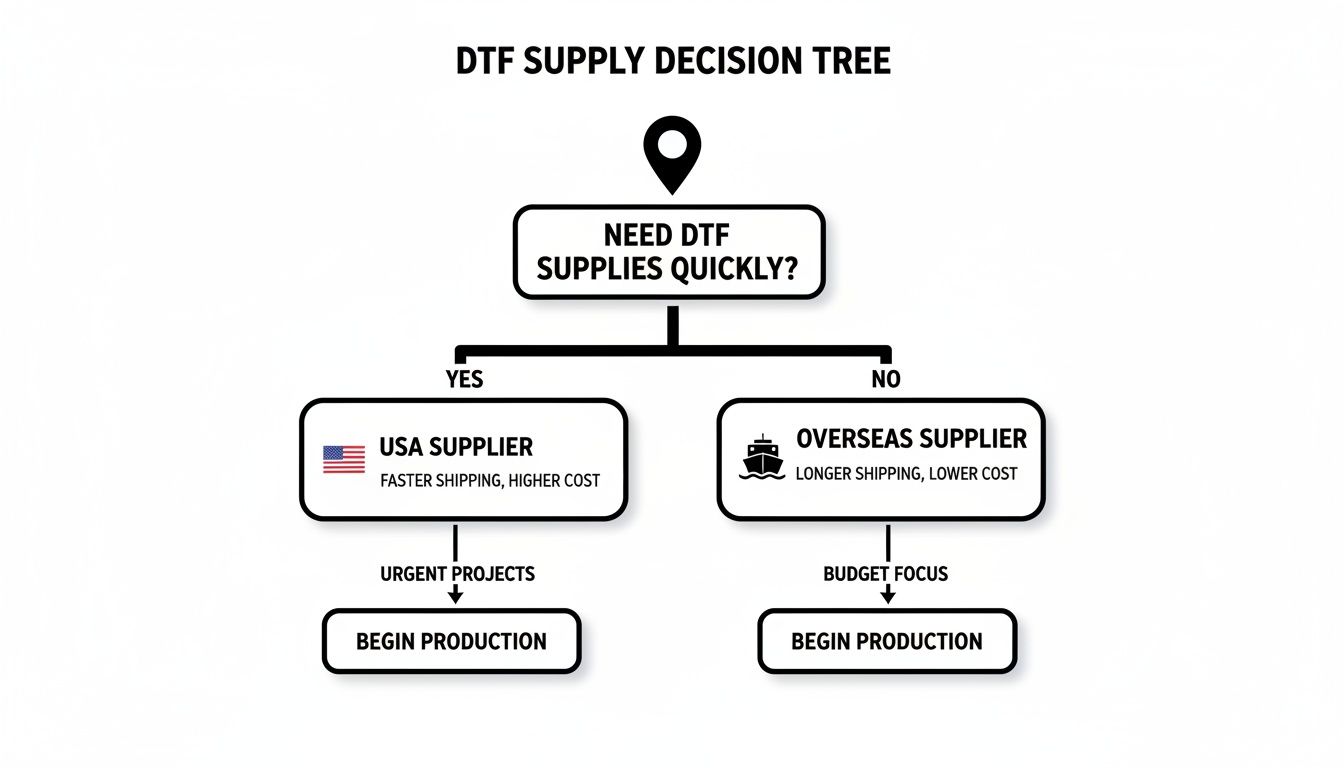
At the end of the day, working with a domestic supplier often means you can skip the shipping delays and quality control headaches, helping you hit your deadlines without fail.
Frequently Asked Questions
When you're weighing DTF against screen printing, a few questions always pop up. Let's tackle them head-on so you can get a clearer picture of which method fits your shop.
Is DTF Printing More Durable Than Screen Printing?
Both DTF and screen printing can produce incredibly durable prints when done right. But modern DTF technology has a real edge here. The specialized adhesives create a bond that's not just strong but also flexible, so it moves with the fabric instead of fighting against it.
This means DTF prints are exceptionally resistant to cracking and peeling, even on tricky materials like spandex or polyester blends. In many cases, a quality DTF transfer will outlast a traditional screen print, especially on anything other than a standard cotton tee.
Can I Use a Standard Printer for DTF?
That's a definite no. Trying to rig a standard office or inkjet printer for DTF is a recipe for frustration and wasted supplies. The process demands a complete, purpose-built system.
You absolutely need a dedicated DTF printer, specialized water-based pigment inks (including white), high-quality PET film, and the crucial powdered adhesive. Every piece of that puzzle is engineered to work together. A regular printer just can't handle the ink chemistry or the transfer process, and the results will be a mess.
Screen printing has a lot of manual steps, but the complexity in DTF is all about the hardware and the chemistry. Cutting corners here doesn't work—it just leads to failed prints and a lot of wasted material.
What Is the Environmental Impact?
This is where DTF really starts to pull ahead for eco-conscious brands. Since the inks are water-based and the process is entirely digital, you're not dealing with the chemical-heavy cleanup that screen printing requires. There are no screens to reclaim, no emulsion to wash out, and no vats of solvents needed.
Screen printing, on the other hand, traditionally uses plastisol inks and a whole host of harsh chemicals for screen prep and cleanup. All that chemical waste has an environmental cost. For shops looking to minimize their footprint, DTF is often the cleaner, more sustainable choice.
Ready to elevate your apparel business with unmatched quality and speed? At Cobra DTF, we provide American-made DTF transfers that eliminate overseas shipping delays and quality issues. Explore our products and see the difference at our official Cobra DTF website.