

DTF Film Price Explained: What Drives Cost and How to Save
A 13-inch by 328-foot DTF film roll typically costs $75 to $120, while premium 24-inch by 328-foot rolls commonly run $130 to $180. The roll price is only the starting point, because usable width, trim waste, coating quality, and rejected transfers determine what each finished transfer costs.
You've probably seen the problem on your own invoices. One supplier offers a roll that looks like a bargain, while another charges noticeably more for what appears to be the same PET film. The cheaper quote may win on the first glance, but freight, inconsistent coating, production waste, and downtime can turn it into the more expensive choice.
Here's the shop-owner version of the answer: buy film for predictable cost per usable transfer, not for the lowest roll price. The numbers below give you a practical way to compare quotes without getting fooled by width, peel type, or a headline discount.
Why Two Quotes for the Same DTF Film Can Vary by Hundreds of Dollars
A quote for a 13-inch by 328-foot roll may look simple until you read the fine print. One supplier lists a price near the low end of the market, while another lands near the upper end. Both may call the product “standard DTF film,” but that label doesn't tell you enough about coating, release behavior, batch control, freight, or return terms.
In major U.S. retail and supplier listings, the practical 2025–2026 range for a 13-inch by 328-foot roll is $75 to $120, while premium 24-inch by 328-foot rolls commonly fall between $130 and $180. Broader supplier listings also show higher-end examples at $149, $159, $165, and $169, with some older list prices reaching $349.99 before discounts, as documented in this U.S. DTF film roll pricing guide.
Read the invoice past the product name
Start with these checks:
- Confirm the dimensions: A narrow roll and a wide roll aren't interchangeable, even when the length matches.
- Identify the peel type: Hot, warm, and cold peel films can behave differently in your production sequence.
- Ask about the coating: Release consistency matters more than a generic “premium” label.
- Check freight and return terms: A low product price can lose its advantage once shipping or a defective-batch return is involved.
- Request a batch specification: You want consistent coating and release performance from one shipment to the next.
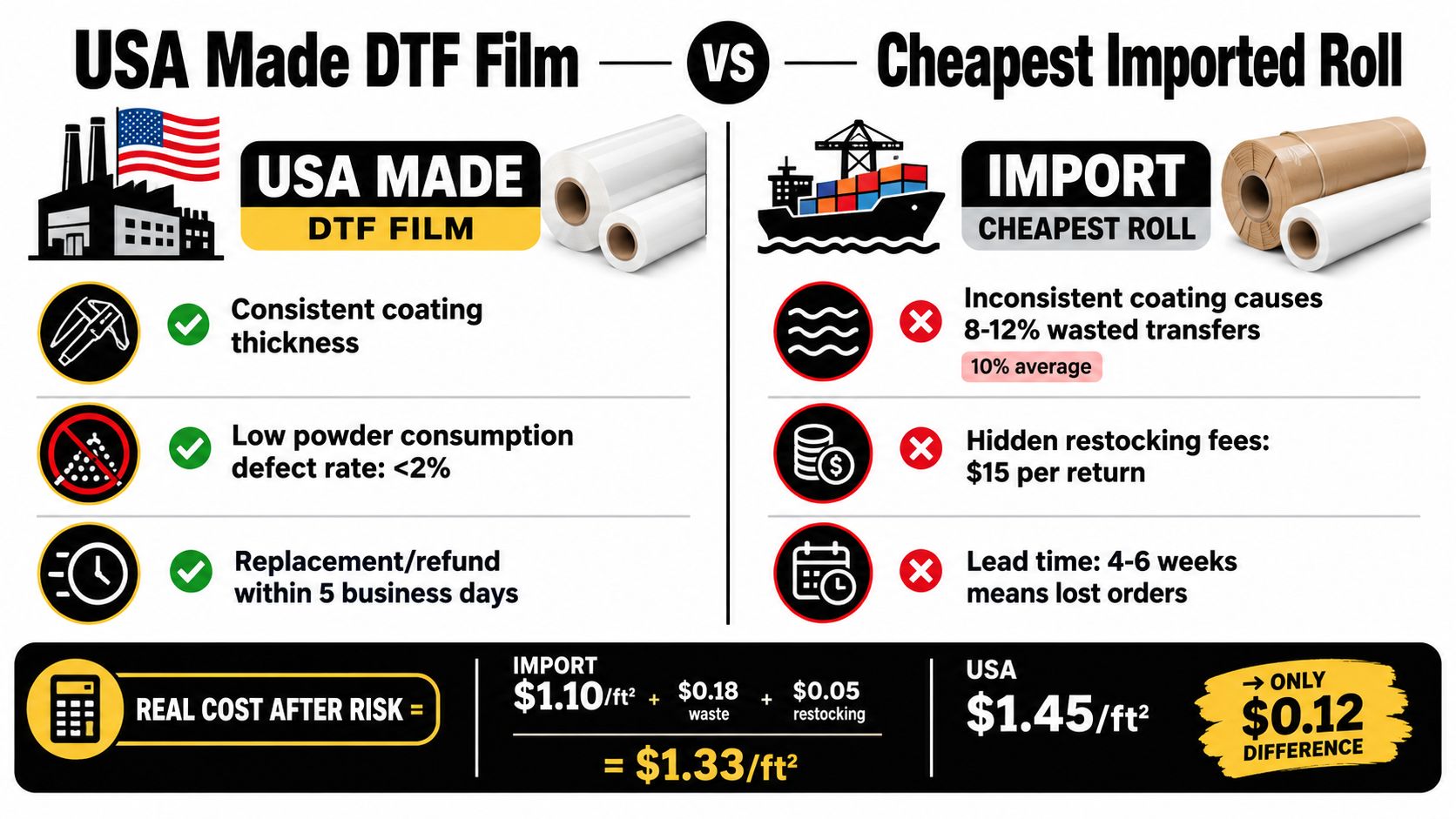
A discount importer may offer an attractive product price, but your real exposure includes delivery uncertainty, customs delays, limited support, and the possibility of losing a production day while you test a new batch. A domestic supplier may charge more at checkout and still leave you with the lower operating cost if the film runs cleanly without reprints.
Practical rule: Compare the delivered cost of usable film, not the advertised cost of an unopened roll.
The price gap exists because DTF film is a layered technical product, not just clear plastic. Base film, coating chemistry, thickness, release behavior, compatibility, quality assurance, order quantity, and logistics all show up somewhere in the final invoice.
What DTF Film Actually Does in the Transfer Stack
DTF film is the PET carrier sheet that receives the printed image, holds the wet ink, accepts the hot-melt adhesive powder, and carries that assembly through curing before release onto a garment. If you're coming from screen printing, think of it as a temporary stencil carrier. A screen-print stencil holds ink in the correct shape, while DTF film holds the ink and powder assembly in place until heat activates the adhesive.
The film sits in a larger production stack:
- PET carrier film provides the printable surface and release layer.
- DTF ink forms the image, including the white underbase.
- Hot-melt powder bonds the image to the garment.
- Curing equipment melts and sets the powder into the ink.
- A heat press transfers the finished image to cotton, polyester, blends, and other apparel substrates.
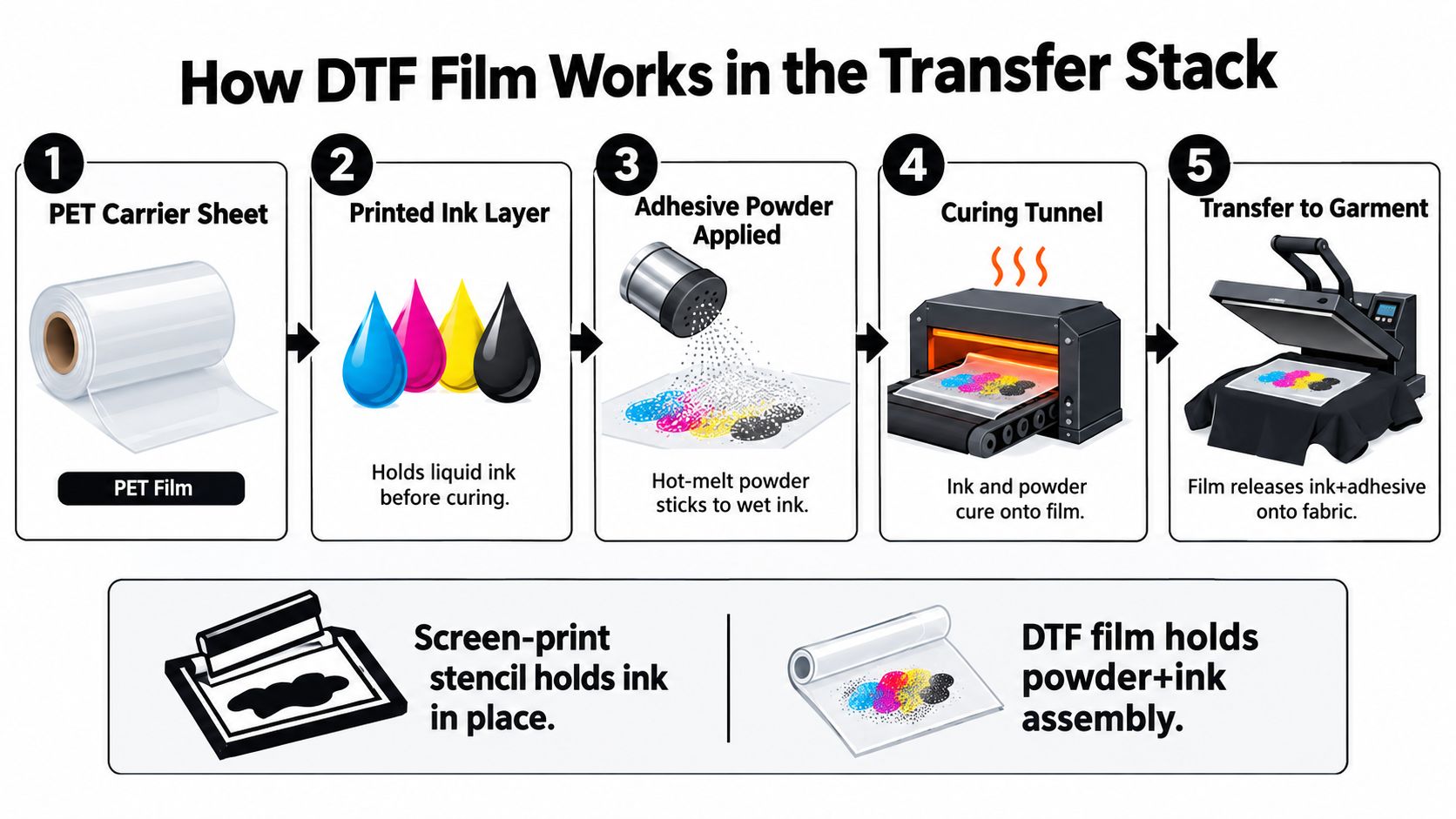
Every layer adds its own cost line. Film is only one consumable, alongside ink, powder, cleaning supplies, energy, labor, and the garment itself. That's why a lower roll price doesn't automatically produce a lower transfer cost.
Where cheap film creates expensive problems
Poor film usually fails at the release stage or during handling. It may curl, feed inconsistently, hold too much powder, release unevenly, or leave part of the design behind. When that happens, the loss isn't limited to the PET sheet. You may also waste ink, powder, press time, operator time, and a blank garment.
A film can also look fine during printing and still cause trouble after curing. The release layer has to separate from the adhesive and ink assembly at the correct point in your workflow. If it doesn't, your operator ends up slowing the line, testing more sheets, and reprinting jobs that should have shipped.
For a practical overview of roll formats and buying considerations, review this guide to DTF film rolls for apparel production. The important takeaway is simple: the film has to work with your printer, ink, powder, curing method, and press settings as one system.
The Seven Drivers Behind Every DTF Film Price Tag
The invoice usually reflects several variables at once. Some affect the material itself, while others reflect the supplier's testing, inventory, and distribution model.
The seven variables to check
-
PET resin and coating chemistry
The base PET gives the film its dimensional foundation, but the printable coating and release layer control how ink and powder behave. More controlled coatings generally move the product toward premium pricing. Don't pay extra for the word “double-sided” unless your workflow needs that feature. -
Gauge and thickness
Thickness influences stiffness, handling, feeding, and heat behavior. One manufacturer lists a BOPET base with a 12±2 micrometer TPU adhesive layer, total thickness of 75 micrometers ±5%, hot-peel strength of at least 2.8 N/cm, cold-peel strength of at least 2.2 N/cm, and thermal shrinkage no higher than 1.5% at 160°C for three minutes in its DTF transfer film specifications. Those specifications show why films with tighter tolerances can cost more than commodity products. -
Peel formulation
Hot-peel film can fit fast pressing workflows, while cold-peel film may suit shops that prefer a cooling step before separation. The right choice depends on your production rhythm and the powder and ink system you run. A higher price is justified only if the peel behavior improves your actual output. -
Brand and batch quality assurance
A supplier that tests batches, controls coating consistency, and handles complaints responsibly has more operating cost than a seller moving anonymous rolls. That support can matter when one inconsistent roll reaches the press. -
Order quantity
Single-roll purchasing includes more distribution and handling cost per roll. Larger orders may reduce the delivered unit cost, but only buy more than you can store and use safely. Film savings disappear if rolls age, collect dust, or sit in poor humidity conditions. -
Ink and powder compatibility
“Universal” film isn't universal in every shop. A film that performs well with one white ink and powder combination may behave differently with another. Ask whether the supplier identifies tested combinations or makes a broad compatibility claim. -
Shipping and import exposure
Freight, dimensional handling, customs processing, and duties can change the delivered number. A supplier quote that excludes those costs isn't comparable to a domestic delivered quote.
| Driver | What It Controls | Typical Price Swing per Roll |
|---|---|---|
| PET resin and coating | Ink holdout, powder adhesion, release behavior | Varies by coating tier |
| Gauge and thickness | Feeding, stiffness, heat stability | Varies by specification |
| Peel type | Production speed and separation timing | Varies by hot, warm, or cold formulation |
| Brand and quality assurance | Batch consistency and support | Varies by testing and supplier controls |
| Order quantity | Distribution cost and purchasing tier | Lower per-roll cost at larger quantities |
| Compatibility | Performance with ink and powder | Varies by tested system |
| Logistics | Freight, handling, customs, and duties | Varies by origin and shipment terms |
A good quote should identify enough of these details for you to compare like with like. If it only says “DTF film roll” and a price, you're not comparing products. You're comparing guesses.
From Roll Price to Real Cost Per Transfer
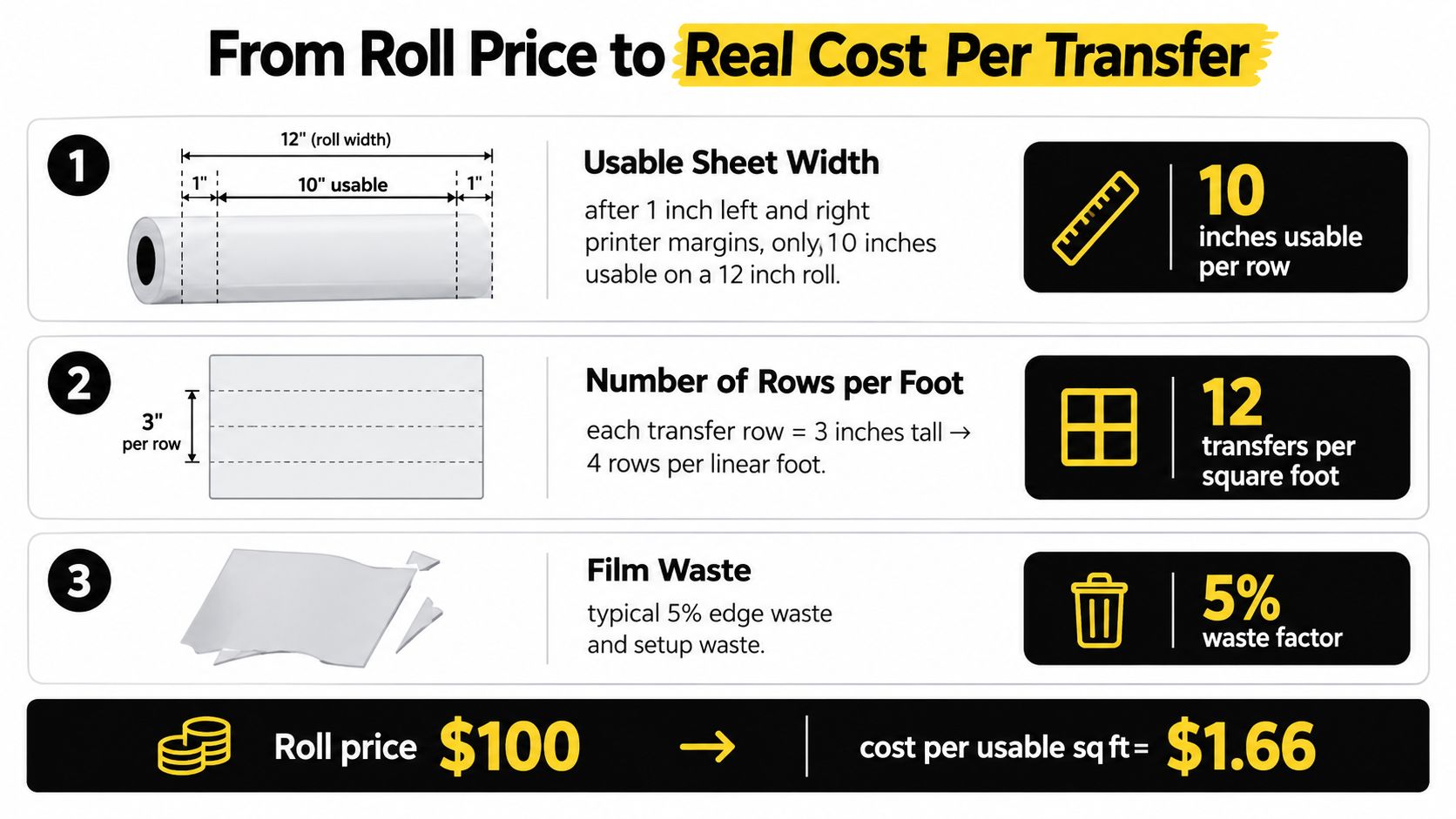
The roll price matters less than the number of saleable transfers you get from it. Three variables control that yield: usable width, layout efficiency, and waste.
A 13-inch roll doesn't necessarily give your printer 13 inches of practical print area. Printer margins, edge handling, registration requirements, and your gang-sheet layout may reduce the width you can use. Trim gaps between designs also consume film, especially when you run mixed-size artwork rather than tightly packed repeats.
A practical calculation
Take a hypothetical $95 roll of 13-inch by 328-foot hot-peel film. The total area is based on the full roll dimensions, but your usable area is lower once margins, trim space, setup sheets, and rejected sections are removed.
For a 12-inch by 18-inch gang sheet, calculate:
Film cost per transfer = delivered roll cost ÷ saleable transfers produced
Then adjust the result for:
- Usable width: Remove the portion your printer cannot reliably print.
- Layout waste: Account for gaps between logos, irregular shapes, and unused spaces around designs.
- Setup and edge waste: Include test strips, leading edges, trailing edges, and sections you discard.
- Reprints: Count film used on failed prints rather than pretending every printed sheet becomes a saleable transfer.
A historical pricing benchmark places DTF film around $0.15 to $0.40 per A3 print, or approximately $0.01 to $0.02 per square inch, according to this DTF transfer film buying guide. The same guide's India pricing snapshot lists A4 sheets at ₹8 to ₹15, A3 sheets at ₹18 to ₹35, 12-inch rolls at ₹2,500 to ₹4,500 per 100 meters, and 24-inch rolls at ₹6,000 to ₹11,000 per 100 meters. These ranges help establish film as a relatively low-cost consumable, but they don't remove the need to measure your own yield.
Don't leave ink out of the math
Film isn't the full transfer cost. Ink coverage, white ink density, adhesive powder, curing energy, labor, and reprint frequency all contribute. A wide sheet may lower film cost per design when you pack it efficiently, but it can raise waste if your artwork leaves large empty areas.
Use a spreadsheet with one row per job. Record roll price, roll dimensions, printed length, usable designs, rejected designs, and the reason for each rejection. After a few production cycles, you'll know whether the problem is the film price or the way your layouts consume the film.
A standard retail or wholesale transfer price should start with that measured cost, then add labor, overhead, packaging, transaction fees, and margin. Don't set your price from another shop's roll quote. Their layout and failure rate may be completely different from yours.
Real 2025 to 2026 DTF Film Price Ranges by Size and Tier
A 12-inch roll for logo work should not carry the same price logic as a 24-inch roll feeding a production printer. Width, coating, peel behavior, thickness, brand positioning, and order volume all change the invoice. Compare rolls by usable output, not by the sticker price alone.
For standard film, one industry listing places a 60 cm by 100 m roll at about $94.09 retail, or roughly $0.14 per square foot. An eight-pack price of $89.72 per roll shows how volume purchasing can improve unit economics without changing the film specification. Use those figures as a reference point, not as a universal quote.
The table below gives a practical buying framework. Economy, mid-tier, and premium describe quality positions, not guaranteed prices.
| Roll Size, width × length | Economy Tier, USD | Mid-Tier, USD | Premium Tier, USD | Typical Use Case |
|---|---|---|---|---|
| 12-inch × 328-foot | Lower-priced narrow roll | Standard shop production | Higher-control specialty film | Small shops, compact printers, logos |
| 13-inch × 328-foot | Commodity or entry film | Everyday apparel work | Tested production film | Common adult apparel and gang sheets |
| 17-inch × 328-foot | Entry wide-format film | General production | Premium wide-format coating | Larger layouts and higher output |
| 24-inch × 328-foot | Economy wide film | Commercial shop use | $130 to $180 | Large gang sheets and wider equipment |
The clearest U.S. pricing anchors are the $75 to $120 range for 13-inch rolls and the $130 to $180 range for premium 24-inch rolls in 2025–2026 pricing guides. A quote below those ranges needs inspection. It may be a promotion, or it may involve thinner coating, weaker release control, or compatibility limits with your ink and powder.
A cheap roll is only cheap if it produces the same number of clean, saleable transfers.
Wholesale pricing usually becomes more relevant around 10 rolls, and supplier guidance indicates that larger orders can reduce cost per print to pennies. Before placing that order, check storage space, cash flow, and expected usage. A lower unit price does nothing for a shop holding unused film while its cash is tied up. For a real quote, ask whether the supplier is pricing the same coating, roll length, and packaging specification, then compare the expected usable output.
Why USA Made DTF Film Often Beats the Cheapest Imported Roll
I don't recommend domestic film because the label sounds good. I recommend it when the supplier gives you a clearer path to consistent production, fast replacement, and accountable support.
Imported film can be perfectly usable. The problem is that the lowest quote often leaves out the operational risk. A supplier may offer a strong product price, but you still need to account for freight, customs handling, longer replenishment cycles, limited technical support, and the difficulty of returning a defective roll.
Compare risk instead of origin
Ask these questions before choosing the lowest offer:
- How quickly can the supplier replace a defective batch?
- Will the supplier identify the production lot?
- Can you get technical help with your exact ink and powder combination?
- Does the return policy cover opened material that fails in production?
- Can you reorder the same specification without receiving a different coating?
A domestic supplier may cost more per roll and still reduce your total cost by cutting uncertainty. Faster fulfillment helps you avoid overbuying. Clear returns protect cash flow. Lot-level consistency reduces the number of test prints your operator has to run before starting a paid job.
What to demand from a supplier
A credible supplier should tell you what the film is designed to do, how it should be stored, which peel process it supports, and what happens if a batch doesn't perform. You don't need marketing language. You need a usable specification and a return process that someone answers.
The DTF film near you search is useful when it leads to suppliers that can provide local fulfillment and direct support. It's not useful if “near me” only changes the shipping page while the product still comes from an unverified source.
The right comparison is delivered roll cost plus expected waste, support time, replacement friction, and the value of keeping production moving.
Run a controlled test before changing suppliers. Print the same artwork with your normal white-ink settings, powder, curing temperature, and press process. Check feeding, powder coverage, curing, peel behavior, edge detail, and the finished garment after pressing. Keep the sample record with the supplier name and lot information so your next purchase has a reference point.
Practical Ways to Lower Your DTF Film Cost This Week
A cheaper roll can raise your transfer cost if it feeds poorly, creates trim waste, or produces rejects. Start by measuring usable output from each roll, then negotiate from that record instead of chasing the lowest quoted price.
Prioritize the moves that affect yield
- Audit roll yield: Record printed length, saleable designs, trim waste, setup waste, and rejected transfers. Separate film failures from layout mistakes so you fix the expense at its source.
- Standardize one width: Match your most common jobs with one practical width. Buying several formats often leaves strips that are difficult to use and creates separate purchasing tiers.
- Consolidate orders carefully: Compare single-roll and multi-roll delivered costs, including freight and handling. A lower unit price is useful only when the full cart total improves.
- Use the right gauge: The thickest film is not automatically the best choice. Test a thinner option with your normal ink, powder, curing, and peel settings, then judge the finished transfer, not the roll in your hand.
- Negotiate freight with the full cart: Combine film and powder when the supplier's terms reduce the delivered total. If bundled shipping does not lower that total, place separate orders.
- Tighten gang-sheet layouts: Rebuild repeat jobs around standard print sizes and reduce empty space. Better nesting often saves more than a small roll discount.
- Separate supplier problems from operator problems: Mark each failure as feeding, coating, powder application, curing, artwork, or pressing. That record shows whether to change material, training, or process.
For a broader production-cost checklist, see this guide on how to reduce printing costs.
A simple order of attack
Measure yield first and remove avoidable layout waste. Then buy around the width your shop uses most, compare delivered case pricing, and test a different film tier against your established process. Leave packaging changes and small list-price arguments until last. Usable area and rejected work usually move the invoice more.
Cobra DTF offers DTF transfers by size and gang-sheet ordering, which gives shops a way to outsource selected jobs instead of carrying every film, ink, and powder expense in-house. Compare your measured transfer cost with the Cobra DTF ordering options, then choose the format that matches your actual job mix rather than your buying habit.