
Direct to Film Printing Pros and Cons
You've got a customer asking for a small run of full-color hoodies, the garments include cotton blends and polyester, and your screen-printing setup is already taking more labor than the order justifies. Your options look simple on paper, but the wrong choice can leave you with wasted supplies, inconsistent prints, or a garment that feels cheap in the customer's hands.
That's why the direct to film printing pros and cons deserve a more practical review than a standard feature checklist. DTF solves real production problems, especially for short runs and mixed fabrics, but its film waste, powder handling, curing demands, and supply variability can change the economics. The right question isn't whether DTF is “better.” It's whether it fits the job you're quoting.
| Factor | DTF | DTG | Screen printing |
|---|---|---|---|
| Best fabric range | Cotton, polyester, blends, and many difficult substrates | Primarily cotton and cotton-rich garments | Strongest on compatible cotton garments |
| Setup | Print, powder, cure, and press | Pretreat, print, and cure | Prepare screens, inks, registration, and press |
| Short runs | Strong fit | Strong fit for detailed cotton graphics | Often inefficient when quantities are small |
| Dark garments | Dense white underbase and vibrant color | Requires careful pretreatment and curing | Excellent opacity with the right ink system |
| Hand feel | More tactile because of the film and adhesive layer | Softer, ink-absorbed feel | Can range from soft to heavy depending on ink |
| Main operational risk | Film, powder, curing, and supply consistency | Pretreatment, maintenance, and fabric limitations | Setup labor, screen storage, and color registration |
What DTF Printing Is and Why Shops Are Switching
A two-person shop gets an order for a couple dozen blended hoodies. The artwork has several colors, the garments aren't all the same fiber, and the owner doesn't want to burn screens for a job that may never repeat. DTF looks attractive because it moves much of the setup into a printed transfer, but replacing an aging screen setup still means learning a different production discipline.
Direct-to-film printing starts with artwork prepared in RIP software. A DTF printer lays down color, commonly with CMYK plus white, onto coated PET film. The white layer matters because it creates an opaque base under the artwork, especially on dark garments and colored polyester.
The basic workflow is:
- Print the design onto PET film. The printer creates the image in reverse so it reads correctly after pressing.
- Apply hot-melt adhesive powder. The powder covers the wet ink and later bonds the design to the garment.
- Cure the transfer. Heat melts the adhesive and turns the printed film into a press-ready transfer.
- Heat-press it onto the garment. Pressure, temperature, dwell time, and peel timing determine whether the transfer bonds properly.
- Peel and inspect. The operator checks edges, small details, gloss, adhesion, and surface feel before packing the order.
The method sits between screen printing and DTG. It avoids the multi-screen setup of screen printing, and it doesn't require DTG's direct-to-garment pretreatment workflow. At the same time, it leaves a film and adhesive layer on top of the fabric, so the result won't feel identical to ink absorbed into cotton.
For shops evaluating equipment, the useful comparison isn't only about the printer. It includes powder management, curing equipment, film storage, heat pressing, maintenance, and operator training. Businesses that need broader production planning may also benefit from reviewing industrial printing services support before investing in a new workflow.
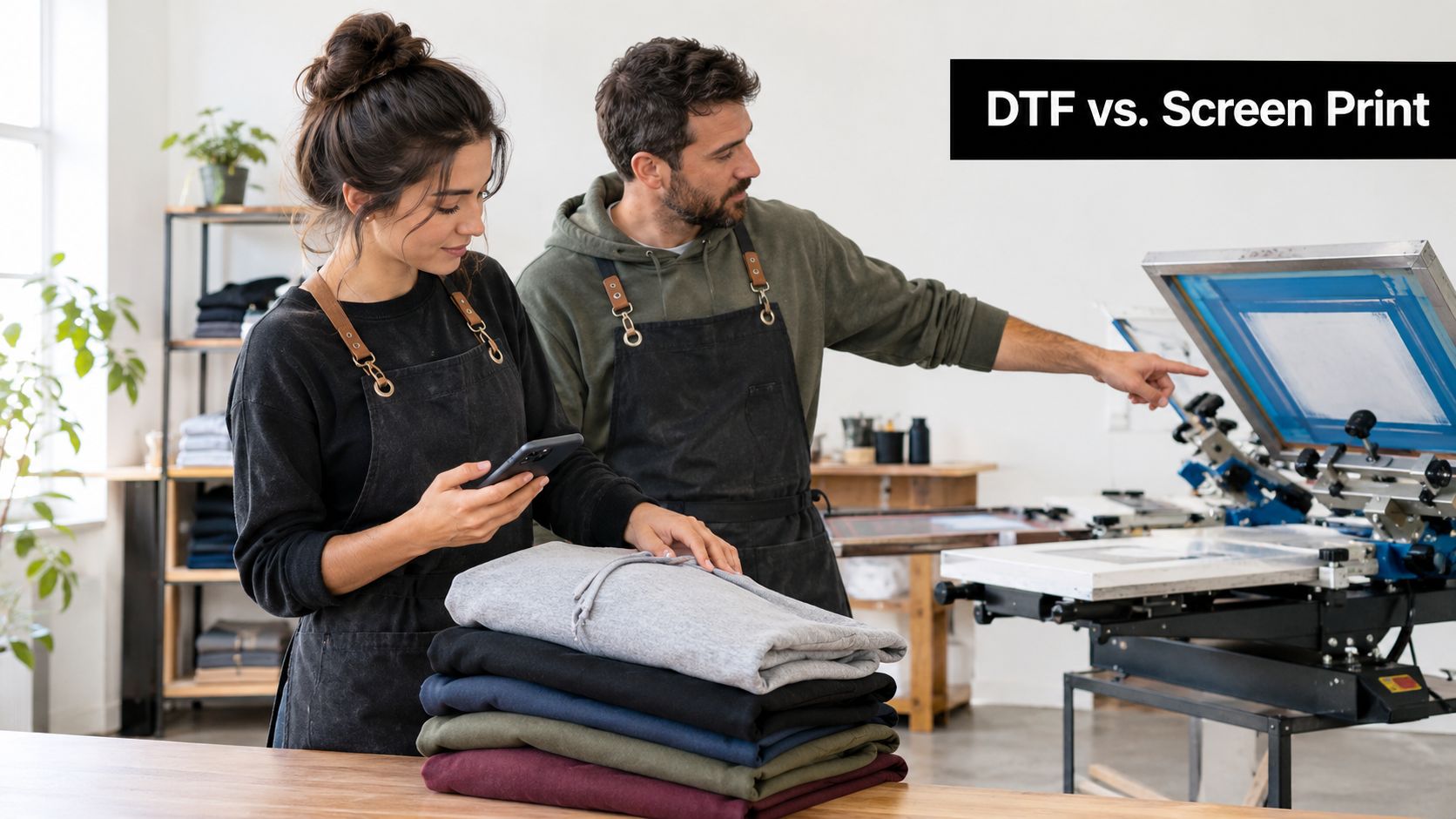
If you're still unclear about the transfer sequence, this guide to what direct-to-film printing is gives you the technical foundation. The short version is simple: DTF separates image creation from garment decoration, which gives a small shop more flexibility but adds consumables and quality-control checkpoints.
Advantages of Direct to Film Printing
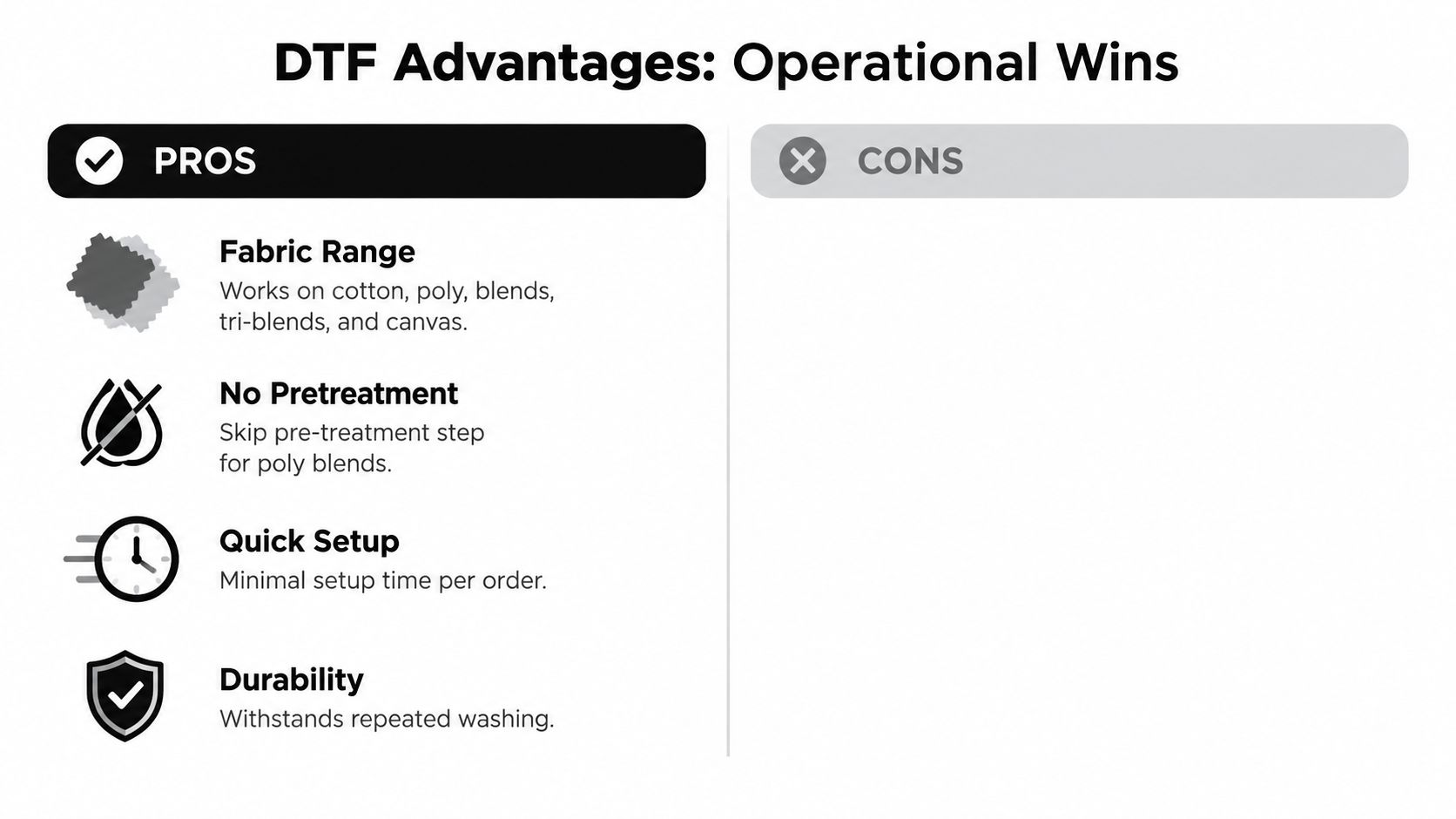
A shop taking orders across cotton, polyester, blends, tri-blends, canvas, and selected synthetics can often keep one DTF transfer workflow instead of changing decoration methods for each fabric. Materials still require testing, but that flexibility simplifies quoting and scheduling. It is especially useful for small businesses serving varied garments rather than repeating one product and one substrate.
DTF's white underbase also gives dark garments dense, saturated artwork. Color stays stronger when the design needs opacity, including detailed graphics and heavy coverage. Comparative testing found that stronger mid-tier films retained over 90% opacity and showed zero edge lift through 25 wash cycles, while weaker films failed before the tenth cycle with visible cracking and substantial color loss. Treat those results as a purchasing benchmark, not a promise for every roll. The comparative film testing and material guidance explains why film quality belongs in the production specification.
Where DTF earns its place
No garment pretreatment removes a handling stage before decoration. You print, cure, and press the transfer instead of pretreating every garment for direct printing. That helps shops process mixed colors and fiber contents with fewer pretreatment marks and less variation between blanks.
Short-run economics favor DTF when an order contains one custom piece, a small team order, or several different graphics. Each design avoids a separate screen setup, so variation becomes easier to price and schedule. The more artwork changes the order includes, the stronger this advantage becomes.
Durability is solid when curing and application are controlled. A realistic benchmark places performance at about 50 home washes under controlled care, while accelerated testing often maps one test cycle to roughly five home launderings. Some tested results showed grey-scale color change around 4 to 4.5 out of 5 after 10 accelerated cycles. This DTF durability guidance also identifies the limits: hot washing, abrasion, and poor curing shorten service life.
The operational decision is straightforward. Choose DTF when you need full color, flexible quantities, and several fabric types in one workflow. Budget for film selection and process checks, because those advantages depend on consistent materials and application.
Shop-floor rule: DTF earns its place when order variety matters more than the lowest possible per-piece consumable cost.
The Real Disadvantages Most Comparisons Skip
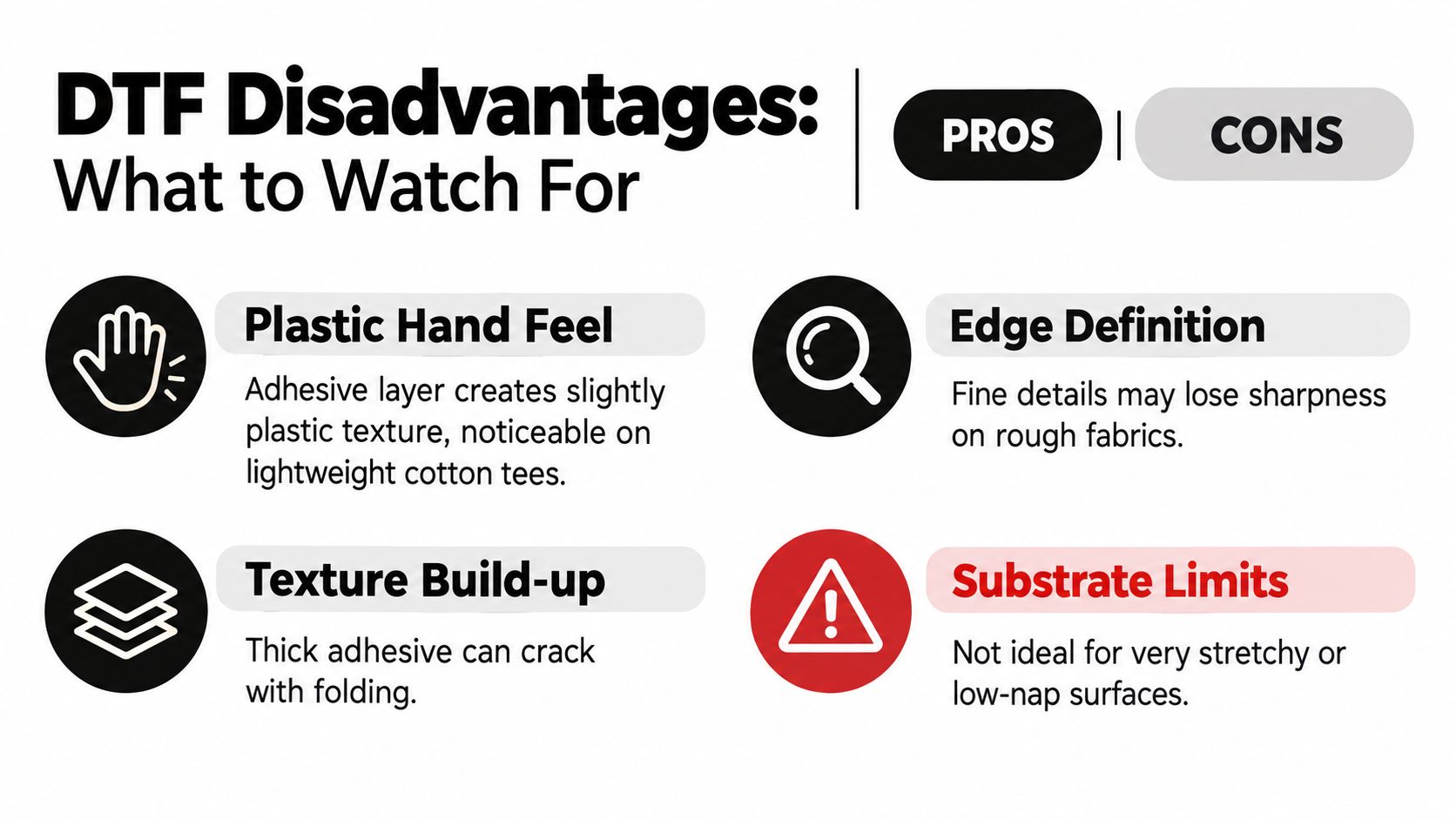
DTF doesn't disappear into the garment. The adhesive and ink form a transfer layer on the surface, which creates a more tactile, sometimes slightly plastic hand feel than sublimation or well-executed DTG. Customers notice it most on lightweight cotton tees, large solid areas, and designs with heavy white coverage.
That surface layer also makes curing a production variable rather than a routine button press. Under-cure the adhesive and you invite cracking, peeling, or poor wash adhesion. Over-cure it and the transfer can become stiff, glossy, or less comfortable. Operators have to monitor film chemistry, powder coverage, oven or shaker settings, press temperature, pressure, and peel timing.
The waste stream is part of the quote
Every DTF shop handles more than the finished garment. The process creates PET film waste, unused or excess adhesive powder, failed transfers, purge prints, test pieces, and packaging from consumables. You may not see those costs on a supplier's transfer price, but someone still pays for the material, storage, handling, and disposal.
Powder creates a separate operational concern. It must be applied evenly, kept away from contamination, and handled with suitable ventilation and housekeeping. A shop that treats powder like ordinary paper dust will eventually face messy work areas, inconsistent adhesion, or unnecessary cleanup labor.
Supply variability is another hidden problem. Film from one vendor can behave differently from film from another. Powder formulations can alter adhesion, gloss, stretch, and curing requirements. Even within a familiar product line, a batch change can force operators to retest settings before they trust production again.
Equipment and control requirements
A serious DTF station usually involves more than a printer and a heat press. Shops may need a powder shaker, curing oven, ventilation, humidity-conscious film and ink storage, maintenance supplies, and a clear inspection area. The equipment list grows because DTF transfers need controlled handling between printing and pressing.
The material risk isn't theoretical. Comparative guidance describes strong films surviving 25 wash cycles without edge lift, while weaker films can fail before 10 cycles. That range shows why a cheap consumable can cost more than a premium one after reprints, refunds, and lost confidence are included.
The transfer price is only one line in the job cost. Count failed prints, cleanup time, testing, storage, and rework before you call DTF inexpensive.
DTF vs DTG vs Screen Printing Side by Side
The right process depends on the job, not on a single feature. DTF suits varied short runs, DTG fits detailed cotton artwork, and screen printing earns its place on repeat orders with stable designs and limited spot colors.
| Factor | DTF | DTG | Screen Printing |
|---|---|---|---|
| Low-volume cost | Practical because varied artwork needs no screens, though every transfer uses film and powder | Practical for individual cotton garments, with pretreatment adding handling | Setup can outweigh the value of a small order |
| High-volume cost | Film and powder remain part of every transfer | Works when artwork and fabric stay consistent | Often delivers the strongest unit economics for repeat bulk work |
| Wash durability | Proper curing and controlled care support reliable wear, but film quality and application affect results | Depends heavily on pretreatment, ink saturation, fabric, and curing | Strong performance is possible with suitable ink, fabric, and curing |
| Color and opacity | Vibrant full color with a white underbase on dark garments | Excellent photographic detail, especially on cotton | Saturated spot colors and specialty ink effects remain strong |
| Fabric compatibility | Broad range, including blends and many polyester garments | Best suited to cotton-rich textiles | Depends on garment, ink, stretch, and print requirements |
| Setup and labor | Print, powder, cure, press, and inspect | Pretreat, print, cure, press or dry, and inspect | Prepare screens, mix inks, register, print, clean, and reclaim |
| Best run length | One-offs, short runs, mixed artwork, and variable orders | One-offs and detailed cotton work | Repeat orders and high-volume production with stable designs |
The operational cost matters more than the feature list. DTF removes screen preparation and avoids garment pretreatment, but it adds film consumption, powder handling, curing, pressing, and transfer inspection. DTG provides a softer ink feel, while its pretreatment process demands tighter control, especially on dark garments. Screen printing requires more preparation upfront, then spreads that labor across a stable production run.
For shops quoting mixed fabrics and changing artwork, DTF is usually the first method to price. The advantage comes from workflow flexibility, not from free production. Film waste from misprints, powder cleanup, and rechecking transfer settings all belong in the quote.
DTG deserves priority for a detailed cotton photograph where softness matters more than broad fabric compatibility. Screen printing deserves the quote for a large run with one simple logo. Its setup becomes productive when the same artwork repeats, while DTF continues consuming film and powder on each transfer.
Use this DTF versus DTG comparison when the artwork could suit either digital method. Add screen printing when quantity rises and the design remains stable. That decision rule is more useful than calling one process universally superior.
Matching DTF to Real Production Scenarios
The easiest way to choose a decoration method is to stop comparing machines and compare jobs. Fabric, quantity, artwork variation, and customer expectations usually reveal the answer quickly.
Scenario one, a 25-piece mixed order
A customer wants 25 hoodies with several graphics across cotton and polyester blends. Screen printing requires setup for each design and color combination. DTG can produce detailed work, but pretreatment and fabric compatibility add friction.
DTF is the practical choice. One transfer workflow handles the artwork variation, the garments don't need the same pretreatment routine, and the white underbase protects color density on darker apparel. The operator still needs to test the press settings, but the shop avoids turning a small mixed order into a screen-management project.
Scenario two, a 1,000-piece promotional run
A company needs 1,000 shirts with one repeat two-color logo. DTF's flexibility stops being its main advantage. The artwork is stable, the garment selection is consistent, and the press can repeat the same operation at scale.
Screen printing wins this quote. Once screens are prepared and registration is set, the production team can run a straightforward design efficiently. DTF can produce the job, but its film and powder consumption remain attached to each transfer, so the method gives up the cost advantage that made it attractive for the smaller order.
Scenario three, a polyester athletic line
A sportswear brand needs bright graphics on polyester garments with stretch and frequent use. DTG is a poor starting point because synthetic fabrics can make pretreatment and ink behavior more difficult. Screen printing can work, but stretch, coverage, and hand feel require careful ink selection.
DTF is the strongest candidate because the transfer layer can deliver opaque, detailed color across difficult fabrics. The shop must still choose compatible film and adhesive, test stretch behavior, and control curing. DTF isn't automatically ideal for every athletic garment, but it aligns with the production problem better than the alternatives.
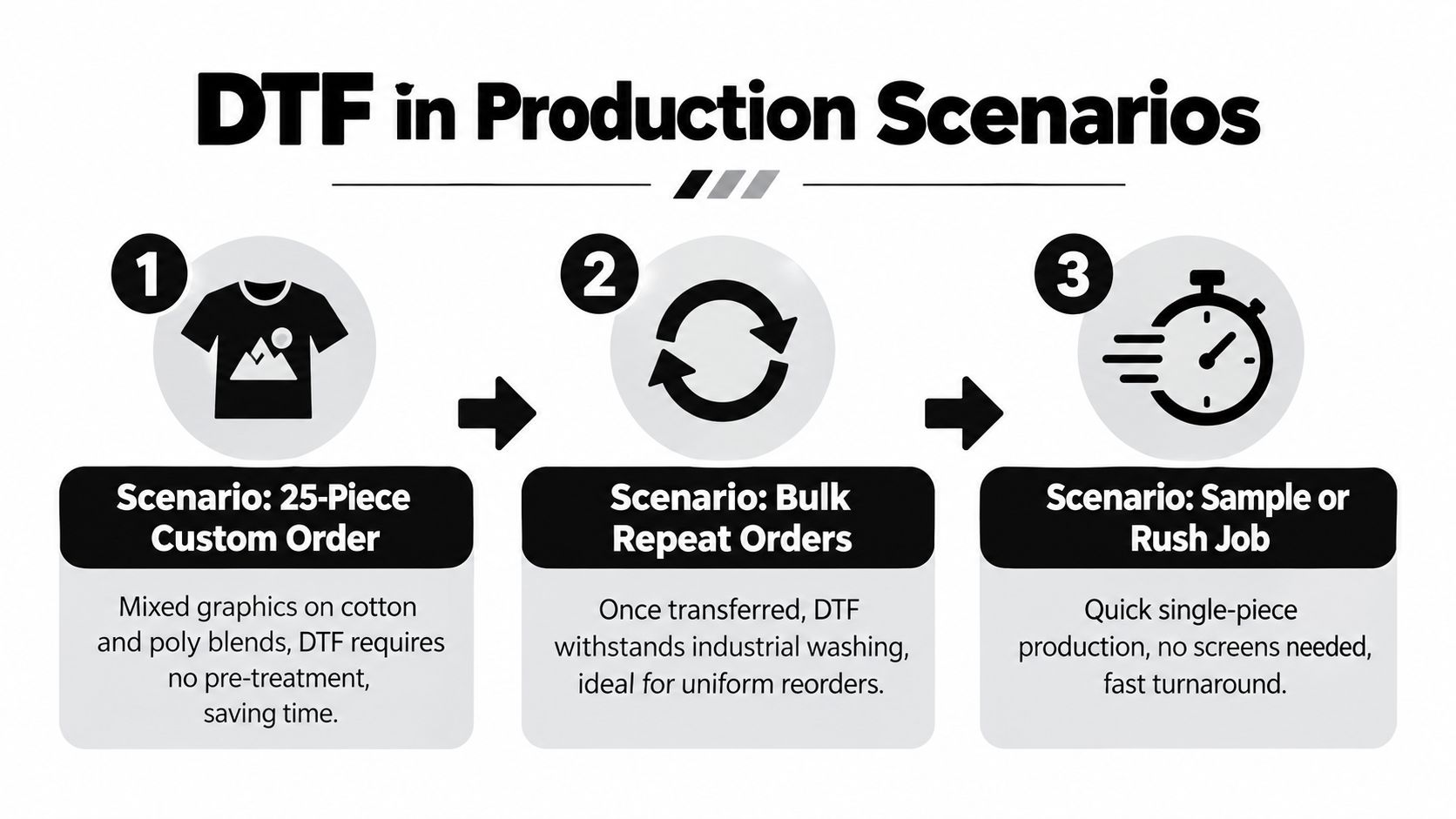
Quoting shortcut: If the order changes fabrics or artwork frequently, favor the method that reduces setup changes. If the order repeats one simple design at scale, favor the method that makes each unit cheaper to repeat.
Cost, Waste, and Reliability Behind the Hype
A DTF transfer can look inexpensive when you count only ink, film, powder, and pressing. That calculation misses the operating layer. Film waste accumulates around gang-sheet layouts, unused spaces, test prints, misprints, and transfers that fail inspection. Adhesive powder adds handling time, cleanup, storage requirements, and ventilation concerns.
Environmental comparisons also need more honesty. DTF reduces the water associated with DTG pretreatment, but it creates PET film waste and adhesive powder disposal. Whether the lower water use offsets those waste streams depends on how efficiently the shop nests artwork, manages failed transfers, and handles end-of-life materials. The 2025 DTF market coverage identifies this as an unresolved practical question rather than a simple “waterless means greener” conclusion.
Reliability matters more than the headline price
A shop can absorb a small material difference more easily than a production interruption. If a film batch changes peel behavior or a powder formulation changes adhesion, the operator may need to recalibrate settings and run tests before completing customer work. A shortage of one compatible consumable can hold up a workflow that depends on matching film, powder, ink, and curing conditions.
Recent market reporting also describes DTF adoption alongside compact systems, workflow software, and AI-assisted print optimization. That direction matters because the competitive advantage is shifting from owning a printer to operating a repeatable system. Market research on DTF costs and reliability highlights supply inconsistency and maintenance as persistent issues for price-sensitive shops.
Track these costs separately:
- Film utilization: Measure unused areas, not just the film consumed by the artwork.
- Powder loss: Record excess powder, contamination, cleanup, and rejected transfers.
- Rework: Count replacement garments and labor when adhesion or curing fails.
- Downtime: Note maintenance, nozzle checks, calibration, and supply delays.
- Storage: Protect film, ink, and powder from conditions that change performance.
For a shop that wants to outsource transfers instead of managing this equipment, DTF cost per print guidance can help separate transfer pricing from pressing, garment, labor, and waste costs. That's the calculation you need for a real quote.
When DTF Is the Right Call and When It Is Not
DTF wins when flexibility has a direct business value. It's the right call for polyester apparel, tri-blends, short runs under 50 pieces, and mixed-fabric orders where pretreatment would slow the shop down. It also makes sense when the artwork uses many colors, gradients, or small details that would require multiple screen setups.
It loses when the job rewards repetition and softness more than versatility. Heavy cotton basics above 500 pieces are usually better candidates for screen printing, particularly when one simple design repeats across the order. Oversized placements that need the softest possible hand feel can favor DTG or a suitable screen-printing system, while metallic and specialty-ink effects generally belong in the screen-printing conversation.
The tactile issue deserves a firm place in customer communication. Don't promise a soft, ink-absorbed feel when the design requires a large DTF transfer. Show a sample, explain the surface layer, and let the customer choose with accurate expectations.
| Scenario | Best method | Why |
|---|---|---|
| Polyester or tri-blend apparel | DTF | Broad fabric compatibility and strong opaque color |
| Short run under 50 pieces | DTF | Minimal setup and efficient varied production |
| Mixed-fabric order without pretreatment | DTF | One transfer workflow handles changing substrates |
| Heavy cotton basics above 500 pieces | Screen printing | Repeated production can reduce setup impact per unit |
| Large placement where softness is essential | DTG or screen printing | DTF's surface layer may feel too tactile |
| Metallic or specialty-ink artwork | Screen printing | Specialty effects are better suited to dedicated ink systems |
If the run is short, the fabric is synthetic, or the design has many colors, choose DTF. Otherwise, weigh screen printing and DTG against the customer's priorities for volume, softness, detail, and specialty effects.
Cobra DTF offers USA-made, full-color DTF transfers for heat pressing, including upload-based custom transfer services, so shops can test or outsource this workflow before buying a complete in-house station. Visit Cobra DTF to review transfer options for your next mixed-fabric, short-run, or full-color apparel quote.