
Custom UV DTF Transfers Explained for Hard Surfaces
You've got a stack of blank tumblers, a batch of glass jars, or a new acrylic sign ready for your shop. The artwork looks perfect on screen, but one question keeps slowing the order down: will the transfer stay on the product after customers handle, wash, or display it?
That uncertainty is where many small businesses lose money. A design can be vibrant and fully cured yet still peel because the surface was oily, textured, poorly coated, or exposed to conditions the transfer wasn't tested for. Custom UV DTF transfers work best when you treat them as a substrate-specific manufacturing choice, not as universal decals.
This guide breaks down how UV DTF works, how it differs from standard DTF, which surfaces are dependable, how curing and film quality affect results, and how to test a new product before placing a larger order. By the end, you'll have a practical way to evaluate tumblers, glassware, acrylic signage, bottles, and other hard goods with fewer surprises.
Introduction to Custom UV DTF Transfers for Modern Makers
A small gift business might begin with a simple request: personalize a set of stainless steel tumblers with a logo, add names to glass candles, and create a few acrylic signs for a local event. Standard apparel transfers seem familiar, but they need heat and fabric. Sublimation requires compatible coatings and dedicated equipment. A traditional vinyl decal may handle simple graphics, yet it can be limiting when the design needs detailed color, layered effects, or a ready-to-apply finish.
UV DTF fills a different role. It creates a printed transfer that can be applied with pressure to many smooth, hard, non-porous items. There's no heat press involved in the application, which makes the method attractive to makers who want to decorate products without building an apparel-style pressing setup.
The opportunity is growing alongside the printer category. One market estimate values the UV DTF printer market at USD 1.59 billion in 2025 and projects USD 3.39 billion by 2032, while another estimates USD 1.67 billion in 2024 and forecasts USD 4.41 billion by 2033. Both reports identify Asia Pacific as the largest regional market, with a share of roughly 40.8% to 41%. These are market projections, not a guarantee that every transfer will perform well on every product, but they show why practical application knowledge matters as adoption expands. (UV DTF printer market estimates)
The question buyers should ask first
Instead of asking only, “Can UV DTF stick to this?” ask:
- Is the surface smooth, clean, dry, and non-porous?
- Does its coating change how the adhesive wets the surface?
- Will the product bend, flex, soak, or face chemical exposure?
- Has the exact blank item been tested before a production order?
That last question separates a reliable product line from an expensive remake pile. A transfer that performs well on one tumbler may behave differently on another tumbler with a different powder coat, texture, or curvature.
The useful path is straightforward. First, understand the layered transfer. Then compare UV DTF with standard DTF, evaluate curing and carrier film control, sort surfaces into reliable and risky groups, and apply a repeatable preparation process. Those steps give you better decisions for real products, from drinkware and jars to acrylic signs and branded packaging.
What Custom UV DTF Transfers Are and How They Work
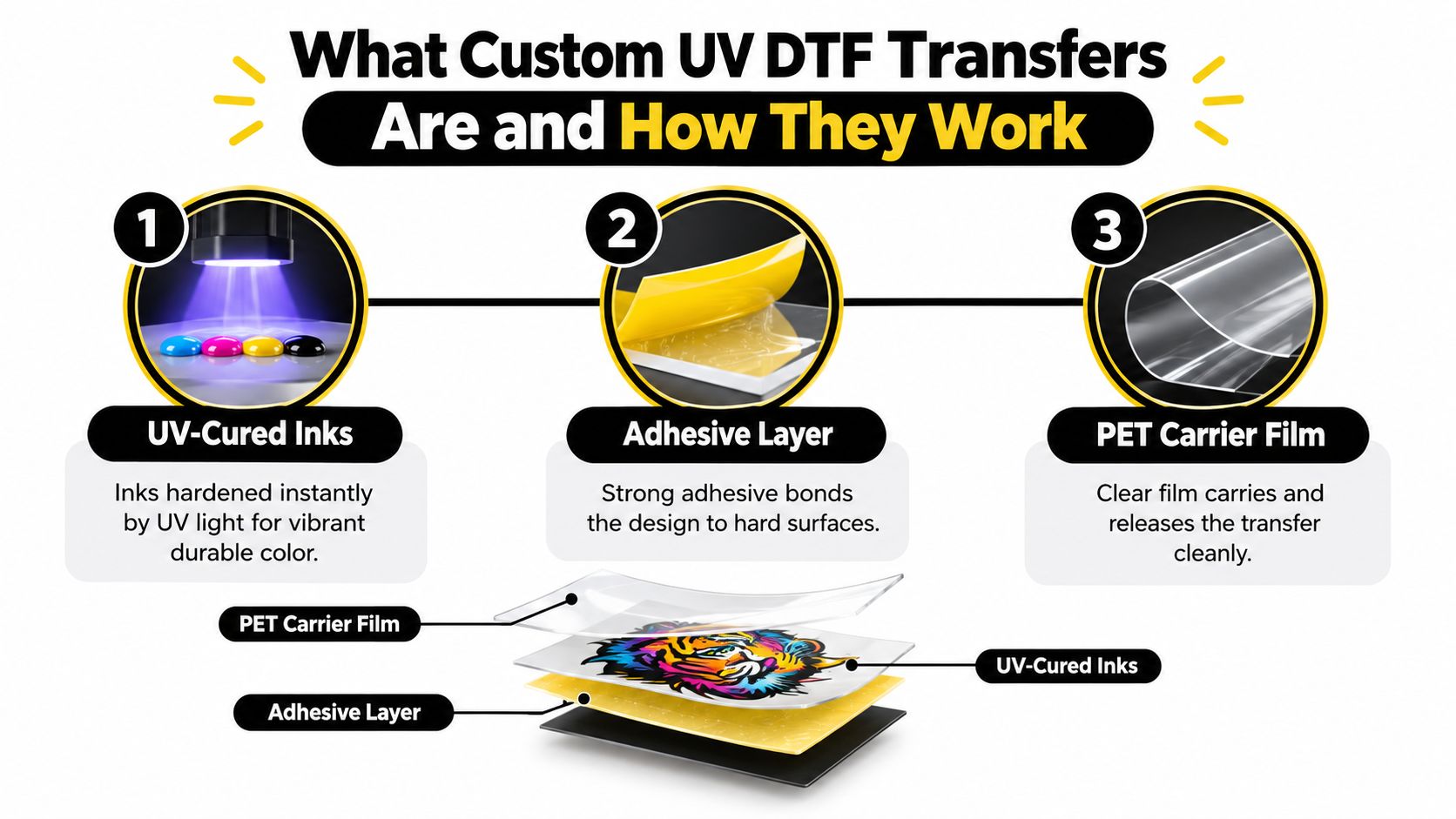
Think of a UV DTF transfer as a temporary carrier holding a finished, pressure-sensitive graphic. The clear film keeps the design aligned while you move it to the product. Once the design is pressed onto a suitable hard surface, the carrier releases and leaves the graphic behind.
The visible artwork is only one part of the system. A typical transfer depends on three connected layers:
- UV-cured ink creates the colored artwork, outlines, highlights, and other visual details. UV light hardens the ink rather than leaving it wet.
- Adhesive provides the bond between the printed design and the product. It needs to make close contact with the surface instead of merely sitting on top of dust, oil, or air pockets.
- PET carrier film supports the transfer during handling and releases it during application.
The light-curing analogy
Imagine spreading a liquid coating onto a surface and then exposing it to a carefully controlled lamp. The light triggers a chemical reaction that links the material into a more stable structure. That's the basic idea behind UV curing.
UV curing first appeared in the 1960s, and manufacturers have used it to increase automation and simplify production processes. Modern UV-curable adhesives are commonly made from 100% solids acrylic polymers. They're coated at approximately 130 to 140°C before UV crosslinking develops the properties needed for a usable pressure-sensitive adhesive. (Background on UV curing and adhesive chemistry)
For UV DTF, this science matters because the transfer isn't just “ink printed on clear plastic.” The adhesive must be formulated and cured so it can release from the film, conform to the product, and build a durable bond after application.
Why the adhesive deserves attention
A strong-looking print can still fail if the adhesive can't wet the surface. Surface energy, contamination, coating type, and application pressure all influence how much of the adhesive contacts the product.
That's why how UV DTF printing works should be understood as a complete system. Color quality attracts the buyer, but adhesive transfer and surface preparation determine whether the design remains attached.
The carrier film also controls handling. It keeps small details in position, prevents the graphic from stretching during transport, and lets the operator place the design as one unit. During application, the operator wants the ink and adhesive to stay on the item while the PET film peels away cleanly.
How UV DTF Differs From Standard DTF Printing
The word “DTF” creates confusion because both methods use film, printed artwork, and a transfer process. The destination changes everything. Standard DTF is designed primarily for fabric, while UV DTF is designed for hard, smooth, non-porous surfaces.
Standard DTF generally uses a heat-activated adhesive powder. A heat press then bonds the transfer to apparel or another compatible textile. UV DTF uses UV-cured ink and a pressure-sensitive adhesive, so the customer applies it with firm pressure rather than heat.
UV DTF vs Standard DTF at a Glance
| Feature | Custom UV DTF Transfers | Standard DTF Transfers |
|---|---|---|
| Primary product fit | Glass, acrylic, metal, plastic, bottles, cups, and tumblers | T-shirts, hoodies, totes, and other fabric products |
| Application method | Peel, position, press, and remove the carrier film | Position and apply with a heat press |
| Curing approach | UV light cures the printed ink and supports the adhesive system | Heat activates the adhesive during pressing |
| Surface feel | Can have a raised, dimensional printed feel | Produces a bonded textile graphic |
| Color behavior | Suitable for detailed, opaque graphics on hard goods | Designed to sit on and bond with textile fibers |
| Equipment needs | Cleaning tools, alignment aids, and a squeegee are commonly useful | Heat press, protective sheets, and temperature control |
| Main risk | Poor adhesion from contamination, texture, coatings, or unsuitable surfaces | Incorrect heat, pressure, time, fabric, or adhesive activation |
| Best buying question | “Has this exact hard surface been tested?” | “Is this fabric compatible with the transfer and press settings?” |
A customer ordering a logo for a cotton hoodie needs a different product from a customer decorating a glass candle vessel. Choosing standard DTF for the candle may leave you with a transfer that expects heat and textile contact. Choosing UV DTF for the hoodie ignores the flexibility and fiber structure that apparel decoration requires.
Color and opacity are only part of the decision
UV DTF can produce strong visual contrast on colored hard goods because the print system can include opaque layers. That doesn't remove the need to evaluate the base item. A glossy black tumbler, a frosted glass jar, and a textured powder-coated bottle each present different adhesion and appearance conditions.
Standard DTF has its own strengths, especially for apparel graphics that need to flex with fabric. UV DTF is a better fit when you need a ready-to-apply graphic for a rigid item and want to avoid a heat press during application.
Buying rule: Choose the transfer according to the product's material and behavior, not according to the shared “DTF” name.
Why Curing and Carrier Film Control Transfer Quality
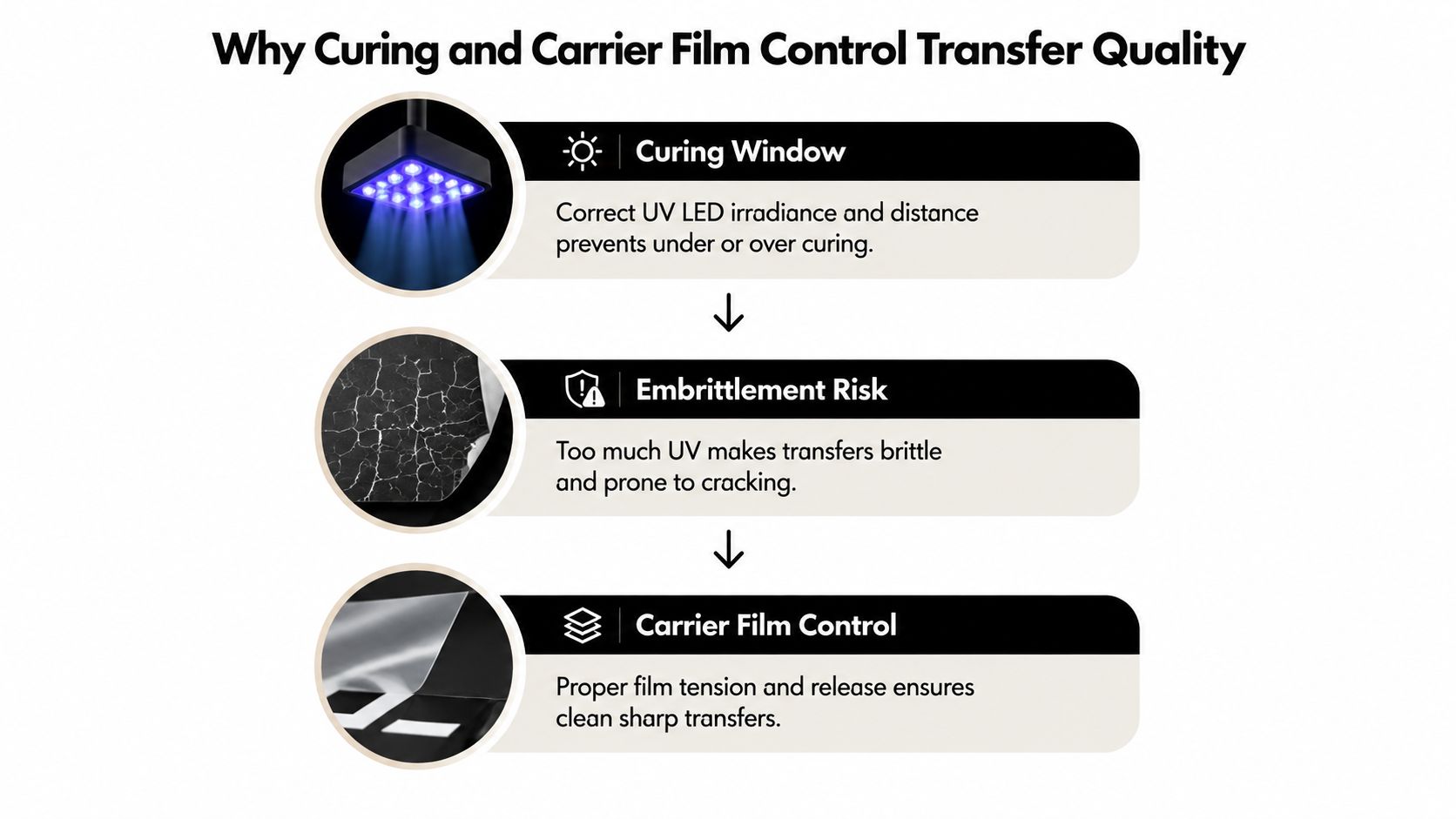
A UV DTF transfer can fail in two opposite ways. Insufficient curing may leave the system too weak or unstable. Excessive curing can make the printed layers or carrier brittle. Operators need a controlled curing window rather than the fastest possible lamp setting.
One technical guide reports UV LED arrays peaking at 365 nm with irradiance at or above 800 mW/cm² at a 1 mm gap. The same guide warns that peak power density above 1.2 W/cm² can embrittle PET carrier film and reduce tensile strength by more than 15% under ASTM D882 testing. (UV DTF curing and carrier film guidance)
Turn specifications into shop checks
You don't need to become a lamp engineer, but you do need a repeatable quality-control routine.
- Verify lamp output: Use the supplier's recommended measurement method or a calibrated radiometer where appropriate. Don't assume a lamp is delivering the same intensity throughout its service life.
- Control cure distance: A small gap change can alter the energy reaching the transfer. Keep the lamp and material position consistent.
- Watch for brittleness: Cracking, edge fracture, or a carrier that tears during release can indicate an over-cure or a film problem.
- Track film behavior: Film that stretches, releases unevenly, or shifts during production can affect registration and small details.
- Inspect surface energy: A stable film surface helps ink and adhesive wet correctly. The cited technical guidance specifies biaxially oriented PET at 63 µm nominal thickness and surface energy of at least 42 dynes/cm.
The film's moisture and oxygen transmission properties also matter because dimensional stability affects registration, adhesive transfer, and long-term peel integrity. A film that changes shape or releases inconsistently can create problems even when the artwork itself looks sharp.
Don't optimize only for speed
Increasing print speed or opacity may appear productive until the shop starts seeing misaligned graphics, lifting edges, or brittle transfers. A better process balances ink laydown, lamp intensity, distance, film stability, and release behavior.
Record the settings that produce a clean transfer on a known product. When a new material enters the shop, treat it as a new variable rather than copying the same production assumptions without testing.
Ideal Use Cases and Surfaces to Avoid
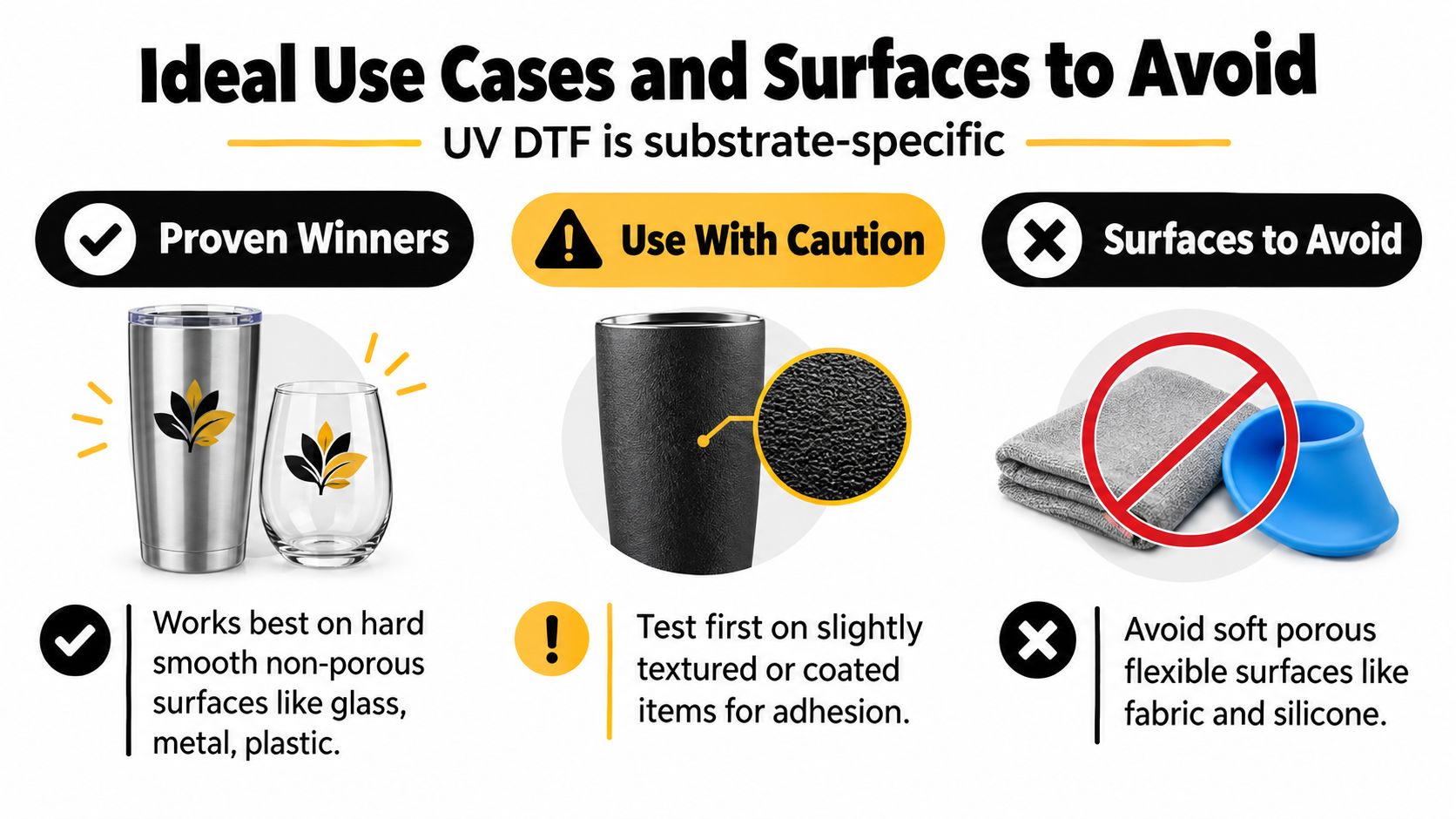
The most reliable UV DTF candidates share a simple profile: hard, smooth, clean, dry, and non-porous. Common examples include glass, plastic, metal, acrylic, plexiglass, bottles, cups, and tumblers. These products provide a stable surface for the adhesive to contact when the operator prepares and presses the item correctly.
A practical surface filter
Use three categories before accepting a production order.
Proven winners include smooth glass candle jars, polished metal bottles, clean acrylic plaques, rigid plastic containers, and many smooth tumblers. These aren't automatic guarantees. They're sensible starting points because the material is rigid and gives the adhesive a continuous surface.
Use-with-caution items include heavily coated products, textured powder-coated drinkware, irregularly curved bottles, and surfaces with an unknown finish. Curvature can make alignment and edge contact harder. Texture reduces the contact area, while an unfamiliar coating can interfere with adhesion.
Poor candidates include fabric, soft porous materials, flexible items, and silicone-like surfaces. UV DTF is not a universal replacement for textile transfers or flexible decoration methods. If the item bends, stretches, absorbs contamination, or has a very low-energy surface, expect a higher risk of lifting or incomplete transfer.
Pilot the exact blank
A supplier's general compatibility list can't replace a sample test. Buy or prepare the same blank used in production, apply the transfer using the intended cleaning and pressure process, and inspect the result after handling. For drinkware, include the care conditions customers will use, especially hand washing, soaking, detergents, and repeated contact.
The UV DTF dishwasher safety guide is useful when you're deciding how to describe care instructions. Don't promise dishwasher performance just because the graphic looks cured. Exposure to water, heat, detergents, and chemicals can challenge the adhesive and printed layers differently from a dry display item.
Production insight: The hidden cost isn't the first transfer. It's the remake, return, replacement blank, and customer service time caused by an untested substrate.
Contamination is another major variable. Finger oils, dust, mold release residue, and cleaning-product film can prevent the adhesive from making full contact. Bubbles and peeling often indicate a preparation or compatibility issue, not a defective design.
Application Tips and Equipment Considerations for Best Results
Good application starts before the transfer touches the product. Clean the item with an appropriate surface cleaner, then wipe it with a lint-free cloth and allow it to dry fully. For many hard goods, rubbing alcohol is commonly used to remove fingerprints and oils, but test the cleaner on the blank first so it doesn't damage the coating.
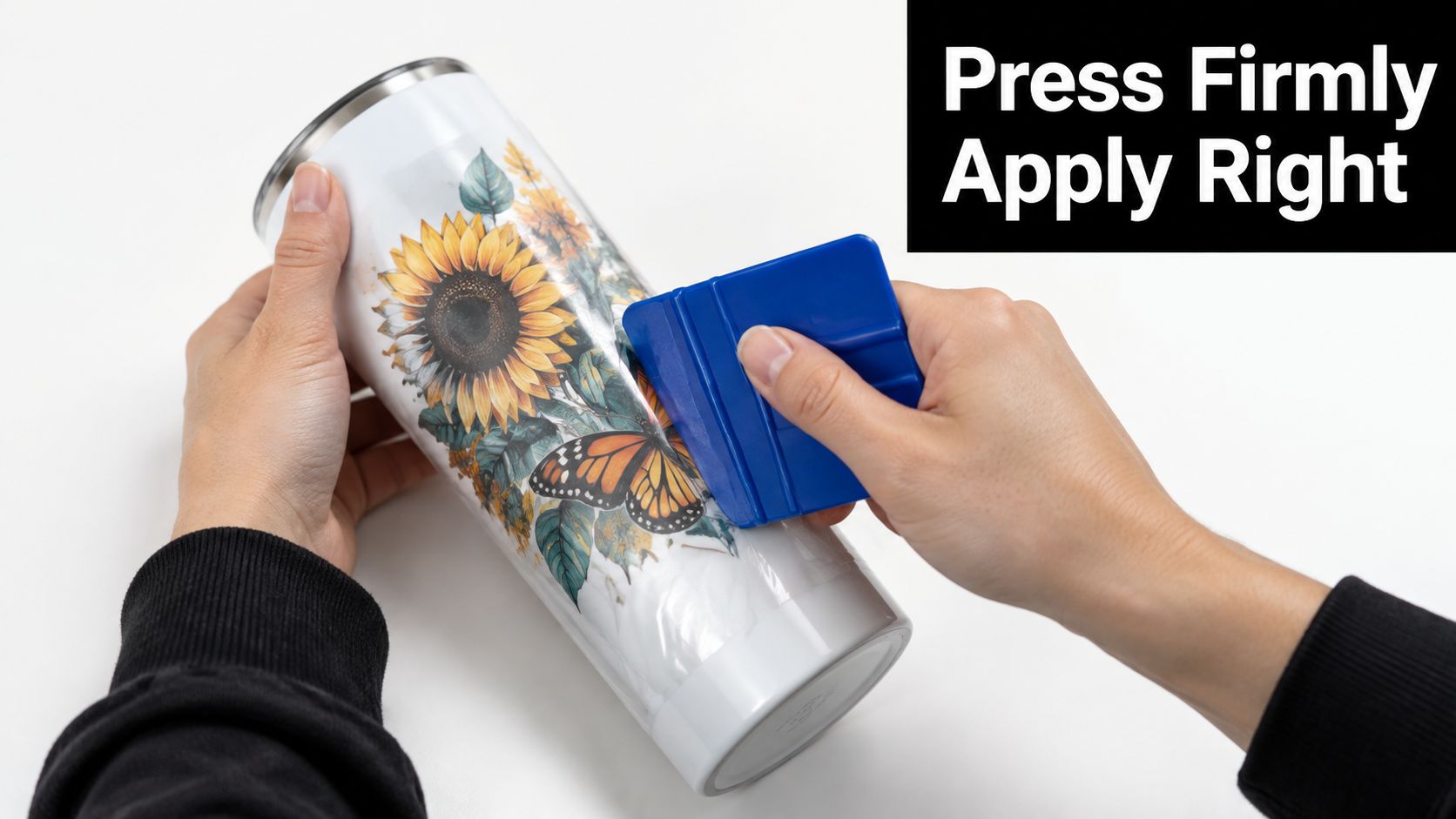
A steady application sequence
Cut the design from the sheet while leaving enough clear border to handle it. Align the transfer before removing the backing, especially on cylindrical items such as tumblers where a small angle error becomes obvious around the curve.
Place one edge first, then press gradually across the surface. A blue plastic squeegee, felt-edge applicator, or similar smooth tool helps push air outward while firm hand pressure increases the adhesive's contact with the item.
Remove the carrier film slowly and at a low angle. If part of the graphic lifts, stop, lay the film back down, press the area again, and give the adhesive time to settle before trying to release the carrier.
The first day matters
Technical UV DTF material guidance reports 5B adhesion in ASTM D3359 cross-cut testing and scratch resistance around 4H for properly formulated UV-cured inks. The same guidance commonly reports LV6 to LV7 UV resistance for color inks and outdoor color retention of up to about 2 years, while also emphasizing that real performance depends on the material, application, exposure, and care conditions. (UV DTF adhesion and durability guidance)
Adhesion continues to strengthen after application. The first 24 hours are critical, so some operators recommend waiting 24 hours before heavy use or washing. Give customers clear care instructions instead of treating the transfer as fully settled the moment the carrier film comes off.
Diagnose before reprinting
- Edge lifting: Recheck cleaning, surface energy, pressure, and curvature.
- Bubbles: Apply more gradually and work from the center outward.
- Cracks or brittleness: Review ink thickness and curing settings.
- Residue or uneven release: Examine carrier film quality and release behavior.
- Fading: Consider sunlight and chemical exposure before promising outdoor longevity.
For multiple small designs, UV DTF gang sheets can help organize artwork and reduce handling between individual transfers. The same application discipline still applies to every item on the sheet.
Ordering Custom UV DTF Transfers With Confidence From Cobra DTF
Once you understand the surface and application risks, ordering becomes much more practical. Start with a representative blank, choose the graphic size and finish, and request enough transfers to test the exact product before committing to a large batch. Ask about the film, adhesive, curing process, color performance, and recommended care instructions.
Cobra DTF operates as a family-owned Texas business and offers a dedicated UV DTF transfer collection for cups, tumblers, and other hard surfaces. Its stated product approach includes 100% USA-made transfers, USA-sourced inks and films, fade-resistant color, and pricing that avoids tariffs and customs fees. Same-day shipping is available for orders placed by 1 PM CST, with stated delivery within 1 to 3 days. These logistics can help a small shop test a product line without depending on international shipping timelines.
The company also describes eco-friendly practices and a satisfaction guarantee. Those details matter most when you're piloting an unfamiliar blank, because a clear quality policy can reduce the risk of being stuck with a batch that doesn't meet your application requirements.
A smarter ordering workflow
- Choose one product SKU: Test the exact tumbler, jar, bottle, or acrylic item you'll sell.
- Prepare it as a customer product: Use the same cleaning, alignment, pressure, and cure process planned for production.
- Apply and document: Record the transfer size, surface finish, curvature, and any visible bubbles or lifting.
- Set realistic care language: Separate dry indoor display, ordinary handling, hand washing, outdoor exposure, and chemical contact.
- Scale gradually: Increase the order only after the transfer performs acceptably under the product's real use conditions.
If you're comparing hard-surface graphics with other custom decoration options, a premium vinyl decal shop can also provide useful context on how decal materials fit different applications. The right choice depends on the substrate, finish, handling, exposure, and appearance you need, not on a single durability slogan.
Cobra DTF offers custom UV DTF transfers for hard surfaces, including peel-and-stick options suited to products such as cups and tumblers. Start with a test order for your exact blank, then visit Cobra DTF to upload your artwork or explore transfer sizes for a repeatable production workflow.