

Custom Apparel DTF Transfers: The Complete Guide
Custom apparel DTF transfers have transformed small-batch garment decoration from a costly impossibility into a reliable production method, driven by global DTF output reaching more than 7.2 billion prints in 2024. The surprising part is that DTF is no longer mainly a transfer technique for experimentation, it's becoming fulfillment infrastructure for shops that need flexible quantities, repeatable pressing, and fast delivery.
For a small apparel business, the hard decision isn't whether DTF can produce bright, detailed graphics. It can. The harder questions are operational: which fabrics will hold up, whether domestic or overseas sourcing fits your promises, how much durability customers should expect, and whether your press workflow is consistent enough to protect margins.
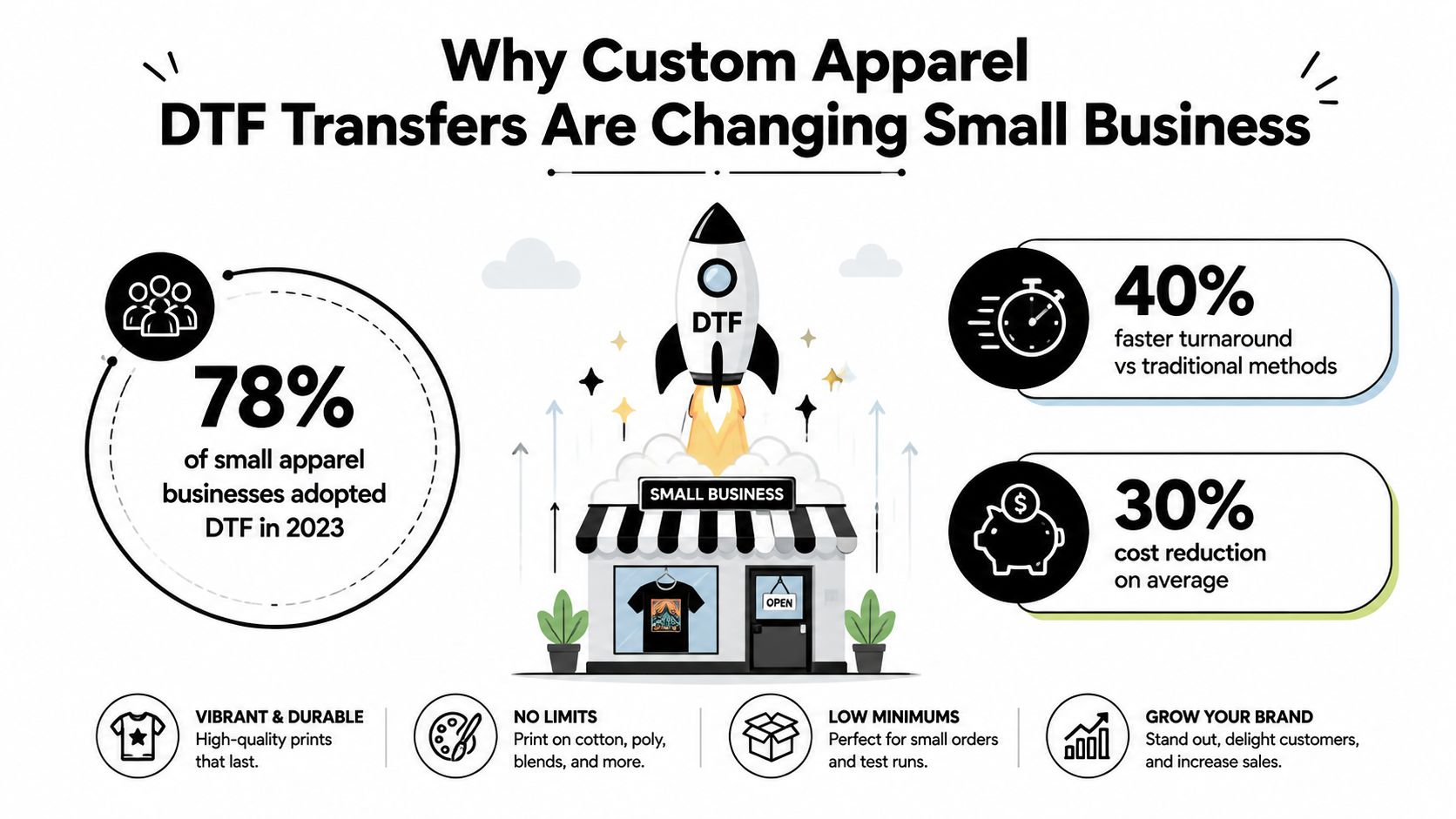
Why Custom Apparel DTF Transfers Are Changing Small Business
DTF moved from an experimental technology in the early 2000s to a mainstream textile printing method in the 2020s. One industry history connects its original development to Kornit Digital, founded in 2002, and identifies the late 2010s as the period when the method broke through commercially. That history matters because it places DTF inside a wider move toward digital, on-demand garment decoration rather than bulk-only production. (DTF's development and industry history)
The scale is now difficult to dismiss. WTiN reported more than 7.2 billion DTF prints produced globally in 2024, almost 30% higher than the previous year, with output covering about 184 million square meters. (WTiN's DTF market review) Those figures don't describe a niche process used only by hobbyists. They describe a production method with enough volume to support everyday custom shirt orders, small brand launches, event merchandise, and repeat e-commerce fulfillment.
The small-shop problem DTF solves
A traditional screen-printing workflow can make sense when a shop has a substantial quantity of the same design, but setup, color separation, and production planning can make short runs awkward. A customer asking for a handful of shirts, a local business testing a logo, or an online seller launching a limited design needs a different cost structure.
DTF lets the decorator separate artwork production from garment inventory. A shop can order transfers, stock blank garments, and apply designs only after an order arrives. That reduces the pressure to guess which graphics, sizes, and colors will sell before demand exists.
The operational benefit is flexibility, not magic. You still need accurate artwork, dependable transfers, a calibrated heat press, suitable blanks, and a quality-control routine. But the method supports a much wider range of order profiles than processes built around large identical runs.
Why adoption changes the buying decision
Grand View Research estimated the global DTF printing market at USD 2.72 billion in 2024 and projected it to reach USD 3.92 billion by 2030, representing a 6.0% CAGR from 2025 to 2030. (Grand View Research market estimate) The broader apparel printing market is also substantial, which gives DTF room to grow as sellers respond to customization and on-demand buying behavior.
For a shop owner, the practical conclusion is simple: DTF has enough industry momentum to justify evaluating it as a repeatable process, but adoption alone won't make the workflow profitable. The shops that benefit most treat transfers as part of purchasing, inventory, pressing, packing, and customer-service decisions. Guidance on reducing production costs is useful only when it includes those connected decisions.
What Custom Apparel DTF Transfers Are
A DTF transfer is a garment graphic printed onto a coated film, then moved to fabric with a heat press. The supplier prints the artwork, applies hot-melt adhesive powder to the ink, cures the adhesive, and ships the finished transfer to the apparel decorator. The decorator handles the final application rather than printing directly onto the shirt.
The workflow has five connected stages:
- Artwork preparation: The design is cleaned, sized, and placed on a transparent background where appropriate. Check edges, small lettering, and fine details at the intended print size.
- Film printing: The printer lays down color ink and a white ink foundation where opacity is needed, especially on dark apparel.
- Powder application: Adhesive powder coats the printed ink and creates the bonding layer between the graphic and the garment.
- Curing: Controlled heat melts the powder into an adhesive film prepared for pressing.
- Heat application: The press supplies the required temperature, time, and pressure to anchor the graphic to the textile surface.
The adhesive is the working connection
The adhesive layer connects the printed graphic with the garment fibers. Heat softens and activates it, while pressure brings the transfer into consistent contact with the fabric. Poor control in either area can leave a design that looks acceptable at first but later develops edge lift, cracking, or pigment loss.
DTF quality depends on the entire chain, including the film, ink, powder, curing, and pressing settings. A sharp file can still produce a weak finished garment if the adhesive is undercured or the press applies uneven pressure. That trade-off matters in production because a transfer that saves preparation time can create rework if the application settings are inconsistent.
Ready-to-press changes the shop workflow
Many small businesses can outsource film printing and curing instead of purchasing a DTF printer. They keep a heat press and blank garments in-house, shifting their investment toward pressing consistency, order tracking, blank selection, and fulfillment speed.
Ready-to-press means the transfer has completed its supplier-side stages. It still requires controlled application. Follow the supplier's peel instructions and fabric recommendations, then test every new garment style before adding it to a customer-facing catalog. A repeatable test process protects both durability and fulfillment schedules.
DTF vs Sublimation vs Heat Transfer Vinyl
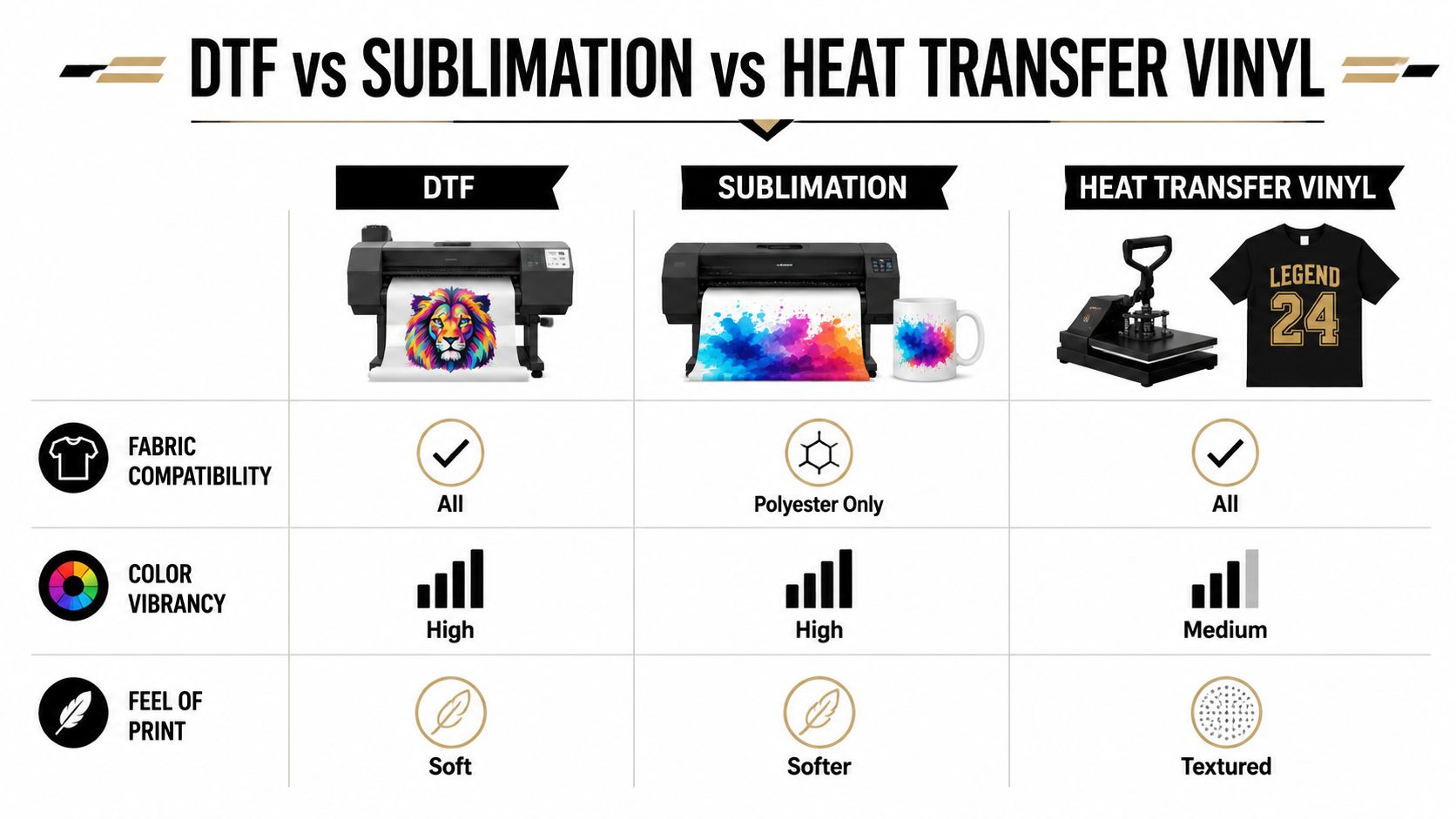
Choosing a decoration method starts with the order, not the equipment. DTF is a strong option for detailed, full-color designs across varied garments, but sublimation and heat transfer vinyl can outperform it in the right conditions.
DTF vs Sublimation vs HTV Comparison
| Criterion | DTF Transfers | Sublimation | Heat Transfer Vinyl |
|---|---|---|---|
| Fabric compatibility | Broad compatibility, subject to testing | Best suited to polyester garments | Broad compatibility, subject to vinyl type |
| Dark garments | Works with an opaque white foundation | Limited because the dye integrates into the fabric | Can use opaque vinyl |
| Color vibrancy | High, with detailed full-color output | High on compatible materials | Varies by vinyl and design |
| Feel of print | Soft transfer film feel | Integrated into the fabric | More textured and layered |
| Setup | Print and press workflow | Print, heat, and compatible substrate workflow | Cut, weed, layer, and press |
| Detailed artwork | Handles gradients, illustrations, and complex graphics | Handles detailed graphics on suitable polyester | More labor-intensive for intricate designs |
| Short runs | Practical for one-off and small-batch orders | Practical when polyester blanks are appropriate | Practical, especially for simple graphics |
| Main limitation | Requires careful bonding and fabric testing | Fabric and color restrictions | Weeding and layering can consume labor |
DTF works particularly well when a catalog includes cotton, blends, light garments, and dark garments. It also makes sense when a shop receives varied orders rather than one repeated design. The supplier can prepare the artwork, and the decorator can apply the transfer when the customer buys.
Sublimation has a different strength. The dye becomes part of the polyester surface instead of creating a separate adhesive film. That can produce a very soft result, but the method is more restrictive. If your catalog centers on compatible polyester apparel and you want the design integrated into the fabric, sublimation deserves serious consideration. If you need dark cotton shirts, it's usually the wrong starting point.
HTV remains useful for names, numbers, simple logos, and designs where a specific specialty finish matters. It gives the operator direct control over cutting and layering, but detailed multi-color artwork can require substantial weeding and assembly time. DTF often reduces that manual work, though the transfer itself introduces supplier dependence.
Decision rule: Choose the method that minimizes the bottleneck in your order. DTF reduces setup and artwork assembly, sublimation reduces surface texture on suitable polyester, and HTV gives hands-on control for simple or specialty graphics.
For a deeper comparison of use cases, review sublimation printing versus heat transfer before standardizing your production line.
Fabric Compatibility and Material Considerations
The phrase “DTF works on almost anything” is useful for attracting attention but too broad for purchasing decisions. A transfer can adhere to many textiles, yet the result still depends on fiber content, garment finish, heat tolerance, stretch, dye behavior, and the supplier's tested settings.
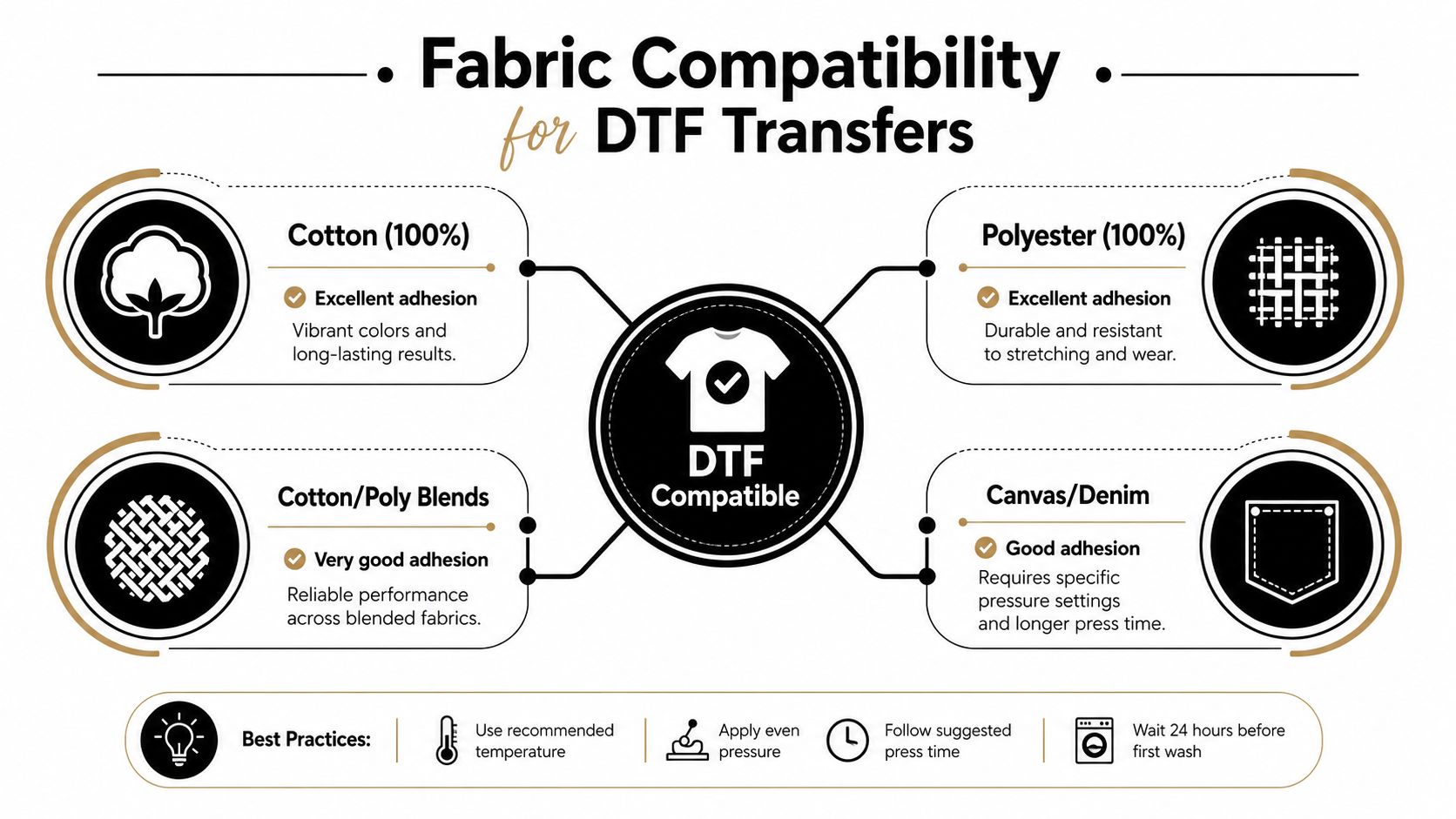
Fabrics that usually make sense
Cotton and cotton blends are often the easiest place to build a DTF catalog. The surface provides a practical bonding target, and these garments are common in T-shirts, hoodies, sweatshirts, and casual workwear. Blends can perform well, but the exact ratio and garment finish still justify a sample press.
Dark fabrics are a major DTF use case because the white ink foundation helps preserve artwork opacity. That gives a shop more freedom than decoration methods that rely on the garment color showing through the design.
Canvas and denim can be viable for totes, jackets, and heavier apparel, but their texture and thickness can change pressure requirements. A transfer that works on a smooth T-shirt may need a more careful setup on a coarse or rigid surface.
Where the risk increases
High-polyester performance fabrics deserve more caution. Heat can affect the garment, and dye migration can interfere with the transferred colors. A shop selling athletic apparel shouldn't assume that the same temperature and pressure used for cotton will protect every synthetic blank.
Sublimation may be the better choice when the product line is built around compatible polyester and the design can integrate into the fabric. DTF remains valuable for mixed catalogs, but the operator should test rather than promise universal performance.
Build a fabric test library
Before adding a new blank to your store, press a sample using the intended design size and placement. Record:
- Fiber content: Note the garment composition and color.
- Press settings: Log temperature, time, and pressure.
- Peel behavior: Follow the supplier's hot, warm, or cold peel instructions.
- Surface result: Check adhesion, stretch, texture, and edge lift.
- Wash response: Evaluate the sample after laundering according to the care instructions.
That record turns trial and error into a repeatable production reference. It also helps staff avoid guessing when an order uses a different hoodie, tote, or performance shirt.
A small business should also inspect garment finishing treatments. Moisture, coatings, textured surfaces, and seams can create localized failures even when the fabric category looks acceptable. The useful question isn't “Can DTF print this?” It's “Can this transfer and this press setup produce a repeatable result on this exact blank?”
US-Made vs Overseas Sourcing for DTF Transfers
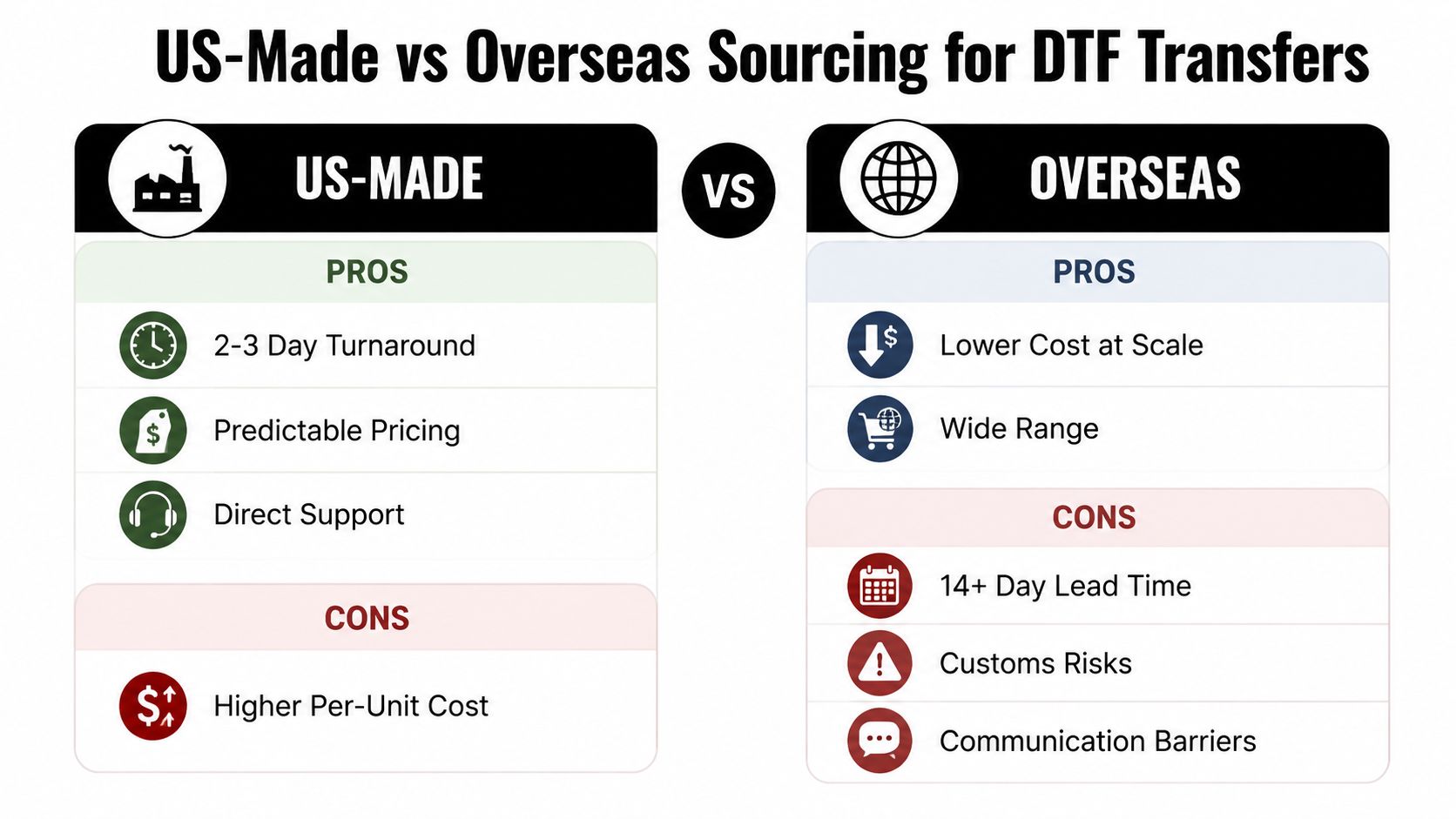
Transfer sourcing affects more than unit price. It determines how quickly you can replenish a selling design, how confidently you can promise delivery, and how much uncertainty enters your purchasing workflow.
Domestic sourcing prioritizes control
A domestic supplier can be a better fit for shops selling fast-turn custom apparel, especially when the decorator carries only a modest transfer inventory. Shorter shipping routes make replenishment easier to plan, and direct communication can simplify artwork corrections, reprints, and urgent changes.
The trade-off is usually a higher per-transfer cost. That cost may still be rational if it prevents missed delivery promises, reduces emergency inventory, or allows the shop to sell designs without tying up cash in large purchases.
Cobra DTF is one domestic option for shops ordering size-specific graphics or arranging multiple designs through a gangsheet workflow. Its product range includes DTF Transfers By Size and a DTF Transfers Gangsheet Builder, which fit different ordering patterns.
Overseas sourcing can reward planning
Overseas suppliers may offer lower costs at scale and a broad selection of transfer options. That model can work when a shop has stable demand, predictable designs, and enough planning time to absorb longer transit. It's less comfortable for a seller whose popular products depend on frequent replenishment.
International orders can also introduce customs exposure, communication delays, batch-to-batch variation, and less convenient correction cycles. None of those risks makes overseas sourcing automatically wrong. They need to be included in the operating calculation rather than ignored because the quoted unit price looks attractive.
Match sourcing to the promise you sell
A shop promising rapid fulfillment should evaluate sourcing through its customer-service policy. Keep a domestic option for high-velocity designs or time-sensitive orders, and consider overseas purchasing for planned inventory when the demand pattern is stable.
The cheapest transfer is expensive if it arrives after the customer's event, requires a reprint, or forces you to cancel an order.
Track each supplier against the same practical criteria:
- Replenishment: How quickly can a proven design be reordered?
- Consistency: Does the next batch press and wash like the last one?
- Communication: Can an artwork issue be resolved before production?
- Inventory exposure: How much cash sits in designs that may not sell?
- Customer promise: Does the supply route support the delivery window you advertise?
Trade coverage describes DTF's growing role in micro-drops, transfer libraries, and on-demand fulfillment across platforms such as TikTok, Etsy, Shopify, and live commerce. (Operational context for DTF fulfillment) That shift makes sourcing a fulfillment decision, not just a printing decision.
Ordering, Pressing, and Care for Maximum Durability
Durability is decided before the press closes. Send clean, correctly sized artwork, confirm the garment, and state the placement clearly. For multiple graphics, sort transfers by size and use case so the pressing team can identify each one without opening every package.
Use a practical guide to ordering DTF transfers to standardize artwork submission and reduce production questions. A local shop also needs demand that matches its capacity, and these local SEO tips for service businesses provide useful direction for connecting local visibility with available fulfillment.
Press for the bond, not just the appearance
A practical baseline for DTF apparel transfers is about 300 to 310°F for 15 to 20 seconds, with firm, even pressure. (DTF pressing and durability guidance) Follow the supplier's instructions when they differ, and check the garment's heat tolerance before production.
Use the same sequence for every order:
- Pre-press the garment to remove moisture and flatten wrinkles.
- Position the transfer, checking seams and placement.
- Apply the recommended temperature, time, and pressure.
- Follow the specified peel method.
- Complete any required post-press step.
- Inspect edges, fine details, and stretch before packing.
Heat and pressure activate the adhesive and anchor it to the textile's surface fibers. Undercuring or uneven pressure creates weak areas that may crack, lift, or lose pigment during laundering. Record the settings for repeat orders so another operator can reproduce the result.
Set honest wash expectations
Quality transfers can commonly survive 50 to 80 or more wash cycles, while undercuring or poor application may reduce durability to roughly 20 to 40 washes. (DTF pressing and durability guidance) Another guide reports 50 to 70 washes for well-executed transfers, with some specifications reaching 90 or more when pressure, temperature, fabric compatibility, and application remain controlled. (DTF care and lifespan guidance)
Treat these figures as operating ranges, not customer guarantees. Fabric choice, press consistency, and laundering determine the result.
Wait at least 24 hours before the first wash. Then wash garments inside-out in cold water on a gentle cycle, and dry on low heat or air-dry when practical. (DTF care and lifespan guidance) Early washing can interfere with the cure, so give the fresh transfer time to set before it enters normal laundry.
Making the Right Custom Apparel DTF Decision
A reliable DTF strategy comes down to three operating questions.
First, what fabrics make up your catalog? If you sell mostly cotton shirts, dark hoodies, and mixed garments, DTF may simplify the product range. If your business centers on polyester performance apparel, test carefully and compare sublimation before committing.
Second, what does your order pattern demand? DTF fits detailed designs, varied quantities, and on-demand pressing. It can reduce the need to decorate every blank in advance, but you still need artwork organization, press records, and enough transfer availability for designs that sell repeatedly.
Third, where does your delivery promise require you to source? Domestic transfers can support replenishment and responsive corrections, while overseas sourcing may suit planned volume and stable demand. Choose based on the cost of delay, not just the quoted transfer price.
The same framework applies to specialized apparel programs. If your catalog includes coordinated ceremonial garments, researching options for ordering custom choir robes can help you think through decoration placement, garment material, and group-order consistency before adding a new category.
DTF is powerful because it connects digital artwork with flexible garment fulfillment. It isn't universally optimal, and it won't compensate for weak sourcing or inconsistent pressing. Test the blanks, document the settings, and choose a supply route that supports the promises your customers buy.
Cobra DTF supplies USA-made custom transfers by size and gangsheet format for apparel businesses that need a dependable press-ready workflow. Visit Cobra DTF to review transfer options and build a sourcing process around your fabrics, order volume, and delivery commitments.