
Crew Neck vs T Shirt
A customer approves a front graphic, the blanks arrive, and the first test press reveals a problem. The artwork sits too close to the collar, the ribbed band pulls under pressure, and the finished shirt looks different from the mockup. The issue isn't always the transfer. Often, it starts with treating crew neck vs T-shirt as a naming question instead of a production choice.
In a custom apparel shop, the neckline affects the printable chest area, the way fabric stretches beneath a transfer, the amount of flat surface available on the platen, and how the garment looks after repeated wear. A crew neck is usually the safest starting point, but it isn't automatically right for every blank, fit, or decoration style.
The Real Decision Behind Crew Neck vs T-Shirt
A buyer ordering blanks for a bulk run usually focuses on color, size availability, and price. Those details matter, but the neckline can create more production friction than any of them. A crew neck's ribbed collar changes where the artwork can sit, how the shirt must be positioned, and whether the upper edge of a transfer lands on stable body fabric or on a curved trim area.
The useful comparison isn't crew neck versus “T-shirt.” A crew neck is one type of T-shirt neckline, while the broader T-shirt category also includes V-necks, scoop necks, Henleys, and other openings. The practical question is whether the chosen neckline gives your artwork and workflow enough predictable surface to produce consistent results.
| Production factor | Crew neck | Lower or wider neckline |
|---|---|---|
| Upper chest coverage | More coverage and a structured collar line | More open exposure around the collarbone |
| Front artwork | Predictable central placement | More vertical room, but a less consistent visual frame |
| Pressing | Ribbed trim needs careful positioning | Curves and stretch can complicate alignment |
| Layering | Works well as a base layer | Often reads as more open or fashion-led |
| Best production fit | Uniforms, promotional apparel, broad retail runs | Boutique, relaxed, or silhouette-led collections |
The ribbed band is the first production variable to inspect. It can compress, stretch, or rebound differently from the body fabric, so artwork placed too close to the neckline may look clean before pressing and uneven afterward. The body can also shrink or relax at a different rate from the trim, which makes collar construction relevant to long-term appearance.
Production rule: Choose the blank by looking at the finished decoration, not just the unprinted garment.
A reliable purchase order starts with the blank specification. Check the collar shape, the available chest area, the fabric surface, the expected fit, and the transfer dimensions before committing to a run. That short review prevents a common mistake, buying a garment that looks right on a product page but leaves no comfortable margin around the artwork.
What a Crew Neck Actually Is
A crew neck is a round, collarless neckline finished with a ribbed band that normally sits close to the base of the neck. Apparel specifications describe it through variables such as neck circumference and neckline drop. One apparel guide places a standard crew-neck drop at about 5 to 7 cm below the clavicle notch and describes mass-market neck-band widths often around 1 to 1.5 inches (crew-neck construction and fit details).
That construction makes the crew neck a pattern choice, not merely a casual name for any round opening. The higher neckline provides more chest coverage, creates a stable visual boundary above the print, and generally layers neatly beneath jackets, overshirts, and outerwear.
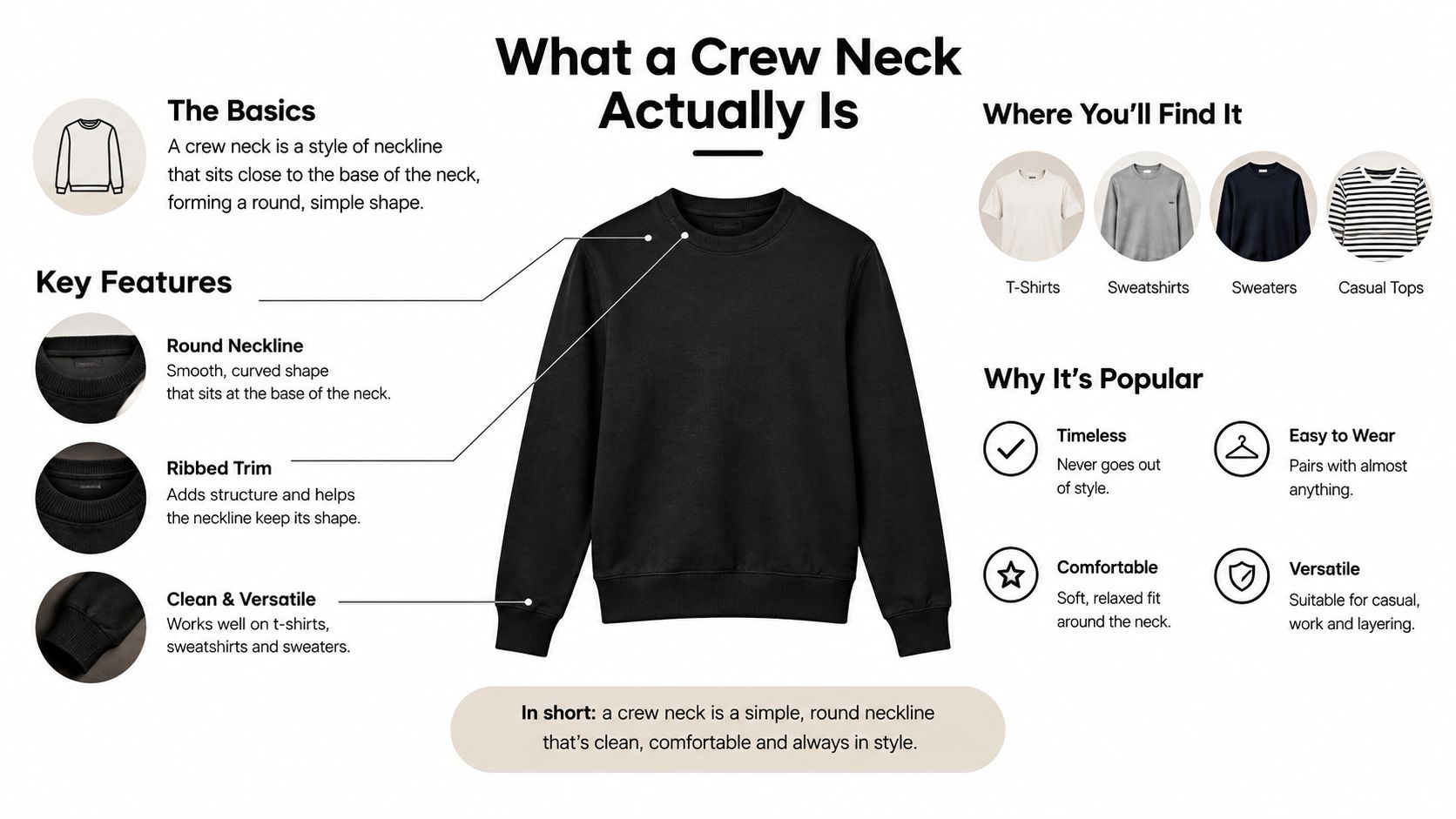
A T-shirt, by contrast, describes the garment category. Its neckline might be a crew neck, V-neck, scoop neck, Henley opening, or another variation. Calling a garment “a T-shirt” doesn't tell a decorator enough about the front geometry to set artwork placement safely.
Why the distinction matters at the press
The ribbed collar sits on a curve rather than a flat plane. It also has different stretch and recovery from the shirt body, which means a transfer crossing the collar edge can buckle, lift, or distort. The same file can therefore behave differently on two T-shirts when one has a close crew neck and the other has a lower, wider opening.
For buyers, the distinction affects more than fit. It influences transfer width, top-margin planning, mockup accuracy, and how much tolerance the operator has during loading. Cobra DTF's guide to T-shirt collar types is useful when a product catalog uses neckline terms inconsistently.
The crew neck became the familiar T-shirt silhouette through practical use. The U.S. Navy began issuing a basic white crew-neck undershirt as a required uniform layer in 1913, the design was adopted for American football players by 1932, and Sears advertised the shirts for 24 cents each in 1938 (crew neck history). Those milestones help explain why the shape remains a dependable default in uniforms, workwear, and everyday merchandise.
T-Shirt Silhouettes and Fabric Types That Matter for Printing
The neckline is only part of the blank. The body knit, yarn, surface texture, and collar trim determine how a transfer settles and how the finished shirt feels in the customer's hands. Two crew necks can have noticeably different press behavior even when both look similar on a supplier's product page.
A soft ringspun cotton blank often gives promotional artwork a smooth, comfortable base. A heavier combed cotton blank usually feels more substantial and gives large graphics a steadier surface. Poly-cotton and tri-blend garments can offer a lighter, more fashion-oriented drape, but they require closer attention to dye migration, surface tension, and heat sensitivity.
| Blank Type | Fabric Weight | Knit Structure | Rib Composition |
|---|---|---|---|
| Soft promotional cotton | Light to medium | Fine, smooth jersey | Often stretch-recovery rib |
| Uniform-weight cotton | Medium to heavier | Denser jersey knit | Structured rib, with or without stretch fiber |
| Fashion poly-cotton or tri-blend | Light | Draped, fine jersey | Rib or self-fabric trim |
| Budget cotton | Light to medium | Looser jersey | Basic rib that may relax with wear |
Surface texture changes the finished hand
A smooth face gives the transfer film fewer surface interruptions to bridge. A looser or more textured knit can make the print feel less uniform, especially around seams and curved areas. Yarn twist and stitch density also affect how much the fabric moves during loading, peeling, and cooling.
The rib band deserves its own inspection. Premium blanks commonly use 1x1 rib with stretch fiber for recovery. Budget garments may use 1x1 rib without that added recovery, while fashion tees sometimes use self-fabric trim for a softer, less structured appearance. These choices affect collar stability and can change how the upper edge of a graphic sits after pressing.
A transfer file doesn't know whether the collar is premium or budget. The blank determines how forgiving the production process will be.
The practical cotton-versus-polyester decision is covered in this cotton and polyester printing guide. In production, don't evaluate the transfer separately from the garment. The same artwork, adhesive, and press routine can produce different results on a dense cotton jersey, a soft ringspun knit, and a lightweight poly blend because each surface accepts heat and tension differently.
For a purchase order, request a sample of every blank family you plan to decorate. Press the largest graphic, inspect the collar edge, stretch the print gently after cooling, and wash the sample before approving the full run. A catalog description can't reveal every interaction between the rib, body fabric, and transfer.
Print Placement, Stretch, and Heat-Press Behavior
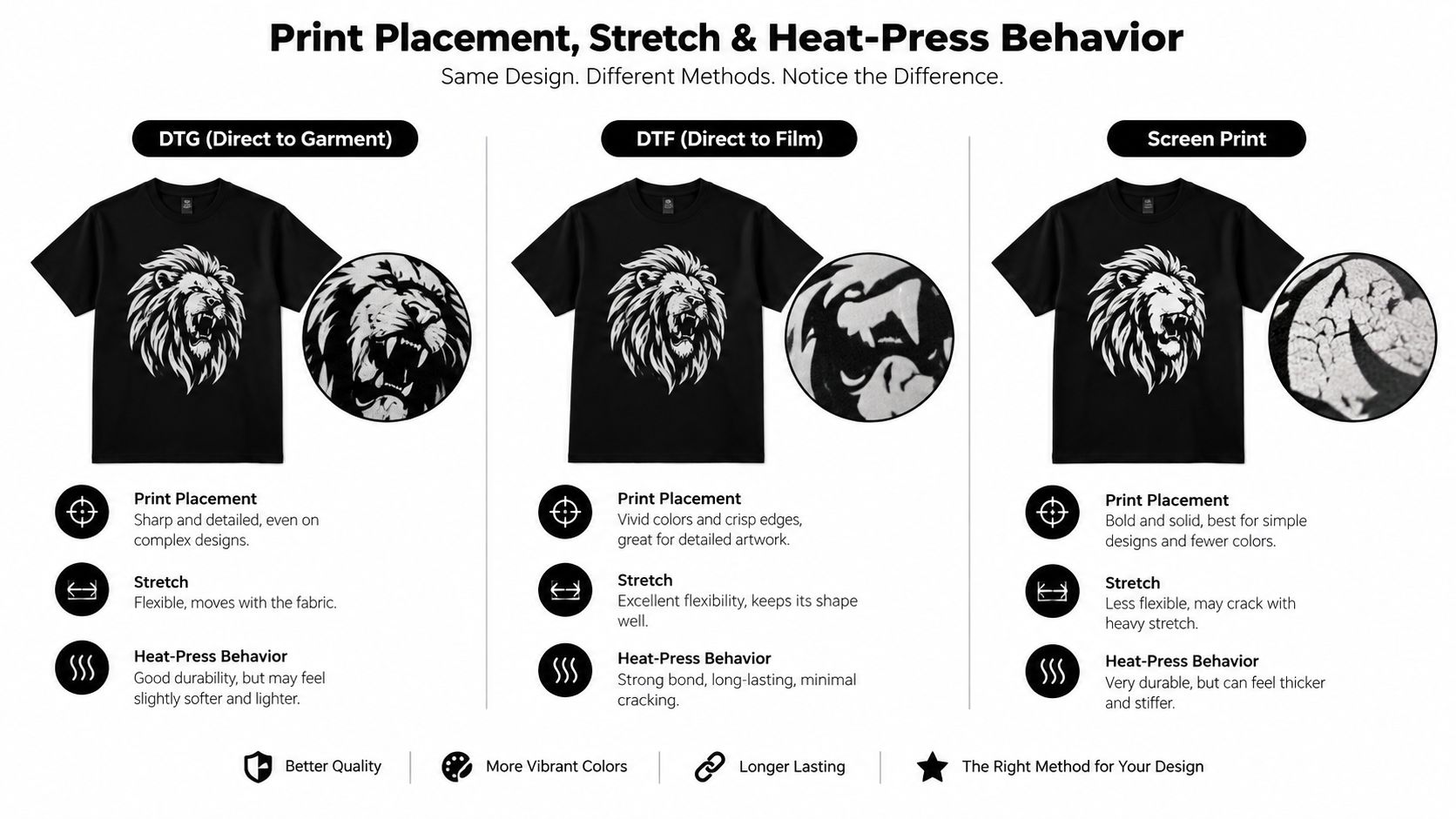
The crew neck gives a decorator a clear visual anchor, but that anchor is also a boundary. The ribbed band creates a hard curve at the top of the garment, and artwork placed too high can ride onto a surface that doesn't lie flat. Keep the upper part of a chest graphic on the body fabric unless the design specifically accounts for the collar contour.
A lower or wider neckline opens more visual space above the chest. That can help a fashion graphic breathe, but the extra opening may also introduce more stretch across the upper front. Thin details can pull apart visually when the wearer moves, particularly on soft, lightweight fabrics.
Map the artwork before loading the shirt
Use the neckline as a reference point, then confirm the center against the shoulder seams and side seams. Don't align a transfer by eye from the collar alone, because a stretched rib can make the garment appear centered when the body is skewed.
A useful placement review includes:
- Upper margin: Keep important text and fine details away from the ribbed band and its curve.
- Chest balance: Check how the graphic sits between the collar, sleeves, and lower hem, not just whether it is centered left to right.
- Back artwork: Use the shoulder line and side seams as references, since the collar can pull the back panel off angle.
- Stretch tolerance: Test thin lines and small lettering on the actual blank before approving production artwork.
The press operator also needs to manage the garment, not just the machine. Lightweight ringspun fabric may need gentler handling and controlled pressure so the body doesn't over-compress or shift beneath the film. Poly blends need a compatible transfer system and a cautious temperature strategy because excessive heat can affect the garment color, surface, or collar recovery.
The collar is a separate material zone
Treat the rib as trim, not as ordinary jersey. It stretches differently, can trap a curved edge of film, and may not accept the same finish as the shirt body. If a design must approach the neckline, make a test press with the exact blank, transfer size, platen setup, pressure, dwell, and peel method.
Press-floor observation: Most collar-related defects begin with placement that was approved on a flat mockup but never tested on the actual garment.
Heavier shirts generally hold their shape more confidently during loading and peeling. Lightweight fashion silhouettes can recover differently after the film is removed, so the operator should inspect the garment while it is still warm and again after it has cooled completely.
Shrinkage, Durability, and Wash Performance
Wash performance starts with the relationship between the body fabric and the collar trim. Cotton can change shape as it is washed and dried, while the rib may recover more or less than the surrounding jersey. That difference can make a previously neat collar look wavy, tight, or stretched even when the transfer itself remains intact.
Combed cotton, ringspun cotton, and poly blends each bring different risks. Cotton blanks may develop a softer hand over time, while lighter fashion fabrics can lose visual structure around the neckline sooner. Poly-rich garments may retain their general shape well but can create dye-migration concerns on dark colors if the transfer system and curing process aren't suited to the fabric.
Inspect the garment, not only the print
A durable decoration isn't enough if the collar seam begins to separate or the rib loses recovery. Before approving a blank, turn it inside out and inspect the collar join. Look for even stitching, a smooth seam allowance, and a rib that returns to its original shape after gentle stretching.
Use this behavior guide as a production starting point:
| Fabric Type | Avg. Shrinkage | Durability Rating | Wash Performance |
|---|---|---|---|
| Combed cotton | May change noticeably without reliable pre-shrinking | Strong when densely knit | Softens with washing and needs care |
| Ringspun cotton | Can relax or change size depending on finishing | Good for soft-hand garments | Comfortable, with greater sensitivity to rough handling |
| Poly-cotton blend | Usually more dimensionally stable than untreated cotton | Strong when transfer compatibility is confirmed | Can retain shape, but dark colors need migration control |
| Tri-blend | May have a light, draped recovery | Best suited to fashion-led products | Requires careful testing around collar and seams |
These ratings are practical production descriptions, not guarantees. Supplier finishing, garment color, knit density, and laundering conditions can change the outcome. A pre-shrunk label helps, but it doesn't replace a press and wash test.
Test the first article properly
Press one shirt from every blank type, then examine the transfer after cooling. Wash the sample using the care instructions you plan to print or provide, and inspect the collar, seams, high-friction areas, and fine artwork. Look for edge lifting, cracking, pilling, color change, and distortion around the rib.
The neckline often reveals failure before the chest graphic does. A 1x1 rib with good recovery can keep a crew neck clean through regular use, while a low-recovery trim may relax at the seam and make the entire shirt look worn. A stable body fabric can't fully compensate for a collar that was poorly specified.
Choosing the Right Blank for Custom Runs
For most promotional, uniform, and e-commerce orders, the crew neck is the safer default. Its familiar silhouette suits a broad customer base, gives the product a predictable front-print frame, and makes repeat sizing and artwork placement easier to manage. Neutral apparel guidance also identifies the crew neck as a common, versatile choice for branded workwear and promotional garments (crew neck versatility for custom apparel).
That doesn't make fashion necklines a bad choice. A scoop neck, V-neck, or relaxed round opening can give a boutique collection a more distinctive proportion and create extra visual openness around the upper chest. The trade-off is additional handling, more sensitive placement, and a greater chance that the garment's intended drape will change how the same graphic reads.
Match the blank to the order
A crew neck usually earns the default position when the buyer needs:
- Repeatability: The same artwork must land consistently across sizes and reorder batches.
- Broad appeal: The product needs a familiar silhouette that works across uniforms, merchandise, and promotional use.
- Layering: Customers may wear the shirt beneath jackets, overshirts, or workwear.
- Efficient decoration: Operators need a stable loading process with fewer neckline-specific adjustments.
A fashion neckline makes more sense when the garment itself carries much of the product's identity. Boutique drops, fitted women's lines, and limited collections can absorb extra sampling because the silhouette is part of the reason customers are buying.
For a premium hand-feel, start with a smooth ringspun cotton and validate its recovery before ordering in depth. Choose poly blends when the product specifically needs their performance or color behavior, not just because the catalog lists them as lightweight.
Shop owners building an online apparel operation may also want to compare Shopify apps for apparel before selecting a product and fulfillment workflow. The software won't solve a poor blank choice, but it can help organize variants, artwork, and customer orders once the physical specifications are settled.
A practical sourcing reference is this guide to blank T-shirts for printing. Use it to narrow the field, then test the exact color, size range, and neckline you intend to sell.
Production Checklist and Sourcing the Right Transfers
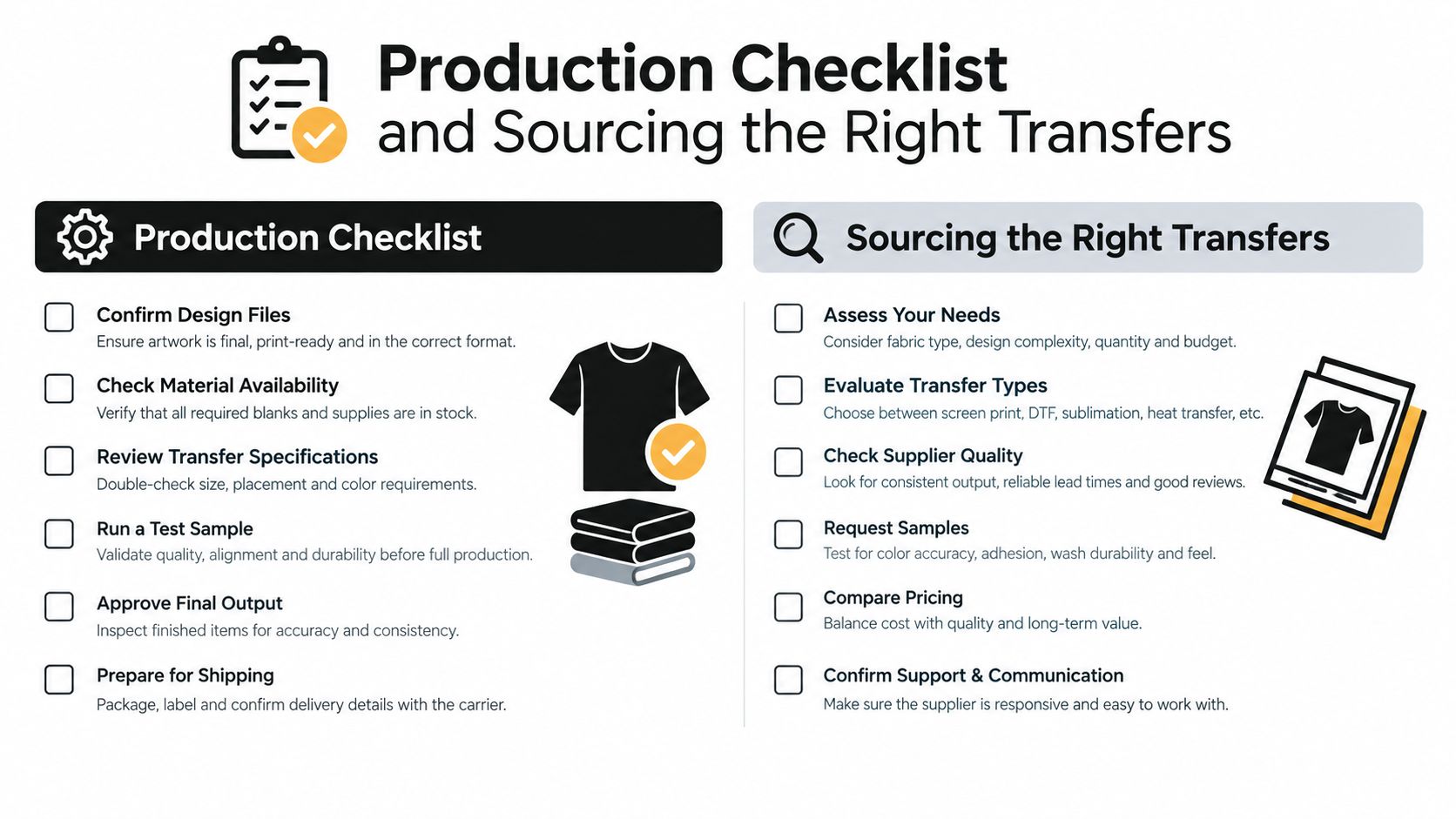
A reliable run begins before the transfer reaches the platen. Inspect the collar stitching, confirm the fabric weight and size tolerance, and check that the blank matches the approved sample. Test press one shirt from each fabric and neckline type, then verify the artwork coordinates after the garment has cooled.
Use this short release checklist:
- Inspect the blank: Check the rib join, seams, surface, color, and size consistency.
- Confirm the print zone: Measure from stable body landmarks, not only from the collar.
- Run a test press: Use the transfer, pressure, dwell, peel, and cure settings planned for production.
- Review the collar edge: Look for distortion, film contact with the rib, and uneven recovery.
- Wash-test the sample: Examine the neckline and graphic after laundering before releasing the full order.
- Verify transfer supply: Ask whether the vendor offers gang sheets, no-minimum gang runs, same-day proofing, polyester-friendly film, and fast domestic shipping.
For a Texas shop, a U.S.-based DTF supplier can simplify replenishment and reduce the risk that transfer delays interrupt a scheduled run. Look for clear proofing, compatible films for cotton and polyester blends, and shipping policies that match your production calendar.
Cobra DTF supplies custom DTF transfers, including gang sheets and no-minimum gang runs, with U.S.-based production and fast shipping options. Visit Cobra DTF with your blank specification and artwork placement plan, then request a proof before pressing the full run.