

Blank T Shirts for Men: A Practical Buying Guide for 2026
You've got two men's blank T-shirts on the heat press. They look interchangeable in the supplier photos, and both are labeled 6.1 oz. One accepts the DTF transfer cleanly. The other ghosts around the edges, lifts slightly after pressing, and comes back from its first wash noticeably smaller. The transfer wasn't necessarily the problem, and neither was the press. The blank created the limit.
For a custom-apparel shop, that limit appears everywhere: inconsistent hand feel, rejected prints, reprint labor, misplaced artwork after shrinkage, returns, and customers who don't reorder. Choosing blank t shirts for men is therefore a production decision, not a simple fabric or color decision. You need to evaluate the substrate before artwork, file preparation, press settings, or pricing.
The practical framework comes down to fabric family, GSM, fit geometry, and sourcing reliability. Each affects how film adhesive bonds, how a design sits on the body, and whether the garment still fits the way you sold it after laundering. The recommendations below focus on what repeatedly matters at the press and after the wash, rather than what looks persuasive on a catalog page.
Why the Right Blank Changes Everything for Your Shop
A blank T-shirt sets the ceiling for the finished product. A smooth, stable shirt gives a transfer a consistent surface. A loose, fibrous, or unstable shirt makes the same transfer more difficult to apply and harder to sell with confidence.
The difference often appears before the first customer sees the garment. One shirt may have a tight knit that lets the adhesive make full contact. Another may have loose fiber ends that sit between the film and fabric. The design can look acceptable immediately after pressing, yet develop weak edges or a rough, uneven appearance after handling and washing.
The substrate controls the production result
The press operator can adjust temperature, pressure, dwell, and peel timing, but those settings can't correct every weakness in the blank. A shirt with poor dimensional stability can shift the relationship between the collar, shoulder seam, and graphic. A shirt with an uneven surface can make a dark transfer look less solid, especially around fine details.
That's why I treat the blank as the first production specification. Before approving artwork, I check whether the garment gives the transfer a clean landing zone and whether the body stays consistent across the intended care cycle.
Practical rule: If two blanks look similar, test the garment that creates fewer variables at the heat press, not simply the one with the lower unit price.
Weak blanks also multiply costs that don't appear on the invoice. A failed transfer consumes film, powder, ink, operator time, and the shirt itself. A shirt that changes shape after washing can create a return even when the print remains intact. Replacing that order costs more than buying a better substrate at the beginning.
Four variables decide the purchase
Start with the fabric family. Combed ring-spun cotton, open-end cotton, polyester blends, and tri-blends each behave differently under heat and during washing.
Next, compare GSM and yarn quality together. Weight affects opacity and drape, but a heavier shirt with a rough surface may print worse than a lighter, tightly constructed shirt.
Then specify the fit by measurements, not labels. Relaxed, oversized, and boxy cuts alter the usable print area in different ways.
Finally, evaluate the supplier. Stock consistency, color continuity, sample accuracy, and clear quality documentation matter when a design moves from a small test run to repeat orders. A blank that performs beautifully once but changes across replenishments isn't a reliable production blank.
Cotton, Blends, and Tri-Blends Explained
Fabric choice is a trade-off between surface quality, hand feel, heat behavior, and cost. No single family wins every job, so match the shirt to the product promise and decoration method.
100% combed ring-spun cotton usually gives DTF and DTG operators the cleanest surface. The yarn is smoother and more uniform than rougher open-end construction, which helps detailed artwork sit evenly. The trade-off is a higher cost per shirt and the need to verify shrink performance rather than assuming every cotton tee is stable.
Open-end cotton often suits price-sensitive event orders, but it can introduce production friction. Its rougher hand and greater lint presence can leave more loose fiber under the transfer. On dark garments, that may show as a speckled or uneven appearance inside areas that should read as solid color.
How blends behave under the press
Poly-cotton blends can provide strong adhesive contact because polyester accepts the adhesive layer well. They can also produce crisp edges on full-color artwork. The downside is dye migration, especially on heather colors, and reduced opacity on dark garments when the transfer system isn't suited to the fabric.
Tri-blends combine cotton, polyester, and rayon for a soft, retail-oriented drape. They feel attractive in the hand, but rayon is less forgiving under hot platen pressure. Excessive heat or poor dwell control can affect the fabric and reduce the long-term performance of a transferred graphic.
Use the t-shirt material guide as a second reference when comparing fiber content, but make the final decision with an actual pressed and washed sample.
| Fabric Family | Print Adhesion | Hand Feel | Shrink Risk | Cost per Shirt |
|---|---|---|---|---|
| 100% combed ring-spun cotton | Consistent on a smooth knit | Soft and substantial | Manageable when tested | Higher |
| Open-end cotton | More variable because of loose fibers | Coarser | Requires verification | Lower |
| Poly-cotton blend | Strong film grip, with dye-migration concerns | Smooth to moderate | Often more stable, depending on construction | Moderate |
| Cotton/poly/rayon tri-blend | Good when heat is controlled | Very soft with fluid drape | Rayon and heat require caution | Higher |
Choose by the finished garment
For a detailed front graphic, combed ring-spun cotton is usually the safer starting point. For workwear, promotional runs, or budget-led orders, open-end cotton may be acceptable if the artwork is less sensitive to surface variation and the sample survives washing.
Blends make sense when you want a smooth, athletic, or heathered look, but test the exact color, not just the same style in a different shade. Tri-blends work best when softness and drape are central to the product, and when the press operator can control heat exposure carefully.
GSM, Yarn Quality, and What Weight Really Buys You
GSM, or grams per square meter, gives you a useful way to compare fabric weight, but it isn't a complete quality score. A heavier garment can offer better opacity, drape stability, and print consistency, yet yarn quality and construction often determine whether those benefits reach the finished print.
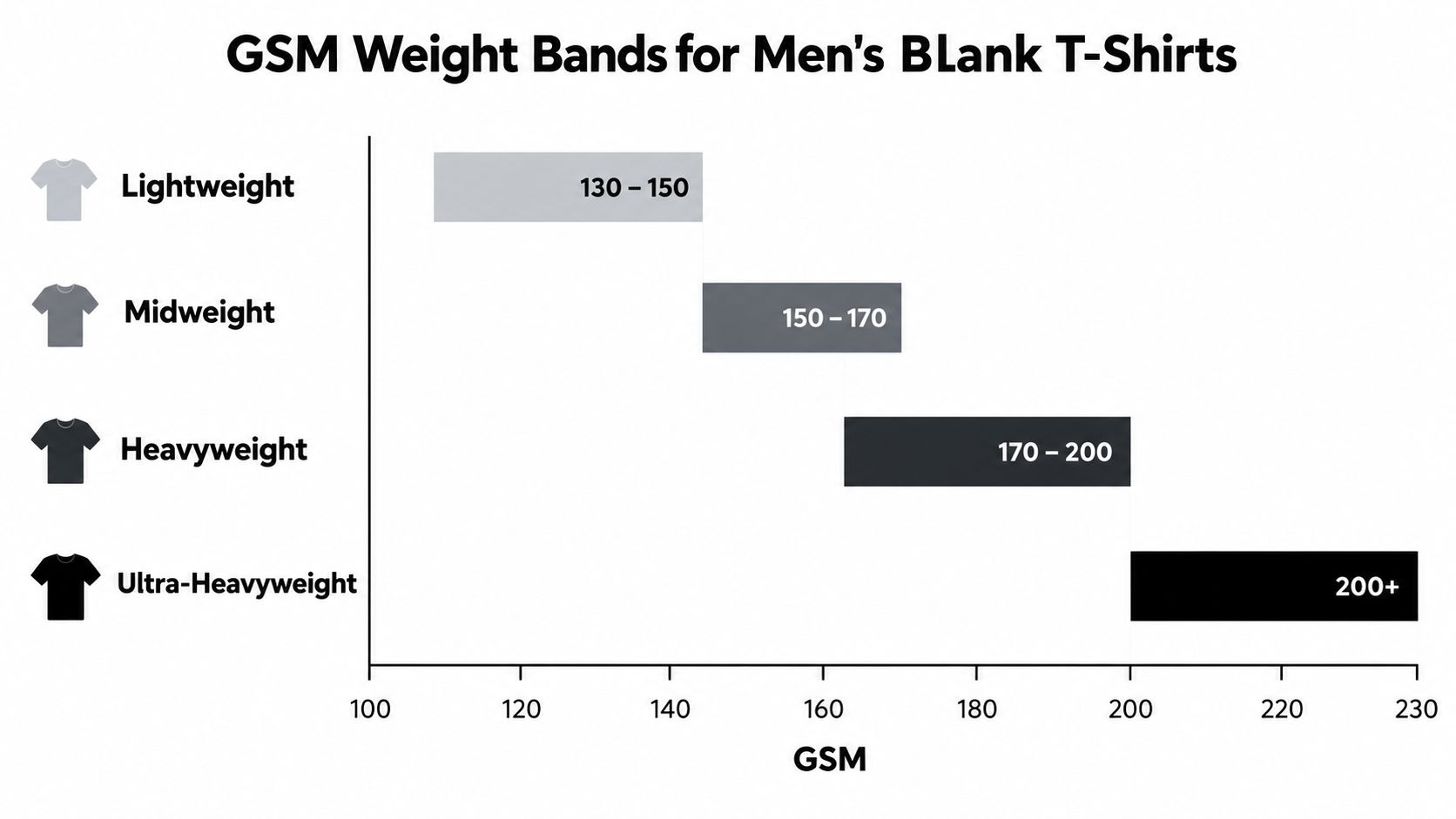
For practical purchasing, these bands are useful:
- Lightweight, 130 to 150 GSM: Cooler and easier to layer, but more prone to show-through and movement during pressing.
- Midweight, 150 to 170 GSM: A versatile range for everyday retail, events, and many DTF applications.
- Heavyweight, 170 to 200 GSM: More body, opacity, and structure, with a stronger fashion or premium feel.
- Fashion-grade, 200 GSM and above: Substantial and architectural, but more expensive and less forgiving if the cut or artwork is poorly specified.
These ranges align with industry guidance that classifies 120 to 150 GSM as lightweight, 150 to 180 GSM as midweight, and 180 to 220+ GSM as heavyweight. The same blank-apparel market analysis identifies T-shirts and tanks as the largest product type, accounting for 48.39% of the market in 2024, which helps explain why small differences in blank specifications matter across a high-volume category.
Why yarn beats the scale
A 160 GSM combed ring-spun shirt can outprint a 220 GSM open-end shirt. The lighter garment may have a tighter, smoother surface, fewer loose fibers, and a more uniform knit. That gives the transfer a cleaner contact area than raw mass alone can provide.
Fiber length also matters. Longer, better-aligned fibers generally create a smoother yarn with less visible fuzz and reduced pilling potential. Stitching provides another clue. Clean side seams and consistent single-needle construction suggest tighter manufacturing tolerances, although you should still confirm performance with a sample.
Industry sourcing guidance notes that each additional 20 GSM can add roughly 8 to 12% in material cost, while yarn quality and construction can outweigh raw fabric mass. See the GSM sourcing guidance for the underlying trade-off.
A useful comparison is cost per GSM, calculated as garment cost divided by GSM. It isn't a complete purchasing formula, but it helps expose a shirt that charges a premium for weight without delivering a smoother surface, stronger construction, or better fit.
Decoding Relaxed, Oversized, and Boxy Fits
Fit labels create problems because suppliers don't use them consistently. A “relaxed” shirt from one manufacturer can resemble an “oversized” shirt from another, while a boxy tee may have the same chest width as an oversized style but a much shorter body.
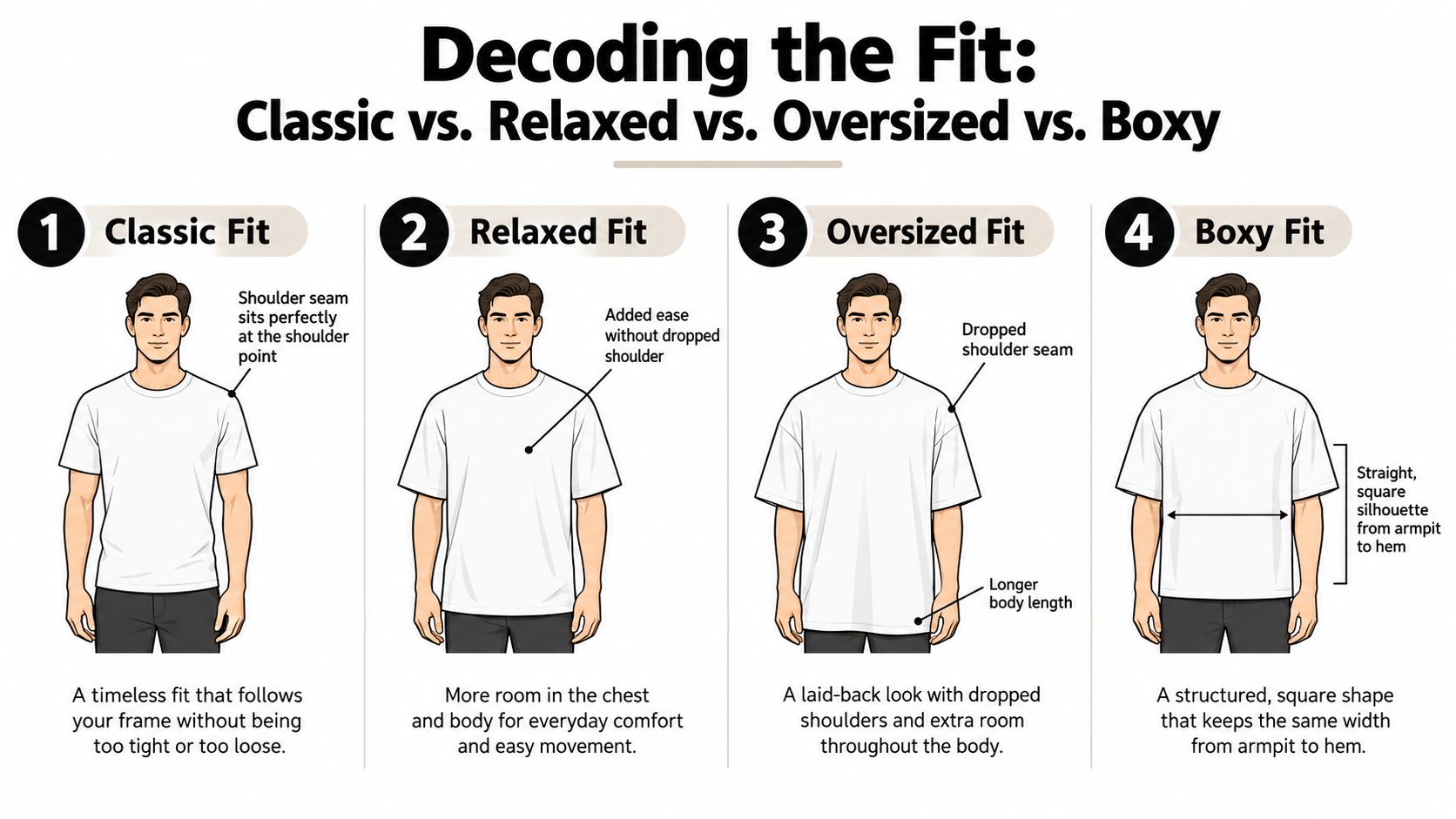
The shoulder seam gives you the first reliable clue. A classic fit places it near the natural shoulder point. A relaxed fit adds room through the chest while generally keeping the shoulder closer to that point. An oversized fit usually drops the shoulder seam and extends the body, creating more visual volume around the wearer.
What the silhouette does to the print
A classic fit gives decorators the most familiar placement reference. The chest area is visually predictable, and a centered design generally sits where customers expect it to sit.
A relaxed fit adds ease through the torso without necessarily extending the shoulder. That extra volume can make a standard chest graphic look slightly higher or narrower in relation to the garment. In practical placement work, decorators often need to shift chest art by 0.5 to 1 inch, depending on the cut and the wearer's size.
An oversized fit combines dropped shoulders, wider sleeves, and a longer body. A standard chest transfer may look undersized, especially on a broad front panel. Scaling the file up can help, but only if the artwork remains readable and doesn't approach the collar, side seams, or hem.
A boxy fit differs from oversized through its shorter, squarer body. The straight line from armpit to hem compresses the center print zone vertically. A large, tall graphic can feel crowded, so a wider composition or smaller centered hit often works better.
Specify measurements instead of marketing names
Ask for the shoulder seam drop, neck opening width, chest width, sleeve opening, and finished body length. Record those measurements for every approved size and keep a physical sample beside the production files.
Use a centered chest design on classic or moderate relaxed cuts when the print needs to read as traditional retail decoration. Choose a fuller front hit for oversized silhouettes when the artwork needs more visual presence, but test the smallest and largest sizes before scaling the entire order.
Mixed runs need a standard. Don't approve one transfer file for classic, boxy, and oversized blanks because the nominal shirt size is identical. Define a placement template for each silhouette, then mark the collar and shoulder relationship on the sample before pressing.
DTF Printability and Dimensional Stability
DTF success begins with the garment, not with a last-minute press adjustment. The blank needs a smooth surface, controlled moisture, a suitable weight, and enough stability to keep the print aligned after laundering.
For a production test, I check four conditions:
- Moisture: Fabric moisture should stay below 8% before pressing. A damp garment can interfere with predictable adhesive contact.
- Surface: The knit should be smooth and free of loose fiber ends. Pre-pressing can flatten minor texture, but it can't turn a fuzzy open-end surface into a tightly knit one.
- GSM: Film-based transfers commonly perform within a 150 to 210 GSM working window when the fabric construction is suitable.
- Press control: A calibrated press at 160 to 165°C with a controlled dwell provides a repeatable starting point, but the transfer manufacturer's instructions take priority.
Those figures come from the production specification in the brief, not from a universal rule for every film and powder system. Always verify the transfer chemistry and test the exact shirt color.
Acceptance checks before a large run
Tri-blends deserve extra caution because rayon can become gummy or stressed under excessive heat. Cheap open-end cotton can also lift fibers into the adhesive layer, producing a reticulated appearance rather than a clean solid print.
| Substrate | Pre-Press Temp | Recommended GSM | Adhesion Risk |
|---|---|---|---|
| Smooth combed ring-spun cotton | Moderate pre-press | 150 to 210 GSM | Low when dry and lint-free |
| Open-end cotton | Short, controlled pre-press | Midweight preferred | Fiber lift and uneven contact |
| Poly-cotton blend | Follow film and dye guidance | Midweight to heavyweight | Dye migration on heathers |
| Cotton/poly/rayon tri-blend | Minimize unnecessary heat | Midweight preferred | Gummy adhesive and heat sensitivity |
A supplier should provide a quality data sheet that identifies fiber content, finished weight, shrink tolerance, color-lot controls, and construction details. If the supplier only provides a product photo and a nominal weight, you don't have enough information for a repeatable DTF workflow.
For a practical overview of compatible garments, compare the best shirts for DTF guide, then test five blanks before approving a production order. Press the same transfer on each garment, record temperature and dwell, wash them under the same conditions, and inspect edge adhesion, cracking, color change, fit, and placement.
Shrinkage is not a cosmetic issue. Textile guidance commonly treats pre-shrunk cotton tees as needing to remain under about 3% shrinkage, while standard commercial cotton garments are often accepted around 3% to 5%. Some broader garment standards allow approximately ±5% length and ±7% width change after laundering, and even 5% shrinkage can reduce a shirt by about one full size in practice. These benchmarks and the ISO 5077 and AATCC 135 testing references are summarized in this T-shirt durability testing guide.
Sourcing Domestically Versus Overseas
The cheapest blank on a spreadsheet isn't always the cheapest blank to operate. A decorator needs to account for replenishment speed, inventory exposure, color consistency, customs handling, and the cost of missing a selling window.
Domestic sourcing generally favors rapid reorders and smaller inventory commitments. Overseas sourcing can make sense for planned, repeatable volume when the buyer can tolerate longer lead times and manage more variables between purchase and delivery.
The operational comparison below uses the sourcing assumptions provided for this brief. Confirm current customs treatment, tariff classifications, and exemptions with a qualified trade professional before importing.
| Factor | Domestic | Overseas |
|---|---|---|
| Typical delivery path | Regional warehouse fulfillment | Asia-origin production and international freight |
| Reorder profile | Faster response for established stock | Longer planning cycle |
| Inventory exposure | Lower for short-turn orders | Higher because stock must cover the lead time |
| Quality variables | Fewer transport and lot transitions | More exposure to dye-lot and production variation |
| Customs responsibility | Usually simpler for the buyer | HS-code and import compliance require attention |
| Best operational fit | Shopify, Etsy, event, and replenishment work | Planned programs with predictable demand |
Lead time changes the business model
Domestic blanks are described here as commonly shipping in 2 to 5 business days, while overseas shipments from Asia are described as running 30 to 60 days door-to-door. The difference affects more than delivery promises. It determines how much cash sits in inventory and how quickly a shop can respond when a design suddenly sells.
The import scenario also includes 90 days of inventory as a working-capital consideration and a 25% Section 301 tariff surcharge above FOB price under the supplied assumptions. Those costs can erase a unit-price advantage, especially when a color or size fails to move.
Overseas runs can introduce dye-lot variation and create liability if a brand misdeclares an HS code. Domestic supply doesn't eliminate quality control, but it can shorten the feedback loop between a failed sample and the next order.
Product photography matters once the blank and print are approved. Accurate, consistent images help an e-commerce seller show fit and print placement without forcing customers to infer the garment from a flat catalog shot. A resource on marketplace-ready fashion photography can help structure those images for product listings.
For a supplier-focused starting point, review the Made in USA blank supplier guide. Treat supplier location as one part of the risk calculation, not as a substitute for sample testing.
Your Blank T-Shirt Buying Checklist
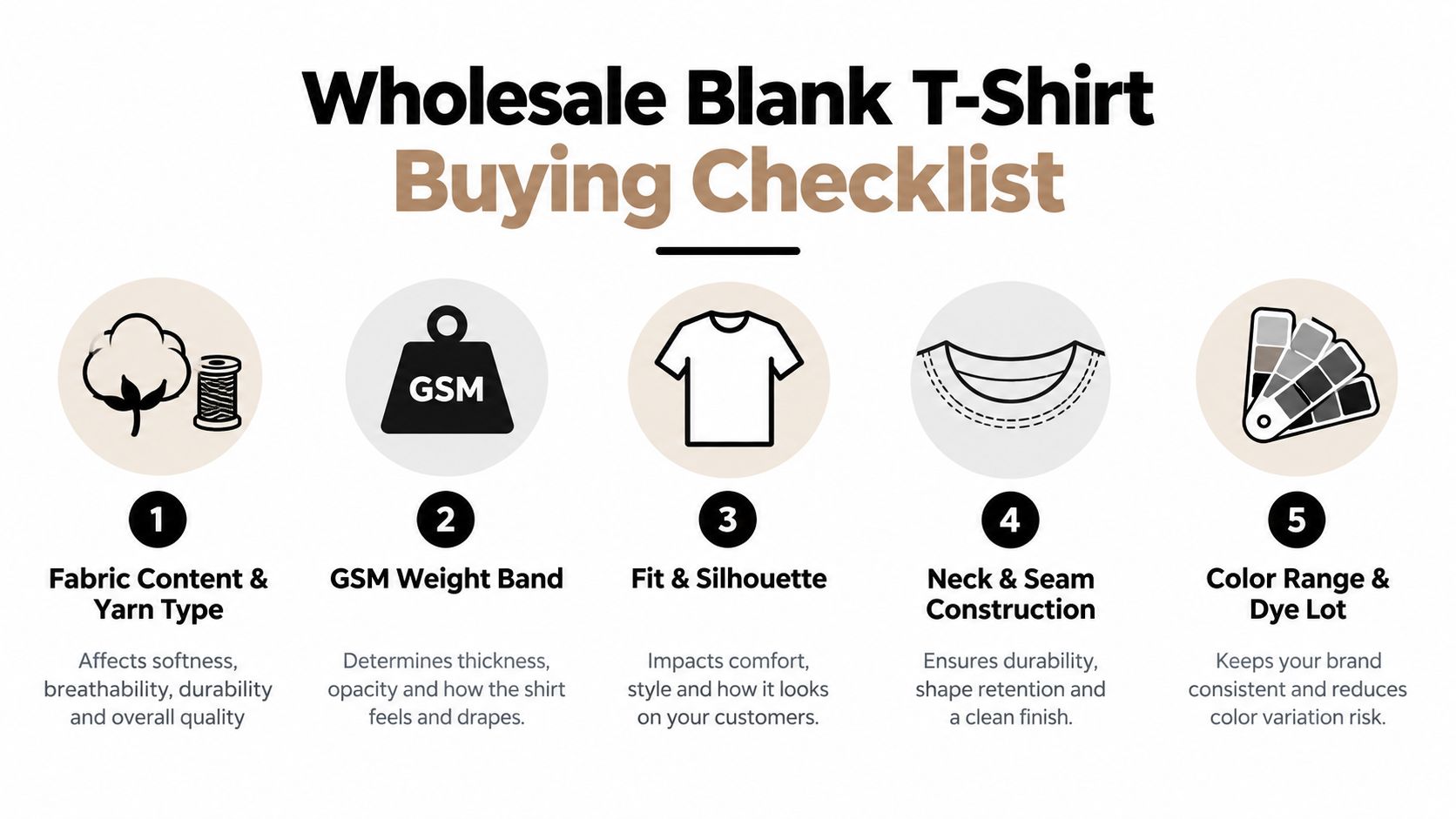
Keep this checklist next to a folded sample, not buried in a purchasing spreadsheet. Catalog copy can describe a shirt as premium, soft, or heavyweight, but the sample shows whether the knit, seams, collar, and body actually support your transfer workflow.
Start with the garment
- Fabric content and yarn: Confirm the fiber percentages and whether cotton is combed ring-spun or open-end. For detailed DTF artwork, look for a tight knit with minimal visible fuzz, slub, or loose fibers.
- GSM band: Record the actual or supplier-stated GSM and compare it with the intended use. Don't approve a heavyweight shirt solely because it feels substantial. Press a lighter, smoother candidate beside it.
- Construction: Check that shoulder seams lie flat and don't telegraph through the planned print. Confirm side-seamed construction when body shape and placement consistency matter.
- Fit category: Mark the shoulder seam, collar opening, chest width, sleeve opening, and body length. Label the sample classic, relaxed, oversized, or boxy only after recording those measurements.
- Color behavior: Test the exact color, particularly heathers and dark blends. A white underbase and adhesive can behave differently across dyes and fiber mixtures.
Then test the production risk
Wash one sample before approving the blank. Measure the body length and width before and after laundering, inspect the collar, and check whether the transfer cracks, lifts, or changes hand feel. If the garment changes shape enough to affect placement, it fails even when the film remains attached.
Ask the supplier for shrink tolerance, fabric content, construction details, color-lot handling, and replenishment information. A supplier who can't answer basic quality questions may still sell a usable shirt, but you won't have a dependable process for repeat orders.
Use cost per GSM only as the tie-breaker
When two blanks feel similar and pass the wash and press tests, divide garment cost by GSM. That gives you a practical comparison of how much you're paying for fabric weight, but it shouldn't override a smoother surface, better fit, or more reliable supplier.
The blank that wins is the one your team can press consistently, photograph accurately, reorder without disruption, and sell with confidence. Run the checklist on five samples, keep the approved shirt folded beside the transfer files, and document the exact garment before placing the wholesale order.
Cobra DTF supplies Direct-to-Film transfers for blank cotton T-shirts and provides press guidance for cotton garments, which fits a workflow built around tested substrates and repeatable application. Review the available options and production details at Cobra DTF, then match the transfer to a blank that passes your own press and wash test.