

100 Made in USA: What It Means for DTF
The popular advice is simple: put a “100% Made in USA” badge on your apparel transfers and let the patriotic appeal do the selling. That advice skips the part that affects your margin and your legal exposure. A domestic supplier may ship from a U.S. facility while relying on imported film, ink, powder, packaging, or replacement parts, and a lower overseas unit price may look attractive until customs delays disrupt a customer order.
For a DTF business, domestic origin is therefore more than a marketing phrase. It can affect claim substantiation, replenishment speed, inventory levels, rush-order capacity, and landed cost. The important question is not just where your supplier is located. It's what the supplier makes, where the inputs come from, and whether the resulting claim accurately describes the finished transfer.
What “Made in USA” Actually Requires from a DTF Supplier
A supplier's headquarters does not establish a product's origin. A U.S. company may employ domestic staff and ship from a U.S. warehouse while using significant foreign-made inputs. That distinction matters because decorators often repeat supplier wording on product listings, invoices, and social posts.
The phrase “100% Made in USA” makes an unqualified domestic-origin claim. It says more than “shipped from the United States,” “assembled in the United States,” or “printed by a U.S. company.” A transfer provider using that wording should be able to explain whether its film, adhesive, inks, curing process, and packaging support the claim.
Shop-floor reality: A domestic shipping label identifies where the package began its journey. It does not, by itself, establish where the product originated.
The exposure has two sides. Regulatory risk arises when a shop repeats an origin claim without reliable documentation. Operational risk appears when overseas purchasing brings customs timing, tariffs, border delays, or extra safety stock into the calculation. A lower invoice price can still produce a weaker margin if a late shipment forces a rush order, partial refund, or lost customer.
Domestic sourcing is a supply-chain decision
The practical case for local sourcing rests on control, not patriotic language alone. A domestic vendor may offer clearer communication, more predictable replenishment, and a faster way to resolve a defective order. Those advantages matter when a decorator has a deadline for team apparel, event merchandise, or an e-commerce launch.
Shorter, more predictable supply routes also change inventory decisions. If a supplier can report production status and dispatch orders quickly, a shop can carry stock based on expected demand rather than guessing around port schedules and border processing. That does not make every domestic option cheaper, and it does not remove the need to verify origin. It means reliability becomes part of the purchase decision.
For a small apparel business, the margin impact is straightforward. Avoiding customs uncertainty can reduce the need for excess stock, emergency freight, and last-minute substitutions. Those savings may matter more than a lower overseas unit price, particularly when one delayed input holds up a customer order.
The National Institute of Standards and Technology reports 15.6 million manufacturing employees in 2023 through the Current Population Survey and 12.8 million in 2024 through the Current Employment Statistics series. Because these figures come from different statistical programs, they should not be treated as a direct year-to-year change. NIST's 2025 Annual Report on the U.S. Manufacturing Economy provides the relevant context.
For a print shop, that broader manufacturing base matters only when a supplier can show what “made in USA” means at the input level. The badge may attract attention, but traceability protects the claim and operational consistency protects the margin.
Decoding the FTC All or Virtually All Standard
The Federal Trade Commission's standard is stricter than many product pages suggest. For an unqualified “Made in USA” claim, the product must be assembled or processed in the United States, and significant parts and processing should also be domestic. Foreign content is acceptable only when it's negligible or de minimis. The FTC doesn't establish one universal percentage threshold for every product.
The agency has applied the “all or virtually all” standard for decades. In a 1997 decision, it reaffirmed that a product advertised as Made in USA must have its final assembly or processing in the United States, with significant parts and processing originating domestically. Its current guidance covers claims on products, packaging, catalogs, websites, and other advertising. Review the FTC guidance on complying with the Made in USA standard before publishing an unqualified claim.
Final processing isn't the whole test
A DTF transfer may pass through several domestic production stages. A supplier could apply adhesive, print artwork, cure the transfer, and package the order in a U.S. facility. That domestic work is relevant, but it doesn't automatically settle the origin question if significant inputs came from abroad.
For example, imported PET film or imported ink may be more than a negligible component of the finished transfer. The same issue can arise with adhesive powder, packaging materials, or other material inputs. The right analysis looks at the complete product, not just the address of the facility performing the final step.
This is why a printer shouldn't rely on vague phrases such as “American company,” “U.S. fulfillment,” or “printed domestically” when deciding whether to repeat an unqualified claim. Those descriptions may be accurate, but they don't necessarily mean the product qualifies as all or virtually all made in the United States.
Evidence should exist before the listing goes live
The FTC says marketers must have a reasonable basis and competent evidence supporting the claim before making it. In practice, that means a supplier should be able to explain its sourcing and processing, not merely add a flag graphic to a product page.
A practical buyer may use a custom workflow such as the DTF Transfers Gangsheet Builder to arrange artwork and order sheets, but the design tool doesn't establish product origin. Origin verification remains a separate purchasing and compliance task.
The July 2025 FTC warning to four companies also shows why casual wording is risky. The agency said violations can lead to administrative subpoenas, federal lawsuits, injunctions, and monetary penalties. The FTC's Made in USA Rule information gives businesses the current enforcement context.
If your supplier can't identify the origin of significant inputs, use a narrower description. “Printed and shipped from the United States” may communicate a domestic operational fact without making the stronger claim that every significant component is American-made.
Tracing DTF Inputs from Film to Finished Transfer
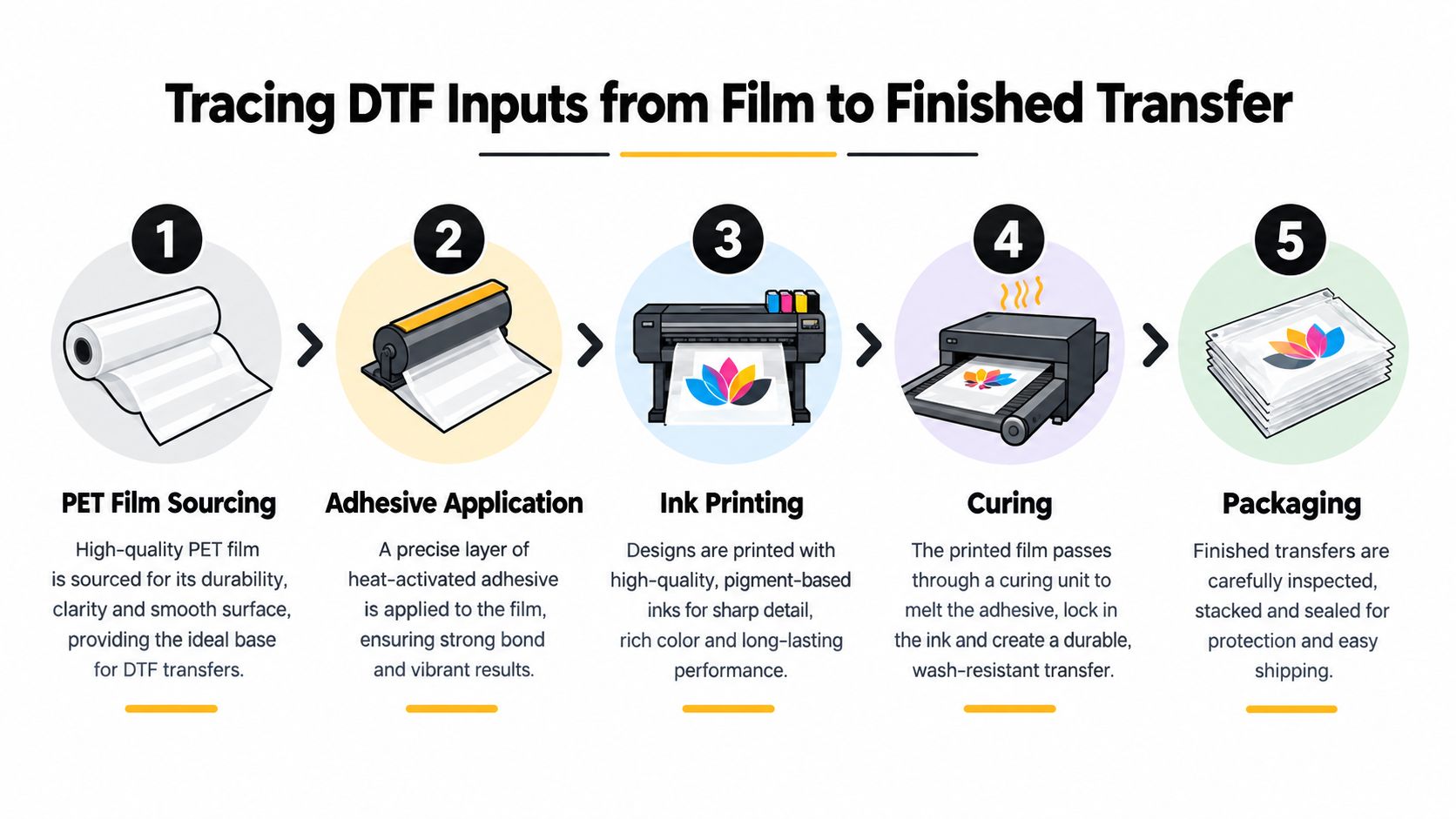
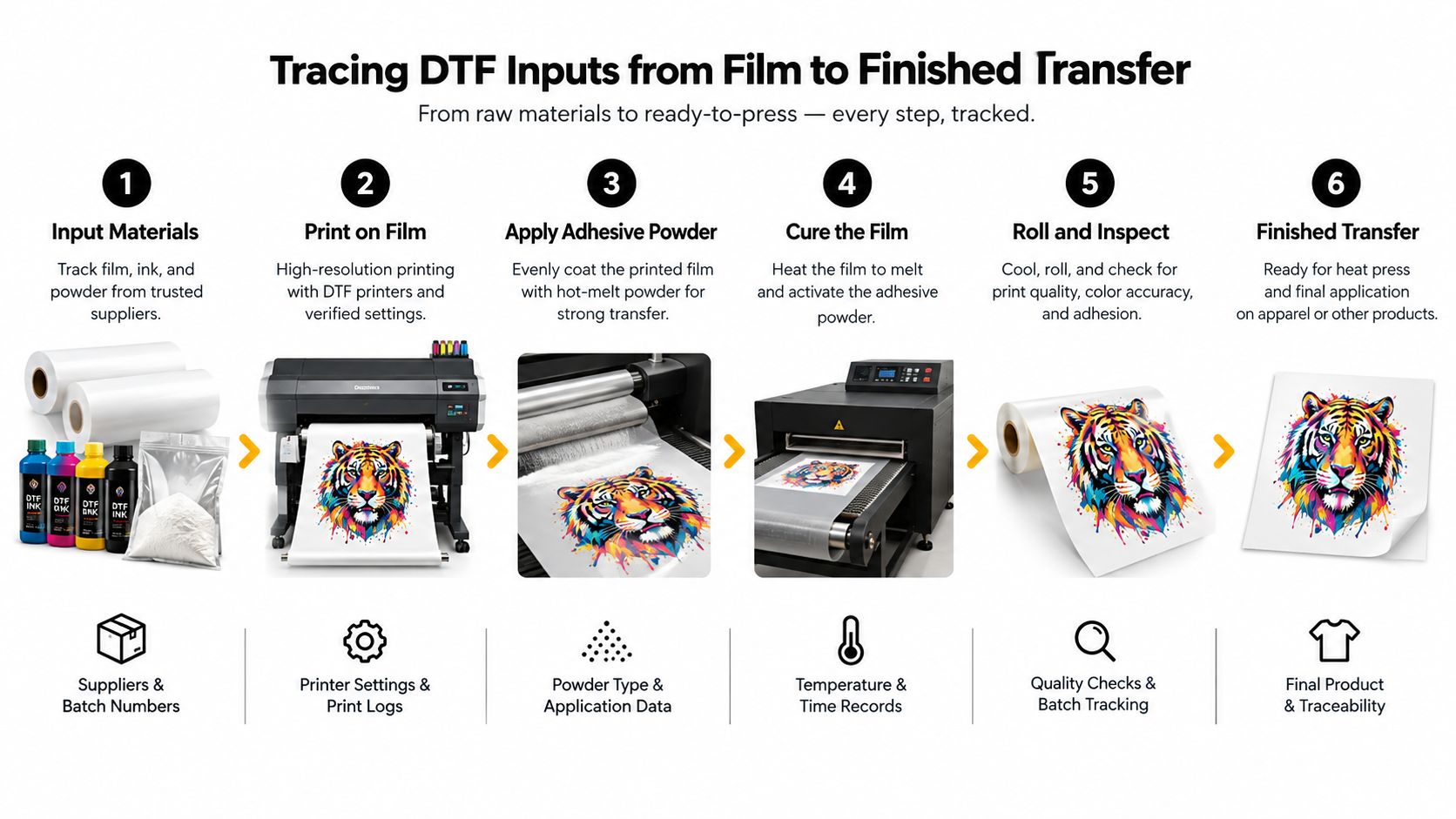
Audit a DTF transfer as a chain of materials and processes, not as a single finished object. Start with the PET film. Ask where the film is manufactured, whether the supplier buys it from a domestic producer or importer, and whether the film specification changes between product lines.
Then examine the remaining inputs. A useful audit file should connect each material to a supplier, a country of origin, and the production stage where it enters the transfer.
Follow the material trail
Use a written request rather than a casual sales conversation. Ask the provider to identify:
- PET film: The country where the film is manufactured and any meaningful processing performed before it reaches the print facility.
- Adhesive powder: The manufacturing location and whether the material is blended, coated, or merely repackaged domestically.
- CMYK and white inks: The manufacturer and country of origin for each ink system, including whether domestic printing changes the origin of imported ink.
- Curing and finishing: The location of printing, powder application, curing, trimming, inspection, and packaging.
- Packaging and labels: The source of mailers, sleeves, backing materials, and printed inserts if the supplier includes them in the finished product claim.
- Records: Supplier origin statements, invoices, product specifications, and safety documentation that help connect the materials to the claim.
A material safety data sheet can help identify a product and its manufacturer, but it isn't automatically proof that the material qualifies for an unqualified U.S.-origin claim. Treat it as one document in a larger substantiation file. The same principle applies to supplier certificates. Request them, retain them, and check that they describe the actual product you buy.
Don't pass through an unsupported claim
Resellers and decorators often face a second problem. A supplier may use broad marketing language, while the retailer repeats it on a storefront without knowing the underlying facts. If your customer asks whether the transfer is 100% made in USA, you need an answer tied to the exact transfer and its inputs.
Keep the supplier's written response with your purchase records and product copy. If the documentation is incomplete, narrow the wording or avoid the claim. A transparent statement about U.S. processing is more defensible than a stronger statement you can't substantiate.
For related apparel-origin considerations, the USA-made T-shirt guide can help separate the origin of the garment from the origin of the transfer. Those are different products, and one domestic claim doesn't automatically establish the other.
Calculating the True Cost of Overseas Sourcing
The invoice price is only the first line in a transfer purchase. An imported order can also carry freight, brokerage, customs handling, tariff exposure, delay risk, payment timing, and the cost of keeping extra inventory available while the next shipment travels.
A domestic order can still cost more per unit. The relevant comparison is whether that premium is smaller than the profit lost through missed deadlines, emergency replacement orders, idle equipment, or excess stock. A shop that accepts frequent rush work may value dependable replenishment more than a shop that plans long production runs well in advance.
Use total landed cost, not unit price
Build a simple worksheet for each supplier. Include the purchase price, transportation, customs-related charges, expected delay exposure, storage, spoilage, and the labor required to monitor or correct disrupted orders. Don't assign a made-up dollar value to uncertainty. Use your own order history and conservative assumptions.
| Operational Factor | Domestic Sourcing | Overseas Import |
|---|---|---|
| Supplier communication | Usually easier to resolve production questions within the same national market | Time zones, language differences, and handoffs can slow resolution |
| Customs exposure | Avoids import clearance for the finished transfer | Requires customs processing and may involve additional charges |
| Replenishment planning | More suitable for short replenishment cycles when the supplier offers them | Requires planning around international transit and border timing |
| Tariff uncertainty | Finished-transfer orders aren't subject to the same import process for your shop | Tariff treatment and landed cost can change with the shipment and classification |
| Safety stock | May allow leaner inventory when delivery is dependable | Delays can encourage larger buffers, tying up cash and space |
| Rush orders | Better fit for urgent domestic production and delivery windows | International timing makes urgent replacement more difficult |
The table isn't a promise that every domestic supplier delivers quickly or that every import is unreliable. It gives you the categories that belong in the decision.
A lower price can create a higher operating cost
Custom printers often measure the wrong saving. If imported transfers reduce the purchase price but force you to carry more stock, the cash remains tied up. If a shipment misses a production window, the shop may pay for expedited alternatives, refund a customer, or lose the order entirely. Those costs belong in the comparison even when they never appear on the original invoice.
The opposite is also true. A domestic premium may not make sense for slow-moving designs with predictable demand. The answer depends on order volume, rush frequency, product life, and how expensive an interruption is for your operation. Use this guide to evaluating DTF film sourcing as a reminder to examine the material supply chain rather than comparing transfer prices alone.
Price sensitivity matters on the customer side too. A 2025 report cited by Yahoo found that about 40% of consumers were willing to pay more for U.S.-made goods, but 75% of those willing to pay more wouldn't accept a premium above 10%. The same report said the share who occasionally look for American-made products fell six percentage points year over year to 59%. Yahoo's report on changing U.S.-made purchasing interest illustrates why domestic positioning must be supported by operational value, not just a higher retail price.
Economic and Environmental Impacts of Local Production
A domestic transfer order can support more than the printer's immediate supplier. It may involve U.S. material producers, equipment service businesses, regional warehouses, logistics providers, and specialized fabrication shops. The manufacturing sector's scale, documented in national economic research, shows why sourcing decisions can affect a broader production network even when a transfer contains imported inputs.
For a decorator, the practical question is where spending, service, and problem-solving capacity remain. Buying from a domestic transfer producer does not prove that every film, ink, or powder originated in the United States. It can, however, keep more purchasing activity within U.S. businesses when the supplier identifies its inputs and production steps clearly. That visibility also makes it easier to assess whether a higher transfer price is offset by fewer customs delays, more predictable replenishment, and less cash tied up in emergency stock.
Environmental claims need the same discipline
Local production can shorten the distance a finished order travels to your shop, particularly when the supplier serves your region. It can also simplify returns and reduce cross-border replacement shipments. These operational benefits support a measured sustainability discussion, but they do not establish a specific emissions reduction without product-level data.
Film and ink require the same scrutiny. Calling an input eco-friendly says little without information about its composition, manufacturing energy, packaging, waste handling, and transportation. A useful comparison of environmental trade-offs in another production field appears in this resource on sustainability in additive manufacturing.
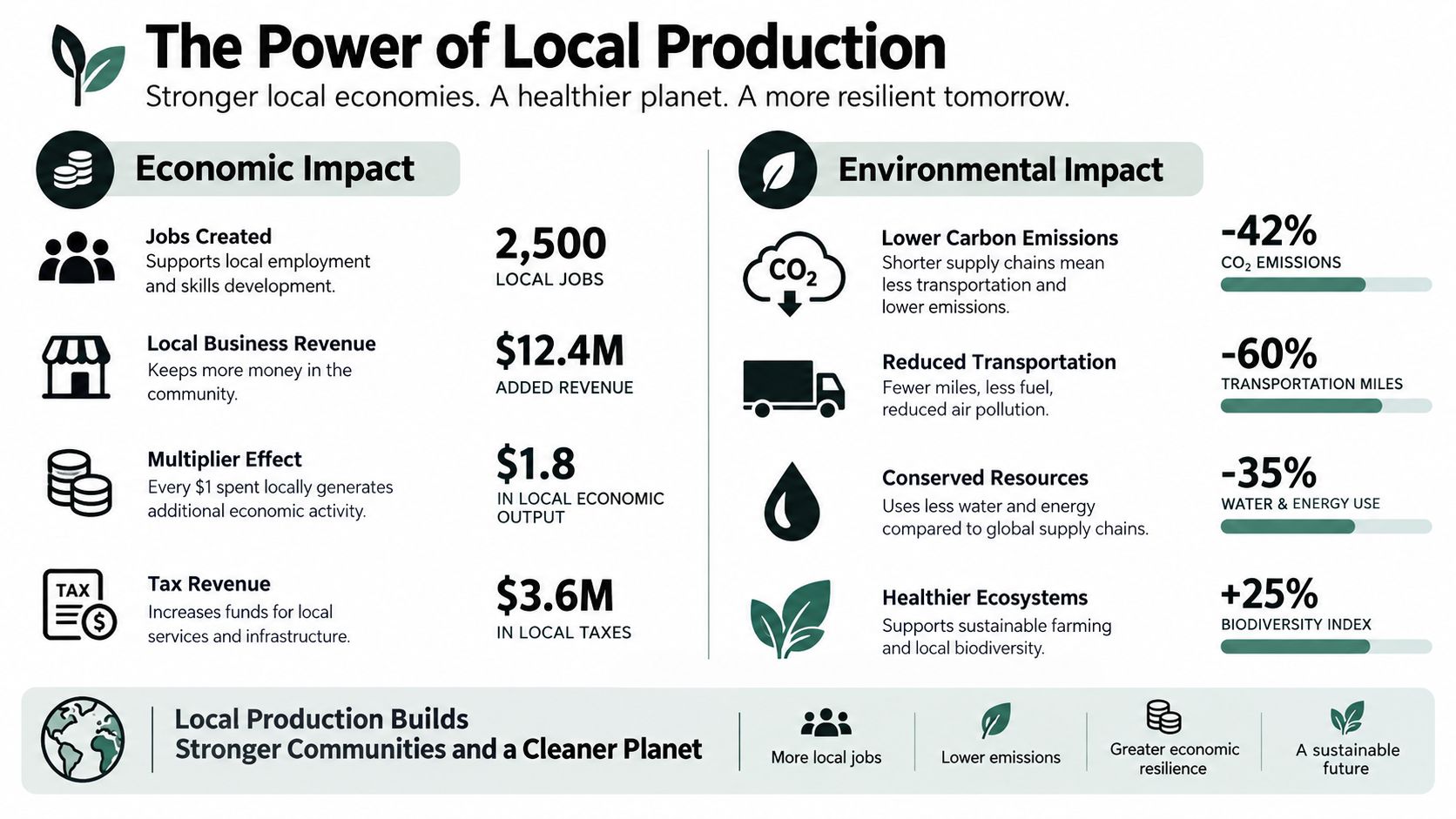
Domestic sourcing gives a shop a stronger customer explanation when the process can be described accurately. State where the transfer is produced, which inputs the supplier verifies, and which origin claims remain limited. For FTC compliance, “Made in USA” requires that the product be made or virtually all made in the United States, so a local shipment alone does not establish the claim. Responsible transparency is more persuasive than calling a product impact-free.
How Compliant Suppliers Operate in Practice
A credible domestic supplier should make its process understandable to a buyer who knows DTF production. That means explaining material sourcing, print and cure steps, order handling, and delivery expectations without hiding behind a generic American flag graphic.
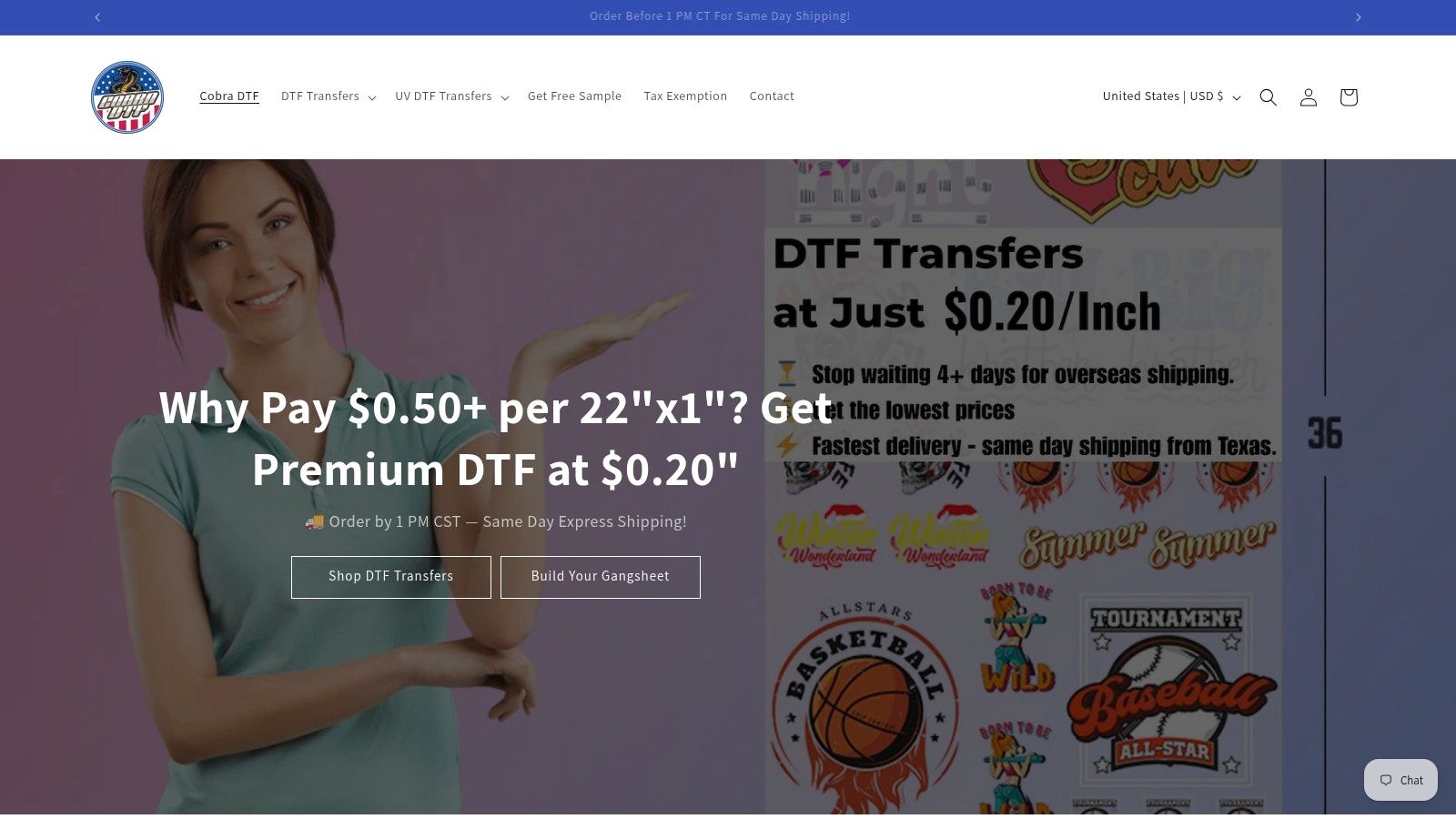
Cobra DTF is described as a family-owned Texas business producing DTF transfers with premium inks and films. Its stated operating model includes same-day shipping for orders placed by 1 PM CST and a delivery guarantee of 1 to 3 days, as described in the publisher information. Those are supplier-specific service claims, so buyers should confirm the current terms and whether they apply to the exact product and destination.
What operational proof looks like
A compliant supplier doesn't need to make the buyer guess. Its documentation and workflow should answer practical questions such as:
- Material origin: Can the supplier identify where film and inks come from?
- Production location: Does printing, adhesive application, curing, inspection, and packaging happen domestically?
- Order cutoff: Is the same-day shipping cutoff stated clearly, and what happens after it?
- Delivery window: Is the delivery promise a guarantee, an estimate, or a target?
- Quality controls: Does the supplier explain how it checks color, curing, adhesion, and finished-transfer consistency?
- Claim boundaries: Does it distinguish “U.S.-made” from “U.S.-based” when imported inputs are involved?
Those details matter because a transfer can be visually excellent and still be poorly documented. Quality, speed, and origin substantiation are separate checks. A supplier that handles all three gives a print shop a stronger basis for purchasing and customer communication.
Use the model as a benchmark, not a shortcut
The practical benchmark isn't “does this vendor sound patriotic?” It's whether the vendor can connect its materials, production steps, fulfillment policy, and written claims. A same-day dispatch policy can help a shop plan, but it doesn't prove that the inputs meet the FTC standard. USA-sourced film and ink can support a claim, but the buyer should still ask what “sourced” means and retain the response.
A supplier comparison should also include defect handling, communication, and consistency across repeat orders. If a vendor answers origin questions directly, documents its process, and gives clear delivery terms, it reduces the amount of guesswork your team carries. The guide to Made in USA suppliers can serve as a starting point for the questions you take to any provider.
Verifying Supplier Claims Before You Buy
Verify a supplier's origin claim before placing a large order or repeating it in your product copy. A written record protects your margins and gives your team a defensible answer when a customer asks where the product was made.
Use this checklist and save the responses with the purchase record:
- Ask for the exact claim. Is the product U.S.-based, assembled in the USA, printed in the USA, or 100% Made in USA?
- Request input origins. Ask where the PET film, adhesive powder, CMYK ink, white ink, packaging, and other significant components come from.
- Confirm domestic processing. Request a description of printing, powder application, curing, finishing, inspection, and packaging.
- Seek supporting documents. Ask for supplier origin statements, product specifications, and other records supporting the claim.
- Check product scope. Confirm that the documentation covers the transfer you intend to buy, rather than another product line.
- Match your wording to the evidence. If the answer is incomplete, use a narrower operational description or avoid publishing an unqualified claim.
A supplier's U.S. address does not establish domestic origin. Pause when a representative answers a question about “100% made here” with “assembled here,” or when the website uses broad origin language without explaining the production process. Those gaps can force a shop to revise customer-facing copy, absorb returns, or defend a claim after the order has shipped.
A supplier may still provide a usable transfer without offering documentation. It has not, however, given you a sound basis for repeating the claim. The FTC standard requires a reasonable basis and competent evidence before marketers make an unqualified Made in USA statement. Treat substantiation as part of vendor qualification, alongside delivery reliability and defect handling.
Verified domestic products can stand out with buyers who prefer U.S.-made goods, but preference does not remove the need for dependable delivery and sensible pricing. Avoiding customs delays and unexpected tariff exposure can protect the margin on small apparel orders, provided the domestic product does not carry an excessive price premium.
Cobra DTF states that its DTF transfers are produced in Texas, use premium inks and films, offer same-day shipping for orders placed by 1 PM CST, and have a stated delivery window of 1 to 3 days. Visit Cobra DTF to review its transfer options and assess whether its sourcing documentation and fulfillment terms fit your shop.