

Wholesale Clothing Suppliers USA: Your Guide to Sourcing
Before you even think about searching for wholesale clothing suppliers usa, you need to take a hard look at your own business. Seriously. I've seen too many entrepreneurs jump the gun, and it's a classic recipe for wasted time and money. Think of your brand identity as your compass; without it, you're just wandering aimlessly through a massive industry.
First Things First: Define Your Brand Before You Source

Diving into supplier catalogs without a clear vision is a bit like going grocery shopping when you're starving. Everything looks good, and you end up with a random assortment of things that don't actually make a meal. The most successful boutique owners I know have their brand identity dialed in long before they ever pick up the phone to talk to a sales rep. This prep work makes every conversation focused and productive.
This isn't just about picking a logo and a color palette; it's about creating a strategic blueprint for your business. It will dictate the fabrics you need, the price your customers are willing to pay, and the order sizes you can realistically handle. If you skip this step, you risk partnering with suppliers who are a terrible fit, leaving you with a storeroom full of inventory that just won't sell.
Pinpoint Your Niche and Ideal Customer
Let's get specific. Who are you actually selling to? "Women's clothing" is way too broad to be useful. Are you catering to professionals who want timeless, sustainable pieces? Or are you targeting Gen Z shoppers who crave the latest micro-trend?
You have to build a detailed profile of your ideal customer. Give them a name, an age, a job, and a lifestyle. What do they care about? Where do they hang out online? What's their budget? Knowing this stuff inside and out will immediately tell you what kind of wholesale clothing suppliers usa you should be looking for.
For example, if your boutique is for eco-conscious millennials, you'll need to find suppliers who can prove their ethical production standards. But if you're serving college students on a budget, your priority will be finding vendors with trendy, affordable styles.
Key Takeaway: Your customer profile isn't just a fluffy marketing exercise. It’s a powerful filter that instantly weeds out the wrong suppliers and points you directly toward partners who get your vision.
Establish Your Price Points and Quality Standards
Your brand's reputation is built on two things: price and quality. So, before you start looking at wholesale costs, you need to decide on your retail pricing strategy. Are you going to be the affordable, go-to spot? A reliable mid-range boutique? Or a high-end, luxury destination?
This decision alone will slash your list of potential suppliers in half. If you want to sell a t-shirt for $25, you can't be paying $15 for it at wholesale. Figure out your target retail prices first, which then helps you calculate your target cost of goods. It gives you a real, workable budget.
Think about it this way:
- Entry-Level Pricing: You'll need suppliers built for volume, which usually means basic materials and simple construction to keep costs down.
- Mid-Range Pricing: This opens the door to better fabrics, more intricate designs, and often, suppliers with more flexible minimum order quantities (MOQs).
- Premium Pricing: This demands suppliers who are masters of their craft, using high-end materials and offering impeccable construction. These partners are usually more selective about the retailers they work with.
Quality is the other side of that coin. Don't just think "good quality." Get granular. Are you after 100% organic cotton, durable poly-blends, or luxe silks? Having these details hammered out prevents you from wasting hours talking to suppliers whose products will never live up to the promise you're making to your customers.
How to Find the Right US Clothing Wholesalers
Alright, you've got your brand vision locked in. Now comes the exciting part: finding the wholesale partners who can bring it to life.
A quick Google search for "US clothing wholesalers" will throw millions of results at you, but here’s a little industry secret: the truly great suppliers, the ones that successful boutiques have on speed dial, rarely show up on the first page. Finding a reliable partner is less about broad searching and more about knowing where to look.
This isn't just about finding someone who sells clothes in bulk. You need a partner who gets the US market, delivers consistent quality, and is genuinely invested in your success. Let's skip the endless, frustrating searches and focus on the three places where the real deals happen: online B2B marketplaces, industry trade shows, and the major fashion districts.
Tap into Premier Online B2B Marketplaces
Think of these marketplaces as the industry's private shopping centers, built exclusively for retailers like you. They aren't random online directories; these platforms vet their vendors, which immediately gives you a baseline of quality and legitimacy you can trust.
They are designed specifically for the fashion world, making them an incredibly efficient starting point. Two of the biggest players for US-based brands are:
- FashionGo: This is one of the heavyweights. FashionGo hosts hundreds of vendors, from contemporary womenswear to shoes and accessories. Its catalog is massive and easily searchable, letting you zero in on exactly what you need.
- LA Showroom: As the name suggests, this platform is your direct line to the heart of the Los Angeles fashion scene. It connects you with a huge variety of brands and manufacturers, many of whom are staples of the LA Fashion District.
Getting access is usually pretty simple. You’ll need to register your business and provide proof, like your reseller's permit or tax ID. Once you’re in, you can filter by style, category, or even specific trends, which makes finding suppliers that vibe with your brand's aesthetic so much easier.
Immerse Yourself in Industry Trade Shows
Online sourcing is great for efficiency, but nothing replaces the power of a handshake. Fashion trade shows are where real relationships are forged. Imagine hundreds of wholesale clothing suppliers usa all under one roof, giving you the chance to see the fabrics, feel the quality, and meet the people behind the products.
Attending a major event like MAGIC in Las Vegas or a Dallas Market Center show can help you accomplish in just a few days what might take you months of online research. You get to compare vendors side-by-side, ask detailed questions, and often stumble upon amazing new brands that haven't hit the big online platforms yet.
Pro Tip: Don't just show up to a trade show and wander. Do your homework. Look at the exhibitor list beforehand and map out your "must-see" booths. But definitely leave some time free to explore—some of the best partnerships I've seen started with a chance discovery down a random aisle.
Explore Major US Fashion Hubs Directly
If you're dead serious about curating a truly unique collection, then booking a trip to a major fashion district can be a total game-changer. The undisputed epicenter in the United States is the Los Angeles Fashion District. This isn't just a street; it's a sprawling neighborhood packed with thousands of showrooms, manufacturers, and wholesalers.
Walking the district gives you a huge advantage. Here’s why:
- Discover Exclusive Lines: Many showrooms carry brands you will never find online or at a trade show.
- Negotiate in Person: A face-to-face conversation can often open doors to better terms or access to limited-run pieces.
- Feel the Trends: Being on the ground gives you a real-time pulse on what's new and what's next, straight from the source.
This direct, hands-on approach takes more effort, but it pays off by yielding the most unique and valuable supplier relationships. It signals to suppliers that you're a serious buyer and lets you build a personal connection that a "click to order" button just can't replicate.
Building a well-rounded sourcing strategy is key. Combining the efficiency of digital platforms with the power of real-world networking will give you a resilient and successful supply chain. If you want to dig even deeper into this topic, you can learn more about how to find wholesale suppliers with this excellent guide.
So, you've got a list of potential wholesale clothing suppliers usa. That's a great first step, but the real work is just getting started. This next part—the vetting—is what separates the boutiques that thrive from the ones that fizzle out.
It's tempting to get dazzled by glossy catalogs and slick websites, but you have to dig deeper. This is where you uncover the truth about a supplier's quality, their reliability, and how they actually do business.
Skipping this due diligence is a massive gamble. A bad supplier can sink your shop with inconsistent quality, missed deadlines, and a brand reputation that's shot before you even get going. A solid vetting process, on the other hand, helps you build a supply chain with partners you can genuinely count on.
This journey to find the right partners usually kicks off in a few key places.
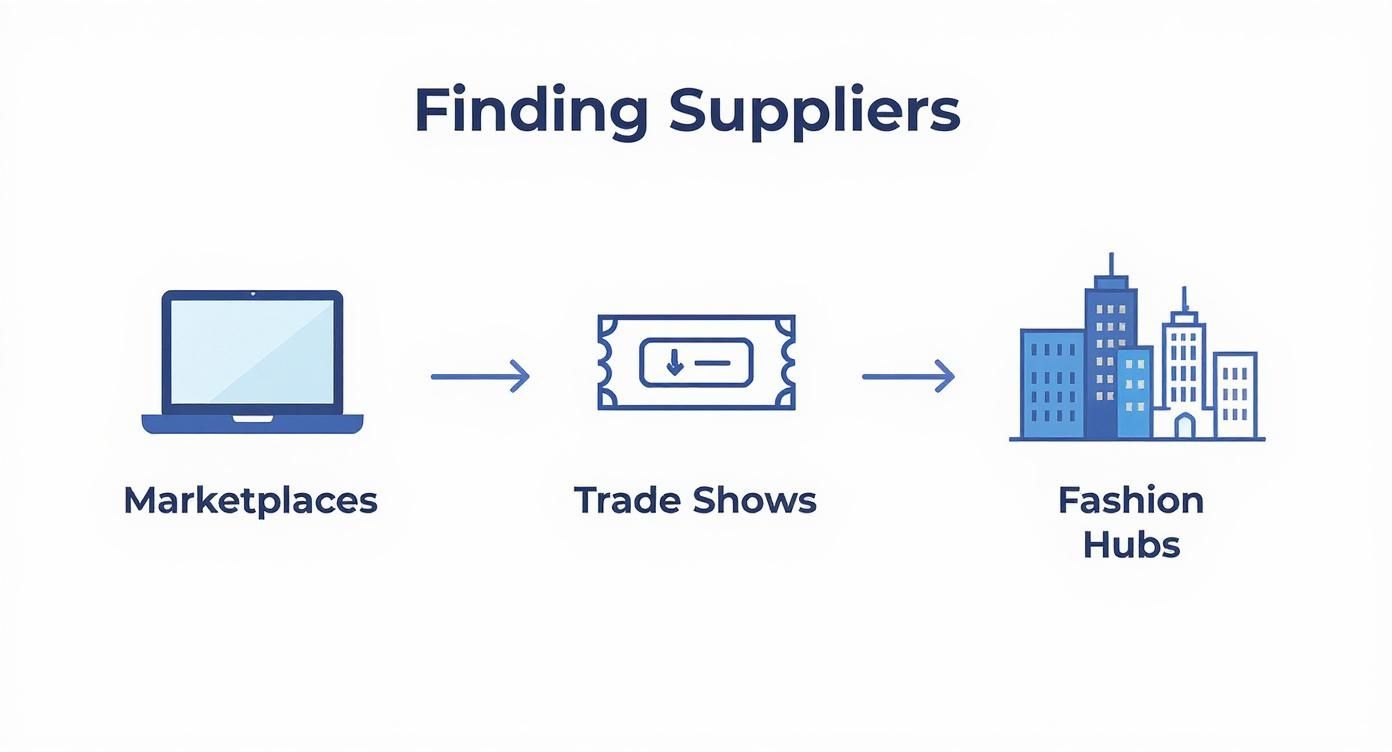
As you can see, you’ll likely start your hunt in online marketplaces, at industry trade shows, or even by visiting fashion districts directly. Each of these channels is a good way to build that initial list of candidates before you dive into the crucial evaluation stage.
Beyond the Catalog: Get Your Hands on Samples
Here’s a non-negotiable rule: never, ever place a bulk order without first inspecting physical samples. A photograph can hide a world of problems, from cheap, scratchy fabric to downright sloppy stitching.
When that sample package arrives, it's time to put on your detective hat. Don't just give the garment a quick once-over; you need to put it through its paces.
Here's what to look for:
- Fabric Quality: How does it actually feel? Does the material match the description—is that 100% cotton really 100% cotton? Hold it up to a light to check for sheerness and an even weave.
- Stitching and Seams: Look for tight, uniform stitches. Gently pull on the seams. Do they feel secure, or can you see gaps and loose threads? Frayed or uneven stitching is a huge red flag signaling poor quality control.
- Construction and Fit: Check every detail—zippers, buttons, and any other hardware. How is the overall construction? Does it hang right? And importantly, is the sizing consistent with standard US measurements?
- The Wash Test: This is the moment of truth. Run that sample through a normal wash and dry cycle, following the care label. Did it shrink to a doll's size? Did the colors bleed or fade? This simple test tells you exactly how the garment will hold up for your future customers.
Asking the Right Questions to Find the Right Fit
Once a supplier’s samples pass your quality inspection, it’s time to talk business. Your goal is to get a clear picture of their operations and figure out if they’re a logistical match for your boutique. Come prepared with a list of direct, specific questions.
Pro Tip: Think of this as a job interview—because it is. You're "hiring" a partner whose performance directly impacts your business. Don't be shy about digging for the details you need.
Make sure you ask every potential supplier these questions:
- What are your Minimum Order Quantities (MOQs)? This is usually the first question, as it immediately tells you if you can even afford to work with them.
- What are your standard production and shipping lead times? You need to know exactly how long it will take to get your inventory from the moment you place an order.
- Can you provide references from other boutiques you supply? A reputable supplier will have no problem connecting you with a few happy clients.
- What is your policy for damaged goods or incorrect orders? Understanding their return and credit process upfront will save you a world of headaches down the road.
Making Sure They're Legit
In an industry with so many players, verifying a supplier's credentials is not optional. The U.S. clothing wholesale sector is massive; it was valued at around $129.3 billion in 2023. And with over 35,000 businesses in the game, it's a competitive and crowded field where doing your homework is essential. You can read more about these clothing industry statistics to get the full market picture.
This means you absolutely must confirm you're dealing with a legitimate, registered business. Ask for their business license or federal tax ID number (EIN). A real wholesaler will provide this without a second thought.
To help you stay organized, here's a quick checklist to run through when you're vetting suppliers.
Supplier Vetting Checklist
| Vetting Criteria | What to Look For | Red Flags |
|---|---|---|
| Business Credentials | EIN or Business License provided | Hesitation to share credentials |
| Online Presence | Professional website, active social media | No website, bad online reviews |
| Communication | Prompt, clear, and professional responses | Vague answers, slow to respond |
| Sample Quality | High-quality fabric, durable construction | Poor stitching, fabric that pills easily |
| References | Willing to provide client references | Refusal to provide references |
| Policies | Clear policies for returns and damages | No clear policy or "all sales final" |
Using a structured checklist like this ensures you don't miss any critical details. Always cross-reference their information online and check for reviews or complaints on platforms like the Better Business Bureau.
For an even deeper dive, explore our guide on finding verified Made in USA suppliers to learn more about ensuring authenticity. This thorough approach protects your investment and makes sure you partner with a credible and reliable wholesale clothing supplier in the USA.
Getting the Numbers Right: Pricing, MOQs, and Payment Terms
This is where the rubber meets the road. Getting a handle on the financial side of a supplier partnership is what will ultimately make or break your boutique's profitability. It’s not about hunting for the absolute cheapest price, but about finding terms that work for your cash flow and allow you to grow sustainably.
We need to dive deep into three critical areas: their pricing structure, their Minimum Order Quantities (MOQs), and the payment terms they offer. Nailing these details is the difference between blindly accepting a price sheet and confidently building a partnership that fuels your business.
Decoding Wholesale Pricing Structures
When you first get a price list from a potential wholesale clothing supplier in the USA, it’s easy to feel a little lost. You’ll see terms like "unit price," "volume discounts," and "tiered pricing." Your job is to look past the raw numbers and figure out what they mean for your actual profit margins.
A tiered pricing model is extremely common. For instance, a supplier might price a t-shirt like this:
- $12 per unit for an order of 25-49 pieces
- $11 per unit for an order of 50-99 pieces
- $10 per unit for an order of 100+ pieces
Looking at that, the goal is to find your sweet spot. You have to balance the savings you get per piece with the risk of sitting on too much inventory. Don't let a juicy discount tempt you into over-ordering a style you haven't even tested with your customers yet. And while you're figuring out their pricing, you also need to know how to calculate wholesale prices for your own products to make sure your retail markup is solid.
Negotiating Minimum Order Quantities (MOQs)
For many new boutique owners, the Minimum Order Quantity (MOQ) feels like the first big roadblock. An MOQ is simply the smallest order a supplier will accept, whether that’s a certain number of units (say, 50 t-shirts) or a total dollar amount (like a $500 minimum order). For a new business, a high MOQ can feel like a non-starter.
But here’s a little secret: MOQs are often negotiable, especially when you’re trying to build a real relationship. If a supplier's MOQ is just a bit higher than you’re comfortable with, don’t just walk away—start a conversation. Propose a smaller "test run" order, with the promise that you'll place a much larger one once you see how the items sell. You’d be surprised how many US-based suppliers are willing to be flexible if they believe in your brand.
A Real-World Takeaway: I once worked with a boutique owner who fell in love with a line of dresses, but the supplier’s MOQ was 100 units per style—far too high for her budget. Instead of walking away, she asked if she could meet the MOQ by ordering 25 units across four different styles. The supplier agreed, and it became a bestselling collection for her store.
Understanding Payment Terms and Hidden Costs
Finally, let's talk about getting the bill. The payment terms a supplier offers can have a massive impact on your boutique's cash flow. You’ll typically run into a few common setups:
- Payment in Advance (PIA): This is exactly what it sounds like—you pay for the whole order before they ship it. It’s pretty standard for new accounts, but it can really tie up your capital.
- Net 30/Net 60: These are credit terms. "Net 30" means you have 30 days from the invoice date to pay your bill. This is a game-changer for cash flow because it gives you a chance to sell some of the product before the payment is even due.
Beyond the payment schedule, you have to be vigilant about potential "hidden" costs. Be direct. Ask about shipping fees, handling charges, and what their policy is for returns or damaged items. Getting this stuff in writing upfront saves you from those nasty surprise expenses that can quietly kill your profit margins. This is especially true in the domestic clothing manufacturing sector, which, valued at $9.9 billion in 2025, is always navigating its own cost pressures. Factors like tariffs can impact a supplier’s pricing, so the more you know, the better. You can dig into a detailed analysis of the domestic clothing sector's economic impact to get a better sense of these market forces.
Building Long-Term Partnerships with Your Suppliers

Finding great wholesale clothing suppliers usa is a huge win, but the real secret to long-term success isn't just finding them—it's building a genuine partnership. The most successful boutique owners I know don't treat their suppliers like a vending machine. They cultivate a strategic alliance.
When you start viewing your supplier as a critical part of your own team, something shifts. You're no longer just another purchase order in their queue. You become a valued client they're invested in, someone they genuinely want to see succeed. This relationship becomes your safety net when things go wrong and your secret weapon for growth.
More Than Just a Transaction
So, how do you build that kind of relationship? It starts with the simple stuff that, frankly, too many people overlook: clear communication and rock-solid reliability.
Always pay your invoices on time. If you can, pay them a little early. It’s one of the fastest ways to stand out and become a favorite client. It shows you respect their cash flow and establishes you as a dependable, low-risk partner. You'd be surprised how much goodwill this single habit builds over time.
Beyond the money, keep them in the loop. Tell your sales rep when a particular style is flying off your shelves. Give them a heads-up on your upcoming promotions. This kind of feedback is gold for them, helping them forecast trends and better anticipate what you'll need next. It becomes a two-way street where everyone wins.
The Perks of a True Partnership
Once you've laid that foundation of trust and respect, you'll start to see the real benefits roll in. A supplier who sees you as a partner will move mountains for your business when you're in a pinch.
What does this look like in the real world?
- First Dibs on New Inventory: You'll likely get a sneak peek at new collections before they hit the general market. This gives you a massive head start on locking down next season's bestsellers.
- Negotiating Power: As the relationship solidifies, you'll find they're more open to negotiating. Maybe they’ll lower the MOQ for a new line you want to test out or offer better payment terms like Net 30 or Net 60.
- Priority Support: When a problem inevitably arises—a shipping delay, a box of damaged goods—they’ll work fast to make it right. They’ll prioritize your issue because your business matters to theirs.
Think of a strong supplier relationship as your business's immune system. It helps you fight off the common colds of retail—inventory shortages, logistical nightmares—and bounce back much faster.
This partnership has a direct impact on your bottom line, especially when it comes to managing your stock. For a much deeper dive, our guide on inventory management best practices shows exactly how a reliable supply chain makes everything easier.
Ultimately, nurturing these relationships isn't just a "nice-to-have." It's a core business strategy that secures your supply chain and gives you a powerful, lasting edge in a crowded market.
Sourcing for Today's Fashion Market Trends
In the fashion business, staying afloat means more than just having products to sell. It's about having the right products. Sourcing isn't a simple transaction; it's the art of aligning your inventory with what people are actually excited to buy right now. The American market is a massive opportunity, but it's also a fast-moving, competitive space.
To succeed, you have to tap into the major trends shaping how people shop. If you ignore these shifts, you'll end up with racks of clothing nobody wants. Today's customers are sharp, and they're looking for pieces that truly reflect their values and lifestyle.
The Rise of Conscious Consumerism
One of the biggest changes we've seen in recent years is the demand for sustainable and ethically made clothing. It's not a fringe movement anymore. Modern shoppers, especially Millennials and Gen Z, are actively looking for brands that are open and honest about how their clothes are made.
This means finding wholesale clothing suppliers usa who can tell you about their material sourcing and labor practices is essential. Highlighting that your products are ethically made or use sustainable materials can be the very thing that sets your boutique apart from the competition.
Key Insight: Sustainability isn't just a buzzword; it's a core value that builds real customer loyalty. Brands that get this aren't just selling clothes; they're selling a story and a commitment that shoppers are eager to get behind.
Tapping Into High-Growth Apparel Categories
Beyond values, certain product categories are just on fire right now. Take activewear, for example. The line between workout gear and everyday outfits has completely blurred. The demand for stylish leggings, functional sports bras, and comfortable hoodies is still climbing as people prioritize comfort in their daily lives.
Contemporary womenswear is another powerhouse. Think versatile pieces like modern blouses, well-cut trousers, and chic dresses that work for the office and a night out. These items appeal to a wide range of customers and don't go out of style as quickly as some of the more fleeting micro-trends. You could even explore different fulfillment models, like the ones in our guide to print-on-demand suppliers, to test new designs without a huge upfront investment.
Ultimately, building a collection that hits on these trends is what will drive your success. The United States leads the global apparel market, which is expected to be worth $1.84 trillion by 2025. The U.S. market alone is projected to reach $365.7 billion. With the average American household spending about $162 a month on clothing, aligning with these major trends is how you claim your piece of the pie. You can find more great info on wholesale clothing trends from Accio.
Diving into the world of US wholesale clothing suppliers can feel like learning a new language, and it’s natural to have a few questions. Let's clear up some of the most common hurdles new boutique owners face so you can move forward confidently.
Do I Really Need a Special License?
This is probably the number one question I get, and the answer is a firm yes. To buy clothing wholesale (and not pay sales tax on it), you absolutely need a reseller's permit. You might also see it called a seller's permit or resale license, but it's all the same thing—a state-issued document that proves you're buying goods to resell them. Don't skip this step; no legitimate US wholesaler will work with you without it.
Manufacturer vs. Distributor: What's the Difference?
It's easy to get these two mixed up. Think of it this way: the manufacturer is the one with the factory, actually sewing the fabric and making the clothes. A distributor, on the other hand, is like a middleman—they buy huge quantities from many different manufacturers and then sell those products in smaller batches to retailers like you.
When you're just starting out, partnering with a distributor is often the smarter move. They usually have lower minimum order quantities (MOQs) and give you access to a bunch of different brands all in one place. This is perfect for testing the waters and figuring out what your customers love without having to buy a thousand pieces of a single style.
What If My Order Arrives Damaged or Wrong?
It’s going to happen eventually. A box shows up, and you've got the wrong sizes, a different color than you ordered, or a few damaged items. This is precisely why vetting your suppliers beforehand is so important.
A good partner will have a straightforward process for returns and credits. The moment you spot an issue, snap a few photos for documentation and get in touch with your sales rep. They should be able to offer a quick solution, like a credit on your next order or a replacement for the faulty items.
Sourcing from US-based wholesalers just makes life easier. You get your orders faster, you're not trying to communicate with someone in a completely different time zone, and you don't have to worry about your inventory getting stuck in customs for weeks. It creates a supply chain you can actually rely on.
Getting these basics down from the start helps you build a strong foundation for a business that's not just profitable, but resilient.
Ready to create stunning, high-quality custom apparel for your boutique? Cobra DTF offers premium, USA-made Direct-to-Film transfers with vibrant, long-lasting color and a super-fast turnaround. Elevate your brand with our reliable, eco-friendly products by visiting us at https://cobradtf.com.