

Boost Your Business: Measure Vendor Reliability
A customer approves artwork on Tuesday. The blanks are counted, the press schedule is blocked, and your team thinks the hard part is done. Then the transfer shipment lands late, two sizes are short, and the colors look just different enough that you know the client will notice. By noon, you're calling the customer, reworking the production queue, and deciding whether to eat the remake cost or miss the due date.
Most print shops have lived some version of that day.
The mistake is treating it like bad luck. In practice, it's a vendor reliability problem. The supplier might have been cheap, friendly, or fast on the last order. None of that helps when one failure knocks out labor planning, shipping promises, and customer trust in a single afternoon. One widely cited business estimate says 60% of businesses experience disruptions due to unreliable vendors, with delays and financial losses tied to those failures, according to ProValet's write-up on long-term vendor reliability.
For a growing apparel brand or custom shop, this isn't abstract procurement talk. It's the difference between running a stable production floor and running a daily fire drill.
Your Shop's Success Starts with Vendor Reliability
A print shop usually doesn't lose margin in one dramatic event. It leaks out through remake labor, rush freight, spoiled blanks, customer appeasements, and press time that should've been spent on profitable work. One unreliable supplier can create all of that.
I've seen shops obsess over print quality while ignoring the upstream problem. They compare transfer feel, garment hand, or price per sheet, but they don't track who ships complete orders, who answers when something breaks, and who modifies timing without transparency once the relationship starts. That gap is where production nightmares start.
A supplier isn't reliable because they're nice on the phone. They're reliable when your team can plan next week with confidence.
Custom apparel shops feel this faster than many other businesses because the schedule is tight and the order mix changes constantly. School spiritwear, team uniforms, event merch, company stores, and rush ecommerce fulfillment all punish variability. If a transfer vendor misses, your press crew still shows up. Your customer still expects tracking. Your reputation still takes the hit.
That also means reliability can be improved. It isn't guesswork. It can be evaluated, measured, and managed like any other operating system in your shop.
Two resources help when you're tightening the full chain around production. If inbound timing and freight handoffs are part of the problem, this guide to choosing a logistics partner is useful for thinking beyond the supplier itself. If you're reviewing transfer sources more directly, Cobra DTF's article on how to choose a DTF printing supplier gives a practical lens for shop owners comparing options.
What Vendor Reliability Really Means for Your Shop
A lot of shop owners hear "vendor reliability" and think one thing: did the box arrive on time?
That's part of it. It isn't the whole thing.
Choosing a vendor is a lot like choosing a work truck. A cheap, flashy truck that starts most mornings but spends random days in the shop isn't helping the business. A less exciting truck that starts every day, carries the load, and doesn't surprise you is worth far more over time. Supplier decisions work the same way.

Reliability includes more than delivery dates
Procurement guidance defines vendor reliability as a mix of delivery timing, correct quantities, pricing accuracy, fast PO acknowledgment, and early communication of changes, as explained in SourceDay's discussion of supplier reliability. That definition fits print shops perfectly because most supplier damage doesn't come from one obvious disaster. It comes from small misses that force your team to compensate.
A shipment can arrive on the promised day and still hurt you if:
- Quantities are off and you're missing youth mediums or a key gang sheet.
- Pricing changes unexpectedly and your quote is suddenly wrong after the customer already approved.
- Communication comes too late and you only learn about the delay when your press operator asks where the order is.
- Acknowledgment is slow so your purchaser thinks the job is moving when it isn't.
Those are reliability issues, not customer service annoyances.
Practical rule: If a vendor makes your team check, chase, confirm, and re-confirm every order, they aren't reliable, even if many shipments eventually arrive.
The hidden cost of chasing the lowest price
In apparel and decorated goods, the cheapest source often looks good on a spreadsheet before the order is placed. After that, the true costs emerge. Your CSR spends half an hour chasing tracking. Your production manager reshuffles jobs. Your team pays more for expedited outbound shipping to protect the customer promise. None of those costs appear in the supplier's unit price.
That's why strong operators stop asking only, "What's the rate?" and start asking, "Can we plan around this vendor without building extra buffer into every job?"
A reliable vendor gives your shop planning confidence. Your receiving team knows what should arrive. Your schedule reflects reality. Your account managers don't need to invent excuses. That stability matters more than a small paper savings that disappears the first time an order goes sideways.
The Five Key Metrics for Tracking Vendor Reliability
Most shops already have opinions about suppliers. Fewer have a scorecard. That's where things get sloppy. If you want better sourcing decisions, you need a short list of metrics your team can track.
A useful framework for vendor reliability is a Supplier Reliability Index that weights on-time delivery at 40%, quality at 25%, fill rate at 20%, and lead-time consistency at 15%, according to Umbrex's explanation of the Supplier Reliability Index. You don't need to copy that model exactly, but the idea is right. Reliability should be measured as a combination of execution and consistency.
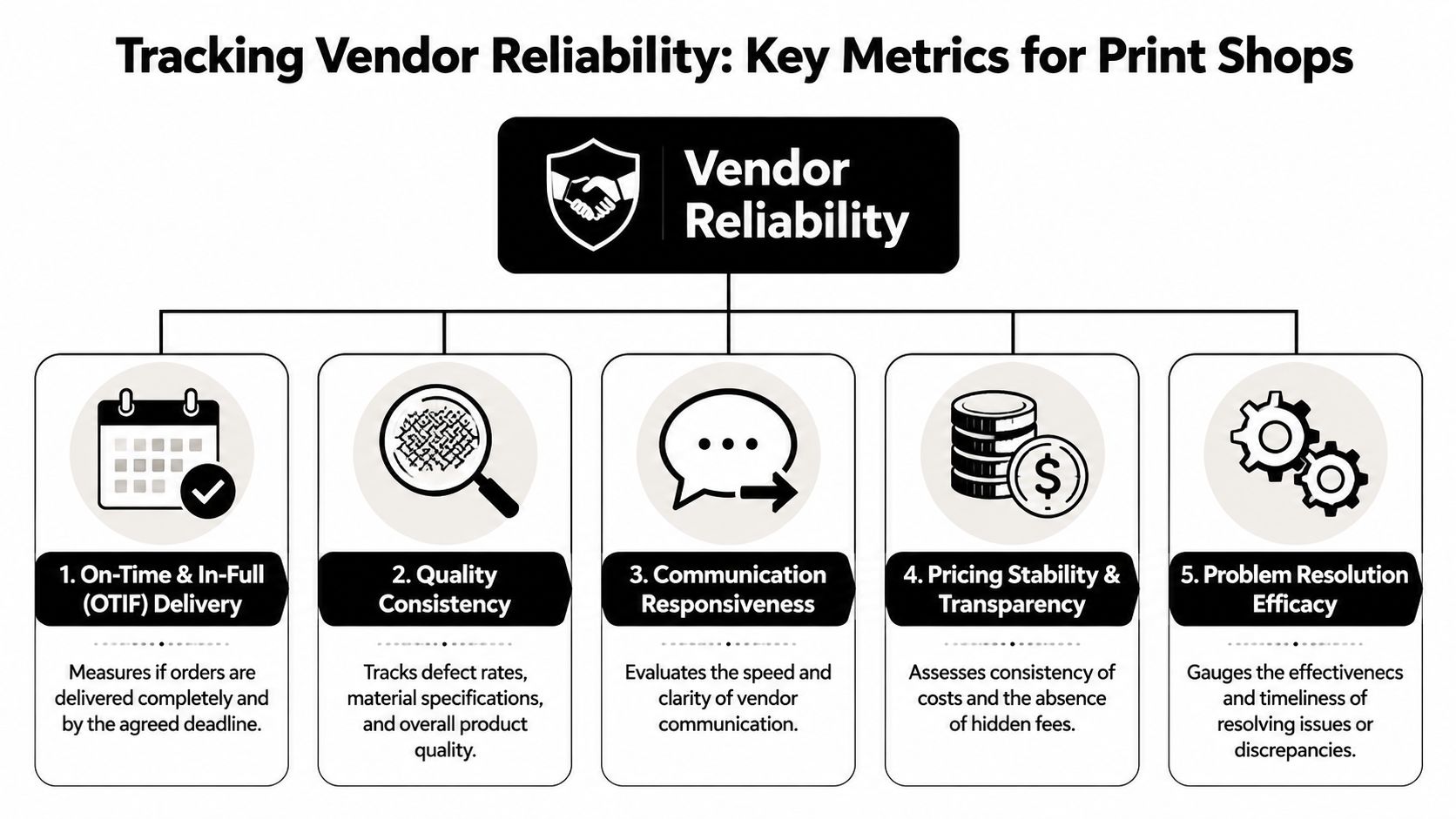
On-time and in-full delivery
This is the first screen. Did the order arrive by the agreed date, and did it arrive complete?
For a print shop, partial shipments can be almost as damaging as late ones. If your blanks arrive without key sizes or your transfer order is short on one logo version, the job still stalls. Track whether each purchase order lands complete and usable, not just whether tracking says "delivered."
What works is simple discipline:
- Log the promise date from the moment the order is confirmed.
- Note shortages clearly by SKU, size, colorway, or sheet count.
- Separate acceptable splits from surprise splits so vendors don't get credit for incomplete orders you never approved.
A supplier that looks "pretty good" on arrival timing but regularly ships short will burn more time than one late order every now and then.
Quality consistency
Quality isn't one complaint. It's a pattern.
For blank garments, that may mean fabric feel, shade consistency, seam issues, or carton damage. For transfers, it's adhesion, color match, line sharpness, release behavior, and how the finished print holds up through handling and wash. If the team has to re-press, sort defects, or pull backup stock, quality inconsistency is already costing you.
Use a basic receiving checklist and have the same person or role review incoming goods when possible. Consistency in inspection matters almost as much as consistency in the product.
If your shop only measures quality when a customer complains, you're measuring too late.
Lead-time consistency
This one gets missed all the time. A vendor can have acceptable average timing and still be a planning problem if their actual turnaround swings too much.
That matters in custom apparel because your schedule is stacked. Art approval, ordering, receiving, printing, finishing, and shipping all depend on predictable handoffs. A transfer source with short and stable turnaround gives you flexibility on late-selling jobs, webstore replenishment, and reorder work. A source with unpredictable timing forces you to pad every schedule.
For many shops, domestic sourcing changes the game. A nearby or US-based supplier often reduces the uncertainty tied to customs, long transit legs, and overnight email lag. Faster is helpful. Predictable is better.
Communication responsiveness
Some suppliers miss the first deadline. Others save the job by telling you early enough to adjust. Those are not the same thing.
Track how quickly vendors acknowledge purchase orders, answer issue emails, and communicate changes. You don't need a complex system. A simple red-yellow-green note in your purchasing log is enough to reveal patterns. If one vendor repeatedly goes silent when something's wrong, that's a reliability risk no matter how friendly they are when sales are easy.
Look for signs such as:
- Early warning behavior when inventory is tight or timing shifts
- Clear ownership of problems instead of bouncing you between inboxes
- Specific updates instead of vague status messages
Pricing stability and problem resolution
Shops hate surprises after a quote is already approved. That makes pricing accuracy part of vendor reliability, not just accounting hygiene.
A vendor that frequently changes charges, adds confusion around freight, or creates invoice mismatches adds friction across sales and operations. The same goes for problem resolution. Mistakes happen. What matters is whether the supplier resolves them cleanly, quickly, and without forcing your team to prove the issue five different ways.
This metric often separates usable vendors from risky ones. A supplier doesn't have to be perfect. They do have to be manageable.
A Practical Guide to Evaluating New Vendors
The worst time to evaluate a vendor is during a rush job. By then, you've already committed your customer to someone else's execution. New supplier vetting needs a process, even if your shop is small.
A good evaluation workflow isn't complicated. It just needs to be repeatable.
Start with desk research
Before you request anything, review how the vendor presents basic operating information. You want clear details on product scope, ordering process, communication channels, policy language, and where the business operates. For cross-border vendors, customs handling and import process matter too. If you're sourcing internationally, a resource like this Customs Broker Selection Guide is helpful for understanding where border friction can creep into your lead time.
Also pay attention to what isn't easy to find. If turnaround expectations, support paths, or issue handling are vague before you buy, they usually won't become clearer after you place a larger order.
Request samples like an operator, not a shopper
A sample isn't just for deciding whether you like the product. It's a test of how the vendor handles your business.
When samples arrive, check the product itself, but also note the process:
- Did they answer clearly when you asked technical questions?
- Did they ship when they said they would or did timing drift immediately?
- Was the packaging organized enough that your receiving team could identify what was sent?
- Did the result match the spec you requested?
For domestic sourcing comparisons, it helps to review suppliers that manufacture and ship closer to your customer base. Cobra DTF's guide to made in USA suppliers is a useful starting point if you're weighing local control against offshore pricing.
Run a low-risk test order
Never jump from sample approval to a critical production order.
Place a small, real order with a real deadline, but one that won't sink the week if something goes wrong. Doing so reveals whether the vendor can manage the full lifecycle. Ordering, acknowledgment, fulfillment, shipping, invoicing, and issue handling all matter. A vendor can ace the sample and still fail the operational test.
The first paid order should be a stress test for the supplier, not a gamble for your shop.
Ask operational questions that reveal reliability
Most sales reps can talk about quality. Fewer can explain how the business handles variance. Ask direct questions that force operational clarity.
Try questions like these:
- How do you confirm order receipt and changes? You want a reliable acknowledgment process.
- What happens when an item is short or delayed? Listen for specifics, not reassurances.
- Who owns escalations? If nobody owns them, your team will.
- How do you communicate inventory or timing changes? Early notice matters more than polished language.
- What records do you require for reorder accuracy? Good vendors value repeatability.
Use a scorecard instead of gut feel
If you compare vendors from memory, the loudest recent experience will distort the decision. A short scorecard keeps the conversation honest.
| Metric | Weight | Vendor A Score (1-5) | Vendor B Score (1-5) |
|---|---|---|---|
| On-time and in-full delivery | High | ||
| Quality consistency | High | ||
| Lead-time consistency | Medium | ||
| Communication responsiveness | Medium | ||
| Pricing stability | Medium | ||
| Problem resolution | High | ||
| Data and order accuracy | Medium |
You can adapt the weight labels to your shop. Some teams use point values. Others keep it simple with High, Medium, and Low. The format matters less than the habit.
Look beyond shipment performance
Reliable vendors also maintain clean records. Vendor master data guidance emphasizes validating vendor identity and keeping banking details, tax status, compliance documents, insurance records, and continuity records current, as outlined in Onspring's vendor master data management practices. For a print shop, that means fewer purchasing errors, fewer accounting problems, and less confusion in repeat ordering.
If your team duplicates vendor names, stores conflicting contact details, or sends purchase orders to outdated addresses, you can create your own reliability problem even when the supplier is performing fine.
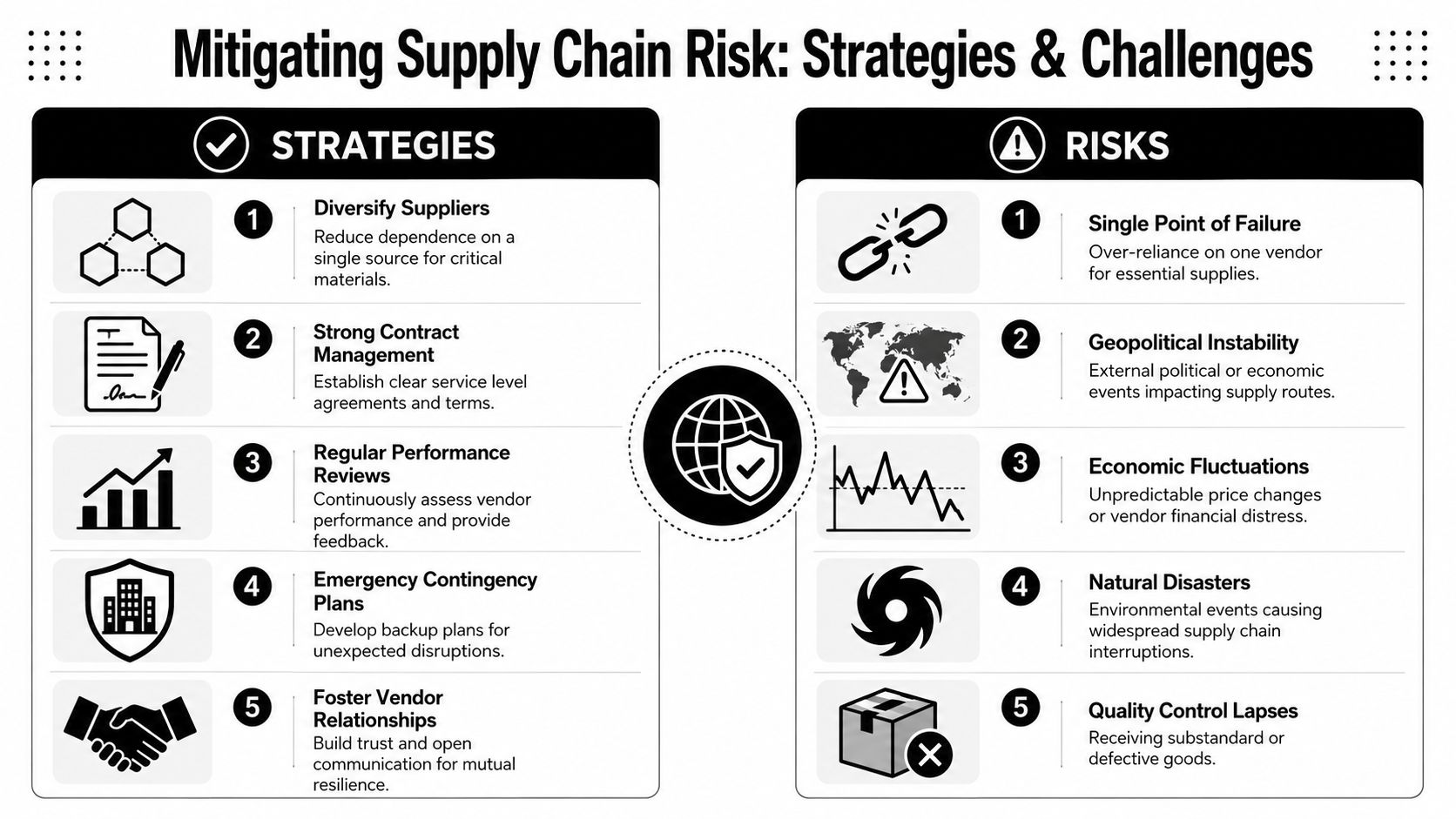
Strategies for Mitigating Supply Chain Risk
A shop can choose a decent vendor and still carry too much risk. That usually happens when one supplier becomes the default answer for everything. It feels efficient until that source hits a disruption and your whole schedule leans with it.
The harder question isn't just whether a supplier is reliable in normal weeks. It's whether your business can keep operating when conditions change. Procurement and risk teams frame that as the difference between reliability and resilience, and Kodiak Hub's vendor assessment discussion captures the key issue well: a vendor can perform acceptably in stable conditions and still be a poor choice if it can't handle shocks.
The real trade-off in domestic and overseas sourcing
Overseas sourcing can make sense for some programs. It can support scale, certain product categories, or planned production runs with longer calendars. But custom apparel shops often underestimate the operational cost of distance.
Those risks show up in familiar ways:
- Customs and border delays that have nothing to do with your specific order quality
- Time zone gaps that slow problem solving when you need answers the same day
- Longer transit chains with more opportunities for handoff failure
- Tariff and compliance uncertainty that complicates landed cost and timing
- Reduced agility when a reorder, correction, or hot-market item needs quick action
Domestic sourcing doesn't remove every risk. It does reduce several of the ones that small and midsize shops struggle to absorb.
Build resilience into the supplier mix
The goal isn't to abandon every overseas vendor. It's to decide which categories need the highest planning confidence and shortest recovery path.
For many print shops, these are the categories to protect first:
- Rush-sensitive items tied to events, launches, and school calendars
- Core blanks and transfer inputs that affect a large share of weekly output
- Repeat reorder programs where consistency matters more than chasing pennies
- Customer-facing custom work where remake windows are tight
For those categories, a domestic partner often gives the shop more control. Communication is easier. Shipping paths are shorter. Reorders are less exposed to border friction. If you want a practical overview of tightening these workflows, Cobra DTF's guide on supply chain optimization is worth reviewing.
Resilience isn't having a vendor that never slips. It's having a supply setup that doesn't collapse when one slip happens.
Reduce single-point-of-failure exposure
One of the cleanest risk moves a shop can make is splitting critical dependence. That doesn't mean dividing every order. It means avoiding a setup where one supplier failure stops production outright.
A workable approach looks like this:
- Primary and backup sources for key categories, even if the backup gets lower volume.
- Regular performance reviews so suppliers know you're measuring execution, not just buying on habit.
- Clear reorder documentation with specs, art references, and contact ownership stored centrally.
- Contingency rules for when to switch sources, expedite, or substitute.
Stockouts are where weak supplier setups become painfully visible. If you're trying to quantify that operational pain more clearly, Online Brand Growth's stockout strategies offer a useful way to think through the business impact of running out at the wrong moment.
Conclusion The Bottom Line Impact of a Reliable Vendor
Vendor reliability isn't a soft concept. In a custom apparel business, it's one of the clearest predictors of whether your shop runs calmly or constantly scrambles.
The shops that handle growth well don't just buy from vendors they like. They buy from vendors they can plan around. That means measuring complete delivery, quality consistency, lead-time stability, responsiveness, pricing discipline, and issue resolution. It also means vetting new suppliers with a process instead of a hunch.
The bigger lesson is strategic. Sourcing decisions shape daily operations more than most owners realize. A cheap source with unstable timing can force extra buffers into production, customer service, and shipping. A stable source can reduce decision fatigue across the whole business. That's why domestic versus overseas sourcing isn't only a pricing question. It's a control question.
Regular review matters too. Procurement frameworks increasingly rely on the golden triangle of time, quality, and cost, use measures like on-time delivery rate, lead time, defect rate, invoice accuracy, and responsiveness, and often evaluate 6 to 12 months of performance data while excluding suppliers with fewer than 20 lines of data for confidence, according to Art of Procurement's overview of supplier performance management metrics. In practice, many organizations also reassess vendors on a quarterly or semiannual basis, as noted earlier in the article.
That kind of discipline pays off in ways every print shop owner understands. Fewer remakes. Fewer rush fees. Better labor planning. More accurate ship dates. Less time spent apologizing for problems your team didn't create.
Reliable vendors don't just help you fulfill orders. They protect margin, customer trust, and your ability to grow without turning the business into a stress factory.
If you're reviewing transfer suppliers and want a domestic option in the mix, Cobra DTF offers USA-made DTF transfers with same-day shipping for orders placed by 1 PM CST and stated delivery within 1 to 3 days, which can be useful for shops that value shorter, more predictable replenishment cycles.