
How to Start a T Shirt Printing Business: t shirt printing business how to start
Starting a T-shirt printing business really comes down to a few key decisions. First, you've got to validate a specific niche—who are you actually selling to? Then, you'll choose a business model, like jumping in with both feet and printing in-house or starting lean with print-on-demand. And of course, you need to create your designs. After that, it's all about building your online store, getting the word out, and fulfilling those orders.
Your T-Shirt Business Launchpad
Jumping into the world of custom apparel is about so much more than just learning how to print cool designs. It’s about building a real brand from the ground up. Consider this guide your complete playbook, laying out a clear, actionable path from a simple idea to your very first sale. This is the big picture, the strategic overview that gives you a realistic look at what it takes to succeed in the custom apparel game.
Right off the bat, you’re faced with a fundamental choice that will shape everything that follows. You need to decide which path you're going to take:
- The Lean Startup Model: This is all about using print-on-demand (POD) services or ordering pre-made transfers. The beauty here is the minimal upfront cash needed, since you aren't buying equipment or holding any inventory. You literally only pay for a shirt after a customer has paid you for it.
- The In-House Production Model: This is where you invest in your own printing equipment, like a DTF printer and a good heat press. This route gives you maximum control over quality and lets you offer much faster turnaround times, but it definitely demands a higher initial investment.
Understanding The Market Opportunity
Let's talk numbers, because they're pretty exciting. The custom T-shirt printing market is booming. Valued at $5.16 billion, it's projected to nearly double to $9.82 billion by 2030, which is a powerful annual growth rate of 11.5%.
What's driving this? A massive demand for personalized gear from small businesses, e-commerce brands, and independent creators who all want unique branding without being forced to buy thousands of shirts at a time.
Knowing your niche, accurately estimating your startup costs, and picking the right business model are the absolute cornerstones of a successful brand. To build a solid foundation from the start, check out our comprehensive guide to creating a t-shirt printing business plan—it’s a non-negotiable first step.
Your business model isn't just about how you make shirts; it's about how you manage risk, cash flow, and your time. A beginner might thrive with the low-risk POD model, while a seasoned creator ready to scale might find in-house production far more profitable.
To help you decide, let's break down the common startup models. The table below gives you a quick snapshot to help you match your budget and goals to the right path forward.
T-Shirt Business Startup Models at a Glance
| Business Model | Typical Startup Cost | Equipment Needed | Best For |
|---|---|---|---|
| Print-on-Demand | $0 – $100 | None (Just a computer) | Beginners testing designs with zero inventory risk. |
| DTF Transfers | $300 – $1,500 | Heat Press | Entrepreneurs wanting quality control without a printer. |
| In-House DTF | $3,000 – $10,000+ | DTF Printer, Heat Press, Shaker | Businesses ready to scale with full production control. |
Each of these paths has its own pros and cons, but seeing them side-by-side makes it easier to figure out where you fit in. The key is to be realistic about your budget, your skills, and how much time you can commit.
Finding Your Niche and Building a Memorable Brand
Before a single shirt ever meets a squeegee or a heat press, your business needs a soul. Let’s be real: the most successful brands in the T-shirt game aren’t just selling cotton; they’re selling an identity. This is your chance to move past generic ideas like "funny slogans" and find a dedicated audience that will become your biggest fans.
A killer brand always starts with a very specific niche. You need to find a corner of the market that's being ignored and that you're genuinely passionate about. That authenticity is your secret weapon—it’ll shine through in your designs, your social media, and how you talk to customers. Think smaller to get bigger. Instead of "t-shirts for dog lovers," drill down to something like "shirts for owners of rescued greyhounds." See the difference?
Uncovering Profitable Niches
So, where do you find these golden opportunities? It’s part soul-searching, part detective work. The sweet spot is where your personal interests collide with a hungry market.
Start by looking at your own life. What communities are you already a part of?
- Hobbies and Passions: Are you into urban gardening, retro sci-fi films, or competitive axe throwing? Every single one of those is a potential goldmine.
- Local Pride: Don't underestimate the power of home. Think about local breweries, town festivals, or beloved landmarks that everyone jokes about. A design that hits home with your community can sell like crazy.
- Professional Groups: What about apparel for nurses, software developers, or electricians? These groups have unique experiences and inside jokes just waiting to be put on a shirt.
Once you’ve got a few ideas bubbling, it’s time to see if they have legs. Hop on platforms like Reddit and Facebook groups to see how active these communities are. Are people talking? Are they sharing stuff? Then, head over to marketplaces like Etsy to scope out the competition. You're not looking for a niche with zero competition—that usually means there's no money in it. You're looking for a place where you can do it better or offer a totally unique spin.
A huge mistake I see people make is chasing a niche just because they think it's profitable. If you’re not genuinely into it, you'll burn out creating designs and marketing. Your enthusiasm is what sells, and it’s what will attract the right people to your brand.
Crafting Your Brand Identity
Okay, you’ve nailed down your niche. Now you can build a brand that speaks their language. This is so much more than just a logo. It’s the entire personality of your business—the name, the visual style, and the voice you use to connect with people.
Think about it. A brand for eco-conscious parents is going to look and feel completely different from one for vintage horror movie fanatics. The first might use earthy tones, a gentle voice, and clean imagery. The second? It's probably going to be all about dark colors, a witty and maybe a bit sarcastic tone, and graphics that feel like they’re straight out of an old B-movie poster.
Your brand identity is built on a few key pillars:
- Business Name: Make it memorable, easy to spell, and give a little hint about what you do. Before you fall in love with a name, do a quick search to make sure the domain and social media handles are free.
- Logo and Visuals: Your logo, color palette, and the fonts you choose are your brand’s uniform. They need to look the part and be consistent everywhere, from your website to your hang tags.
- Brand Story: Why did you start this? What do you believe in? People connect with stories, and your story is what turns a simple T-shirt into a statement they’re proud to wear.
A compelling brand story creates an emotional hook. It’s the difference between someone buying a shirt and becoming a fan who joins your tribe. This foundation is crucial as you get ready to start your t-shirt printing business; it will guide every single decision you make from here on out.
Choosing Your Printing Method and Gear
Alright, this is where the magic happens. It’s time to take your digital designs and turn them into real, wearable products. Picking the right printing method is probably one of the biggest decisions you'll make. It’s going to dictate your product quality, how fast you can crank out orders, and, most importantly, your profit margins.
You've got a few main players in the t-shirt game: Direct-to-Film (DTF), Direct-to-Garment (DTG), Screen Printing, and Heat Transfer Vinyl (HTV). Each one has its own quirks and strengths. The best one for you really boils down to your business goals, what you can afford to invest upfront, and the kind of designs you're dreaming up.
Decoding the Printing Technologies
Let's get into the weeds of what makes each method tick. Think of it like this: you wouldn't use a sledgehammer to hang a picture frame. The same logic applies to printing shirts.
Direct-to-Film (DTF) has seriously shaken up the industry, especially for small shops and startups. The process is straightforward: you print your design onto a special film, apply an adhesive powder, and then heat-press it onto the garment. The biggest win here is versatility. DTF sticks to just about anything—cotton, polyester, blends, even tricky fabrics like nylon that other methods can't handle.
The prints come out looking sharp and vibrant, they last a long time, and they have a soft, flexible feel. For a brand new business, you can actually just order pre-made DTF transfers from a supplier like Cobra DTF. All you need is a good heat press to get started, which keeps those initial costs way down.
Direct-to-Garment (DTG) is basically a souped-up inkjet printer designed for fabric. It sprays water-based inks right onto the shirt, and because the ink soaks into the fibers, you get a print with zero feel to it. It’s incredibly soft. This makes DTG fantastic for super-detailed, photorealistic designs with millions of colors.
The catch? DTG really only shines on 100% cotton. It can also look a bit less punchy on dark-colored shirts unless you lay down a solid white underbase first. The printers themselves are a major investment, so this route tends to make more sense for established businesses with some cash to burn.
Screen Printing is the old-school workhorse of the industry. It's a classic for a reason. This technique involves pushing ink through a mesh screen onto the fabric, one color at a time. The results are incredibly vibrant and durable prints that can outlast the shirt itself. If you're planning to print big batches—think 50+ shirts of the same design—screen printing is by far the most cost-effective method per piece.
The downside is the setup. Creating a separate screen for each color in a design is a ton of work, which makes it a poor choice for small orders or complex, multi-color designs.
This flowchart can help you visualize where you should focus before you start dropping money on equipment.
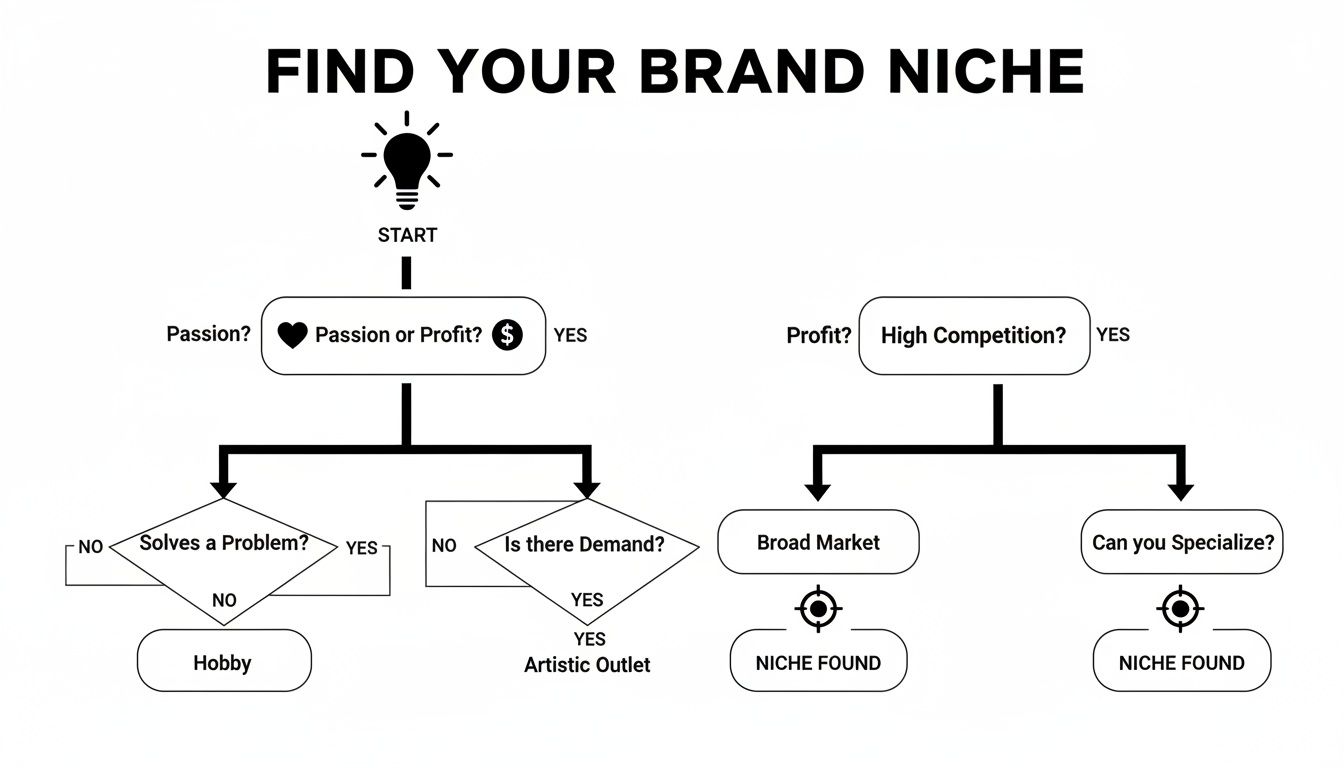
It’s a simple guide to help you decide whether to build a brand around something you love or a niche that’s purely driven by profit potential.
Printing Method Comparison DTF vs DTG vs Screen Printing
To make this decision a little easier, let's put the top three methods head-to-head. This table breaks down the key differences that will impact your day-to-day work and your bank account.
| Feature | DTF (Direct-to-Film) | DTG (Direct-to-Garment) | Screen Printing |
|---|---|---|---|
| Best For | All fabric types, small to medium batches, full-color designs | 100% cotton, photorealistic detail, small orders | Large bulk orders (50+), simple designs with few colors |
| Feel on Fabric | Soft, flexible, slightly raised | Very soft, breathable, no feel | Thicker layer of ink on the fabric |
| Durability | Excellent, withstands many washes without cracking or fading | Good, but can fade over time, especially on darks | Excellent, extremely long-lasting |
| Startup Cost | Low (with transfers) to high (with printer) | Very high initial investment for the printer | Moderate to high for screens, press, and inks |
As you can see, DTF hits a sweet spot. You get the full-color detail of DTG, but it works on way more fabrics and holds up better in the wash. Plus, it’s far more approachable for a new business than screen printing. If you want to dive deeper, you can check out our guide to find the best machine for printing t-shirts and see what fits your vision.
Gearing Up Your In-House Setup
Ready to bring production in-house? Having your own setup gives you total control over quality and turnaround times. Here’s a quick-and-dirty checklist of what you'll need, especially if you’re leaning toward a DTF workflow.
- A Quality Heat Press: This is the absolute heart of your operation. Do not go cheap here. A press that provides even temperature and consistent pressure is critical for getting professional results. A 16"x20" clamshell or swing-away model is a great, versatile starting point.
- DTF Printer and Finishing Gear: If you're ready to print your own transfers, you’ll need the printer, an automatic powder shaker, and a curing oven. Going with US-based suppliers often means better customer support and faster access to parts when you need them.
- Essential Consumables: This is your inventory: blank t-shirts, DTF films, inks, and adhesive powder. Remember, the quality of your blank tees is just as important as the print on them.
- Design Software: You’ll need a program like Adobe Illustrator or Affinity Designer to create your artwork and get it ready for printing.
Pro Tip: When you're just starting, partnering with a US-based DTF transfer supplier is a brilliant strategy. It allows you to offer high-quality, durable prints with only the investment of a heat press, completely bypassing the steep learning curve and cost of a DTF printer. You avoid international shipping delays and customs issues, ensuring you can deliver for your customers quickly and reliably.
Pricing Your T-Shirts for Sustainable Profit
Figuring out what to charge for your T-shirts can feel like walking a tightrope. Go too high, and you might scare off potential customers. Go too low, and you're basically working for free, with no room to grow your business. The real goal is to find that sweet spot—the price that covers all your costs, pays you for your time, and builds a brand that's actually profitable.
It all boils down to knowing your numbers, starting with your Cost of Goods Sold (COGS). This is the bedrock of your pricing strategy, representing every penny you spend to create a single, finished shirt. If you miss even one small expense here, it'll quietly chip away at your profits over time.
Calculating Your Cost of Goods Sold
To get your true COGS, you need to tally up every single direct cost. It’s more than just the blank tee; it's the full picture of what it takes to get that product out the door.
Here’s what you absolutely must include:
- The Blank T-Shirt: This is your biggest and most obvious cost. The price tag will swing based on the brand, fabric (cotton, poly-blend, tri-blend), and your supplier.
- The Print Transfer: If you're going with DTF, this is the cost of the transfer itself. Don't forget to roll in any shipping fees you paid to get them to your workshop.
- Labor: Your time isn't free! Assign yourself a reasonable hourly rate and figure out how long it takes you to press one shirt. Even if it's only a dollar or two per shirt, it adds up fast.
- Packaging: This covers everything from your mailer bags and hang tags to the thank you cards or stickers you slip into each order.
Let's walk through a real-world example. Say your blank shirt costs $4.50, the DTF transfer is $3.00, and your packaging materials average out to $0.75 per order. You time yourself and figure your labor comes out to $1.25 per shirt.
Add it all up, and your total COGS is $9.50. This number is your foundation.
Common Pricing Strategies for T-Shirts
Once you have your COGS of $9.50, you can start thinking about your pricing strategy. There’s no single right answer here—the best approach really depends on your brand's vibe and who you're selling to.
A straightforward and popular method is cost-plus pricing. This is where you simply mark up your COGS by a set percentage. For apparel, a typical markup is between 50% and 75%, which works out to a 2x to 4x multiplier on your cost.
Let's use our $9.50 COGS:
- 2x Markup (50% Margin): $9.50 x 2 = $19.00 retail price.
- 3x Markup (67% Margin): $9.50 x 3 = $28.50 retail price.
This approach ensures you’re covering your expenses and locking in a predictable profit on every sale. To go deeper on other pricing models, check out our complete guide on how to price custom shirts.
Beyond Costs: Considering Perceived Value
While your costs are critical, they shouldn't be the only thing driving your price. You also have to think about value-based pricing. This is less about math and more about the perceived value of your brand and designs.
If you’ve carved out a passionate niche with killer, unique artwork, you can often charge more than a simple COGS formula suggests.
Take a look at what your competitors are doing in the same space. What are their prices? Is their quality on par with yours? This kind of market research helps you position your brand competitively without accidentally leaving money on the table.
Finally, keep your initial investment in mind. Getting a T-shirt business off the ground can have a fairly modest startup cost, often landing between $800 to $3,000 for things like samples, your first batch of supplies, and marketing. If you go the print-on-demand route, your risk is even lower. In that model, production costs might be around $10–$20 per shirt, which can easily retail for $25–$35, giving you healthy 30%–60% profit margins. You can find more insights on these startup costs on Financial Models Lab.
Understanding these financial benchmarks from day one helps you set realistic sales goals and leads to one last crucial calculation: your breakeven analysis. This tells you exactly how many shirts you need to sell to cover your startup costs and finally start making real money. It turns a vague financial hope into a clear, actionable target.
Setting Up Your Store and Marketing Your Designs
You can have the best designs and the highest quality prints in the world, but if nobody sees them, you don't have a business. Now it's time to shift gears from creator to marketer and build the engine that drives your sales. This means creating a storefront and figuring out how to get your t-shirts in front of the right eyeballs.
The first big question is: where are you going to sell? You've got a couple of solid paths, and frankly, many of the most successful brands I've seen use a mix of both.
- Your Own E-commerce Store: Platforms like Shopify or BigCommerce give you total command. You control the branding, the customer journey—everything. This is your digital headquarters, and it’s crucial for building a real, lasting brand.
- Online Marketplaces: Think of sites like Etsy as a built-in customer base. Millions of people are already there, actively searching for unique products just like yours. It's an incredible way to get early traction and see which designs are hitting the mark without having to generate all your own traffic from day one.
And don't sleep on the offline world. Setting up a booth at a local farmer's market, a comic convention, or a craft fair can be surprisingly profitable. It also puts you face-to-face with your customers, which provides priceless feedback and helps you build a genuine community around your work.
Building Your Online Presence
Let’s zero in on building your own online store, since that will be the core of your brand. Getting a Shopify store up and running is more straightforward than you might think; you don't need to be a coding wizard. The goal is to create a space that looks professional and feels trustworthy.
High-quality product mockups are completely non-negotiable. Your customers can’t touch the shirt, so your photos have to do all the heavy lifting. Use mockups that show your designs on different colored shirts and, if you can, on models who look like your target customer. This helps people picture themselves wearing your gear, which is a huge step toward making a sale.
Your product descriptions are another secret weapon. Don't just list the specs like a robot. Tell the story behind the design. What inspired it? What does it stand for? You need to connect with people on an emotional level while still giving them the essential details like fabric type and sizing info.
Marketing Your Designs to Drive Sales
Okay, your store is live. Now what? You have to get people there. This is where a lot of new entrepreneurs get overwhelmed, but a smart, focused marketing plan works wonders. You don't need a massive budget, just a strategic approach.
Social media is basically a visual playground built for apparel brands. Instagram and Pinterest are gold mines for showing off your mockups and lifestyle shots. The key is to create content that actually connects with your niche—it’s not just about posting "buy my shirt" all day. It’s about building a community around the vibe of your brand.
Here's a common mistake I see all the time: trying to be on every single platform. Don't do it. Find the one or two places where your target audience actually hangs out and go all-in there. Consistent effort on one channel will always beat half-hearted posting on five.
Paid ads, especially on Facebook and Instagram, let you get ridiculously specific with your targeting. You can build audiences based on interests that perfectly match your niche, meaning your ads show up for the people who are most likely to care. Start with a small daily budget to test which designs and ad copy perform best.
Finally, email marketing is your most powerful long-term tool. Building an email list gives you a direct line to people who have already raised their hand and said they're interested. Once your store is ready, you need a solid strategy for this. To learn how to promote new drops, run special sales, and turn first-time buyers into loyal fans, check out this ultimate guide to Shopify email marketing.
Planning for Long-Term Growth
Getting those first few sales is a huge win. But what comes next is what separates a hobby from a real business. Scaling isn't just about chasing more orders; it’s about building a system that can handle that growth without letting quality slip. The real challenge isn't launching—it's growing without breaking.
So, how do you know it's time to level up? The signs are usually pretty clear. Are you spending all your time pressing shirts and none on marketing? Do you find yourself turning down bulk orders because your setup just can't handle the volume? That's your cue. It's time to think about investing in better gear, whether that's a more serious heat press or even bringing production in-house with your own DTF printer.
Smart Ways to Expand Your Product Line
Growth also means looking beyond just T-shirts. They're a great foundation, but adding a few well-chosen products can do wonders for your average order value.
Think about what makes sense for your brand and your customers:
- Hoodies and Sweatshirts: This is the most natural next step. They command a higher price and give your loyal customers something to buy when the weather turns cool.
- Tote Bags: These are a fantastic low-cost, high-margin addition. They're perfect for people who love your designs but might not want another piece of clothing.
- Hats: Custom patches or DTF transfers on hats can open up an entirely new market that fits perfectly alongside your apparel.
The trick is to expand without losing your identity. Every new item should feel like it belongs. A solid e-commerce growth strategy is what will guide these decisions and keep you on track.
Don't just throw new products at the wall to see what sticks. Ask yourself, "Is this something my audience would actually want?" If your brand is all about minimalist, eco-conscious designs, organic cotton totes are a perfect fit. If you're in the streetwear game, custom snapbacks make a lot more sense.
Gearing Up for More Orders
When the orders start pouring in, the cracks in your process will begin to show. This is when you need to get serious about optimizing everything. I'm talking about how you organize blank shirts, how you batch your printing, and how you streamline your packing and shipping.
Eventually, you'll hit a point where you just can't do it all yourself. That's a good problem to have. Bringing on your first employee, even just part-time to help with shipping, can be a game-changer. It frees you up to work on the business, not just in it.
With potential profit margins between 20%–60%, efficiency is what turns volume into real profit. In a market projected to grow 25.3% annually, being ready for that demand is everything. You can find more stats on the potential of the print-on-demand market on PODBase.
Common Questions About Starting a T-Shirt Business
Even the best-laid plans run into snags. When you're just starting out in the T-shirt game, you're bound to have questions pop up that feel like major roadblocks. Let's walk through a few of the most common ones I hear from new shop owners—getting these answers straight can save you a ton of headaches down the road.
What's the Most Profitable Printing Method for a Beginner?
Hands down, I almost always recommend starting with Direct-to-Film (DTF) transfers. For someone just getting their feet wet, it strikes the perfect balance between profit and simplicity. Your initial investment is surprisingly low; all you really need to get going is a quality heat press.
The real magic here is that you can order your transfers from a supplier as you need them. This means you don't have to sink thousands into a printer or deal with the mess and stress of managing ink and film inventory. You can test out a dozen different designs without any real financial risk, all while producing vibrant, tough, full-color prints that look great on cotton, polyester, and blends.
My advice? Start with DTF transfers. You get top-tier, professional quality from day one without the huge learning curve or the high cost of bringing all the printing in-house. It’s the smartest way to balance quality, flexibility, and profit when you're new to the business.
Do I Really Need a Business License to Sell T-Shirts Online?
Yes, you almost certainly do. Selling T-shirts online is a legitimate business, and in most places, that means you need to be official. The exact paperwork you'll need can vary a lot depending on your state, county, or even your city.
Generally, you're looking at two key pieces of paper:
- A general business license that gives you the green light to operate in your local area.
- A seller's permit (sometimes called a resale license) that allows you to legally collect sales tax from your customers.
Don't guess on this one. Your best bet is to get in touch with your local Small Business Administration (SBA) office or city hall. They'll tell you exactly what you need to do to stay compliant.
How Much Should I Charge for a Custom T-Shirt?
A great rule of thumb is to price your shirts at 2 to 3 times your cost of goods sold (COGS). This gives you a healthy margin to cover your other expenses and actually make a profit.
First, you need to figure out your COGS. Just add up the cost of the blank shirt, the price of your print (like the DTF transfer), your packaging, and a little something for your time and labor.
Let's say your all-in cost for one finished shirt is $10. Based on that, you should be pricing it somewhere between $20 and $30. Of course, always take a look at what your competitors are charging. You want to make sure your pricing makes sense for your niche and doesn't scare customers away.
Ready to create stunning, durable custom apparel with ease? Cobra DTF offers premium, USA-made DTF transfers with same-day shipping, ensuring you get the quality you need without the wait. Start your order today