

T Shirt Ninjas Explained and Reviewed for Custom Apparel
A small business owner searches “T Shirt Ninjas” while preparing shirts for an event. The results seem to point in different directions: a possible apparel company, ninja-themed merchandise, and several printing methods. Ordering before resolving that ambiguity can mean comparing the wrong vendor, preparing artwork for the wrong process, or promising customers a delivery date based only on production time.
The practical question isn't whether the phrase sounds memorable. It's what the searcher needs: a company that can decorate garments, a transfer supplier, or inspiration for a ninja-themed collection. That distinction affects artwork, licensing, fulfillment, material claims, and total cost.
Introduction to T Shirt Ninjas Confusion
Search intent drives the entire buying decision. A retailer looking for a supplier needs production details, shipping terms, sample procedures, and replacement policies. A customer searching for ninja shirts may want a recognizable graphic or licensed character apparel.
The phrase also overlaps with Shirt Ninjas, an apparel-decoration business, and with the broader appeal of ninja imagery in pop culture. Those aren't interchangeable results. A brand search should lead to vendor verification. A theme search should lead to design, licensing, and garment-selection questions.
Practical rule: Before requesting a quote, write down whether you need finished garments, printable transfers, artwork services, or a ninja-themed product concept.
That short step prevents a common mistake: evaluating a supplier by how well its name matches a theme. A memorable name doesn't establish turnaround, capacity, price, or quality. Buyers need to inspect the actual service model and then benchmark its promises against their own deadline and fulfillment obligations.
Clarifying the T Shirt Ninjas Identity
“T Shirt Ninjas” isn't associated with a clearly documented standalone industry, company, or historical movement in the available sources. The phrase can describe a search for Shirt Ninjas, a general idea involving ninja-themed shirts, or merchandise connected to a larger entertainment property.
The strongest historical apparel connection is the Teenage Mutant Ninja Turtles. Kevin Eastman and Peter Laird created the characters in a self-published comic in 1984. After the animated series debuted on December 28, 1987, Playmates Toys licensed the property, and more than 1.2 million licensed TMNT T-shirts shipped within six months, according to a secondary account of the franchise's apparel history (the TMNT apparel account). That example shows how visual identity, television exposure, licensing, and retail distribution can turn a niche concept into a mass-market garment.
The lesson for a small apparel business is straightforward. If you want to sell recognizable characters, confirm commercial rights before printing. If you want an original ninja-inspired line, build a distinct visual system rather than copying protected characters, logos, or poses.
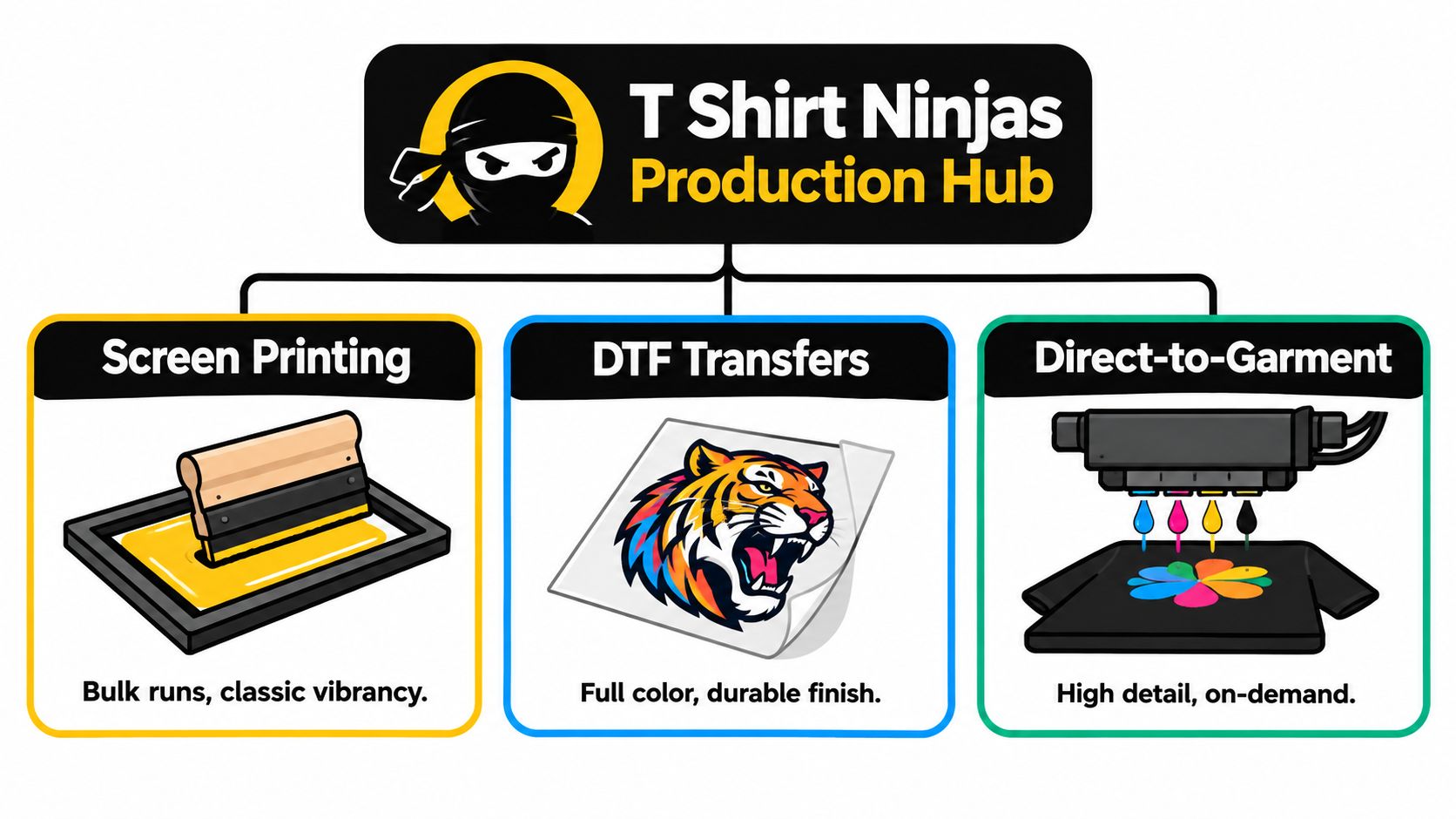
For production, a buyer may compare screen printing, DTG, and DTF. A size-specific option such as DTF Transfers By Size illustrates the transfer model: artwork is prepared for a defined placement such as a chest, sleeve, or full front, then applied to the garment with heat.
Inside the T Shirt Ninjas Brand
A shop owner usually cares less about the name than about how many production handoffs stand between artwork approval and finished garments. Shirt Ninjas operates as a full-service apparel-decoration shop, combining T-shirt printing, graphic design, and embroidery under one roof (Shirt Ninjas).
That integrated model has a clear operational advantage. One partner can assess whether a logo should be printed, embroidered, or adapted for both. The customer doesn't need to send artwork to a separate designer, printer, and embroiderer, which can reduce file confusion and inconsistent branding.
Where the model helps
The arrangement suits businesses with mixed apparel needs. A company might need printed event shirts, embroidered workwear, and artwork cleanup for a new logo. Keeping those tasks together can simplify approvals and make the brand system easier to control.
It doesn't eliminate the need for due diligence. The available company information doesn't disclose measurable production capacity, equipment models, turnaround benchmarks, ink systems, wash-test results, or per-unit pricing. Those details matter if a buyer has a fixed event date, recurring e-commerce demand, or a large uniform order.
Ask for written answers before committing:
- Production scope: Which decoration methods are handled in-house?
- Artwork process: What file types and proofing steps are required?
- Fulfillment terms: Does the quoted timeline cover production only, or production plus delivery?
- Quality control: What happens if a print, stitch, size, or garment is incorrect?
A sample order remains the sensible test. Businesses evaluating transfer quality can also review Get a Free DTF Transfers Sample, which describes DTF transfers for fabric and UV DTF stickers for hard surfaces. The listing states that a shipping fee applies, so buyers should confirm current terms before ordering.
Key Services and Production Methods
The right method depends on artwork complexity, order volume, garment material, and placement. Don't choose a process because its label sounds modern. Choose it because its setup and cost drivers match the job.
Screen printing
Screen printing works well for repeatable designs and bulk runs. Each spot color generally needs its own separation and screen, so more colors increase setup complexity. Flat artwork with strong shapes and limited colors is easier to price and reproduce than a design built around gradients or photographic detail.
Ask the printer whether setup is charged separately, whether screens are retained for reorders, and how proofs are approved. Those answers matter more than a generic “low-cost” claim.
DTF transfers
DTF prints artwork onto film, applies adhesive powder, and transfers the finished image to fabric with a heat press. It suits detailed, multicolor designs, small batches, variable garment colors, and made-to-order workflows. It also lets a shop hold transfers rather than finished printed inventory.
File sizing still matters. For reliable output, prepare raster artwork at 300 DPI at its final physical size. A 12-inch-wide print therefore needs roughly 3,600 pixels across, according to a production guide for custom apparel files (apparel artwork specifications). Vector files such as AI, EPS, PDF, or SVG are preferable for logos, typography, and flat shapes because they scale without raster pixelation.
DTG and embroidery
Direct-to-garment printing is useful for high-detail artwork and on-demand production, especially when screen setup would add unnecessary work. It can be a better fit for gradients and image-like designs, while DTF may be more flexible across garment types and batch sizes. For a focused technical comparison, use this guide to DTF versus DTG printing.
Embroidery creates a raised, durable decoration for polos, caps, jackets, and workwear. It isn't a direct substitute for a detailed full-front illustration. Small lettering and fine artwork may need simplification, and digitizing the design is a separate production consideration.
For visual inspiration before approving artwork, browse these shirt decorating ideas. Then send the decorator the final physical dimensions, garment type, placement, color requirements, and preferred file format.
Delivery Promises Versus Industry Realities
A production window isn't a delivery promise. A vendor may finish the decoration quickly, yet the order can still arrive late because of cutoff times, weekends, carrier delays, geographic distance, or a split shipment.
Print-on-demand fulfillment commonly takes 5 to 7 business days, and 29% of customers cite slow delivery as their top complaint, according to an apparel-printing industry source (fulfillment benchmarks and customer complaints). The key word is “business.” A weekend can extend the calendar time without appearing in the production estimate.
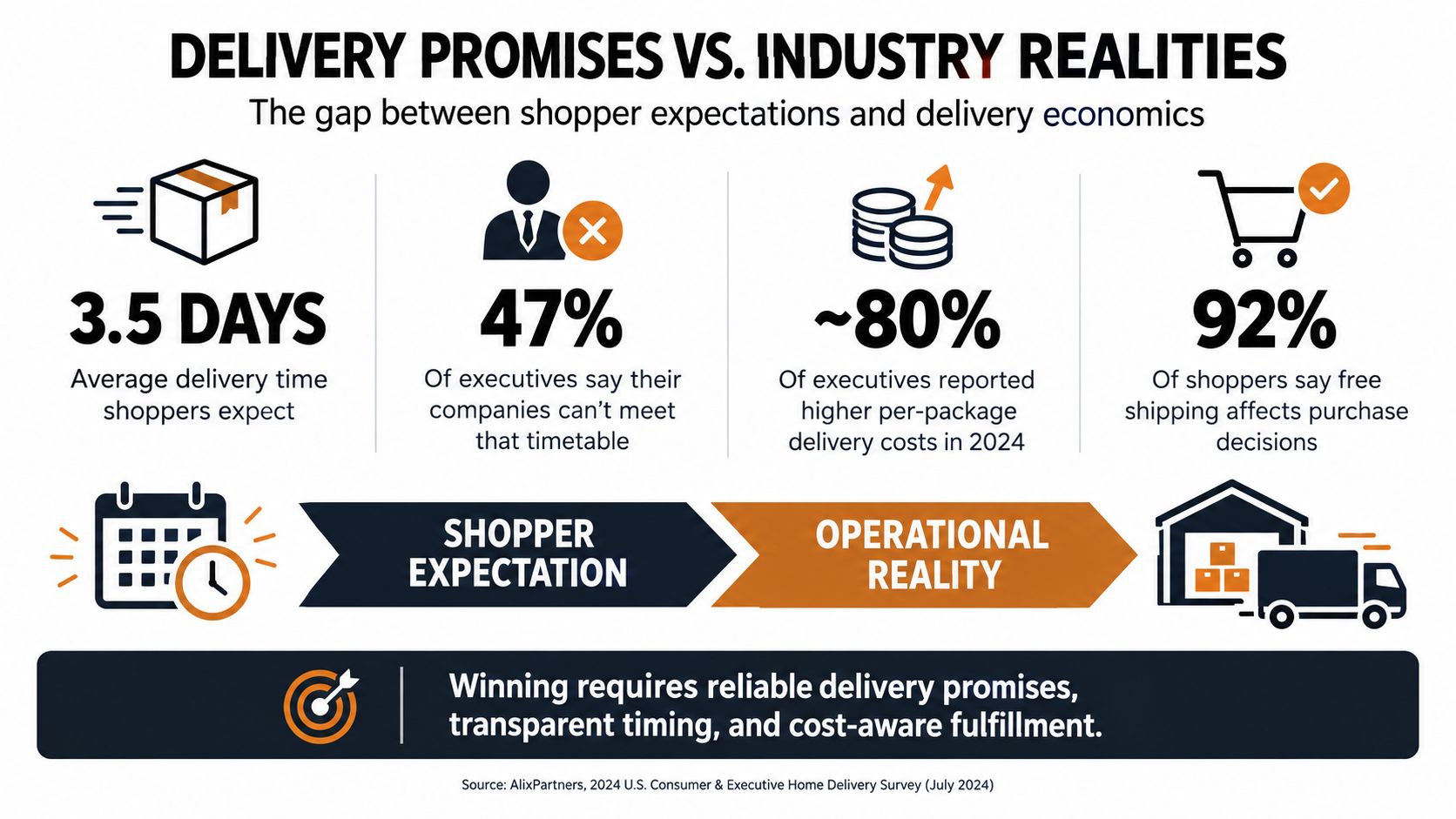
Shipping and fulfillment can represent 15 to 20% of a custom garment's total cost, as reported by the same industry source. That makes a low decoration price less useful if expedited freight, replacement shipments, or failed deliveries consume the margin.
Questions that expose the real SLA
- Cutoff time: What time must an order be approved to enter the stated production window?
- Calendar definition: Do weekends and holidays count?
- Shipping scope: Is the quoted timeline production, transit, or both?
- Tracking: When is tracking created, and when does the carrier receive the parcel?
- Failure handling: Who pays for a reprint if the wrong size, color, or decoration arrives?
- Event buffer: What date does the vendor recommend for an order tied to a fixed event?
For urgent orders, prioritize a supplier with a verifiable location and a clear replacement process. For recurring e-commerce orders, calculate the cost of holding transfer inventory, reprinting defects, and shipping individual parcels. For bulk business apparel, request a production schedule rather than accepting a single broad delivery phrase.
Sustainability and Material Considerations
“Eco-friendly” is not a production specification. A credible assessment needs to identify ink chemistry, film composition, garment sourcing, packaging, energy use, shipping distance, rejects, and wash durability.
Consumer scrutiny is already material to the purchase decision. 45% of consumers research sustainability practices before buying printed apparel, while 55% verify claims through third-party certifications, according to reported apparel-printing research (sustainability research and certification behavior). A vendor that offers only broad environmental language isn't giving a buyer enough information to make a defensible claim.
What to request from a vendor
Ask for supplier certifications, material specifications, packaging details, and disposal guidance. If the vendor uses transfers, clarify the film and adhesive materials. If it promotes water-based or digital printing, ask what that statement covers and what it doesn't.
Made-to-order production can reduce unsold printed inventory, but it isn't automatically the lowest-impact option. Individual parcel shipments, long transport distances, failed deliveries, reprints, and short garment life can offset the benefit of avoiding preprinted stock.
Use a simple vendor checklist:
- Materials: Identify garment fiber content, film, adhesive, ink, and packaging.
- Evidence: Request certifications or supplier documentation, not just a marketing label.
- Durability: Ask how wash performance is tested and what care instructions apply.
- Fulfillment: Include shipping distance, split shipments, replacements, and returns.
- Waste: Ask how misprints, rejected garments, and unused materials are handled.
For a broader framework, review these sustainable manufacturing practices. Use the information to write accurate product copy. Don't promise that a garment has a lower impact unless you can define the boundary and support the claim.
Alternatives and Vendor Comparison Guide
A useful comparison separates known facts from missing facts. The available information confirms Shirt Ninjas' integrated printing, design, and embroidery model. It doesn't establish a verified price range, minimum order, location, or turnaround benchmark for that company. The same caution applies to unnamed domestic and overseas suppliers.
| Provider | Location | Turnaround | Min Order | Price Range |
|---|---|---|---|---|
| Shirt Ninjas | Not disclosed in the available source | Not disclosed | Not disclosed | Not disclosed |
| Cobra DTF | Texas, according to publisher information | Confirm directly | Confirm directly | Confirm directly |
| Domestic DTF supplier | Varies | Confirm directly | Confirm directly | Confirm directly |
| Screen-printing shop | Varies | Confirm directly | Often depends on setup and run size | Quote required |
| Overseas supplier | Varies | Add production and international transit time | Confirm directly | Quote required |
This table isn't a substitute for quotes. It's a warning against filling unknown fields with assumptions. A supplier's country or advertised production speed doesn't tell you the landed cost until shipping, customs exposure, reprints, and delivery risk are included.
Match the vendor to the job
Urgent event order: Choose a domestic transfer supplier with a published cutoff, reachable support, and a sample process. Confirm the arrival date in writing, not just the dispatch date.
Recurring online sales: Compare transfer storage, finished-garment fulfillment, packaging, and replacement handling. A flexible no-inventory model may be useful, but individual shipments can change the economics.
Large repeat run: Request screen-print pricing and ask how setup changes the total. If the design uses many colors or frequent artwork changes, compare that quote with DTF before deciding.
Sustainability-led brand: Require certifications and material documentation. Don't accept “green” as evidence.
Businesses researching design workflows and marketplace options may also find this AI for Merch by Amazon research useful for evaluating idea generation and print-on-demand decisions. For supplier vetting, use this DTF printing supplier guide alongside your written questions.
Conclusion and Next Steps
“T Shirt Ninjas” has two practical meanings. It can refer to a search for Shirt Ninjas, a full-service apparel-decoration shop, or to ninja-themed apparel shaped by pop culture and licensing. Resolve that meaning before comparing suppliers, because the buying criteria differ.
For a vendor decision, inspect the actual decoration method, file requirements, production window, shipping terms, material documentation, and replacement policy. Prepare artwork at the correct final size, use vector files where appropriate, and don't treat a production estimate as the date your customer receives the shirt.
Run a controlled sample before a large order. Test the design on the intended garment, inspect placement and color, follow the care instructions, and record the landed cost. Then ask the supplier to explain any gap between the sample result, quoted timeline, and final invoice.
A disciplined buyer doesn't choose based on the word “ninja.” They choose the production partner that can document the process and meet the commercial promise.
For a practical transfer workflow, Cobra DTF offers DTF transfers designed for heat application to garments, with size-specific options and sample ordering available through its catalog. Visit the site, request a sample, and use the file, fulfillment, material, and replacement questions above before committing to a larger run.