

Screen Printing Equipment for Sale: Buyer's Guide 2026
Orders are getting bigger, deadlines are getting tighter, and your current setup is starting to fight you. That usually shows up in obvious ways first. You stay late to finish a run, you avoid larger wholesale requests because setup takes too long, or you realize one misregistration mistake can wipe out the margin on a job that looked profitable on paper.
That's the point where browsing screen printing equipment for sale stops being casual research and starts feeling like a real business decision. You're not just buying metal and motors. You're buying capacity, consistency, and the ability to say yes to better work without burning out your crew or yourself.
Getting Ready to Scale Your Print Shop
A lot of small shops hit the same wall. The manual press that felt like freedom at the beginning starts to feel like a bottleneck once repeat clients want reorders, local brands want cleaner multicolor work, and your weekends disappear into catching up on production.
That's not a sign you picked the wrong path. It usually means demand is there and the business is asking for a more serious production system. The broader market supports that move. The global screen printing market is projected to reach USD 9.86 billion in 2025 and grow at a CAGR of 3.87%, reaching USD 11.92 billion by 2030, which points to ongoing demand across apparel, packaging, and industrial applications, according to Mordor Intelligence's screen printing market outlook.
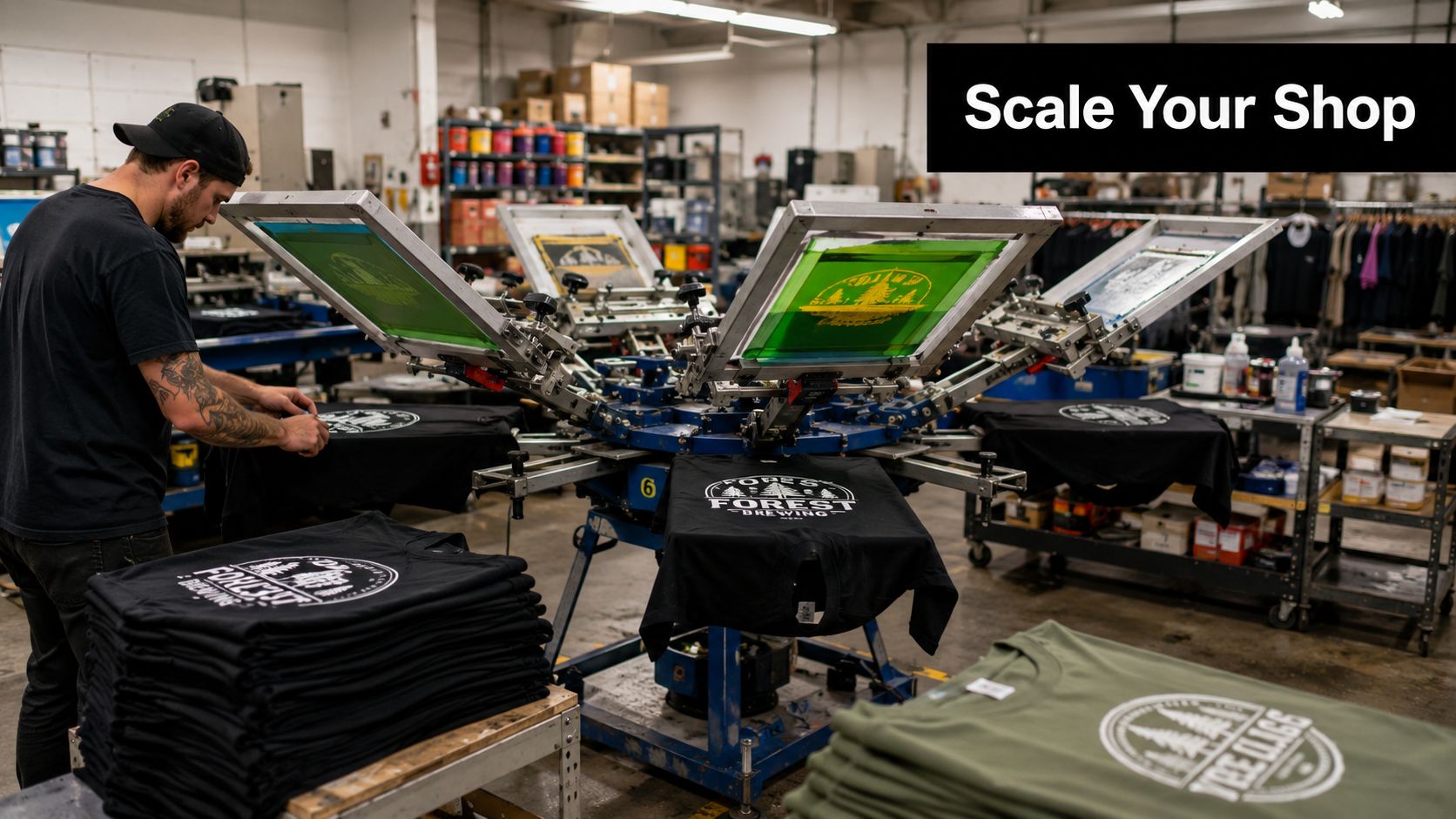
The real trigger is usually production stress
Most first major equipment purchases don't happen because someone wants a shinier machine. They happen because the current workflow creates too much friction.
Common signs you're ready:
- You're turning down orders: Not because demand is weak, but because lead times and labor limits make the work risky.
- Your setup time is eating profits: Short runs become frustrating because loading, registering, flashing, and curing take too much hands-on effort.
- Quality depends too much on one operator: If one person has to “feel” their way through every job, scaling gets hard.
- Your online storefront is outrunning your production floor: Shops that optimize Shopify for AI discovery often improve product visibility, but that only helps if production can keep up once orders start landing.
Practical rule: Buy equipment when it solves a proven bottleneck, not when it flatters your ambition.
Start with capacity planning, not shopping
Before you compare brands, write down what your next stage requires. How many colors do you print most often. How often do you reorder the same designs. Are you mostly selling event shirts, retail-quality brand merch, contract printing, or niche specialty work.
That planning matters because the wrong machine can slow you down just as badly as the old one. A shop that mostly prints repeat jobs needs something different from a shop handling custom one-offs every day. If you want a solid framework for that side of the decision, this project planning guide for production growth is worth reviewing before you start requesting quotes.
The best equipment purchase usually comes from one clear question: what machine lets this shop produce profitable work with less strain, fewer mistakes, and room to grow.
The Core Components of a Screen Printing Setup
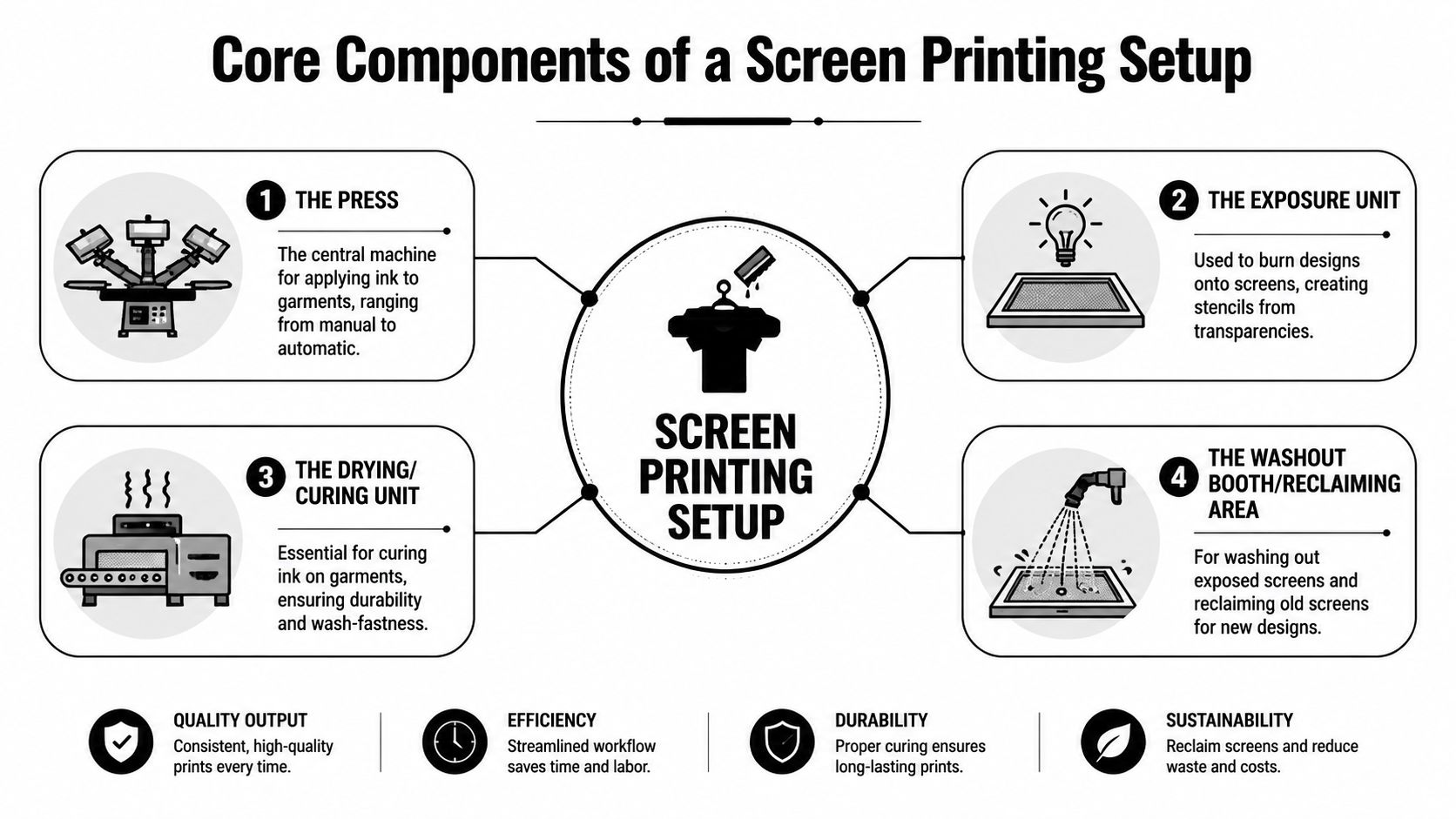
Most beginners search for screen printing equipment for sale as if the press is the whole operation. It isn't. A functioning shop is a system. If one part is weak, the rest of the workflow slows down or quality drops.
The easiest way to think about it is a professional kitchen. The press is your stove. The exposure unit is your recipe control. The dryer is your oven. The washout booth is your sink and cleanup station. If any of those are missing or undersized, service falls apart.
The press is the production hub
The press is often the initial focus, and for good reason. The press determines how garments move through production, how many colors you can run efficiently, and how repeatable your registration will be.
A better press doesn't automatically fix a messy workflow, but it does reduce operator fatigue and improve consistency. That matters most when jobs stack up. If your press requires constant adjustment, every reorder feels like starting over.
The exposure unit controls stencil quality
If the screen room is unreliable, the print floor pays for it. Weak exposures, soft stencils, and inconsistent detail create avoidable problems before ink even hits the shirt.
A good exposure unit gives you repeatability. That means cleaner edges, fewer breakdowns on press, and less time remaking screens. Shops often underestimate this because exposure equipment doesn't look glamorous in a sales listing. In practice, it protects output quality every day.
A clean print starts long before the squeegee stroke.
The dryer is where profit often gets lost
A dryer isn't just a hot box at the end of the line. It determines whether your prints cure correctly and hold up after delivery. Shops that underspend here often create a hidden warranty problem for themselves through undercured or inconsistent prints.
That's why it helps to study the curing side with the same seriousness as the press itself. If you're comparing options, this guide to dryers for screen printing gives a solid overview of how dryer choice affects throughput and reliability.
The washout booth keeps the shop moving
No one gets excited about the washout area until production backs up because screens can't be processed cleanly. A proper booth and reclaiming area reduce mess, improve visibility during washout, and make screen turnaround faster.
This matters more as order volume rises. In a small startup setup, you can improvise for a while. In a busy shop, improvised reclaiming turns into wasted labor, chemical mess, and damaged screens.
Think in systems, not single purchases
A workable setup usually needs these four pieces to support each other:
- Press capacity that matches your order mix: Too small and you choke production. Too large and you overbuy before demand justifies it.
- Exposure that gives repeatable screens: That lowers setup frustration and improves detail on fine work.
- Drying that matches your ink workflow: If curing lags behind printing, the whole floor waits.
- Washout and reclaim space that operators can use efficiently: Fast turnover in the screen room keeps the press from sitting idle.
If your budget won't cover everything at once, prioritize the chain that protects finished quality. A faster press without dependable exposure and curing usually creates expensive mistakes faster.
Choosing Your Press Manual vs Automatic
The press is still the biggest fork in the road. Most buyers aren't really choosing between machines. They're choosing a production style. That's why the manual versus automatic debate gets emotional. Each option solves a different kind of problem.
For many small shops, the right answer sits in the middle. In Europe, semi-automatic screen printing machines hold a 42.78% market share in 2025, largely because they balance efficiency, precision, and affordability for smaller and mid-sized manufacturers, according to Data Bridge Market Research's Europe screen printing machines market report.
A quick side by side view
| Feature | Manual Press | Semi-Automatic Press | Automatic Press |
|---|---|---|---|
| Cost | Lowest entry cost | Mid-range investment | Highest capital commitment |
| Speed | Slower, operator-dependent | Faster than manual with more repeatable cycles | Highest throughput |
| Consistency | Depends heavily on operator skill | Better repeatability | Strongest consistency on repeat jobs |
| Setup burden | Simple but labor-heavy | Moderate | More technical, but efficient once dialed in |
| Labor demand | High physical involvement | Reduced strain | Lowest manual effort per print |
| Best fit | Startups, test markets, low-volume custom work | Growing shops, SMEs, scalable mixed production | Established shops with steady volume |
Manual presses still make sense
A manual press is still a valid machine. It teaches registration, off-contact, squeegee pressure, and shop discipline. For low-volume custom work, niche art prints, and early-stage apparel brands, manual production can be profitable if the owner understands its limits.
What doesn't work is pretending a manual press can carry the same business model as an automatic shop. Once jobs become repeatable and deadlines tighten, labor becomes the primary cost center. The machine may be paid for, but your time isn't free.
Semi-automatic is the overlooked sweet spot
Semi-automatic presses don't get the same attention as flashy full autos, but they solve a real problem. They give smaller shops improved repeatability and throughput without requiring the leap into a fully automated production floor.
That matters when a shop is growing but not yet feeding a large automatic every day. Semi-auto often fits operators who need cleaner output, less fatigue, and a more scalable workflow while keeping the footprint and complexity manageable.
Shop-floor advice: If your order book is inconsistent but trending upward, semi-auto often gives you breathing room without forcing an oversized bet.
Automatic presses reward stable volume
An automatic press pays off when the shop has consistent demand, trained staff, and enough supporting equipment to keep it busy. If screens aren't ready, garments aren't staged, or curing can't keep pace, an automatic can become an expensive monument to poor planning.
Automatic systems shine on repeatable production. They lower physical strain, reduce variation across long runs, and make larger orders less disruptive. They are not a shortcut around weak process control.
How to decide honestly
Use your current jobs, not your fantasy jobs.
Choose based on questions like these:
- What kind of orders fill your week right now: Repeat client runs, local business uniforms, event merch, or highly customized small batches.
- How stable is demand: Consistent enough to keep advanced equipment busy, or still uneven from month to month.
- Who will operate it: A trained production team, or an owner juggling sales, art prep, and printing.
- Can the rest of your shop support it: Screens, drying, staging, and maintenance all have to scale with the press.
The best press is the one your shop can feed, maintain, and profit from consistently.
Budgeting for Your Equipment and Calculating ROI
A machine quote never tells the whole story. Buyers get into trouble when they budget for the press and forget everything around it. Freight, setup, utilities, consumables, and downtime during installation all count. That's why the number that matters most is total cost of ownership, not sticker price.
The range in this market is wide. Screen printing equipment can cost about $200 for entry-level DIY kits and rise to over $100,000 for professional ten-color automatic presses. A four-color automatic press typically lands near $40,000, based on McLogan's breakdown of screen printing equipment costs.
What belongs in your real budget
The machine is only one line item. A cleaner budgeting process includes the surrounding costs that operators feel immediately once equipment arrives.
Make room for:
- Freight and unloading: Heavy equipment can create delivery complications before installation even starts.
- Electrical readiness: Some machines need power arrangements your current space may not have.
- Installation and training: A machine that arrives assembled incorrectly or is operated poorly can waste weeks.
- Initial consumables: Screens, emulsions, inks, chemicals, squeegees, pallets, tape, and test garments add up fast.
- Workflow disruption: Expect some learning curve while production shifts to the new setup.
A simple ROI method that actually helps
You don't need a complicated spreadsheet to make a smart decision. Start with contribution per job. Look at what a machine would let you print more efficiently, what labor it would save, and what jobs it would help you accept with confidence.
Ask:
- Which jobs does this equipment make easier or more profitable
- How often do those jobs already appear in the pipeline
- What labor or rework cost does the equipment reduce
- How long can cash flow comfortably carry the purchase before it pays back
This is similar to how smart operators think about paid growth. If you need a clean framework for the math side, CartBoss's guide to marketing ROI is useful because it teaches the basic habit of measuring investment against actual return.
Don't let a monthly payment trick you into thinking a machine is affordable. A machine is affordable when your shop can keep it productive.
What buyers usually underestimate
The biggest budgeting mistake isn't overspending on quality. It's underestimating the cost of half-solutions. A bargain press with weak support equipment can create spoiled shirts, remade screens, missed ship dates, and operator frustration.
A strong buying decision usually looks boring on paper. The buyer knows the full landed cost, understands the first jobs the equipment will support, and has enough reserve cash left to operate without panic. That's how equipment becomes an advantage instead of pressure.
Sourcing Your Gear New Used and USA-Made
Used equipment is tempting for obvious reasons. The listing price looks manageable, the seller says it was “lightly used,” and the machine appears to solve a real production problem without crushing cash flow. Sometimes that works out. Often, the hidden costs show up after the press is on your floor and a job is due.
The biggest mistake is treating used equipment as if the only risk is cosmetic wear. On production machinery, mechanical condition is the deal.
Used presses can hide expensive problems
A key issue with used automatic presses is that buyers rarely get hard, decision-grade lifespan data from sellers. Most listings talk about brand, color count, and visible condition. Very few tell you what matters most for risk assessment, such as service history, impressions, alignment wear, motor health, clamp performance, and whether a qualified technician has inspected the machine recently.
That gap matters. A 2025 SPAI survey of 1,200 small business owners found that 68% of buyers who purchased used automatic presses without a certified mechanical inspection reported unexpected mechanical failures within the first 12 months, with an average cost of $4,200 in repairs and lost production time.
If a seller can't document condition in a serious way, treat the price as the start of the story, not the end of it.
Dryer obsolescence is a quieter risk
Used dryers create a different problem. A dryer can appear functional and still be a bad fit for the inks you plan to run. That's especially true if the machine was built around older curing expectations and you're trying to move into newer, more efficient ink systems.
A 2024 technical report from the American Apparel & Textile Association found that 54% of small printers who bought used conveyor dryers from 2010 to 2015 experienced significant curing inconsistency when switching to newer eco-friendly inks. The same report noted that 41% had to retrofit those dryers with heating and control upgrades costing $2,500 to $3,800.
That's why used equipment pricing can mislead buyers. The lower purchase price may only be lower because someone else already discovered the machine no longer fits current production needs.
When new makes financial sense
Buying new usually means paying more up front, but it also buys clarity. You know the machine's condition, you get some level of manufacturer or dealer support, and parts availability is usually easier to manage. That reduces the odds of your shop losing days to troubleshooting something a warranty or dealer tech could have handled quickly.
Certified refurbished equipment can also be a good middle path if the seller provides documented inspection, replaced wear parts, and post-sale support. “Refurbished” should mean more than cleaned up and repainted.
Why USA-made matters to many shops
USA-made equipment appeals to shops for practical reasons, not just patriotic ones. Parts support, communication, service turnaround, and build familiarity can all be easier when the manufacturer is domestic.
If domestic sourcing is part of your strategy, this guide to made in USA suppliers is a useful place to start comparing options.
How to inspect before you buy
Don't buy from photos alone. Ask for documentation and watch the machine operate if possible.
Use this short diligence list:
- Request service records: Maintenance history tells you more than polished paint.
- Ask how the machine was used: Contract production, occasional shop overflow, and hobby use create very different wear patterns.
- Verify parts access: A cheap machine with hard-to-find components can become dead capital.
- Check compatibility with your inks and workflow: Especially on dryers and control systems.
- Bring in a qualified inspection when the stakes justify it: Inspection cost is small compared with avoidable failure.
A good used deal is possible. A blind used purchase is a gamble.
Your Practical Pre-Purchase Checklist
Before money changes hands, slow down and run through the details that buyers skip when they get excited by a listing or a trade show demo.
Workspace and utilities
- Measure every access point: Check doors, hallways, loading access, ceiling height, and final floor space.
- Confirm power requirements: Make sure your shop can support the machine safely before delivery day.
- Map production flow: Decide where receiving, screen prep, printing, curing, folding, and packing will happen.
Vendor and machine questions
- Ask what support is included: Training, installation help, phone support, and startup guidance all matter.
- Get warranty terms in writing: Know what's covered, what isn't, and how service claims are handled.
- Ask about replacement parts lead times: Downtime gets expensive fast when one component stalls the line.
- Request a live demonstration or operation video: Don't rely on still photos for moving equipment.
Final check: If you can't explain why this machine fits your order mix, wait before buying it.
Financial readiness
- Build the full budget: Include freight, setup, consumables, and likely shop upgrades.
- Protect working capital: Don't spend so much on equipment that normal operations get squeezed.
- Match financing to realistic production demand: Hope isn't a payment plan.
- Set a payback target: Know what kind of work needs to come through the door for the purchase to make sense.
Good equipment decisions usually feel disciplined, not dramatic.
Frequently Asked Questions
How much space do I need for a screen printing setup
There's no one-size answer because footprint depends on press type, dryer size, screen room layout, and how garments move through the shop. What matters is usable production flow. A cramped shop can own good equipment and still print badly because operators can't stage blanks, rotate around the press, or reclaim screens efficiently.
Can I build a starter setup piece by piece
Yes, and many shops do. The mistake is buying the centerpiece first and ignoring the support equipment. Build in a sequence that protects output quality. Reliable screen prep and curing matter just as much as the press itself.
Is new always better than used
Not always. New is usually safer. Used can work if the seller provides real documentation, the machine matches your workflow, and you inspect it seriously. A cheap machine with hidden wear or outdated curing behavior can cost more than a properly supported new purchase.
Should I buy a screen printing press or use DTF for some jobs
For repeat runs, strong opacity, and efficient bulk garment production, screen printing still makes a lot of sense. For short runs, high-color artwork, names and numbers, or jobs where setup time would kill margin, DTF can complement a screen print shop very well.
What else should I think about after production is handled
Presentation still matters. If you sell online, product images affect trust and conversion. A solid guide to consistent product images can help you tighten that part of the business once your production side is under control.
If you need a fast, dependable way to handle short runs, complex color artwork, or overflow jobs without tying up your press time, Cobra DTF is a practical partner. Their Texas-based, family-owned operation offers premium USA-made DTF transfers, quick turnaround, and reliable shipping, which makes them a strong fit for shops that want to expand capacity without overcomplicating production.