

Boost Shop Efficiency: Quality Improvement Strategies
A rush order is due tomorrow. The first sheet comes off with the wrong red, the second has a placement shift, and now someone is digging through the queue to figure out whether the art file, RIP settings, or curing step caused the miss. In a small custom apparel shop, that one mistake burns film, ink, labor, and schedule at the same time.
Small printing operations usually do not struggle because the team lacks effort. The problem is that the shop added jobs, equipment, and people faster than it added standard work. One operator uses one set of printer settings. Another checks gang sheets differently. A problem that should have been caught at artwork approval shows up at packing, after the cost is already locked in.
Quality improvement strategies fix that gap. They give a DTF shop a repeatable way to hold color consistency, cut reprints, reduce waste, and still hit tight turnaround dates.
The goal is simple. Build a process that catches drift early, corrects the cause, and keeps the same issue from showing up again next week. For small shops, that usually means better handoffs, clearer checks, cleaner work areas, and a few numbers tracked with discipline instead of guesswork.
Some methods focus on waste. Some focus on variation. Some help teams standardize daily work or solve recurring problems without finger-pointing. If you need a practical starting point for production efficiency improvement in a print shop, these frameworks give you a way to tighten the floor without turning the business into a corporate science project.
That includes established systems such as lean manufacturing process improvement, Six Sigma, Kaizen, SPC, supplier controls, and root cause analysis. Used well, they help a small apparel decorator make fewer avoidable errors and recover faster when something does go wrong.
1. Lean Manufacturing
Lean works well in a small DTF shop because waste is easy to see when you know where to look. It shows up as extra motion, waiting time, partial reprints, overproduction, unclear job travelers, and film or ink used on work that wasn't ready to print in the first place.
In practice, Lean starts with one question. Where does the job slow down or get messed up between order intake and final packing?
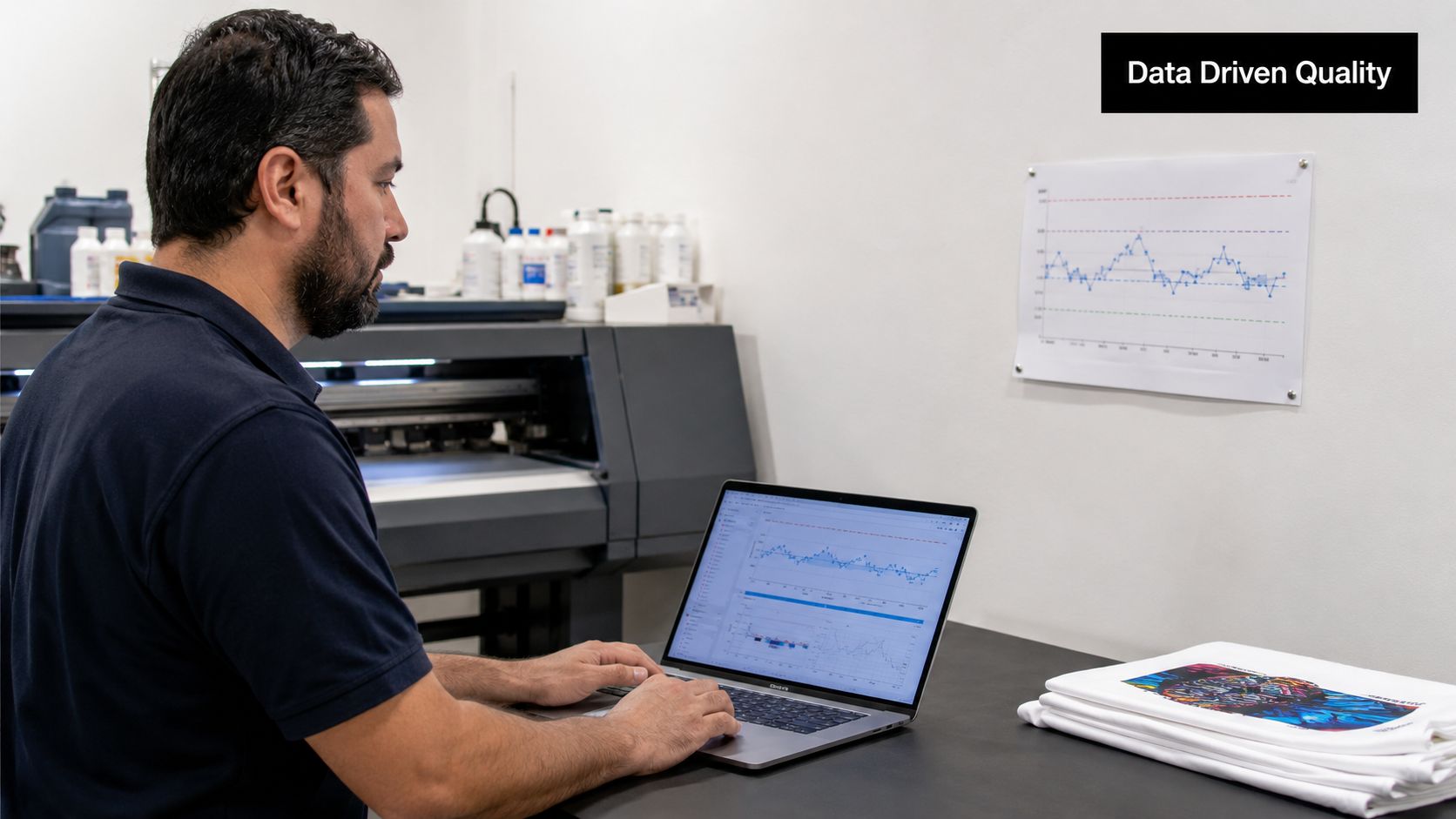
A small shop can map the full path of a standard order. Artwork approval, RIP setup, film loading, print queue, powder application, curing, sheet sorting, packing, and pickup. Once you write it down, bottlenecks usually stop hiding.
What Lean looks like on a DTF floor
If setup takes too long, don't start by buying new equipment. Start by reducing chaos around the equipment.
- Sort tools by task: Keep nozzle-cleaning supplies, swabs, wipes, and calibration materials at the printer, not in three drawers across the room.
- Stage jobs before production: Approved art, garment counts, transfer sizes, and ship dates should be clear before a file hits the queue.
- Use visual flow control: A whiteboard or job board can show what's waiting, printing, curing, and ready to pack.
Practical rule: The fastest way to improve throughput is often to remove confusion, not increase speed.
Lean also fits the broader quality-improvement standard. The NCBI guidance notes that QI is often a dynamic process using more than one tool, which is exactly how Lean succeeds in real shops. You combine process mapping, daily checks, and feedback instead of betting everything on one big fix.
If you want a practical shop-level example of tightening flow and cutting wasted motion, this guide on production efficiency improvement is worth reviewing alongside broader ideas from lean manufacturing process improvement.
2. Six Sigma
A customer calls at 4:30 asking why this week's reorders look warmer than the last run, even though the file did not change. The press operator says settings were normal. The printer log looks fine at a glance. That is the kind of problem Six Sigma is built for.
Six Sigma helps small DTF and custom apparel shops solve repeat defects with a method instead of a debate. DMAIC, Define, Measure, Analyze, Improve, Control, gives the team a clear path. First, name the defect in plain language. Next, measure it the same way every time. Then test likely causes, confirm the fix, and put controls in place so the problem stays fixed during busy weeks.
Where it helps in printing
It works best on expensive, recurring problems that hurt output or customer trust. In a print shop, that usually means color inconsistency across reorders, soft detail on small text, poor adhesion on certain garment types, or spoilage that keeps showing up on one printer or shift.
The key trade-off is time. Six Sigma takes more discipline than quick troubleshooting, so it is not the right tool for every small issue on the floor. If one sheet misfires because someone loaded film badly, correct it and keep production moving. If the same defect keeps showing up across jobs, operators, or batches, stop guessing and run the problem through DMAIC.
A practical example: a shop keeps seeing inconsistent adhesion on performance fabrics. Instead of changing three settings at once, track a few variables that matter. Record the garment type, transfer age, powder laydown, curing temperature, dwell time, and press settings. Review failed jobs for patterns. Then test one change at a time, or a small set of controlled changes, until the failure rate drops for the right reason.
That discipline matters in small operations because one bad habit can spread fast. An operator finds a workaround that saves a job. Another operator copies it. Two weeks later, no one remembers which setting was the actual fix and which one just happened to be there that day.
Use Six Sigma for defects that cost real money, create reprints, or keep showing up without a clear cause.
For a small shop, that often means picking one chronic issue per quarter and solving it fully. That approach is easier to manage than trying to run a formal improvement project on every complaint or production hiccup.
3. Total Quality Management
TQM sounds big, but the practical version is simple. Quality isn't just the printer operator's job. It starts when the order is entered and ends when the customer opens the box.
A lot of small shops struggle because each department optimizes its own piece. Sales wants fast approvals. Production wants clean files. Shipping wants complete counts. Customer service wants quick fixes. TQM forces those groups to act like one system.
Quality has to cross departments
If the art team approves low-resolution files to move jobs faster, production eats the problem later. If receiving doesn't flag questionable film or ink batches, operators get blamed for defects they didn't create. If shipping doesn't record repeated packaging issues, management misses a quality signal.
That's why TQM is less about one tool and more about shared standards.
- Define quality in writing: Spell out acceptable print density, registration tolerance, curing expectations, and pack-out requirements.
- Train beyond job titles: Let customer service understand common production failures and let operators understand what customers complain about most.
- Include suppliers in the quality conversation: Material quality is part of output quality.
One practical lesson from TQM is that customer expectations and production reality have to stay connected. In a DTF shop, that means the same quality standard should show up in quoting, art prep, print checks, and customer communication. If one stage uses looser standards, defects slip through the cracks.
TQM works best in shops where the owner or production lead models it daily. If leadership accepts “close enough,” the floor will too.
4. Kaizen
Kaizen is the opposite of the big reset. It's small, steady improvement built into regular work. That matters in a small shop because most quality gains don't come from one dramatic change. They come from dozens of tiny fixes that stick.
A better film rack layout. A clearer preflight checklist. Better labeling on hot peel and cold peel stock. A faster handoff from print to cure. None of those changes look impressive alone. Together, they reduce friction every day.
Small fixes that actually hold
Kaizen works when your team can point to one thing that got easier this week. Operators usually know where waste lives. So does the person packing transfers at the end of the shift. The mistake is asking for ideas, then never acting on them.
Here's a practical way to run it:
- Keep the suggestion system simple: A whiteboard, shared note, or printed card beats a fancy system nobody uses.
- Fix one annoyance at a time: If weeding through mixed jobs causes sorting mistakes, change batch labeling first.
- Standardize every successful change: If a new curing check reduces rework, write it into the SOP.
A lot of shops skip the last part. They improve something once, but don't document it, train it, or audit it. Then the fix disappears when someone is out sick or a new employee starts.
The best Kaizen ideas often come from the person who loses time to the problem every day.
Kaizen also keeps morale healthier than constant crisis management. Instead of only gathering the team when something goes wrong, you create a habit of improving work before it becomes a failure.
5. Statistical Process Control
A press operator sees one gang sheet come out slightly off shade, bumps a setting, and the next run shifts even farther. I've seen small shops create more variation by reacting too fast than by leaving a stable process alone for another few jobs. Statistical Process Control helps prevent that.
In a DTF shop, SPC means tracking a few repeatable process signals over time so you can separate normal day-to-day variation from a real drift that needs action. That matters when deadlines are tight and materials are expensive. If every small change triggers another adjustment, waste goes up, color consistency gets worse, and the team loses confidence in the settings.
Track the points where jobs usually go sideways
For small custom apparel operations, SPC works best when it stays tied to real production pain. Start with the measurements that affect reprints, customer complaints, and late orders.
A practical short list includes:
- Color check results: Record whether output stays within your approved visual standard across shifts, operators, and film or ink batches.
- Press or cure verification: Track the settings and pass-fail results tied to adhesion problems, especially on garments that have caused trouble before.
- Reprint causes: Log the reason in a consistent way so you can spot repeat failures instead of treating each one like a one-off mistake.
- Pack-out defect rates: Watch whether missed defects spike on rush orders, large runs, or specific handoff points.
One chart that people review beats six charts nobody updates.
Use control thinking, not constant tweaking
SPC is useful because it slows down bad decisions. If color drift appears once on a humid afternoon, that does not always mean the RIP profile, powder, or press setup needs to change. If the same drift shows up across multiple jobs or one material batch, then you have a pattern worth addressing.
That trade-off matters in small shops. Too little response lets defects pile up. Too much response creates instability. Good SPC gives the production lead a basis for deciding when to hold the line and when to intervene.
If your team needs a simple way to map recurring failure paths, these technical fault tree analysis examples can help you break a broad issue, like poor adhesion, into specific contributing factors.
Keep it simple enough to survive a busy week
You do not need software-heavy quality systems to make this work. A shared sheet, whiteboard, or basic dashboard is enough if the team uses it every day. Review the same signals at a set time, with the same definitions, and assign one person to decide whether the trend needs action.
That discipline also supports service. Stable output makes promises easier to keep, which ties directly to improving customer satisfaction in a custom printing business. Customers may never ask whether you use SPC. They notice when repeat orders match, transfers hold, and rush jobs ship without surprises.
6. Root Cause Analysis and Customer Feedback Analysis
If the same complaint keeps coming back, the shop probably fixed the symptom, not the cause. Root cause analysis helps you dig below the obvious answer. Customer feedback tells you where to dig first.
For small custom shops, this pairing is powerful because customers often describe the failure in plain terms. “The print peeled.” “The red looked dull.” “The order was mixed.” That's not a diagnosis, but it is a signal.
Turn complaints into usable shop data
When a complaint comes in, record it in a consistent way. Product type, fabric type, order size, ship method, operator, material batch, and what the customer saw. Then run a 5 Whys or fishbone review with the people closest to the job.
A peeling transfer, for example, might trace back to press dwell time, pressure variation, powder cure, garment finish, or incomplete instructions sent with the order. Without a structured review, teams usually stop at the first plausible explanation.
Customer feedback should also feed back into prevention. That's where many shops fail. They solve one order but never update the process.
- Categorize complaints: Group them by adhesion, color, count accuracy, trim issues, or shipping damage.
- Close the loop internally: If customer service hears a repeat issue, production needs that signal fast.
- Document preventive changes: New press settings, revised artwork rules, or a better final check should be written down.
For shops trying to strengthen the customer side of quality, this guide on how to improve customer satisfaction pairs well with deeper problem-structuring methods like technical fault tree analysis examples.
A complaint is expensive, but it's also useful. It shows you exactly where your process failed in the customer's hands.
7. Quality Assurance and Quality Control
A rush order goes sideways fast in a small print shop. The film prints clean, the gang sheet looks fine, and the job still comes back because the white underbase was weak on half the run or the transfers failed after the first wash. That is the difference between having QA, having QC, and hoping experience will cover the gap.
QA and QC do different work on the floor. Quality assurance builds the process so the job runs the same way every time. Quality control checks the output so bad work does not leave the building.
In a DTF shop, that split matters because reprints are expensive. Ink, film, powder, labor, press time, and shipping all stack up quickly. Final inspection catches some of that risk, but it does not fix a setup routine that changes by operator or a curing step that drifts during a long day.
Build the process, then verify the job
Quality assurance covers the parts of production that prevent trouble before the press is hot. That includes artwork review, printer startup checks, humidity and material handling rules, maintenance schedules, operator training, and written press settings for common fabric types.
Quality control happens during and after production. It includes test prints, color and registration checks, adhesion testing, count verification, and final pack-out review. For a practical checklist, this guide to quality control in printing does a good job translating quality terms into shop-floor checks.
The trade-off is simple. More QC catches more defects, but it also slows throughput if the underlying process is unstable. More QA reduces firefighting, but it takes discipline to document steps that experienced operators may do from memory. Small shops need both, and they need them in the right places.
A workable setup usually looks like this:
- QA sets the standard: File approval rules, approved substrates, startup checklists, cure settings, and maintenance logs.
- QC checks the risk points: First article review, spot checks during long runs, wash or stretch checks when needed, and pack-out verification.
- QC findings trigger QA updates: If the same defect keeps showing up at final inspection, change the setup, training, or work instruction upstream.
Keep the scorecard short enough that the team will use it. I have seen shops bury good operators under forms and still miss the obvious defect because nobody had time to look closely. Track the checks tied to your real failure points, such as color match, adhesion, missing pieces, print placement, and shipping accuracy.
Shops that want tighter inspection without adding another full-time set of eyes are also starting to look at camera-based systems and automated review tools. For a grounded overview, understanding AI quality control is worth reading, especially if you run repeat jobs where visual defects follow a pattern.
The goal is not more paperwork. The goal is fewer reruns, fewer customer complaints, and more jobs that ship right the first time.
8. 5S Methodology
If your shop is always looking for tape, blades, order sheets, sample swatches, or the right film roll, 5S will pay off fast. It's one of the simplest quality improvement strategies because it attacks disorder directly.
5S stands for Sort, Set in order, Shine, Standardize, and Sustain. On paper that sounds basic. On the floor it changes how quickly people can do the job without making mistakes.

Apply it to the places that cause delay
Don't launch 5S across the whole business in one shot. Start with the area where clutter causes quality problems. That might be the printer station, the finishing table, or the transfer storage area.
- Sort what you really use: Remove duplicate tools, expired consumables, damaged samples, and mystery materials.
- Set in order by workflow: Store film, ink, wipes, and maintenance tools where the operator uses them.
- Standardize locations: Every item needs a home that any employee can identify quickly.
A clean and consistent workspace does more than save time. It reduces accidental mix-ups between jobs, lowers handling damage, and makes abnormal conditions easier to notice.
One overlooked benefit is training. New employees learn faster in an organized shop because the physical layout teaches the process. If everything important is labeled, visible, and stored by function, people make fewer avoidable errors.
For shops interested in where workplace organization can connect with newer inspection approaches, understanding AI quality control offers a broader perspective.
9. Supplier Quality Management
Monday starts with a rush order for 48 shirts. The artwork is approved, the press is open, and the crew is ready. Then the powder behaves differently from the last bag, the film releases unevenly, and an easy job turns into a reprint. That is a supplier quality problem, not an operator problem.
Small DTF and custom apparel shops feel this fast because there is not much buffer in the schedule. A little variation in film, ink, powder, blanks, or packaging can throw off color, adhesion, hand feel, or packing accuracy. Tight shops need incoming materials to act the same way from job to job.
Judge vendors by how their materials run in your shop
Price matters. So do freight terms and lead times. But the cheapest supply often gets expensive once it starts costing press time, test prints, remakes, and customer service time.
I have seen shops save a few cents per transfer sheet and lose far more in wasted film and operator adjustments. A vendor that answers lot issues quickly, keeps product behavior consistent, and replaces bad stock without a fight is usually worth more than a lower invoice total.
Treat supplier quality as part of production control. That means keeping one shared record of issues by vendor and lot, instead of letting purchasing, production, and fulfillment all track problems separately. If a blank shirt runs small, a film batch needs more adjustment, or packaging arrives damaged, log it the same way every time.
A simple system works well:
- Set clear material standards: Define acceptable film thickness, powder behavior, ink performance, garment specs, packaging condition, and lot labeling.
- Inspect incoming shipments: Check a sample before stock hits production, especially on new vendors or new lots.
- Track defects by batch: Record what failed, when it showed up, and which supplier and lot were involved.
- Score vendor performance over time: Look at consistency, on-time delivery, response speed, and how often the shop has to compensate on press.
- Qualify a backup source: Do this for any material that can stop production if it disappears or changes.
This does not need fancy software. A shared spreadsheet, lot photos, and a short intake checklist are enough for many small shops.
The key trade-off is simple. Adding incoming checks takes a little time up front. Skipping them pushes that time into press delays, troubleshooting, and reruns, where the cost is higher. Good supplier management reduces surprises on the floor and gives the shop a stronger chance of hitting color, quality, and ship dates consistently.
10. Design of Experiments
A small DTF shop usually hits this point the same way. Prints look fine on one hoodie, then fail wash testing on another. The operator bumps temperature, then pressure, then dwell time, and by the end of the day nobody knows which change helped and which one created a new problem.
Design of Experiments, or DOE, gives that troubleshooting process some order. Instead of changing one setting whenever a problem shows up, you choose a few factors, set defined levels for each one, and test them in a planned matrix. That matters in custom apparel because press temperature, press time, powder load, artwork coverage, film behavior, and garment type often interact. A setting that works on a 100% cotton tee may break down on a poly blend or heavy fleece.
For a small shop, DOE does not need software, a consultant, or a full-time engineer. It needs a clear question and a controlled test. Start with one problem that costs real money, such as poor adhesion on nylon, inconsistent white underbase on large prints, or edge detail softening on fine text.
Set one response variable that the shop can judge the same way every time. That could be peel strength, wash durability, edge sharpness, hand feel, or percent of test pieces that pass inspection after pressing.
Then build a simple test plan. For example, if transfers are failing on a difficult garment, test three factors:
- Press temperature
- Dwell time
- Pressure level
Run the combinations on the same garment type, with the same artwork, film, powder, and operator if possible. Label every sample. Score the result the same way each time. Photos help, but a pass/fail standard helps more.
The trade-off is time. DOE uses blanks, labor, and press time that could go to production. In return, it cuts the endless cycle of small adjustments that burn more time later through reruns, wasted film, and rushed orders. I have seen shops lose a full afternoon to random tweaking when a one-hour test plan would have given them a usable standard.
One warning matters here. Do not run experiments on live customer orders unless the risk is contained and the customer spec is protected. Use test garments, spoilage stock, or clearly isolated samples.
Done well, DOE helps a small print shop turn shop-floor guesswork into repeatable settings. That is the true payoff. Better first-pass quality, fewer reruns, and faster answers when deadlines are tight.
10-Point Quality Improvement Comparison
| Approach | Implementation complexity 🔄 | Resource requirements | Expected outcomes ⭐📊 | Ideal use cases | Key advantages + Tips 💡 |
|---|---|---|---|---|---|
| Lean Manufacturing | Moderate–High, requires culture change and process mapping | Moderate, training, some systems/equipment upgrades | ⭐ Improved throughput, lower waste, faster lead times | Mid-to-high volume DTF production seeking speed & consistency | Reduces waste and lead time. 💡 Start with value-stream mapping and 5S pilots. |
| Six Sigma | High, structured DMAIC projects and statistical rigor | High, certified staff, data systems, training time | ⭐📊 Significant defect reduction and measurable ROI | Complex quality problems where variation drives returns/complaints | Data-driven defect elimination and control. 💡 Begin with Green Belt training and target high-impact projects. |
| Total Quality Management (TQM) | High, organization-wide cultural transformation | High, leadership commitment, ongoing training/resources | ⭐ Long-term quality culture, improved customer loyalty | Company-wide quality focus and brand differentiation | Embeds quality across all functions. 💡 Secure visible executive sponsorship and communicate values. |
| Kaizen (Continuous Improvement) | Low–Moderate, incremental, employee-driven changes | Low, mostly employee time and low-cost improvements | ⭐📊 Steady improvements, higher engagement, sustained gains | Continuous daily improvements on the shop floor | Low-cost, quick wins that build momentum. 💡 Hold regular short improvement meetings and reward ideas. |
| Statistical Process Control (SPC) | Moderate, requires control charts and interpretation skills | Moderate, data collection tools and training | ⭐📊 Early detection of drift; reduced variation and scrap | Processes with measurable parameters (color, adhesion, curing) | Objective, preventive process monitoring. 💡 Monitor key characteristics daily and set clear control limits. |
| Root Cause Analysis + Customer Feedback | Moderate, structured analyses and cross-functional teams | Moderate, time for investigation and feedback systems | ⭐📊 Identifies permanent fixes; reduces repeat complaints | Recurring failures and customer complaints needing permanent resolution | Targets root causes rather than symptoms. 💡 Use 5 Whys/Fishbone and close the loop with customers. |
| Quality Assurance (QA) & Quality Control (QC) | Moderate, SOPs, inspection points, and documentation | Moderate–High, testing equipment, trained inspectors | ⭐📊 Prevents and detects defects; supports guarantees/compliance | Final verification, regulatory needs, and satisfaction guarantees | Combines prevention and detection systematically. 💡 Balance sampling plans and feed QC data into QA improvements. |
| 5S Methodology | Low, straightforward workplace organization steps | Low, labels, storage, employee time | ⭐ Improved organization, safety, and reduced search time | Initial step before Lean/Kaizen; shop-floor organization | Fast visible improvements; foundation for other methods. 💡 Pilot one area and enforce daily routines. |
| Supplier Quality Management | Moderate, audits, specs, scorecards and supplier collaboration | Moderate, auditing resources, incoming inspection | ⭐📊 More reliable inputs, fewer incoming defects and disruptions | Critical materials (DTF films, inks) and supply-chain reliability | Prevents upstream defects and builds partnerships. 💡 Use scorecards and prefer responsive/local suppliers when possible. |
| Design of Experiments (DOE) | High, requires experimental design and statistical analysis | Moderate, controlled tests, software, analysis expertise | ⭐📊 Optimized process settings and insight into interactions | Process optimization (temperature, ink, curing, pressure) | Efficiently finds optimal settings and interactions. 💡 Start with 2-level factorials and clear, measurable responses. |
From Strategy to Action Embedding Quality in Your Shop's DNA
It is 4:30 p.m., the carrier cutoff is coming, and a rush DTF order is back on the table because the reds shifted between batches. The problem is not one bad operator or one bad press setting. The shop has no repeatable way to catch drift early, lock in the right setup, and stop the same miss from happening again.
That is what quality improvement strategies are for in a small print shop. They turn quality into a daily operating system. Color checks happen before a full run. Job information is consistent from intake to production. Rework gets tracked by cause, not shrugged off as part of the business.
Small apparel shops do not need to roll out all ten methods at once. In fact, that usually creates forms, meetings, and very little change on the floor. Start where the money is leaking. If you keep losing time to searching, extra motion, and remake work, begin with Lean and 5S. If the same complaint keeps showing up in customer emails, start with root cause analysis, then tighten QA and QC around that failure point. If press settings drift by operator or shift, use SPC or a simple DOE test to identify a stable window.
Keep the first win small and visible.
A good rule is to choose one problem that happens every week, not one disaster that happened once. In many shops, that means cracked transfers after wash, gang sheets printed with the wrong file version, inconsistent white ink coverage, or late jobs caused by missing garment counts. Fixing one of those issues usually does more for margin and customer trust than launching a big quality program with no clear target.
The trade-off is real. More control can slow production if the team is checking everything, recording too much, or waiting on owner approval for routine decisions. I have seen shops build detailed checklists that operators stop using after three days because they add time without preventing defects. The better approach is simple. Add controls only where failure is expensive, frequent, or hard to detect later.
Sustainability matters more than a strong first week. A process is not fixed if it depends on one experienced press operator remembering the right adjustment from memory. It is fixed when the settings are documented, the incoming file is reviewed the same way every time, the operator knows the inspection point, and the shop can hold the result on a busy Friday. That is the lesson behind sustaining and spreading quality improvement, even though the original context is outside printing.
Measurement also needs more discipline than many small shops give it. Track defects by job type, garment, transfer film, artwork source, shift, or due date pressure. Averages can hide where the problem sits. Shops often say quality is improving overall while rush orders still fail at a much higher rate, or one garment style keeps causing adhesion issues. The same logic shows up in equity-centered quality improvement. Break results into useful groups so the team can see where the process still breaks down.
Clean information supports clean production. Bad file names, missing PO details, unclear reorder notes, and inconsistent color instructions create avoidable mistakes before the first sheet prints. As noted earlier, poor data handling can sink improvement work. In a print shop, it usually shows up as avoidable callbacks, wasted transfers, and operators making judgment calls with incomplete job specs.
If you want to make this practical this week, do three things. Pick one recurring defect. Write the current best method for preventing it. Review results with the team after five working days and decide whether the fix held under normal production pressure.
For shops that want stable inputs as part of that effort, Cobra DTF is one relevant option to evaluate for USA-made DTF transfers and related workflow consistency.
If you're tightening quality and want a supplier that aligns with fast-turn, USA-based production, take a look at Cobra DTF. Their Texas-based operation, domestic production model, and focus on DTF transfers make them a practical fit for shops that want fewer supply surprises and a more consistent workflow.