
A Practical Guide to Printing Techniques for T Shirts
Figuring out the best way to get your designs onto a t-shirt can feel like a maze, but it’s a decision that directly impacts your brand's reputation and bottom line. The five heavy hitters in the t-shirt printing world are Screen Printing, Direct-to-Garment (DTG), Direct-to-Film (DTF), Dye Sublimation, and Heat Transfer Vinyl (HTV). Each one has its own personality, strengths, and ideal use cases.
Navigating Your T-Shirt Printing Options
Choosing a printing method isn't just a technical decision—it's a creative and financial one. Think of it like cooking: you wouldn't use a delicate searing technique meant for tuna on a tough cut of brisket that needs slow roasting. In the same way, the best method for a huge run of simple two-color logos is completely different from what you'd need for a single, complex photographic print.
This choice ripples through your entire operation, affecting everything from the final texture and vibrancy of your designs to your production speed and profit margins. Consider this guide your field manual, breaking down each technique to help you match your vision with the right technology.
A Quick Look at the Top 5 Techniques
Let's start with a bird's-eye view. Each method has a "sweet spot" where it truly shines, making it the perfect tool for a specific type of job.
- Screen Printing: The undisputed king for large-volume orders with a limited color palette. Think band merch or event staff shirts.
- Direct-to-Garment (DTG): The go-to for printing intricate, full-color masterpieces directly onto cotton, even for a single shirt.
- Direct-to-Film (DTF): The jack-of-all-trades. It delivers vibrant, durable prints on virtually any fabric you can throw at it.
- Dye Sublimation: The specialist for creating those seamless, all-over prints on polyester activewear that will never fade or crack.
- Heat Transfer Vinyl (HTV): Perfect for one-off customizations like jersey names and numbers or simple, bold logos for a small startup.
And if your designs lean more toward photorealism, it’s worth learning how to effectively print photos on clothing to get the details just right.
To make things even clearer, let's lay it all out side-by-side.
Quick Comparison of T-Shirt Printing Methods
This table gives you a high-level snapshot of what each technique brings to the table, helping you quickly see which one aligns with your needs.
| Technique | Best For | Feel and Durability | Cost Profile | Fabric Compatibility |
|---|---|---|---|---|
| Screen Printing | Bulk orders (50+), simple designs | Thick, durable, sits on fabric | Low per-shirt on high volume | Cotton, blends |
| DTG | Single prints, complex photos | Soft, breathable, in the fabric | Mid-range for one-offs | Best on 100% cotton |
| DTF | All fabric types, vibrant graphics | Flexible, slightly raised, durable | Mid-range, scales well | Cotton, poly, blends, nylon |
| Sublimation | All-over prints, sportswear | No feel, permanent, breathable | Higher for one-offs | 100% light-colored polyester |
| HTV | Names, numbers, simple logos | Thicker layer, can crack over time | Low for one-offs | Cotton, poly, blends |
As you can see, there's no single "best" method—only the best method for your specific project. Now, let’s dive deeper into what makes each of these techniques tick.
Screen Printing: The Time-Tested Workhorse
Think of screen printing like a highly refined stenciling process. It’s the undisputed heavyweight champion for large t-shirt orders and the classic method behind most of the band merch, event apparel, and company uniforms you’ve ever owned.
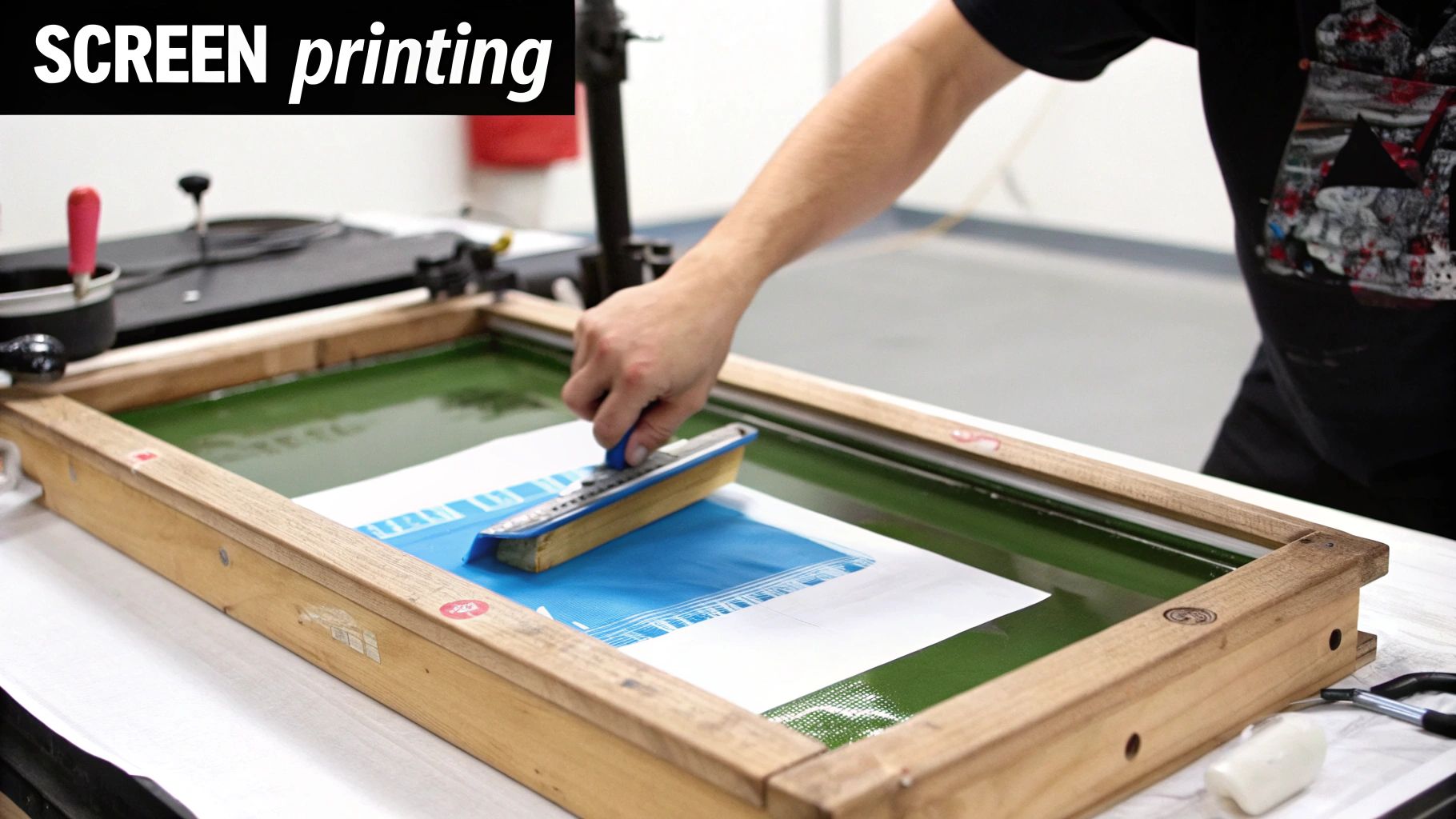
The process starts by creating a mesh screen—the "stencil"—for every single color in your design. Ink is then pushed through this screen and onto the shirt using a tool called a squeegee. Because each color needs its own dedicated screen, you'll find that designs with fewer colors are much friendlier on the wallet.
Why It Excels for Bulk Orders
The real magic of screen printing is its incredible economy of scale. The initial setup is where most of the work and cost lies—creating the screens, coating them, and aligning them perfectly on the press. This makes printing just one or two shirts incredibly expensive.
But once that setup is done, cranking out more shirts is remarkably fast and affordable. This is where the price per shirt plummets. As your order volume climbs, screen printing becomes the most budget-friendly of all printing techniques for t shirts, especially for orders of 100 units or more.
This cost-effectiveness is precisely why screen printing still dominates the industry. It's estimated to handle 70-80% of all commercial t-shirt production worldwide, a true testament to its mass-production power.
Modern automated presses can now print over 2,000 shirts per hour, a far cry from the manual methods of the mid-20th century. Innovations like the rotary press and durable plastisol inks in the 1960s cemented its place as the go-to for high-volume apparel.
Print Quality and Feel
Screen printing is renowned for its use of plastisol inks. These are thick, durable, plastic-based inks that cure on top of the fabric fibers instead of soaking in. This creates a distinct, slightly raised texture that you can feel with your hand—it’s a classic, professional finish.
The result is a print that's incredibly vibrant and opaque, which means the colors pop just as well on a black t-shirt as they do on a white one. The edges are crisp, the colors are bold, and the design is built to withstand countless cycles in the washing machine without fading.
For a deeper dive, our guide on how to start screen printing is a great resource.
Ideal Use Cases for Screen Printing
This method isn't for everyone, but it’s the perfect choice when volume and durability are the top priorities.
- Merchandise for Bands and Brands: It delivers consistent, high-quality results for large production runs.
- Company Uniforms: The prints are tough enough to handle daily wear and frequent, aggressive washing.
- Event Apparel: Think of 5k runs, music festivals, or corporate retreats where hundreds of identical shirts are a must.
- Simple, Bold Graphics: Designs with just one to three solid colors are where screen printing truly shines from a cost perspective.
Limitations You Need to Know
Despite its strengths, screen printing isn't the right tool for every job. Its main weakness is the complexity and cost that come with multi-color designs. Remember, every color requires a separate screen. A design with ten colors means ten screens, ten setups, and a significant jump in cost and labor.
This makes it impractical for printing photorealistic images or designs with smooth color gradients. It's also completely unsuitable for a print-on-demand business model or one-off custom jobs. For single pieces or small batches, the setup cost per shirt is simply too high, making other methods a much smarter choice.
2. Direct-to-Garment: The Digital Artist’s Choice
Think of a high-end inkjet printer, but instead of paper, it prints directly onto a t-shirt. That's Direct-to-Garment (DTG) printing in a nutshell. This method uses specialized, water-based inks that soak right into the cotton fibers of the garment.
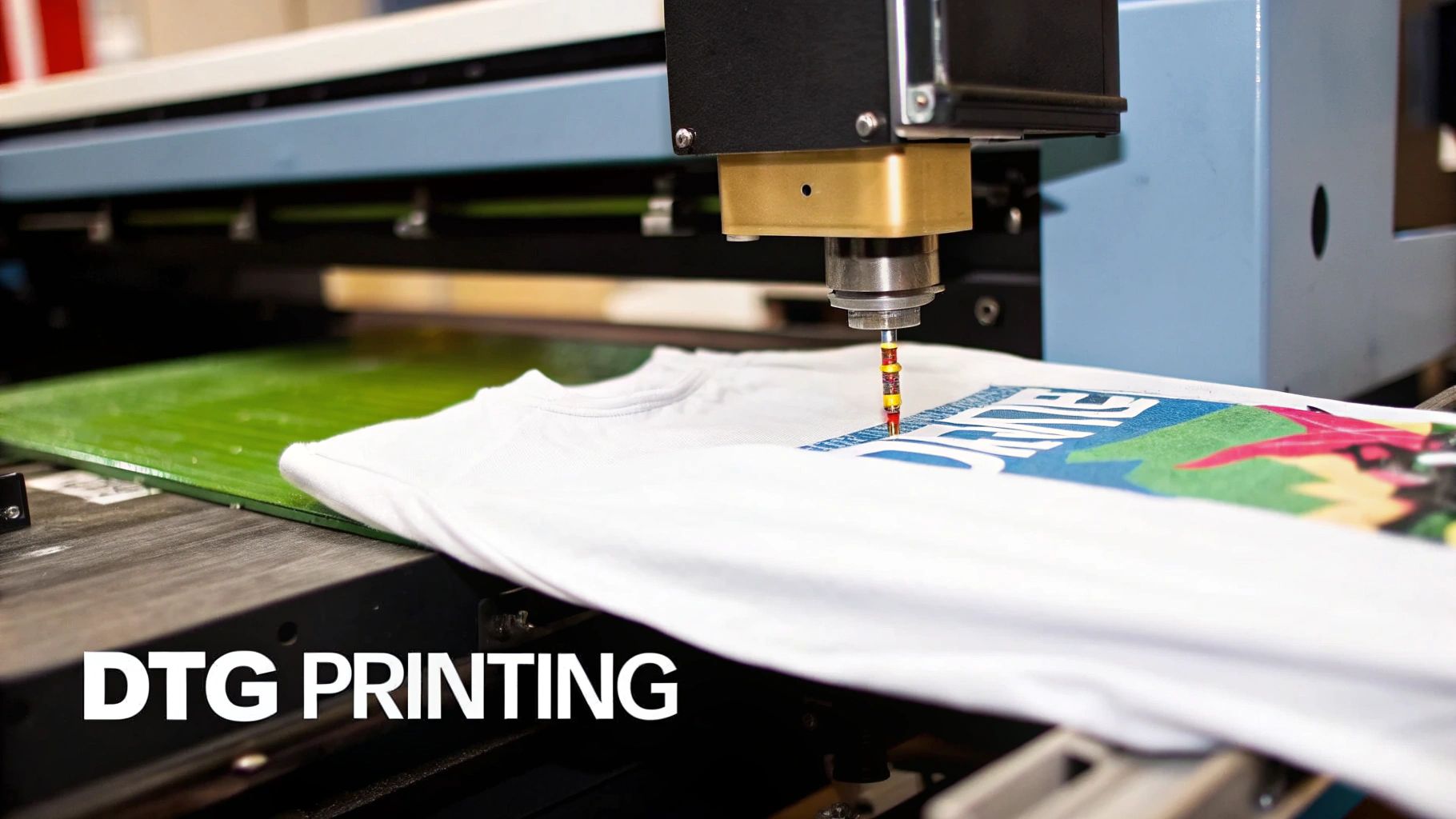
The result is a print with an incredible level of detail, making DTG the go-to for printing photorealistic images, complex illustrations, or designs with subtle color gradients. Unlike other methods that lay ink on top of the fabric, DTG ink becomes part of the fabric.
This integration gives the final print a remarkably soft, breathable feel. When you run your hand over the design, it feels just like the rest of the shirt—no thick, plastic-like layer. It's this premium feel and stunning detail that makes DTG a favorite for artists and high-end apparel brands.
The Hero of On-Demand Printing
Where DTG really shines is in its ability to produce a single, one-off print just as easily as a small batch. There are virtually no setup costs. You don't need to burn screens for every color like you do with screen printing, which makes it the engine behind the print-on-demand business model.
This flexibility empowers small businesses and creators to offer a massive catalog of designs without holding any inventory. You can test new ideas, offer personalized products, and fulfill orders as they come in, one shirt at a time.
Direct-to-Garment printing first appeared in the late 1990s, offering a way to create high-detail prints without screens. Today, DTG accounts for over 50% of small-batch orders in the US print-on-demand market and has seen an annual growth of 25% since 2015. A single print can take 1-5 minutes, but its zero-setup-cost model is a perfect match for intricate designs and e-commerce.
Fabric and Color Considerations
The magic of DTG, however, comes with a specific requirement: fabric type. The technique works best on garments made from 100% ring-spun cotton. The natural fibers are porous and drink up the water-based inks, creating a vibrant, lasting print. While you can print on some cotton blends, the quality starts to fade as the polyester content goes up.
The color of the garment also plays a big role. Printing on a white or light-colored shirt is pretty straightforward. For dark fabrics, the process needs a couple of extra steps:
- Pre-treatment: A special liquid solution is applied to the shirt before printing. This creates a smooth, primed surface for the ink.
- White Underbase: The DTG printer first lays down a layer of white ink in the exact shape of your design.
- Color Layer: Finally, the colored inks are printed on top of this white base, ensuring the final design pops with bright, opaque color.
For a complete breakdown, check out our guide on what is Direct-to-Garment printing.
When to Look Beyond DTG
While DTG is a champion for detail and small orders, it has its limits. The biggest drawback is its speed and cost when you need to print in bulk. The time it takes to print each shirt is much longer than screen printing, making it less economical for orders of 50 or more identical designs.
Its reliance on cotton also restricts your product range. If you're looking to print on polyester athletic wear, nylon jackets, or a wide variety of synthetic blends, DTG simply isn't the right tool for the job. And while durability is good, the prints can be slightly less resilient to harsh washing over time compared to screen printing or DTF.
Direct-to-Film: The Versatile Game Changer
What if you could get the stunning, full-color detail of DTG printing but with the freedom to print on almost any fabric, like you can with screen printing? That's exactly what you get with Direct-to-Film (DTF). This technique is a powerful hybrid that has quickly become a go-to for small businesses and brands that don't want to be boxed in by fabric limitations.
The magic happens in a clever two-step process. First, your design is printed directly onto a special PET transfer film. But this isn't a simple one-layer print. The printer strategically lays down the color ink first, then a layer of white ink on top, which is the secret to making your designs look bold and vibrant, even on the darkest fabrics.
Once the ink is down, the film gets a dusting of a special hot-melt adhesive powder, which only clings to the wet ink. After shaking off the excess, the film is cured with a bit of heat. What you’re left with is a durable, self-contained graphic, ready to be applied to a t-shirt in seconds with a standard heat press.
Unleashing Unmatched Fabric Freedom
The single biggest reason people are flocking to DTF is its incredible versatility. DTG printing is pretty much best friends with 100% cotton, but DTF plays well with almost everything.
It delivers fantastic results on a huge range of materials:
- Cotton and Blends: Expect bright, consistent colors every single time.
- Polyester: It’s a perfect match for athletic wear and performance gear.
- Nylon: Think custom jackets, windbreakers, and bags.
- Fleece and Other Textiles: Easily expand your product line well beyond simple t-shirts.
This freedom from fabric jail is a huge deal. You can slap the same design on a cotton tee, a polyester hoodie, and a nylon bag without ever having to switch up your printing method. Better yet, DTF requires no pre-treatment, which saves you a ton of time, cuts down on chemical use, and makes your entire workflow simpler.
Want a deeper dive into the nitty-gritty? Our full guide on what is Direct-to-Film printing breaks down every step.
An Ideal Solution for Growing Businesses
DTF printing seems almost custom-made for small businesses that need to scale smart. One of the best tricks of the trade is "ganging" your prints. This means you arrange a bunch of different designs—maybe a few chest logos, some sleeve hits, and a handful of neck labels—all onto one large sheet of film. It’s a brilliant way to use every square inch of material, which seriously slashes your cost per print.
While 'film' is the hero of our story, it’s a material with a massive range of uses. To get a better sense of its broader role, you can explore information on various types of industrial films used for things like packaging and product protection.
For those not quite ready to drop a ton of cash on a full DTF printer setup, there's a much easier way in: buying pre-made transfers. Companies like Cobra DTF specialize in producing top-tier, USA-made DTF transfers. All you have to do is upload your ganged-up designs, and they ship you the ready-to-press film. From there, it's just you and your heat press.
This model gives you the best of both worlds. You get professional-grade printing without the six-figure price tag for equipment, allowing you to create high-quality, vibrant apparel on demand and go toe-to-toe with bigger operations.
The final print has a soft, flexible feel that sits on top of the fabric. It’s a little more substantial to the touch than a DTG print, but its durability is off the charts. With proper care, these prints will often outlast the garment itself. This makes DTF a smart, scalable, and seriously versatile choice for any brand looking to make a lasting impression.
To put it all into perspective, let's see how DTF really stacks up against the other major players in the t-shirt printing game.
Comparing DTF with Other Printing Techniques
| Feature | Direct-to-Film (DTF) | Direct-to-Garment (DTG) | Screen Printing |
|---|---|---|---|
| Fabric Versatility | Excellent (Cotton, poly, blends, nylon, leather) | Limited (Best on 100% cotton) | Good (Cotton, poly, blends) |
| Color Vibrancy | High, especially on darks | Good, but white ink can be tricky | Excellent, with bright, opaque colors |
| Feel of Print | Soft, flexible film on top of fabric | Very soft, ink soaks into fabric | Can be thick depending on ink layers |
| Durability | Excellent, very wash-resistant | Good, but can fade over time | Excellent, very long-lasting |
| Best Order Size | 1 to 500+ (Great for on-demand) | 1 to 100 (Ideal for one-offs) | 50+ (Best for large bulk orders) |
| Setup Cost | Moderate (Printer) or Low (Transfers) | High (Printer & pre-treatment) | High (Screens, press, emulsion) |
| Cost Per Print | Low to moderate, great for small runs | High for small runs | Very low for large runs, high for small |
This table makes it clear: DTF hits a sweet spot that the other methods just can't match, offering a unique blend of quality, flexibility, and cost-effectiveness that's perfect for today's apparel businesses.
2. Niche Powerhouses: Sublimation and Vinyl
Beyond the big three, we have two specialized methods that absolutely dominate their corners of the T-shirt world: dye sublimation and heat transfer vinyl (HTV). Both use heat to get the job done, but they solve completely different problems. Think of them as specialist tools in your printing toolbox—perfect for specific, high-impact jobs.
First up is dye sublimation, which is more like a science experiment than a printing process. Instead of laying ink on top of a shirt, sublimation turns solid dye into a gas that actually fuses into the fabric's fibers. It's a bit of magic. Using special inks and a heat press, the design becomes a permanent part of the garment, leaving absolutely zero feel on the surface.
The Magic of Dye Sublimation
This unique process is the undisputed champion for those super-vibrant, edge-to-edge, photorealistic prints you see on 100% polyester clothing. Because the dye bonds with the synthetic fibers at a molecular level, the result is a print that is incredibly bright and will never crack, peel, or fade. Wash it a hundred times; it'll look just as good as day one.
This is why sublimation is the gold standard for sportswear and performance gear. The print doesn't block the fabric's pores, so it stays breathable and moisture-wicking—a must-have for athletic apparel. But here’s the catch: its magic only works on light-colored, polyester-based fabrics. It’s simply not an option for cotton or dark garments.
Sublimation is so good at what it does that it currently holds a 40% share in sports apparel markets, used for pro-level uniforms like those in the NFL and Premier League. These prints can endure over 100 washes with 95% color retention, a level of durability other methods can't touch on synthetics. If you're curious about how we got here, this history of clothing printing on dubhumans.com offers some great background.
Heat Transfer Vinyl: For Bold Simplicity
At the other end of the spectrum, we have Heat Transfer Vinyl (HTV). The best way to think about this is creating high-quality, durable "stickers" specifically made for fabric. A computer-guided blade—a vinyl cutter—carves your design from a sheet of colored vinyl. After you peel away the excess material (a process called "weeding"), you simply place the design on the shirt and lock it in with a heat press.
HTV is the go-to for simple, bold graphics that need sharp, clean edges. It’s the classic technique behind the names and numbers on the back of sports jerseys and is absolutely perfect for one-off custom shirts, small batches for a local team, or even DIY projects at home.
Because it doesn’t involve any ink, HTV is fantastic for designs with one or two solid colors. The result is a slightly raised, smooth layer that sits on top of the fabric.
Understanding HTV’s Strengths and Weaknesses
The beauty of HTV lies in its accessibility and low cost for small jobs. You can get started with a relatively small investment, and it makes personalization incredibly easy. Creating a single shirt with a custom name is just as straightforward as making a dozen.
But it has clear limitations. HTV isn't built for complex, multi-color, or photographic designs. Every color requires a separate layer of vinyl, which quickly becomes a tedious process and results in a thick, heavy print. And while it’s durable, the vinyl can sometimes crack or peel after many washes, especially if it wasn't applied perfectly. It delivers a professional finish for the right kind of job but doesn't offer the soft, integrated feel of sublimation or DTG.
Making the Right Choice for Your Business
Diving into the world of T-shirt printing can feel overwhelming at first. But once you have a handle on the technology, turning that knowledge into a smart business decision is all about asking the right questions. There’s no single "best" method—the right choice is the one that clicks perfectly with your products, your customers, and how you want to run your shop.
Think of it this way: your choice should be a direct answer to a few simple questions. What are you actually making? Who are you selling to? How do you plan to get it done?
Answering Your Core Business Questions
To find your perfect printing match, you need to get crystal clear on your goals. That clarity will naturally point you toward the most logical and profitable printing method for you.
-
What fabrics will you be printing on? If your brand is all about 100% cotton, DTG is a fantastic option. If you’re catering to the athletic crowd with polyester performance wear, sublimation is really your only game. But for total freedom to print on cotton, blends, and even synthetics, DTF is the undisputed champion of versatility.
-
What’s your average order size? Are you fulfilling one-off custom orders from an online store? DTG and DTF transfers are built for that. On the other hand, if you're printing 200 identical shirts for a corporate event, screen printing’s economy of scale just can’t be beaten.
-
How complex are your designs? For simple, one or two-color logos and text, screen printing is a workhorse—it’s efficient and incredibly cost-effective. But for photorealistic images, intricate gradients, or designs with a whole rainbow of colors, both DTG and DTF deliver the stunning detail and vibrancy you need.
-
What’s your budget look like? Committing to an in-house screen printing or DTG setup is a serious upfront investment in equipment and space. If you want to get started with professional results on a smaller budget, ordering pre-made DTF transfers from a supplier like Cobra DTF is a brilliant way in. All you need is a heat press.
This decision tree gives a great visual for how these choices play out, especially for more specialized projects.
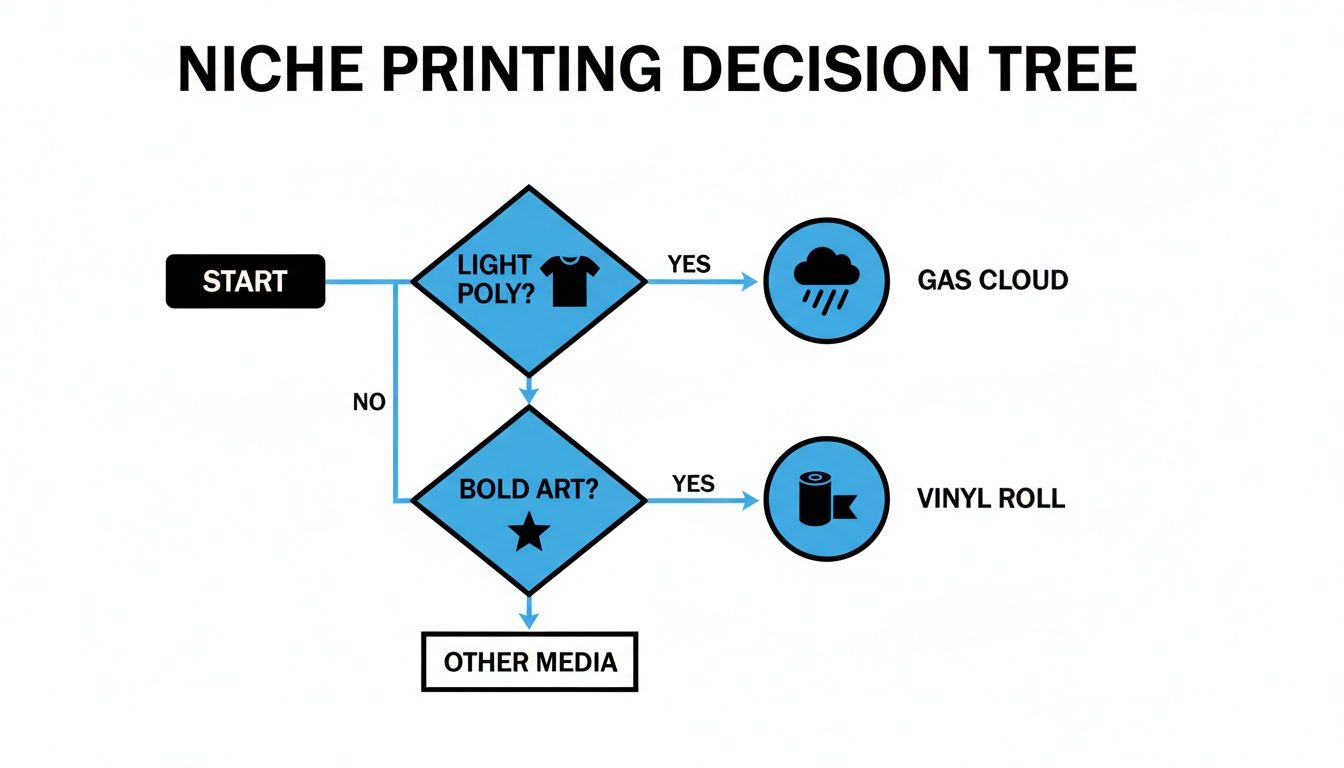
As the flowchart shows, sometimes the material itself (like polyester) or the art style (like bold, simple graphics) immediately narrows down your options to methods like sublimation or vinyl.
Making a Confident, Actionable Choice
Let's put this all together into some clear, real-world scenarios. Your business model will almost always lead you straight to the right technique.
Let’s say you’re launching a print-on-demand store selling cotton tees with complex, artistic designs. DTG is your answer. But if you land a big order for 500 event shirts with a simple two-color logo, screen printing is definitely the most profitable path.
However, if your main goal is maximum versatility—the ability to print vibrant, tough designs on any fabric without sinking a fortune into equipment—then starting with high-quality, US-made DTF transfers is easily the smartest and most scalable way to launch or grow your business. It’s an approach that lets you say "yes" to almost any customer request, right from day one.
Got Questions About T-Shirt Printing? We've Got Answers.
Jumping into the world of custom apparel printing can feel like learning a new language. You've got questions, and we've got straight answers from years of experience in the industry. Let's tackle some of the most common ones that pop up.
Which T-Shirt Printing Method Lasts the Longest?
When you’re talking about pure, rugged durability, a couple of methods have earned their reputation. Screen printing is the old-school champ; its thick plastisol inks form a tough layer on the shirt that can easily power through more than 100 washes. For anything polyester, dye sublimation is unbeatable because the ink literally becomes part of the fabric. It's not on the shirt, it's in it, so there's nothing to crack, peel, or fade.
But don't count out the new kid on the block. Modern DTF (Direct-to-Film) transfers are seriously tough. A quality DTF print is engineered to resist stretching and cracking, and it's not uncommon for the print to outlast the t-shirt itself. This makes it a top-tier choice for designs that need to look great for a long, long time.
What Is the Best Printing Method for Full-Color Photos?
If you're trying to print a complex, photorealistic image—think portraits, landscapes, or detailed artwork—you need to go digital. Your best bets are DTG (Direct-to-Garment) and DTF. Both work like a high-end inkjet printer, capable of reproducing millions of colors, subtle gradients, and fine details with stunning accuracy.
DTG is fantastic on 100% cotton, as it soaks the ink right into the fibers for a super soft, breathable feel. DTF, however, gives you that same jaw-dropping, high-fidelity quality on a much bigger playground of materials. It works beautifully on cotton, polyester, blends, and more, which gives it a huge advantage in versatility.
How Do I Choose the Right Method for My Business?
There’s no single "best" method—the right choice really comes down to what you're trying to accomplish. To figure it out, think through these key points:
- How many shirts are you making? If you're running hundreds or thousands of the same design, screen printing is your workhorse. For one-offs or print-on-demand orders, DTG and DTF are your go-to options.
- What materials are you printing on? Sticking to just cotton? DTG works great. Need the freedom to print on polyester, nylon, or tricky blends? DTF is the clear winner for fabric compatibility.
- How complex are your designs? Simple, one- or two-color logos are perfect for screen printing. For intricate, full-color masterpieces, a digital method like DTF is the only way to do them justice.
The most critical decision you'll make is matching the printing method to your product goals. Getting this wrong—like trying to use DTG for a 500-piece order on polyester jerseys—is a surefire way to get disappointing results and sink your profits.
When you line up these factors against what each method does best, you can pick a technique that not only creates a fantastic product but also makes solid business sense.
Ready to see what top-tier versatility and quality look like? Cobra DTF offers premium, US-made DTF transfers that bring any design to life on virtually any fabric. Start creating vibrant, durable apparel today by visiting cobradtf.com.