
How Do I Start a Shirt Printing Business A Founder's Guide
So, you’re thinking about starting a shirt printing business. It's an exciting venture, and getting it right from the beginning really comes down to a few core decisions: figuring out who you're selling to, choosing the right printing tech (like the incredibly versatile DTF transfers), and sketching out a basic business plan to keep you on track.
Your 11-Step Launchpad for a Thriving T-Shirt Business

Jumping into the t-shirt world can feel like a lot at once, but trust me, success is all about making smart choices from day one. Think of this guide as your personal roadmap. We're going to cut through the noise and focus on what actually works to build a business that lasts.
Your first move? It's the most important one: deciding exactly who you’re going to serve.
1. Find Your Focus with a Niche
The biggest mistake new sellers make is trying to create shirts for everybody. The real secret to breaking through is to find a specific, passionate audience and make something they absolutely love. This is your niche—a dedicated group of people brought together by a shared interest or identity.
Think about communities you're already a part of or know inside and out. A great niche could be anything:
- Merch for local craft breweries or indie coffee shops.
- Apparel for a specific fitness tribe, like powerlifters or trail runners.
- Funny, inside-joke shirts for owners of a particular dog breed (like Corgis or French Bulldogs).
- Custom designs for corporate events and team-building retreats.
When you narrow your focus, your marketing becomes so much easier and more effective. You’re no longer just shouting into the void; you’re having a direct conversation with people who are already looking for what you have to offer.
2. Validate Your Ideas Before You Print a Thing
Got a niche in mind? Great. Now, before you spend a dime on inventory, you need to see if your ideas will actually sell.
Don't just guess what people want. Create a few digital mockups of your designs and share them where your audience hangs out online—think specific Facebook groups, Subreddits, or Instagram hashtags. Ask for feedback, run a poll, and see what gets a reaction. This feedback is pure gold.
The goal isn't just to sell shirts; it's to build a brand that people connect with. Validating your concepts first ensures you're meeting a real demand, saving you from the headache of unsold stock and wasted money.
3. Get a Handle on the Printing Technology
The final piece of your initial planning is understanding the printing methods out there. You don't need to be a technical expert right away, but knowing your options is crucial. Your choice—whether it’s traditional screen printing, direct-to-garment (DTG), or direct-to-film (DTF)—will shape your startup costs, daily workflow, and the quality of your finished products.
And make no mistake, this is a booming industry. The global custom t-shirt market was valued at around $5.16 billion last year and is expected to hit $5.68 billion this year. Analysts project it will soar to $9.82 billion with an 11.5% compound annual growth rate in the next five years, according to data from Grand View Research. The opportunity is definitely there.
We'll get into the nitty-gritty of each printing method soon, but for now, you've got the foundational thinking to get the ball rolling.
Your Niche and Your Tech: The Two Pillars of Your Business
Alright, let's get down to brass tacks. Two decisions are going to shape your entire business more than anything else: who you're selling to (your niche) and how you're going to make your shirts (your printing method). This is the point where we move past the daydreaming phase and make some real, practical choices.
Forget trying to be everything to everyone with generic t-shirts. The real money in this business is made by being specific. We'll walk through how to find a group of passionate buyers you actually connect with, then figure out the best technology to bring your ideas to life for them.
Finding a Niche That Actually Makes Money
A "niche" isn't just some marketing buzzword; it's your secret weapon. It’s how you go from being a tiny, invisible fish in a massive ocean to the biggest, most popular fish in a cozy pond.
Think about it. A shirt that just says "I Love Dogs" has to compete with thousands of nearly identical designs. But a shirt that says "My Corgi is My Co-Pilot"? Now you're talking directly to a very specific, very passionate community that will instantly get the joke.
The best place to start is with what you already know. Are you in a local hiking club? A vintage sci-fi book club? A community of urban gardeners? These built-in passions are goldmines.
Here’s a quick sanity check to see if a niche has real potential:
- Scope out Social Media: Jump on Reddit, browse Facebook Groups, or search for dedicated hashtags on Instagram. If a subreddit like r/welding has hundreds of thousands of members or you find a Facebook group for "Dachshund Lovers" with a huge, active following, that's a fantastic sign.
- Analyze the Marketplaces: Spend some time on sites like Etsy and TeePublic. See what's already selling to your target audience. A little bit of competition is actually a good thing—it proves people are spending money there. Your job is to find the gaps they aren't filling.
- Listen for the Magic Words: Pay close attention to how people talk in these communities. When you hear someone say, "I wish I could find a shirt that said X," that’s not just a comment—it's a direct order for a product you can create.
A great niche does more than just give you customers. It gives you a roadmap for your designs, your marketing copy, and your entire brand. You're building a business on a genuine connection, not just a simple transaction.
Picking the Right Printing Technology
Once you've figured out who you're selling to, you have to decide how you’re going to print the shirts. This choice directly impacts your startup costs, the quality of your final product, and what your day-to-day work will actually look like.
Let's break down the three main players in the game.
Printing Method Comparison: DTF vs DTG vs Screen Printing
Choosing your printing technology is a foundational decision. To help you see how these three popular methods stack up, here’s a side-by-side look at what they offer. This will help you align your choice with your business goals, budget, and the kinds of products you want to create.
| Feature | Direct-to-Film (DTF) | Direct-to-Garment (DTG) | Screen Printing |
|---|---|---|---|
| Best For | Small to large runs, detailed multi-color designs, incredible versatility. | Small runs, print-on-demand, photo-realistic images. | Large bulk orders (50+ items) of the same simple design. |
| Fabric Compatibility | Excellent. Works on cotton, polyester, blends, nylon, leather, and more. | Limited. Works best on 100% cotton. Struggles with synthetics. | Very good. Works on most fabrics but ink types may need to vary. |
| Feel of Print | Soft, flexible, and sits on top of the fabric. | Very soft, as the ink soaks directly into the fibers. | Thicker feel, very durable, sits on top of the fabric. |
| Color Vibrancy | Excellent, especially on dark garments. | Good, but dark garments require a white underbase, which can affect feel. | Excellent, produces very opaque and vibrant colors. |
| Setup Cost & Complexity | Moderate initial equipment investment. Simple per-job setup. | High initial equipment investment. Simple per-job setup. | Low-to-moderate initial cost, but very high setup time per design. |
Ultimately, the best method depends entirely on your business model. For startups focused on flexibility and a wide product range, DTF is often the clear winner. For those doing massive bulk orders for a single client, screen printing still holds its ground.
Direct-to-Film (DTF): The Modern All-Rounder
DTF printing is a relatively new method that’s completely changing the game. The process involves printing your design onto a special film, which is then transferred to the shirt using a heat press. It's exploding in popularity for one simple reason: its incredible versatility.
DTF is fantastic for creating super vibrant, full-color designs that are both soft to the touch and seriously durable. The biggest advantage, though, is that it works on almost any fabric you can throw at it—cotton, polyester, blends, even tricky stuff like nylon. This opens the door for you to sell everything from standard tees to performance wear and hoodies without changing your process.
Direct-to-Garment (DTG): The Cotton Specialist
Think of DTG printing as a sophisticated inkjet printer, but for t-shirts. It applies ink directly onto the fabric, resulting in incredibly detailed, high-resolution prints. Because the ink soaks right into the fibers, the final print has a very soft, barely-there feel.
The catch? DTG is really only happy on 100% cotton fabrics. Its performance on polyester or dark-colored blends can be hit-or-miss without careful pre-treatment, which adds time and complexity to your workflow. This can seriously limit the types of apparel you can offer.
If you want to see a full breakdown of how these two digital methods compare, check out our complete guide on the different t-shirt printing techniques.
Screen Printing: The Old-School Workhorse
Screen printing is the classic, time-tested method. It uses stencils (called screens) to push layers of thick ink onto a shirt one color at a time. It produces incredibly durable, vibrant prints and is, by far, the most cost-effective way to print large batches (think 50+ shirts) of the exact same design.
The big downside is the setup. Every single color in your design needs its own custom screen. This makes the whole process slow, messy, and expensive for small runs or designs with a lot of colors. It’s just not practical for a modern startup that needs to be agile and offer custom, on-demand products.
This is a key reason why digital printing has taken over. In fact, the market for digitally printed custom t-shirts is projected to grow by 12.5% annually for the next five years. This isn't just a trend; it's a massive shift in how printing businesses are built for success today.
Setting Up Your Production Space and Supply Chain
Alright, you’ve picked your niche and landed on the best printing method for your vision. Now it's time to get your hands dirty and build the physical heart of your business. This is where your designs stop being pixels on a screen and start becoming real, wearable products. Getting your production space and supply chain right from the get-go is the foundation for everything that comes next.
You don’t need a sprawling warehouse to get started. Honestly, some of the most successful shirt brands I know started in a spare bedroom, a garage corner, or a small basement setup. The secret isn't about having a ton of space; it’s about being smart with the space you have.
Designing an Efficient Workspace
Think through your process from the moment a box of blank shirts arrives to the second a finished order heads out the door. A logical flow saves you time, prevents mistakes, and keeps you from going crazy when you’re swamped with orders.
Your space really just needs a few dedicated zones:
- Receiving & Storage: This is where your blank apparel lives before it gets printed. Find a spot to keep the boxes off the floor—clean, dry, and out of direct sunlight to keep the fabric in perfect shape.
- The Production Hub: Here’s where the magic happens. You'll need a sturdy, level table for your heat press. Make sure you have enough room to move around it comfortably without bumping into things.
- Transfer & Tool Station: Designate a small, organized spot for your DTF transfers, Teflon sheets, heat-resistant tape, and anything else you use regularly. You want these within arm's reach.
- Packing & Shipping: A clean, flat surface is a must for folding, bagging, and labeling your finished shirts. This is where you'll keep your mailers, boxes, shipping scale, and label printer.
A Quick Word of Caution: Your heat press is a power-hungry piece of equipment. Don't just plug it into any old outlet. To get consistent heat and avoid tripping breakers (or worse, creating a fire hazard), you really need to run it on a dedicated electrical circuit.
Building a Lean and Reliable Supply Chain
Your supply chain is just a fancy term for the partners who get you the stuff you need. For a modern startup using Direct-to-Film, this really comes down to two key relationships: your source for blank shirts and your provider for DTF transfers. The quality of your final product is a direct reflection of the quality of these suppliers.
This decision tree gives you a good visual on how different factors point toward the best printing method for a given job.
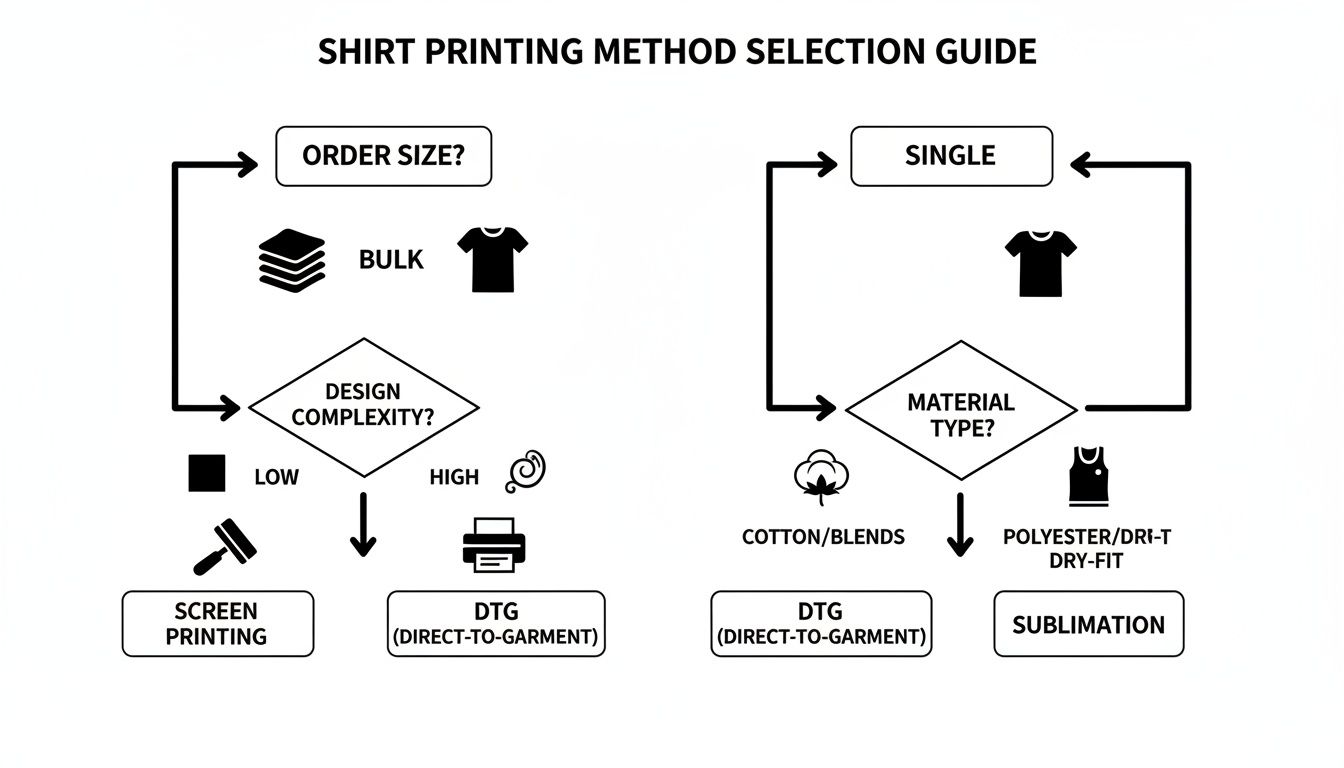
As you can see, for smaller runs and highly detailed, custom designs, digital methods like DTF are the clear winner. Screen printing still has its place, but typically for massive bulk orders.
Choosing the right partners isn't just about finding the cheapest option. Reliability, speed, and consistent quality are what will make or break your business in the long run.
The Smart Way to Start DTF Production
Here’s a huge mistake I see new entrepreneurs make: they assume they need to buy their own DTF printer right away. That's a fast track to a lot of debt and frustration.
Running a DTF printer involves a steep learning curve, daily maintenance, and a finely-controlled environment (think specific temperature and humidity levels). A much, much smarter approach is to simply outsource the printing of your transfers.
By partnering with a company that prints the transfers for you, you completely sidestep the $3,000-$20,000 upfront investment in a machine and all the headaches that come with it. Your only major equipment cost is a quality heat press. This frees you up to pour all your energy into designing cool stuff, marketing your brand, and taking care of customers—the things that actually make you money.
Selecting Your DTF Transfer Supplier
When you're looking for a transfer supplier, my number one tip is to find a USA-based company. This single decision saves you from the nightmare of international shipping delays, surprise customs fees, and late-night calls across time zones. A domestic partner like Cobra DTF means you can get your transfers in just 1-3 days, which is a game-changer for keeping customers happy.
Here's a quick checklist to use when vetting a supplier:
- Print Quality: Always order samples first. Are the colors popping? Are the edges crisp? How does it feel on the shirt after you press it—is it soft or stiff?
- Turnaround Time: How fast can they get your order out the door? Look for a commitment to same-day or next-day shipping. Speed is everything.
- Customer Support: Can you get a real human on the phone or chat if something goes wrong? Good support is priceless when you're in a jam.
- Ease of Ordering: Their website should be dead simple to use. Uploading art, picking sizes, and checking out should be a smooth, painless process.
Sourcing Quality Blank Apparel
The other half of your supply chain is the blank apparel itself. The shirt is the canvas for your art. A fantastic design printed on a cheap, scratchy shirt is still a cheap, scratchy shirt.
Always order samples to test everything—the fit, the feel, and how it holds up after a few washes. For a great list of trusted vendors, check out our guide to wholesale blank apparel suppliers.
By thoughtfully setting up your workspace and strategically picking your supply partners, you're building a powerful, lean foundation for your business that minimizes risk and sets you up to scale when the time is right.
Creating a Realistic Business and Financial Plan
An idea without a plan is just a hobby. Now it's time to build the framework that transforms your passion for shirt printing into a legitimate, profitable business. Forget those intimidating 50-page documents from business school; what you really need is a practical roadmap to keep you focused and help you make smart decisions from day one.
This is where you get real about your vision. The goal is to clarify your mission, get laser-focused on who you're selling to, and pinpoint what makes your brand stand out in a sea of T-shirts. A solid plan will be your guide, and understanding how to write a comprehensive business plan is the perfect place to start.
Breaking Down Your Startup Costs
Before you can think about profit, you need a crystal-clear picture of what it's going to cost to get the doors open. Honesty here is your best friend—no surprises down the road. Your startup costs really boil down to two buckets: one-time investments and ongoing expenses.
One-time investments are the things you have to buy upfront to get rolling.
- Heat Press: This is the heart of your operation. Don't cheap out here; a quality press is the difference between prints that last and prints that peel. Expect to invest $300 to $800 for a machine that won't let you down.
- Business Formation & Licenses: This varies a lot depending on where you live, but budgeting $100 to $500 to set up an LLC and get local permits is a safe bet.
- Initial Inventory: This covers your first batch of blank shirts and your first order of DTF transfers. A modest starter inventory can run from $200 to $600.
- Website & Branding: Getting a domain name, a Shopify plan, and maybe a simple logo from a freelance designer can cost as little as $50 to $150 to get started.
Ongoing expenses are the recurring bills you'll have each month. Think about your Shopify subscription, shipping supplies like mailers and labels, and any money you set aside for social media ads.
Don't let these numbers scare you. Many successful brands launched with just a few thousand dollars. By starting lean with pre-made DTF transfers, you completely sidestep the massive $3,000+ investment for a DTF printer, making this one of the most accessible businesses to start right from your home.
Estimated Startup Costs for a DTF T-Shirt Business
Getting a handle on your initial investment is key. This table lays out a realistic look at what it takes to launch a home-based shirt business using DTF transfers.
| Expense Item | Cost Range (Low End) | Cost Range (High End) | Notes |
|---|---|---|---|
| High-Quality Heat Press | $300 | $800 | Your most important equipment investment for durability. |
| Business License/LLC | $100 | $500 | Varies greatly depending on your state and local laws. |
| Initial Blank Apparel | $150 | $400 | A small stock of popular sizes and colors to start. |
| First DTF Transfer Order | $50 | $200 | Enough for your initial product mockups and first orders. |
| Website Setup & Domain | $50 | $150 | Includes domain name and initial e-commerce platform fees. |
| Shipping Supplies | $40 | $100 | Poly mailers, shipping labels, packing tape, etc. |
| Marketing Budget (Initial) | $50 | $200 | For social media ads or influencer collaborations. |
| Total Estimated Startup | $740 | $2,350 | A lean launch is very achievable under $1,000. |
As you can see, you don't need a fortune to get started. A smart, focused approach allows you to get up and running for less than the cost of a new laptop.
Pricing Your Shirts for Real Profit
Now for the fun part: making money. A huge mistake I see new sellers make is just adding a few bucks to their costs. To build a business that lasts, you have to price for value, not just for survival. A healthy profit margin in the custom apparel world is anywhere from 40% to 60%.
Let's walk through a simple pricing model.
- Calculate Your Cost of Goods Sold (COGS): This is just the direct cost to make one shirt. Let's say a quality blank tee costs you $5, and the DTF transfer for the design costs $4. Your total COGS is $9.
- Set Your Retail Price: To hit a 50% margin, the simplest formula is to double your COGS. So, $9 x 2 = $18. This is your starting price.
- Adjust for Value: Is your design super unique? Are you targeting a premium niche? Don't be afraid to price higher. If your brand feels special, people will happily pay $25 or $30.
Navigating the Legal Essentials
Finally, let's make it official. You don't need a team of lawyers, but taking a few key steps will protect you personally and add a layer of legitimacy to your brand. The two most common options for a new shirt business are a Sole Proprietorship or an LLC.
A Sole Proprietorship is the easiest and cheapest route, but it offers zero liability protection—meaning your personal assets are at risk if something goes wrong.
An LLC (Limited Liability Company) costs a little more to set up, but it creates a legal wall between you and your business. For most entrepreneurs, the peace of mind and protection an LLC offers is well worth the small investment.
For a much deeper dive into structuring your finances and goals, check out our sample t-shirt printing business plan for more detailed guidance.
Marketing Your Brand and Landing Your First Sale
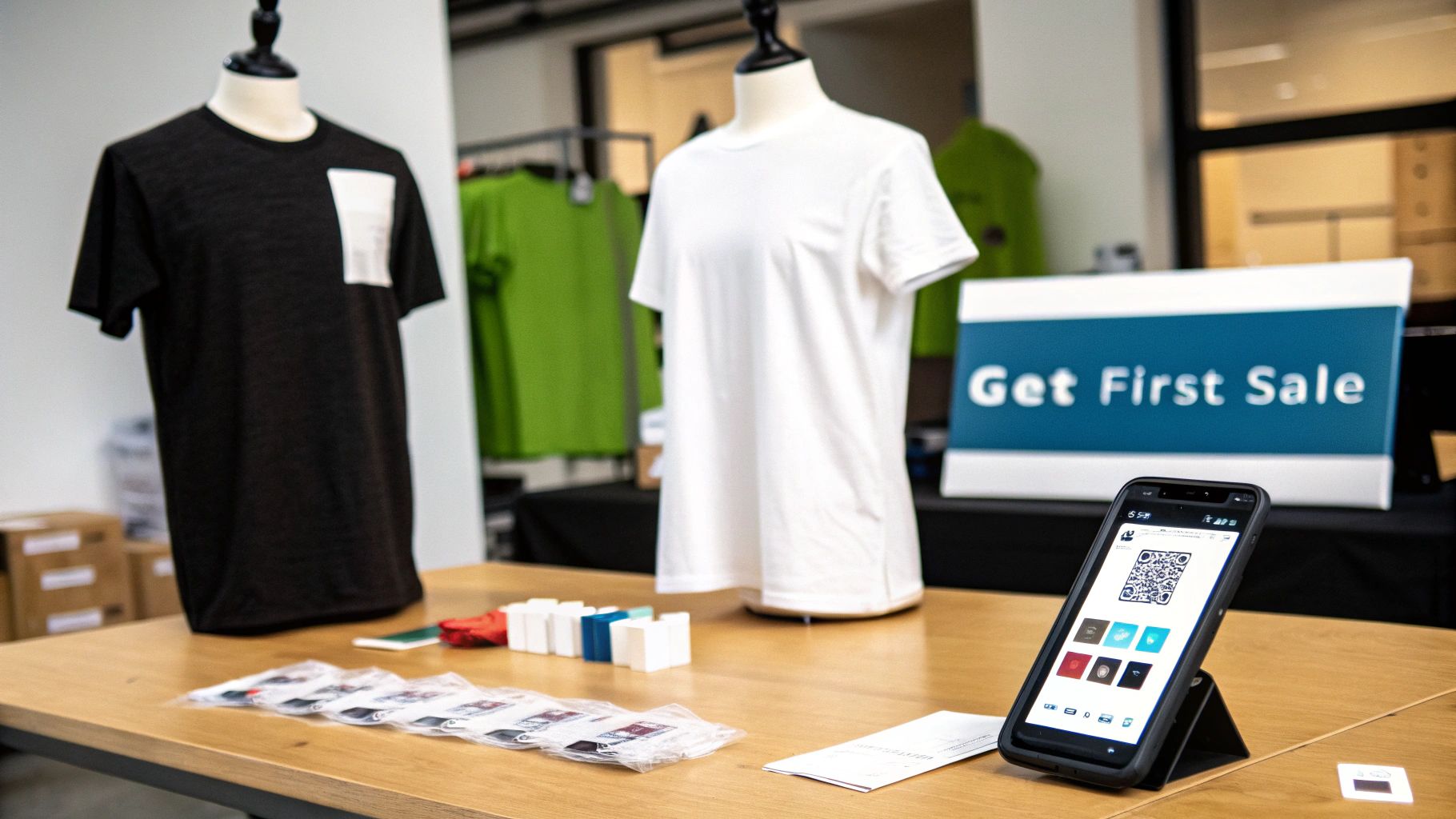
Alright, your workspace is set up and your supplies are ready to go. This is where the real fun begins: getting your shirts in front of people and making that very first sale.
Marketing isn't just about throwing ads out into the world and hoping for the best. It's about showing up where your ideal customers already are and building real connections. You don't need a huge budget to get started, either. A smart combination of online and local strategies will help you build momentum faster than you might think.
Build Your Portfolio Before You Have a Client
One of the first hurdles you'll face is the classic "chicken-and-egg" scenario. You can't get clients without a portfolio, but you can't build a portfolio without clients. The workaround is simple: make your own projects.
Go ahead and print shirts for yourself, for a passion project, or even for a fictional brand you dream up. This move is brilliant for two reasons:
- It proves your quality. High-quality photos of actual, physical shirts are infinitely more convincing than digital mockups.
- It helps you practice. Every single shirt you press is another rep, helping you dial in your technique and get comfortable with your gear.
Take photos of these samples in good, natural light. Even better, get friends or family to model them. This gives you a solid library of professional-looking content you can use to launch your website and social media channels.
Establish Your Digital Storefront
Think of your online store as your modern-day storefront. It needs to look professional and be incredibly easy for customers to use. For anyone just figuring out how do I start a shirt printing business, platforms like Shopify or Etsy are fantastic because they handle the headache of payment processing for you.
Pick a clean, simple theme that lets your product photos shine. When you write your product descriptions, tell a story. Who is this shirt really for? What’s the inspiration behind the design? The more you can connect with a customer on an emotional level, the closer you are to a sale. As you start to get traction, you'll also want to improve your e-commerce customer experience to keep people coming back.
Use Social Media to Tell Your Story
Visual platforms like Instagram and TikTok are perfect for a T-shirt business. But don't just post flat, boring product shots. Instead, create content that shows off your brand's personality.
Try shooting short videos of your heat press in action, that super-satisfying moment of peeling a DTF transfer, or the care you take when folding and packing an order. This kind of behind-the-scenes content builds trust and makes your brand feel much more human. And don't forget to use relevant hashtags so your niche audience can actually find you.
Connect with Your Local Community
While selling online gives you a global reach, never underestimate the power of your own backyard. Building a strong local customer base can create a steady income stream and generate some of the most powerful marketing there is: word-of-mouth.
- Partner with Other Businesses: Offer to create some cool staff shirts for a local coffee shop or brewery. In return, maybe they can display your business cards at their counter.
- Attend Local Events: Set up a small booth at a farmers' market, craft fair, or a neighborhood festival. Nothing beats that face-to-face interaction.
- Create Sample Packs: Put together a small package with a sample shirt and your business card. Drop them off with local bands, school clubs, or other small businesses that could use custom gear.
The global custom T-shirt market is massive, but you don't need to compete with everyone. The rise of e-commerce and on-demand services has empowered small, local businesses to thrive by offering what the giants can't: niche products, faster turnarounds, and superior, personal customer service.
Even though the Asia-Pacific region contributes an estimated 47% to global market growth, the core principles of connecting with a dedicated audience are universal. Your local focus is a genuine competitive advantage, not a limitation.
Alright, you’ve got the dream and the drive. But launching a business is one thing; navigating the first year is where the real work—and the real learning—truly begins. Once you shift from planning to the day-to-day grind, you’ll hit all sorts of practical questions and unexpected speed bumps.
Think of this section as a conversation with someone who's been there. We're going to tackle the most common headaches and hurdles new shirt printing entrepreneurs face, giving you the straight answers you need to sidestep the pitfalls and keep moving forward.
How Much Money Can I Actually Make Selling Shirts?
This is the big one, isn't it? The honest answer is that your profitability comes down to your niche, how you price your shirts, and how efficiently you can run your operation. In this business, a healthy profit margin usually lands somewhere between 30% and 60%.
Let’s put that into perspective. Say a great blank shirt and a custom DTF transfer from a supplier like Cobra DTF costs you about $10 total. A perfectly reasonable price to sell that finished shirt for is somewhere between $25 and $30. That leaves you with $15 to $20 in your pocket for every single shirt you sell, before you factor in other costs like marketing or website fees.
Even a small, home-based setup selling a modest 50 shirts a week with an average profit of $15 per shirt could bring in $3,000 a month in gross profit. The secret to making that number grow is twofold: first, build a loyal following that keeps coming back for more, and second, start buying your supplies in larger quantities to knock down your cost for each shirt.
What's the Absolute Bare-Minimum Gear I Need to Start?
It's so easy to get lost in endless lists of equipment when you're first figuring out how to start a t-shirt printing business. But the truth? You can get off the ground with a surprisingly lean setup. If you're smart about it and use a modern, transfer-based approach, you really only need two things.
- A High-Quality Heat Press: Do not cheap out on this. It's the heart of your entire operation. You need consistent, even heat and pressure to create prints that last. A reliable press is the difference between a professional-grade shirt and one that peels after the first wash.
- A Great DTF Transfer Supplier: This is the game-changer. By partnering with a supplier for your transfers, you completely sidestep the need for a DTF printer, special inks, film, powder, and all the software that goes with it. Your startup costs plummet from thousands of dollars to just a few hundred.
Beyond that, all you need are some quality blank shirts and a couple of Teflon sheets to protect your garments and your press. That's it. You're in business.
Starting with pre-made transfers is the single smartest move a new shirt business can make. You get to pour your limited cash into marketing and inventory—the things that actually make you money—instead of sinking it all into complicated, expensive machinery right out of the gate.
Do I Have to Be a Graphic Designer?
Nope. Not at all. This is one of the biggest myths that stops people from even trying. While being a design whiz is a nice bonus, it's absolutely not a requirement for success.
Plenty of incredibly successful shirt businesses don't create a single design themselves. Instead, they become the go-to production pros for clients who already have their artwork ready. Think about it:
- Local businesses that need branded shirts for their staff.
- Bands who need merch for their next show.
- Artists looking to put their illustrations on apparel.
- Schools and sports teams that need custom gear for events.
And if you do want to offer your own original designs, you can buy commercially licensed, ready-to-print artwork from online marketplaces. Or, for those who want to try their hand at design, super user-friendly tools like Canva or Kittl are fantastic places to start. The key is to know what you're good at and focus on delivering an amazing final product.
How Do I Handle Copyright with Customer Designs?
This is a big one, and getting it right from day one will protect your business. When a customer sends you a design, the legal responsibility for that artwork has to be on them, not you.
You need a crystal-clear clause in your terms of service that says the customer guarantees they have the legal rights to use and reproduce any design they upload. The easiest way to handle this is with a simple checkbox they have to click during the ordering process, confirming they agree to your terms.
You also need to use your own common sense. If someone sends you a design with Mickey Mouse, the Nike swoosh, or an NFL team logo, you have to say no—unless they can show you an official licensing agreement that proves they have permission. Spending a little bit of money to have a lawyer draft this one policy for you is a very wise investment that can save you from a world of legal and financial pain down the road.
Ready to build your business on a foundation of quality and speed? Cobra DTF provides premium, USA-made DTF transfers that will make your products stand out. Get your transfers in just 1-3 days and start pressing with confidence. Explore our products and see the difference for yourself.