
direct to film vs direct to garment: choosing a print method
At its core, the difference between direct-to-film (DTF) and direct-to-garment (DTG) really boils down to application and versatility. Think of DTF printing as the champion of flexibility; it lets you create durable, vibrant designs on a huge range of fabrics, including tricky ones like polyester and blends. On the other hand, DTG printing is the specialist, excelling at producing soft, breathable, and incredibly detailed prints directly onto cotton garments.
DTF vs DTG: Which Printing Method Is Right for You?
Choosing the right apparel decoration technology can feel like a huge decision, but it gets a lot easier when you frame it around your actual business goals. Ask yourself: are you trying to offer a massive array of products, from athletic jerseys to custom hats? Or is your focus on building a premium brand known for its high-quality, super-soft cotton tees? Your answer points you directly to the right choice.
Direct-to-Film (DTF) is all about versatility. The process involves printing your design onto a special film, which is then heat-pressed onto the garment. This two-step method is what allows it to work so well on materials that are notoriously difficult for other techniques.
In contrast, Direct-to-Garment (DTG) operates more like a high-end office printer but for fabric. It applies water-based inks that soak directly into the cotton fibers. The result is a print with an incredibly soft hand-feel, almost like it's part of the shirt itself.
At a Glance: DTF vs DTG Comparison
To get a quick handle on things, this table breaks down the core differences. It's a great starting point for seeing where each technology shines.
| Feature | Direct-to-Film (DTF) | Direct-to-Garment (DTG) |
|---|---|---|
| Best For | Versatility across many fabric types (cotton, polyester, blends, nylon) | High-detail, soft prints on 100% cotton garments |
| Print Feel | Smooth, slightly raised layer on top of the fabric | Extremely soft, breathable, and integrated into the fabric fibers |
| Color Vibrancy | Excellent vibrancy and opacity, especially on dark garments | Great color depth, but can appear less vivid on darks without proper pre-treatment |
| Durability | Highly durable, flexible, and resistant to cracking or peeling | Good durability, but can fade over time with improper washing |
| Ideal Products | Sportswear, workwear, hats, bags, polyester and blended apparel | Premium t-shirts, hoodies, tote bags, and fashion apparel |
| Workflow | Print on film, apply powder, cure, then heat press to garment | Pre-treat garment (for darks), print directly, then cure with heat |
This table makes it clear: the best choice really depends on what you're making and for whom.
The demand for personalized apparel is only getting bigger, making both technologies incredibly valuable assets for a print shop. In fact, the global DTG market alone is projected to climb from USD 3.2 billion in 2025 to a staggering USD 9.1 billion by 2035, a trend largely fueled by e-commerce and customers wanting unique products.
Key Takeaway: If your business model relies on product diversity and decorating all sorts of materials, DTF is the clear winner. If you specialize in premium, breathable designs exclusively for cotton apparel, DTG offers a superior feel and finish that customers love.
Ultimately, knowing the strengths of each method is what matters most. When you align the technology with your product line and target audience, you can invest with confidence and set your business up for long-term growth. To really dig into this, check out our guide on the best printing method for t-shirts.
A Look at How the Core Printing Processes Work

Before you can really decide between DTF and DTG, you have to get a feel for how they actually work. On the surface, they both create custom shirts, but their mechanics are completely different. Those differences ripple out to affect everything from the types of fabric you can print on to how the final design feels in your hand.
Let's walk through the day-to-day workflow of each method.
The Direct-to-Garment (DTG) Method
Think of DTG printing like your office inkjet printer, but built for t-shirts. It sprays specialized water-based inks right onto the fabric, allowing them to soak in and become one with the fibers.
This direct approach is why DTG prints are famous for their incredibly soft feel—you can barely tell they're there. But there's a catch: for the ink to stick properly, especially on dark garments, you have to apply a pre-treatment first.
The DTG Workflow, Step by Step:
- Pre-Treatment: First, you spray a liquid pre-treatment solution onto the area you're printing. This chemical acts as a primer, giving the ink something to grab onto so it doesn't bleed. On dark fabrics, it also creates a white base so the colors pop.
- Printing: Next, the shirt is smoothed onto a platen and loaded into the DTG printer. The machine then meticulously sprays the ink directly onto the fabric, recreating your digital file.
- Curing: As soon as it comes out of the printer, the garment goes under a heat press or through a conveyor dryer. This heat blast permanently sets the ink, making the design durable enough to withstand washing.
The pre-treatment stage is a huge point of difference for DTG. Getting it right is non-negotiable for a sharp, vibrant print, but it also adds an extra step—and a potential point of failure—that you just don't have with DTF.
If you want to get into the nitty-gritty, we cover this process in much more detail in our guide on what is direct to garment printing.
The Direct-to-Film (DTF) Method
DTF flips the script with an indirect, two-part process. Instead of printing on the shirt, you first print your design onto a special sheet of PET transfer film. This film is just a temporary carrier for the ink and adhesive.
It's this clever workaround that makes DTF so incredibly versatile. Because the printer never actually touches the final garment, you can press these transfers onto almost anything, completely skipping the pre-treatment hassle of DTG.
The DTF Workflow, Step by Step:
- Film Printing: The design is printed in reverse onto the DTF film. The printer lays down the color (CMYK) layer first, then immediately covers it with a layer of white ink that will serve as the base.
- Powder Application: While the ink is still wet, a fine, hot-melt adhesive powder is sprinkled over the entire design. You shake off the excess, so the powder only sticks to the wet ink.
- Curing the Transfer: The powdered film is then passed through a small oven or placed under a heat press (without contact) to melt the adhesive. This creates a smooth, solid backing on the transfer.
- Heat Pressing: Finally, you place the finished transfer onto your garment and press it with heat. The heat activates the now-solid adhesive, bonding the design permanently to the fabric. After a moment to cool, you peel the film off, and only the print is left behind.
Comparing Print Quality, Durability, and Feel
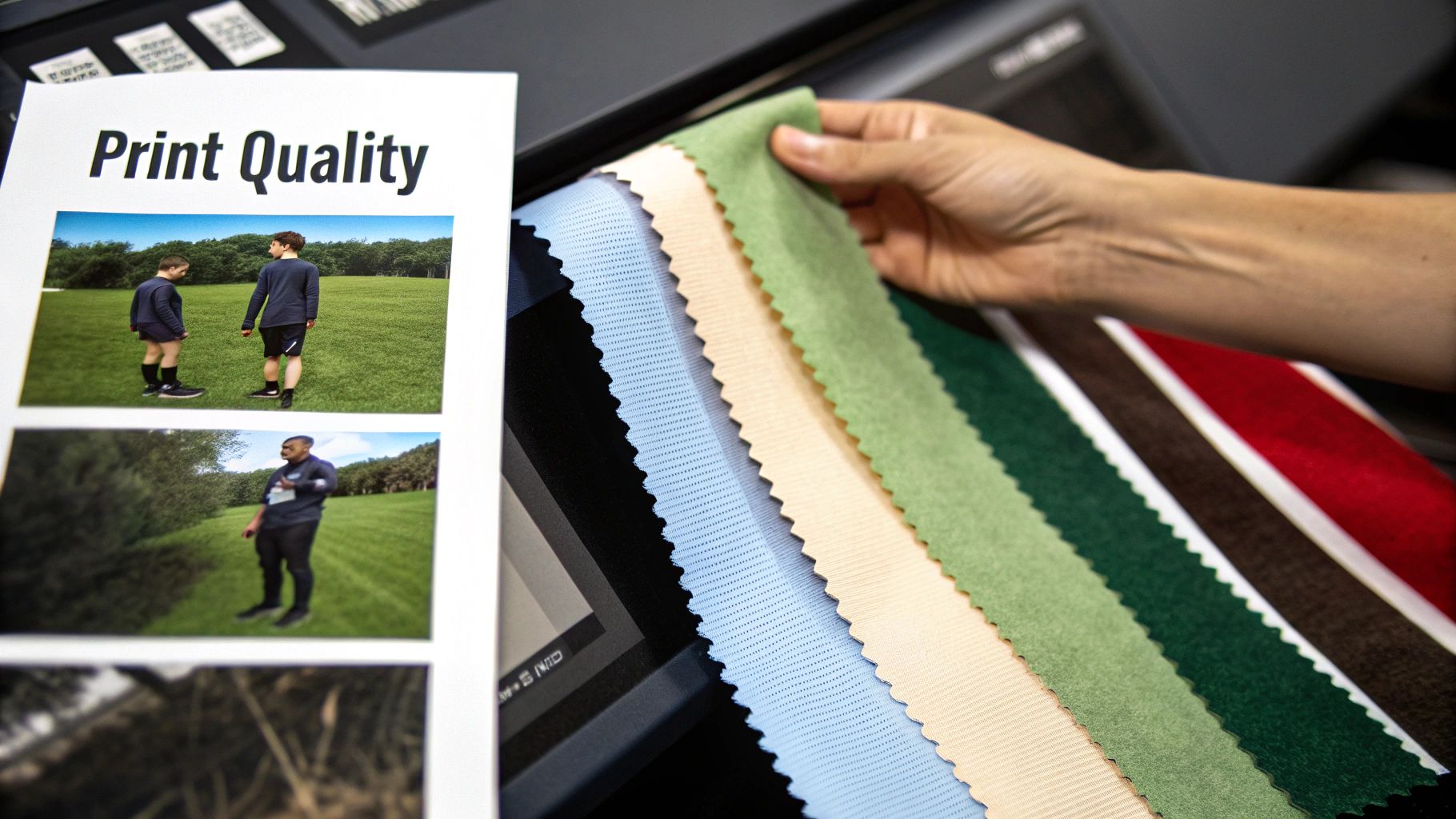
Let's get right to it: what your customers will see, feel, and experience with their decorated apparel is what truly matters. It's the difference between a one-time sale and a repeat customer. While both DTG and DTF produce stunning results, they get there in very different ways, and those differences show up in the final product's look, feel, and lifespan.
DTG printing is the master of subtlety and detail. Think of it as dyeing the fibers of the shirt. The water-based ink soaks right in, creating photorealistic images with beautiful color gradients that are incredibly soft and breathable. You can barely feel the print at all. This makes it the undisputed champion for high-end fashion, vintage-inspired designs, or anything where a soft, integrated feel is non-negotiable.
DTF, on the other hand, is all about punch and vibrancy. The design is printed onto a film and backed with an opaque white layer, which means colors scream, even on the darkest fabrics. There's no pre-treatment needed. The result is a crisp, bold graphic that sits on top of the fabric—perfect for logos, bold text, and any design that needs to grab attention.
Assessing the Final Print Quality
The visual difference is night and day. A DTG print becomes part of the shirt; a DTF transfer sits proudly on top of it.
- DTG’s Strength in Detail: An artist selling tees with intricate watercolor paintings or detailed photos will find DTG is the only way to go. It captures those subtle color blends and fine lines that DTF's layer-based method just can't match.
- DTF’s Power in Vibrancy: A construction company needing bold logos on polyester safety vests or a sports team wanting crisp numbers on jerseys will see DTF as the clear winner. The colors stay 100% true and opaque, no matter what color the fabric is underneath—a major hurdle for DTG on anything but cotton.
The industry has taken notice of DTF's powerful visuals and versatility. In fact, its growth has been explosive, with global production hitting over 7.2 billion prints in 2024. That's a jump of nearly 30% in just one year, showing it's quickly moving from a niche technique to a major player in the garment world.
Exploring Durability and Wash Performance
How a print survives the washing machine is a huge deal for any apparel business. This is where the structural differences between DTF and DTG really shine through.
DTF transfers are built to last. The adhesive powder melts to create a flexible, almost rubbery layer that stretches with the fabric. This makes it incredibly resistant to cracking, peeling, and fading. It’s the go-to choice for anything that's going to take a beating, like workwear, sports uniforms, and kids' clothes.
DTG prints are durable too, but they age differently. Because the ink is in the cotton fibers, the print can fade gracefully over time, much like a classic screen-printed shirt. Its longevity really depends on a good pre-treatment and proper care—washing inside out in cold water is a must. If customers don't follow care instructions, you might see premature fading, especially on dark garments.
Real-World Durability: Picture a local soccer team's jerseys. They get thrashed in weekly games and thrown in the wash constantly. A DTF print will keep its sharp lines and bright colors far longer under that kind of abuse than a DTG print ever could.
The Critical Difference in Hand-Feel
The "hand" is what we call the tactile feel of the print. For some customers, it's everything. It’s how the design feels against the skin.
DTG printing offers a truly superior hand-feel, often called a "no-hand" or "soft-hand" finish. The ink is literally part of the fabric, so the printed area stays light, breathable, and comfortable. This is an absolute must for premium brands, baby clothes, or any product where comfort is the primary selling point.
DTF, by its very nature, has a more noticeable hand. The transfer creates a smooth, slightly raised layer on the fabric's surface. Modern DTF is impressively thin and flexible, but it does cover the fabric's natural weave and can affect breathability in that specific area. For a huge, solid print on the chest of a summer t-shirt, this could be a downside. But for smaller logos or designs on a hoodie or jacket, the hand is often unnoticeable or even adds to a polished, premium feel. The fabric type makes a big difference here, which you can learn more about in our guide to cotton vs polyester.
A Practical Breakdown of Costs and Workflow
For any apparel business, the conversation always comes back to the numbers. Your profit lives and dies by how well you manage your costs and streamline your workflow. When you put DTF and DTG head-to-head, the financial and operational differences are stark, and they touch everything from your initial investment to how many shirts you can get out the door on a busy day.
Let's break down these real-world factors, because figuring out where each method fits is crucial before you sink your money and time into either path.
Analyzing the Initial Investment
The price of the gear is usually the first big hurdle. Right away, DTF and DTG present two completely different financial stories.
- A full DTG setup is a serious commitment. You're looking at $15,000 to over $30,000 for a reliable commercial printer, a pre-treatment machine, and a good heat press. That price tag reflects the complex engineering required to print directly onto a finished garment.
- A DTF system offers a much lower barrier to entry. A complete setup—printer, powder/shaker/curing unit, and heat press—can be had for somewhere between $5,000 and $15,000. This makes it a far more approachable option if you're just starting out or looking to add a new service without taking out a second mortgage.
Of course, there's a third option that a lot of smart businesses are choosing: skip the equipment investment altogether. By sourcing your transfers from a dependable US-based supplier like Cobra DTF, you get all the perks of DTF—the versatility, vibrant colors, and durability—with zero equipment costs. Your capital expense becomes a simple, predictable line item.
Comparing Per-Print Consumable Costs
Once you're up and running, it's the day-to-day consumable costs that really dictate your profit on each shirt. This is where the DTF vs. DTG debate gets really interesting.
With DTG, your main variables are ink and pre-treatment fluid. The real kicker is that the amount of pre-treatment you need changes dramatically between light and dark garments. A black shirt needs a heavy, expensive white ink underbase, which can cause your per-print cost to skyrocket.
DTF, on the other hand, is refreshingly predictable. Every print uses ink, film, and adhesive powder. Since the process is identical whether you're printing for a white tee or a black hoodie, your costs are consistent. More often than not, the combined cost of DTF consumables for a design is lower than the ink and pre-treatment needed for that same design on a dark DTG-printed shirt.
A key financial advantage for DTF is consistency. Your cost to produce a logo for a black polyester polo is the same as it is for a white cotton tee, which simplifies quoting jobs and managing inventory.
Evaluating Production Speed and Workflow
Efficiency is about more than just how fast a printer can lay down ink. It's the entire process, from opening the art file to handing the finished shirt to a customer.
DTG printing is a very linear, one-at-a-time job. You pre-treat the shirt, carefully load it onto the platen, send the print, and then cure it. That’s perfectly fine for a one-off custom order, but it quickly becomes a bottleneck when you have a dozen different small orders piling up.
DTF completely changes the game with gang sheeting. This is a huge deal. You can print designs for ten different customers on a single large sheet of film, then powder and cure them all at once. These transfers are now ready to be pressed whenever you need them.
This "print now, press later" model gives you incredible operational flexibility.
Picture a busy Saturday in your shop:
- With DTG: You’re tied to the printer, handling orders one by one as they come in.
- With DTF: You grab pre-printed transfers from a gang sheet and press them in seconds. You can fulfill multiple orders almost instantly without ever having to fire up the printer.
This workflow makes DTF incredibly efficient for juggling small, diverse jobs. It also lets you build up an inventory of your most popular designs, ready for on-demand pressing. In the fast-paced world of custom apparel, that kind of agility is a massive competitive advantage.
Before we move on, let's put these cost and efficiency factors side-by-side to make the differences crystal clear.
Cost and Efficiency Analysis: DTF vs. DTG
This table breaks down the key financial and operational considerations for a small to medium-sized apparel business, highlighting how each technology impacts your bottom line and daily workflow.
| Factor | Direct-to-Film (DTF) Analysis | Direct-to-Garment (DTG) Analysis |
|---|---|---|
| Initial Investment | Lower: $5,000 - $15,000 for a full setup. Option to start with $0 investment by ordering transfers. | Higher: $15,000 - $30,000+ for printer, pre-treatment machine, and heat press. |
| Per-Print Cost | Consistent & Predictable: Cost is the same regardless of garment color. Often lower for darks. | Variable & Complex: Costs rise significantly for dark garments due to heavy white ink and pre-treatment needs. |
| Workflow Efficiency | High (Batch Processing): "Print now, press later" model via gang sheets allows for rapid fulfillment of multiple small orders. | Moderate (Linear Process): One-garment-at-a-time workflow is ideal for one-offs but can be a bottleneck for multiple orders. |
| Operational Flexibility | Very High: Print transfers in advance and store for on-demand pressing. Ideal for events, web stores, and varied job types. | Moderate: Best suited for on-demand, single-item fulfillment. Less efficient for batching varied designs. |
| Labor/Time Per Item | Fast Application: Pressing a pre-made transfer takes 15-30 seconds. The printing itself is done separately in batches. | Slower Overall Process: Each shirt requires individual handling: pre-treatment, loading, printing, and curing. |
Ultimately, the numbers show two distinct operational philosophies. DTF, especially when outsourcing transfers, offers a low-risk, highly flexible model built for speed and variety. DTG requires a more significant upfront investment and is tailored for a "one-shirt-at-a-time" direct printing process.
Choosing the Right Technology for Your Products
When you’re weighing Direct-to-Film against Direct-to-Garment, the debate really boils down to one simple question: what are you actually selling? Your product line is the single most important factor. Each technology is a specialist in its own right—one is an incredibly versatile jack-of-all-trades, while the other has mastered a specific, high-demand corner of the market.
Direct-to-Film's biggest advantage is its sheer flexibility with materials. Because you're printing onto a transfer film first, then applying it with heat, the fabric type becomes almost irrelevant. This is a game-changer for any shop that wants to offer a truly diverse catalog.
Forget just cotton t-shirts. With DTF, you open the door to a whole range of products that are simply non-starters for DTG.
- Polyester Jerseys: An absolute must for sports teams and athletic wear.
- Nylon Jackets: Perfect for branding windbreakers or corporate outerwear with sharp, lasting logos.
- Leather Patches: A fantastic way to add a premium, detailed touch to hats, bags, and jackets.
- Blended Fabrics: Effortlessly handles those popular 50/50s and tri-blends that give DTG printers fits.
Key Insight: If your business model is built on saying "yes" to every customer—from team uniforms and promotional totes to custom hats—DTF gives you that power. It’s the tool that lets you adapt to whatever material your next job requires.
Where Direct to Garment Finds Its Home
On the flip side, Direct-to-Garment printing absolutely shines in a very specific, and very profitable, niche. It produces its best work on 100% cotton, where the water-based inks can chemically bond with the natural fibers. This isn't a limitation; it’s a specialization that perfectly serves the premium apparel world.
The market backs this up. The global DTG printing industry was valued at around USD 1.92 billion in 2024 and is expected to nearly double by 2030. That growth is fueled by a massive demand for high-quality, on-demand cotton clothing. You can dig into the full market analysis to see just how strong that trend is.
The real magic of DTG on cotton is the print's "hand-feel"—or rather, the lack of it. The ink soaks into the fabric instead of sitting on top, becoming part of the shirt itself. The result is a soft, breathable print that people associate with high-end retail quality.
Actionable Use Cases for Your Business
Let's ground this in a couple of real-world examples to make the choice crystal clear.
-
Scenario 1: The High-End Fashion Brand: A designer is launching a line of premium, vintage-soft tees. The artwork is photorealistic with delicate color fades and gradients. DTG is the only real option. It’s the only way to get the fine detail and the soft-hand feel that a luxury customer demands.
-
Scenario 2: The All-in-One Custom Shop: A local print shop gets orders from schools, sports teams, and local businesses. One day it's polyester safety vests, the next it’s nylon gym bags, and Friday it's a run of blended polo shirts. DTF is the undisputed champion here. Its ability to stick to pretty much anything makes it the workhorse you need to handle that kind of variety.
At the end of the day, it’s a strategic decision. DTG lets you specialize and become the go-to expert for premium cotton apparel. DTF sets you up to be the versatile, one-stop shop for any custom printing need that walks through your door.
Making the Final Call for Your Business
Picking between direct-to-film and direct-to-garment isn't just a technical detail—it's a core business decision that shapes what you can sell and who you can sell it to. The best choice really hinges on your business model, the customers you're trying to reach, and where you want to take your shop. Honestly, there’s no single "best" method, only the one that fits your vision.
You have to look past just the print quality and think about how you operate and where you fit in the market. Are you building a brand around high-end, boutique cotton tees? Or do you want to be the go-to shop for anyone needing custom gear, no matter the item? Each path requires a totally different setup.
Matching the Tech to Your Business Model
If your shop is all about one-off custom designs for a premium t-shirt brand that sticks to 100% cotton, then DTG is probably your best bet. You simply can't beat it for creating soft, breathable, and incredibly detailed prints in that niche. The slightly higher cost for each print makes sense when you're delivering a top-shelf product.
On the other hand, if your goal is to cater to a wider audience with everything from polyester polos for corporate clients to jerseys for the local sports teams, DTF’s flexibility is a massive advantage. Its ability to work with almost any material means you’ll rarely have to say "no" to an order. That opens up more ways to make money and positions you as the versatile problem-solver everyone turns to.
The Bottom Line: When it comes down to it, the direct-to-film vs. direct-to-garment debate is about specialization versus diversification. DTG shines in a focused, high-quality cotton market. DTF wins when it comes to product variety and handling different materials.
This image really simplifies how your product focus points you to the right printing tech.

As you can see, if you're laser-focused on cotton apparel, DTG is the natural fit. But if your catalog is a mix of fabrics, DTF is the clear winner.
What About a Hybrid Approach?
Here’s a thought: you don't have to be stuck with one technology forever. Plenty of successful shops use a hybrid model. For instance, you could start out with DTF transfers, which is a low-cost way to get into the game while offering a massive range of products. By getting high-quality, US-made transfers from a trusted supplier like Cobra DTF, you can build your brand and your bank account without dropping a dime on equipment upfront.
This strategy lets you serve a broad customer base right away. Then, as your business grows and you start seeing a steady demand for premium cotton goods, you can invest in a DTG printer to add to your workflow. This kind of phased growth means your money goes directly toward what’s already selling, cutting down your risk while expanding what you can offer.
Got Questions? We've Got Answers
Even after breaking down the nitty-gritty of DTF vs. DTG, a few key questions always pop up. Getting these details sorted can be the final piece of the puzzle when you're deciding which way to go for your shop. Let's tackle them.
Is DTF More Durable Than DTG?
In a word, yes. DTF transfers have a reputation for being incredibly durable and stretchy. Because the design is essentially a flexible layer of ink and adhesive bonded to the top of the fabric, it stands up exceptionally well to cracking and fading. This makes it the clear winner for gear that gets a lot of abuse, like work uniforms or sports jerseys.
DTG prints, on the other hand, soak right into the fabric fibers. That gives them that super-soft feel, but it can also make them fade a bit faster over time. How long a DTG print lasts really depends on the shirt quality, getting the pre-treatment just right, and how it’s washed.
Can I Start a T-Shirt Business With Just DTF?
You absolutely can. In fact, DTF is quickly becoming the go-to for launching a new apparel brand. Its biggest selling point is its sheer versatility. You're not stuck with 100% cotton; you can print on polyester, blends, canvas, and more without a second thought, instantly expanding what you can offer.
Plus, the ability to gang up multiple designs on a single sheet of film makes DTF a powerhouse for handling small and medium-sized orders efficiently. The only real trade-off is the feel—the print sits on top of the fabric, so it's not as soft as DTG. But for most people, the amazing color and a print that lasts are well worth it.
Which Method Has a Steeper Learning Curve?
Both have their quirks, but the challenges are different. Most people find that the learning curve for DTG is steeper, and it all comes down to mastering the pre-treatment. Figuring out the exact amount of spray for a black cotton shirt versus a blue tri-blend is a bit of an art form, and it takes a lot of trial and error to get it perfect.
With DTF, the learning curve is more about getting a consistent workflow down: print, powder, cure, and press. While there are more steps, many find the process easier to master because it's more predictable. You take the tricky variable of fabric pre-treatment completely out of the equation.
Ready to bring vibrant, versatile prints to your apparel business without the huge upfront cost? Cobra DTF provides top-tier, US-made transfers that are tough, eco-friendly, and simple to press. Forget the equipment maintenance and get your custom transfers shipped the same day by checking us out at https://cobradtf.com.