
Explore different types of t shirt printing methods for your business
So, you have a killer t-shirt design, but now you're staring at a list of acronyms like DTG, DTF, and HTV, wondering which one is right for you. It can feel like alphabet soup when all you want is a great-looking shirt that lasts.
The truth is, the "best" printing method really comes down to what you're trying to accomplish. Your ideal choice will hinge on your design's complexity, how many shirts you need, and the type of fabric you're using. Each technique strikes a different balance between cost, quality, and durability.
Choosing the Right T-Shirt Printing Method
Think of it like having a toolbox. You wouldn't use a sledgehammer for a delicate job, right? Same idea here. Some methods, like screen printing, are powerhouses built for cranking out hundreds of identical shirts with unmatched efficiency. Others, like Direct-to-Garment (DTG), are more like fine-tipped paintbrushes, perfect for creating one-off masterpieces with photographic detail.
The real challenge for any brand or creator is hitting that sweet spot where vibrant design, lasting quality, and a smart budget all meet.
To get it right, it helps to understand all the available custom printing options before you commit. This guide is designed to be your roadmap, helping you navigate the choices and find the perfect fit for your project.
A Quick Overview of Your Options
Before we get into the nitty-gritty, let's do a quick fly-by of the main players in the t-shirt printing game. Understanding their core strengths will help you quickly narrow down your choices.
- Screen Printing: The undisputed king for large bulk orders (think 50+ shirts) with simple, bold designs.
- Direct-to-Garment (DTG): The go-to for complex, multi-color designs on 100% cotton, especially for single shirts or very small batches.
- Direct-to-Film (DTF): An incredibly versatile modern method that produces vibrant, durable prints on almost any fabric, from cotton and polyester to tricky blends.
- Heat Transfer Vinyl (HTV): Perfect for personalizing items with names, numbers, or simple logos. This is what you see on most sports jerseys.
- Dye-Sublimation: A specialty technique for creating those amazing all-over prints on 100% polyester garments, where the ink becomes part of the fabric itself.
To give you a clearer picture of how these methods stack up, here’s a handy comparison chart.
Quick Comparison of T-Shirt Printing Methods
This table gives you an at-a-glance summary of the most popular techniques, helping you see where each one shines.
| Method | Best For | Fabric Compatibility | Feel on Shirt | Durability |
|---|---|---|---|---|
| Screen Printing | Bulk orders (50+) | Cotton, Blends | Slightly raised ink | Very High |
| DTG | Detailed, multi-color designs | 100% Cotton | Very soft, no texture | Moderate |
| DTF | Vibrant designs on any fabric | Cotton, Polyester, Blends | Flexible, smooth layer | Very High |
| Sublimation | All-over prints, sportswear | 100% Polyester | No feel, part of fabric | Excellent |
| HTV | Simple graphics, text, numbers | Cotton, Polyester, Blends | Varies (smooth to textured) | High |
Use this as a starting point. As we dive deeper into each method, you'll get a much better feel for the nuances that will make or break your specific project.
Screen Printing: The Go-To for Big Batches
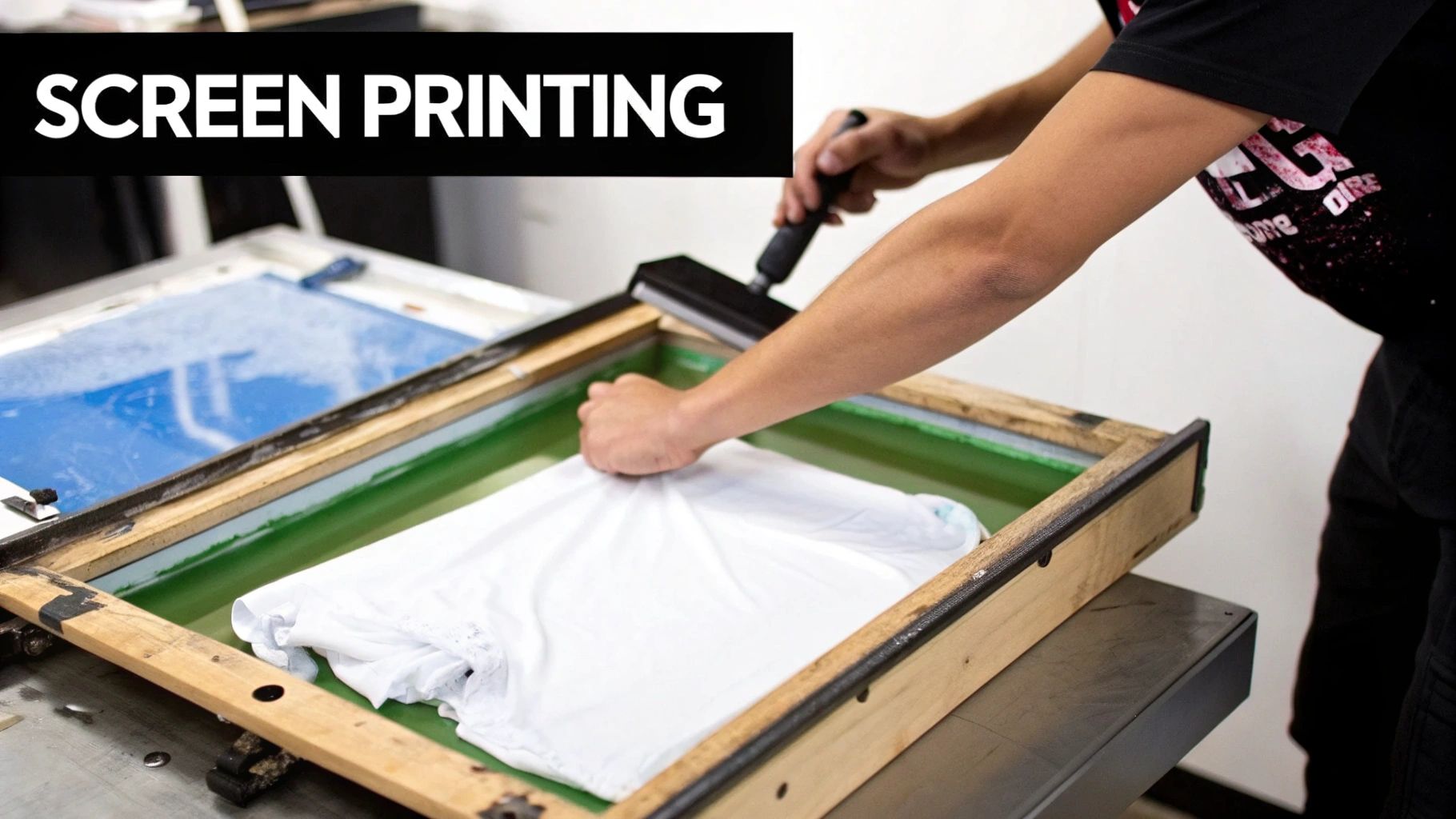
When you picture classic t-shirt printing, you’re almost certainly thinking of screen printing. For decades, it’s been the undisputed champion for producing vibrant, long-lasting designs in large quantities. This is the method behind most band merch, event apparel, and company uniforms for a reason—it’s built for volume.
The whole process is essentially a highly refined stenciling technique. Imagine a fine mesh screen stretched taut in a frame. A stencil of your design blocks out parts of the screen, and a squeegee is used to push a thick layer of ink through the open areas directly onto the t-shirt.
Here’s the catch: you need a separate screen for every single color in your design. Getting those screens prepped takes time and effort, but once they’re made, you can crank out hundreds of identical shirts with incredible speed and consistency.
How Does It Actually Work?
The beauty of screen printing is in its layered approach. Each color is applied one at a time, creating a distinct, solid layer of ink. This is why screen-printed shirts have that slightly raised feel and such a bold, punchy look, especially when printing light colors on a dark shirt.
The process breaks down into a few key stages:
- Art Separation: Your digital design is broken down into separate layers, one for each color.
- Screen Prep: A mesh screen is coated with a light-sensitive emulsion. The design for a single color is then "burned" into the screen with UV light, creating a hardened stencil.
- Printing: The shirt is placed on a flat board, the screen is lowered on top, and ink is pushed through the stencil with a squeegee. This is repeated with a new screen for every color.
- Curing: Once all colors are on, the shirt goes through a tunnel dryer. This high heat cures the ink, chemically bonding it to the fabric so it won’t wash out.
The real payoff comes with scale. All that initial setup work gets spread across a large order, which is why the per-shirt price drops dramatically the more you print.
Screen printing isn't just a popular method; it's the dominant one. It holds a massive 56% share of the entire global custom t-shirt market. For a big job, say 500 shirts, screen printing can cut your costs by up to 40% compared to digital methods and deliver a print that easily survives 50+ washes. You can dig into the numbers yourself over at Straits Research.
The Highs and Lows of Screen Printing
Like any method, screen printing has clear strengths and weaknesses. Knowing them is crucial for deciding if it’s the right tool for your specific job.
Why Choose Screen Printing?
- Cost-Effective in Bulk: This is its superpower. For orders of 50+ shirts, it’s almost always the cheapest option. The more you order, the better the price gets.
- Incredibly Vibrant Colors: The thick, opaque ink lays on top of the fabric, making colors pop in a way other methods can't match, especially on dark garments.
- Built to Last: A properly cured screen print is exceptionally durable. It will often outlive the t-shirt itself without cracking or fading.
- Specialty Inks: Want a design with a puff, glitter, or metallic finish? Screen printing handles these unique, textural inks with ease.
What Are the Downsides?
- Expensive for Small Runs: The setup costs are just too high for one-off prints or small batches. Creating all those screens makes it financially impractical.
- Limited Color Complexity: It’s not the best choice for photorealistic images or designs with subtle gradients and dozens of shades. Each color adds cost and complexity.
- Not for On-Demand: The upfront work means you can't just print a single shirt whenever an order comes in. It’s a batch-production process through and through.
Ultimately, screen printing remains the workhorse for any large-scale project where cost per piece, color vibrancy, and durability are the most important factors. If you're curious about diving in yourself, you can learn more about how to start screen printing in our in-depth guide.
Direct-to-Garment (DTG) for Detailed On-Demand Designs
Think of your home office inkjet printer. Now, imagine instead of sliding in a piece of paper, you load a t-shirt. That’s pretty much the gist of Direct-to-Garment (DTG) printing.
This technique uses highly specialized inkjet printers to spray water-based inks straight onto the fabric. The result? Designs with millions of colors and photorealistic detail. Because the ink soaks right into the cotton fibers instead of sitting on top, the final print feels incredibly soft and breathable—almost like it’s part of the shirt itself. This makes it a go-to for print-on-demand businesses, artists selling complex designs, and anyone who needs just one high-quality custom shirt.
How DTG Printing Works
The process itself is quite simple. First, the digital design file is sent over to the DTG printer. Before any ink hits the fabric, the shirt is pre-treated with a special solution that helps the water-based inks bond with the cotton fibers. This step is crucial for getting those bright, sharp colors to really pop.
Next, the printer applies the ink, layer by layer, just like your desktop printer does on paper. If you're printing on a dark-colored shirt, the machine first lays down a white ink base layer. This creates a blank canvas for the colors to sit on, ensuring they look vibrant instead of getting lost in the dark fabric. Once the design is printed, the shirt goes into a heat press to cure the ink and make it permanent.
The popularity of this method is surging. The DTG market is expected to jump from USD 3.2 billion to a whopping USD 9.1 billion over the next decade. Its ability to produce on-demand prints at resolutions up to 1200 DPI is a major driver of this growth. You can read more about it in the Future Market Insights report.
Strengths and Weaknesses of DTG
DTG is a fantastic choice for certain jobs, but it's not a one-size-fits-all solution. Knowing its pros and cons will help you decide when it's the right tool for your project.
Key Advantages of DTG
- Unlimited Color Palette: DTG can handle millions of colors, smooth gradients, and intricate details with incredible accuracy. This makes it the perfect method for printing photos or complex, painterly artwork.
- Incredibly Soft Feel: Since the ink becomes one with the fabric, the print is super soft and breathable. You can barely feel it on the shirt, which is a huge plus for comfort.
- No Minimum Orders: There are practically zero setup costs, which is a game-changer. You can easily print a single test shirt, a one-off custom gift, or run a print-on-demand shop where you only produce what customers order.
Pro Tip: The soft-hand feel is DTG's signature feature. If you want a print that feels like it’s woven into the fabric itself, especially on light-colored garments, DTG is hard to beat.
Potential Downsides to Consider
- Fabric Limitations: DTG works best on 100% cotton. Natural fibers do a great job of absorbing the water-based inks, but performance drops sharply on polyester and other synthetic materials. It can handle some cotton blends, but pure cotton gives the best results.
- Higher Per-Item Cost: Unlike screen printing, you don't get the same economies of scale with DTG. The cost to produce each shirt is higher, making it less ideal for large bulk orders where every penny counts.
- Durability Concerns: Modern DTG prints hold up well, but they might not last as long as a screen-printed or DTF design after dozens of washes. The colors can start to fade over time, particularly on dark shirts that needed that heavy white underbase.
When it comes down to it, DTG is the artist's choice for detailed, on-demand work on cotton apparel. For a deeper look, check out our guide on what is Direct-to-Garment printing.
Direct-to-Film (DTF): The Versatile and Vibrant Challenger
If screen printing is the old-school industrial powerhouse and DTG is the cotton specialist, then Direct-to-Film (DTF) is the incredibly adaptable newcomer that borrows the best traits from both. This technology has quickly become a go-to for small businesses and custom apparel shops, and for good reason: it delivers stunning, durable prints on almost any fabric you can throw at it.
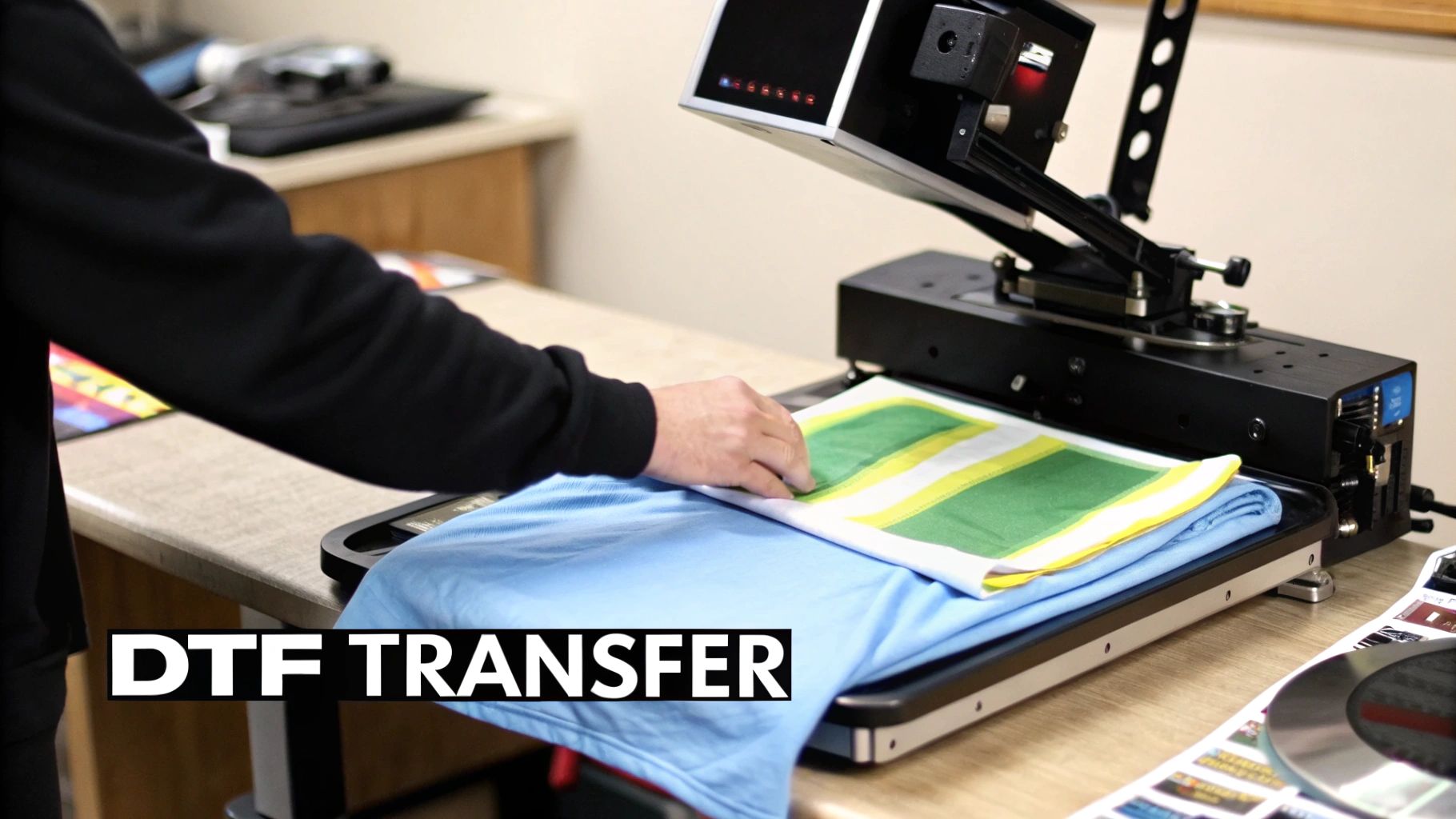
The easiest way to think about DTF is that you're creating a high-end, super-thin graphic "sticker" that you permanently bond to the garment. Instead of ink going directly onto the shirt, your design is printed onto a special PET film first. This film then gets a coating of adhesive powder and is cured, creating a ready-to-use transfer you can apply with a simple heat press.
This two-step process is the key to DTF's amazing flexibility. Since the design is made on a separate film, the fabric's color, texture, and material don't interfere with the print quality. This opens up a whole new world of creative possibilities that other different types of t shirt printing methods just can't match.
How The DTF Printing Process Works
Understanding the mechanics of DTF shows you exactly why it’s so powerful. It’s a smart process that combines the precision of digital printing with the staying power of a heat transfer, giving you a professional-grade finish every single time.
Here's a look at the workflow from start to finish:
- Print on Film: First, your digital design is printed onto a clear PET film using specialized DTF inks. A crucial difference from DTG is that the printer lays down all the colors first, then applies a solid white ink layer on top of them.
- Apply Adhesive Powder: While the ink is still wet, a fine, hot-melt adhesive powder is dusted over the design. The excess is shaken off, so a clean layer of powder sticks only to the inked areas.
- Cure the Transfer: Next, the powdered film goes through a small curing oven or under a heat press that hovers just above the surface. This melts the powder, creating a smooth, stable backing for your graphic.
- Heat Press to Garment: Finally, you place the cured film onto the t-shirt and press it with high heat and firm pressure. The heat activates the adhesive, which permanently bonds the ink to the fabric's fibers. After it cools, you peel away the film, and your vibrant design is left behind, perfectly applied.
Why DTF Is So Popular Right Now
DTF's rapid rise isn't just a fleeting trend. It's a direct solution to a real need in the market for a printing method that’s versatile, high-quality, and budget-friendly. This method is absolutely booming, with digital printing techniques like DTF showing an impressive 12.28% compound annual growth rate.
It’s a workhorse: DTF excels on synthetic fabrics, can cut prep time by 50%, and produces brilliant colors on dark garments with prints proven to last for 60+ washes. In the United States alone, adoption in custom print shops has jumped by 30% year-over-year. You can see more on this growth in the latest market analysis from Mordor Intelligence.
This growth comes down to a few game-changing advantages that solve the pain points of older methods.
- Unmatched Fabric Versatility: This is DTF’s superpower. It works beautifully on cotton, polyester, nylon, fleece, leather, and tricky blends. You can print the exact same design on a cotton tee, a polyester jersey, and a denim jacket without changing a thing.
- Vibrant Colors on Any Background: Because the design is backed by a solid white ink layer on the film, your colors pop with incredible brightness, even on the darkest black shirts. This completely eliminates the need for the chemical pre-treatment that DTG requires.
- Exceptional Durability and Stretch: DTF transfers are incredibly tough. The finished print is flexible and moves with the fabric, meaning it resists cracking and peeling far better than many alternatives. This makes it perfect for activewear and apparel that gets a lot of use.
- No Minimum Order Quantity: Just like DTG, DTF is a digital process with almost no setup time. This makes it ideal for printing one-off samples, handling small custom orders, or running a print-on-demand business.
Key Takeaway: DTF printing bridges the gap between other methods. It offers the full-color capabilities of DTG but applies them to the wide range of fabrics that were once only possible with screen printing or vinyl.
Are There Any Downsides to DTF?
While DTF is a fantastic all-around solution, there are a couple of trade-offs to be aware of. The print sits on top of the fabric rather than soaking into it, so it doesn't have that ultra-soft, "no-feel" finish you might get from a DTG print on a light cotton shirt. The hand-feel is closer to a very thin, flexible screen print.
Also, while it's great for small to medium runs, the per-item production time means it's less efficient than screen printing for massive bulk orders of several hundred identical shirts. For most small businesses that need versatility, though, the benefits easily outweigh these minor points. For a complete deep dive, check out our guide on what is Direct-to-Film printing.
DTF vs DTG vs Screen Printing at a Glance
Choosing the right printing method can feel overwhelming, but seeing them side-by-side makes the decision much clearer. This table breaks down the key differences between the top three contenders to help you figure out which one is the perfect fit for your business needs.
| Feature | Direct-to-Film (DTF) | Direct-to-Garment (DTG) | Screen Printing |
|---|---|---|---|
| Best For | Small to medium runs, full-color designs on any fabric | One-offs & small batches, soft-feel prints on cotton | Large bulk orders (100+), simple designs with few colors |
| Fabric Compatibility | Excellent (Cotton, poly, blends, nylon, leather) | Limited (Best on 100% cotton, light colors) | Good (Cotton, poly, blends) |
| Print Feel | Smooth and flexible, sits on the fabric | Very soft, ink soaks into the fabric | Thicker layer, can feel heavy depending on ink |
| Color Vibrancy | Excellent on all fabric colors, including darks | Good on light fabrics, can look faded on darks | Excellent, with very opaque colors |
| Durability | High (Lasts 60+ washes without cracking) | Moderate (Can fade over time with washing) | Very high (Extremely durable and long-lasting) |
| Setup Cost | Moderate | High | High (Screens for each color are expensive) |
| Per-Item Cost | Low for small runs | High for small runs | Very low for large runs, but high for small runs |
Ultimately, DTF stands out as the most versatile and cost-effective option for businesses that need to print vibrant, full-color designs on a wide variety of products without committing to huge order quantities. It truly combines the best of both worlds.
A Look at Other Specialized Printing Methods
While screen printing, DTG, and DTF get most of the attention, a few other techniques have carved out their own essential niches. These methods aren't just alternatives; they offer unique looks and finishes that are perfect for specific jobs. Knowing about them can give you a real edge.
Heat Transfer Vinyl (HTV)
First up is one of the most popular and accessible methods: Heat Transfer Vinyl, or HTV.
Think of it as a professional, souped-up version of the iron-on decals you might have used as a kid. The process is simple: your design is cut from a sheet of colored vinyl, you peel away the parts you don't need (a process called "weeding"), and then you apply the graphic to the shirt using a heat press.
HTV is the undisputed champion for bold, simple graphics with razor-sharp edges. It's the go-to for putting names and numbers on sports jerseys or adding clean, single-color logos to work uniforms. The vinyl sits on top of the fabric, creating a distinct feel that can be anything from smooth and matte to glittery, metallic, or even puffy.
Dye Sublimation for Mind-Blowing All-Over Prints
Next, we have a process that feels a bit like magic: dye-sublimation. This isn't about putting ink on the fabric; it's about infusing color into the very fibers of the material. The solid ink turns into a gas under heat and permanently becomes one with the fabric.
Here's how it works: a design is printed on special transfer paper with sublimation inks. That paper is laid on a garment—which absolutely must be 100% polyester or a poly-heavy blend—and hit with high heat and pressure. The heat makes the ink vaporize (sublimate) and opens up the polyester fibers, letting the gas sink in. When it cools, the fibers trap the ink for good.
The result is a print you literally cannot feel. The design becomes part of the shirt. Because the ink is fused right in, dye-sublimation prints will never crack, peel, or fade, no matter how many times they go through the wash.
This makes it the best choice for those vibrant, edge-to-edge, all-over prints you see on performance sportswear and activewear. Its only real drawback? It only works on light-colored polyester. You can't sublimate on dark fabrics. While we're focused on apparel, the core idea of applying custom graphics translates elsewhere, too. For instance, you can use similar design principles to make your own custom sticker for vehicles and other hard surfaces.
Classic Looks with Plastisol and Discharge
Finally, let's touch on two techniques that grew out of screen printing to create some really sought-after styles: Plastisol Transfers and Discharge Printing.
Plastisol Transfers are a clever hybrid. You screen print a design with plastisol ink—that super durable, classic screen printing ink—onto a special release paper instead of a shirt. These printed transfers can then be stored and applied to a garment later with a heat press whenever you get an order. You get the quality and slightly-raised feel of a traditional screen print, but with the on-demand flexibility of a heat transfer.
Discharge Printing is completely different. It's a "subtractive" process used on dark, 100% cotton shirts. Instead of adding color, you're taking it away. A special water-based ink with a bleaching agent is screen printed onto the shirt. When heated, this agent removes the garment's original dye, revealing the natural, light color of the cotton underneath. This leaves you with an incredibly soft print that has zero feel, perfect for that popular vintage look. You can also mix in pigments to re-dye the bleached area, creating a vibrant design with a premium, soft touch.
So, Which Printing Method Is Right for Your Project?
Alright, let's move from theory to reality. Picking the right printing method is the moment you decide what your final T-shirt will actually look, feel, and cost. There's no single "best" option—the right choice is completely tied to what you're trying to accomplish.
Let's walk through a couple of real-world examples.
Imagine you're launching a new apparel brand. You've got a dozen different designs, all of them intricate and full of color. In this case, DTF printing is your best friend. It lets you produce small batches of each vibrant design, on pretty much any fabric, without the massive setup costs that would sink a new venture.
Now, flip the script. You’re tasked with outfitting 500 employees for a company picnic. The design is a simple two-color logo. Here, screen printing is the clear winner for its unbeatable value at scale. Your cost per shirt drops dramatically with higher quantities, making it the most budget-friendly choice for big orders.
A Simple Decision Framework
To cut through the noise, just ask yourself four basic questions. Your answers will steer you directly to the best printing method for the job.
- How many shirts are you making? A one-off custom tee or a run of a thousand? For smaller jobs, say 1-50 pieces, DTF and DTG are perfect. For bulk orders of 50+, screen printing will almost always be more cost-effective.
- How complex is the artwork? Are we talking about a simple text-based logo or a full-blown photorealistic painting? Simple graphics with just a few colors are a great fit for screen printing or HTV. But for those complex, multi-color images, DTF and DTG are built to handle the detail.
- What fabric are you printing on? This is a big one. For 100% cotton, a DTG print will feel incredibly soft, almost like it's part of the fabric itself. But if you’re working with polyester or blended materials, dye-sublimation (for those all-over prints) and DTF (for logos and graphics) will give you far better results.
- What do you want the print to feel like? If you want a print with zero feel—something that literally becomes part of the fabric—then dye-sublimation or DTG on a light-colored cotton shirt is the way to go. If you need a durable, flexible layer that sits on top of the fabric and pops with color, DTF is an excellent choice.
This decision tree can help you visualize the path for more specialized projects, like creating jerseys or getting that perfect vintage look.
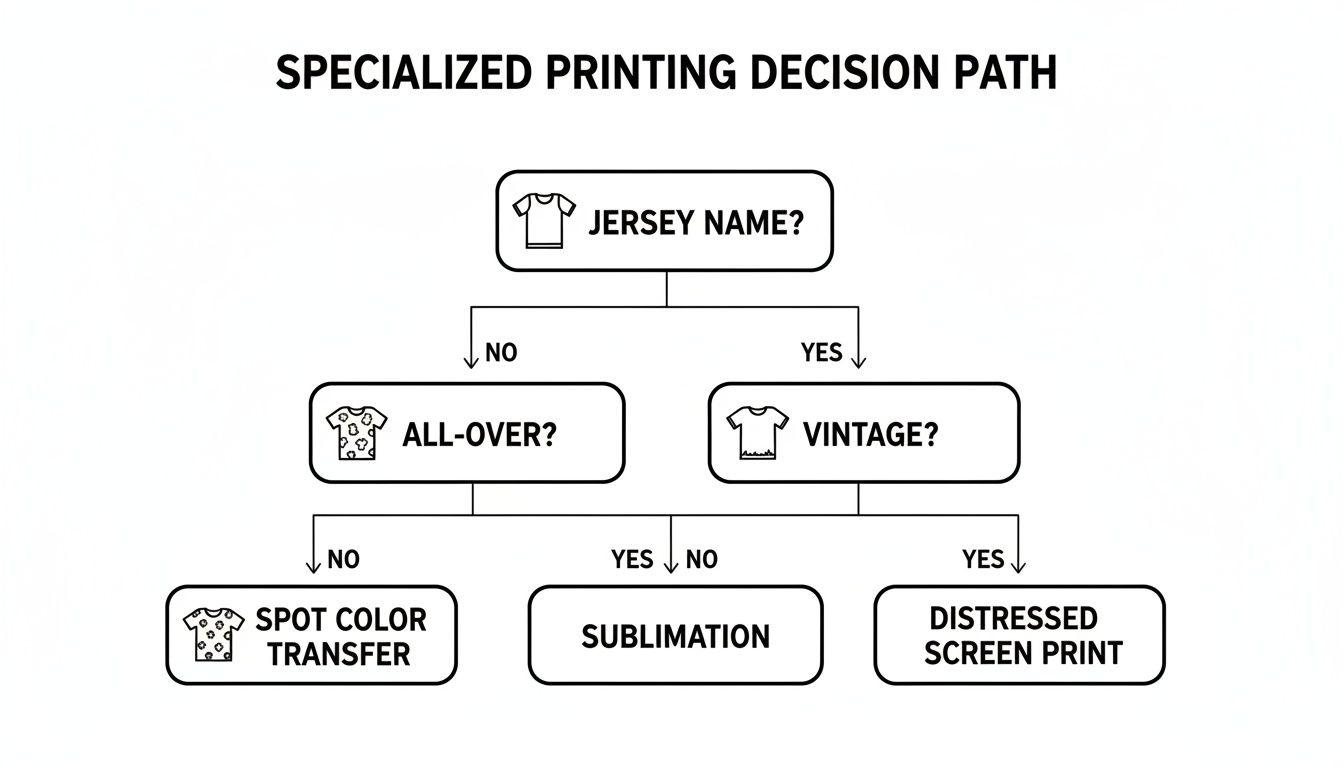
As the flowchart shows, specific goals—like chasing a worn-in, vintage vibe—point you toward niche techniques like distressed screen printing. By thinking through these questions, you can put your money in the right place and be confident that the final product will be exactly what you envisioned.
Got Questions? We've Got Answers.
Even after you've got the basics down, a few questions always seem to pop up when you're trying to pick the right printing method. Let's tackle some of the most common ones to help you make your final call.
What’s the absolute highest-quality printing method for T-shirts?
Honestly, there's no single "best" method. Quality really depends on what you're printing and what you're printing on.
If you're after photorealistic detail on 100% cotton and want a super soft feel, it's hard to beat DTG. The ink soaks right into the fibers, so you can barely feel it. But if you're looking for a tough, vibrant print that works on almost anything, DTF is the top contender. Its prints are incredibly resistant to cracking and fading, making it a fantastic all-around choice.
Which printing method lasts the longest?
When we talk about pure longevity, a couple of methods really shine.
Dye-sublimation is probably the champ here. Because the ink literally becomes part of the polyester fabric, it can't crack, peel, or fade—ever. It will last as long as the shirt does. Right behind it are DTF and traditional screen printing.
- DTF Transfers: These are built to last. You can expect them to hold up through 60+ washes without losing their pop.
- Screen Printing: A properly cured plastisol ink print is legendary for its toughness. It will often outlive the t-shirt itself.
So, is DTF better than screen printing?
This is a classic question, but one isn't "better" than the other—they're just built for different jobs.
Screen printing is the undisputed king for large-scale production. If you need hundreds of shirts with a simple design, its low cost-per-shirt at high volumes is unbeatable.
But for a small business or a brand that needs flexibility, DTF is a game-changer. It's perfect for producing full-color, complex designs in small or medium batches without those hefty setup fees. Plus, it works on a much wider variety of fabrics.
Think of it this way: A small brand that needs ten different full-color designs on a mix of cotton and poly tees should go with DTF. But a school that needs 500 identical two-color shirts for a fundraiser? Screen printing is the smart financial move, hands down.
What's the most profitable way to print T-shirts?
Profitability really boils down to your business model.
If your game is large, bulk orders, screen printing is where the money's at. The margins get huge once you scale up.
For print-on-demand shops or e-commerce brands with a ton of different designs, DTF and DTG are far more profitable. There's no inventory to manage and no big upfront investment. DTF, specifically, hits a real sweet spot—it keeps costs low on small runs while delivering a high-quality, durable product that customers value. That combination makes it exceptionally profitable for custom apparel businesses.
Ready to create vibrant, durable, and professional-grade custom apparel? Cobra DTF offers premium, USA-made Direct-to-Film transfers that work on any fabric. Get brilliant colors, unmatched durability, and fast 1-3 day shipping on all orders.