

Customised T Shirt Transfers
Customised T Shirt Transfers usually make sense when you match the transfer to your order size, fabric mix, and equipment budget, not when you hunt for one universal "best" option. In a market where the U.S. custom T-shirt printing segment was valued at USD 857.5 million in 2023 and is projected to reach USD 1,845.6 million by 2030 at 11.6% CAGR (WorldMetrics apparel printing statistics), the question isn't whether transfers work. It's whether your process can stay profitable after the samples, the reprints, the shipping delays, and the customer complaints.
A lot of owners find that out the hard way. The order looks solid on screen, the first press looks clean, and then the fifth wash or the missed ship date turns a good sale into a refund problem.
Why Transfer Method Choices Cost More Than You Think
A Friday product launch exposes sourcing problems quickly. A small shop may have a clean design, paid promotion, and customers waiting for 50 shirts, yet an overseas transfer order can spend 10 days in transit before production even starts. Missing the launch can mean refunds, wasted ad spend, and a rush order that removes the expected margin.
customised T shirt transfers therefore require production planning, not just a choice between printing methods. The transfer price is one input. Available stock, approval time, shipping reliability, and the cost of correcting a failed order matter just as much.
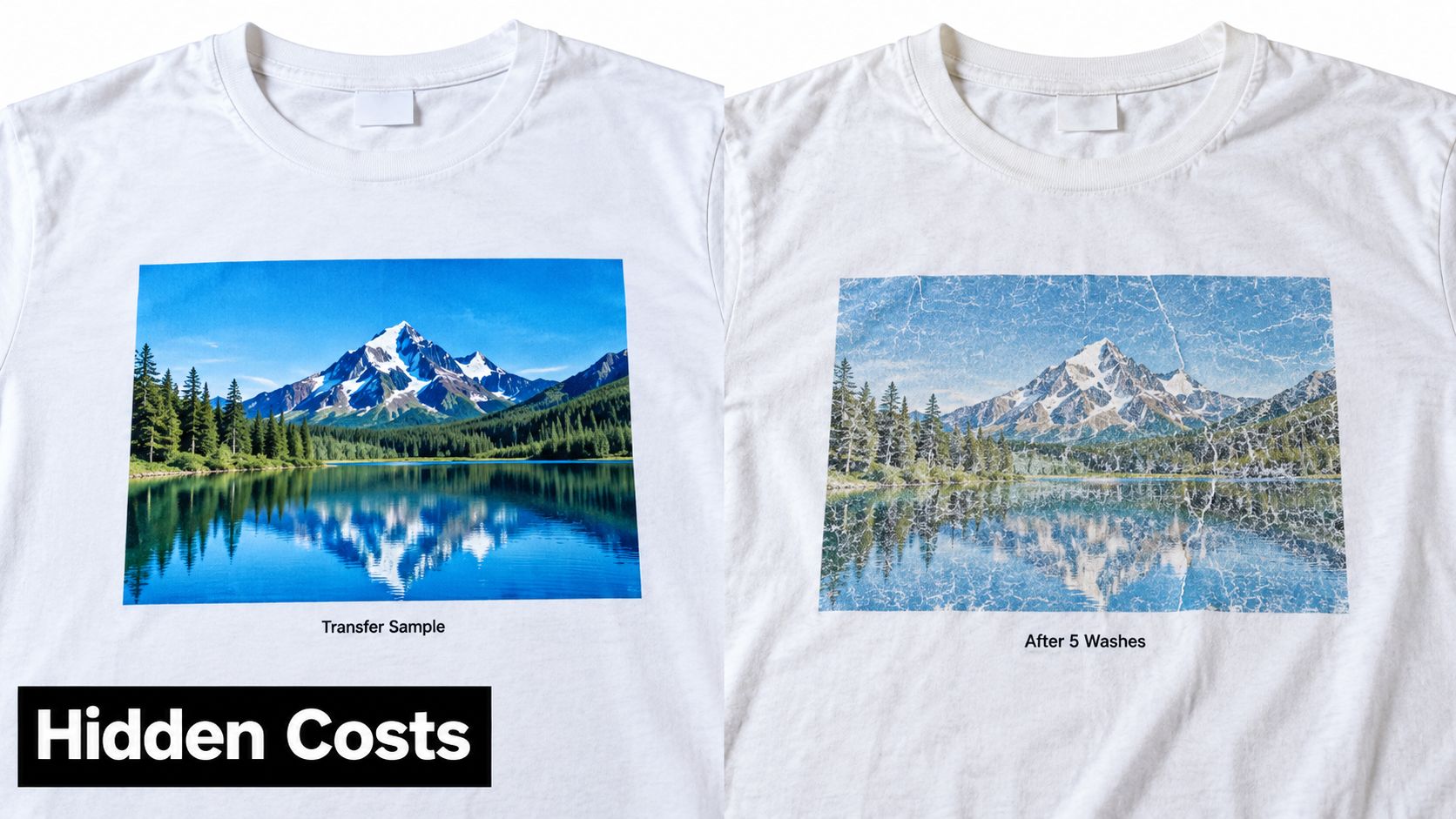
The hidden cost sits outside the sheet price
A low quote can conceal freight, customs, colour drift, minimum quantities, and rework. Those expenses often arrive after you have accepted the customer's payment and committed to a delivery date. They also tie up cash in transfer stock that may not fit the next order.
Domestic production can reduce transit uncertainty and make replacement orders easier to arrange. Global suppliers may still suit stable, planned production, particularly when you have enough lead-time buffer and a reliable forecast. The apparel printing market supports both approaches, with continued demand across domestic and international production (WorldMetrics apparel printing statistics).
Practical rule: if an order has a launch date, paid advertising, or a repeat customer attached to it, include time-to-delivery in the cost calculation.
What usually goes wrong first
The first failure is often the schedule around the print. Artwork approval takes longer than expected, garments arrive with the wrong size mix, or a customer requests a replacement after the original stock has already been allocated. Each problem consumes labour and can force a rush shipment.
Set checkpoints before ordering: approve the final artwork, confirm garment quantities, check the supplier's production window, and define the latest acceptable arrival date. A domestic supplier may provide faster checks and simpler replacements. Overseas sourcing can work when variability is acceptable and the schedule includes a real buffer.
Ordering enough to strain cash flow, but not enough to secure predictable unit economics, leaves small shops exposed. The right decision protects delivery capacity as well as the transfer margin.
DTF, HTV, and Screen-Printed Transfers Compared
A shop taking mixed artwork, short runs, and urgent reorders needs a different transfer method from one producing the same logo every week. DTF handles gradients, photo detail, and frequent design changes with fewer setup delays. HTV suits names, numbers, and simple one-colour graphics. Screen-printed transfers become more economical when artwork stays fixed and production volume is predictable.
| Criterion | DTF Transfers | Heat Transfer Vinyl | Screen-Printed Transfers |
|---|---|---|---|
| Setup cost | Moderate, requiring press discipline and consumable control | Low for simple in-house work | Higher because setup and colour separation take time |
| Per-unit economics | Strong for short to medium runs and mixed designs | Good when artwork is simple and weeding is quick | Best when steady volume absorbs setup costs |
| Design flexibility | Handles detailed, multi-colour artwork well | Suits simple shapes, lettering, and text | Strong for repeatable spot-colour designs |
| Durability profile | Good when cured and pressed correctly, with wash performance tied to process control (Wellye Paper) | Depends on film quality, weeding, and press accuracy | Strong when the production process is controlled |
| Ideal use case | E-commerce drops, mixed orders, and fast reorders | Starter shops, names, numbers, and simple branding | Regular volume, stable artwork, and planned inventory |
Gang sheet layout changes the margin. A 22x60 DTF gang sheet can fit 12 to 15 left-chest logos or 4 to 6 full-back designs, changing per-unit cost by $0.80 to $1.20. Measure usable sheet space before comparing supplier prices.
A practical reference for vinyl limitations is what is heat transfer vinyl. HTV works well when the design is simple enough to cut, weed, and press without turning each garment into a labour-heavy job.
Where the DTF workflow fits
DTF is useful for mixed artwork because the shop does not need screens for every colour. That reduces setup time when orders contain varied designs, although it may not deliver the lowest unit cost for one repeated design at high volume.
Layout still affects profitability. A DTF Transfers Gangsheet Builder can help organize multiple designs into a production-ready gang sheet. The operational benefit is better sheet utilization and less wasted film before pressing begins.
Choose the method against the order pattern, not the transfer price alone. A cheaper transfer that creates more setup, weeding, or rework can reduce the margin on every garment.
File Specifications and Artwork Requirements
Bad files waste more money than bad materials. A transfer can be made with excellent film and ink, then still fail because the art came in soft, flattened, or built for a screen, not for a press.
DTF files need clean, press-ready artwork
For DTF, the practical standard is simple, transparent art that prints cleanly and doesn't need rescue work on the shop floor. PNG files with transparent backgrounds are common because they preserve edges and keep the garment colour from showing through.
Artwork also needs to be set up so the designer sees what the press will reproduce. If your file is muddy at the design stage, it will usually stay muddy after printing.
HTV files should be simpler than people want
HTV punishes complexity. Fine gradients, tiny interior gaps, and thin lines create weeding problems and slow down production. Vector files are the safer route because they scale cleanly and cut with less guesswork.
That's also why teams often overdesign logos for vinyl. The art looks impressive on a screen and becomes a maintenance problem on the bench.
Screen-printed transfers need separation discipline
Screen work rewards clean colour separation and realistic expectations. If the artwork depends on soft blends or too many tiny details, you'll either spend more time on setup or accept a weaker result.
A practical file review should answer three questions before the order moves forward:
- Can the art be reproduced without cleanup?
- Will the method preserve the details that matter most?
- Does the file match the production method, not just the marketing mockup?
For more on preparing logo files before you order, the guide on logo file types is worth a look because file choice decides how much correction work you buy later.
Understanding Pricing Structures and Cost Drivers
Transfer pricing looks simple until you compare quotes line by line. One provider may look cheaper on the sheet, but the true cost shows up in shipping, wasted space on the gang sheet, reprints, or inventory you don't turn fast enough.
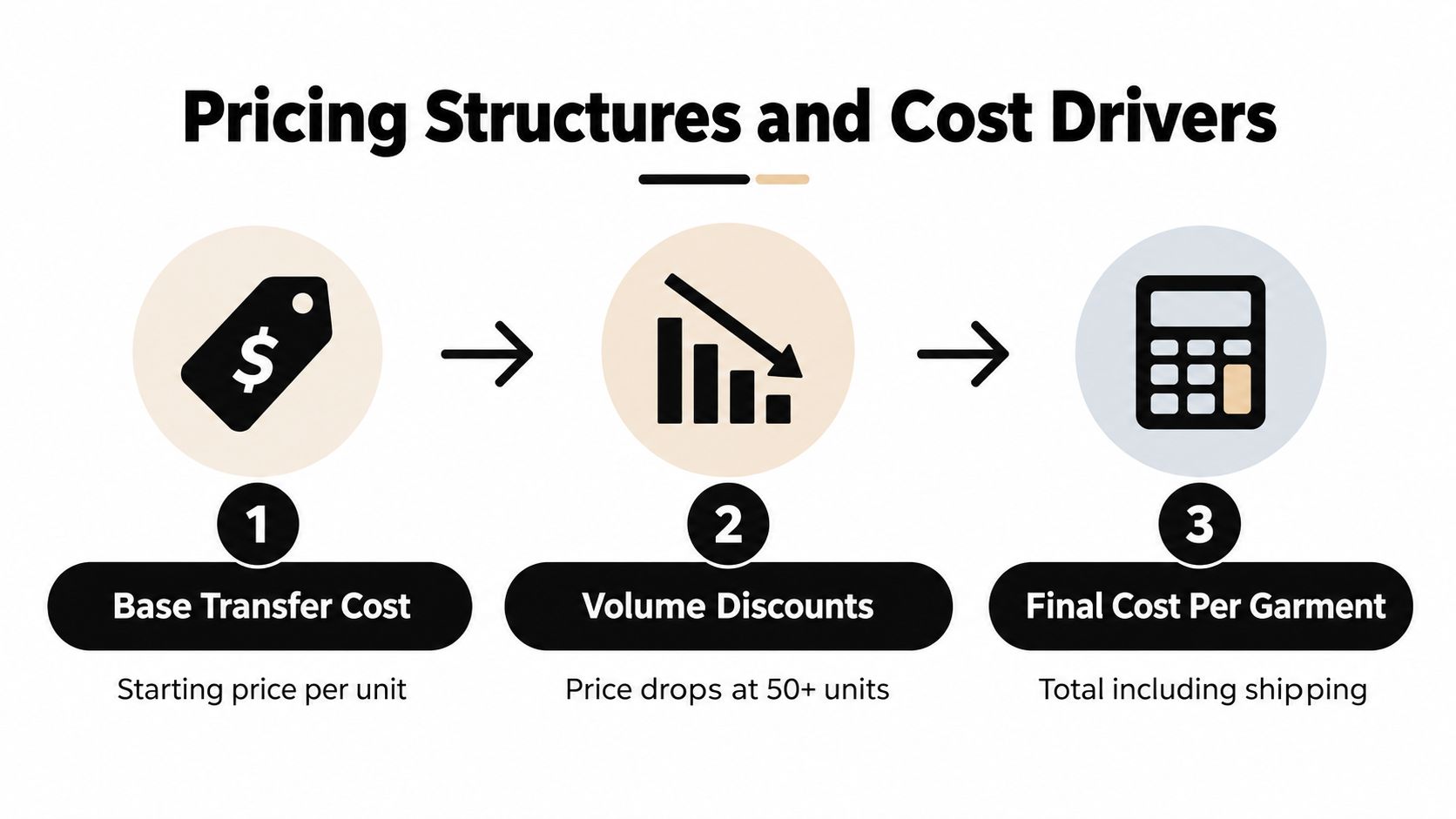
The price you see is not the price you pay
The first number is usually just the base transfer cost. After that come the decisions that affect margin, including how much of the sheet you fill, how much shipping adds, and whether you're paying for convenience or for volume.
The note about volume discounts can be misleading if you don't already have demand. Bulk pricing only helps when you can move the product quickly enough to avoid tying up cash in slow inventory.
What changes the quote
Several things move pricing up or down, even when two vendors offer similar-looking products:
- Film quality and adhesive consistency influence how reliably the transfer performs in production.
- Ink system and colour range affect how detailed the final print can be.
- Gang sheet utilization changes the true per-garment cost because unused space is wasted money.
- Domestic versus overseas sourcing changes shipping risk, customs exposure, and how quickly you can reorder.
That's why a sheet that looks more expensive can still be the better buy if it saves a rush shipment or avoids a second production run. The supplier with tighter turnaround can also protect your ad schedule and your customer promise.
How small shops should think about cost
The right question is not “What does a sheet cost?” It's “What does one finished garment cost after everything is added in?” If you can't answer that, you're guessing at margin.
Margin survives on repeatability. A quote that works once but breaks every time you reorder is a bad system, not a good deal.
Ordering Workflows and Production Turnaround
A clean ordering workflow protects you from the two worst mistakes in this business, approving the wrong file and missing the ship date. That's why the best suppliers build validation into the front of the process instead of treating it as an afterthought.
What a good workflow looks like
A solid process starts with upload and validation, not printing. The artwork gets checked, the layout gets confirmed, and the order doesn't move until someone has approved what will hit the film.
That matters even more when you're ordering mixed sizes or multiple designs. One wrong quantity or one missed art revision can turn a profitable run into a rush remake.
Domestic vs overseas is an operations decision
Overseas sourcing can look attractive on base price, but the business risk moves elsewhere. Lead time becomes less predictable, and if the order needs correction, the delay gets longer.
Domestic production usually gives smaller shops a tighter operating loop. You can validate files faster, resolve issues sooner, and get product back into production without waiting on customs or long transit windows.
What to ask before you place the order
If you're comparing suppliers, ask direct questions:
- How do you verify artwork before production?
- What happens if the file needs correction?
- When does the order ship?
- How do you handle a reprint if the first run is wrong?
For ordering discipline specifically, the guide on how to order DTF transfers is a useful reference because the workflow matters as much as the product.
Durability Benchmarks and Quality Verification
A shirt can leave the press looking perfect and still become a replacement order after its first wash. The cost is more than the garment. You also absorb rework, shipping, and a customer who may not trust the next delivery. Verify durability before a larger run commits your margin.
DTF performance depends on process control, not only transfer quality. Properly applied transfers are typically cured at 320–350°F (160–177°C), allowing the adhesive powder to bond into a flexible layer. Under-curing weakens adhesion. Over-curing can make the print brittle and encourage cracking at the edges. Controlled testing commonly uses 40–50 washes as a practical benchmark, while higher wash counts require consistent curing, suitable garment preparation, and careful washing (Wellye Paper).
The prep work matters before the press closes
Lint-roll the garment and pre-press it to remove moisture before applying the transfer. Lint, condensation, and fabric movement can all interfere with adhesion. Skipping this step saves seconds while increasing the chance of failed pieces across a batch.
Film type changes the operating method. Hot-peel and cold-peel films need different timing, temperature, pressure, and post-press treatment, so operators should follow the supplier's specification rather than repeat a familiar setting. Example workflows include 160°C for 8 seconds with a hot peel and a second post-press, or 120°C for 30 seconds followed by cooling and a second press for cold-peel use (DTF transfer process guidance).
How to verify before you scale
Run samples on the actual garment blanks, not just a similar fabric. Check whether the transfer survives the expected wash routine, whether edges remain clean, and whether different operators can reproduce the result. Record the film type, press settings, garment, peel timing, and defects. Those records turn a successful sample into a repeatable production standard.
Use this QC sequence:
- Visual check after pressing, looking for edge lift, uneven gloss, pinholes, or incomplete bonding.
- Stretch check on the garment, because brittle prints often reveal weakness before washing.
- Sample wash testing, using the care instructions customers will receive rather than an unusually gentle demonstration cycle.
A small first run is a quality-control expense, not wasted inventory. Finding a press or garment problem on ten shirts is far cheaper than discovering it after a hundred have shipped.
Making the Right Transfer Choice for Your Business
The right method depends on what your shop needs to protect most, cash, speed, or consistency. If you're running a small e-commerce brand or launching a new collection, flexibility usually matters more than squeezing every cent out of a repeated design. If your work is steady and predictable, scale starts to matter more than flexibility.
Match the method to the business model
DTF fits shops that need mixed artwork, short runs, and a low-friction way to keep designs moving without building screens. HTV still has a place for simple decoration, especially when you're testing demand or keeping equipment costs low. Screen-printed transfers make more sense when the same artwork sells again and again and the setup can be amortized across enough units.
That's the decision most beginners skip. They compare methods by surface cost instead of by how those methods fit their production pattern.
Build the workflow around repeatability
If you're scaling, the actual upgrade isn't just a new machine or a new vendor. It's a tighter operating system, art intake that catches errors early, supplier rules that keep ship dates honest, and a layout process that reduces waste.
A practical example from the broader apparel market is how operators combine production with paid traffic. If you're sending people to a shirt drop, the landing page, the ad timing, and the production schedule all have to line up. The Facebook and TikTok ad automation resource is useful because it shows how merchandising decisions and ad execution can support each other instead of fighting for attention.
The simplest buying rule
Start with the method that matches your current order mix, not the method you hope to need someday. Upgrade only when the current process is creating delays, waste, or quality problems you can measure.
If you need a transfer partner that works around production realities instead of hobbyist assumptions, Cobra DTF offers DTF transfer options built for practical shop use, including gang sheet ordering and fast turnaround planning. Visit Cobra DTF to review transfer options, compare formats for your next run, and keep your workflow focused on margin, consistency, and on-time delivery.