

Customer Satisfaction Guarantee That Actually Works
A customer emails at 9 p.m. with a photo of a dark shirt and a complaint about color shift. The artwork looked right on the proof, but the finished transfer appears less vibrant on fabric. Before the transfer even reaches a heat press, the customer wants a refund. If your shop doesn't have a written answer, you're left negotiating from a phone screen while another production order waits.
A customer satisfaction guarantee gives that conversation a structure. It tells the buyer what qualifies, what evidence to send, how quickly you'll respond, and whether the outcome is a reprint, replacement, refund, or credit. It also forces the shop to decide what it can afford to promise before a frustrated customer makes that decision for it.
When a DTF Order Goes Wrong and Why a Guarantee Helps
A small DTF operation handles orders that are rarely identical. One file may print on cotton, another on a blended garment, and a third may be pressed by a decorator using a different temperature or peel method. A color shift, adhesion problem, or missed shipping expectation can become a dispute even when nobody acted with intent to deceive.

The guarantee absorbs some of that uncertainty before it turns into a public complaint or payment dispute. It doesn't make every complaint valid. It creates a fair process for deciding whether the issue came from the supplied artwork, the printed transfer, the garment, the pressing method, or shipping.
Practical rule: A guarantee should answer three questions immediately, what went wrong, what will the shop do, and what must the buyer provide?
For example, a policy might require clear photos of the transfer and pressed garment, the order number, and a description of the wash or pressing conditions. The shop can then compare the complaint with its production record, proof approval, artwork file, and shipping scan. A documented quality-control process for printing makes that review faster because the seller isn't relying on memory.
The operational benefit matters as much as the marketing benefit. Instead of improvising a response in a long text thread, the owner can send a prepared message, assign the claim a category, and apply the stated remedy. A guarantee works when it turns anxiety into a repeatable workflow, not when it merely adds reassuring language to a product page.
What a Customer Satisfaction Guarantee Actually Means
A customer satisfaction guarantee is a specific promise about the remedy available when an order falls short of the stated standard. In DTF terms, it's similar to defining a hot-peel tolerance window. You decide what result counts as acceptable, then state what happens when the result falls outside that range.
The policy should distinguish a production defect from a preference or buyer-side error. Film that fails to adhere under the shop's recommended application instructions is different from a customer choosing a garment fabric that isn't suitable for the transfer. A noticeable difference between an approved proof and the printed result may deserve review, while an expectation of an exact fabric color match needs clearer limits.
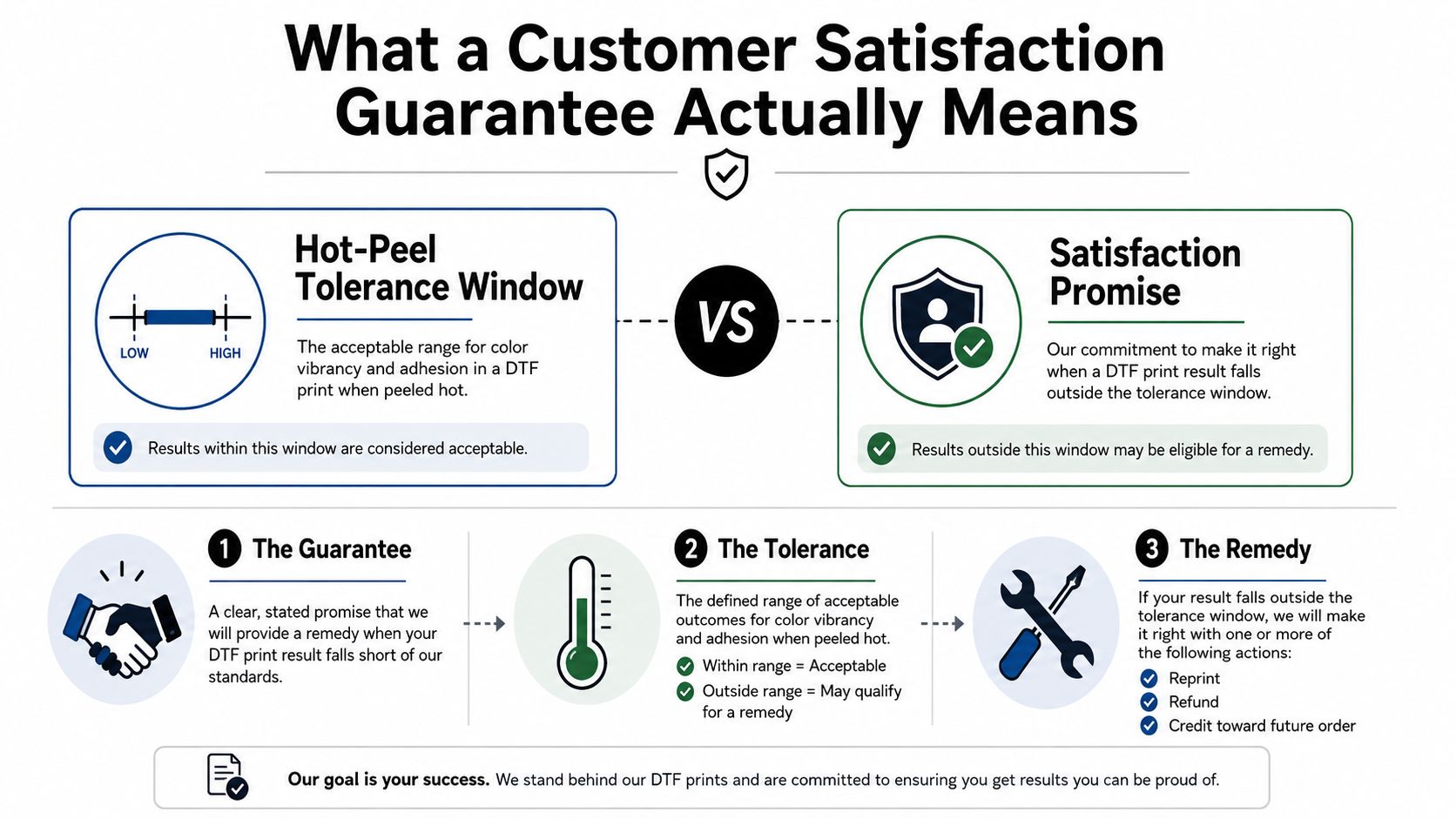
Four remedies customers commonly see
- Refund: The shop returns the purchase price under the stated conditions. This creates a strong trust signal, but it removes revenue and may leave the seller with unusable custom stock.
- Replacement: The shop sends a new product when the wrong item, damaged parcel, or shipping-related loss is the central problem.
- Reprint: The shop reproduces the same transfer or gang sheet when the artwork is correct but the print has a defect. This often protects the relationship without creating reverse logistics.
- Store credit: The shop applies value to a future order. Credit can work as a goodwill option, but it shouldn't replace a legally required refund or an expressly promised remedy.
A policy is incomplete unless it also explains the workflow. State the claim window, required photos, response time, and resolution method. A conditional guarantee that requires evidence is not the same as an unconditional money-back promise. Buyers should be able to tell the difference without interpreting legal language.
For broader customer-experience principles, the CallZent customer experience guide is a useful companion, especially when you're building response standards around the policy. The central lesson for a print shop is simple: write the promise so the customer and the operator reach the same conclusion from the same facts.
Why Small Print Shops and DTF Sellers Benefit Most
Small print shops often sell trust before they sell price. A visible guarantee reduces hesitation at checkout because the buyer can see that the seller has already considered what happens if the transfer arrives damaged, prints incorrectly, or misses the expected production window.
Consumer research supports the commercial value of that reassurance. Ninety-three percent of consumers say they're more likely to purchase from retailers offering quality guarantees or warranties, and ninety-two percent regularly check a retailer's return policy before buying, according to Retail Customer Experience. Those findings fit DTF purchasing behavior, where a decorator may be ordering custom artwork from a supplier they haven't used before.
The first response also matters. Ninety-seven percent say a positive return experience makes them more likely to buy again, while 43% say they'd avoid a brand if an item were ineligible for return or exchange, as reported in the same source. For a shop serving apparel decorators, a clear resolution can preserve a recurring account even when one gang sheet fails inspection.
| Benefit | Daily Workflow Impact |
|---|---|
| Checkout confidence | A short guarantee statement addresses risk before the buyer submits a custom order. |
| Faster complaint handling | Staff can follow the same evidence and remedy steps instead of escalating every claim to the owner. |
| Better repeat-order potential | Decorators can reorder with less concern that one production issue will leave them carrying the loss. |
| Cleaner payment records | Consistent resolutions create documentation when a buyer threatens a chargeback. |
| Stronger marketplace presentation | A clear policy gives customers a visible process instead of forcing them to search through messages. |
The guarantee won't eliminate reprints or refunds. It can reduce the friction around them, which is often where a small operation loses the most time. A shop that resolves a genuine adhesion failure quickly may spend material once, while a shop that argues over an unclear policy can also lose the next order, the review, and the payment dispute.
Operational Legal and Cost Trade-offs to Plan For
A guarantee becomes expensive when the shop promises outcomes it can't control. Before publishing one, separate production responsibilities from customer responsibilities. Photograph finished transfers, record the relevant film or ink batch, save the approved artwork, and document the shipping handoff. Those records give the team something concrete to review when a customer reports a defect.
Set operational cutoffs in plain language. If next-day production depends on an order arriving by 1 p.m. Eastern, state that cutoff alongside the applicable business-day terms. Don't call a carrier delay a production guarantee unless the business is prepared to absorb that risk.
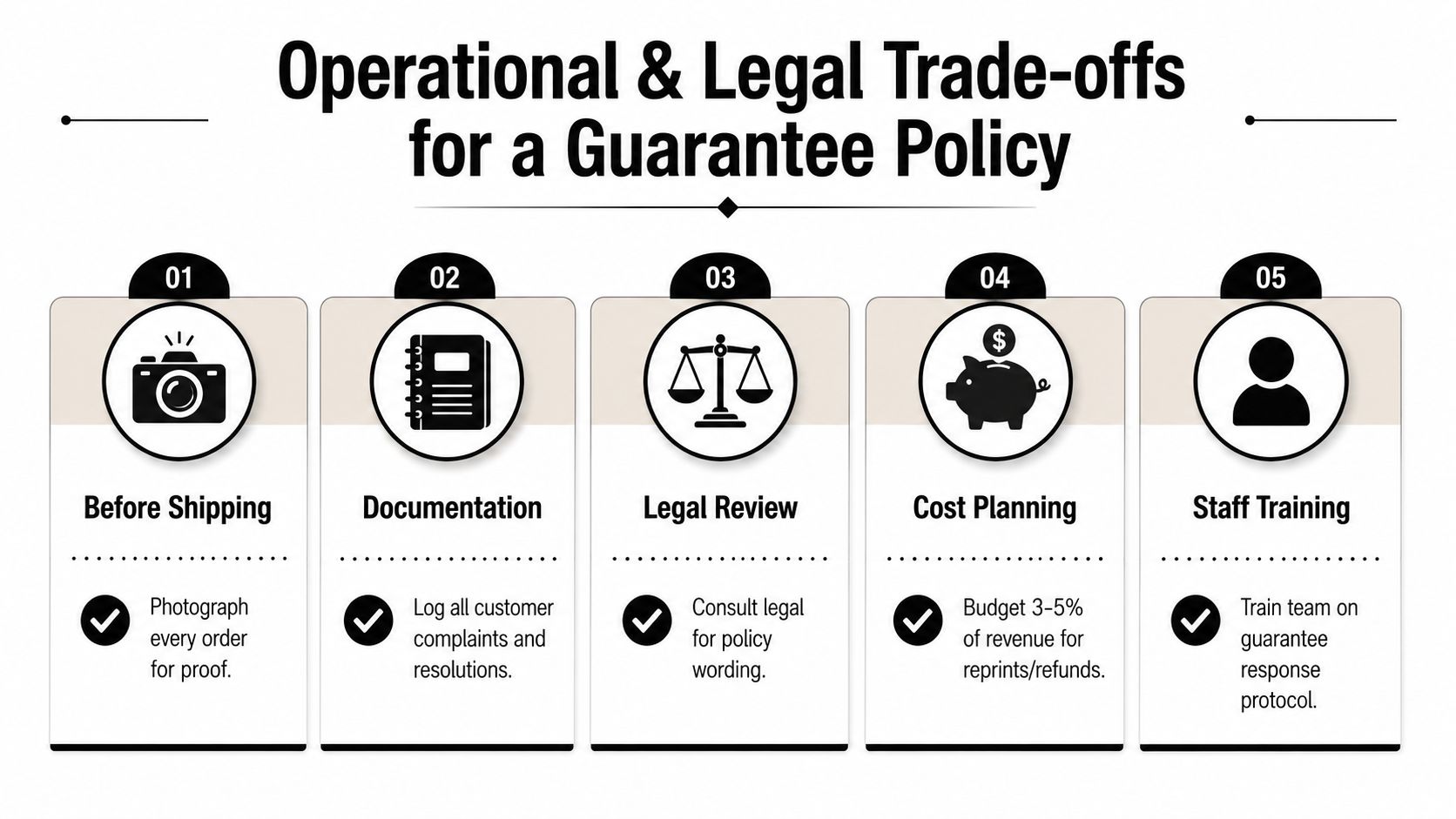
Where the exposure appears
Legal wording deserves review before publication. The FTC guidance on satisfaction and money-back guarantees should be checked with qualified counsel because an advertised money-back guarantee can create a full-refund expectation. A limited remedy should say exactly what the seller offers, rather than using broad language that sounds like insurance against every disappointing result.
The cost is also easy to underestimate. A 5% reprint rate on $2,400 in monthly transfers equals $120 in film and ink, but that example is a planning illustration, not a universal industry rate. A chargeback can add a $15 to $25 fee, so the same failed order may cost more than the production material alone. Those figures should be replaced with your processor's actual fee and your own material cost before you set a reserve.
Don't use the infographic's broad budgeting suggestion as a promise or benchmark. Build a reserve from your actual claims, shipping losses, labor, and refunds. The guide to reducing printing costs can help identify material and process waste, while free painting invoice templates offer a practical starting point for documenting job details and charges, even though the templates aren't designed specifically for DTF production.
Choosing the Right Remedy Refund Replacement Reprint or Credit
The right remedy depends on the failure, not on whichever option sounds most generous. A free reprint makes sense when the shop printed the wrong color or produced a transfer with adhesion failure. A refund may be more appropriate when the customer no longer has a usable deadline or when the shop can't reproduce the order accurately.
| Remedy | Cost to Shop | Customer Trust | Fulfillment Effort | Abuse Risk |
|---|---|---|---|---|
| Refund | Direct cash loss and possible recovery or disposal work | High, because the outcome is easy to understand | Moderate, with payment processing and documentation | Moderate if evidence rules are weak |
| Replacement | Product and shipping cost | High when the wrong or damaged item is clearly the shop's responsibility | Moderate to high | Lower when shipment records are available |
| Reprint | Material, labor, and outbound shipping | Strong for a verified print defect | Lower when the artwork is already approved | Moderate if defect criteria are vague |
| Store credit | Preserves cash inside the business | Variable, depending on the customer's need | Low | Lower, but unsuitable where a refund is owed |
Match the fix to the failure
A hot-peel adhesion failure usually points to a reprint when the artwork and order details are correct. A parcel damaged in transit may call for a replacement, especially when the carrier accepts the claim. A customer who selected the wrong garment size or submitted the wrong artwork should not automatically receive a refund for a seller-side defect.
Credit works best as a discretionary goodwill gesture, not as a substitute for every other remedy. For a repeat buyer, credit can acknowledge inconvenience while keeping the account active. For a one-time buyer facing a missed event, credit may feel dismissive.
A practical default is reprint for verified production defects, replacement for seller-caused shipping damage or wrong items, refund when neither correction is workable, and credit for voluntary goodwill. Put that order in the policy, then allow staff to escalate unusual cases rather than making every employee negotiate from scratch.
Sample Guarantee Wording for DTF Defects Color and Turnaround
A checkout page needs short, confident language. The full policy can carry the evidence rules and exclusions, but the first promise should be understandable without expanding a menu.
Print quality promise: If we make a confirmed production error, we'll reprint the affected transfer or provide the remedy stated below. Contact us within the claim period with your order number and clear photos so we can review the issue.
Defects and adhesion
If a transfer cracks, peels, or fails to adhere when applied according to our published pressing instructions, send photos of the transfer, garment, and application result with your order number. After review, we'll reprint the affected item or issue the applicable refund under this policy. Claims caused by incorrect temperature, pressure, dwell time, peel method, garment selection, or washing outside the care instructions may be excluded.
The example of a 25-wash standard should only appear if your shop has chosen and documented that limit. If you use it, write the remedy plainly: “If your transfer cracks or peels within 25 washes under normal care, we'll reprint the affected sheet free or issue a full refund within 5 business days after approval.” A promise that specific needs operational support.
Color and appearance
Printed colors may vary from an on-screen display, proof, or garment surface. We don't promise an exact Pantone match on fabric. If the printed transfer materially differs from the approved proof because of a production error, send comparison photos and we'll review the claim for a reprint or refund.
Avoid blanket lifetime promises. Define what “premature fading” means, identify the care conditions that apply, and exclude fluorescent or specialty-color expectations if your process can't control the result consistently.
Turnaround and shipping
Orders received before our stated production cutoff qualify for the production schedule shown at checkout. If we miss that production commitment because of an internal error, we'll contact you and offer an appropriate remedy. Carrier delays, weather, incorrect addresses, and events outside our control are handled under our shipping policy.
Place the short promise near the product price and cart button. Put the complete terms on the guarantee page, order confirmation, and packing slip. The refund email should state the approved remedy, amount or replacement action, expected timing, and any return or disposal instruction. Don't make the customer reconstruct the agreement from earlier messages.
Marketing the Guarantee and Measuring Real Success
A guarantee only reduces purchase anxiety when buyers see it before paying. Put a concise badge or line near the product price, repeat the essential promise in the cart, and include the claim contact in the order confirmation. The footer policy page should provide the complete terms without forcing customers to search through an FAQ.
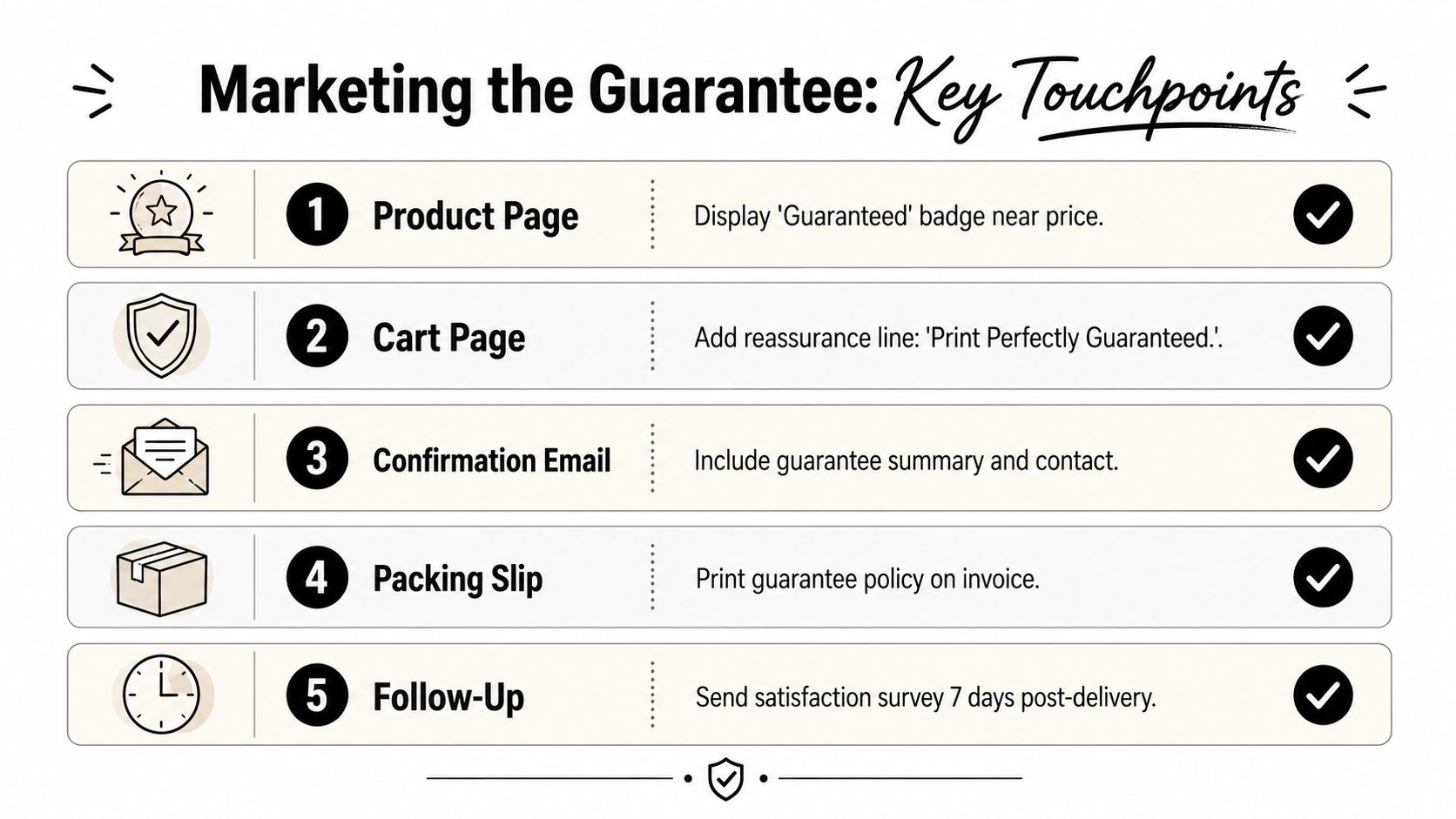
A packing slip is useful because it stays with the order after the customer leaves the website. A short footer can say where to report a defect, what photos are needed, and whether the shop generally starts with a reprint. Keep the wording consistent across every touchpoint. Contradictory promises create disputes even when the production work was correct.
Measure claims, not just compliments
Send a short customer satisfaction survey after delivery, with one question about transfer quality and one about turnaround. You can use CSAT to identify immediate order problems, then use an occasional NPS pulse to understand whether customers would recommend the shop. These scores are directional tools, not proof that the guarantee caused a particular result.
Track the operational numbers that affect margin:
- Claim rate: Count claims by order type and defect category.
- Reprint rate: Separate printer-caused reprints from buyer-approved corrections.
- Resolution cost: Include material, labor, outbound shipping, refunds, and processor fees.
- Response time: Record when the claim arrived and when the first meaningful reply was sent.
- Repeat behavior: Compare whether resolved customers return, without assuming every return came from the guarantee.
A weekly review can fit into ten minutes if the categories are consistent. Look for recurring patterns, such as dark-garment color complaints or instructions that customers misunderstand, then revise the proofing, application guide, or policy. The SigOS feedback analysis guide provides useful context for turning raw comments into recurring themes, and Cobra DTF's customer-satisfaction guidance can support the broader service workflow.
Handling Disputes and Strengthening Your Guarantee Over Time
A vague promise encourages negotiation. A documented dispute workflow gives honest buyers a fast path while giving the shop enough evidence to challenge unsupported claims.
Start with a claim form or dedicated email address. Ask for the order number, photos of the transfer and finished garment, application details, and a description of the problem. A 48-hour response SLA can mean an initial review response, not necessarily a completed refund or reprint. State that distinction so customers don't mistake an acknowledgement for a final decision.
Use claim categories consistently
| Claim Type | Evidence Required | Standard Remedy | Escalation |
|---|---|---|---|
| Confirmed print defect | Order number, clear photos, production record | Reprint of the affected item | Owner or quality lead reviews repeated failures |
| Adhesion or peeling complaint | Application details, garment photos, care history | Reprint when instructions were followed | Technical review if the same batch creates multiple claims |
| Wrong item or damaged shipment | Packing record, delivery photos, carrier details | Replacement or refund under shipping terms | Carrier claim or processor documentation |
| Buyer artwork or garment error | Submitted file, order approval, product details | Correction at buyer's cost or discretionary credit | Owner review for goodwill exception |
| Color expectation dispute | Approved proof, printed item photos, display context | Review for production variance, then stated remedy | Policy review if the issue recurs |
A 7-day photo-evidence window can be used if it matches your product and shipping process, but publish it clearly and check it against applicable law. Don't deny a legitimate statutory right merely because your private policy uses a shorter period. In the EU, consumers have at least a 2-year legal guarantee of conformity, and repair or replacement can lead to a refund when those remedies are impossible or too slow, as explained by Your Europe. Australia's consumer guidance also describes possible remedies including repair, replacement, refund, cancellation, or compensation through the ACCC.
If a buyer threatens a chargeback, don't respond defensively. Review the order record, the policy shown at purchase, delivery proof, messages, and the remedy already offered. Absorb a small, credible loss when the evidence supports the customer. Challenge a claim when the documentation clearly shows fulfillment and the buyer is seeking an outcome outside the published terms, while recognizing that a processor decision isn't the same as a legal ruling.
Log every complaint by defect type. If fluorescent ink repeatedly creates color-shift disputes, add a direct disclaimer to the proof and checkout page. If customers misunderstand pressing instructions, improve the application guide instead of merely rejecting more claims. A strong guarantee protects margin by fixing the process that creates disputes, not by making the customer work harder.
If you need DTF transfers with a clearly defined reprint-based satisfaction promise, visit Cobra DTF and review the product and shipping terms before placing your next production order. Use the guarantee language in this guide as a checklist, then choose the remedy your shop can deliver consistently.