
Custom T Shirt Printing Reddit: 10 Providers Compared
A small shop owner with a launch deadline usually has too many tabs open and not enough certainty. One Reddit thread says a printer's colors survived repeated washes, another says the same provider delivered peeling graphics, and a third recommends a completely different blank shirt. The useful signal in custom T shirt printing Reddit discussions isn't the loudest opinion. It's the repeated, specific complaint or praise tied to a garment, print method, order size, wash result, or delivery problem.
That distinction matters because a provider can be excellent for one production model and frustrating for another. A no-minimum POD service may suit personalized orders, while a screen printer may make more sense for a repeat batch. A DTF transfer supplier may fit a shop that already owns a heat press but won't solve a fulfillment problem by itself.
The providers below are judged by the practical questions Reddit users keep asking: What happens after the first wash? What minimums apply? How consistent are blanks and decoration? What order problems appear repeatedly? Use the discussion as evidence, not a verdict. For a broader approach to documenting and citing Reddit findings, see these Reddit citation services.
1. Printful
A seller under deadline usually picks Printful for one reason. It removes a lot of failure points. You can connect the store, publish a design, and fulfill one-off orders without chasing a local printer, holding inventory, or meeting a batch minimum.
That convenience is real, but Reddit threads are more useful when you read past first impressions. The pattern with Printful is usually about consistency on the exact shirt and print setup you chose. Users who are happy after the first wash often mention a specific blank and a print that held up as expected. Complaints tend to cluster around artwork that was poorly suited to DTG, dark garments, or orders where the sample looked different from what they assumed the full catalog would deliver.
Where Printful fits best
Printful fits shops that want fewer moving parts and can accept a higher per-shirt cost in exchange for simpler operations. If you are testing demand, selling personalized designs, or running a store without your own production setup, that trade-off often makes sense. Its catalog includes familiar blanks such as Bella+Canvas and Gildan, and the workflow is easier to control than juggling multiple vendors.
Margin is the catch. Reddit users regularly compare Printful with lower-cost alternatives, but the smarter comparison is total hassle, not base price alone. Reprints, support tickets, stock substitutions, and inconsistent fulfillment eat time fast. Before committing, see how this platform stacks up in a direct vs Printful Printify comparison.
Practical rule: Order the exact blank, garment color, and artwork combination you plan to sell, then wash it. A good report on one Printful product does not automatically apply to the rest of the catalog.
If you want to press transfers in-house instead of outsourcing finished shirts, Cobra DTF offers a DTF Transfers Gangsheet Builder. For a broader shortlist, this comparison of print-on-demand suppliers helps frame the trade-off between POD fulfillment and your own workflow. Visit Printful to review its current catalog and integrations.
2. Printify
You can get a great shirt from Printify. You can also get a disappointing one if you pick a provider on price alone.
That split shows up all over Reddit. Complaints after the first wash, print feel, color accuracy, and late problem resolution usually point back to the specific print partner, not the marketplace itself. Printify gives sellers a wide provider network, multiple fulfillment locations, and room to compare blanks, methods, and base costs. The trade-off is simple. You do more of the vetting work yourself.
That flexibility is why some stores stay with Printify for a long time. You can test the same design across different providers, swap to a better blank, or choose production closer to your buyers. It also offers plan-based discounts for sellers trying to protect margin. On Printify, the Premium plan is listed at $39 per month.
The provider matters more than the marketplace
Reddit threads are only useful if you read them at the provider level. A post saying “Printify quality is good” or “Printify quality is bad” does not tell you much unless the user names the printer, blank, shirt color, and print method. One partner may hold up well after washing, while another shows fading, cracking, or rougher hand feel on similar artwork.
The common mistake is weak sampling. Sellers connect a product, publish it, and assume every provider listing for that shirt will behave the same. Then the actual problems start. Stock differs. Packaging differs. Turnaround differs. The print that looked fine out of the bag may not look as good after one wash.
Use a tighter checklist before you trust any provider at scale:
- Compare the exact blank: Same brand and model, not just a similar tee.
- Check the fulfillment route: A cheaper base cost can create slower or less convenient delivery.
- Wash the sample: First-impression quality is not enough.
- Watch support early: Clear replies before purchase often signal fewer headaches when stock or artwork issues come up.
Printify is a strong option for sellers who are willing to act like a production manager and build a shortlist from sample orders, not marketing claims. If you want one platform to make all those choices for you, this model will feel like extra work.
3. CustomCat
A typical Reddit pattern goes like this. A seller needs a US printer with no minimums, fast handling, and base costs that still leave room for margin. CustomCat website keeps coming up for exactly that reason, especially for stores selling one design at a time instead of placing bulk runs.
The appeal is straightforward. CustomCat focuses on US-based POD production, offers a wide catalog, and uses its DIGISOFT process for many apparel orders. In practice, that puts the conversation less on branding extras and more on whether the print still looks good after the first wash, whether the blank stays in stock, and whether support is clear when something goes wrong.
Reddit comments about CustomCat tend to be strongest on speed. Sellers often mention it when they want domestic fulfillment without waiting on a longer production queue. CustomCat also describes relatively fast fulfillment on its own site, but that should be treated as a provider target, not a promise for every garment, print method, or destination.
That trade-off matters. If your store wins on fast delivery and simple POD economics, CustomCat can fit. If your brand depends on heavy private labeling, premium garment presentation, or more control over finishing, it is a narrower match than some apparel-first competitors.
The paid PRO option can lower base costs, but only when your order volume supports the subscription. Cheap unit pricing does not fix weak demand, prevent stock substitutions, or solve a workflow that still needs manual checks before launch.
The bigger question is consistency. Reddit users describe mixed experiences with DTG and embroidery, plus the usual complaints that matter more after a customer has paid: stock gaps, uneven communication, and occasional order friction around deadlines. Those are the threads to pay attention to, because they point to what can break under normal store conditions, not just what looks good on a product page.
Test it like you expect problems:
- Order one dark and one light garment: decoration problems show up differently across bases.
- Use fine details in the art: small text and thin lines expose weak processing fast.
- Do a one-wash check: compare the washed sample against an unwashed one.
- Send support a specific pre-order question: ask about stock or decoration and judge the reply for clarity, not friendliness.
4. Bonfire
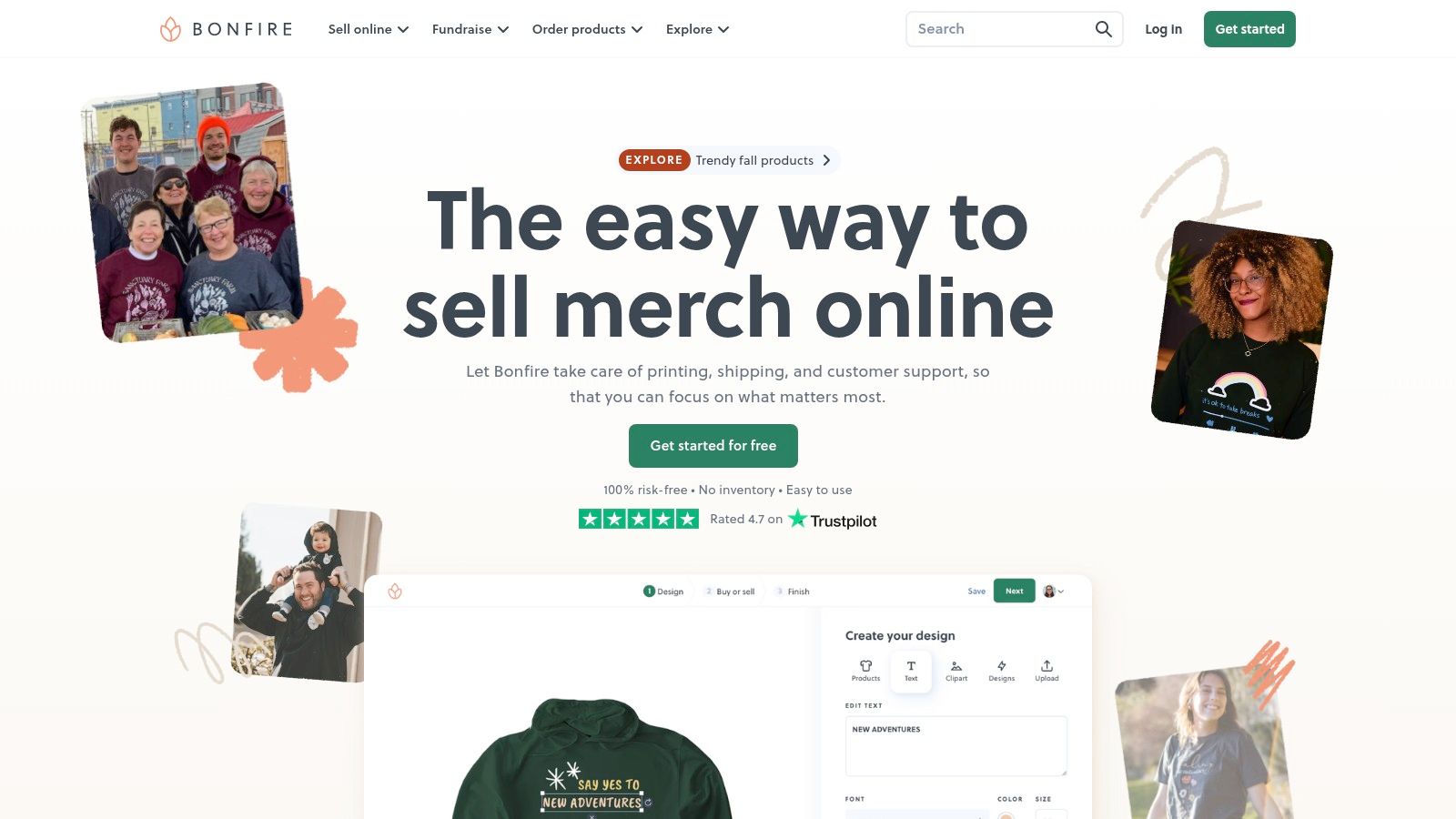
A typical Bonfire order starts with a cause, not a merch program. A school fundraiser, creator drop, or community campaign needs a page that collects orders, handles payments, and ships shirts without someone managing inventory in a spare room. That is Bonfire's appeal. It is built for campaigns, preorders, and supporter sales, and that matters when the organizer cares as much about simplicity as the shirt itself.
That setup also changes how Reddit feedback should be read.
Users who approach Bonfire like a fundraising tool often accept a narrower product experience if the campaign runs smoothly. Users who expect a brand-grade print shop are usually harder on it, especially once shirts have been worn and washed. In those threads, the complaints worth noticing are the practical ones: peeling graphics after the first wash, mixed print quality across the same order, and shipping that slips enough to create problems around events or campaign promises.
Those reports do not mean every Bonfire campaign goes wrong. They do mean the safest way to judge it is not by the campaign builder or the payout flow. Judge it by what happens after delivery. If the print weakens fast or the garment feels cheaper than supporters expected, the damage lands on the organization behind the sale.
For that reason, sample testing matters more here than many first-time organizers assume. Order the exact shirt you plan to sell. Wash it once. Compare the actual print, color, and placement to the campaign mockup. Then read recent Reddit threads with a narrow filter: look for comments that describe the blank used, what happened after washing, whether there was a minimum issue or preorder constraint, and how Bonfire handled delays or order mistakes.
Bonfire makes sense for groups that want a simple campaign system and do not want to buy stock up front. It is a weaker fit if the shirt is the main product, or if your reputation depends on tighter control over garment quality, sizing consistency, and decoration durability. If you are still deciding between a campaign platform and a store built around repeat sales, this guide on starting a print-on-demand business helps frame that choice. You can review the platform directly at Bonfire before putting a live campaign in front of supporters.
5. Apliiq
Apliiq is aimed at sellers who want more than a printed front graphic. Its private-label options include sewn labels and patches, with embroidery, DTF, and DTG available across a fashion-oriented blank catalog. That makes it especially relevant to streetwear startups and small brands that want a finished garment to feel like branded merchandise rather than a marketplace product.
Reddit users often point to good DTF quality and strong branding options when the order is straightforward and the process is properly set up. Apliiq can be a useful middle ground for a brand that wants private-label details without purchasing and storing a large inventory.
Branding adds another failure point
The same customization that makes Apliiq attractive also increases the number of details that can go wrong. Reddit feedback includes reports of stock substitutions, incorrect graphics, and communication gaps on complex orders. A shirt can have a good print and still be unusable if the wrong blank arrives or a label is applied incorrectly.
Treat each branding add-on as a separate quality checkpoint. Confirm the garment is in stock, verify the label or patch placement, and ask how substitutions are handled before paying for production. Keep written approval of the artwork and product combination so you have a clear reference if the finished order differs.
Don't approve a private-label run from a mockup alone. A sample should confirm the blank, print, label, patch, placement, and overall fit.
Apliiq is a stronger candidate for brand builders than for sellers seeking the simplest possible POD setup. It offers more control, but control only helps when the seller actively checks the details. Review the current options at Apliiq, then use Reddit threads to identify recent complaints tied to the exact service combination you need.
6. RushOrderTees
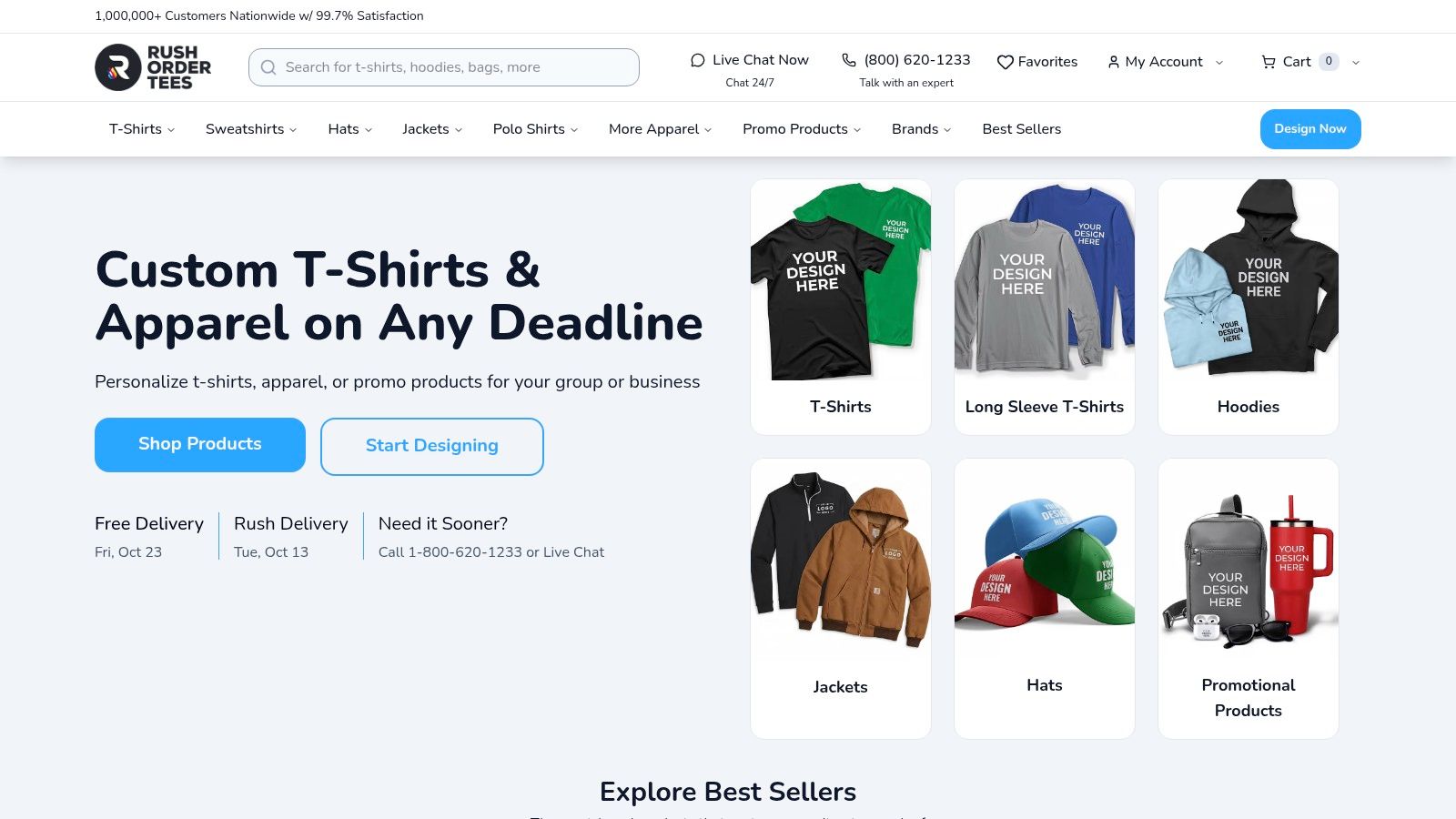
RushOrderTees earns attention for one reason above all others, speed. It offers screen printing, embroidery, and fast-turn DTG, with rush options that can include next-day and two-day production on selected items. That makes it relevant to teams, events, and organizers who discover a deadline too late for a normal production cycle.
Reddit users report successful overnight deliveries, but those stories shouldn't become a blanket promise. Rush production depends on the garment, decoration method, artwork approval, destination, and order timing. The provider's online design studio and art review process can help reduce avoidable errors, but they can't make every product available for every deadline.
Fast doesn't mean unlimited choice
Ultra-fast orders may restrict garment choices, decoration methods, or design complexity. A rushed screen-printed job may not offer the same flexibility as a standard order, and the cheapest per-piece pricing usually comes with volume rather than urgency.
Use the service when delivery certainty has higher value than maximum customization. Ask which shirt and method are available for the date you need. Then order one sample if the event matters enough that color, garment feel, or print placement could affect your reputation.
A useful question for Reddit isn't “Is RushOrderTees good?” Ask instead: “Did this exact garment and print method arrive by the promised date, and what happened after washing?” That wording produces more actionable replies than general praise.
The RushOrderTees website explains its current rush options and design workflow. If your local search is focused on immediate production, this guide to same-day printing services near me adds a useful comparison point. RushOrderTees is a deadline tool, not automatically the best long-term supplier for a retail line.
7. BlueCotton
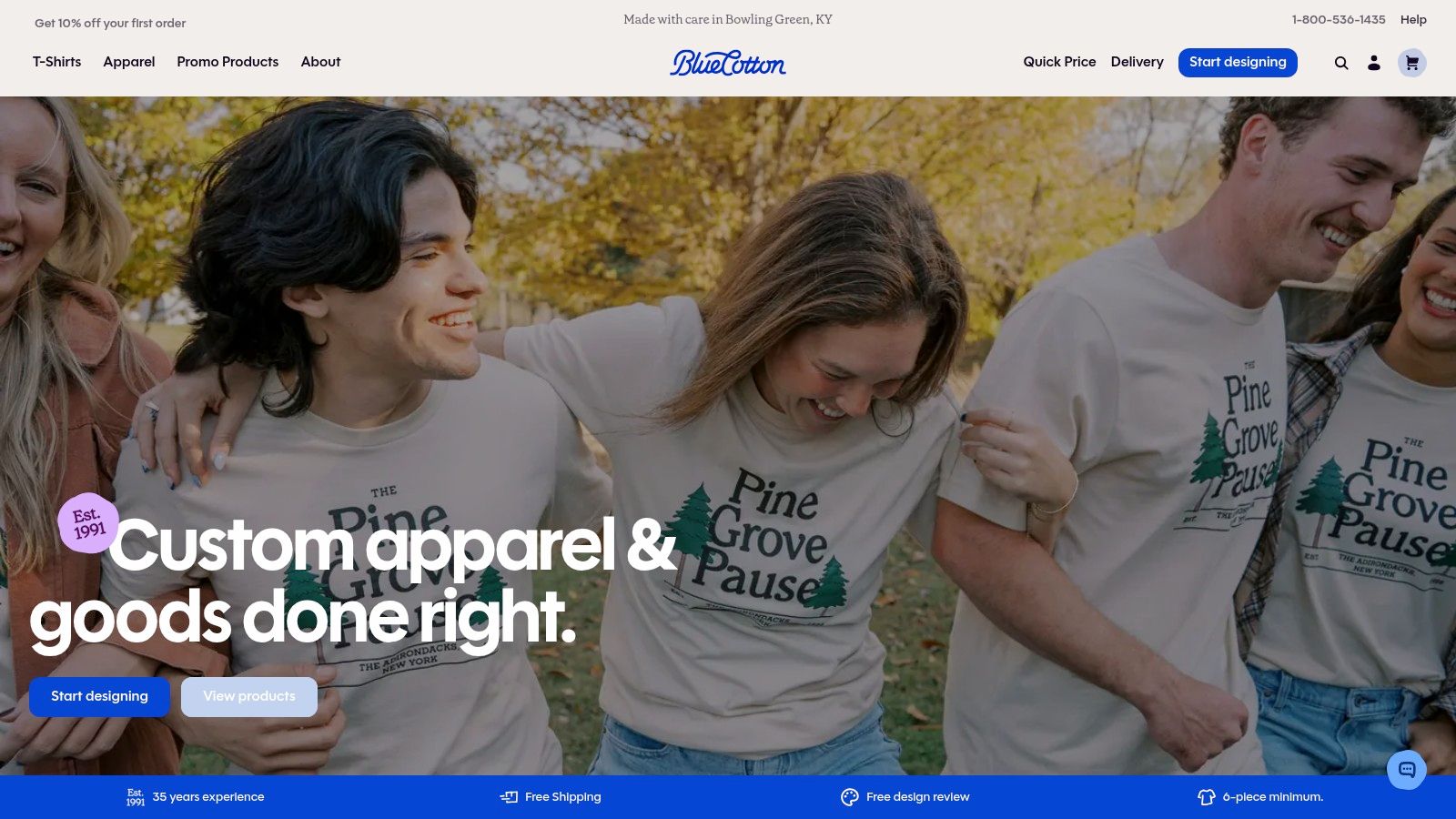
BlueCotton has a simpler proposition than the marketplace POD providers. It keeps production and support in-house, offers screen printing and embroidery, and provides a Quick Price tool that shows how garment, quantity, and design choices affect the quote. That transparency is valuable for small orders, nonprofits, bands, and organizations that need a clear number before collecting money.
Reddit feedback is frequently positive around dependable quality and customer service for these smaller projects. BlueCotton also describes guaranteed delivery dates and a return or remake policy when the shop makes an error. Those policies help, but they don't replace checking the garment before a public event or recurring merch launch.
Good for controlled projects
BlueCotton is strongest when the order has a clear design, a defined quantity, and one production destination. Complex multi-location or multi-color artwork can increase costs, so a quote that looks attractive for a simple chest print may change quickly when a back print, sleeve mark, or detailed graphic is added.
The Quick Price process makes it easier to compare scenarios before ordering. Test the garment choice and print feel with a sample, especially if the shirts need to match existing merchandise. A soft blank with a heavy print can feel very different from a heavier garment with a lighter decoration, even when both look accurate on a digital mockup.
A dependable printer still needs a precise brief. List every placement, color, garment, size, and delivery requirement before approving the quote.
BlueCotton suits buyers who want a managed US shop instead of a provider marketplace. It may be less economical for highly complex jobs or unusual brand details. Visit BlueCotton and use its quoting workflow to see whether the project remains within your target cost before requesting production.
8. Underground Printing
A typical Reddit pattern with Underground Printing is straightforward. Someone places a small order for a campus event or club, likes how easy the first run was, then comes back later expecting the reorder to feel the same after the first wash. That is where UGP needs a closer read.
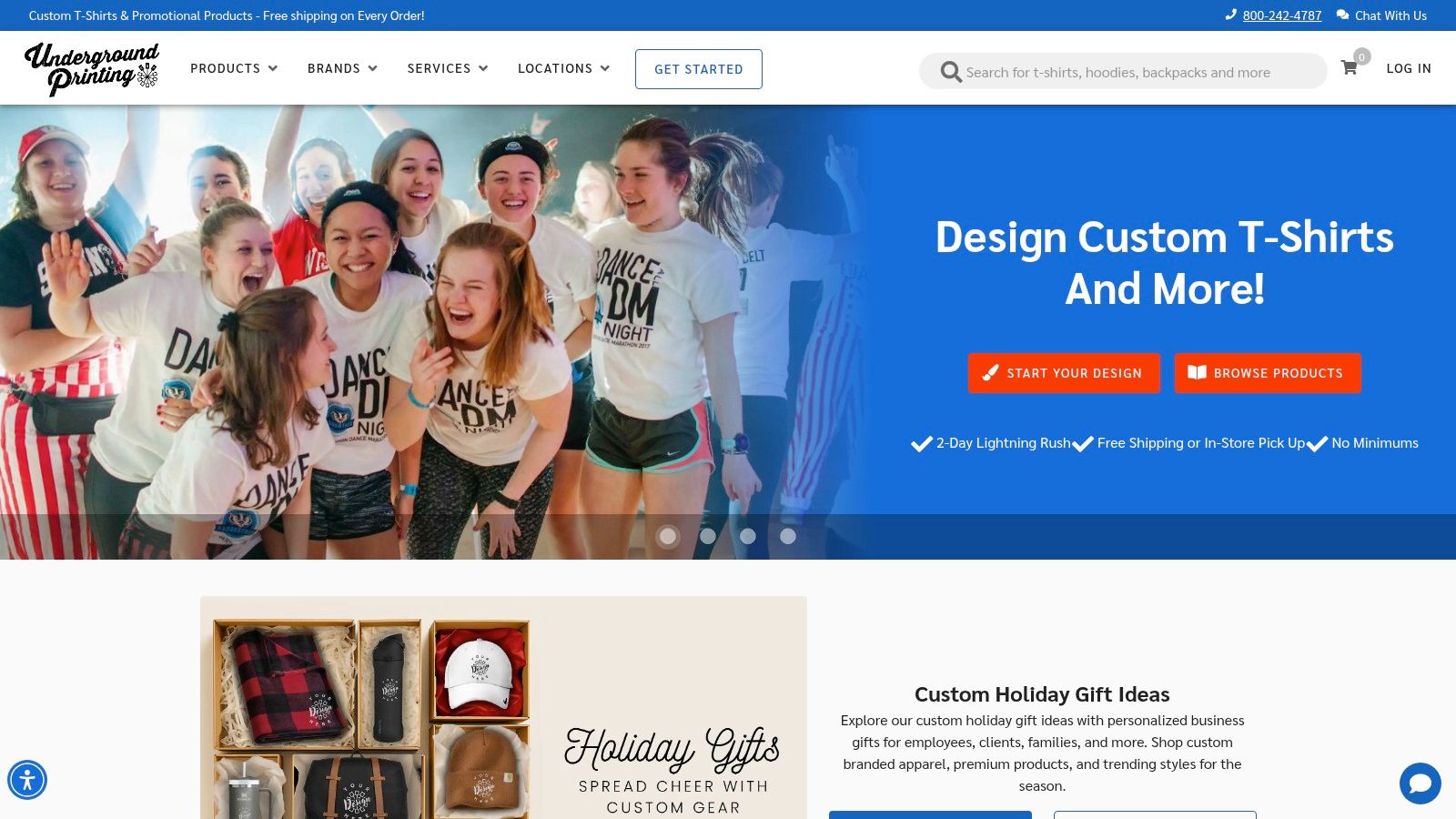
Underground Printing covers both ends of the market. You can place a low-volume custom order, then shift into a larger run for a school, team, or organization once the design proves itself. The trade-off is production consistency. A small digital run and a larger screen-printed run can carry the same artwork but wear differently, feel different in hand, and age differently in the wash.
That matters more than the sales pitch.
If you are reading Reddit threads about UGP, sort them by three things first: location, print method, and whether the complaint showed up immediately or after laundering. A local storefront can make communication easier, but one branch does not stand in for every branch. Complaints about cracking, heavier print feel, or color shift often mean the buyer changed methods without realizing it, not that every UGP order has the same issue.
The practical move is to treat Underground Printing as a shop with range, not as a single uniform production line. For one-offs and small tests, that flexibility is useful. For repeat merchandise, alumni apparel, or any design that needs to match an older batch, you need tighter controls before approving the order.
Use this provider like a sample-test candidate, not a blind reorder:
- Decoration method: confirm whether the job is digital printing, screen printing, or embroidery.
- Reorder match: ask whether the same method and blank can be held for future runs.
- After-wash feel: sample the shirt and wash it before committing to a larger batch.
- Quantity breakpoints: ask when the order shifts into a different production process.
UGP fits groups that want an easy first order and a realistic path into higher-volume production. It is less dependable for a premium merch line where every batch has to match closely from day one. Review the current options, then compare them against your shortlist with one sample order first.
9. Real Thread
A common Reddit pattern goes like this. The first impression is great because the shirt feels soft and the print does not sit on top like a thick patch. The question shows up after the first wash. Did the ink stay clean, did the color shift more than expected, and does the softness still look intentional instead of faded?
That framing matters with Real Thread. The shop is built for premium-feel decoration, especially soft-hand water-based and discharge screen printing, plus embroidery, custom tag printing, samples, and guidance on print limits. That makes it appealing for brands that care about retail feel, but it also means you have to judge it by the trade-offs those methods bring, not by a mockup or a product page at Real Thread.
Minimums are part of the decision, and they change who this provider suits. Screen printing works well for planned batches where the artwork, blank, and reorder path are already fairly settled. It works poorly for someone trying to test a pile of unrelated one-off ideas. If your Reddit research is aimed at finding a sample-test shortlist, Real Thread usually belongs in the “quality-first batch order” group, not the “cheap single shirt” group.
The useful complaints are specific. Water-based and discharge prints can feel excellent while still printing differently on dark garments, blends, or garment-dyed blanks. A soft print is not automatically a durable print for every fabric. A disappointing order here is often a mismatch between the shirt, ink method, and color expectations.
Use the sample program like a filter, not a formality.
Check four things before you approve a larger run: whether your key colors need strict matching or can flex a bit, whether the exact blank you want changes how the ink behaves, where the minimums start to affect your order size, and how the print looks and feels after a wash. Neck labels matter too if the goal is branded merch rather than generic event apparel.
Real Thread makes sense for a considered launch, band merch drop, or any batch where hand feel is part of the product. It is a weaker fit for single personalized shirts or broad design testing across many small variations.
10. Cobra DTF
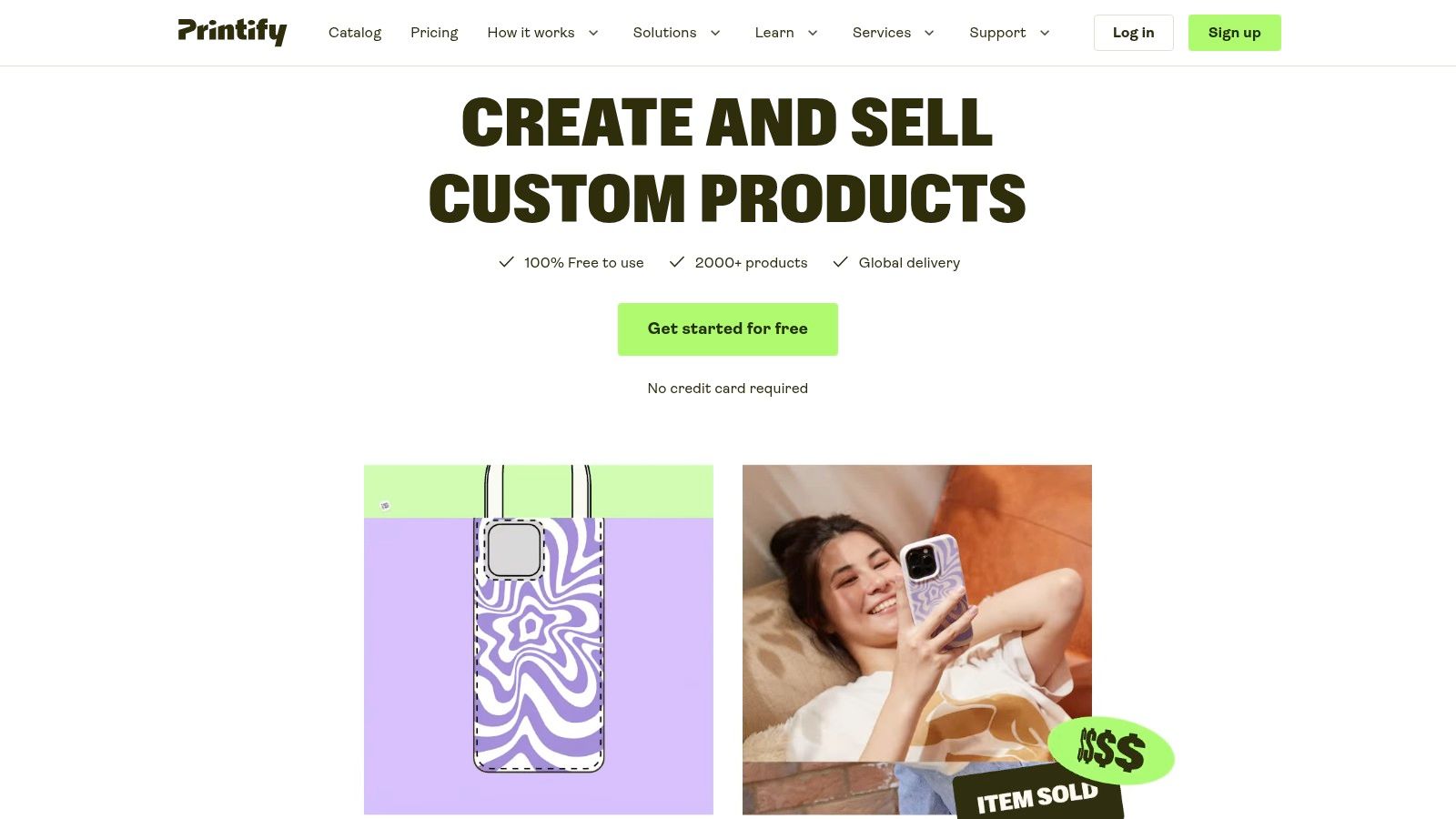
A lot of Reddit complaints about custom shirts show up after the first wash, but Cobra DTF sits in a different lane from the finished-shirt POD names above. It sells transfers, not completed tees. That matters because the result depends on two things at once: the transfer quality and how well you press it onto your own blank. For a shop that wants control over garment choice, inventory, and reorders, that setup can be useful. For a beginner who wants a printer to handle everything, it adds another failure point.
Cobra DTF describes itself as a Texas-based, family-owned supplier focused on Direct-to-Film transfers for small shops, apparel makers, and ecommerce sellers. The company says its transfers are 100% made in the USA, use premium inks and films, offer same-day shipping on orders placed by 1 PM CST, and usually arrive within one to three business days. Those are company service claims, not proof that your order will perform the same way on every garment or to every destination.
Where DTF helps a shop
DTF works well when you need short runs, varied artwork, or quick restocks without setting up screens for every design. Cobra DTF promotes vibrant, fade-resistant prints, hot and cold peel film options, and durability rated for 100+ washes. Treat that wash number as a manufacturer claim. Reddit threads about transfers often show the same pattern: a supplier can print a solid transfer, then a bad press temp, pressure issue, or weak blank makes the order look worse than it should after laundering.
The pricing section needs to be read carefully. Cobra DTF presents transfer pricing at about $0.20 per inch and compares that with competitors at $0.50 or more per inch. In its catalog, the DTF Transfers Gangsheet Builder is listed at $7 and the UV DTF Transfer Gang Sheet Builder at $12. That is a more useful starting point than vague low-end price talk, but it still does not tell you your true shirt cost until you calculate artwork size, waste on the sheet, pressing labor, and the blank you plan to use.
That is also why Reddit-style evaluation matters here. With Cobra DTF, the first question is not whether the marketing sounds good. It is whether the transfer still looks clean after washing, whether your order size fits the minimum friction of gangsheet buying, and whether any reported order problems sound like supplier mistakes or shop-floor setup mistakes. The Cobra DTF website highlights upload tools and a satisfaction guarantee with reprints if a buyer is not satisfied. It also shows 2,689 reviews, which is useful as first-party social proof, but not a substitute for your own test press.
The trade-offs buyers should document
Cobra DTF does not show third-party certifications or formal environmental or quality seals in the provided materials. Its eco-conscious inks and films are described by the company, not backed here by independent certification. That distinction matters because DTF can reduce some setup waste while still relying on transfer film and adhesive powder.
International buyers should also weigh shipping reality against the domestic-US pitch. A US shop may benefit from domestic production and fewer customs problems. Buyers outside the United States may not.
Test one design on your actual blank, at your actual press settings, then wash it hard.
Cobra DTF is worth shortlisting if you want fast transfers, low minimum friction, and control over the finished shirt. Use it the way experienced Reddit buyers usually sort suppliers. Start with samples, log the press settings, check edge sharpness and stretch recovery after washing, and only then move a design into regular production.
Top 10 Custom T‑Shirt Printers, Quick Comparison
| Provider | Core features ✨ | Quality & UX ★ | Price / Value 💰 | Best for 👥 | Unique selling point ✨ |
|---|---|---|---|---|---|
| Printful | In-house US/EU fulfillment, no mins, broad blanks | ★★★★, Consistent DTG, mature UX | 💰 Moderate–High; branded packing | 👥 Small sellers & ecommerce | ✨ Reliable DTG + strong integrations |
| Printify | Marketplace of 70+ providers, choice per provider | ★★★, Varies by provider | 💰 Competitive (varies); Premium $39/mo | 👥 Sellers needing price/options | ✨ Wide provider choice & pricing flexibility |
| CustomCat | DIGISOFT (film-like DTF), sublimation, no mins | ★★★, Fast US fulfillment; mixed feedback | 💰 Lower base with PRO plan | 👥 Fast-turn ecommerce shops | ✨ DIGISOFT film process, quick US turn |
| Bonfire | Campaigns, preorders, storefronts, no upfront cost | ★★★, Mixed print/lead-time reports | 💰 No upfront; sellers keep margin above base | 👥 Nonprofits, creators, schools | ✨ Built-in campaign & fundraiser workflow |
| Apliiq | Private-label (labels/patches), DTF/DTG, embroidery | ★★★, Good DTF; complexity can cause issues | 💰 Mid-range; add-on costs for branding | 👥 Streetwear startups & small brands | ✨ Sewn labels/branding-focused production |
| RushOrderTees | Rush DTG/screen, design studio, art review | ★★★★, Speed is standout; clear checks | 💰 Higher for rush; better per-piece at volume | 👥 Events, teams, urgent orders | ✨ Next-day/2-day rush production options |
| BlueCotton | In-house screen & embroidery, Quick Price quoting | ★★★★, Dependable for small runs | 💰 Transparent pricing; higher for complex art | 👥 Small orders, nonprofits, bands | ✨ Live quoting + strong customer service |
| Underground Printing | No-min runs, bulk screen programs, storefronts | ★★★, Good scaling; local variance | 💰 Good for scaling; digital feel on one-offs | 👥 Schools, campus groups, orgs | ✨ No-min options + retail storefront network |
| Real Thread | Water-based & discharge inks, soft-hand prints, tags | ★★★★, Premium soft-hand retail quality | 💰 Higher for premium feel; minimums apply | 👥 Brand builders wanting soft prints | ✨ Soft-hand water/discharge printing & custom tags |
| 🏆 Cobra DTF | Made in USA, same-day ship (orders by 1 PM CST), 1–3 day delivery, eco inks, instant hot/cold peel | ★★★★★, Vibrant, fade-resistant; 100+ wash durability | 💰 Very low (~$0.20/inch); SKUs from $1; bundles ~$7; free samples & free shipping $59+ | 👥 Small shops, apparel makers & e‑commerce (U.S.) | 🏆 ✨ Domestic, ultra-fast fulfillment + aggressive pricing |
Turn Reddit Research Into a Shortlist You Can Test
Reddit is most useful when you turn scattered experiences into a controlled buying process. Start by choosing the production model that matches the job. A POD service may be appropriate when you need fulfillment and no inventory. A campaign platform may solve fundraising logistics. A screen printer may provide the best feel for a planned batch. A transfer supplier may be better when you already own a heat press and want control over blanks, application, and restocking.
Narrow the providers to two or three finalists based on quantity, garment type, artwork, customer location, and deadline. Don't shortlist every provider that receives a positive comment. A seller printing one personalized garment has a different problem from a brand producing a repeat design, and both have a different problem from a nonprofit coordinating a campaign.
Then search each provider's Reddit threads for dated, specific evidence. Look for the exact blank, print method, order size, destination, and wash result. General praise such as “great quality” is weak evidence. A detailed comment explaining how a graphic looked after repeated laundering, whether a minimum blocked the order, or how support handled a stock substitution is much more useful.
Order paid or sample garments from each finalist. Use the same artwork where possible, or at least artwork with comparable detail and color demands. Inspect the shirt before washing, then compare:
- Color and coverage: Is the graphic as vibrant and opaque as the proof?
- Hand feel: Does the print feel appropriate for the garment and target customer?
- Edge durability: Do fine lines remain clean after laundering?
- Garment consistency: Does the fit, size labeling, and fabric match your product description?
- Order accuracy: Did the provider deliver the correct blank, placement, quantity, and packaging?
- Communication: Did the team answer production and deadline questions clearly?
Your Reddit question should include the garment brand and model, quantity, artwork file type, color count, decoration method, deadline, and budget. That information gives experienced members something concrete to evaluate and helps you separate a method problem from a supplier problem.
Document the result in a simple supplier record. Note the sample date, production details, wash observations, shipping experience, support response, and any substitutions. Treat Reddit as evidence to weigh, not a verdict. The best provider is the one that performs predictably for your actual workflow, not the one with the most enthusiastic isolated recommendation.
If you're testing DTF as part of that shortlist, order a small transfer run, press it onto the exact blank you plan to sell, and keep both an unwashed and washed sample. That record will make your next buying decision faster and more objective.
Cobra DTF supplies USA-made DTF transfers for shops that need flexible short runs, fast restocks, and control over the final garment. Build and arrange artwork with the Cobra DTF gangsheet builder, test the result on your chosen blank, and compare the finished shirt against the Reddit feedback that influenced your shortlist.