
How to Start Print on Demand Business: Quick Start Guide
So, you're thinking about starting a print on demand business. It's a fantastic model that boils down to three key parts: finding a passionate niche, creating designs they'll love, and partnering with a solid company to handle the printing and shipping.
The best part? You can launch a real ecommerce brand with minimal risk and absolutely no inventory. It's one of the most accessible ways for new entrepreneurs to get started.
Your Launchpad for a Thriving POD Business
Jumping into print on demand is about more than just slapping a design on a t-shirt. It's about building a brand that genuinely connects with a specific community of people. The magic of this business model is its simplicity. You get to be the creative force, while your fulfillment partner manages the nitty-gritty of production and logistics.
This guide is your roadmap. I’m going to cut through the noise and focus on what you actually need to do to launch successfully, starting with the big decisions that will define your business from day one.
The Core Framework for Success
Before you get lost in the weeds of setting up a Shopify store or running your first ad, you need a blueprint. Nailing these foundational steps first will save you a ton of headaches and money down the road.
Getting from that initial spark of an idea to your very first sale involves hitting a few crucial milestones:
- Finding Your Niche: This means getting super specific. Instead of "car lovers," think "vintage muscle car restorers" or "JDM racing fans." You want an audience with a shared passion.
- Creating Your Designs: This is where you bring your brand to life. Your artwork needs to speak directly to your niche—think inside jokes, shared values, or designs that just make them say, "That's so me."
- Choosing Products & Partners: You'll need to select quality blank products that align with your brand's vibe and, most importantly, find a fulfillment partner you can count on for top-notch print quality and reliable shipping.
This whole process is a simple, repeatable flow.
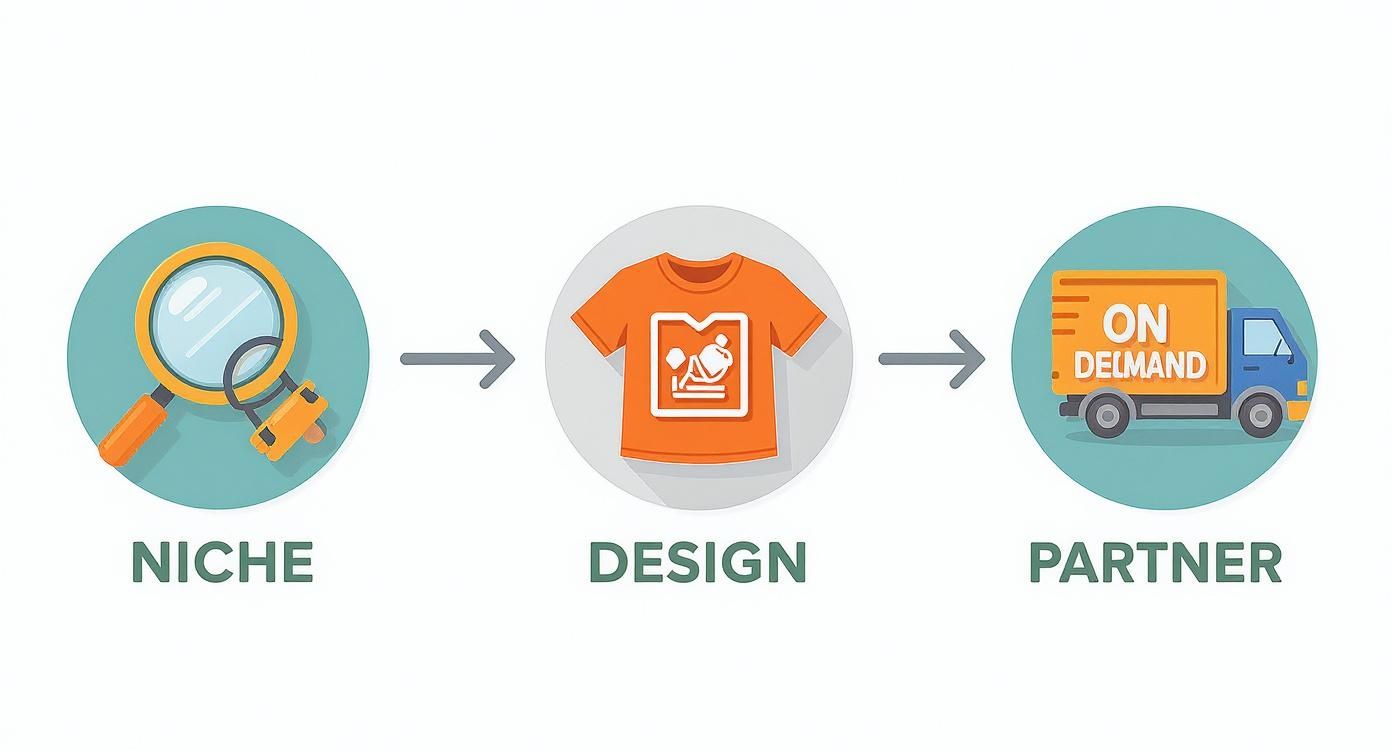
As you can see, it all starts with a specific audience. Only then can you move on to creating the right designs and getting the operational side locked in.
Understanding the Market Opportunity
You couldn't pick a better time to jump in. The global print on demand market is on a rocket ship, projected to hit an incredible $57.49 billion by 2033. That’s driven by a massive 23.3% compound annual growth rate.
What’s fueling this? People want unique stuff. In fact, 36% of shoppers say they're actively looking for personalized or custom products. This isn't a fleeting trend; it’s a fundamental shift in consumer behavior. You can dive deeper into the research on print on demand market growth to see the full picture.
Getting these early stages right is what separates a flash-in-the-pan store from a sustainable, profitable brand. You're not just selling products; you're building an identity and a purpose that people can connect with.
To help you keep track of everything, here's a quick checklist that breaks down the entire launch process into manageable stages.
Print on Demand Business Launch Checklist
| Stage | Key Action | Primary Goal |
|---|---|---|
| 1. Foundation | Niche & Product Research | Identify a profitable audience and select high-quality blank products. |
| 2. Brand Building | Design Creation & Branding | Develop unique designs and a cohesive brand identity (logo, colors). |
| 3. Operations | Fulfillment & Store Setup | Choose a reliable print partner and build your ecommerce storefront. |
| 4. Pre-Launch | Pricing, Mockups & QC | Set profitable prices, create realistic mockups, and order samples. |
| 5. Go-Live | Launch & First Sale | Publish your store and implement your initial marketing plan. |
Think of this table as your high-level project plan. As you work through this guide, you'll be checking off each of these key actions on your way to a successful launch.
Find Your Niche and Create Designs That Sell
A great design is only half the battle. To actually sell, it needs to connect with the right audience. That's why your print-on-demand journey doesn't start with a cool graphic—it starts with a rock-solid niche.
Forget casting a wide net with generic ideas like "funny shirts." The real money is in serving passionate, often overlooked communities. You have to get specific.
Instead of just "tech," think smaller. What about 'retro synthwave aesthetic for coders'? Or 'minimalist circuit board patterns for electrical engineers'? These micro-niches are filled with dedicated fans who are actively looking for products that get them. When a design speaks their language, it’s not just a t-shirt; it’s a badge of identity.
To get your business off the ground, it's absolutely critical to understand how to find profitable niches that actually have buyers. This means digging into online communities, scoping out the competition, and making sure your ideas have legs before you spend a single second designing.
Drilling Down to Find Your People
Finding a profitable niche isn’t a guessing game; it’s about good old-fashioned observation and research. You need to hang out where your potential customers are already gathered online.
- Explore Subreddits: Reddit is a goldmine for this. Look for communities built around hobbies, professions, or pop culture. Pay close attention to the inside jokes, shared frustrations, and running gags. That’s where your best ideas will come from.
- Analyze Social Media Trends: Jump on Instagram and Pinterest and search for hashtags related to your ideas. See what kind of content gets the most love and what visual styles are resonating within that community.
- Validate with Search Data: Use a tool like Google Trends to check if people are consistently searching for your niche ideas. This is a quick way to spot a genuine market versus a fleeting fad.
Once you have a few promising concepts, go deeper. Who’s already selling to this audience? What are they doing well, and more importantly, where are the gaps? Maybe their designs feel dated, or they aren’t offering a product that people are begging for. That's your opening.
Key Takeaway: A successful print-on-demand business is built on a strong niche. Don't rush this part. The more specific and passionate your audience, the easier it will be to create designs that practically sell themselves.
Turning Your Ideas into Sellable Designs
With a clear niche locked in, it's time for the fun part: bringing your vision to life. You don’t have to be a professional graphic designer to create things people want to buy. You just need to know the basic rules and where to find the right tools.
If you’re a designer, tools like Procreate or the Adobe Creative Suite are your playground. If you're new to this, don't sweat it. Platforms like Canva have incredibly user-friendly interfaces and tons of elements you can customize. The main goal is to create high-resolution artwork that looks crisp and professional when it's printed on a real product.
Apparel is king in the POD world, making up nearly 40% of all sales, with custom t-shirts and hoodies leading the pack. But here's a sobering statistic: while the average profit margin is around 20%, a staggering 76% of POD shops don't make it past their first three years. That statistic proves that success comes down to more than just a good idea; it requires great designs and knowing your numbers.
Mastering the Technical Side of Design
To avoid common but costly mistakes like blurry prints or weird colors, you have to nail the technical file requirements. This isn't optional—it's about protecting your brand's reputation and keeping customers happy.
- Resolution: Always design and export at 300 DPI (dots per inch). This is the industry standard for quality printing and guarantees your designs look sharp, not pixelated.
- File Type: A PNG file with a transparent background is your best friend. This lets you print your design on any color garment without that ugly white box around it.
- Color Profile: Stick to an RGB color profile. This is what most DTF printers and POD services use, and designing in CMYK can cause some nasty color shifts in the final product.
Getting these details right is crucial, especially as you explore different printing methods. For instance, you'll find more in-depth advice in our guide to making a shirt with DTF printing, which has its own unique requirements. Master these fundamentals now, and you'll ensure every product you ship is a perfect reflection of your brand's quality.
Choosing Your E-commerce Platform and POD Partner
Alright, you've got a killer niche and a folder full of designs ready to go. Now comes the part where we build the engine of your business. This boils down to two critical choices that will shape everything that follows: picking your e-commerce platform and finding a reliable print-on-demand partner.
Think of it this way: your e-commerce platform is your digital storefront—it's where your customers shop. Your POD partner is the workshop out back, the one that actually prints, packs, and ships every single order. For this to work, they have to communicate flawlessly.
Your Store, Your Rules… or a Built-in Audience?
The first big fork in the road is deciding where you’re going to sell. You can either build your own independent store on a platform like Shopify or tap into a massive existing marketplace like Etsy. Each path has its own set of very real pros and cons that impact your brand, your reach, and your bottom line.
Shopify is about total control. It's your brand, your domain, and your rules. You get to design the entire customer experience from the ground up and, most importantly, you own your customer data. This is the long game—building a real brand asset. But it also means you're responsible for generating 100% of your own traffic.
On the flip side, Etsy hands you an audience on a silver platter. Millions of people are already on the site actively looking for unique stuff. This can get you your first sales much faster. The trade-off? You're a small fish in a huge pond, fighting for attention and playing by Etsy's rules when it comes to branding and policies.
Honestly, it's a classic trade-off. Do you want the immediate traffic of a marketplace, or are you in it to build your own independent brand for the long haul? There's no single right answer, but you need to decide which strategy fits your goals from day one.
Here’s a quick breakdown to make the choice a little clearer:
| Feature | Shopify (Your Own Store) | Etsy (Marketplace) |
|---|---|---|
| Brand Control | Full customization of your site and brand experience. | Limited to Etsy's platform structure and templates. |
| Customer Access | You must drive all your own traffic. | Access to millions of active, built-in buyers. |
| Fees | Monthly subscription fee plus payment processing fees. | Listing fees, transaction fees, and payment processing fees. |
| Competition | You compete with the entire internet. | You compete directly with other sellers on the same page. |
Finding the Right Print-on-Demand Fulfillment Partner
Once you know where you’ll be selling, you need to decide who will be making your products. Let me be clear: this is probably the single most important decision you'll make. Your supplier's quality is your quality. Their shipping speed is your shipping speed.
Big names like Printful and Printify are popular for a reason—they have huge catalogs and integrate easily. They're a great place to start your research. But don't just stop at the product selection. You have to dig deeper, because this is where so many new sellers get tripped up. For a more detailed comparison, our guide to the top print-on-demand suppliers is a great resource.
The opportunity here is massive. The North American market was valued at $3.03 billion in 2023 and is on track to hit $15.54 billion by 2033. The U.S. alone accounts for over 36% of the entire global POD market. That means incredible opportunity but also some serious competition. You can dive into the full North American print on demand market research to see the numbers for yourself.
The One Step You Absolutely Cannot Skip: Order Samples
I’m going to say this as plainly as I can: Never, ever sell a product you haven't held in your own hands. Ordering samples isn't just a good idea; it's a non-negotiable quality control step. It’s the only real way to know if what your customer receives will actually live up to the vision you have for your brand.
When that sample package arrives, put on your most critical customer hat. Here’s what you need to check:
- Print Quality: Are the colors rich and true to your design file? Is the image sharp, or is it blurry and pixelated?
- Garment Feel: Does the shirt feel cheap and scratchy, or is it something you'd actually want to wear? Check the material quality.
- The Wash Test: Follow the care instructions and throw it in the laundry. Does the design crack, peel, or fade dramatically after just one wash?
- Packaging & Shipping: How did it arrive? Was it protected? And did it get to you within the timeframe they promised?
A few bucks spent on samples now can save you from a tidal wave of angry emails, costly refunds, and a flurry of one-star reviews that can sink your store before you even get started. Your brand's reputation is everything. Protect it.
This is where the magic happens. You’ve got your niche, your designs are ready to go, and now it’s time to build the digital storefront where your brand comes to life. Turning a folder of ideas into a real, shoppable business is a huge step, and getting it right from the start makes all the difference.
An online store is more than just a pretty theme. It's about building a professional, trustworthy space where people feel completely comfortable pulling out their credit cards.
Building Your Store's Foundation
Before you even think about uploading your first design, you need to lay the groundwork. This means creating those essential pages that answer customer questions before they even have a chance to ask. Think of these as your trust-builders.
- About Us Page: This is your chance to connect. Why did you start this? What’s the passion behind your work? People buy from people, so share your story.
- Shipping Policy: Be brutally honest here. You’re using print-on-demand, which means you have production time plus shipping time. Clearly state that it might take 2-7 business days for the item to even be printed. Managing expectations upfront prevents a lot of angry emails later.
- FAQ Page: Get ahead of the curve. What's the return policy? How should they wash the shirts? A solid FAQ page is your first line of defense and saves you from answering the same questions over and over again.
Once those core pages are locked in, you can turn your attention to the main event: your product listings. This is where you actually make the sale.
The Power of High-Quality Mockups
Your customers can't touch or try on your stuff, which makes your mockups the single most important part of your product page. They are the bridge between a cool design on a screen and a shirt someone can actually imagine wearing.
Please, do not just use the generic, flat-lay images your supplier gives you. They’re fine for a secondary image, but they have zero personality. You need to invest in quality lifestyle mockups that match your brand's vibe. Selling to rock climbers? Show the shirt on someone at a climbing gym, not floating in a white void.
My Two Cents: For every product, use a variety of mockups. Show a close-up of the design, a full shot of the item, and at least two lifestyle photos showing it in action. You're giving your customers a 360-degree view, which builds the confidence they need to hit "Add to Cart."
Writing Product Descriptions That Convert
Think of your product descriptions as your 24/7 salesperson. A great description does way more than just list specs like "100% cotton." It tells a story, sparks an emotion, and reminds the buyer why your design is so special. It's part creative writing, part SEO strategy.
Start with the why. What was the inspiration? What inside joke or shared passion does this design tap into for your audience? That’s how you create a connection. From there, weave in the keywords your customers are actually searching for. Getting this right is a game-changer, and using a complete guide on how to write product descriptions that drive sales can teach you how to master this crucial skill.
Platform Showdown: Shopify vs. Etsy
Choosing where to build your store is a big decision. The two most popular launchpads are Shopify and Etsy, and they serve very different purposes. Here’s a quick breakdown to help you decide which path is right for you.
| Feature | Shopify | Etsy |
|---|---|---|
| Audience | You build your own from scratch. | Access to a huge, built-in marketplace of active buyers. |
| Branding | Complete control. Your store, your rules, your brand identity. | You're a shop within Etsy's brand. Limited customization. |
| Fees | Monthly subscription fee ($29+) plus payment processing fees. | Low listing fees ($0.20/listing) plus higher transaction & offsite ad fees. |
| Ease of Use | User-friendly, but requires more setup (domain, theme, apps). | Incredibly easy. You can be up and running in under an hour. |
| Scalability | Limitless. It's built to grow with you from a side hustle to a global brand. | Can be difficult to scale into a major brand due to platform limitations. |
| Best For | Entrepreneurs serious about building a long-term, independent brand. | Sellers looking for quick setup, built-in traffic, and a simple side hustle. |
Ultimately, there's no single "best" choice. If you're serious about building a standalone brand with full control, Shopify is the way to go. If you just want to test your designs quickly with a built-in audience, Etsy is a fantastic starting point.
Nailing Your Pricing Strategy for Profitability
Okay, let's talk about the money. Pricing feels complicated, but it’s just simple math once you know all the variables. The goal is to find that perfect price point that covers all your costs, gives you a healthy profit, and still feels like a great deal to your customer.
To figure out your retail price, you have to add up every single cost. Miss one, and you could be losing money on every sale.
- Supplier's Base Cost: This is what your POD partner charges for the blank item and the print. It’s your biggest expense.
- Shipping Fees: The cost to get the product from them to your customer. Pro-tip: Many sellers roll this cost into the item price to offer "free shipping," which can boost conversion rates by up to 50%.
- Platform & Transaction Fees: Your platform (Shopify or Etsy) and payment processor (Stripe, PayPal) will take a cut of every sale. Don't forget these!
- Marketing Costs: While not a direct cost per item, you need to be mindful of what it costs you to acquire a customer when looking at your overall profitability.
Add all those numbers up. That’s your break-even point. Anything you charge above that is your profit. A good starting point for a print-on-demand business is a 30-50% profit margin, but always, always check out what your competitors are charging. You need to be in the right ballpark for your niche.
Marketing Your POD Store and Landing Your First Sale
Hitting "launch" on your new store feels incredible, doesn't it? But it's just the starting line. Now comes the real fun: getting your awesome products in front of the right people.
Marketing isn't about throwing a ton of money at ads and hoping for the best. It's about being clever, targeted, and authentic. It's about connecting with your niche audience where they already hang out. Your goal is to drive that first wave of traffic and build the momentum that lands your very first sale—and then the next one, and the one after that.
Lean Into Visual Social Media Platforms
Your products are the stars of the show, which makes visual platforms your single most powerful marketing tool. Think Pinterest and Instagram. These aren't just places for people to scroll endlessly; they are massive search and discovery engines where your ideal customers are actively looking for ideas and things to buy.
Put yourself in your customer's shoes. If you sell t-shirts for vintage car lovers, they're probably saving pins of classic Mustang restorations or following Instagram accounts dedicated to their favorite models. Your job is to show up right there in their feed with content that adds to the experience, not just a blatant sales pitch.
This is where those high-quality lifestyle mockups you created come into play. Post images that tell a story and capture the whole vibe of your brand. A shot of your "retro synthwave" tee against a neon-lit arcade backdrop is infinitely more compelling than a sterile, flat product photo on a white background.
Your Content Plan for Instagram and Pinterest
A winning social media presence is more than just an endless stream of product photos. You need to create a mix of content that pulls people in and makes them actually want to follow you.
- Behind the Design: Share the spark of inspiration for a design. Did a funny inside joke on a Reddit thread give you the idea? People are surprisingly interested in the "why" behind a product.
- User-Generated Content (UGC): Once you get those first few orders out the door, gently encourage your customers to share photos of themselves wearing or using your products. Reposting this stuff is pure gold—it’s social proof that shows other potential buyers that real people are loving what you do.
- Niche-Relevant Posts: Don’t make it all about you. Share memes, articles, or cool finds that your specific audience will get a kick out of. This shows you're a genuine member of the community, not just a business trying to make a buck.
Your social media channels should feel like a cool, curated hub for your niche. When you offer value beyond just the things you sell, you build a loyal following that will be genuinely excited to support you when they're ready to buy.
Get the Basics of On-Page SEO Right
Don't sleep on the power of search engines, especially if you're on a platform like Shopify. And on Etsy, search is everything. On-page SEO is simply the process of tweaking your product listings so that Google and other search engines can understand what you're selling and show it to the right people.
Start by brainstorming the words and phrases your ideal customer would actually type into a search bar. This is your keyword strategy.
For instance, instead of a generic product title like "Cool T-Shirt," get hyper-specific: "Minimalist JDM Racing T-Shirt for Car Enthusiasts." That title is packed with terms your target audience is actively searching for, which dramatically increases your odds of being discovered. For a much deeper dive, exploring proven techniques on how to increase ecommerce sales can give you some fantastic, actionable ideas for optimizing your listings.
Become an Active Part of Your Community
Honestly, the most effective marketing is often free. It just costs you a bit of time and genuine effort. The key is to become a real, contributing member of the online communities where your audience already lives.
Find the right subreddits, Facebook groups, or niche forums. The golden rule here is don't spam your product links. That’s the quickest way to get banned and burn any goodwill you might have built.
Instead, just participate. Join discussions, answer people's questions, and share your own knowledge. If you created a design based on a community inside joke, you can share the image and say something like, "You guys inspired me to make this!" People will naturally ask where they can get one. This builds trust and positions your brand as a natural part of the culture, not some outsider trying to cash in. This is how you build a POD business that actually lasts.
Got Questions About Starting a Print on Demand Business?
Jumping into any new business is going to bring up a lot of questions. Even though the print on demand model is pretty straightforward, it’s smart to get a few things ironed out before you dive in. Let's tackle some of the most common questions I hear from new entrepreneurs, so you can get started with your head in the game.
So, How Much Money Do I Really Need to Start?
This is always the first question, and the answer is one of the best parts about this business: it's incredibly flexible. You don't have to sink thousands of dollars into a garage full of t-shirts that might never sell. The barrier to entry is refreshingly low.
Your main costs are going to be pretty minimal at the start:
- Platform Fees: If you're building your own brand on Shopify, you're looking at a monthly subscription, which starts around $29/month. If you go the marketplace route with Etsy, you just pay a $0.20 listing fee for each new product you post.
- Design Costs: Not a graphic designer? No problem. You can find talented folks on sites like Fiverr or 99designs to create designs for you. This can cost anywhere from $25 for a simple graphic to a few hundred dollars for something more complex.
- Sample Orders: Do not skip this step. I can't stress this enough. You need to set aside $50-$100 to order a few of your main products. You have to see, touch, and test the quality before you ever dream of sending it to a paying customer.
Honestly, you can get the ball rolling for less than $100, especially if you make your own designs and launch on a marketplace like Etsy.
A huge mistake I see people make is thinking they need a big ad budget from day one. Don't. Your first job is to focus on organic marketing and building a real community. You can absolutely bootstrap your way to profit and then reinvest those early sales into ads down the road.
How Do I Deal with Returns and Customer Service?
This is a big one. When you work with a print on demand partner, they're the ones printing and shipping the orders, but you are always the face of your business. That means every customer service email—from shipping questions to returns—lands in your inbox.
Most POD suppliers will only send a replacement or issue a refund if there’s a genuine quality problem, like a smudged print, a damaged shirt, or if they sent the wrong item entirely. What they won't cover is buyer's remorse or if a customer orders the wrong size.
Because of this, you absolutely must have a crystal-clear return policy on your site. Be upfront and explain that since every item is printed on demand just for them, you can’t accept returns for sizing mistakes. This gently pushes customers to check your size charts and protects your bottom line.
Is Print on Demand Even Profitable Anymore?
Absolutely. The global print on demand market isn't just growing—it's booming. Projections show it's set to expand at a compound annual growth rate of over 25% in the next few years. Now, success isn't just handed to you, but profit is definitely there for the taking if you treat this like a real business.
Your profitability will come down to a few key things:
- Niche Selection: Finding a passionate audience that isn't already flooded with competition.
- Design Quality: Making unique, eye-catching designs that your niche can't resist.
- Pricing Strategy: Doing the math to make sure you're leaving a healthy profit margin on every single sale.
On average, a POD business can see a profit margin of around 20%, but with killer branding and a loyal following, that number can climb much, much higher. Your success really boils down to how well you can make your brand stand out from the crowd.
Ready to bring your designs to life with vibrant, durable prints? Cobra DTF specializes in high-quality, USA-made DTF transfers that make your products stand out. Get same-day shipping and consistent quality you can count on. Explore Cobra DTF Transfers