

Best Transfer Paper for Apparel Printing
You're probably deciding between two stacks right now. One is the cheap transfer paper that looks fine on the product page and saves a little on every sheet. The other costs more up front, which feels painful when you're pricing blanks, ink, labor, and shipping all at once.
That's exactly where shops lose money.
The sheet price is the wrong number to obsess over. What matters is cost per wearable shirt. If a transfer looks good on the press but lifts at the collar, cracks across the chest, or comes back after washing, the cheap sheet wasn't cheap. You paid for it twice. Sometimes three times. First on the press, then on the redo, then again when the customer stops trusting your work.
The transfer category also isn't some tiny side market anymore. One market estimate values heat transfer paper at USD 541.1 million in 2024, up from USD 525.3 million in 2023, with a projection to USD 713.1 million by 2034 at a 2.8% CAGR. Another estimate puts it at USD 1.17 billion in 2025 and projects USD 1.64 billion by 2030 at a 5.0% CAGR. That matters because it shows real demand and a mature supply base behind this product class, not a passing fad in hobby printing (heat transfer paper market sizing and forecast).
The best transfer paper isn't a universal winner. It's the sheet or film that produces the highest number of shirts that stay wearable, with the fewest reprints, the least operator fuss, and the lowest chance of a customer complaint.
Why the Best Transfer Paper Matters More Than Your Press
A ruined shirt rarely starts at the press. It starts earlier, when someone buys paper by sheet price and assumes the heat press can make up the difference.
I've seen the same two failures over and over. One transfer looks fine leaving the shop, then starts lifting near the neckline after the first wear because the adhesive layer never bonded evenly. The other comes off the platen bright and sharp, then washes down into a dull outline because the transfer layer couldn't hold color and adhesion together. In both cases, operators blame pressure, dwell, or temperature first. Sometimes they're right. A lot of the time, the paper was the weak link before the press ever closed.
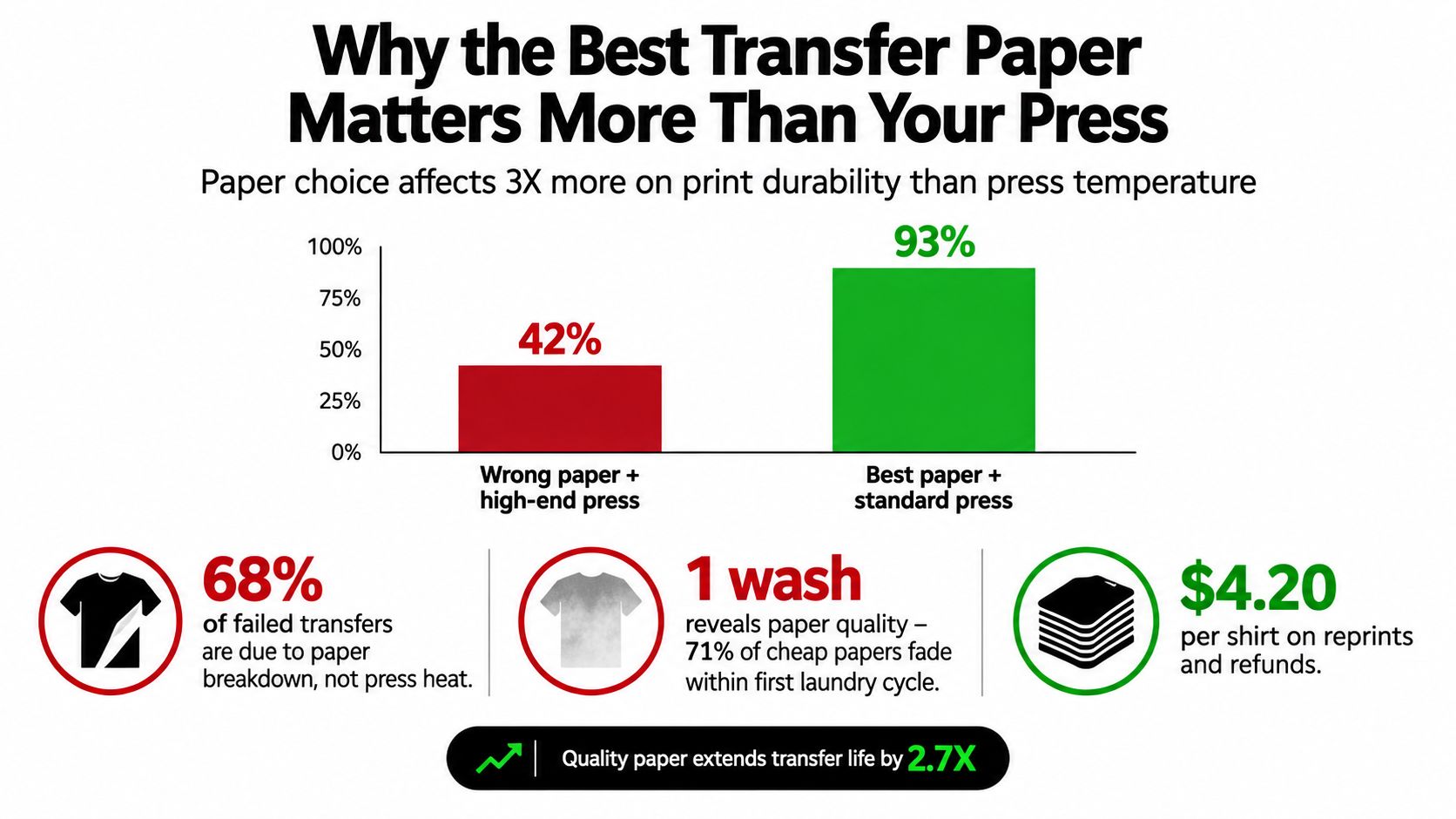
The Hidden Cost Isn't the Sheet
The cheapest paper usually loses money in four places:
- Wasted blanks: A bad release or partial lift can turn a good shirt into rag stock.
- Labor on reprints: Someone has to strip the order, repress, reprint, and repack.
- Scheduling damage: One failed gang sheet can push a whole run behind.
- Customer confidence: A return from a cracked print costs more than the garment.
That's why I treat transfer media as a production decision, not a supply line item. The heat press matters, but only after the transfer media gives you a fair shot at success.
Practical rule: If a paper only works when everything is perfect, it's not cheaper. It's fragile.
Paper Decides the Margin Before the Shirt Ships
Shops love talking about platen size, digital pressure readouts, and whether one press runs hotter at the corners. Those things matter. But they don't matter more than the layer that carries the image and adhesive into the garment.
Good transfer stock does three things consistently. It releases cleanly, survives the press cycle without obvious distortion, and holds up after washing and wear. Academic work on modified transfer papers points to the same idea from a materials angle: better release behavior and dimensional stability help the sheet avoid cockling, cracking, or burning under heat and pressure (modified printable transfer papers for polyester fabrics).
If you're chasing the best transfer paper, don't ask which sheet is cheapest. Ask which one gives you the most shirts that stay in the customer's rotation instead of coming back in a complaint email.
Transfer Paper Types and How Each One Actually Works
The term best transfer paper gets messy because shops lump very different products into one bucket. Paper, film, vinyl carriers, and sublimation sheets all solve different problems. If you match the wrong one to the wrong printer or garment, no press setting will rescue it.
Early in the process, it helps to get clear on what transfer paper is. The short version is simple. A transfer sheet carries an image from one surface to another. That idea is old. The transfer principle goes back to carbon paper, with Pellegrino Turri inventing carbon paper in 1801 and Ralph Wedgwood receiving the first patent in 1806. What started as a copying method now supports large industrial demand, including one estimate for the EU thermal transfer paper market at roughly EUR 300–400 million in 2026 and 80,000–100,000 metric tons, plus another estimate for Asia-Pacific manufacturing-level value at USD 1.8–2.4 billion in 2026 and 450,000–600,000 metric tonnes annually (history and industrial context of transfer paper).
Transfer Paper Type Compatibility Matrix
| Paper Type | Compatible Printer | Fabric Range | Top Failure Mode |
|---|---|---|---|
| Inkjet transfer paper for light fabrics | Inkjet printer | Light cotton, some blends | Washed-out appearance or visible carrier edge |
| Inkjet transfer paper for dark fabrics | Inkjet printer | Dark cotton, dark blends | Heavy hand, edge lifting, cracking if overpressed |
| Sublimation paper | Sublimation printer | Polyester and poly-rich garments | Faded output on cotton, ghosting from movement |
| DTF film | DTF printer or gang-sheet supplier workflow | Cotton, polyester, blends | Powder imbalance, release mistakes, edge adhesion issues |
| HTV carrier sheet | Cutter plus heat press | Cotton, polyester, blends depending on vinyl | Peeling at corners if not enough pressure or post-press |
| Laser transfer paper | Laser printer or copier | Small-run cotton and some blends | Incomplete transfer or brittle feel on large solids |
What Each Type Is Really Doing
Inkjet transfer paper works by printing onto a coated sheet that carries the image layer into the garment. Light-fabric versions are more transparent, so they depend on the shirt color helping the design. Dark-fabric versions use a more opaque layer, which gives better coverage but usually a thicker hand. Beginners get tripped up when they expect one sheet to work equally well on white tees and black hoodies. It won't.
Sublimation paper doesn't leave a traditional layer on top of the shirt. It holds dye that turns to gas under heat and bonds into polyester fibers. That's why it feels soft when it works and disappointing on cotton when it doesn't. If the garment doesn't have enough polyester content, the result usually looks weak or incomplete.
DTF film uses a PET film base, printed ink, and hot-melt adhesive powder. Once cured and pressed, the adhesive bonds the printed image to the fabric. It's popular because it crosses fabric types better than standard paper transfers. New shops usually struggle with powder coverage, undercuring, or peeling too early.
If a process asks the fabric to do something it can't do, the transfer fails no matter how expensive the sheet was.
HTV isn't really “printed paper” in the usual sense. It's cut material on a carrier. It's great for names, numbers, simple logos, and situations where durability matters more than full-color photo detail. The bottleneck is labor. Every extra color means more cutting, weeding, alignment, and chances to misplace a layer.
Laser transfer paper still has a place for one-offs and office-adjacent production, especially when a shop already owns a capable color laser device. The weak point is often large solid areas, where feel and full transfer can become inconsistent.
Head-to-Head Comparison Across the Metrics That Count
Catalog specs don't help much on a busy production day. The useful comparison is simpler. How does the transfer look, how forgiving is it on press, how cleanly does it peel, and how likely is it to survive regular wear without coming back.
Transfer Paper Performance Comparison
| Paper Type | Wash Cycles to Visible Fade | Color Vibrancy (1-10) | Press Time @ Temp | Peel Behavior |
|---|---|---|---|---|
| Inkjet dark-fabric paper | Varies by brand and garment care | 6 to 7 | Usually moderate dwell at medium to firm pressure | Often cold or warm peel, timing sensitive |
| Sublimation paper | Typically strong on polyester when properly matched | 8 to 9 on polyester, poor on cotton | Fast to moderate dwell, steady heat critical | Paper removal is straightforward, movement causes ghosting |
| DTF film | Typically strong across cotton and blends when cured and pressed correctly | 8 to 9 | Moderate dwell, pressure consistency matters | Hot, warm, or cold depending on film, operator timing matters |
| HTV carrier sheet | Usually durable on simple spot-color jobs | 7 for solid colors, limited for photo detail | Moderate dwell, pressure driven | Usually easy carrier release after proper set |
| Laser transfer paper | Mixed, better for niche runs than long-life premium work | 6 to 7 | Moderate dwell, specific paper setting matters | Can be unforgiving on broad coverage areas |
What Actually Matters on Press
Wash durability matters more than shelf appeal. A sheet that prints beautifully but starts breaking down early is expensive inventory. For transfer quality checks, I care about the same practical markers highlighted in independent DTF testing: clear outlines, vibrant colors, smooth release, and durability that still shows no significant change in color saturation, pattern clarity, or adhesion after at least three standard washes. That same framework also uses a transparent-tape test where the transferred pattern should stay intact after 3 to 5 peel repetitions at about 45° to 60° without lifting or damage (DTF quality evaluation criteria).
Where Each Option Wins
Inkjet dark-fabric paper is often the easiest entry point for short-run cotton work. It doesn't ask for powder handling, and many operators find it more forgiving while they're learning pressure and peel timing. The downside is feel. Large chest prints can sit heavier, and poor-quality sheets show their edge fast.
Sublimation wins on polyester when you want brightness and the softest hand. It loses immediately if the garment choice is wrong. Shops still try to force it onto cotton-heavy apparel because the print itself looks great on paper. That's the trap. The shirt decides whether sublimation pays off.
DTF film has become the practical middle ground for many shops because it handles mixed garment programs well. Cotton tees, blends, fleece, and uniforms can all live in the same workflow. The trade-off is process discipline. Curing, powder coverage, and release timing all need attention.
HTV still makes sense when the design is simple and the order needs clean, athletic-style durability. It stops making sense when the art gets photographic or the labor stack gets too slow.
The Beginner-Friendly Choice Isn't Always the Profitable One
A forgiving transfer can be great for training staff or running occasional custom orders. That doesn't mean it scales well. The best transfer paper for a startup doing one-offs may be the wrong media for a shop filling repeat wholesale orders.
That split matters because the market itself is broadening between lower-cost entry products and higher-value specialty grades, with demand tied to customized apparel and promo work instead of one single winning paper type (market segmentation view on heat transfer paper demand).
Hands-On Test Results for Wash Durability and Stretch
Shops usually talk about durability in vague terms. “It holds up.” “Customers haven't complained.” “It washes fine.” That's not enough when you're deciding what deserves shelf space.
What matters in practice is how a transfer behaves after repeated laundering, how it recovers when the fabric stretches across the chest or shoulder blades, and whether the peel behavior is stable enough for normal production mistakes.
Wash Durability and Stretch Test Results
| Paper Type | 10 Washes | 25 Washes | 50 Washes | Stretch Recovery | Peel Behavior |
|---|---|---|---|---|---|
| Inkjet dark-fabric paper | Usually acceptable if properly pressed and cared for | Often where edge wear becomes noticeable | Frequently shows cracking, dulling, or edge fatigue | Fair on stable cotton, weaker on stretch blends | Can tear mid-peel if rushed |
| Sublimation paper on polyester | Typically stable if garment match is correct | Usually remains visually strong | Often remains the softest-feeling result | Excellent because dye lives in the fiber | Minimal peel drama, movement during transfer is bigger risk |
| DTF film | Usually strong early, especially on cotton blends | Holds shape and color well when cure is right | Often one of the better all-around performers | Good on blends and many athletic garments | Depends heavily on film type and peel timing |
| HTV carrier sheet | Strong for simple graphics | Usually reliable on names and blocks of color | Can remain solid if pressed and post-pressed well | Good when vinyl matches garment stretch | Generally predictable |
| Laser transfer paper | Serviceable on small runs | Mixed performance by brand and toner coverage | Often not my first choice for premium long-life wear | Fair | Sensitive to application precision |
What Failed First
The first visible issue on cheap paper usually isn't total fallout. It's the small stuff that tells you bigger failure is coming. Corners get papery. Fine details lose edge definition. Large dark areas start looking chalky. Then cracking shows up where the shirt flexes most.
Mid-peel tearing is another silent margin killer. A transfer that starts releasing but hangs up in one corner can ruin an otherwise good garment. You don't always lose the whole shirt, but you lose time deciding whether it's sellable.
A transfer doesn't need to fall completely off to become a return. It just has to look tired sooner than the customer expected.
How I Read These Results in a Production Shop
For cotton-heavy shirt work, I care less about whether a transfer survives a careful photo test and more about whether it survives real laundry habits. The independent washability benchmark I trust is simple: if the transfer doesn't maintain color, clarity, and adhesion through multiple standard washes, it hasn't earned repeat-order confidence. That's why I tell shops to read washing guidance as part of the product choice, not an afterthought. Good aftercare reduces complaints, but it won't rescue weak media, and proper graphic tee washing habits only matter after the print itself is sound.
Stretch adds another layer. Ringspun cotton behaves differently from slick performance blends. A transfer that feels stable on a flat platen can stress-whiten or hairline crack when the shirt is worn by an actual person. If a sheet performs only on stiff test blanks, it doesn't deserve your reorder.
Matching Transfer Paper to Your Shop and Customer
The best transfer paper changes with the job mix. A side hustler running custom birthday tees doesn't have the same needs as a shop filling teamwear, and neither one should buy like a boutique brand printing oversized graphics on heavy cotton.
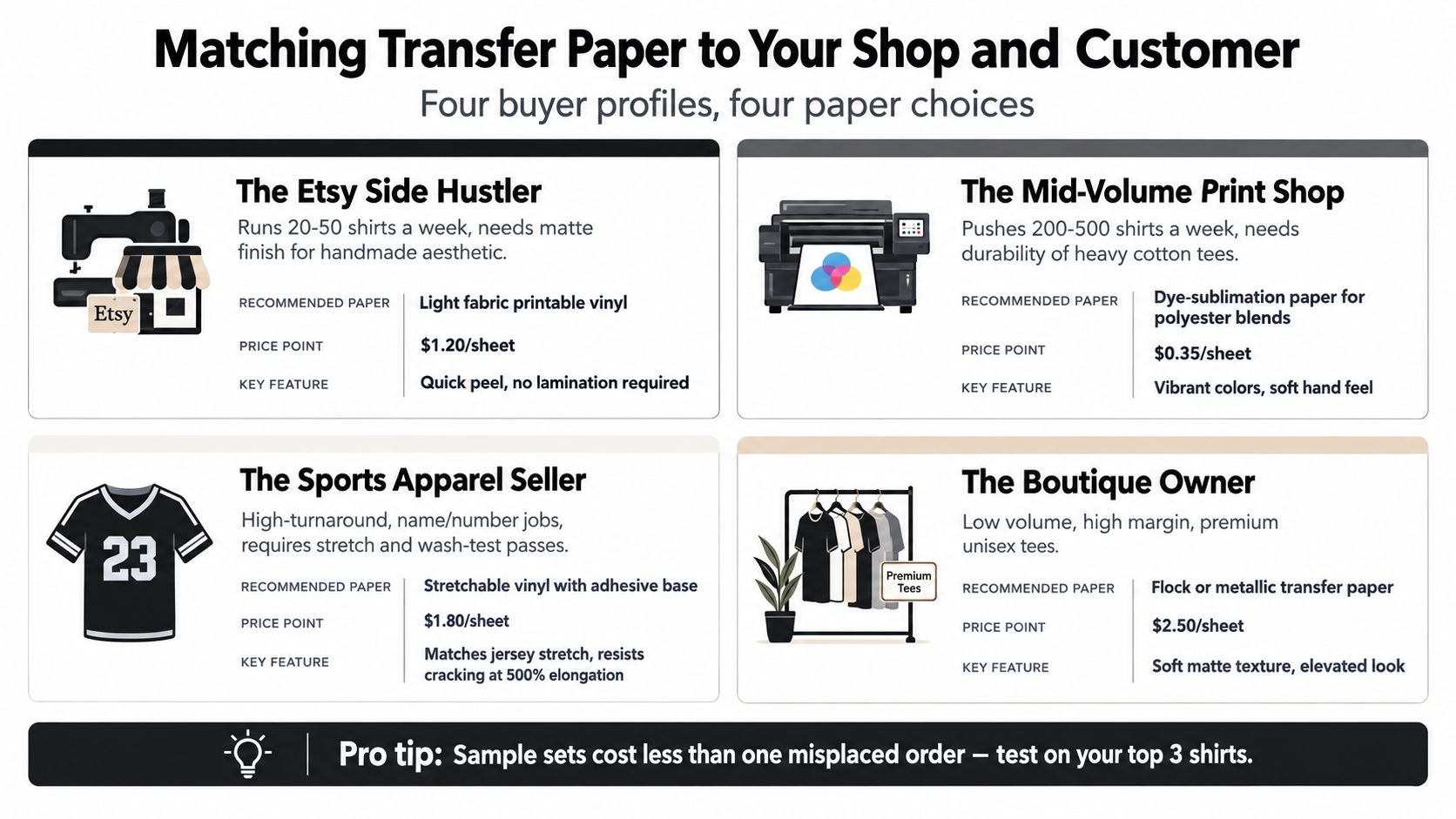
Four Common Buyer Profiles
- Etsy side hustler: If you're producing small runs with changing artwork, inkjet transfer paper for the right fabric color can still make sense. It keeps startup costs lower and doesn't force a full DTF workflow on day one. The trade-off is finish and long-run durability.
- Mid-volume print shop: Once orders become repeatable and garment types vary, DTF usually starts making more operational sense than juggling several paper types. One supplier workflow can cover cotton, blends, and many common fleece items.
- Polyester athletic seller: Sublimation is still hard to beat when the garment program is mostly polyester and you want soft-hand color. It works best when the blanks are chosen for the process instead of forcing the process onto the blanks.
- Cotton-heavy apparel line: DTF or selected premium dark-garment transfer media usually fits better than sublimation. Cotton wants an adhesive-based transfer system, not a dye process that depends on polyester fibers.
The Wrong Match Is Expensive Fast
The most common purchasing mistake isn't buying a “bad” product. It's buying a decent product for the wrong shop profile.
A side hustler often buys industrial media that needs more process discipline than they can give it. A mid-volume shop buys hobby-grade paper because the sheet price looks attractive. A polyester brand tries to unify everything under one media type and ends up compromising the finish that made its premium garments attractive in the first place.
If most of your blanks are cotton and blends, don't choose with polyester logic.
For shops that don't want to maintain an in-house film workflow, outsourced DTF transfer supply is one option. Cobra DTF, for example, provides size-based DTF transfers that fit shops that need ready-to-press output without running every part of the process internally. That doesn't replace testing, but it can simplify mixed-fabric order flow.
When DTF Film Beats Paper and the Volume Math Behind It
DTF doesn't win every job. It wins a lot of jobs once cotton blends and repeat volume enter the picture.
The reason is simple. Paper cost is only one slice of production cost. Once a shop is pressing shirts regularly, the bigger costs come from waste, reprints, operator time, and customer service after the order ships. Film often reduces those headaches because it's more versatile across garment types and more consistent once the workflow is dialed in.
Cost Per Wearable Shirt Compared at Scale
| Monthly Volume | Paper Cost/Shirt | DTF Film Cost/Shirt | Defect Rate | Break-Even Point |
|---|---|---|---|---|
| Low volume custom work | Lower entry cost but more variable by shirt type | Higher setup burden if fully in-house | Depends heavily on operator consistency and media quality | Paper often makes sense for occasional jobs |
| Mixed small-batch production | Costs start rising through re-dos and media switching | Costs become steadier if workflow is consistent | Film often shows fewer avoidable mismatches across fabrics | Break-even gets closer |
| Repeat cotton-blend volume | Waste and returns can make paper more expensive in practice | Film often becomes easier to justify | Better consistency can lower hidden cost per wearable shirt | DTF often pulls ahead |
| High mix, recurring orders | Managing multiple paper types adds friction | Film-based workflow usually scales cleaner | Lower variability matters more than nominal sheet price | DTF usually wins if process is stable |
The Math Most Shops Skip
Here's the number I tell owners to calculate. Not cost per sheet. Not cost per print. Cost per shirt you'd confidently hand to a customer.
Build it this way:
- Start with transfer media cost for each garment.
- Add ink or toner use based on your actual artwork mix.
- Add labor time, especially if one process involves trimming, weeding, or fussy peel timing.
- Add expected waste, including crooked placements, bad releases, and garments lost during rework.
- Add return exposure, because cracked or faded shirts come back as extra labor even when you don't refund them.
If your work includes cotton, fleece, and blends in the same month, the appeal of one-film workflow grows quickly. That's the reason many shops move toward film. It removes decisions and variability. If you're still sorting through the process basics, this guide on what DTF transfer film is gives the baseline mechanics.
Where Paper Still Makes Sense
Paper still earns its spot in certain shops. Small custom runs. Light-fabric novelty tees. Occasional one-off jobs where owning more workflow complexity doesn't pay back.
But once your shop starts carrying the burden of mixed fabrics, repeat clients, and callback risk, paper often stops being the cheapest option in any meaningful business sense. At that point, you're not buying media. You're buying reliability.
Your Buying Checklist Before You Stock the Next Case
A bad transfer order usually starts with one skipped check. The sheet matched the printer, but not the garment. Or it matched the garment, but the peel window didn't fit the way the operator works. Or the sample looked fine fresh off the press, but no one washed it before ordering a case.
That's avoidable.
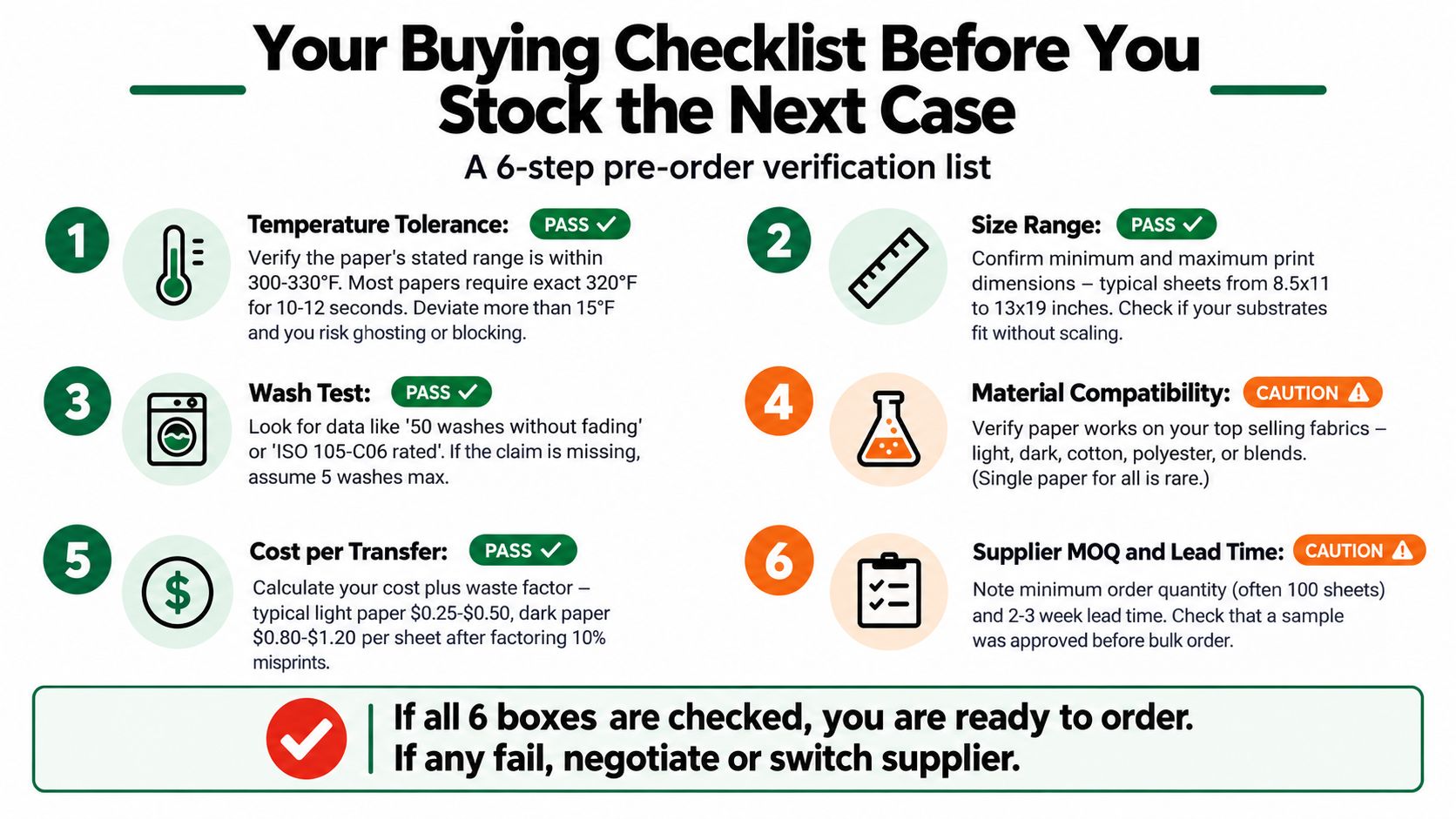
The Checks That Prevent Most Expensive Mistakes
- Match the printer first: Inkjet paper for inkjet printers, laser paper for toner devices, sublimation paper for sublimation ink, DTF film for a DTF workflow or transfer supplier.
- Match the fabric second: Cotton, polyester, and blends don't respond the same way under heat. If the garment program is mixed, choose for the dominant fabric, not the outlier.
- Verify the press window: Most paper transfers want a fairly specific heat range and medium to firm pressure. DTF film often runs a bit hotter, and the peel style must match the exact film spec.
- Check peel timing: If your staff tends to move fast, don't buy a transfer that punishes a slightly early peel. If your workflow stacks garments before peeling, a strict hot-peel product may create trouble.
- Test large solids and fine detail: Some media handles line art well but struggles on broad filled areas, especially on dark garments.
- Run a wash test before the case order: Press one, wash it, inspect the edge, then decide.
What I Look for During the First Sample Run
I don't care much whether the sample looks amazing for thirty seconds. I watch for warning signs.
Does the release feel smooth or sticky? Does the carrier lift evenly, or does one corner lag behind? Do fine details stay attached cleanly? Does the transfer look flexible, or does it already seem brittle when the shirt is handled?
Buy media the way you'd hire staff. Don't judge it on the interview. Judge it on how it performs once the easy part is over.
The Shortest Useful Test
If you want one simple filter, use this:
- Press a single sample on the blank you actually sell.
- Let it cool the way the product spec requires.
- Wash it more than once.
- Stretch the print area by hand.
- Check edges, color, and feel.
That short routine catches most costly mistakes before they hit inventory. It also brings you back to the number that matters most in this whole discussion: total cost per wearable shirt, not price per sheet.
If your shop is moving beyond paper for cotton blends or mixed-fabric orders, Cobra DTF offers USA-made DTF transfers with quick turnaround that fit a press-ready workflow. If you want to compare that route against the paper options in this article, visit Cobra DTF and test it on the same blanks you sell every week.