
Baseball DTF Transfers: A Complete Guide for Custom Uniforms
A well-applied DTF transfer can commonly last 40 to 80 wash cycles, but baseball success starts with pressing moisture-wicking polyester at 135–149°C (275–300°F) rather than using standard cotton settings. Higher heat and longer dwell can distort performance fabric, cause dye migration, or leave a glossy press mark.
A coach usually notices the problem after the first game. A nameplate looks sharp on the rack, then a baserunner slides, sweat saturates the jersey, and repeated team laundry begins testing every edge of the design. The transfer may have looked perfect when it left the shop, but baseball uniforms face stress that a casual cotton T-shirt never sees.
That's why baseball DTF transfers need a different workflow. The artwork can be vibrant and flexible, but the application must respect polyester fibers, moisture-wicking finishes, dark garment dyes, sliding abrasion, UV exposure, and frequent washing. The right result comes from treating the jersey as a technical substrate, not as ordinary cotton.
What Are Baseball DTF Transfers
A custom shop's most frustrating baseball order is often the one that looked easiest. The logo is approved, the player names are ready, and the transfers appear clean. Then a jersey comes back with a lifting corner or a glossy rectangle around the design. In many cases, the problem wasn't the artwork. It was a mismatch between the transfer process and the performance fabric.
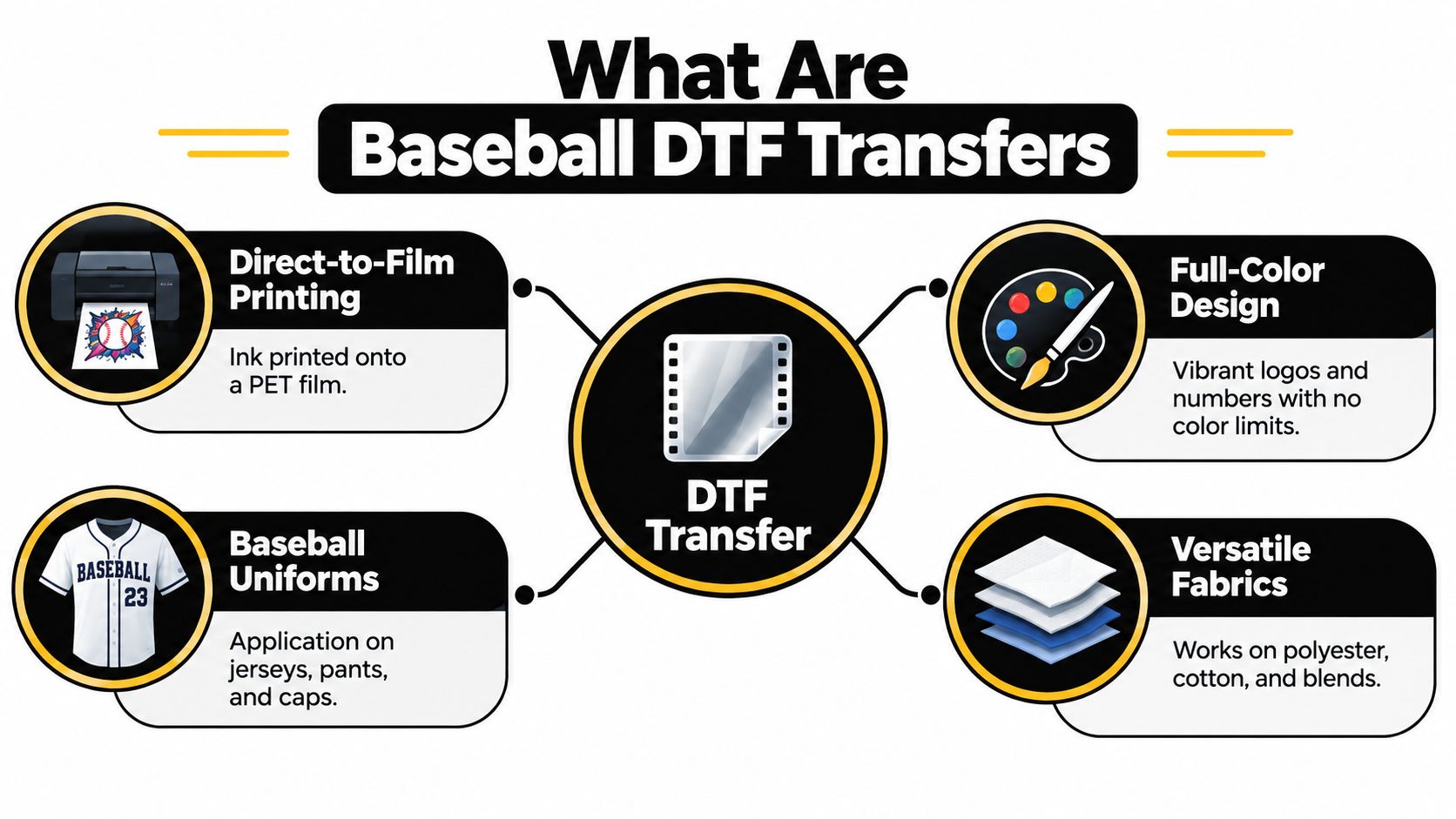
Direct-to-film, or DTF, transfers are made by printing a design onto a coated film, applying adhesive powder, and curing the transfer so it can be moved onto a garment with a heat press. On a baseball jersey, that process supports full-color logos, numbers, names, and sponsor marks without requiring a separate screen setup for every color. The film carries the design until heat and pressure bond it to the fabric.
Why the film and adhesive matter
The transfer isn't just ink sitting on top of a shirt. Printed ink, adhesive powder, and fabric fibers must form a reliable interface. If the powder hasn't fused correctly, the design may not anchor evenly. If the press overheats polyester, the garment can change before the adhesive has a chance to bond properly.
DTF differs from many traditional decoration assumptions here. The method works across cotton, polyester, and blends, but each substrate still needs appropriate heat control. A useful overview of the printing method is available in this guide to what direct-to-film printing involves.
What makes a baseball application different
A jersey front may encounter repeated contact with batting equipment, while a back graphic can rub against dugout surfaces, shoulder pads, or the ground. Sweat and detergent add chemical stress, and outdoor play exposes colors to sunlight. Pants and caps introduce additional shapes and seams that can complicate pressing.
DTF is a strong fit for short team runs, replacement jerseys, individual names, and detailed artwork. It isn't automatically the right choice for every location. A large transfer over a ridge, pocket, button, or heavy seam can press unevenly, so the garment's construction must be checked before production.
Practical rule: Treat the jersey, not the artwork, as the starting point. Confirm the fabric, finish, seams, and dye behavior before choosing your press settings.
Why DTF Is Transforming Custom Baseball Uniforms
A coach calls for replacement names after a weekend series. Another team needs a small run of tournament jerseys with a detailed logo on dark polyester. A third wants every player's number and name changed without ordering a full new set. DTF gives a shop one practical workflow for these varied jobs, provided the transfer and garment are tested together.
The market has moved beyond experimentation. An industry report cited the global DTF market at $2.72 billion in 2024, rising to $2.89 billion in 2025, with a projection of $3.92 billion by 2030. Those figures appear in the 2025 state of the DTF market report. For a shop owner, the relevance is operational: suppliers, decorators, and teams are treating DTF as a practical method for on-demand garment decoration.
The economics of short runs
Screen printing remains efficient for repeatable, high-volume work with stable artwork. It becomes harder to manage when a roster requires different names and numbers, gradients, photographic details, or late substitutions. DTF handles those variations without creating a separate setup for every design.
A separate projection summarized in DTF transfer trend research puts the DTF transfer film market at roughly USD 760 million in 2025, growing to about USD 1.64 billion by 2032, at an 11.58% CAGR. This projection is not a guarantee for any individual shop. It does help explain continued investment in the format.
Speed only helps when quality holds
Baseball uniforms expose transfers to repeated stress. A jersey front can contact batting equipment, while a back graphic may rub against dugout surfaces, shoulder protection, or the ground. Moisture-wicking polyester also holds sweat against the decoration, and frequent washing adds detergent and heat exposure. A transfer that looks sharp on press day can become a reprint if adhesion, curing, or heat control is inconsistent.
Fast production helps only when the result survives team use. Reprints, complaints, and replacement garments consume margin and strain relationships with coaches. Control artwork preparation, powder curing, garment testing, and press calibration before chasing shorter production times.
The strongest use case is flexible personalization with consistent application, particularly for small-batch uniforms and late replacements. The wrong approach is treating every jersey like the same cotton blank. Baseball's fabric, wear points, and laundering routine should shape the production decision from the start.
Essential Materials and Substrate Compatibility
Start with the garment specification, not the transfer size. Baseball jerseys commonly use polyester or moisture-wicking blends, and those fabrics can react differently to heat than cotton. DTF can work on cotton, polyester, and blends, but polyester needs lower pressing temperatures and closer control because dye migration can discolor lighter transfers.
A useful reference for comparing the main garment substrates is this guide to cotton versus polyester. The practical lesson is simple: a transfer that works well on a cotton tee may still require a different temperature, dwell time, peel method, or protective layer on a performance jersey.
Build the materials list around polyester
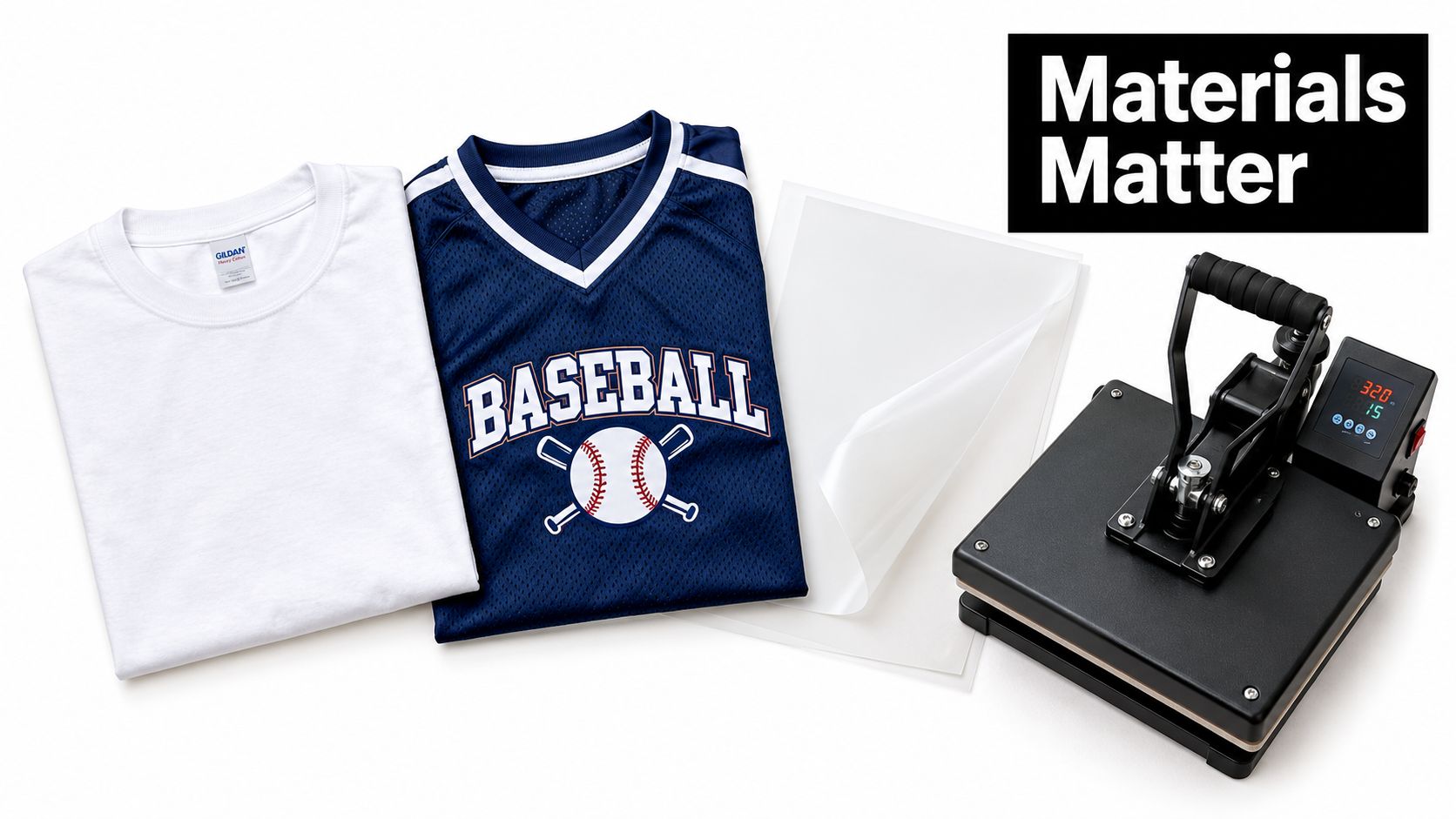
You'll need a reliable heat press with an even platen, the prepared DTF transfer, a lint-free work surface, a pressing pillow or pad when seams interfere, and a protective sheet for the final press. Keep a temperature probe or independent heat check available if your press has inconsistent readings across the platen.
The transfer itself should have a properly cured adhesive layer. Poorly cured powder can create weak adhesion or uneven texture, while excessive powder can leave an unwanted feel around the artwork. For dark jerseys, check the transfer's opacity and inspect a sample under the garment's actual lighting conditions.
Inspect the jersey before pressing
Look for mesh panels, piping, zippers, buttons, pockets, raised seams, and manufacturer treatments. A baseball jersey can appear flat while still having enough construction detail to prevent even pressure. If the design crosses a seam, move it or use a suitable pressing aid so the transfer doesn't bridge a gap.
Use this preparation sequence:
- Confirm the fiber content. Record whether the garment is polyester, cotton, or a blend.
- Check the color risk. Test dark or strongly dyed polyester for possible migration.
- Measure the decoration area. Keep names and numbers clear of seams and closures.
- Test one garment first. Wash and inspect the sample before committing to a team order.
- Document the result. Save the successful temperature, dwell, pressure, and peel notes for repeat orders.
Fabric compatibility isn't a paperwork step. It determines whether the adhesive can bond without damaging the garment's hand, stretch, or appearance.
Step-by-Step Application and Press Settings
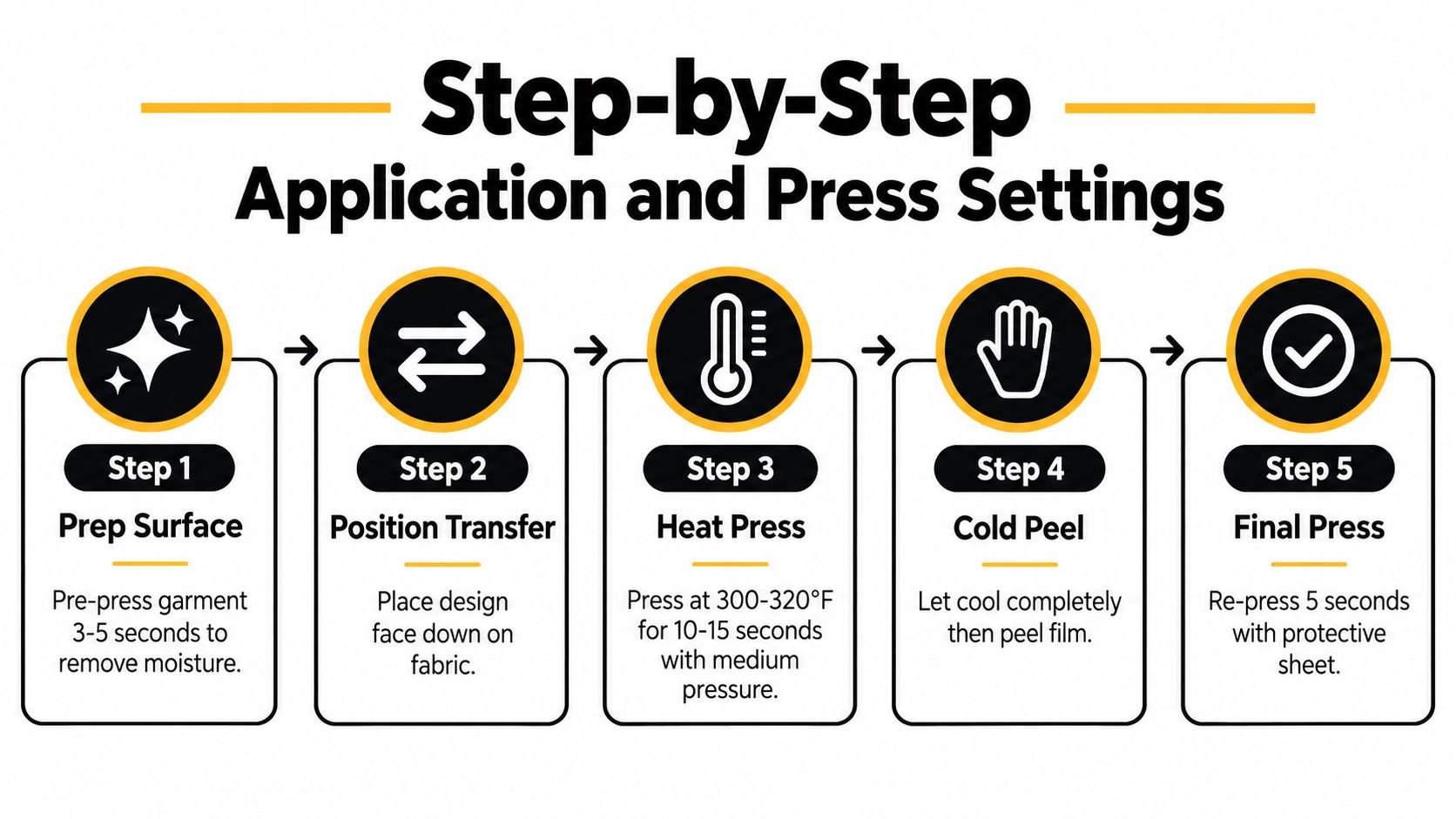
A jersey that feels dry in the shop can hold moisture after practice, while shoulder stretch, sliding, and repeated contact with dugout surfaces test the transfer from several directions. Set the press for the most heat-sensitive garment in the order. For moisture-wicking polyester, technical guidance commonly recommends 135–149°C (275–300°F), 8–15 seconds, and light-to-medium or medium pressure. Our heat press settings for DTF guide explains the calibration workflow, with additional ranges outlined in these DTF heat press setting recommendations.
The transfer system and jersey still determine the final setting. Test one jersey whenever possible, and do not apply a cotton setting to polyester just because it appears on a press chart. Some performance fabrics also respond better to a cold peel because hot peeling can stretch the surface or leave press marks.
Prepare the work area
- Pre-press the jersey. Apply a short pre-press of about 3–5 seconds to remove surface moisture and flatten the decoration area. Keep pressure controlled, since excess heat can affect a sensitive polyester finish before the transfer is applied.
- Position the transfer. Place the printed side against the garment in the correct orientation. Check its distance from the collar, side seams, buttons, and existing decoration. Measure player names and numbers instead of relying on visual alignment.
- Protect the substrate. Use a pressing pillow where seams or raised areas could block even contact. A protective sheet can shield the fabric and transfer, provided it does not prevent consistent platen pressure.
Press, peel, and finish
Set the press within the polyester-safe range of 135–149°C, beginning with 8–15 seconds at light-to-medium or medium pressure. Start near the lower end for a particularly heat-sensitive jersey. A more stable performance fabric may tolerate the upper end after testing.
- Let the transfer cool. Follow the film supplier's peel instructions. For a cold-peel system, wait until the film and garment cool, then lift one corner slowly. Pulling hot film from soft polyester can disturb the graphic or stretch the knit.
- Post-press the design. A second press of about 10–15 seconds is commonly used to improve wash and abrasion resistance when the garment and transfer system tolerate it. Use a protective sheet, and do not drag the platen across the graphic.
Pressing mistake to avoid: Extra heat cannot correct unsuitable pressure or incomplete curing. On polyester, it can cause dye bleed, distortion, or surface glossing before improving adhesion.
Durability Standards for Active Sports Use
A baseball transfer should be judged by more than whether it survives a gentle wash. Players slide, sweat, stretch fabric across the shoulders, lean against dugout surfaces, and expose uniforms to sunlight. The graphic also has to tolerate team laundry, where garments may be washed together and handled more aggressively than a personal T-shirt.
Well-applied DTF transfers commonly cluster around 40–80 wash cycles, with several technical sources placing typical service life around 50–60 washes and premium systems exceeding that when a post-press is used and care instructions are followed, according to this DTF and screen-printing durability comparison. Those figures are useful benchmarks, but they don't recreate a full baseball season. Wash count alone can't measure slide abrasion, sweat, UV exposure, or the effect of a particular laundering program.
Test for the stresses that matter
For baseball uniforms, I separate durability into three questions:
| Test area | What to inspect | Why it matters |
|---|---|---|
| Wash-fastness | Color change, edge lifting, cracking, and adhesion after laundering | Team uniforms may be washed repeatedly |
| Light-fastness | Fading or visible color shift after outdoor exposure | Games and practices take place in sunlight |
| Abrasion resistance | Scuffing, surface wear, and corner failure | Sliding and repeated contact attack the graphic mechanically |
Independent durability guidance recommends evaluating both wash-fastness and light-fastness, while noting that generic claims about DTF lasting 50+ wash cycles often don't specify baseball conditions or test methods. The baseball durability guidance makes that limitation clear.
Compare the transfer, not just the label
A generic transfer may look acceptable on a sample shirt but reveal weak edges after repeated sports use. A professionally produced transfer with consistent ink, powder, and curing gives the decorator a more stable starting point, but application quality still determines the final result. Neither a domestic label nor a premium price excuses poor pressing.
My standard is to test the actual garment, actual transfer, and intended care routine together. Inspect the graphic for lifted corners, cracking, changes in surface feel, and color shift. If the design fails in the test, change the process before the team order goes out.
Advantages of Using US-Made Cobra DTF Products
Domestic production can simplify a uniform order, but it doesn't remove the need for substrate testing. A shop still needs to verify the garment, apply the correct polyester settings, and inspect the finished transfer. What domestic sourcing can do is reduce uncertainty around ordering, communication, and replenishment when a team deadline is fixed.
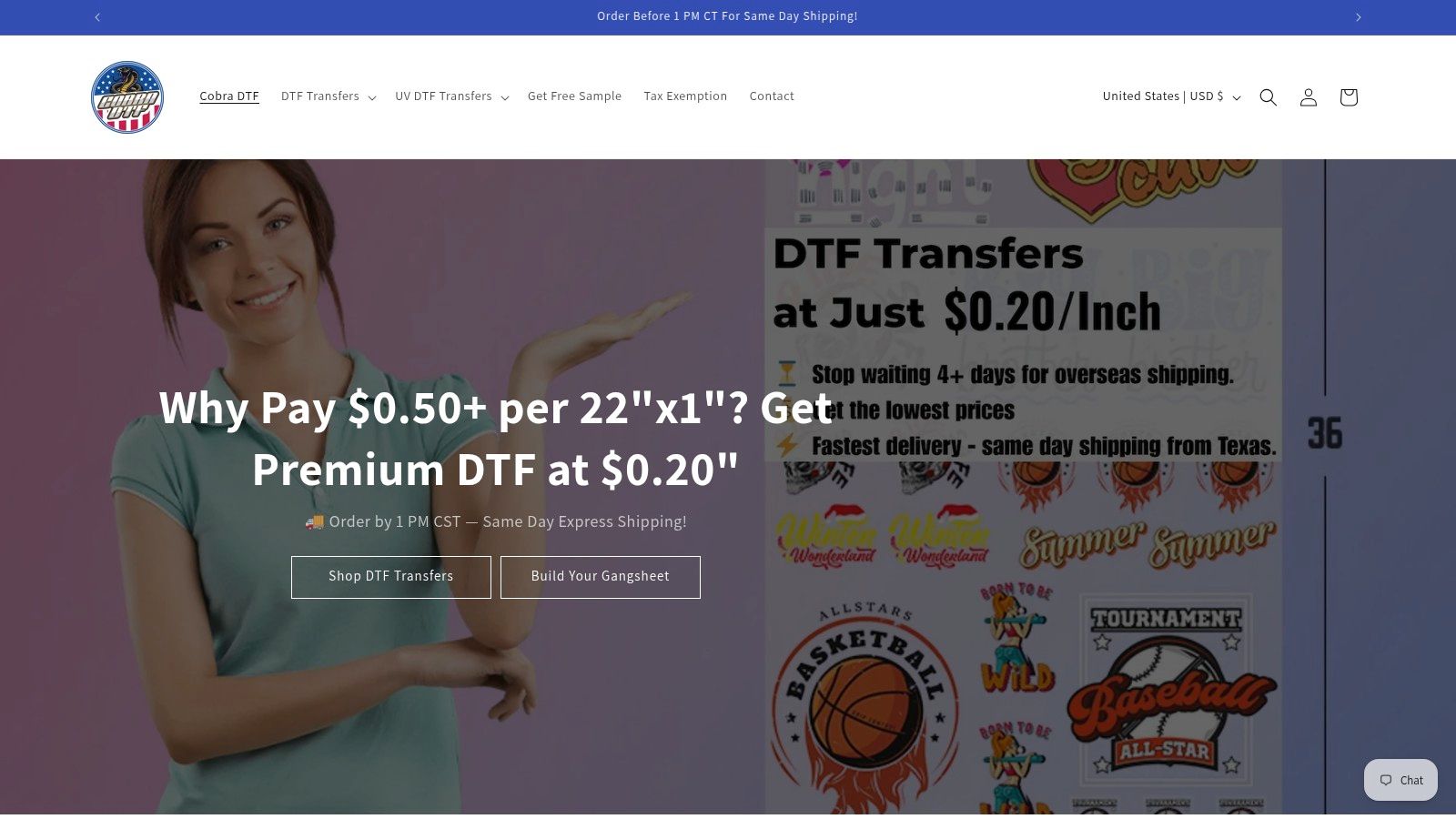
Cobra DTF offers ready-to-press, size-specific DTF transfers printed on film for heat application to apparel. Its published company information describes USA-made products, USA-sourced inks and films, and shipping options intended to avoid international customs and tariff complications. Those are operational features, not substitutes for a controlled press workflow.
Turn the settings into a repeatable shop process
The most useful workflow is a documented one:
- Order by finished size. Match transfer dimensions to jersey placement instead of resizing casually at the press.
- Test the actual polyester. Use a spare jersey or the least visible area approved for testing.
- Record the press profile. Write down temperature, dwell, pressure, peel condition, and post-press time.
- Keep a replacement path. Team orders often change when players join, leave, or switch numbers.
- Inspect before delivery. Check edges, alignment, hand feel, seams, and visible dye migration.
A reliable supplier helps only when the shop turns that reliability into repeatable production. The combination of consistent transfers, careful material selection, and written settings gives a team a better chance of receiving matching uniforms that behave consistently on the field.
Care Instructions for Longest Transfer Life
Care instructions should be given to the coach or equipment manager with the finished uniforms. The transfer needs time to settle after application, so wait 24 hours before laundering, a practice repeatedly cited in technical durability guidance. Wash garments inside out in cold water, use a suitable mild detergent, and avoid tumble drying when possible.
Heat is the enemy after pressing, too. High dryer temperatures can stress both the transfer and the performance fabric, while aggressive washing can increase abrasion at the graphic's edges. Don't iron directly over the design, and avoid folding the garment with the decorated surfaces pressed tightly against one another while warm.
For the longest service life: Cold water, inside-out washing, gentle handling, and air drying are safer choices than hot, aggressive laundry routines.
A shop should also tell teams to inspect uniforms after muddy games and remove heavy soil without scrubbing directly across the transfer. If a jersey needs stain treatment, test the product on an inconspicuous area first. Solvents and harsh chemicals can affect the graphic's surface or the garment dye.
Domestic sourcing can make replacement transfers easier to plan, but the team still controls much of the final lifespan through laundry and storage. Give the customer written care directions, keep the tested press profile on file, and treat every future reorder as a controlled production job rather than an automatic repeat.
Cobra DTF offers ready-to-press, size-specific DTF transfers suited to custom baseball jerseys and other apparel applications. Visit Cobra DTF to review transfer options for your next team order, then test the selected design on the actual performance fabric before pressing the full run.