

Warm Transfer vs Cold Transfer: A Practical Guide
One in five contact-center callers gets transferred, and transferred calls show a 12% lower CSAT and 14% lower FCR than calls resolved without a transfer, according to Bland's industry summary. That makes the warm transfer vs cold transfer debate an operational decision, not a matter of etiquette.
Warm transfers protect context, but they consume agent time. Cold transfers protect queue speed, but they can force customers to start over. The right choice depends on the call's complexity, emotional stakes, compliance exposure, and the pressure on the receiving queue. A blanket “always warm” policy wastes capacity. A blanket “always cold” policy creates avoidable repeat contacts.
What Warm and Cold Transfers Mean
A warm transfer, also called an attended or consultative transfer, keeps the first agent involved while the next agent receives the necessary context. The originating agent places the caller on hold, contacts the receiving agent, explains the account and issue, confirms readiness, and introduces both parties before leaving.
A cold transfer, also called a blind transfer, routes the caller directly to another agent, extension, or queue without that private briefing. It saves handle time because the first agent does not open a second conversation. The receiving agent, however, may have no record of the caller's history or prior troubleshooting.
The difference is procedural. The operational cost depends on the call type and queue pressure. Bland reports that 19% of callers are transferred, while transferred calls have a 12% lower customer satisfaction score and a 14% lower first-call resolution rate than calls handled without transfers. Those figures apply to transferred calls generally. They do not prove that every cold transfer fails or that every warm transfer succeeds.
Operational rule: Use a warm handoff when missing context threatens FCR, CSAT, compliance, or repeat contact. Use a cold handoff when the destination is clear and the caller's request needs little explanation.
Warm does not mean perfect
A warm transfer can still create a poor experience. The caller may wait too long, the receiving agent may misread the briefing, or the three-way connection may fail. The originating agent also remains occupied while the next agent prepares, which matters in a high-volume queue.
A cold transfer can be the smarter choice for a straightforward routing request, such as reaching a specific information queue. It becomes a problem when the receiving agent must reconstruct a complex account history that could have been passed forward.
Nextiva's explanation of cold and warm transfers draws the distinction clearly: warm transfers pass customer details and an issue summary before bridging the caller, while cold transfers route the caller without that context. Set the break-even line against your targets. If the extra handoff time protects resolution and satisfaction on complex calls, warm it. If it mainly delays both queues on simple calls, cold transfer it.
Step-by-Step Process for Each Handoff
A warm transfer has a deliberate sequence. The agent first confirms that another person or team is required, then tells the caller why the handoff is necessary. After asking permission for a brief hold, the agent contacts the receiving party and delivers a concise summary.
That briefing should cover the caller's identity or verification status, the account history relevant to the issue, what the first agent already checked, the customer's desired outcome, and any risk or urgency. The first agent then confirms that the receiver can take ownership, introduces the caller, and exits only after the connection is stable.
A cold transfer removes the private consultation. The first agent identifies the destination, tells the caller they're being connected, and releases the call into the chosen line or queue. The receiving agent answers without a direct account of what happened before the transfer.
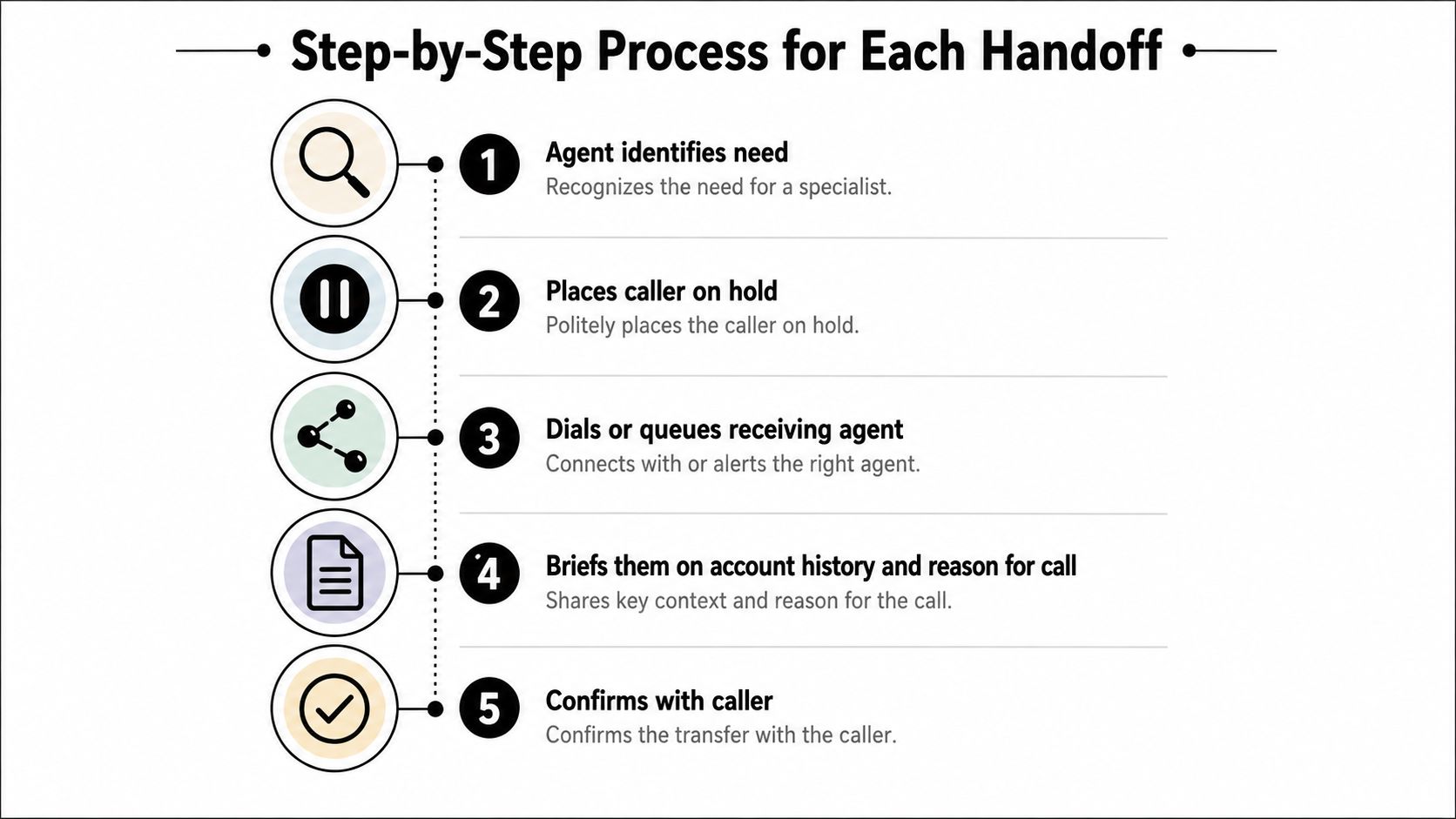
Where the time gets spent
Manual warm transfers add about 30 to 90 seconds per call, according to Retell AI's guide to warm transfers. That time appears in the hold, the receiving-agent connection, and the briefing itself. It can be worthwhile when it prevents a second explanation, preserves a delicate conversation, or gives a specialist the information needed to act immediately.
The failure points deserve equal attention:
- Dropped bridge: One call leg disconnects while the agents are consulting or introducing the caller.
- Unmanaged hold: The caller waits without an expectation, increasing frustration before the second agent even speaks.
- Incomplete briefing: The receiver hears a vague label such as “billing issue” instead of the actual disputed charge or requested action.
- Silent cold landing: A caller reaches voicemail or an unfamiliar queue without knowing what to expect.
Agents who need help with the mechanics should review practical desk phone call forwarding tips, especially if their phone system handles transfers differently from the contact-center platform. The technology matters, but the operating discipline matters more. Every transfer should have a known destination, a caller-facing explanation, and a fallback if the receiving party doesn't answer.
How AI and Automation Are Rewriting the Handoff
AI changes the calculation by making context portable. A virtual agent can capture intent, identity details, account state, and the conversation transcript before escalation. When that information appears in the receiving agent's workspace, a technically cold transfer may carry more useful context than a rushed human handoff.
That doesn't make automation equivalent to judgment. It changes where the briefing happens. Instead of the first agent spending time explaining the call verbally, the platform can create a structured recap card, populate the CRM, surface authentication status, and show the next agent which steps have already been completed.
The new handoff sequence
A modern escalation can work like this:
- The AI identifies a request outside its authority or knowledge.
- The system records the reason for escalation and attaches the transcript.
- Identity and account information carry into the human agent's screen, subject to the organization's controls.
- Real-time agent assist highlights relevant procedures or missing information.
- The receiving agent accepts the call with a visible summary instead of asking the caller to restart.
This compresses the traditional warm-briefing step. It may also reduce unnecessary transfers when automation resolves routine requests before a human queue is involved. Resources discussing AI productivity benefits for busy professionals are useful background for understanding why teams use automated summaries and task handoffs beyond contact centers.
Where human judgment still wins
Routine routing is the easy case. Emotional calls, disputed payments, cancellation threats, and complex troubleshooting still require a person to assess tone, ambiguity, and risk. A transcript can state what the caller said, but it may not fully capture what the first agent noticed during a tense interaction.
Compliance creates another boundary. Automated identity carryover and handoff logs may support a clearer audit trail, as ActiveProspect explains in its discussion of call transfers, but the organization still needs rules for verification, authorization, privacy, and escalation. AI-generated context can shorten the handoff. It can't replace the receiving agent's responsibility to validate what they're allowed to do.
The open operational question is whether AI-assisted handoffs outperform traditional warm transfers across FCR, CSAT, and recontact outcomes for each call type. Don't assume the answer is yes. Instrument both models and let the queue evidence decide.
Warm Transfer vs Cold Transfer Compared Side by Side
The right handoff protects the resource your operation cannot waste. Warm transfers spend more agent time to preserve customer context. Cold transfers keep the queue moving, while shifting more explanation and diagnosis to the next interaction. The better method depends on call type, queue pressure, staffing model, and the effect on FCR and CSAT.
| Criteria | Warm Transfer | Cold Transfer |
|---|---|---|
| Handling time | Adds a briefing and usually extends the live interaction | Faster initial routing |
| Customer context | Passed directly from one agent to the next | Must be supplied by the caller or system |
| CSAT exposure | Better fit for complex or emotional calls because repetition is reduced | More vulnerable when the caller has already explained the issue |
| FCR exposure | Supports continuity when the receiving specialist needs history | Can weaken resolution when the next agent starts without context |
| Compliance risk | Allows verification status and authorization details to be discussed before connection | Requires reliable system context or renewed verification |
| Agent skill requirement | Requires concise briefing and controlled call bridging | Requires accurate routing and clear caller expectations |
| Training overhead | Higher, because agents must consult and introduce properly | Lower for simple, predictable routing |
| Queue pressure tolerance | Lower when receiving queues are congested | Higher for straightforward requests |
| Best call type | Complex, emotional, specialist, or regulated escalation | Simple, transactional, or time-sensitive routing |
The extra time can be justified. Retell AI notes that a warm-transfer briefing can take about 30 to 90 seconds. The same guide cites SQM Group benchmarks placing cross-industry FCR near 70%. That level of repeat contact makes context preservation a reasonable trade when a briefing prevents the receiving agent from repeating discovery.
Treat 30 to 90 seconds as an operating cost, not a universal penalty. A specialist handling a multi-step technical failure may use the briefing immediately. An agent receiving a package-tracking request may need only the order number, which the system can pass automatically.
The break-even question
Ask what the cold path costs after connection. If the caller reaches the correct queue and the receiving agent can act without reconstruction, cold transfer protects throughput. If the caller repeats the story, waits through another discovery process, or contacts the center again, the initial speed advantage disappears and FCR suffers.
Transfer choice also affects customer sentiment. The Bland summary reports that cold transfers have a 30% higher call drop rate than warm transfers, while warm transfers can raise customer satisfaction by up to 30%. Use those figures as directional benchmarks, not promises for your operation. Measure transfer rate, FCR, CSAT, repeat contact, and queue occupancy by call type. Set the break-even line where the added briefing time costs less than the repeat work and customer friction caused by a cold handoff.
When a Cold Transfer Is the Smarter Call
Warm transfers are not a virtue when the receiver doesn't need a briefing. In a high-volume queue, spending agent time on a ceremonial introduction can damage service levels without improving resolution. The correct cold transfer is direct, transparent, and aimed at a destination that can handle the request.
Use a cold handoff for simple transactional requests. Order status, tracking information, store hours, basic policy questions, and straightforward re-authentication often have limited history. If the receiving queue can see the order or account record immediately, the caller gains more from speed than from a narrated relay.
Cold transfers also work for predictable informational routing. A caller asking for a particular department may already know what they need. The first agent should name the destination and set a clear expectation, rather than pretending to provide a warm experience that adds no useful context.
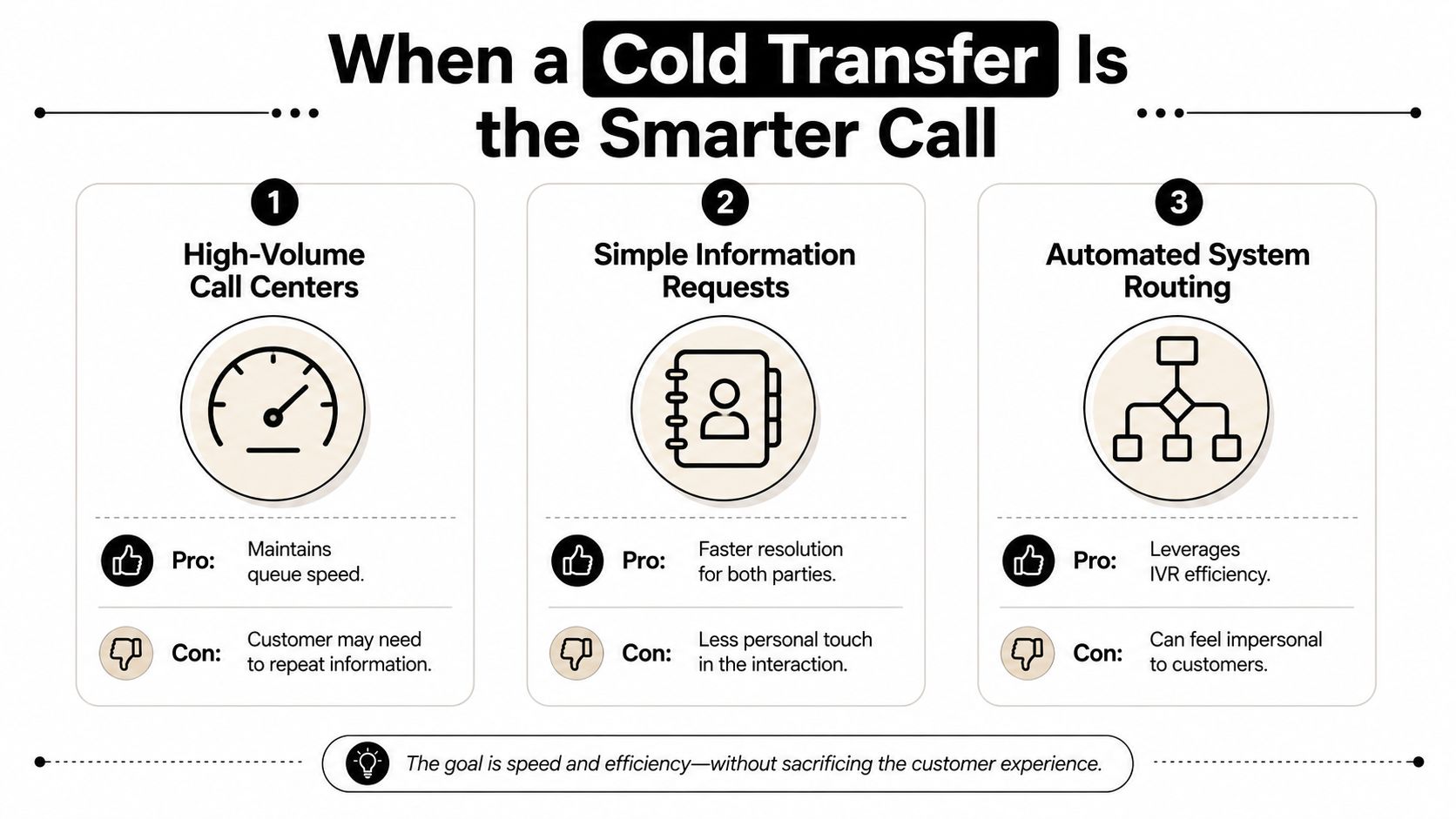
Queue pressure changes the answer
When the receiving team has limited availability, a forced warm transfer can leave two agents occupied while the caller waits. That is a poor design if the request is simple and the receiving agent has no additional context to use.
A cold transfer is also safer than a failed warm transfer when no qualified receiver is available. Don't keep the caller in an indefinite hold just to satisfy a policy. Offer a callback, provide the expected queue destination, or explain the next step before routing.
A cold transfer is responsible only when the caller knows where they're going and the receiving system can recover the necessary context.
The boundary is clear. Don't cold-transfer a billing dispute, an upset cancellation request, or a complicated technical escalation merely because the queue is busy. That choice protects one service-level measure while creating work elsewhere. Use cold routing for low-context calls, and reserve warm capacity for cases where continuity changes the outcome.
Matching the Method to the Call Type
A transfer policy should classify calls before it dictates behavior. Four variables provide a practical decision frame: complexity, emotional stakes, compliance sensitivity, and queue pressure.
Complexity asks whether the call involves one clear action or several connected problems. A package-tracking request is usually narrow. Technical troubleshooting with previous tests, account access, and device history is not. The more reconstruction the receiver would need, the stronger the case for a warm handoff.
Emotional stakes matter even when the underlying task is simple. A customer may need only one account change but may be angry after repeated failures. Passing that person cold into another queue makes the receiving agent inherit frustration without the context that caused it.
Compliance sensitivity sets a harder boundary. Payment disputes, identity verification problems, regulated complaints, and requests involving protected account information require explicit attention to what was verified, what was disclosed, and what the next agent is authorized to do.
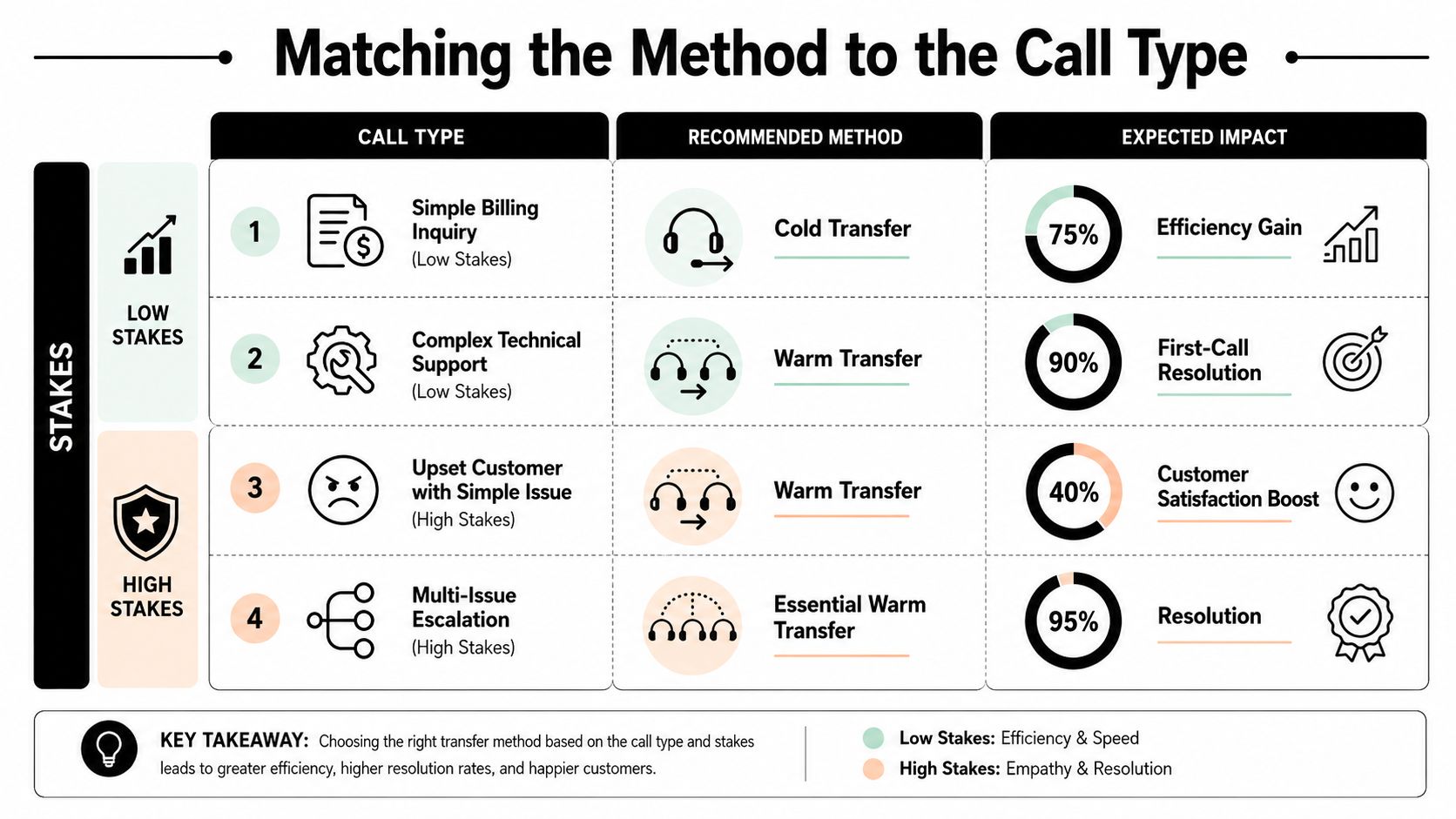
A supervisor-ready decision logic
Use this sequence in routing rules and QA reviews:
- If the issue is simple and low stakes, cold-transfer it when the destination can identify the account or request without a verbal history.
- If the issue has multiple steps or prior troubleshooting, warm-transfer it and summarize what has already been attempted.
- If the caller is upset, default to warm unless the receiving agent has complete context and the cold route is demonstrably faster.
- If verification or regulated handling is involved, warm-transfer with verification status and authorization boundaries clearly stated.
- If the receiving queue is under pressure, permit cold routing only for calls that meet the low-context rule.
Password resets illustrate the nuance. A verified caller with a standard reset can go cold if the system passes the needed account context. An unverified caller should not be pushed blindly to a team that must repeat identity checks.
Technical support usually deserves a warm handoff when the first agent has already run diagnostics. Package tracking usually doesn't. A payment dispute escalation should carry a deliberate briefing, because the receiver needs the facts, actions taken, and customer expectation before taking ownership.
Implementing a Transfer Strategy That Holds Up
Don't launch a warm-versus-cold policy from instinct. Start with recordings and transfer reason codes, then identify which handoffs generate repeat contacts, low CSAT, or avoidable queue work. The point isn't to warm-transfer more calls. The point is to spend briefing time where it prevents a worse outcome.
Use a short briefing template. It should be consistent enough for QA to score and brief enough that agents won't turn it into a second discovery call:
- Caller identity and verification status.
- Account or order context relevant to the issue.
- The problem in one plain-language sentence.
- Actions already completed.
- Caller sentiment or urgency.
- The next action the receiving agent needs to take.
Train agents to confirm the destination before putting the caller on hold. Require a fallback when the receiver doesn't answer. A transfer that lands in voicemail without warning isn't a successful handoff, regardless of whether the original agent attempted a briefing.
Rollout checklist
| Phase | Action | Metric to track | Target to advance |
|---|---|---|---|
| Audit | Review call recordings and classify transfers by reason | Transfer rate by reason code | Clear categories with accountable owners |
| Diagnose | Identify reasons linked to repeat contacts | Repeat-contact rate and FCR | Priority list of failure-producing transfer types |
| Design | Assign warm or cold rules by call type | CSAT and FCR by transfer method | Approved routing logic for supervisors |
| Train | Practice concise briefings and caller explanations | Briefing quality and transfer failures | Consistent QA performance |
| Pilot | Run the protocol in one queue alongside a comparison queue | AHT delta, FCR, CSAT, and repeat contacts | Evidence of improvement without service-level damage |
| Review | Reassess the rules as staffing and automation change | Monthly transfer dashboard | Updated playbook, not a static policy |
Track transferred-call CSAT against first-touch CSAT, FCR before and after the change, average handle-time delta, transfer failure rate, and repeat contacts within your chosen reporting window. Bland's benchmark summary gives you a starting reference for the broader transfer penalty, but your reason-code data should govern local decisions.
Staffing changes the equation. So does AI-generated summarization, new IVR routing, and a shift in call mix. Teams that schedule support coverage or coordinate operational availability can also use an appointment scheduler for support ops as part of a broader capacity plan, particularly when specialist availability determines whether a warm handoff will succeed.
Keep the policy living. Supervisors should review exceptions, QA should score context quality, and operations should remove warm requirements from call types that consistently resolve without them. The best warm transfer vs cold transfer strategy is a controlled decision system that protects both customer outcomes and queue capacity.
Cobra DTF offers USA-made Direct-to-Film transfers with warm-peel and cold-peel handling guidance for different fabric workflows, making it a practical option when your production team needs clear transfer decisions. Visit Cobra DTF to review its transfer products and pressing guidance, then match the peel method to your material and production requirements.