
Silk Printing vs Screen Printing A Definitive Comparison Guide
So, what's the real difference between silk printing and screen printing? The short answer is: there isn't one. They are the exact same printing method.
"Silk printing," or "silk screening," is simply the old-school name for the process. It's a throwback to the days when the stencils were made from actual silk mesh. Today, that delicate silk has been replaced by far more durable and practical synthetic materials like polyester, so the industry universally calls it screen printing.
Unraveling the Terminology: Silk Printing vs. Screen Printing
When someone mentions "silk printing," they're talking about one of the most tried-and-true methods for customizing apparel. The name comes from its ancient origins, where artisans would stretch a fine silk fabric over a wooden frame to create a stencil. Ink was then forced through the open areas of the mesh onto fabric or paper, bringing the design to life.
As technology marched on, printers discovered that polyester and nylon meshes were not only cheaper but also held up better to the rigors of printing. They offered more consistent tension and were built to last. With this shift away from natural silk, the name naturally evolved to the more accurate term we use today: screen printing.
Key Takeaway: The material used for the screen has changed—from natural silk to synthetic mesh—but the fundamental technique of pushing ink through a stencil hasn't. So, if you're comparing silk printing vs. screen printing, you're really just talking about screen printing.
Setting the Stage for Modern Comparisons
Getting this history straight is important because it shifts the conversation. The real debate for any print shop or apparel brand today isn't about two old, identical methods. It’s about how classic screen printing holds up against modern digital alternatives.
Screen printing, with its roots in ancient China, is now a massive industrial force. According to a report on the industrial screen printing market on coherentmarketinsights.com, the textile segment dominates, fueled by the relentless demand from e-commerce and fast fashion for bold, vibrant apparel.
To make the right call for your business, you need to see how screen printing compares to its main digital rivals: Direct-to-Garment (DTG) and Direct-to-Film (DTF).
Printing Methods Quick Comparison
This table gives you a quick snapshot of where screen printing shines compared to its digital counterparts. Think of it as a cheat sheet for deciding which technology fits your production needs.
| Feature | Screen Printing (Silk Screening) | Direct-to-Garment (DTG) | Direct-to-Film (DTF) |
|---|---|---|---|
| Best For | High-volume, simple designs (1-4 colors) | Small orders, complex photorealistic designs | Versatile designs on various fabrics |
| Cost-Per-Print | Very low for bulk orders, high for small runs | Moderate for small runs, high for bulk | Low to moderate at any volume |
| Durability | Excellent, very long-lasting and wash-resistant | Good, but can fade faster than screen prints | Excellent, flexible and crack-resistant |
| Setup Time | High (screen preparation for each color) | Very low (digital file upload) | Low (print to film, then apply) |
Each method clearly has its own strengths. Screen printing is the undisputed king of bulk orders with simple graphics, while DTG is perfect for one-off, full-color prints. DTF, meanwhile, offers a fantastic blend of versatility and durability that works for a huge range of jobs.
How The Modern Screen Printing Process Works
Even though we sometimes hear the term "silk printing," that name really just points back to the history of the craft. Today's screen printing is a much more refined process, a perfect blend of hands-on skill and technical precision. Walking through the workflow makes it clear why this method is the undisputed king for certain jobs—especially large batches with a limited color palette.
It’s a very physical process, where each step lays the foundation for the next to create a print that’s not just vibrant, but incredibly durable.
The whole thing starts well before a drop of ink hits a t-shirt. First, the artwork has to be broken down into separate layers, one for each color. Every single color in the design needs its own screen—a mesh, which used to be silk but is now almost always polyester, stretched super tight across a frame. This digital separation is a critical first step that directly impacts the job's complexity and cost.
This diagram traces the evolution from the original material to the modern-day tool.
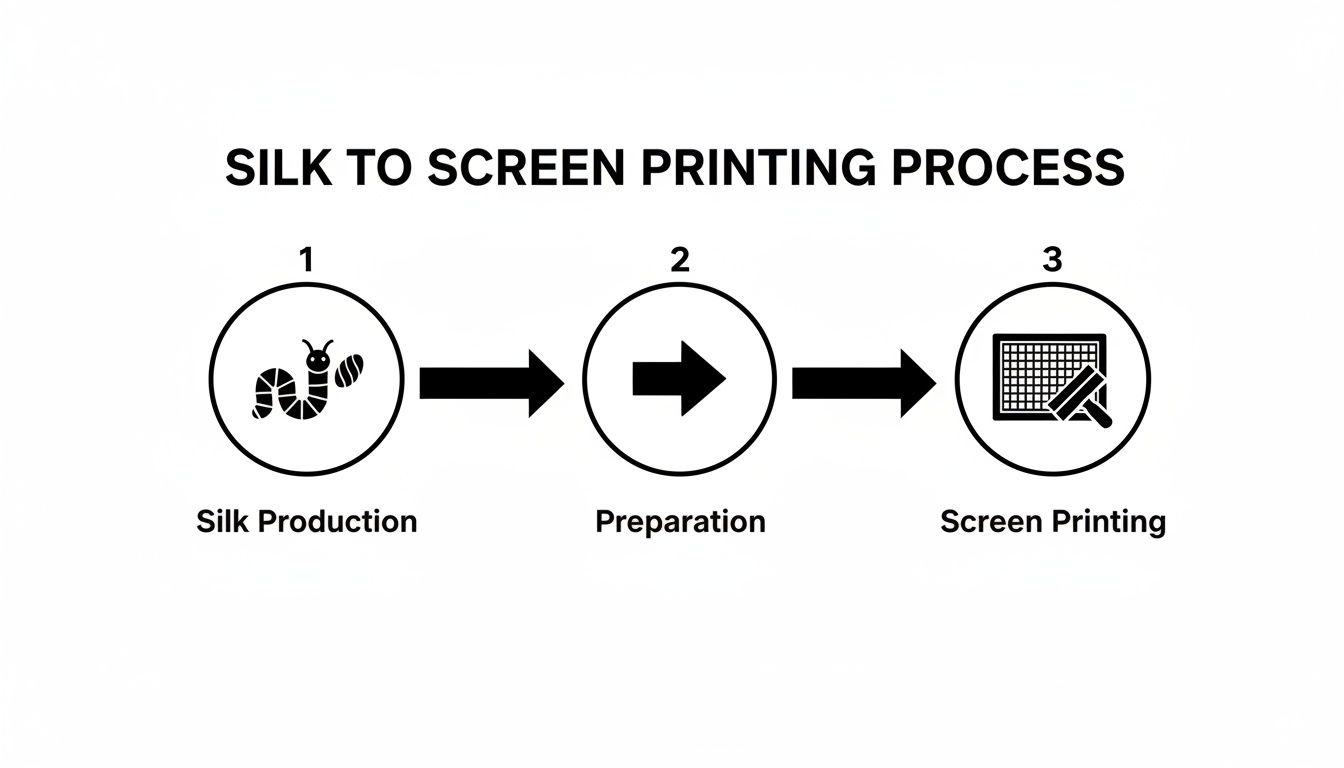
You can see the direct line from the old silk-based techniques to the synthetic screens we use in shops today. The core idea hasn't changed a bit.
Preparing The Stencil
With the color separations ready, it's time to turn each screen into a stencil. This is done with a light-sensitive liquid called photo emulsion, which gets coated thinly and evenly across the mesh. Once the emulsion is dry (a process done in a dark room), a film positive—basically, a transparent printout of one color layer—is laid flat against the screen.
Next, the screen is blasted with a powerful UV light. The light instantly hardens the emulsion everywhere except where the black artwork on the film is blocking it. Those unexposed areas remain soft and are easily washed out with water, leaving a perfect, clean stencil for ink to pass through. You have to repeat this entire process for every color in the design, creating a dedicated screen for each.
The Printing And Curing Stages
Now for the fun part. With all the screens prepped, the garment is smoothed onto a flat board called a platen, and the first screen is locked into place above it. A thick bead of ink is poured along the top edge of the screen.
Using a rubber blade called a squeegee, the printer pulls the ink firmly down the screen. This single, smooth motion forces the ink through the open mesh of the stencil and onto the fabric. If the design has multiple colors, the process is repeated with each screen, often with a quick flash-dry in between to keep the colors from bleeding. Getting each screen lined up perfectly—a step called registration—is an art in itself and is absolutely essential for a sharp, professional-looking print.
Crucial Insight: All the manual work and materials involved—creating, registering, and eventually cleaning each screen—is exactly why screen printing has high setup costs. It's a lot of upfront effort for a small batch, but for large orders, the cost per shirt drops dramatically, making it unbeatable.
After the last color is down, the final step is curing. The garment is run through a conveyor belt dryer, which heats it to a precise temperature—typically around 320°F (160°C) for standard plastisol inks. This heat doesn't just dry the ink; it chemically bonds it to the fabric fibers. This is what gives screen prints their famous longevity, making them tough enough to survive years of washing without cracking or fading.
For a more detailed breakdown, our guide on how to start screen printing goes even deeper into these steps.
When you're trying to choose between classic screen printing and newer digital methods, the decision almost always boils down to three things: print quality, cost, and durability. These aren't separate issues; they're all tangled together. There’s no single "best" choice—the right answer depends entirely on your project's goals, from how many pieces you're making to how complex your design is.
The difference in how these prints look and feel is something you'll notice right away. A traditional screen print has a real presence on the garment. The ink, especially plastisol, sits slightly on top of the fabric, creating a thick, solid layer you can feel. This is what gives you those incredibly bright, opaque colors that really stand out, particularly on dark shirts.
Digital methods like Direct-to-Garment (DTG), however, produce a much softer result. The ink is sprayed directly into the cotton fibers, essentially dyeing them instead of sitting on top. The final print feels like it's part of the shirt itself, but sometimes you lose a bit of that vibrant punch you get from a screen print, especially with simple, bold graphics.
Analyzing The Cost Per Unit
Cost is usually the deal-breaker, and this is where screen printing’s economic model makes perfect sense. The process has a lot of upfront work: burning stencils, mixing custom inks, and setting up the press. Because of all this initial labor, small runs of less than 24 pieces just don't make financial sense.
But once that setup is done, the actual printing is incredibly quick. For larger orders—we’re talking 500 units or more—screen printing becomes a powerhouse, often coming in 30-50% cheaper than digital options because you're spreading that setup cost over hundreds of shirts. On massive runs of 1,000 pieces, the savings get even better. If you want to dive deeper into the numbers, there are some great cost differences between printing methods on vstees.com.
Digital printing completely flips that around. With practically zero setup, you can print one full-color t-shirt quickly and affordably. This makes DTG and its cousin, Direct-to-Film (DTF), ideal for print-on-demand businesses, small shops testing out new designs, or one-of-a-kind personalized gifts. The catch? The price per shirt stays pretty much the same whether you print one or one hundred, so you don't get those sweet economies of scale.
Key Insight: Screen printing is a volume game. Its high initial setup costs are offset by a drastically lower per-unit price on large orders. Digital methods offer low entry costs but don't provide the same bulk discounts.
The table below breaks down exactly how the cost-per-print for screen printing plummets as you increase your order size. It’s a clear illustration of why this method is unbeatable for bulk production.
Screen Printing Cost Efficiency Analysis
| Metric | 1-50 Units | 51-500 Units | 500+ Units |
|---|---|---|---|
| Ideal Method | DTG or DTF | Screen Printing (at higher end) | Screen Printing |
| Setup Cost | Very Low | High | High (but distributed) |
| Cost-Per-Unit | Moderate | Moderate to Low | Very Low |
| Turnaround Time | Fast | Moderate | Slow to Moderate |
As you can see, the economic tipping point is dramatic. What starts as an expensive option for a few shirts becomes the most affordable choice by far once you hit a few hundred units.
Color Fidelity And Design Complexity
If you need your colors to be perfect, screen printing is the way to go. Inks are mixed by hand before the print run, which means you can hit exact Pantone Matching System (PMS) colors. For brands that demand absolute color consistency across all their merchandise, this is a non-negotiable advantage.
The trade-off is the number of colors you can use. Every single color needs its own screen, and the labor and cost stack up with each one you add. Most print shops will top out at around 6-8 colors, which makes screen printing best for logos and graphics with a limited, solid-color palette.
Digital printing shines exactly where screen printing struggles. DTG and DTF printers function just like the inkjet printer on your desk, capable of recreating millions of colors, smooth gradients, and photo-quality details in one go. There's no extra charge for complexity; a design with two colors costs the same as a design with two hundred.
Here’s a quick breakdown of which method fits which design:
- Screen Printing: Perfect for bold, graphic designs with just a few solid colors. Think company logos, text-based shirts, and team jerseys.
- DTG Printing: The go-to for photorealistic images, complex illustrations with tiny details, and designs with tons of color gradients.
- DTF Printing: A versatile middle-of-the-road option. It handles complex, full-color designs beautifully and works on a wider range of fabrics than DTG.
This makes digital the clear winner for artists, photographers, and brands that use highly detailed or multi-colored artwork. The compromise is that hitting a specific PMS color can be tricky, as these printers are approximating colors using a CMYK process.
Durability And Longevity In The Real World
When it comes to holding up over time, screen printing's legacy is undeniable. When cured correctly, the ink forms a tough, flexible layer that’s bonded tightly to the fabric. It is incredibly resilient and can handle dozens—if not hundreds—of washes without fading or cracking. This is why it’s the standard for workwear, band merch, and any apparel that needs to take a beating.
Digital prints have come a long way, but they wear differently.
- DTG prints, because they are absorbed into the fibers, can fade slowly over time with repeated washing, much like any other store-bought graphic tee.
- DTF transfers, when applied right, are surprisingly durable and can even rival screen printing. The adhesive creates a strong, flexible bond that resists cracking.
Ultimately, the choice comes down to what the garment is for. For a promotional t-shirt that might only get worn a handful of times, DTG is a fantastic, cost-effective choice for a small batch. But for a construction crew's uniforms, you need the rugged dependability of screen printing. It’s all about matching the method to the mission.
Sustainability In Screen Printing And Its Alternatives
As more brands and their customers start asking tough questions about where their clothes come from, the environmental impact of apparel production is getting a closer look. When you're weighing silk printing vs. screen printing, it's smart to think beyond just the final look and cost. The sustainability of the entire process—and its modern alternatives—is a huge part of the story.
Traditional screen printing, for all its strengths, has a few environmental weak spots. The big ones are water consumption and chemical usage. After every single print job, each screen has to be meticulously cleaned and reclaimed. This means washing away all the leftover ink and then using chemical solvents to strip the old emulsion, creating wastewater that needs careful treatment before it can be released.
On top of that, you have the energy drain. The large conveyor dryers needed to cure plastisol inks are power-hungry, adding a significant chunk to a print shop's carbon footprint, especially in high-volume operations.
Ink Types And Their Environmental Impact
The ink you choose is probably the single biggest factor in screen printing's environmental equation. The two main players offer a classic trade-off: convenience versus eco-consciousness.
- Plastisol Inks: These have been the industry workhorse for a long time. They're essentially tiny PVC plastic particles mixed into a liquid plasticizer. While they're incredibly durable and user-friendly, they contain phthalates and aren't biodegradable. Their plastic base also means you need chemical solvents to clean them up.
- Water-Based Inks: A much gentler alternative, these inks use water as their primary solvent. They absorb right into the fabric, creating a much softer feel. Best of all, they clean up with water, which dramatically cuts down on the need for harsh chemicals. The downside? They can be a bit trickier to work with and sometimes require more energy to cure properly.
Switching to water-based inks is a great move toward a greener shop, but it doesn't solve the other resource-heavy parts of the screen printing process.
Digital Printing: A Greener Alternative
This is where digital methods like Direct-to-Garment (DTG) and Direct-to-Film (DTF) really start to shine from a green perspective. Because they print directly onto the surface or a transfer film, there are no screens involved. Zero. This simple fact completely erases the massive water and chemical consumption tied to screen prep and cleanup.
Key Environmental Insight: The on-demand nature of digital printing is its greatest sustainable strength. By producing items only when they are ordered, it drastically reduces overproduction—a major source of textile waste in the fashion industry, where an estimated 92 million tons of fabric ends up in landfills annually.
Digging deeper, a full lifecycle analysis shows that digital printing can seriously cut carbon emissions. Research has found savings of around 2 kg of CO2 equivalent per kilogram of fabric compared to screen printing in Europe. That figure skyrockets to 7.8 kg in places with less clean energy grids. You can check out the complete environmental impact comparison on Carbonfact.com.
For businesses serious about shrinking their ecological footprint, looking into sustainable manufacturing practices is no longer optional. Digital methods, especially a well-managed DTF setup that uses high-quality, eco-conscious inks and films, offer a responsible way forward. They help you create top-notch custom apparel by minimizing waste, water, and energy—all without the heavy environmental toll of old-school techniques.
When To Choose Screen Printing For Your Project
Knowing the technical details is one thing, but knowing when to use a particular printing method is what gives your business a real advantage. Screen printing isn't just an old-school technique; it’s a strategic choice for projects where its specific strengths deliver the best possible value. It's still the undisputed champ when you need volume, durability, and perfect color fidelity.
This method really shines once your production numbers start to climb. For any large-scale project, the economics of screen printing are tough to beat.
Ideal Scenarios For High-Volume Production
Think about any job where you need a huge batch of identical items. This is where screen printing's financial model—a higher setup cost followed by a super low per-unit cost—becomes incredibly efficient.
-
Concert and Event Merchandise: Tour merch and festival apparel are the classic examples. Bands need hundreds, sometimes thousands, of t-shirts that are both cheap to make and durable enough to survive as a fan's keepsake.
-
Corporate Uniforms and Workwear: When a company needs to outfit its entire team, screen printing delivers consistency and resilience. These prints have to withstand daily wear and tear plus constant washing, making the robust bond of cured plastisol or water-based inks absolutely essential.
-
Promotional Giveaways: Need 1,000 tote bags for a trade show or 500 t-shirts for a product launch? Cost-per-item is king. Screen printing is what makes these large marketing campaigns financially realistic.
In all these cases, the initial time and money spent burning screens are quickly recovered once the press starts running, which drastically lowers the price per garment.
Projects Demanding Unmatched Durability
Beyond simple cost savings, the physical toughness of the print is often a deal-breaker. Screen printing lays down a thick, resilient layer of ink that literally bonds with the fabric's fibers during the curing process. The result is an exceptionally tough print.
This is exactly why it remains the go-to for:
- Athletic Team Jerseys: Sports apparel has to endure stretching, scuffs, and endless laundry cycles. Screen-printed numbers, logos, and sponsor graphics are built to take that abuse without cracking or peeling.
- Retail Apparel Lines: Major clothing brands rely on screen printing to make sure their products look great for the long haul, which is crucial for protecting their reputation.
- School and University Gear: From spirit wear to club uniforms, these items get worn and washed constantly. The durability of a screen print ensures they still look good at the end of the school year.
Situational Insight: If the success of your project depends on the print outlasting the garment itself, screen printing is almost always the right answer. Its track record for longevity offers a kind of peace of mind that newer digital methods are still trying to achieve.
When Color Accuracy Is Everything
For many brands, a specific shade of red or blue isn't just a color—it’s their identity. Digital processes like DTG use a CMYK model to approximate colors, which can sometimes result in small but noticeable variations. Screen printing gets rid of that guesswork.
Because the inks are mixed by hand before the run even starts, printers can nail exact color formulas using the Pantone Matching System (PMS). This guarantees a company's logo is the exact same shade of green on a t-shirt as it is on their website. For maintaining brand consistency, that level of precision is non-negotiable. If your design calls for a specific spot color that has to be perfect, screen printing provides a degree of control that digital simply can't match.
Choosing The Right Printing Method For Your Business
Picking a printing method isn't just about the tech; it's a core business decision that shapes your costs, how fast you can grow, and what your brand stands for. The right choice depends entirely on your business model.
For Small Shops, Startups, and E-commerce Brands
If you're just starting out or running a small shop, the steep upfront cost of screen printing equipment can be a dealbreaker. It’s a lot of cash to sink into one process. Digital printing methods, on the other hand, let you get started with a much smaller investment, giving you the flexibility to test the market without breaking the bank.
E-commerce sellers, in particular, live and die by inventory management. Screen printing forces you to print in bulk, which means you're tying up money in stock that might not sell. This inventory-heavy approach can be risky, especially when you're trying to figure out which designs will be a hit.
Digital on-demand printing completely flips that script. You can offer a massive catalog of designs with zero inventory cost, printing items only after a customer places an order. This is perfect for testing new ideas, offering personalized products, and keeping financial risk low. You can even use tools like an AI T-Shirt Design Generator to quickly create a wide range of designs before deciding which printing method to use.
For Established Apparel Manufacturers
For large-scale apparel manufacturers pumping out high volumes, it's all about efficiency. This is where screen printing truly shines. While the setup cost is high, the per-item cost plummets on large orders, making it the undisputed champ for bulk production. A fine-tuned screen printing press can crank out prints at a speed that digital methods simply can't match for big, identical runs.
When To Consider A DTF Alternative
So, what if you don't fit neatly into either of those boxes? What if you need the best of both worlds? This is exactly where an alternative like Cobra DTF comes in, bridging the gap between traditional screen printing and other digital methods.
Key Recommendation: For businesses that need vibrant, full-color designs on a wide variety of fabrics—without the high setup costs or color limitations of screen printing—DTF is the ideal middle ground.
Think about using Cobra DTF when you run into these common situations:
- Complex, Multi-Color Designs: Your artwork has too many colors or fine details to make screen printing affordable, but you need more versatility than DTG can offer.
- Small to Medium Runs: You need to print orders between 25 and 500 pieces. DTF is a cost-effective way to get top-notch prints without committing to a massive screen printing run.
- Diverse Material Needs: You want to print on cotton, polyester, blends, or even hard surfaces. DTF transfers work beautifully on almost anything, giving you way more flexibility than DTG, which is mostly limited to cotton.
At the end of the day, getting familiar with the different t-shirt printing methods is what sets successful print businesses apart. By matching the right technology to your business model—whether you're a startup, a bulk producer, or an online innovator—you can nail the balance of quality, cost, and efficiency.
Still Have Questions? Let's Clear Things Up.
Even after breaking down the details, a few practical questions always pop up. Here are the answers to the most common queries we get from printers trying to decide between these methods.
Is Screen Printing Better Than DTG?
It's not about "better," it's about what's right for the job.
Screen printing is the undisputed champion for bulk orders, hands down. If you're printing 50 or more shirts with a bold, straightforward design, nothing beats its durability and low per-item cost.
On the other hand, Direct-to-Garment (DTG) printing is perfect for small batches or one-off prints. Think complex, full-color photographs or intricate artwork. You get incredible detail with zero setup cost, making it ideal for on-demand jobs.
What's The Best Way To Print T-Shirts?
There's no single "best" method—the right choice depends entirely on your business goals and the specific design you're working with.
- If you're running a high-volume operation with designs that use just a few colors, screen printing is your workhorse. It's cost-effective, tough as nails, and built for production.
- For e-commerce stores selling unique designs on demand, digital methods like DTG or DTF printing are a lifesaver. They give you the flexibility to print complex art without holding tons of inventory.
- When you need vibrant, full-color graphics that work on all kinds of fabrics (cotton, polyester, and blends), DTF printing is an incredibly versatile choice.
Which Print Lasts Longer, Screen Print Or DTG?
In a durability contest, screen printing almost always wins.
The process lays down a thick, solid layer of ink that bonds directly to the fabric. When cured properly, that print can withstand hundreds of washes without cracking or fading.
DTG prints are also durable, but because the ink is absorbed into the fabric fibers, they can fade a bit over time, especially with rough washing.
The Bottom Line: It really boils down to two things: your order size and your design's complexity. If you have a high-volume run with simple graphics, go with screen printing. For small orders with detailed art, look at digital options like DTG or DTF.
Getting these key differences straight will help you make a smart decision every time, ensuring your final product delivers on quality, cost, and durability.
Ready to explore a powerful and versatile printing alternative that combines vibrant colors with incredible durability? Cobra DTF offers premium, USA-made Direct-to-Film transfers that elevate your apparel business. Learn more about Cobra DTF.