

Hot Peel DTF Transfers: A Complete Business Guide
You're probably looking at the same problem most growing print shops hit. Orders are coming in faster, customers want quick turnaround, and the press becomes the choke point. Not the printer. Not artwork. The press.
That's where Hot Peel DTF transfers start making business sense.
Most writeups stop at the technical difference between hot peel and cold peel. That's useful, but it misses the core question a shop owner asks: does this method help you press more shirts, keep labor moving, and avoid unhappy customers a month later when those garments have been washed over and over?
That's the lens that matters. Speed is only valuable if quality stays controlled. Quality is only valuable if your workflow doesn't stall. Hot peel sits right in that tension, and when it's used correctly, it can give smaller shops a real production advantage.
The Need for Speed in Custom Apparel
Monday at 9 a.m., the order board already looks bad. A school wants a last-minute reorder. A local brand needs an event run by tomorrow. Weekend web orders are stacked beside the press, and none of them ship until pressed garments are off the table and into boxes.
That is the point where peel time stops being a technical detail and turns into a business cost.
If every transfer has to sit and cool before the carrier comes off, the press operator keeps hitting small pauses all day. On a handful of shirts, you can work around it. On 40, 60, or 100 pieces, those pauses slow output, crowd the press area, and push packing later into the day. I have seen shops blame printing for missed turnaround when the actual slowdown was the press cycle.
Hot peel gets attention for one reason. It helps finished pieces move faster through the press area.
Speed changes more than the clock. It changes the economics of the job:
- More garments out of the same setup: The press stays in motion instead of waiting on cooldown.
- Lower labor cost per piece: Paid time goes into pressing, peeling, and staging the next shirt, not standing by the platen.
- Better odds on rush work: Fast, controlled production lets a shop say yes to short-deadline jobs without wrecking the rest of the schedule.
- Fewer fulfillment pileups: When pressed goods clear the table faster, packing and shipping can stay on schedule.
Practical rule: If the press area stalls, the whole order stalls.
Small shops usually feel this first because there is less room for inefficiency. You may have one heat press, one main operator, and no extra person to take over while someone answers customer emails, checks artwork, or packs finished orders. In that setup, five or ten seconds of dead time per garment is not trivial. It adds up across the shift and shows up as overtime, late carrier pickups, or both.
That is why practical operators pay attention to any workflow that cuts waiting without creating quality problems later. Shops that offer same-day DTF printing workflows usually win by removing wasted motion, not by rushing the press and hoping for the best.
The question is not whether hot peel is faster on paper. It is whether that speed holds up under daily production, keeps labor efficient, and still leaves the customer with a print that looks good after repeat washes.
What Exactly Are Hot Peel DTF Transfers
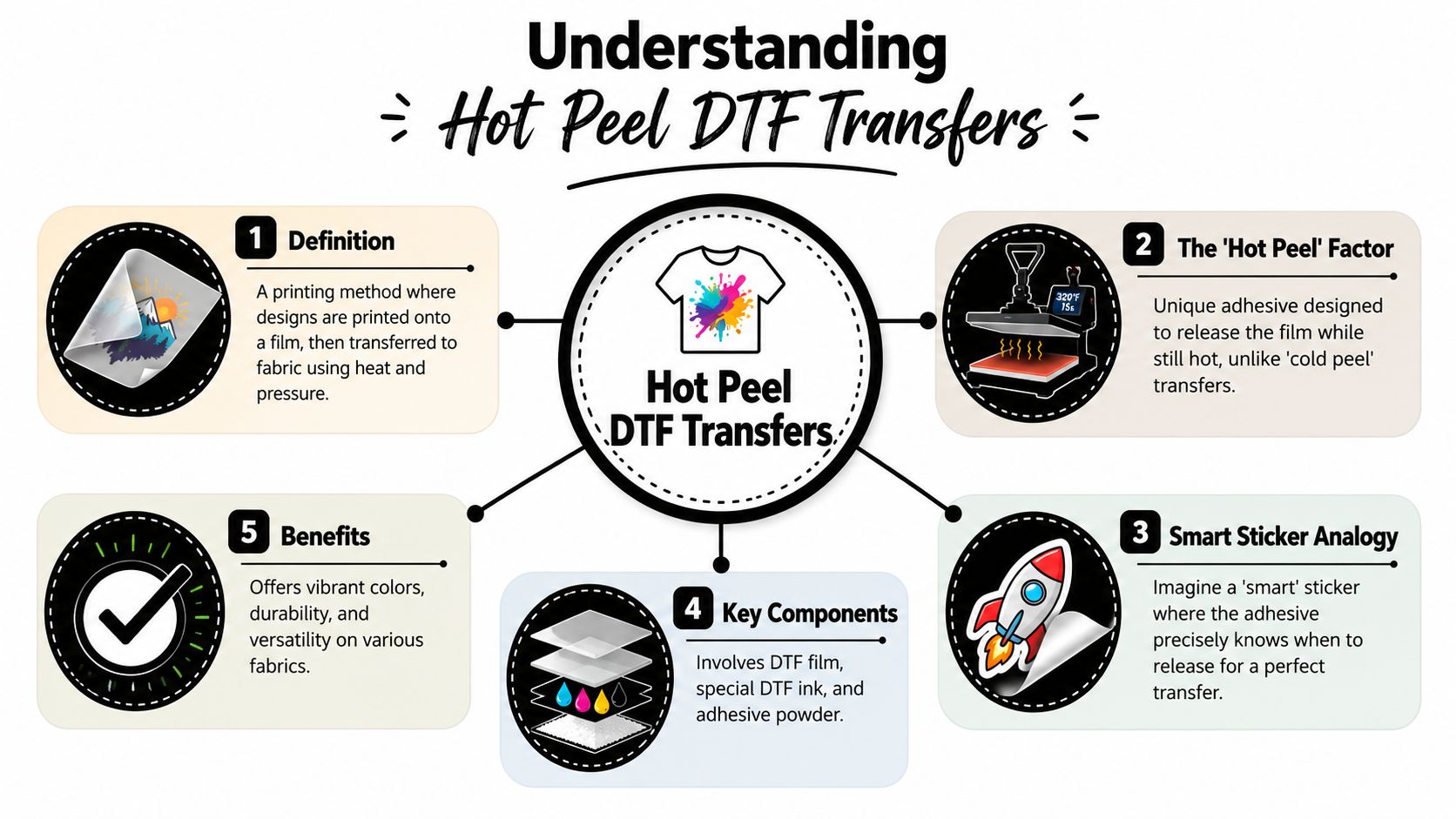
A hot peel transfer is designed so the carrier film releases from the garment immediately after pressing, while the print is still hot. That is the defining difference. The peel happens right away instead of after a cooling pause.
For a shop owner, that is more than a technical detail. It changes how the production table runs, how much operator attention each shirt needs, and how quickly finished pieces move to the next step.
How the release works
The film is built to let go under the right heat and pressure window. While the adhesive is bonding the printed layer into the fabric, the carrier side is releasing cleanly so the operator can peel at once. In practice, you are asking two things to happen in the same press cycle. Strong adhesion to the garment, clean separation from the film.
That balance is what makes hot peel efficient. It is also what makes it less forgiving when press settings drift.
The parts that matter in practice
The transfer still uses the same core components as any DTF print:
- DTF film: Holds the design until pressing and peeling
- DTF ink: Forms the printed image
- Adhesive powder: Melts and bonds the image to the garment
The difference is not the basic stack. The difference is how the film is coated and how it behaves the moment the press opens.
On the production floor, that changes the workflow in a very specific way. Shirts do not need to sit off to the side waiting to cool before someone comes back to peel them. The operator can press, peel, inspect, and reset in one rhythm. That usually means better throughput and lower handling time per garment, especially on repeat jobs where every extra touch costs money.
Hot peel also puts more pressure on consistency. If platen temperature runs cold, pressure is uneven, or the press time is short, the film usually shows the problem immediately. Cold peel can hide a weak setup for a little longer. Hot peel rarely does.
In my experience, hot peel saves time only when the press is truly dialed in. If settings wander, you give that time back through reprints and second touches.
Newer shops often misread hot peel as a blanket upgrade. It is better understood as a faster production system with a tighter operating window. If your shop values speed, cleaner labor flow, and quick turn capacity, that can be a strong advantage. If your setup is inconsistent, the same feature that speeds you up can also expose every weak point in the process.
If you want a broader foundation before choosing peel style, this guide on what DTF transfers are and how they work gives the base layer first.
Hot Peel vs Cold Peel The Critical Business Differences
A technical comparison only gets you part of the way. Shop owners need to know what each peel style does to output, labor cost per shirt, and customer experience after the order leaves the building.
The choice between hot peel and cold peel comes down to job mix, operator capacity, and the margin for error your shop can afford. Hot peel usually improves line speed. Cold peel usually gives the operator a little more control on demanding prints.
Hot Peel vs. Cold Peel at a Glance
| Attribute | Hot Peel DTF | Cold Peel DTF |
|---|---|---|
| Production speed | Immediate peel keeps garments moving | Cooling delay slows the line |
| Labor efficiency | Less waiting between press and peel | More handling and staging time |
| Best fit for order type | Repeat runs, fulfillment, fast-turn jobs | Detail-sensitive work, slower controlled runs |
| Operator rhythm | Fast, continuous, press-to-peel motion | More stop-and-wait workflow |
| Risk window after pressing | Print needs careful handling until cool | More stable by the time film is removed |
| Fine detail preference | Strong when dialed in, but less forgiving | Often preferred when maximum detail is the goal |
| Shop priority match | Throughput and turnaround | Deliberate finish control |
Where hot peel makes money
Hot peel earns its keep on orders where speed affects profit. School drops, event shirts, staff uniforms, reorder programs, and online fulfillment all benefit from a faster press cycle. The operator presses the shirt, peels right away, checks the print, and loads the next garment without building a rack of cooling pieces.
That matters even more in a small shop.
If one person is running the press, peeling, and stacking finished goods, every forced pause raises labor cost per garment. Cold peel adds a waiting stage. On some jobs that is fine. On high-volume work, it creates a bottleneck you feel by the end of the day.
I usually frame it this way for newer shop owners. Hot peel does not just save a few seconds. It removes a task break. That improves rhythm, lowers handling, and helps one operator produce more sellable shirts in the same shift.
Where cold peel protects quality
Cold peel still has a clear place in production. It suits jobs where finish quality matters more than raw speed.
Designs with very fine linework, soft tonal transitions, or artwork going onto less familiar garments often benefit from the slower release. The print has more time to settle before the film comes off. That extra pause can reduce the chance of edge lift, distortion, or operator error on premium pieces.
Customer satisfaction matters here. A delayed peel costs time in the shop. A reprint or a disappointed customer costs more. If the order is for a boutique brand, a specialty fabric, or a client who notices every small flaw, cold peel can be the better business decision even if throughput drops.
The best peel method is the one that fits the order, not the one that sounds faster on paper.
A decision framework that works on the floor
Use Hot Peel DTF transfers when your priorities look like this:
- Turnaround drives the sale: Rush orders, fulfillment work, team apparel, and repeat corporate jobs.
- The garments are predictable: Standard tees and common blends are easier to run at pace.
- Labor efficiency matters: A smaller crew benefits from fewer pauses and fewer touches per garment.
Cold peel tends to fit better when:
- Artwork has less room for error: Tiny details and presentation-heavy graphics need more control.
- You are testing a garment or setup: The slower process gives you more room to inspect results.
- The buyer is paying for finish quality first: Premium orders often justify the extra handling time.
If you are testing both methods in a live shop, start by confirming the press is set correctly. A lot of peel problems come from temperature, dwell time, or pressure drift, not the film itself. This guide to heat press settings for DTF transfers is a good baseline before you decide one peel style is right or wrong for your workflow.
Mastering the Hot Peel Application Process
A rush order exposes every weak spot in a shop. If the shirt is damp, the platen runs cold, or the operator hesitates on the peel, speed disappears fast. Hot peel works best when the routine is tight enough to save seconds per garment without giving those seconds back in reprints.
The baseline press routine
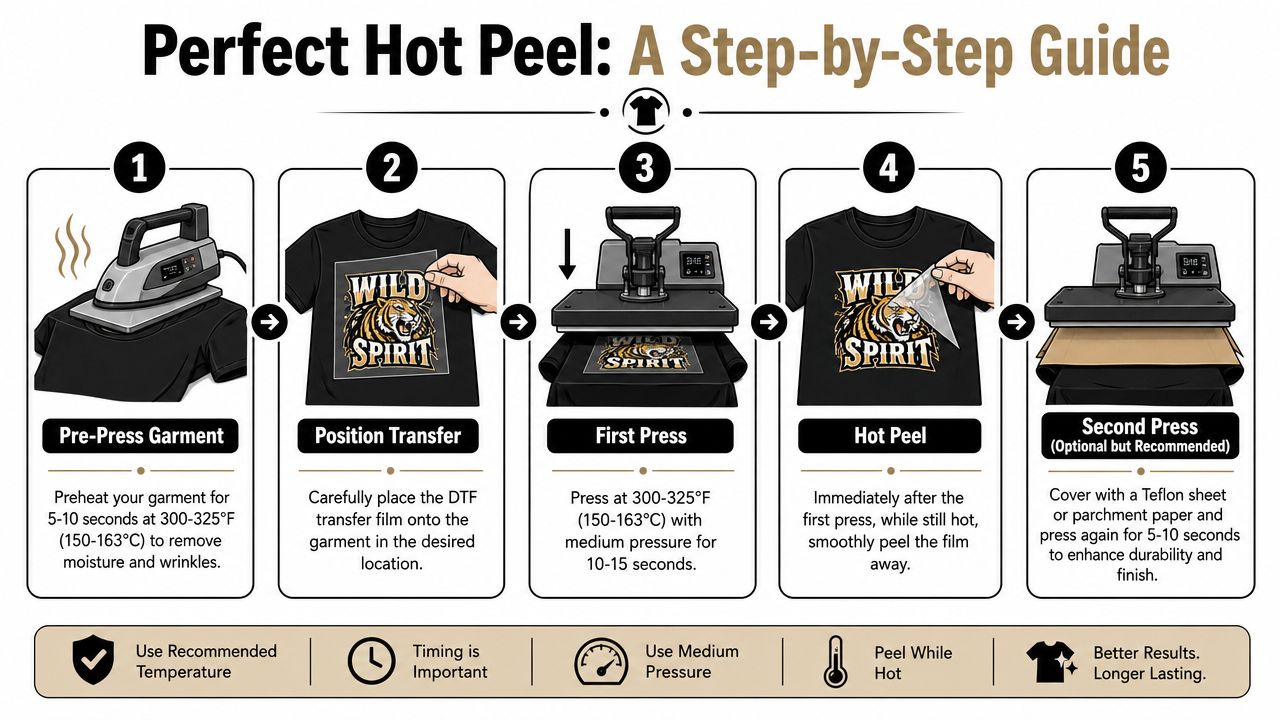
Start with the garment. Moisture, wrinkles, and uneven seams are common causes of failed presses, especially on the first run of the day or when blanks came straight from storage.
-
Pre-press the garment
Give the shirt a short pre-press to flatten the print area and push out moisture. That step reduces wasted transfers and helps pressure stay even across the design. In a busy shop, it also cuts down on random failures that slow the whole line.
- Place the transfer cleanly
Set the film in position and keep it from shifting as the press closes. If alignment is off, fix the handling, not the temperature. Operators often chase settings when the actual problem is film movement.
- Run the main press
Hot peel films are commonly applied around 300 to 320 °F for 10 to 15 seconds with firm pressure. Use the supplier's starting point first, then adjust based on your press, your garment, and how the film releases. Shops lose time when they copy a generic recipe and assume every platen reads true.
-
Peel immediately
Peel while the transfer is still in its release window. Lift one corner and pull in one smooth motion. Waiting too long can turn a clean hot peel into a partial release, and then the job gets slower than cold peel.
-
Post-press if needed
A short finishing press with a protective sheet can settle the print surface and help the edges sit down cleanly. I use it more often on cotton-rich shirts and larger graphics, where edge finish matters to the customer after repeated washes.
What good peeling looks like
The peel should stay low and steady. Pull back across the garment, not straight up off the platen. A low angle keeps stress off the printed layer and gives a cleaner release at the edges.
Hand motion matters because labor cost hides in inconsistency. If one operator peels cleanly and another stops halfway or snaps the film upward, the shop gets different results from the same transfer and the same press settings. Standardize the motion and train it until it becomes automatic.
Shop-floor habit: Train every operator to peel the same way. Consistent motion protects quality and keeps throughput predictable.
Handling right after the peel
Fresh prints still need a little care. According to Manutech's hot peel film details, hot peel films often use a carrier substrate around 75 µm thick, and after hot peeling the image is more susceptible to damage until it cools, so the garment should be handled carefully and the print area should not be creased until it reaches ambient temperature.
That affects production more than many shops expect. If shirts are stacked too quickly, thumbed to "check" the print, or folded while still warm, you can mark a job that looked perfect coming off the press. That is lost labor, not just a cosmetic issue.
Use a few simple rules:
- Do not stack carelessly: Freshly pressed prints can pick up marks if shirts slide against each other too soon.
- Do not press on the image: Checking adhesion with a thumb right after peeling creates avoidable surface damage.
- Do not rush to bagging: Let the print cool before folding or packing.
A practical setup checklist
Use this checklist when you are dialing in a new garment or transfer batch:
- Check platen consistency: Uneven heat shows up first in patchy release.
- Verify pressure before changing temperature: Pressure problems often look like heat problems.
- Run a real test shirt: One live sample tells you more than guessing from the film alone.
- Watch the first inch of the peel: It usually shows right away whether the release is clean.
- Finish with a covered press when needed: This helps edge consolidation on garments that need a cleaner final surface.
On standard cotton tees and common blends, this process usually gets a shop to stable production quickly. On performance fabrics or unusual blends, slow down and test more. The fastest workflow is the one that holds up after delivery, because every remake wipes out the labor savings hot peel was supposed to give you.
Troubleshooting Common Hot Peel Problems
Most hot peel failures come from a small group of causes. Heat is off. Pressure is weak or uneven. The operator waits too long, or not long enough, or peels in a jerky motion.
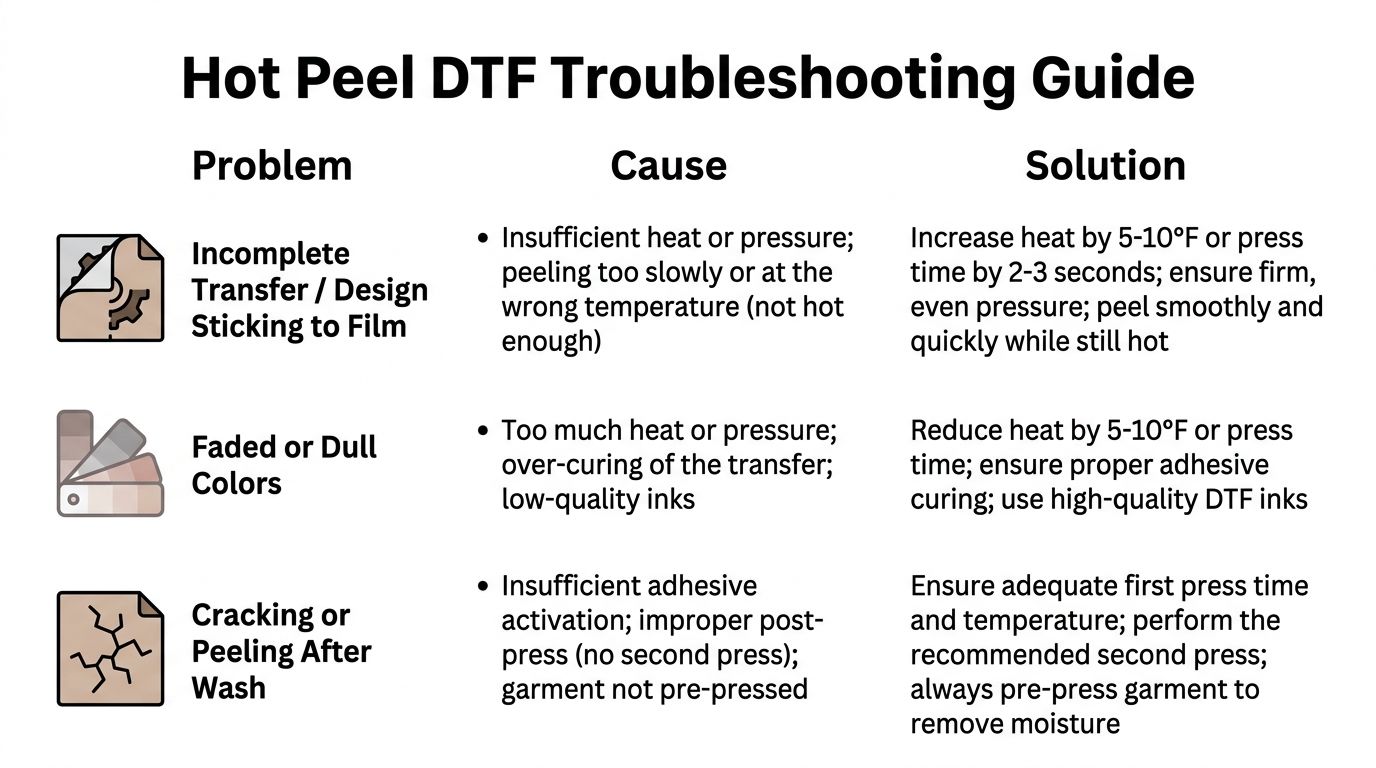
The fastest way to fix them is to think in three steps: symptom, likely cause, correction.
Problem and fix guide
| Problem | Likely cause | What to do |
|---|---|---|
| Design sticks to the film | Not enough heat, weak pressure, or the peel happened outside the proper hot window | Increase heat slightly, extend dwell carefully, and check press pressure before changing everything else |
| Film tears or leaves residue | Release coating didn't activate cleanly | Confirm platen temperature is accurate and pressure is even across the full print area |
| Haloing around the design | Too much heat or too much pressure | Back off one variable at a time and test again |
| Print looks dull after pressing | Press conditions are choking the finish or the transfer wasn't applied cleanly | Recheck settings and make sure the garment surface was pre-pressed and flat |
| Edges fail later | Adhesive didn't fully lock in, or aftercare and handling were poor | Improve first press consistency and add a controlled finishing press |
| Print feels too heavy | Over-pressing, poor transfer quality, or the wrong product for the job | Reduce unnecessary dwell and judge the transfer itself, not just the settings |
Start with pressure before chasing everything else
A lot of operators chase temperature because it feels like the obvious variable. In practice, inconsistent pressure causes many of the “mystery” hot peel issues. One side peels, the other drags. The center looks good, edges don't.
If the transfer only partially releases, don't immediately overhaul the whole recipe. Confirm that the press is closing evenly and delivering the pressure you think it is.
When a transfer peels badly in the same spot again and again, suspect the press before you suspect the film.
What specific failures usually mean
If the film won't release cleanly, the press may not be hot enough, pressure may be too light, or the operator may be waiting past the ideal peel moment. Hot peel relies on timing. You want the release layer to let go while the transfer is still in that proper hot state.
If you see a faint outline or halo, that usually points to too much heat or pressure. The transfer can spread slightly, especially on jobs where the setup is already aggressive.
If the print cracks or peels later, the hard truth is that the issue may not show up on press day. That's why process discipline matters. A weak first press, skipped pre-press, poor post-press habits, or rough handling while the print is still hot can all create future complaints.
The durability gap every shop owner should respect
One of the biggest gaps in DTF guidance is durability data. As Ninja Transfers notes in its discussion of hot and cold peel differences, consumers expect prints to survive at least 50 home washes without visible cracking, yet few resources connect peel type directly to AATCC or ISO wash-test outcomes. That means you can't lean on generic internet advice and assume your hot peel setup is wash-proof.
You have to test your own workflow, your own garments, and your own supplier quality. That's the part many new shops learn the expensive way.
Choosing the Right DTF Partner for Your Business
Hot peel is a strong fit for shops that need speed, repeatability, and a cleaner production rhythm. It's especially practical for fulfillment work, standard apparel lines, and orders where customers care as much about turnaround as they do about the print itself.
But the method alone doesn't save you. The supplier does a lot of the heavy lifting.

What to look for in a transfer partner
Because durability data is still thin across the market, a good supplier should give you confidence in consistency, not just flashy marketing. You want a partner that produces transfers you can build a workflow around.
Focus on these criteria:
- Reliable release behavior: If one batch peels beautifully and the next fights you, your production schedule takes the hit.
- Consistent print quality: You shouldn't need to reinvent settings every time stock changes.
- Fast domestic fulfillment: Delays in receiving transfers become missed ship dates on your side.
- Clear support on application: Good suppliers help you solve pressure, fabric, and peel issues quickly.
That last point matters more than people think. Since few published resources tie hot vs cold peel performance directly to formal wash test outcomes, many businesses end up relying on supplier testing and real-world consistency anyway.
Match the supplier to your business model
If your customers buy online, your print quality is only part of the brand experience. The garment also needs to arrive on time, look clean, and hold up after repeated wear. Even details like artwork readability and apparel presentation affect whether a customer comes back, which is why resources like these typography tips for your e-commerce brand can help shops think beyond the press and into the full product experience.
A domestic partner can also reduce friction that has nothing to do with print chemistry. Faster shipping, fewer customs problems, and easier communication all make your operation steadier. That doesn't sound glamorous, but steady shops keep customers.
For many small businesses, the right supplier isn't the cheapest option on paper. It's the one that helps you produce confidently, quote tighter deadlines without panic, and avoid remakes that eat your margin.
If you need Hot Peel DTF transfers from a U.S.-based partner that understands turnaround pressure, Cobra DTF is worth a look. They're family-owned in Texas, offer same-day shipping on qualifying orders, and focus on consistent, high-quality transfers that help small shops move fast without gambling on overseas delays.