
DTF Transfers Online Buyers Guide That Saves Time
You've got a customer waiting on a small run of shirts, but you don't own a DTF printer. The artwork is ready, the blanks are stacked, and the delivery date is getting uncomfortably close. One online transfer order could keep the job moving. The wrong supplier could leave you with late packages, inconsistent colors, or transfers that lift after the first wash.
That's why buying DTF transfers online is more than uploading artwork and choosing a size. You're choosing a production partner for a specific part of your workflow. The key questions involve landed cost, reorder speed, press reliability, quality control, and support.
The direct-to-film category has moved well beyond a niche decoration method. One market study estimated the global direct-to-film printing market at USD 2.72 billion in 2024, with a projection of USD 3.92 billion by 2030 and a 6.0% CAGR from 2025 through 2030. The same study estimated the market at USD 2.93 billion in 2025, reflecting growing adoption among apparel decorators and on-demand producers. (Grand View Research direct-to-film printing market analysis)
This guide is for custom shirt makers, e-commerce sellers, print shops, and micro-brands that want dependable transfers without immediately investing in a complete DTF production system. You'll learn how the process works, how to inspect quality, how to compare made-in-USA and overseas fulfillment, and how to calculate the cost that affects your margin.
Introduction to Buying DTF Transfers Online
A small apparel business usually doesn't lose money because the owner can't recognize a good design. It loses money when a supplier misses a deadline, a transfer arrives with weak adhesion, or a repeat order doesn't match the first one. A customer sees only the finished shirt, but you carry the risk through every step between checkout and delivery.
Ordering online solves a practical problem. You can send artwork to a specialized supplier, receive ready-to-press transfers, and produce garments with a heat press instead of running a printer, powder shaker, curing system, and white-ink maintenance routine. That makes the model attractive to businesses that need flexibility without tying up cash in equipment or inventory.
The printer side of the industry has also gained measurable commercial traction. One industry report estimated the global DTF printer market at USD 2.5 billion in 2023 and projected it could reach USD 4.8 billion by 2028. Mimaki also announced in January 2024 that its first DTF printer, the TxF150-75, had surpassed 300 units sold across EMEA. (DTF printer market report)
What you're really buying
The transfer itself is only one line on your invoice. Your actual purchase includes:
- Production capacity: Can the supplier handle your order when demand rises?
- Delivery certainty: Will the package arrive before your pressing schedule or customer promise?
- Repeatability: Will the next batch press and look like the first?
- Support: Can someone help when a file, color, or application result needs attention?
- Total cost: Does a low transfer price remain low after shipping, customs, delays, and reprints?
A domestic supplier may cost more at checkout but reduce the risk of missed deadlines and complicated returns. An overseas supplier may offer attractive unit pricing, yet the decision changes when you add longer transit, customs exposure, or the need to order far ahead.
Practical rule: Treat every transfer order as a production input, not a one-time craft purchase.
The following decisions will help you move from browsing product pages to building a repeatable buying routine. Start by understanding the physical process, then evaluate quality, vendor operations, and the care instructions your customers will follow.
How DTF Transfers Work and Why They Matter
A DTF transfer is easiest to understand as a layered sticker designed to become part of a garment. The image doesn't go directly from a printer onto the shirt. It's built on film, coated with adhesive, cured, and then bonded to fabric with heat and pressure.
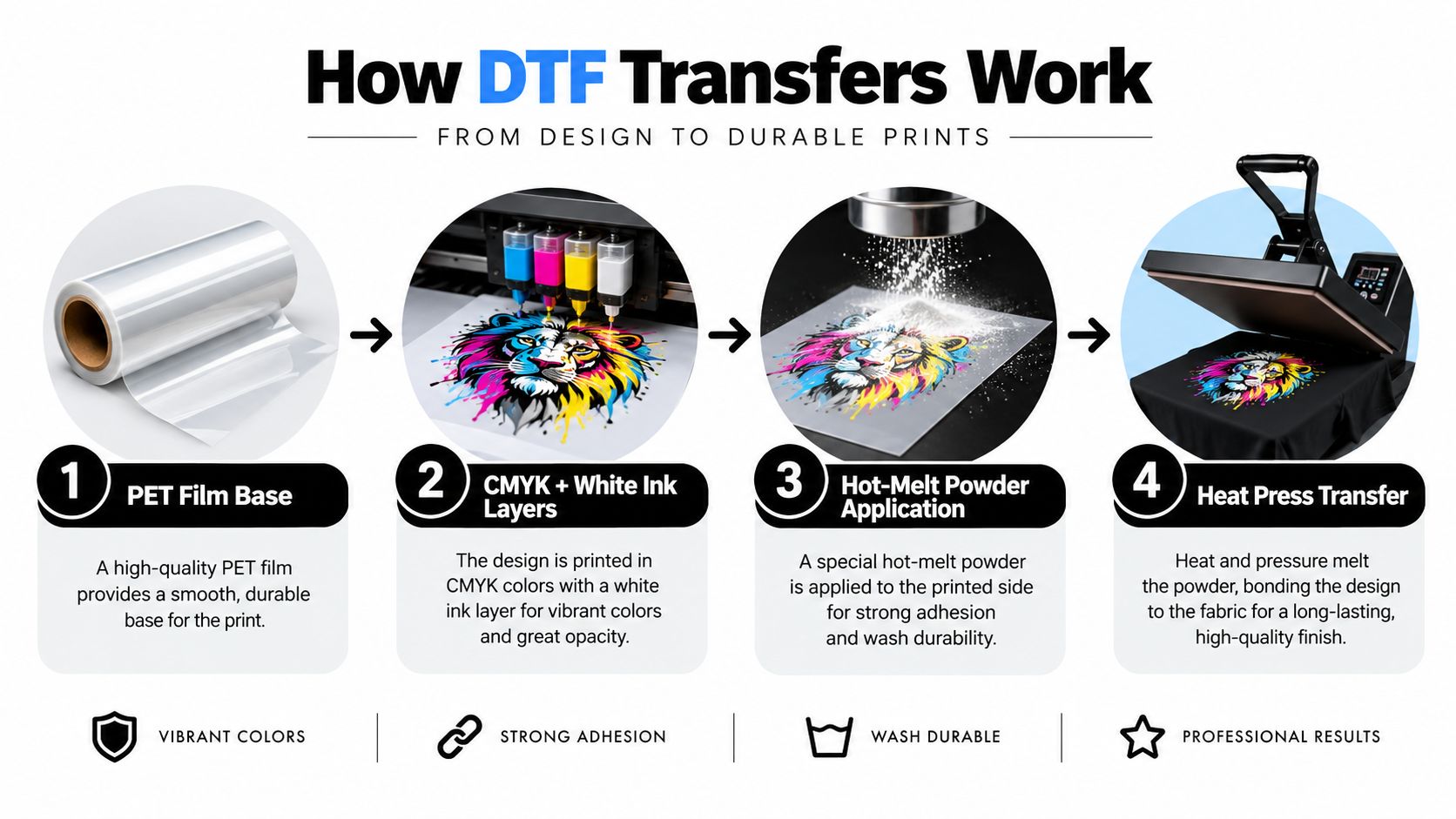
The four layers and actions
- PET film base: The printer deposits the design onto a coated polyethylene terephthalate film. The film holds the image flat while it moves through printing and powder application.
- CMYK plus white ink: Colored inks create the visible artwork, while white ink provides an opaque foundation. That white layer matters especially on dark garments, because it keeps the colors from disappearing into the fabric.
- Hot-melt adhesive powder: The printed side receives TPU or PU adhesive powder. The powder must cover the intended ink area evenly, because it becomes the bonding layer between the printed image and the garment.
- Heat press transfer: Heat activates the adhesive, while pressure pushes the transfer into the fabric surface. After cooling or peeling according to the supplier's instructions, the design remains on the garment.
A properly engineered workflow uses a CMYK plus white ink layer on PET film, followed by hot-melt TPU or PU adhesive powder that's fused before pressing. Process references place the press window around 150 to 170°C for roughly 8 to 20 seconds, with medium-to-firm pressure, although the supplier's instructions should take priority because films and adhesives vary. (DTF transfer film process reference.pdf))
Why fabric flexibility matters
DTF works across cotton, polyester, and blends, which gives small brands more freedom than methods designed for a narrower fabric range. You can use the same general production model for T-shirts, hoodies, performance garments, and other compatible products, but you should still test each blank because fabric texture, coating, stretch, and heat tolerance affect the finished result.
DTG prints directly onto the garment and can create a soft surface, but it usually requires direct printer access and careful garment preparation. Sublimation embeds dye into suitable polyester material, so it isn't a universal solution for cotton apparel. DTF sits between those workflows, offering full-color artwork and broad fabric compatibility through a transfer that you apply later.
People often confuse DTF with other transfer products, especially when they're comparing heat-applied decoration methods. For a useful comparison of transfer materials and related applications, you can find infusible ink materials from The Fabric Company. Cobra DTF also provides a plain-language explanation of what DTF transfers are.
The key lesson is simple: the press doesn't repair a poorly cured transfer. If the powder coverage, cure, temperature, dwell time, or pressure is wrong, the adhesive may not form a reliable bond.
How to Spot High Quality DTF Transfers Before You Buy
A polished product photo can hide weak film release, uneven powder, or a translucent white layer. Quality checks begin before you place a large order, and the best suppliers make those checks easy by offering clear specifications, sample options, consistent artwork previews, and direct answers.
Inspect the design, film, and edges
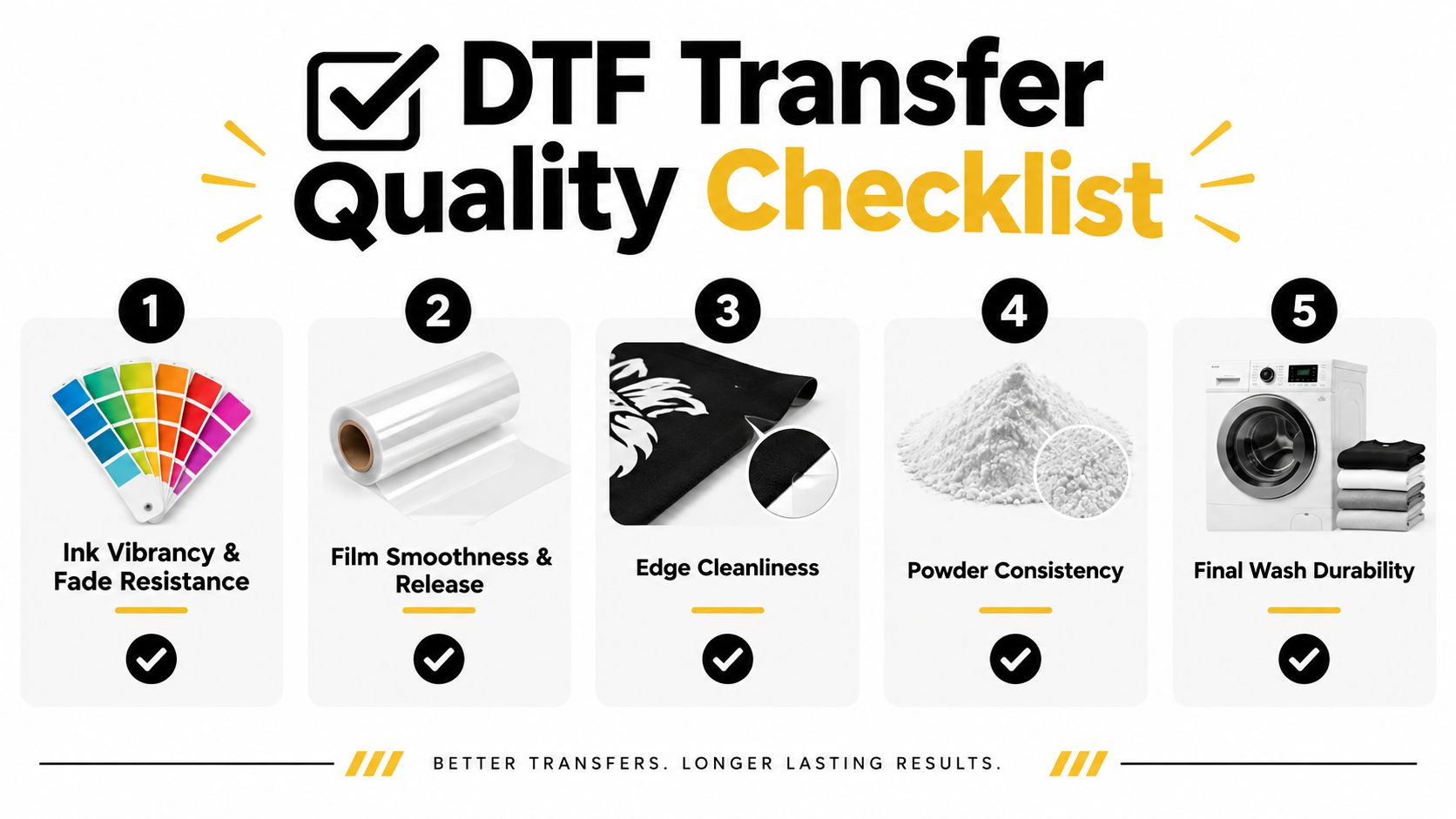
Start with the artwork preview. Colors should look saturated rather than gray or washed out, and fine details should remain distinct instead of merging into blobs. A consistent white underbase helps preserve color strength on dark garments, so ask whether the supplier can show the same design on both light and dark fabric.
Film quality shows up during handling and peeling. A good transfer should feel stable without being excessively brittle, and the design shouldn't shed powder when you move it. If the supplier's sample images show curled film, rough borders, or visibly uneven surfaces, treat those as warning signs rather than cosmetic flaws.
Edge quality deserves special attention. Clean edges suggest controlled printing, powder application, and cutting. Fuzzy borders, stray adhesive, or a halo around the design can make an otherwise attractive graphic look unfinished on a shirt.
Ask questions that expose process control
Use a short supplier questionnaire before committing:
- Ink consistency: How do you maintain white ink opacity across repeat orders?
- Film release: Is the transfer hot peel, cold peel, or dependent on a specific cooling interval?
- Powder coverage: How do you check that adhesive powder is even before curing?
- Artwork handling: Do you inspect transparent backgrounds, thin lines, and small text before production?
- Garment testing: Can you recommend a press setting for the blanks you commonly support?
- Resolution process: What happens if the delivered transfer doesn't match the approved artwork?
A supplier doesn't need to reveal proprietary equipment settings, but it should explain the customer-facing process clearly. Evasive answers about peeling, curing, or replacement policies create more risk than a modest price difference.
Look for repeatability, not just brightness. A vivid sample proves that one transfer looked good. A useful supplier can make the next order look good too.
Durability depends on more than ink. Independent industry guidance reports that well-applied transfers typically survive about 50 to 80 wash cycles, while weak curing or incorrect application can reduce lifespan to roughly 20 to 40 washes. The common failure pattern is gradual fading or softening, not an instant complete peel. (DTF transfer durability and wash testing guide)
That's why a sample order is valuable. Press the transfer on the actual blank you plan to sell, inspect the surface after cooling, stretch the fabric gently, and record the settings that worked. Your test should evaluate the entire chain, including transfer construction, garment compatibility, press behavior, and laundering.
How to Evaluate DTF Vendors and Made in USA Options
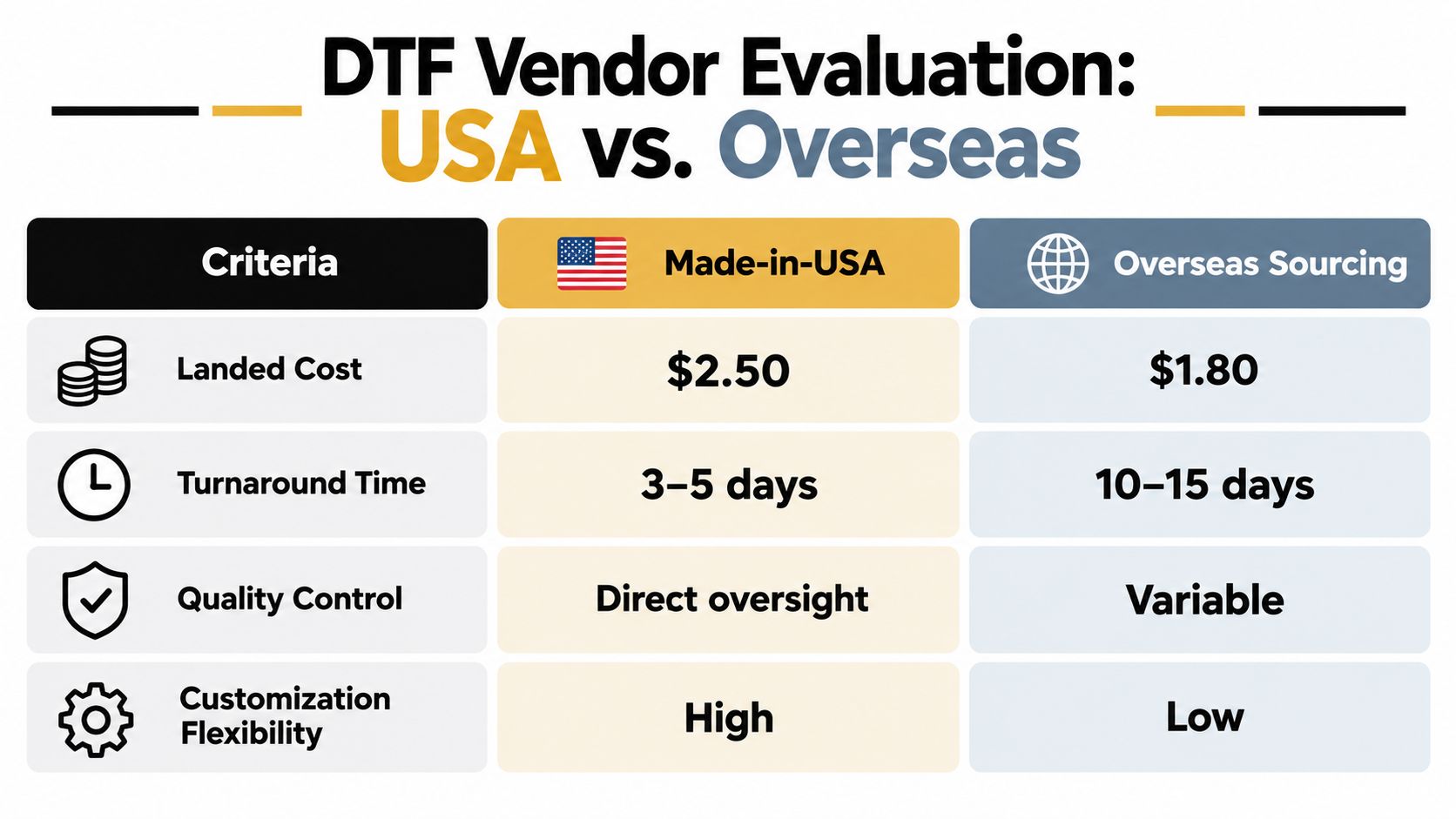
The cheapest transfer price isn't necessarily the cheapest production choice. Compare suppliers by the cost and risk that remain after checkout, including shipping, customs, replacement time, communication, and the chance that a repeat order behaves differently.
A practical comparison
| Evaluation Criteria | Made in USA Supplier | Overseas Supplier |
|---|---|---|
| Landed cost | May include more predictable domestic delivery costs | Lower listed pricing may change after shipping, customs, or fees |
| Turnaround | Often easier to plan around domestic fulfillment | Longer transit can require earlier ordering |
| Quality control | Direct communication and closer production oversight may simplify resolution | Oversight, specifications, and response times can vary |
| Customization flexibility | Often convenient for revisions, small runs, and local support | May favor larger batches or standardized options |
| Reordering | Domestic delivery can simplify urgent replenishment | International timing can make rush reorders difficult |
| Customer support | Easier time-zone and language alignment for many U.S. buyers | Communication may involve time-zone or escalation delays |
Made-in-USA fulfillment can appeal to businesses that value domestic production, support for American jobs, and fewer customs complications. It can also make operational planning easier when a customer needs a replacement or when a popular design sells faster than expected.
Overseas sourcing can still make sense for a buyer with predictable demand, enough planning time, and a clear understanding of landed cost. The mistake is comparing only the displayed unit price. A transfer that arrives late can force a refund, rush a replacement garment, or consume staff time that never appears on the invoice.
Score the supplier before scaling
Build a simple vendor scorecard rather than relying on a single review:
- Proofing: Does the supplier confirm artwork dimensions, transparency, and placement?
- Consistency: Can it reproduce colors, white opacity, and cut edges on repeat orders?
- Minimums: Are the required quantities appropriate for your current sales volume?
- Support: Can you reach a real person who understands DTF production?
- Guarantee: Is there a clear process for damaged, incorrect, or unusable transfers?
- Fulfillment: Does the stated production window match how you schedule customer orders?
- Material story: Does the company identify its film and ink sourcing clearly?
For a broader supplier evaluation, review Cobra DTF's guide to choosing a DTF printing supplier. Cobra DTF is a family-owned Texas business that offers online DTF transfers, including size-specific transfers and uploaded gang sheets, with products described as made in the USA.
The right vendor depends on your operating model. A local decorator handling urgent team orders may prioritize speed and support. A brand with stable seasonal demand may prioritize planned pricing and larger production runs. Either way, choose based on delivered reliability, not a headline price.
Pricing Turnaround Shipping and Customization Explained
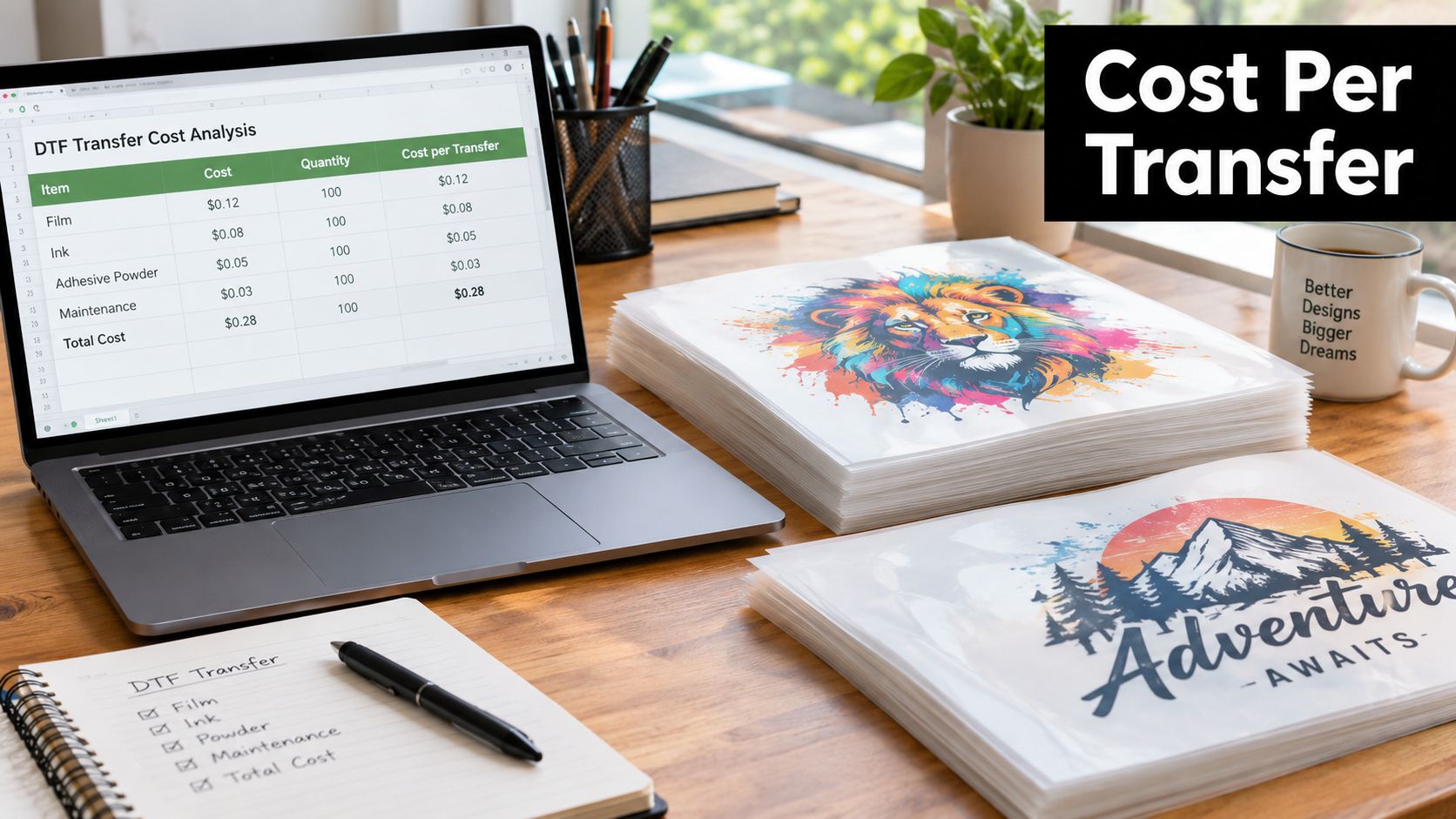
Your order price has at least two parts: what the supplier charges for the transfer and what the order costs you after shipping and delivery conditions. Add the labor involved in preparing artwork, receiving the package, pressing the garments, and correcting problems, and you have a more useful picture of profitability.
Calculate the order before you upload
Gang sheets let you arrange multiple designs on one larger sheet so you can use the available print area efficiently. They work well when you have several logos, sleeve graphics, or repeated designs, but poor spacing can create wasted film or make cutting awkward.
Before ordering, write down:
- The finished width and height required for each design.
- The number of each design you need.
- The amount of unused space on a gang sheet.
- The shipping charge and any order threshold for reduced shipping.
- The cost of a replacement if a transfer arrives damaged or unusable.
Then divide the full order cost by the number of usable transfers, not just by the number of artwork files. If a sheet contains several designs but some areas can't be cut or used efficiently, those gaps are part of your real cost.
Size-based ordering can be simpler for repeat products. A chest logo, sleeve hit, and full-front graphic each have different material requirements, and ordering by finished size helps you keep production consistent across garments.
Plan around the customer promise
Ask when production begins, not just how quickly the package travels. A supplier may quote shipping speed while the order still waits in a production queue. Confirm the order cutoff, proofing policy, business-day definition, carrier options, and what happens when artwork needs correction.
Some suppliers advertise same-day shipping for orders placed by 1 PM CST and delivery within 1 to 3 days. Cobra DTF publishes those service details as part of its domestic fulfillment offer, so verify the current terms before promising a customer a date. You can also review its information about same-day DTF printing.
Schedule from the delivery promise backward. Leave room for artwork approval, carrier variation, pressing, inspection, and customer pickup.
Customization usually works best when your file arrives clean. Use a transparent background where appropriate, check the final dimensions, convert small text into a readable size, and identify colors that matter to the brand. If you need a specific color match, ask whether the supplier offers a proof or whether the screen preview is only an approximation.
Send one organized file per design or follow the supplier's gang-sheet template exactly. A tidy file reduces clarification messages, protects the production schedule, and helps the supplier print what you intended.
Application and Care Instructions for Long Lasting Results
A good transfer can still fail if the press applies the wrong combination of heat, time, and pressure. Keep the supplier's application sheet beside the press, and record the settings that work for each transfer type and blank garment.
Independent process references place many DTF applications around 150 to 170°C for approximately 8 to 20 seconds, using medium-to-firm pressure. (DTF transfer film process reference) Because that source URL has already been cited earlier, use the supplier's instructions as the operational reference for your specific product.
A repeatable pressing routine
Pre-press the garment briefly when the material and supplier instructions allow it. This helps remove moisture and flatten the application area. Position the transfer carefully, protect it with the recommended sheet if required, and make sure the press applies even pressure across the entire design.
Peel according to the film specification. Some products use a hot peel, others require cooling, and some need a second press after the film is removed. Don't guess based on how another transfer behaved. The wrong peel timing can pull the design away before the adhesive has stabilized.
Inspect the shirt while it's still at your workstation:
- Edges: They should lie flat without lifting corners.
- Surface: The design should look even, without glossy gaps or powdery residue.
- Coverage: Fine details and white areas should remain visible.
- Bond: A gentle stretch of the garment shouldn't expose obvious separation.
Give customers care instructions
Washing affects the transfer long after it leaves your shop. Recommend cold washing, turning the garment inside out, and using low-heat drying. Harsh chemicals, high heat, and aggressive laundering can shorten the useful life of the print.
Well-applied transfers are commonly reported to last about 50 to 80 wash cycles, while poor curing or application may reduce that range to about 20 to 40 washes. (DTF transfer durability and wash testing guide) Put those instructions on a care card or inside your order confirmation so the customer doesn't have to remember a verbal explanation.
Troubleshooting Common Issues and Final Buying Checklist
Most DTF problems leave clues. Cracking can point to excessive stress, a poor bond, or an unsuitable garment. Peeling at the edges often indicates insufficient pressure, incorrect temperature, inadequate dwell time, or incomplete adhesive curing. Dull colors may come from the artwork preview, ink balance, the white underbase, or a transfer that was overheated.
Powder residue around the design suggests uneven adhesive application or incomplete cleanup before curing. If the transfer looks good before washing but fades or softens quickly, review the cure and press records first. If the film won't release cleanly, confirm whether the product requires a hot peel, cold peel, or a second press.
Use this reorder checklist
- Test the exact blank: Confirm the transfer works on the garment your customers will receive.
- Save the press recipe: Record temperature, time, pressure, peel method, and any second-press instruction.
- Inspect a sample: Check color, white opacity, edges, film release, and powder coverage.
- Calculate landed cost: Include shipping, fees, unusable space, replacement risk, and labor.
- Confirm the vendor promise: Check production time, cutoff, carrier method, support access, and guarantee terms.
- Plan replenishment: Order based on expected demand and reorder time, not only on current inventory.
- Include care guidance: Tell customers to wash cold, turn garments inside out, and dry with low heat.
Keep photos of successful and failed presses. A dated record helps you distinguish a supplier issue from a garment, file, or application mistake. If a transfer arrives visibly damaged or doesn't match the approved artwork, contact the supplier promptly and provide order details, photos, garment information, and your recorded press settings.
The best online buying routine is repeatable. You know what quality looks like, what delivery promise your business can accept, and what the transfer costs after it reaches your worktable.
Cobra DTF offers online DTF transfers, size-specific options, and uploaded gang sheets for businesses that want domestic fulfillment and a made-in-USA sourcing option. Visit Cobra DTF to review transfer choices, compare your production needs, and place an order built around dependable pressing and reordering.