
Blank Ball Caps Explained for Custom Printers
Three orders hit your shop on the same Monday. One needs a crisp embroidered logo, one calls for a full-color DTF transfer, and the third customer wants a premium streetwear cap with a clean front panel. The blanks may look similar in a catalog, but they won't behave similarly under a needle, heat press, or platen.
That difference is where profitable cap work is won or lost. A poor blank can cause transfer lifting, uneven pressure, distorted embroidery, visible press marks, returns, and wasted production time. A good blank makes the decoration process predictable before the first case arrives.
Blank ball caps belong to a large, global supply chain rather than a small specialty category. Industry coverage described a single Chinese factory producing 30 million baseball caps per year, while one 40-foot container held 60,000 caps for shipment to the United States and Europe at an average price of $1.50 per cap. The same coverage described Korean headwear exports worth $100 million reaching more than 60 countries. The manufacturing overview from Apparel Resources shows why decorators have so many profiles, fabrics, and construction standards to choose from.
Why Your Blank Cap Choice Shapes Every Order
Your press operator doesn't decorate a catalog photo. They decorate a curved, stitched, layered product with a specific crown height, seam layout, fabric finish, and closure. Those details determine whether a transfer sits flat, whether the platen reaches the target area evenly, and whether an embroidered design needs extra underlay or a smaller stitch count.
Start with the decoration method, then work backward to the blank. DTF requires a stable front panel, reliable adhesive contact, and enough clearance for the platen. Heat transfer vinyl needs similar surface stability, but its carrier and pressure requirements can expose wrinkles or raised seams. Embroidery depends on crown support, backing, needle access, and how much the front panel collapses during stitching.
Use a simple intake process
Before you buy, answer four questions:
- What decoration dominates your orders? A DTF-heavy shop needs a different first cap than an embroidery-focused shop.
- What equipment will run the work? A cap press with a narrow or shallow platen may struggle with thick brims and tall crowns.
- Who buys from you? Golf shops, team programs, streetwear brands, and corporate buyers usually want different fits.
- What failure can you absorb? If a rejected cap means a rush remake and a lost shipping deadline, choose repeatability over the lowest unit cost.
A structured six-panel cap often gives you the cleanest front for branding, but it also brings more buckram, seams, and pressure variables. An unstructured cap may feel better for casual wear, yet its soft crown can wrinkle beneath a transfer or collapse around an embroidery hoop.
Shop-floor rule: Test the actual cap, transfer, platen, and press combination before you commit to a case.
The same discipline applies if your shop offers embroidery and patches for hats. Decoration isn't an afterthought added to a blank. The cap is part of the production system, so choose it with the same care you give thread, film, adhesive, and finishing equipment.
The Short History Behind Today's Blank Ball Caps
The modern baseball cap has a traceable design history. The Brooklyn Excelsiors introduced a precursor to today's style in 1860, the rounded-crown form became widespread in the 1900s, and New Era launched the 59FIFTY in 1954. Industry market background from 360 Research Reports connects those milestones with the continuing commercial strength of the category.
Those historical details still show up in the blanks you stock. A flat brim and tall crown echo the structured athletic and streetwear cap. A curved visor, soft front, and adjustable closure create the relaxed profile customers often call a dad cap. Snapbacks developed into a strong streetwear and youth-market format, while fitted and stretch constructions support a more polished retail feel.
Heritage details create production variables
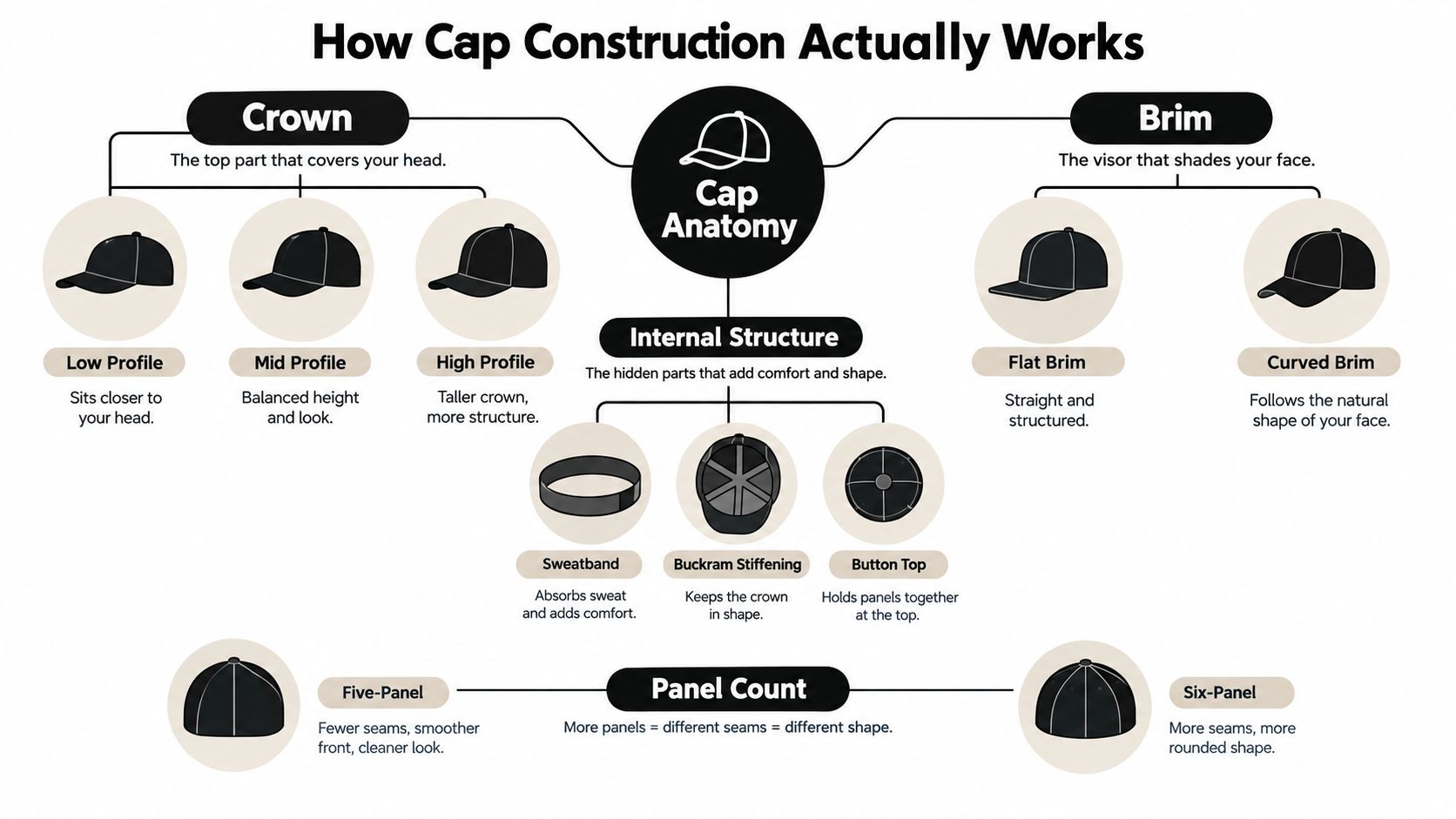
The stiff front of a classic structured cap usually comes from buckram or another internal support layer. That stiffness protects the silhouette, but it can also make the cap harder to position on a shallow platen. A curved visor reduces the usable decoration area, while a flat visor gives you more predictable contact across the front.
Panel count matters too. Six-panel construction places a center seam directly through the front, which can sharpen symmetry but restrict image placement. Five-panel construction may offer a cleaner uninterrupted front, although the crown shape and seam arrangement can change how a transfer sits.
The modern blank market combines old visual cues with newer fabric and fit demands. A buyer who understands the historical construction language can make a better production decision, rather than treating “structured,” “trucker,” or “dad cap” as simple style labels.
How Cap Construction Actually Works
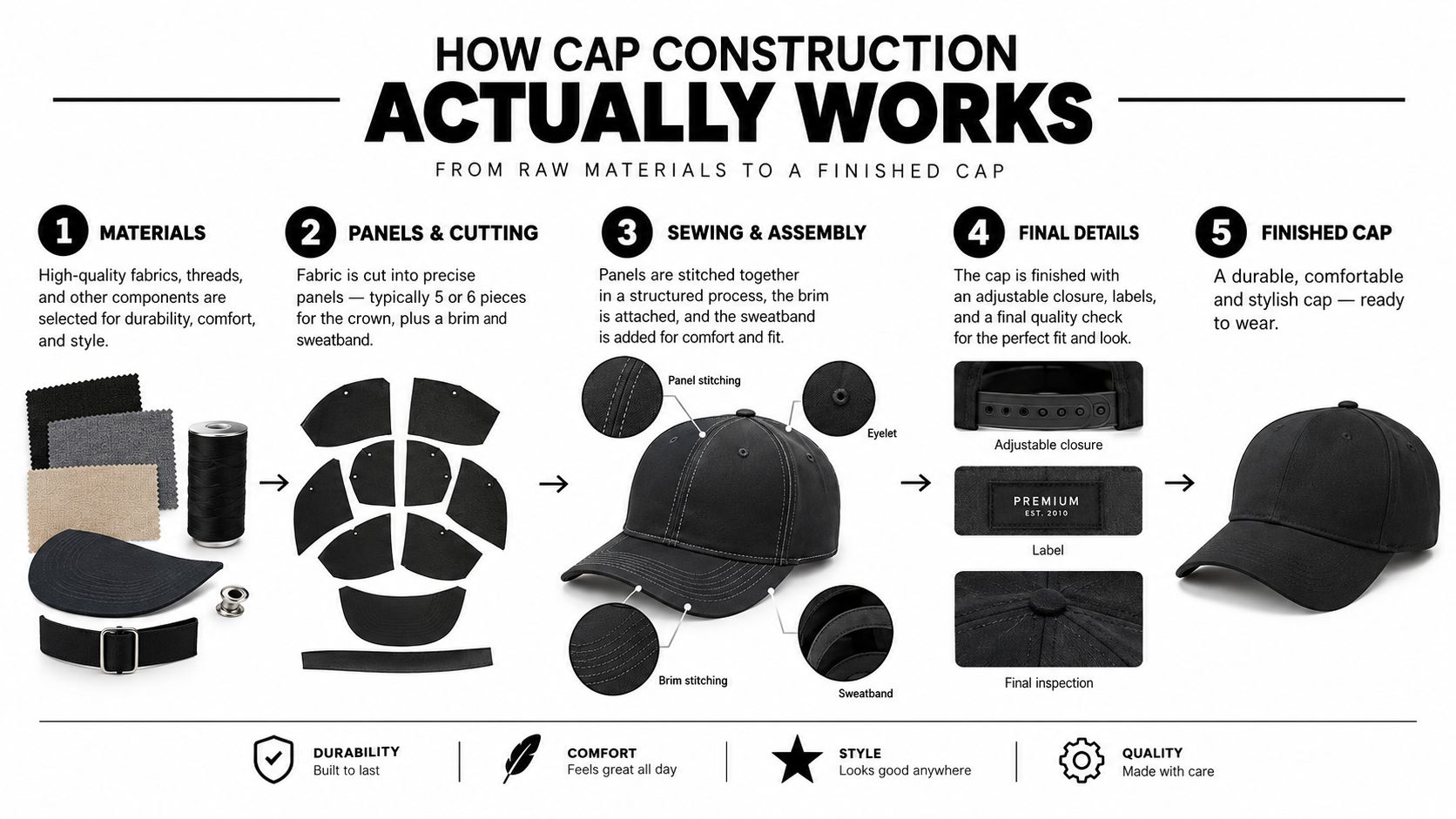
A cap has three working systems: the crown, the brim, and the internal structure. Each affects decoration in a different way. The crown provides the branding surface, the brim controls how the cap sits on the platen, and the internal components determine how much pressure the cap can tolerate before it changes shape.
Crown profile and panel layout
A low-profile crown sits close to the head and usually presents a smaller decoration zone. It can look sharp with compact logos, but a large DTF graphic may run into seams or the crown curve. A mid-profile crown is the safest general-purpose choice because it balances front-panel area, wearability, and platen access. A high-profile crown gives a bold, upright shape, though its extra height can create pressure differences if the platen doesn't match the cap.
Panel count changes the geometry. Six panels bring seams together at the center front, so a design needs accurate placement and enough clearance from the seam ridge. Five panels can provide a broad uninterrupted front, but the cap may have a different centerline and side tension than an operator expects.
Structured caps use internal buckram or stiffened front panels. That support helps embroidery resist collapse and keeps a transfer surface more stable. Unstructured caps have a softer front that conforms to the wearer's head, but the same flexibility can create wrinkles, air gaps, and inconsistent pressure during heat application.
Brim and internal parts
The visor may be flat or pre-curved, with a plastic or other stiffening insert between fabric layers. A thicker visor can prevent the crown from sitting low enough on a cap platen. A pre-curved brim can also limit the lower edge of a design, while a flat brim usually offers more predictable positioning.
Don't overlook the sweatband, seam taping, eyelets, top button, and closure. A thick sweatband can interfere with hooping or platen placement. Seam taping may create a ridge behind the front panel. Metal eyelets and stiff closures rarely affect a small front transfer directly, but they can make the cap harder to rotate or support during production.
For embroidery, crown stability and backing access matter most. For DTF, flat contact, clean fabric, and controlled pressure matter more. The best cap for one process isn't automatically the best cap for the other.
Matching Blank Fabrics to Decoration Methods
Fabric selection should follow your dominant decoration method, not a color card. Cotton twill remains the safest starting point for many decorators because its woven surface accepts needle penetration and brief heat without the same melt concerns associated with some synthetics. Industry guidance also identifies heavier, structured materials as strong embroidery candidates and notes that a 7 oz twill with suitable fusible backing can support a 10,000 to 12,000 stitch front logo with less puckering than many lightweight synthetics. BlueCotton's embroidery guidance provides the technical context for that recommendation.
Fabric comparison
| Fabric | DTF Transfer | Heat Transfer Vinyl | Sublimation | Embroidery | Notes |
|---|---|---|---|---|---|
| Heavy cotton twill | Strong first choice when the front panel is smooth and stable | Reliable for standard applications with controlled pressure | Not a practical choice | Excellent support for detailed stitching | Best starting fabric for a mixed-decoration shop |
| Performance polyester or poly-blend | Requires careful temperature and dwell testing | Use a compatible low-temperature system | Suitable only when the cap has a light polyester decoration surface | Can work, but backing and needle heat need attention | Watch for scorching, glazing, shrinkage, or finish changes |
| Recycled or heathered blend | Often workable, but surface texture and finish can affect adhesion | Test for press marks and uneven texture | Usually unsuitable unless the fabric construction specifically supports it | Results vary with stretch and surface stability | Treat each construction as a separate test item |
What the press sees
A heavy cotton front usually gives a transfer a stable landing zone. A slick performance fabric may resist adhesive bonding or show a shiny press mark. Recycled blends can perform well, but their surface texture and finishing treatments vary more than a buyer can safely assume from a product name.
Sublimation deserves a narrow recommendation. It works on light polyester surfaces, but it isn't a universal cap process and rarely makes sense as the default decoration method for a mixed blank inventory.
Production advice: If most of your orders are DTF, buy the blank that gives you the cleanest, most repeatable front panel, not the fabric with the most fashionable sustainability label.
Sizing, Closures, and Profiles Explained
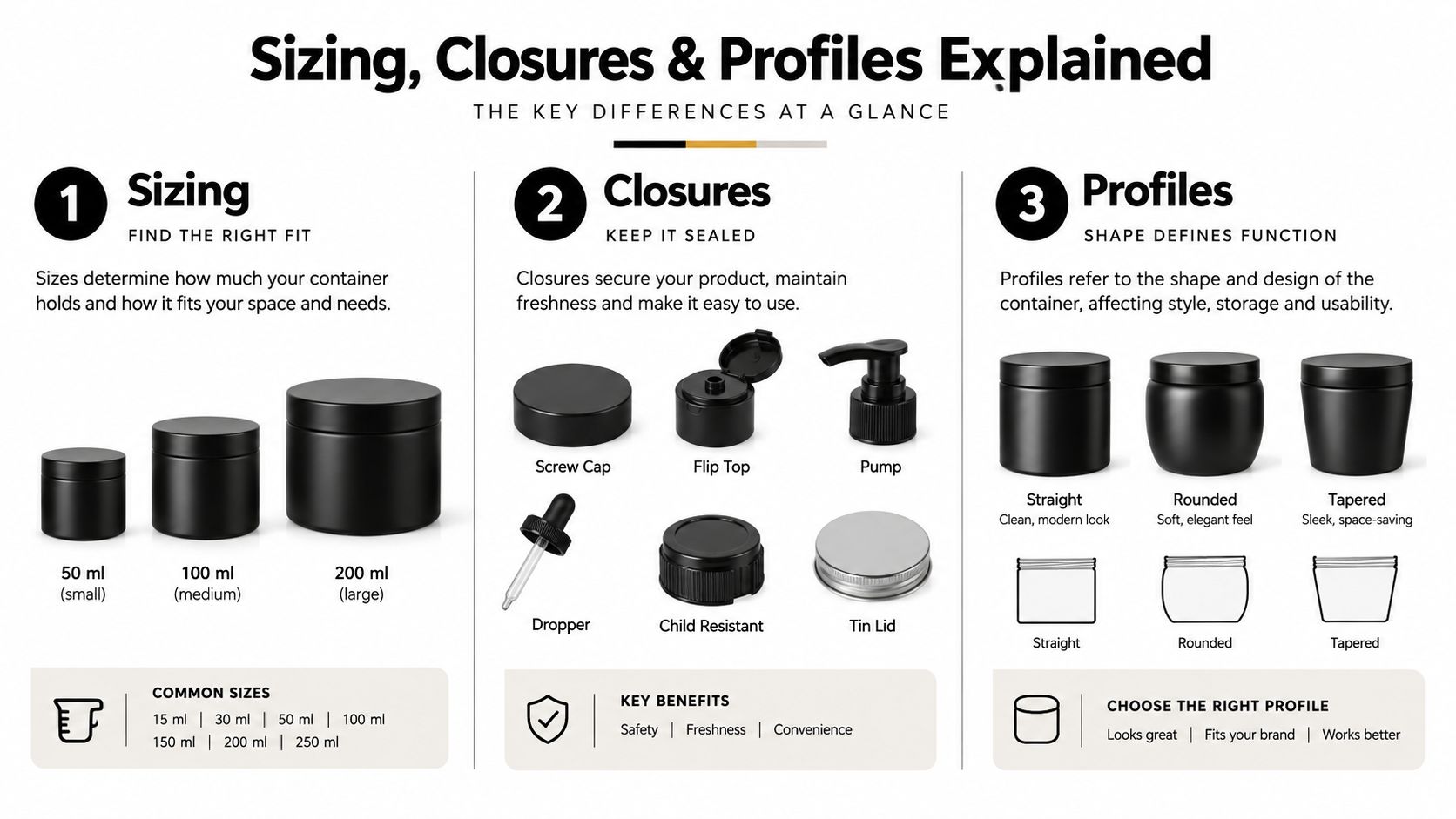
Fit decisions begin before decoration. A cap that presses beautifully but fits the wrong customer won't become a successful product. Separate your buying decision into size system, closure, and crown profile, then match each choice to the market you serve.
Size and closure
OSFA adjustable caps cover a broad customer range and simplify inventory. Fitted caps offer a more retail-oriented experience, but they require more size planning and can tie up cash in less predictable units. Yupoong 6007 and Otto 31-069 are examples of lines that also serve customers looking for fitted options.
Closure changes the product's perceived value:
- Snapback: Easy to stock, easy to adjust, and a strong choice for youth, event, and budget programs.
- Hook-and-loop: Practical for casual and corporate gifts, especially when the buyer values quick adjustment.
- Stretch-fit: Feels more premium and works well for customers who want a closer fit without a rigid fitted-size program.
- Fitted closure: Gives a cleaner retail presentation, but you need a reliable size assortment.
The profile should follow the customer's visual reference. Low-profile caps suit a modern, close-to-the-head look. Mid-profile caps are the safest all-rounder. High-profile caps work for throwback, team, and bold streetwear programs.
Golf customers often care about sweat management, visor shape, and a secure fit as much as decoration space. Tattoo Golf's cap guide is useful background when you're choosing blanks for pro-shop or golf-event orders.
Don't copy a stock ratio blindly. Start with the profile that matches your current customer base, then test one contrasting option. That approach limits dead inventory while giving you evidence about what sells and what presses cleanly.
Popular Blank Cap Brands Worth Stocking
A practical starting lineup doesn't need every catalog model. It needs a few blanks that cover different customer expectations and reveal how your equipment handles construction changes.
Yupoong 6005 is a strong unstructured option for casual logos, DTF work, and relaxed retail programs. It has the softer character customers expect from a dad cap, so operators need to control wrinkles and avoid oversized transfers that fight the crown shape.
Yupoong 6606 brings a structured profile for decorators who want a firmer front. The Classic 6007 snapback is a sensible benchmark for snapback work because it gives you a recognizable shape and a clear front-panel test.
Otto's 31-069 and 39-165 offer a heavier hand and a clean decoration surface. That construction can reward embroidery, but a thicker front may require more careful heat management and platen support for transfers.
Flexfit 110 and 110M target customers willing to pay more for a premium adjustable or mesh-back feel. The 110M works best for DTF when the front panel contains enough cotton-rich material to provide reliable contact. Richardson 112 and 168 are dependable choices for structured and trucker programs, especially when customers want an athletic, high-visibility profile. Pacific Headwear belongs in the conversation when team and performance programs make up a substantial part of your business.
| Brand / Model | Crown | Closure | Best For | Price Tier |
|---|---|---|---|---|
| Yupoong 6005 | Unstructured | Adjustable | Dad caps, casual DTF, relaxed branding | Budget to mid |
| Yupoong 6606 | Structured | Adjustable | General custom work and firmer logos | Mid |
| Yupoong Classic 6007 | Structured | Snapback | Streetwear, youth, and snapback programs | Mid |
| Otto 31-069 | Structured | Adjustable | Embroidery and heavier front-panel branding | Mid |
| Otto 39-165 | Structured | Adjustable | Premium-feel custom work | Mid |
| Flexfit 110 | Structured | Adjustable stretch | Premium retail and lifestyle orders | Premium |
| Flexfit 110M | Structured mesh-back | Adjustable stretch | Trucker programs with a premium fit | Premium |
| Richardson 112 | Structured | Snapback | Trucker orders, teams, and event programs | Mid |
| Richardson 168 | Structured | Adjustable | Athletic and structured trucker work | Mid |
| Pacific Headwear | Varies | Varies | Team and performance programs | Mid to premium |
My recommendation is simple: start testing Yupoong 6005 and Richardson 112. They give you two distinct profiles, one relaxed and one structured trucker, without forcing you to buy a wide assortment before you understand your press results.
Why Not Every Blank Cap Presses the Same
The assumption that every blank cap accepts DTF transfers equally well will cost you. Two caps can share the same color and general silhouette while differing in panel tension, fabric finish, buckram thickness, brim shape, and sweatband construction.
A cap with a soft crown may leave an air gap under the transfer. A rigid crown may create pressure at the edges while the center sits lower. A thick front seam can push into the film. A water-repellent treatment can interfere with adhesive bonding even when the fabric looks perfectly printable.
The construction traits that matter
| Cap Trait | What It Does | DTF Impact |
|---|---|---|
| Panel count and seam placement | Controls the uninterrupted front area | Limits image width and can create raised edges |
| Crown stiffness | Holds or resists the platen shape | Changes pressure consistency across the transfer |
| Front-panel thickness | Adds support but may increase height | Can cause uneven contact or require platen adjustment |
| Brim shape | Determines how the cap sits in the press | Restricts lower artwork placement on curved brims |
| Sweatband material | Adds layers near the pressing zone | Can obstruct placement or change pressure |
| Water-repellent finish | Reduces surface wetting | May weaken adhesive bonding |
| Heavy front stitching | Creates ridges and hard transitions | Can leave gaps, texture, or edge lift |
The same issue affects embroidery, but DTF exposes it differently. Embroidery can follow the crown with a suitable hoop and backing. A transfer needs a reasonably continuous contact surface at the moment pressure and heat are applied.
Before you stock a case, press one cap from each candidate model and inspect the transfer after cooling.
Use a cap-specific setup guide such as Cobra DTF's hat heat press guide when you need to compare platen support, positioning, and press technique. The guide won't eliminate model-to-model variation, but it can help you keep the equipment variables consistent while you test the blanks.
Your Blank Cap Buying Checklist
Buy blanks in the order your production process uses them. Start with the decoration method, then check the surface, structure, fit, and supply terms. A low price doesn't help if the cap forces manual rework on every order.
Before you place the order
- Choose the primary decoration method: DTF, heat transfer vinyl, sublimation, and embroidery each impose different fabric and construction requirements.
- Inspect the fabric surface: Look for a stable woven front, consistent texture, and finishes that won't interfere with adhesion.
- Check crown structure: Decide whether your customers need a soft unstructured feel or the firmer front required for crisp branding.
- Measure the seam layout: Confirm whether the front seam, side seams, or stitching will restrict your intended artwork size.
- Match the brim to your equipment: A flat or lightly curved brim usually gives you more predictable platen contact than a heavily curved visor.
- Select the closure for the buyer: Snapback, hook-and-loop, stretch-fit, and fitted designs serve different markets.
- Review color and replenishment: A great blank isn't useful if your supplier can't maintain the core colors your customers request.
- Confirm order terms: Check minimum quantities, case packing, lead times, and return rules before committing inventory.
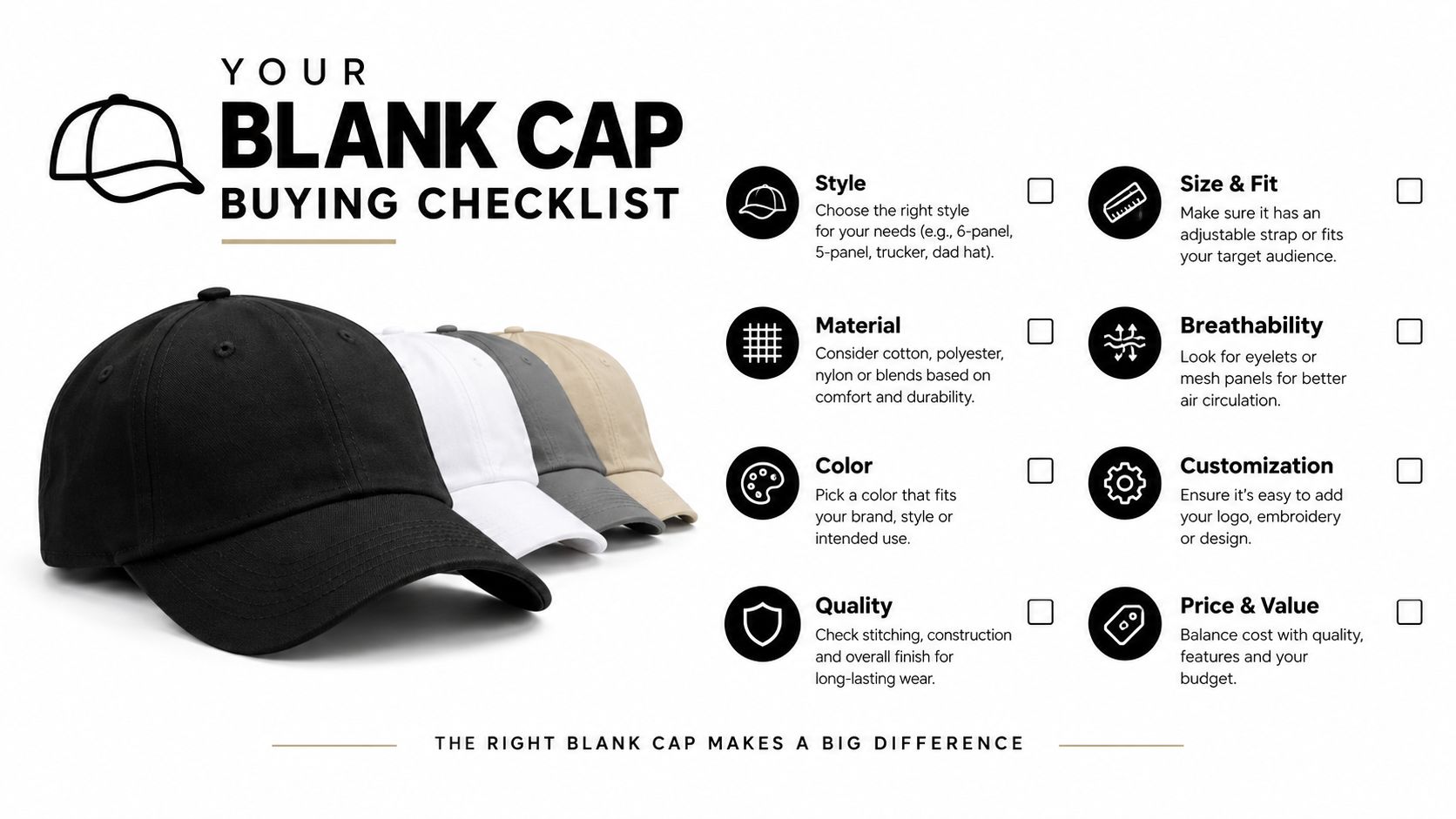
The final test should use two profiles from the same supplier. Press the same transfer on both, then compare edge adhesion, image clarity, pressure marks, crown distortion, and the cap's appearance after normal handling. Run an embroidery sample too if that service matters to your shop.
Don't guess from a product photograph or a fabric label. Put the candidate blanks on your actual equipment, record the settings that work, and only then place the larger order. That small test is the clearest way to protect your film, labor, customer relationships, and shelf space.
Cobra DTF offers made-in-the-USA DTF transfers with vibrant color, fade-resistant output, and fast fulfillment for shops decorating blank ball caps and other apparel. Visit Cobra DTF to order transfers, review hat-press guidance, and build a more predictable cap-printing workflow.